


Overview
Introduction
Binance Coin (BNB) is one of the most-used crypto assets in the world, but most people only know half of what it does. It started as a simple fee-discount token on the Binance exchange and grew into the native token for an entire blockchain ecosystem. Today BNB pays gas fees, secures the network through staking, and ties into a range of exchange products. The supply shrinks through an automatic burn system, which affects how the token behaves over time. This guide covers how BNB works, what it is actually used for, and what risks beginners should understand before buying or staking.

Key Takeaways
- What it is. BNB is the native utility token for BNB Chain and a major exchange-linked crypto asset.
- Why it matters. BNB sits at the center of BNB Smart Chain, opBNB, BNB Greenfield, and Binance-linked trading utilities.
- Main risk or limitation. BNB’s value and perception remain exposed to BNB Chain centralization debates, regulatory pressure, and Binance-specific events.
From Exchange Token to BNB Chain Fuel
BNB did not start as a blockchain token. It launched through an initial coin offering from June 26 to July 3, 2017, shortly before the Binance exchange opened for trading. At that stage it was an ERC-20 token running on Ethereum, used mainly to pay discounted trading fees on Binance. The broader blockchain infrastructure came later, when BNB moved to its own chain during the BNB Chain mainnet launch on April 18, 2019.
That timeline explains why BNB has two identities that can confuse new users. One is the exchange-side asset, used for fee discounts, token launches, and Binance account perks. The other is the network token, used to pay gas, stake with validators, and interact with decentralized apps on BNB Chain. Both identities run on the same token, but they work through completely different systems.
The naming adds another layer of confusion. “Binance Coin” is still widely used by traders, wallets, and search engines. The official name is now BNB, which the project says stands for “Build and Build,” changed from the original “Binance Coin” in February 2022. In practice, BNB is the current ticker and the name used in all official documentation.
How Binance Coin (BNB) Works Without Slowing Every App Down
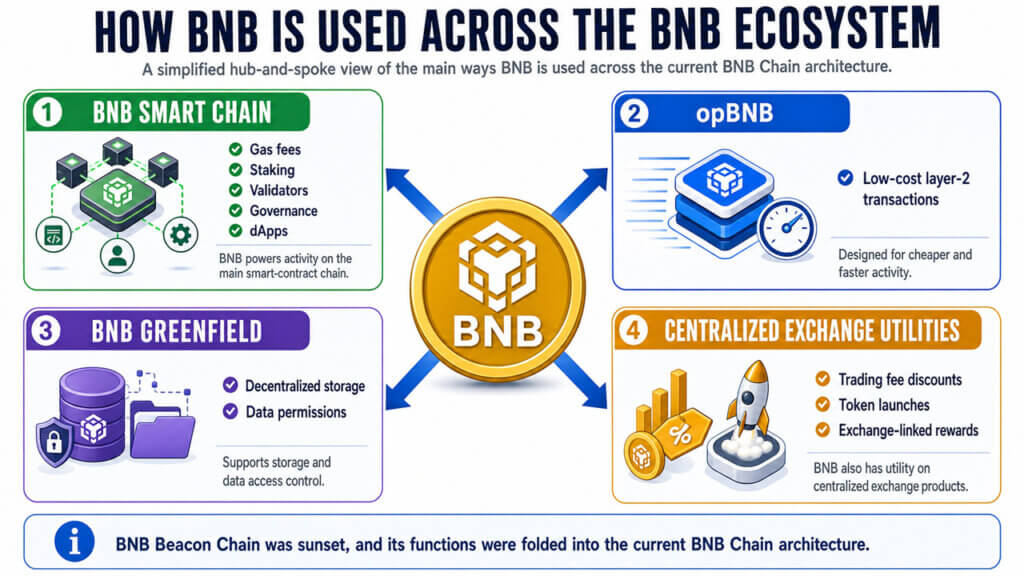
BNB Chain is not a single blockchain. It is an ecosystem of three separate chains, each built for a different purpose, with BNB as the shared token across all of them.
BNB Smart Chain (BSC) is the main layer-1 chain. It supports smart contracts and is compatible with Ethereum Virtual Machine tooling, meaning most Ethereum-style wallets, developer tools, and contracts work on BSC with minimal changes. BSC uses 45 validators under a Proof of Staked Authority model. That model blends staking-based validator selection with a fixed, authority-style block production process, which keeps the chain fast and cheap but limits how decentralized it can be.
opBNB is the layer-2 scaling solution. It is built on Optimism's OP Stack (Bedrock version) and processes transactions off the main chain before settling them on BSC. Apps that need high throughput or lower costs can run on opBNB without putting every transaction directly on BSC.
BNB Greenfield is the storage layer. It focuses on decentralized data storage and connects data ownership to the DeFi context of BNB Chain. It is less relevant for most beginners but matters for developers building data-heavy applications.
BNB functions as the shared unit across all three chains and Binance's centralized products. That is why the token has so many apparent use cases: it is doing different jobs depending on which layer of the ecosystem you are interacting with.
What BNB Is Used For Today
BNB has more use cases than most tokens its size, but they fall into four clear categories. Understanding which category applies to you is more useful than memorizing the full list.
Transaction fees are the most basic use. Any interaction with BSC, whether trading on a decentralized exchange, moving tokens, or calling a smart contract, requires BNB to cover gas. This is the same role ETH plays on Ethereum. Without BNB in your wallet, you cannot execute any transaction on the network.
Staking lets BNB holders delegate tokens to BSC validators. That delegation helps secure the network and can earn staking rewards. The rewards are not a fixed return and depend on which validator you choose, their commission rate, overall network conditions, and BNB's market value. Staking is covered in more detail in the section below.
Governance gives BNB holders a say in network changes. In practice, governance on BSC is tied to the validator and staking system rather than a simple vote, so influence scales with stake weight rather than token count alone.
DeFi and payments round out the onchain use cases. BNB works as a gateway into DeFi on BSC and opBNB, including liquidity provision, yield farming, liquid staking, and DEX trading. On the payments side, supported platforms accept BNB for shopping, travel, and other services, though availability depends on the platform and region.
The exchange-side utility, fee discounts, Launchpool, Megadrop, and account perks, is separate from all of the above. Those products run through Binance's custodial systems and depend on your account status, country, and the product being available in your region.
BNB In The Binance Ecosystem
Binance utility and BNB Chain activity are easy to conflate, but they run through entirely different systems. Exchange products are custodial: Binance holds the assets, sets the rules, and controls regional access. Onchain activity runs through your own wallet and depends on network rules, not Binance policy.
Trading fee discounts are the oldest BNB utility. Paying eligible fees with BNB reduces Spot and Margin trading fees by up to 25% and Futures trading fees by up to 10%. BNB balance also counts toward the Spot and Margin VIP tier criteria.
VIP access is tied to BNB holdings. The Holder VIP route starts with a daily average BNB balance of at least 5 BNB across any Binance account. Higher VIP tiers unlock lower fees, reduced interest rates, higher borrowing limits, higher API order frequency, and access to the VIP Portal.
Simple Earn is the main Binance product that ties BNB to rewards. The Flexible Product replaced what was previously the BNB Vault and combines base APR rewards with potential Launchpool and HODLer Airdrop eligibility. Locked Products add a fixed term and can qualify for Launchpool, Megadrop, and HODLer Airdrop campaigns where available.
Token-launch products vary by campaign. Launchpool distributes new token rewards to eligible BNB Flexible Product subscribers. HODLer Airdrops use historical BNB Simple Earn snapshots rather than live balances. Megadrop combines locked BNB with Web3 quests for project rewards and runs through both Binance Exchange and Binance Wallet.
Binance Alpha is not a pure BNB program. Alpha Points are calculated from eligible balances and activity across Binance Exchange and Binance Wallet, and some DeFi BNB assets and certain PancakeSwap LP pairs can count. BNB can matter for Alpha eligibility, but it is not the only input.
A useful mental model: if you are interacting with BNB through your Binance account dashboard, you are in custodial territory. If you are using a wallet like MetaMask or Trust Wallet and signing blockchain transactions, you are onchain. The risks, rules, and exits are different in each case.
How To Earn BNB
Some routes earn BNB directly. Others use BNB as the qualifying asset for rewards paid in other tokens. APRs, reward tokens, eligibility, regional access, product quotas, and campaign rules all change over time. This guide does not quote live APRs for that reason.
The table below covers the main methods. All Binance-side routes carry custody risk. All onchain routes carry smart-contract or validator risk. Many involve both if you move assets between the two environments.
| Method | How It Works | Native Or Third-Party? | Main Risk |
|---|---|---|---|
| Binance Simple Earn | Subscribe eligible assets through Binance Earn. Flexible Products provide liquidity to Binance business units and distribute yield as APR rewards. | Binance custodial | Custody risk, variable APR, product visibility, redemption limits, and regional access. |
| BNB Flexible Or Locked Products | BNB Flexible Product can combine APR rewards with Launchpool and HODLer Airdrop eligibility. BNB Locked Products can also qualify for Launchpool, Megadrop, and HODLer Airdrop projects where permitted. | Binance custodial | Lockups, changing APRs, forfeited rewards on early redemption, and campaign eligibility limits. |
| Launchpool | BNB subscribed to eligible Simple Earn products can receive token rewards from active Launchpool projects where the product is available. | Binance custodial | Reward-token volatility, campaign allocation, KYC, and jurisdiction limits. |
| HODLer Airdrops | Historical snapshots of BNB Simple Earn balances calculate certain token airdrops. | Binance custodial | Snapshot timing, hard BNB calculation limits, KYC, and country eligibility. |
| Megadrop | Users can lock BNB in Simple Earn Locked Products and complete Web3 quests for project rewards. BNB locking is not mandatory for every Megadrop route. | Binance plus Binance Wallet | Lockup rules, partial regional access, quest validation, and reward-token volatility. |
| Onchain BNB Chain Staking | Delegate BNB to a BSC validator. Staking helps secure the network and can earn rewards. | Native BNB Chain | Validator performance, slashing, commission, market risk, and unbonding delay. |
| Liquidity Or DeFi Opportunities | Use BNB in BNB Chain DeFi, such as DEX liquidity, yield applications, liquid staking, or restaking where supported. | Third-party dApps | Smart-contract risk, impermanent loss, oracle risk, liquidity risk, and project failure. |
| Faucets | Official BNB Chain faucets issue testnet tBNB for testing, not mainnet BNB income. | Official testnet tooling | Scam risk if a third-party site promises free mainnet BNB. |
How To Stake BNB
Native BNB Chain Staking
Native staking means delegating BNB directly to a validator on BNB Smart Chain through your own wallet. This is an onchain action, so Binance is not involved and your assets are not under exchange custody.
BSC uses Proof of Staked Authority, where a fixed validator set produces blocks and validator roles are determined by staking-weighted governance. To stake natively, connect a supported wallet (Trust Wallet, MetaMask, or any WalletConnect-compatible option) to the BNB staking dApp, select a validator, enter the BNB amount, and sign the delegation transaction. Successful stakes appear on the My Staking page with a transaction hash.
Validator choice matters more than most beginners realize. Commission rates affect how rewards are split between the validator and delegators. Staking credit, which represents your staked BNB plus accumulated rewards, is non-transferable between wallet addresses. If a validator behaves incorrectly, slashing can reduce your staked balance.
Exiting requires two steps: an undelegation transaction and a claim. After undelegating, there is a 7-day unbonding period before the BNB and rewards return to your wallet. You cannot access those funds during the unbonding window, so factor that into any liquidity planning.
Native staking is not a savings account. Validator selection, commission rates, slashing conditions, network uptime, and BNB's market price all affect the outcome.
Binance Simple Earn is a custodial product. It may feel like staking because it pays rewards, but it works differently. The user relies on Binance to hold assets, process rewards, and allow withdrawals. There is no validator selection, no onchain transaction, and no unbonding period in the native staking sense.
Flexible Products allow subscription at any time, accrue rewards approximately every minute, and normally return redemptions to the Spot Account immediately, though limits and delays can apply in certain conditions. Locked Products fix a term, meaning early redemption can forfeit accrued rewards or deduct from principal. APRs on Locked Products are not fixed unless specifically stated.
The risks for both routes include custody risk (Binance holds the assets), variable reward rates, regional product restrictions, and early redemption penalties for locked terms. If you also use those earnings in DeFi protocols, you are stacking exchange-custody risk on top of smart-contract risk.
BNB Tokenomics, Burns, and Supply
BNB is not mined like Bitcoin. The original supply was issued at launch, and BNB’s tokenomics are built around supply reduction rather than ongoing block-subsidy issuance.
The main supply-reduction mechanism is BNB Auto-Burn. The Auto-Burn system reduces the total supply toward 100,000,000 BNB, with the burn amount adjusted based on BNB’s price and the number of blocks on BNB Smart Chain. A separate real-time gas-fee burn destroys a fixed ratio of collected gas fees in each block, set by BSC validators.
BEP-95 is the real-time burn mechanism. Each block burns a fixed ratio of gas fees collected by validators, and the burn ratio can be adjusted through governance. The mechanism continues even after scheduled burns reach the 100,000,000 BNB circulation target.
Burns can make supply smaller, but they do not make BNB risk-free. A lower supply can support price only if demand is durable. Demand depends on network usage, Binance-linked utility, liquidity, regulatory context, and broader market conditions.
For live figures, use CryptoSlate’s BNB live market data rather than a static guide. Price, circulating supply, trading volume, and market cap move constantly, and hardcoding those numbers into an explainer creates stale copy.
How BNB Compares With ETH and Exchange Tokens
BNB is often compared to ETH because both assets pay gas on EVM-compatible networks. The comparison makes sense at a surface level but breaks down quickly. ETH is the native token of Ethereum, which has its own validator set, fee market, and layer-2 ecosystem. BNB powers a separate ecosystem built around BSC, opBNB, and BNB Greenfield.
Where BNB has an advantage over most exchange tokens is breadth. Many exchange-issued tokens exist primarily for fee discounts or loyalty perks and have limited utility outside the exchange that issued them. BNB covers gas, staking, governance, DeFi access, and Binance account utilities. That makes it more similar to a network asset than a loyalty point.
The main caveat is perception concentration. Even when a transaction happens entirely on BNB Chain without touching Binance the company, the asset is still associated with Binance in most users' minds. Legal, compliance, or reputational pressure on Binance tends to affect BNB price and sentiment, even when the underlying chain continues running normally. That link does not exist for ETH and Ethereum in the same way.
BNB also differs from pure governance tokens. A DeFi governance token typically controls one protocol. BNB acts as gas token, staking token, exchange utility token, and ecosystem access asset simultaneously. That layered role is what gives BNB broad utility, and it is also what makes risk analysis more complicated than for a single-purpose token.
Main Risks and Limitations
BNB carries several risks that beginners often underestimate. They do not all apply equally depending on how you hold or use BNB, but they are all worth understanding before buying.
- Market risk. BNB is a volatile asset. Price can move based on crypto-wide cycles, Binance-specific news, validator and chain activity, DeFi usage, burn volume, and liquidity conditions.
- Ecosystem concentration. BSC runs on 45 validators under Proof of Staked Authority. That design keeps the chain fast and cheap but results in far less validator dispersion than a permissionless proof-of-work network.
- Regulatory exposure. In 2023, Binance entered a major U.S. criminal resolution tied to anti-money-laundering, money-transmission, and sanctions issues, agreeing to pay $4.3 billion in penalties and operate under an independent compliance monitor. U.S. Department of Justice
- Civil litigation history. On May 29, 2025, the SEC filed a joint stipulation to dismiss its civil action against Binance entities and Changpeng Zhao with prejudice. The dismissal did not reflect the SEC's position on other proceedings. U.S. SEC litigation release
- Operational and transfer risk. BNB Chain's architecture changed significantly with the BNB Beacon Chain halt on Nov. 19, 2024, during BNB Chain Fusion. BNB also operates across BSC, opBNB, and exchange accounts, meaning a transfer to the wrong network can cause delays or permanent loss.
How to Research or Buy BNB
Before looking at where to buy, it is worth deciding why you want BNB. The answer changes which venue and which setup make sense.
If you want BNB for onchain use, such as paying gas or staking natively, you need a self-custody wallet and BNB on the BSC network. If you want BNB for Binance-linked perks, such as fee discounts or Simple Earn, a Binance exchange account is the simpler route. If you want BNB purely for price exposure, either route works, though exchange custody adds a layer of counterparty risk.
For live price, market cap, and supply data, start with CryptoSlate's BNB market page. For venue comparisons, the crypto exchanges hub covers the main options. BNB is widely listed, but exchange access varies by country, KYC requirements, payment method, and product type.
Beginners comparing platforms for the first time can also look at exchanges for beginners, which filters for simpler onboarding. Users who prefer self-custody can compare decentralized exchanges or instant swap platforms, though those routes require understanding wallet approvals, gas, slippage, and network selection before transacting.
If you plan to store BNB outside an exchange, a crypto wallet that supports BSC is required. Hardware wallets are the most secure option for long-term storage. Trust Wallet and MetaMask both support BSC for everyday onchain use.
Three things to confirm before any purchase: which network the exchange or wallet uses for BNB deposits and withdrawals (BSC and older Beacon Chain addresses are different), whether BNB staking or DeFi products are available in your country, and whether you are comfortable with the validator, smart-contract, and custody risks that come with each route.
FAQs
Can you earn tokens with BNB on Binance?
Yes, if the product is available and the account is eligible. BNB subscribed to Binance Simple Earn or Locked Products can qualify for token rewards through Launchpool, HODLer Airdrops, and Megadrop. Rewards are not guaranteed. Each campaign sets its own snapshot, allocation, eligibility, and distribution rules.
Is BNB Simple Earn the same as staking?
No. BNB Simple Earn is a custodial Binance product, while native BNB Chain staking is direct validator delegation on BSC through a wallet. Simple Earn rewards, lockups, redemption rules, and product access are governed by Binance. Native staking depends on validator choice, network rules, and the onchain unbonding process.
How do you stake BNB on BNB Chain?
To stake natively, connect a supported wallet to the BNB staking dApp, choose a validator, enter the BNB amount, and sign the delegation transaction. To exit, undelegate, wait through the unbonding period, and claim the BNB and rewards after the network allows withdrawal.
Can BNB be used for Binance Alpha?
BNB can matter indirectly, but Binance Alpha is not just a BNB program. Alpha Points come from eligible balances and activity across Binance Exchange and Binance Wallet. Some DeFi BNB assets and certain LP pairs can count, while event thresholds, expiry, and eligibility rules change by campaign.
Can you get free BNB from faucets?
Official BNB Chain faucets issue testnet tBNB, which is used for development and testing. Testnet tokens are not mainnet BNB and cannot be treated as income. Avoid third-party faucet sites that promise free mainnet BNB unless the claim is verified through official BNB Chain or Binance channels.
