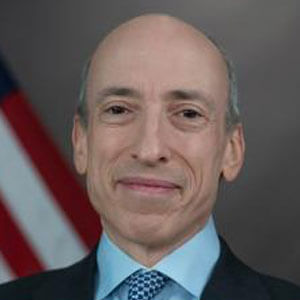

Gary Gensler is an American government official and former investment banker who served as the 33rd Chair of the U.S. Securities and Exchange Commission (SEC) from 2021 to 2025. Currently a Professor of the Practice at the MIT Sloan School of Management, Gensler is a polarizing figure in the cryptocurrency industry, known for his “regulation by enforcement” approach during his tenure at the SEC. While he oversaw the historic approval of the first spot Bitcoin ETFs in the United States, his administration was largely defined by high-profile legal battles against major crypto exchanges and a refusal to create a bespoke regulatory framework for digital assets.
Overview
Appointed by President Joe Biden, Gensler took office in April 2021 with a mandate to bring order to what he frequently termed the “Wild West” of crypto markets. He resigned effective January 20, 2025, coinciding with the inauguration of President Donald Trump. His departure marked the end of an era characterized by strict adherence to the Howey Test, under which he classified the vast majority of crypto tokens (excluding Bitcoin) as unregistered securities.
Following his resignation, Gensler returned to academia at MIT, where he had previously taught a popular course on blockchain technology.
Early Life and Wall Street Career
Born in Baltimore, Maryland, in 1957, Gensler earned his MBA from the Wharton School at the University of Pennsylvania. He spent 18 years at Goldman Sachs, becoming one of the youngest partners in the firm's history at age 30. He led the firm’s fixed income and currency trading in Asia and served as Co-Head of Finance.
Gensler transitioned to public service in the 1990s, serving as Assistant Secretary of the Treasury under the Clinton administration. He later served as the Chair of the Commodity Futures Trading Commission (CFTC) under President Obama from 2009 to 2014, where he gained a reputation as a tough regulator for implementing the Dodd-Frank Act reforms on the $400 trillion swaps market.
SEC Tenure (2021–2025)
Gensler’s time leading the SEC was dominated by his combative relationship with the crypto industry. His strategy relied heavily on enforcement actions rather than rulemaking, arguing that existing securities laws were sufficient to regulate digital assets.
- The “Wild West” Narrative: Gensler frequently warned that the crypto market was rife with fraud, abuse, and non-compliance, urging platforms to “come in and register”—a process industry leaders claimed was operationally impossible.
- Major Lawsuits: Under his leadership, the SEC sued the industry's largest players, including Binance, Coinbase, Kraken, and Ripple. These cases yielded mixed results, with courts sometimes pushing back against the SEC's broad jurisdictional claims.
- Spot Bitcoin ETFs: In January 2024, Gensler provided the deciding vote to approve spot Bitcoin ETFs, a watershed moment for institutional adoption. However, he issued a statement simultaneously emphasizing that the agency did not endorse Bitcoin itself, calling it a “speculative, volatile asset.”
- SAB 121: Gensler supported Staff Accounting Bulletin 121, a controversial rule that effectively prevented highly regulated banks from custodying crypto assets, drawing bipartisan criticism from Congress.
The “Blockchain and Money” Paradox
Prior to his SEC chairmanship, Gensler was a Professor of the Practice at MIT, where he taught a course titled “Blockchain and Money.” Video lectures from this course circulated widely during his time as Chair, often cited by critics to highlight perceived contradictions in his views. In the lectures, Gensler appeared to acknowledge that Ethereum and other assets might have evolved sufficiently to no longer be securities—a nuance that was largely absent from his policy stance as a regulator.
Legacy and Criticism
Gensler's legacy is viewed through starkly different lenses. To consumer advocates and skeptics, he was a necessary bulwark against a predatory industry, credited with protecting investors from the fallout of collapses like FTX and Terra. To the crypto industry and free-market proponents, he was an obstacle to innovation who drove legitimate businesses offshore through “regulation by enforcement.”
Upon his resignation in 2025, the crypto markets rallied significantly, reflecting the industry's relief at the conclusion of his term.