Miners and fees: How rising transaction fees affect Bitcoin mining costs
CryptoSlate's latest market report dives deep into the effect rising fees had on public Bitcoin miners and analyzes their performance in the wake of rising revenues.
The introduction of the Ordinals Protocol has transformed Bitcoin from a single-asset network to a multi-asset blockchain enabling NFTs and BRC-20 tokens.
This transition has caused a lot of controversy in the industry, with the market forming strong opinions about inscriptions.
A strong critical current formed, arguing that flooding the blockchain with inscriptions created unsustainably high fees and caused congestion. On-chain data confirmed these worries — previous CryptoSlate analysis found a sharp spike in transaction fees. The number of transactions bloated the mempool, with hundreds of thousands of transactions waiting to be processed.
Others argued that inscriptions were a natural progression and perfectly represented Bitcoin’s ability to foster a free market.
And while the market debated the impact rising fees had on the average user, Bitcoin miners experienced a much-needed surge in revenue.
Miner revenue has declined rapidly since October 2021, with many public mining companies struggling to cover operating costs and service debt. The jump in transaction fees has pushed miner revenue to yearly highs.
In this market report, CryptoSlate dives deep into rising fees’ effect on public Bitcoin mining companies and analyzes their performance in the wake of increasing revenues.
Breaking down miner revenue
After a long and painful year that saw many large mining operations drastically reduce their capacity, the first week of May brought some much-needed relief.
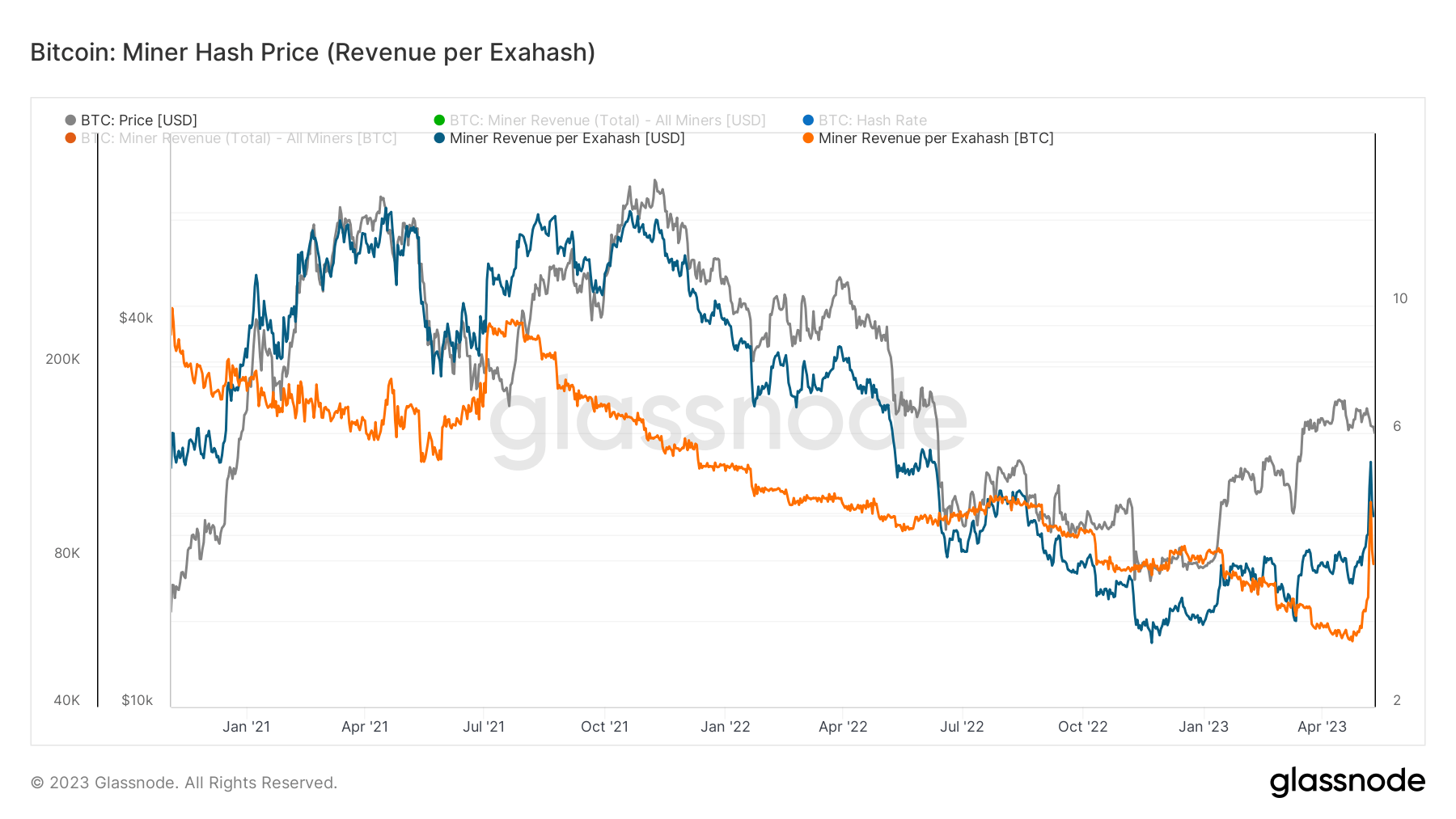
Previous CryptoSlate analysis found that miner revenue per exahash increased significantly at the beginning of May, breaking the two-year downtrend.
Graph showing miner revenue per exahash from January 2021 to May 2023 (Source: Glassnode)
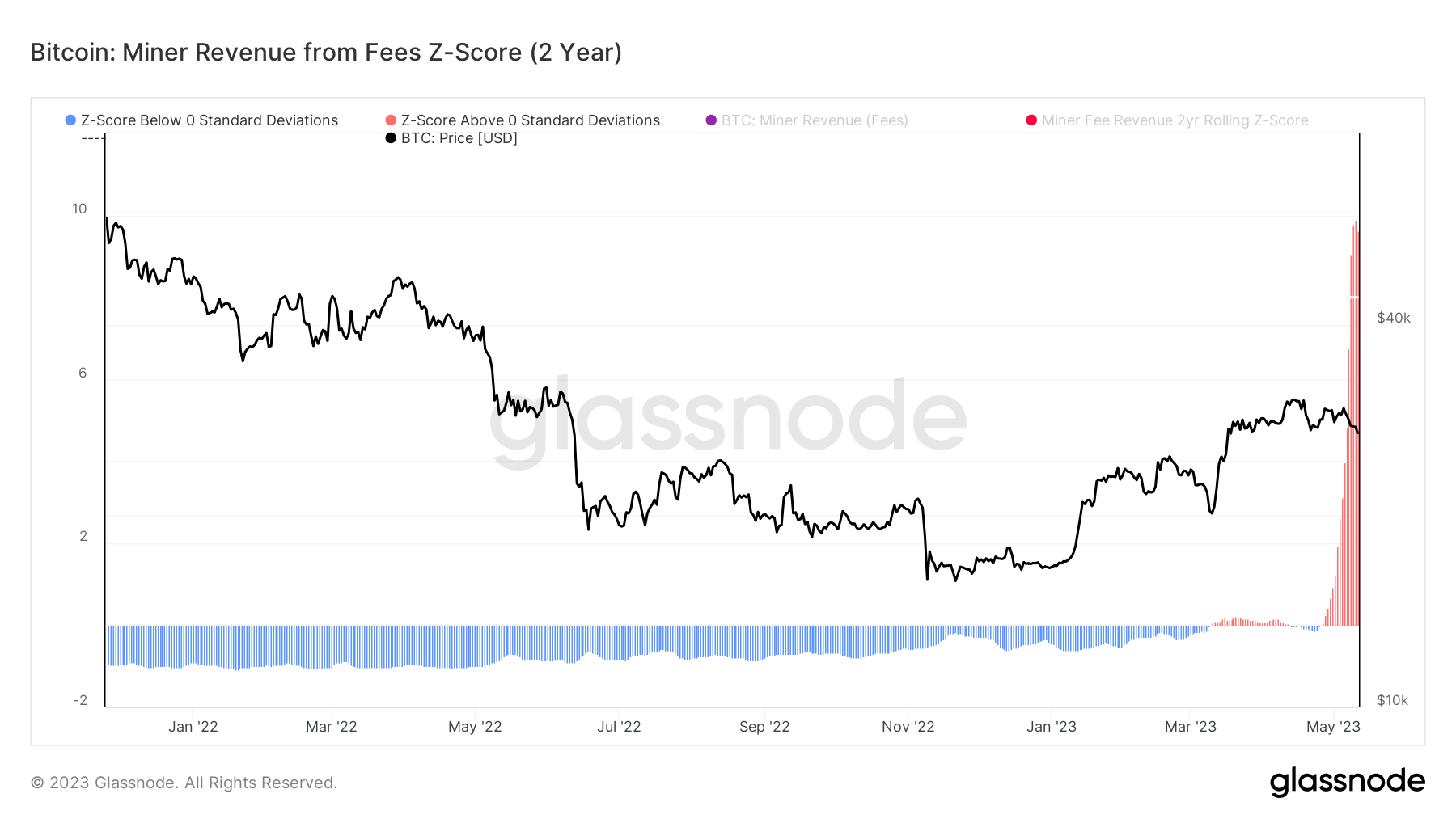
Bitcoin’s relatively flat price throughout May meant that a large portion of the revenue came from transaction fees. On-chain data showed a sharp spike in the percentage of miner revenue derived from fees — 42.59%. This is the second-highest revenue from fees recorded in Bitcoin’s history, topped only by the 43.57% recorded during the December 2017 bull run.
Graph showing miner revenue from fees from 2012 to 2023 (Source: Glassnode)
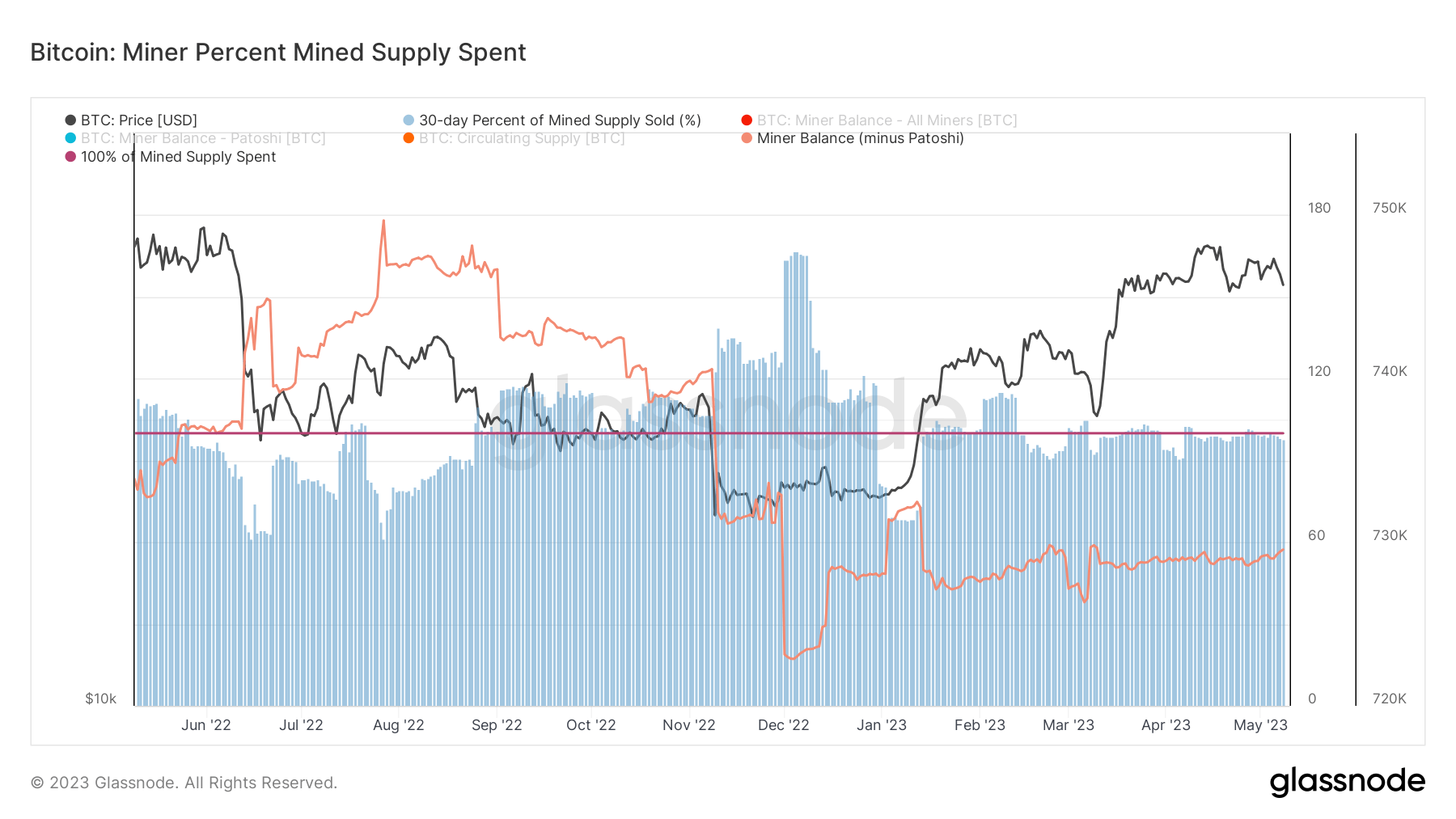
Further analysis of Bitcoin miner holdings shows that the increased revenue isn’t heading toward exchanges. According to data from Glassnode, miners have been keeping an increasing number of mined BTC in their reserves.
Miner percent mined supply spent is a metric estimating the percentage of mined supply miners spent over 30 days. The model compares the change in miner balance and total issuance to estimate the proportion of mined coins spent. A score lower than 100% indicates miners retained some of the mined supply in their treasury reserves.
Graph showing Bitcoin miner percent mined supply spent from January 2022 to May 2023 (Source: Glassnode)
This is the fourth time miners have retained a portion of their supply in reserves this year. The increase in BTC reserves was also visible in quarterly reports from public companies, most of which announced slight increases in their treasuries.
Public mining companies performance
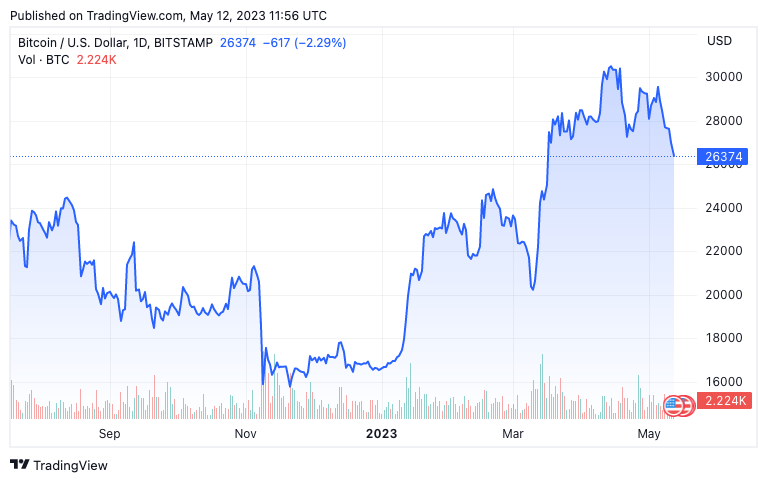
Almost all large, publicly-listed mining companies posted notable growth in 2023. The new year started with price action that ended nearly two months of flatlining for Bitcoin, pushing it past $27,000 by the end of the first quarter.
Graph showing Bitcoin’s price from July 2022 to May 2023 (Source: CryptoSlate BTC)
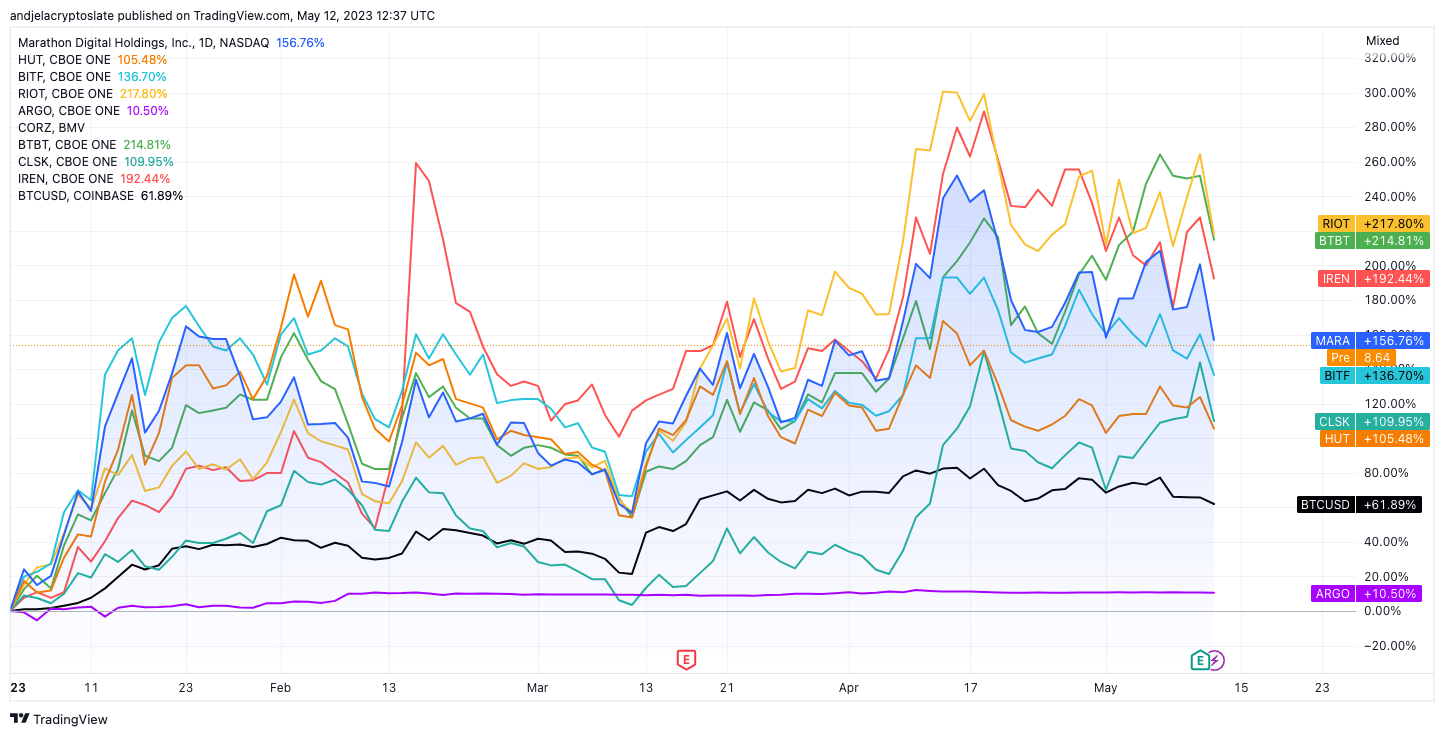
Analyzing the year-to-date performance of public miners shows significant gains.
Riot Platofrms (RIOT), a Texas-based mining company, is the leader with a 217.80% YTD increase in stock price. Bit Digital (BTBT) is closely behind, with a 214.81% increase. Canadian Iris Energy (IREN) ranks third with a 192.44% YTD jump, followed by Marathon Digital (MARA) and its 156.76% increase.
CleanSpark and Hut 8 posted 109.95% ad 105.48% increases since the beginning of the year, while Argo Blockchain (ARGO) saw its stock increase only 10.50%.
Graph showing the YTD performance of public Bitcoin mining companies (Source: TradingView)
Zooming out shows that only Riot and Bit Digital regained the losses they sustained last year, with the two posting a 56.58% and 37.84% yearly increase, respectively.
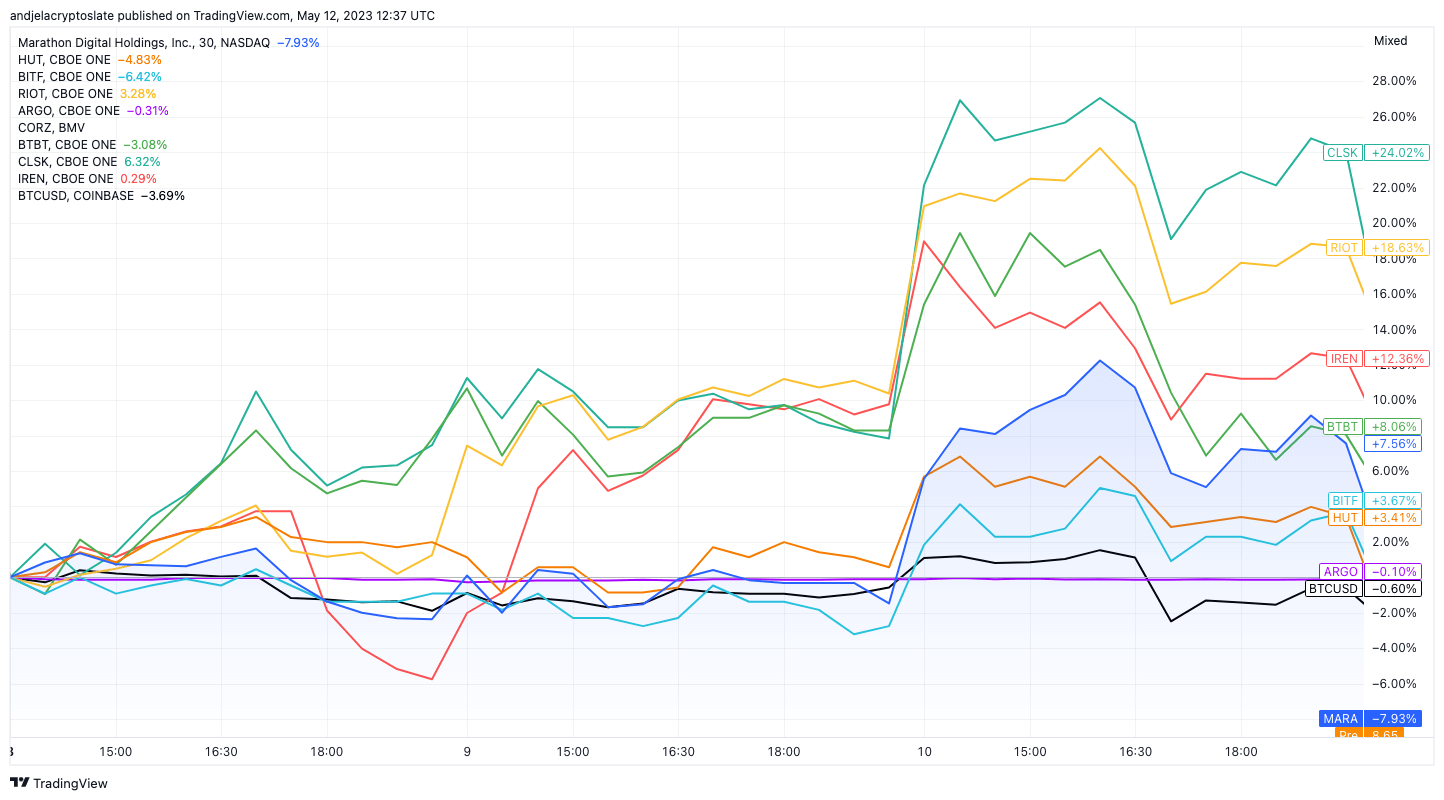
CryptoSlate analysis found that the stock market reacted positively to the increase in miner revenue. The historically high revenue from fees recorded on May 8 translated into notable gains for most miners. The market reacted strongly on May 10 when some mining stocks saw two-digit gains.
Between May 8 and May 10, CleanSpark (CLSK) rose 24.02%, while Riot (RIOT) and Iris Energy (IREN) grew 18.63% and 12.36%, respectively. Bit Digital (BTBT) and Marathon (MARA)saw gains of 8.06% and 7.56%, while Bit Farms (BITF) and Hut 8 (HUT) rose by 3.67% and 3.41%.
Only Argo remained unaffected by this miner revenue-driven rally, staying relatively flat for the entire month.
Graph showing the performance of mining stocks between May 8 and May 10 (Source: TradingView)
Increasing BTC balances
Almost all public mining companies have increased their unencumbered Bitcoin holdings since the beginning of the year. Quarterly reports showed Bitfarms, CleanSpark, Riot, and Marathon increased the amount of BTC held in their treasuries.
Bitfarms led the way with a 14.8% quarterly increase, with CleanSpark ranking second with a 4% increase. Riot and Marathon held 1.9% and 1.3% BTC more at the end of March 2023 than in December 2022.
Chart showing miner BTC holdings in Q1 2023 and Q4 2022 (Source: Mark Harvey)
As last week’s miner stock rally occurred in the middle of the second quarter, it will take another month and a half before the market sees whether this increase continues. Some analysts argued that the increase in miners’ BTC holdings wouldn’t last, as it was a result of a short-lived spike in transaction fees.
However, others argue that the slow and steady growth in BTC held in miner treasuries will persist and carry over into the second quarter.
Most large miners have steadily increased their mining capacity over the past year, increasing their hash rate to prepare for the next bull cycle. Hodling a growing percentage of mined supply instead of selling it shows an increasing conviction in another bull run.
Conclusion
The increase in transaction fees has been hugely beneficial to Bitcoin miners. And while mining stocks began to recover at the beginning of the year thanks to Bitcoin’s positive price action, it wasn’t until the drastic fee increase that miners saw notable revenue growth.
Mining companies holding smaller amounts of BTC in their treasuries saw the most significant growth from the spike in transaction fees. Miners with extensive holdings saw much slower growth over the past week, as seen with Marathon and Hut 8. Companies with large BTC holdings also saw the smallest percentage increase in their treasuries over the past quarter.
Some market analysts argued that the companies unencumbered by large holdings and debt were the ones to profit the most from this spike in revenue, as their high operational efficiency enabled them to retain a large portion of their mined BTC.
While this might very well be the case, it will be hard to see who benefited the most from the rise in fees until the end of the quarter. Bitcoin’s lack of volatility throughout the week showed that mining stocks can decouple from BTC and have their price driven only by mining performance.