KemyCard Review

Verified Review
Published Updated

KemyCard is a prepaid crypto card. It has no credit line and no bank account link. You add funds through crypto or mobile money, then spend through a virtual card or a physical card issued through banking partners. KemyCard offers high stated limits, mobile wallet support, and a physical card with NFC, but its fee stack looks heavy for regular use.

Yousra Anwar Ahmed
Reviewed by
Fact-checked by
Pending Assignment

KemyCard Overview

Product Name KemyCard
Card Type Prepaid
Network VisaMastercard
Availability Varies By Jurisdiction
Rewards No rewards.
Fees $15 virtual; $250 physical (DHL Express shipping included)
Daily Spend / ATM Limit $500 per day and $15,000 per month
Funding Source On-chain Wallet
Digital Wallets Apple Pay, Google Pay, Samsung Pay
Virtual Card & Shipping Virtual card creation takes a few minutes. Physical card delivery uses DHL Express.

KemyCard Screenshots

KemyCard Pros and Cons

Pros

  • Virtual card can be created quickly for online spend
  • Physical card supports Apple Pay, Google Pay, Samsung Pay, and NFC
  • Physical card has unusually high stated spend limits
  • Multiple virtual cards help separate subscriptions or budgets
  • Freeze and unfreeze controls are built into the dashboard

Cons

  • Main account deposits carry a very high stated fee
  • Virtual card charges both top-up fees and per-transaction fees
  • Physical card has a high upfront cost and monthly fee
  • Supported crypto assets are not clearly broken out
  • US account and crypto-to-fiat payout features are not live yet

Who KemyCard Is Best For And Who Should Skip It

KemyCard suits users who need high limits and card flexibility. It is a poor fit for low-cost everyday spending.

User TypeFitWhy
Everyday SpenderLowThe fee stack can add too much drag on routine purchases.
TravelerMediumMobile wallet support and a physical card help, but FX costs are not clearly disclosed.
Stablecoin UserMediumCrypto funding exists, but the supported asset list is not clearly mapped.
Self-Custody Wallet UserLowThis is a prepaid custodial setup, not direct wallet-linked spending.
Cashback HunterLowThere is no rewards program to offset the card costs.
Heavy SpenderHighThe physical card's stated balance and spend limits are the strongest part of the offer.
Low-KYC UserMediumThe onboarding pitch is lighter than many rivals, but eKYC is also part of the compliance model.
User Who Wants Simple TaxesLowCrypto funding plus card spending can create more record-keeping than a standard fiat card.

KemyCard fits more naturally for those who want a virtual card fast, need a physical card with high stated limits, or want to manage spend through separate card balances instead of a bank account. It also has some practical appeal for online payments, subscriptions, and cases where mobile wallet support is useful.

Fees become the main problem when cost matters more than access. Between deposit fees, top-up fees, monthly card fees, and transaction fees, the model starts to look expensive for normal daily use.

What This Card Actually Is and How Spending Works

KemyCard is a prepaid card with virtual and physical options. Spending runs from a preloaded balance funded through crypto or mobile money, and there is no buy-now-pay-later or revolving credit component.

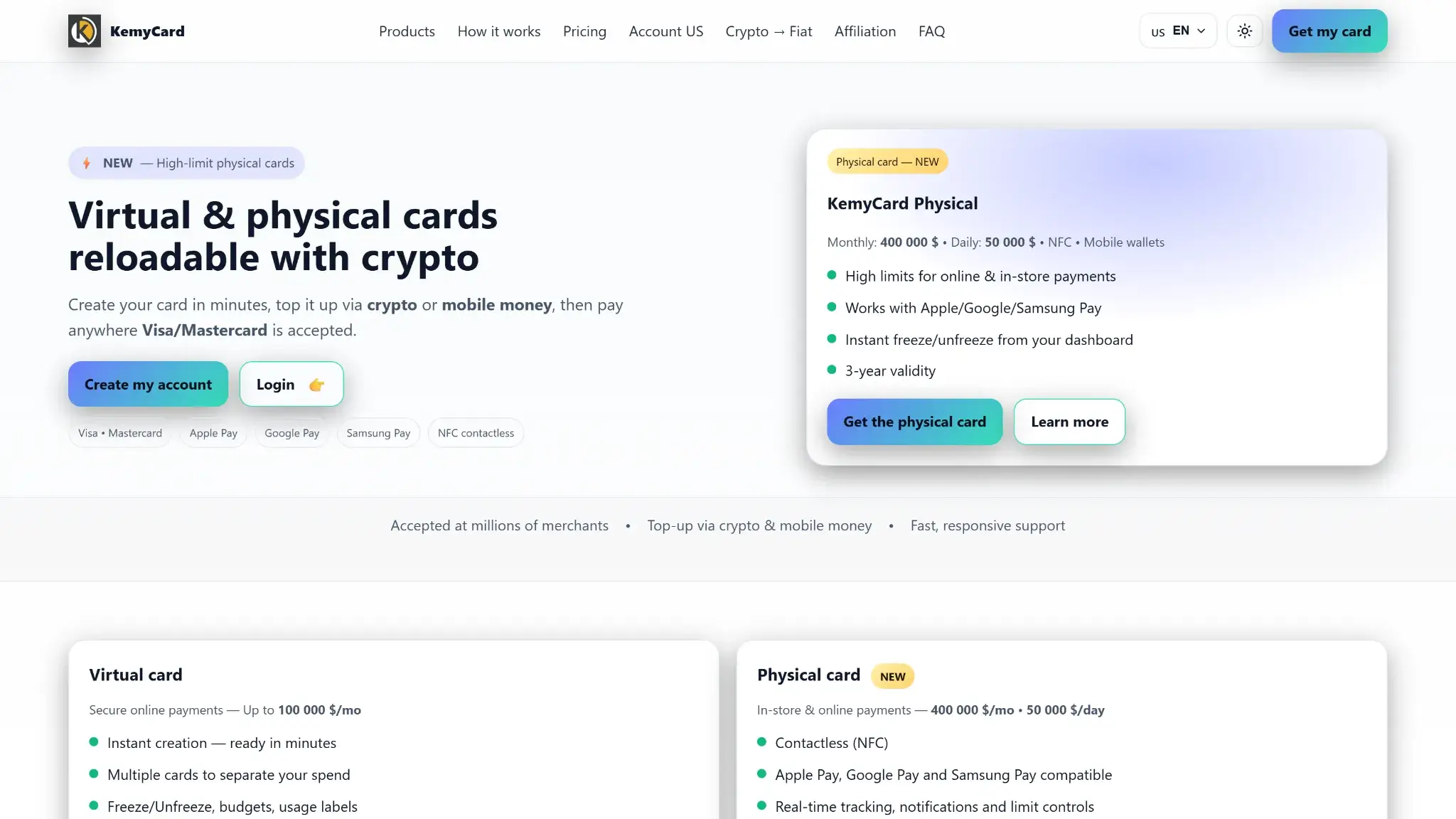
KemyCard desktop hero section promoting virtual and physical cards reloadable with crypto, plus a highlighted physical card offer with spending limits and wallet support.

The virtual card is built for online purchases, subscriptions, and verifications. The physical card covers in-store spend, contactless payments, and mobile wallet use. Refund handling is not disclosed.

The product is built for controlled prepaid spending. You load funds first, then spend from that balance.

Availability, KYC and Setup Friction

The real question is how quickly signup, funding and compliance checks clear in your region.

Region AvailabilityVaries By Jurisdiction
Unsupported RegionsNot Disclosed
Who Can ApplyIndividuals, Varies By Jurisdiction
KYC LeveleKYC infrastructure, checks may vary by product
Credit CheckNo
Account Or App NeededKemyCard account and dashboard
Issued-Country LimitsVaries By Jurisdiction
Time To First SpendMinutes for virtual card, longer for physical card

KYC is lighter at signup and heavier once regulated money flows are involved. A user may be able to sign up and reach card setup quickly, but full verification can come into play for compliance reviews, partner-level checks, higher-risk activity, the upcoming US account feature, and the crypto-to-fiat bank transfer flow.

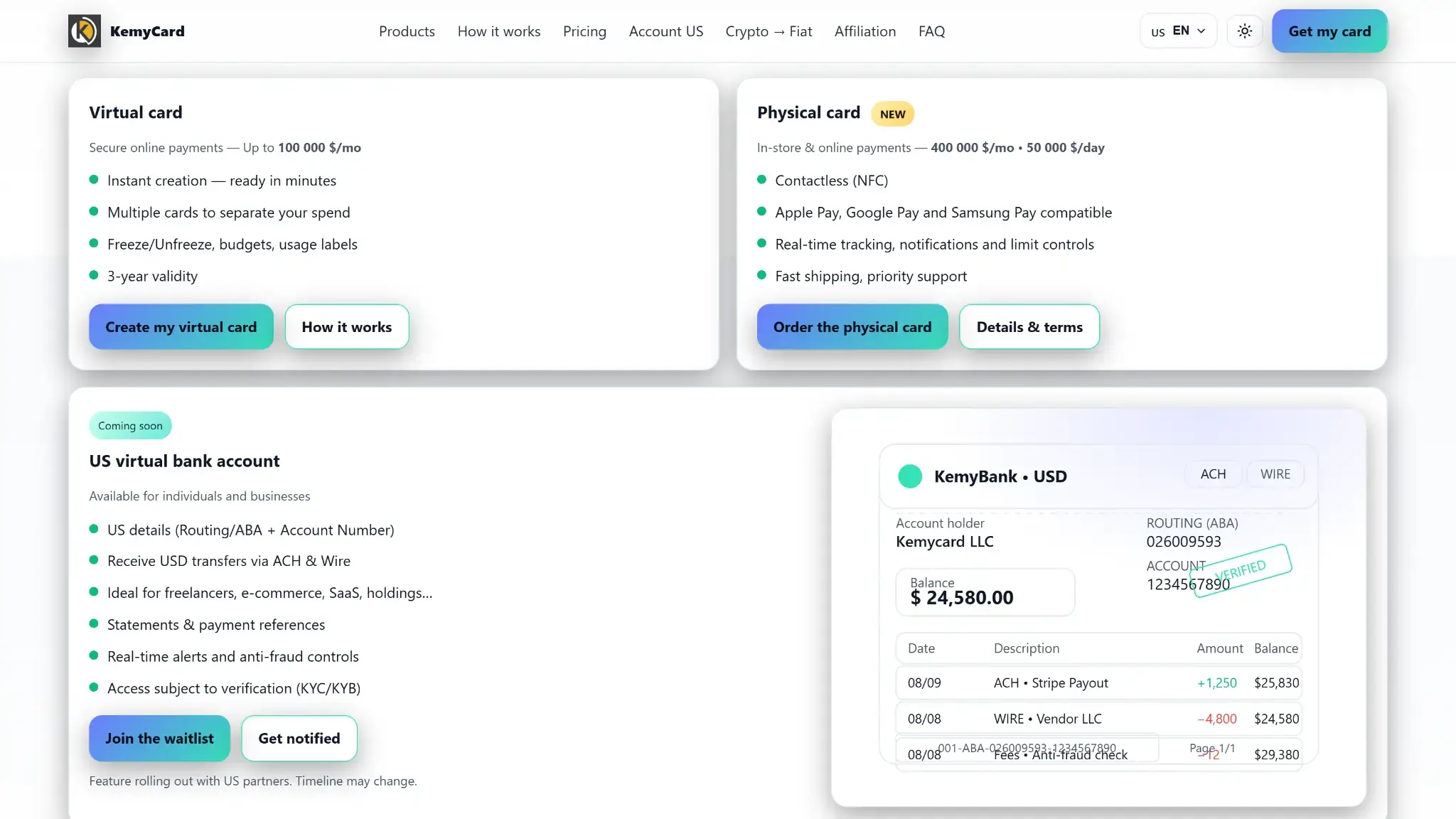
KemyCard desktop section showing virtual card and physical card features alongside a coming soon US virtual bank account panel with ACH and wire details.

Funding Rails, Supported Assets and Conversion Path

A long asset list matters less than whether the funding flow reaches a spendable balance cleanly. The key questions are which rails work cleanly, how fast the balance becomes spendable, and what the conversion path looks like.

Funding RailSupported AssetsTypical SpeedMain Friction
Bank TransferUSD via upcoming US virtual account, plus upcoming crypto-to-fiat bank payout railsComing soonACH and Wire access are announced, not live, and both depend on verification and partners
Debit Or Credit Top-UpNot DisclosedNot AvailableNo confirmed live bank-card top-up flow
Exchange BalanceNot SupportedNot AvailableNo exchange-linked balance or transfer path is described
Onchain StablecoinsStablecoins, exact token and network list not disclosedAfter blockchain confirmationToken and network coverage is still unclear
Other Crypto AssetsCrypto, exact asset list not disclosedAfter blockchain confirmationFull asset and network coverage is still unclear
Fiat Wallet Or Cash BalanceMobile money, plus upcoming USD balance through the US virtual accountQuick once processed for mobile money; US account coming soonMobile money coverage is not mapped by country, and the USD account rail is not live yet

Stablecoin funding is the most straightforward live path. The bigger drag comes from the incomplete asset and network map, plus limited detail on how loaded funds turn into spendable card balance.

Rewards, Perks and The Catch

KemyCard has no rewards program. It has no cashback, travel perks, or subscription rebates.

The only visible incentive structure is the affiliate program, which pays promoters rather than card users. There is nothing to unlock because no reward layer exists.

Fees and Total Cost

The cost picture is clear: KemyCard looks expensive before normal spending even begins.

CostWhat Users PayWhen It HitsNotes
Monthly Or Annual Fee$2/month virtual, $10/month physicalOngoing after card issuanceNo annual plan is disclosed
Issuance Or Replacement Fee$15 virtual, $250 physicalAt card creation or orderPhysical card price includes DHL Express shipping; replacement fee not disclosed
Conversion Or Spread CostVirtual card transaction fee is 3.5% + $1; separate spread not disclosedOn virtual card spendA separate physical-card spend fee is not clearly disclosed
FX FeeNot DisclosedCross-border or non-base-currency spendFX charges are not clearly broken out
ATM FeeNot DisclosedPhysical card cash withdrawalATM limits are available, but ATM fee is not disclosed
Top-Up FeeMain account deposit is shown as 5% in one pricing block and 8% in the pricing FAQ; card top-up is $1.50 under $100 or 1.25% at $100+When funding the main account or topping up cardsVirtual minimum top-up is $5; physical minimum top-up is $10
Inactivity FeeNot DisclosedNot AvailableNo inactivity charge
Network Or Gas FeeVaries by blockchainWhen sending crypto to fund the accountExternal chain fees can sit on top of KemyCard charges

The cost problem is the stacked structure. Deposit fees, top-up fees, transaction fees, and failed-transaction fees can all hit in the same flow.

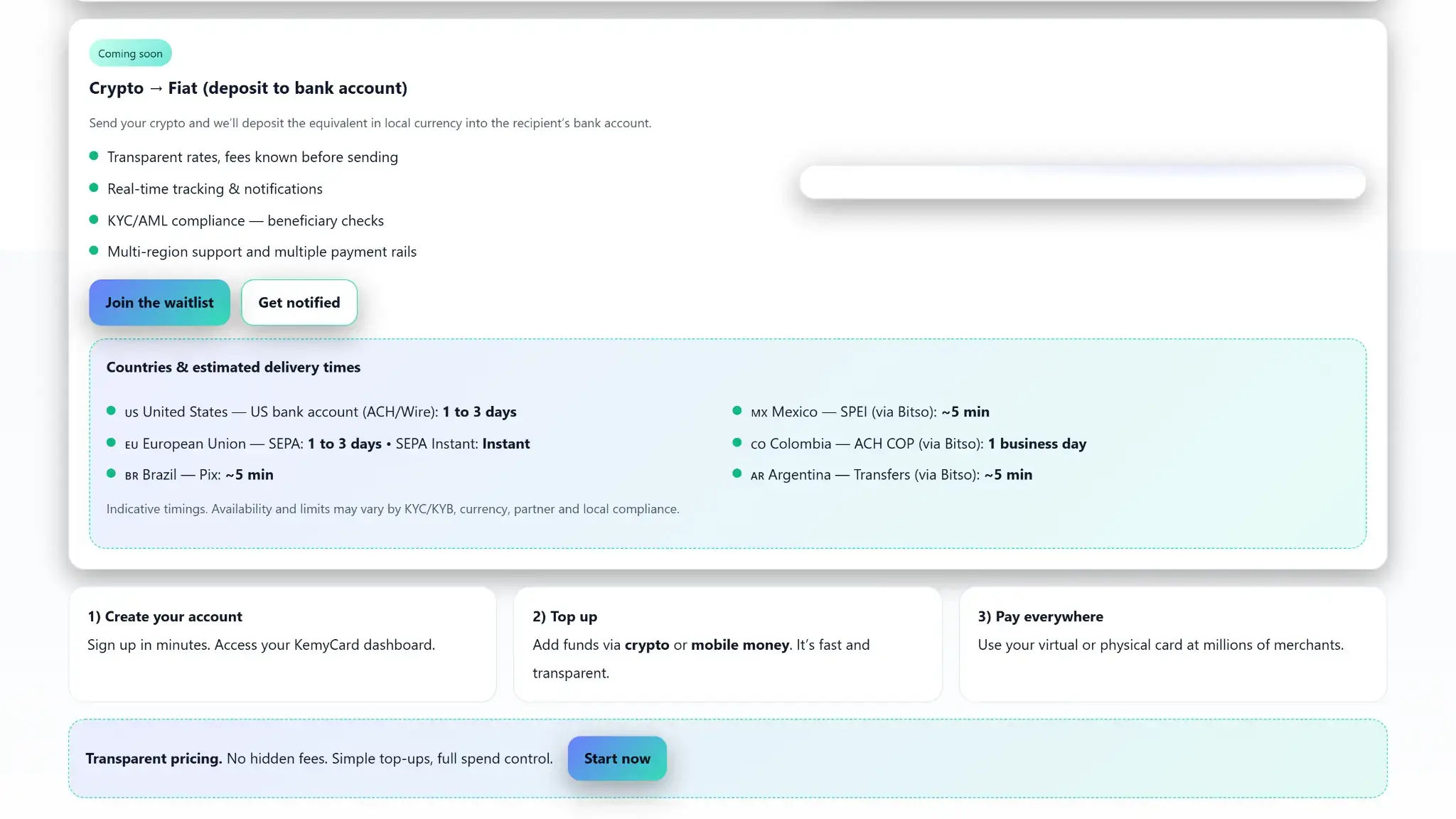
KemyCard desktop crypto-to-fiat bank deposit section showing transfer benefits, estimated delivery times by country, and a three-step how-it-works flow.

Limits, Speed and Cash Access

Virtual card creation is fast. Physical delivery, cash access, and edge-case support are slower and less clearly defined.

Virtual Card SetupVirtual card creation is framed around minutes, not days. Fast setup does not mean immediate unrestricted access.
Physical Card DeliveryPhysical card delivery uses DHL Express.
Funding To SpendFunds become spendable after crypto confirmation or mobile money processing. Timing depends on the rail used and any review that follows.
Compliance ClearanceNo public timing is disclosed. Fast signup does not guarantee fast clearance.
Virtual Card Limits$100,000 ceiling and $10,000 max per transaction. Strong enough for large online payments.
Physical Card Balance$400,000 maximum balance. Higher than most consumer card limits.
Physical Transaction Limit$25,000 max per transaction. Better suited to larger purchases than many rivals.
Physical Spend Limit$50,000 daily spend and a $400,000 monthly spend ceiling. Spend capacity is much stronger than cash access.
Spending CeilingsCertain security-related changes can temporarily reduce card spending to $1,000 per transaction and $1,000 per day for 24 hours.
ATM AccessPhysical card only. No cash access from the virtual card.
ATM Withdrawal Limits$500 per day and $15,000 per month. Cash withdrawals are much tighter than card spend limits.
Refund TimingNot disclosed. Hard to plan around merchant reversals or disputes.
Reversal TimingNot disclosed. The same uncertainty applies to canceled or failed transactions.
Common Delay PointsBlockchain confirmation, mobile money processing, compliance review, and physical shipping. Delays usually sit outside the card swipe itself.

KemyCard approves and issues virtually fast. Funding speed depends on the rail. Spending is faster once the balance is live. Cash access is slower and depends on the physical card and tighter ATM limits.

Security, Custody and Trust

Trust sits with KemyCard and its issuing partners. Self-custody does not apply once funds are deposited. Once funds move into the card flow, it becomes a custodial setup controlled through your KemyCard account. The main risks shift to issuer dependence, partner restrictions, and card operations rather than key management. Account security still depends on strong credentials, and KemyCard points users toward password hygiene and 2FA.

A clear list of restricted merchant categories is not available. The terms require lawful use only. KemyCard reserves the right to intervene, limit use, or act on complaints without a penalty schedule. Paid fees are non-refundable once the service is activated. That raises the cost of gray-area spend, sanction-sensitive use, or partner-triggered compliance reviews.

Recent Incidents And Reputation Issues

Recent 2025 Trustpilot disputes centered on blocked deposits, disabled cards, and slow support. KemyCard replied that some cases were tied to AML reviews or payment-processor issues and said balances could be manually credited back or replacement cards could be issued.

Customer Support, Refunds and Chargebacks

The help center covers basic setup and policy questions. Human escalation is weaker when deposits are delayed, compliance holds appear, or the card stops working.

  • Help center: Basic setup and policy questions are covered, but deeper troubleshooting is limited
  • Live chat: Chat is available, but hours and escalation rules are not clearly mapped
  • Email or ticket support: Email support contacts include [email protected] and [email protected], and company also point users to Telegram.
  • What support can actually fix: account access, card status, some balance-credit issues, and compliance questions
  • What support cannot reverse: blockchain fees, activation fees, partner AML holds, or merchant-side declines

Support looks weakest when a problem crosses partner boundaries. If the issue sits between KemyCard, a payment processor, and the card-issuing side, timelines, ownership, and escalation remain unclear.

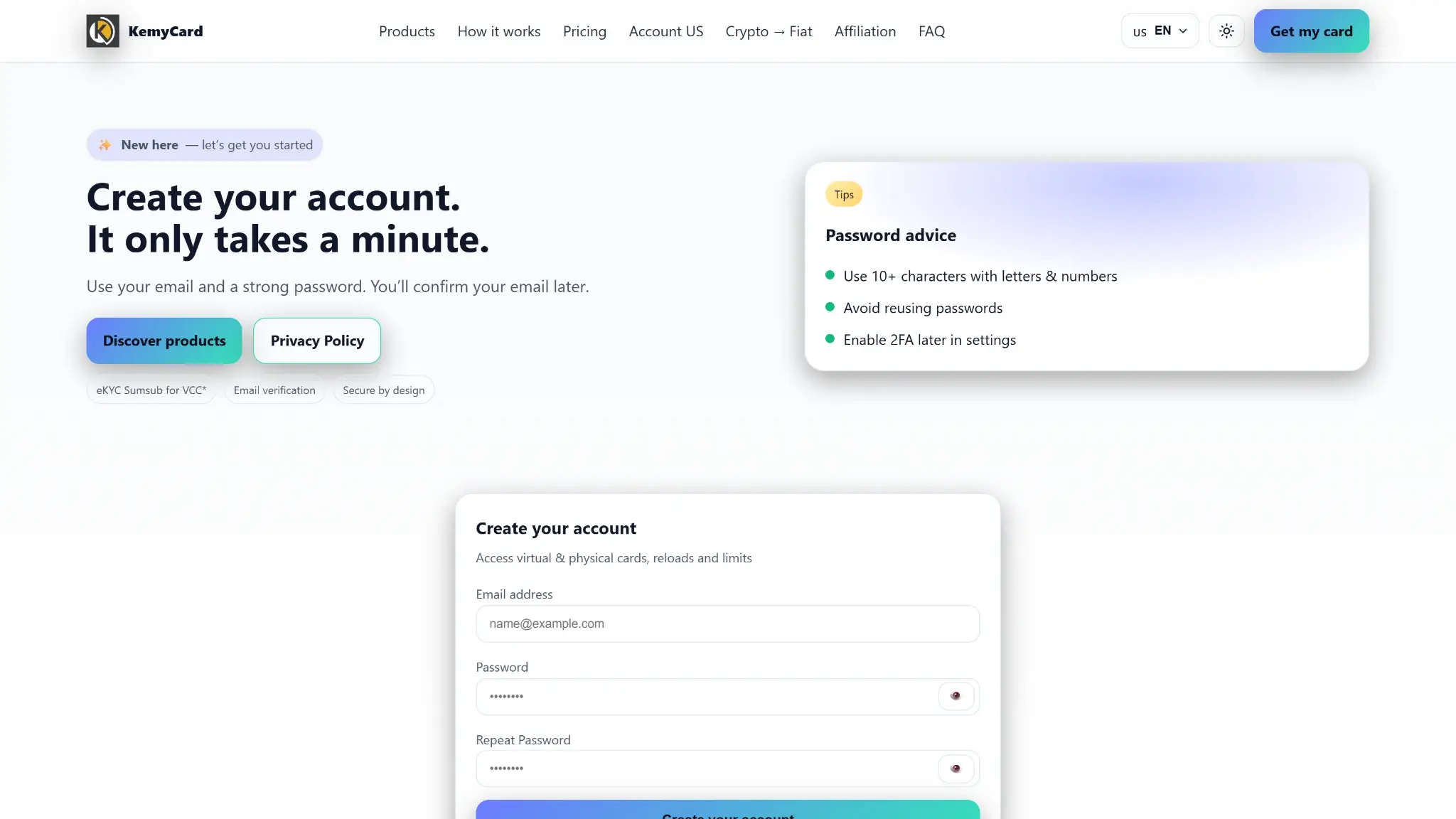
KemyCard desktop account creation page showing sign-up messaging, password advice, and a registration form with email and password fields.

Taxes, Statements and Record-Keeping

Record-keeping is manual throughout. Crypto-funded spending can create a taxable disposal when assets are converted on deposit. Stablecoin funding simplifies tracking but does not remove the reporting requirement. There is no cardholder rewards layer, so there is no separate rewards-income issue, but export quality, cost-basis visibility, and third-party tax software compatibility are all not disclosed.

The reporting burden still lands mostly on the user. Statements and payment memos are tied more clearly to the upcoming US account feature than to the current live card flow, so the user may still need to track the source wallet, deposit amount, conversion timing, spend amount, failed transactions, refunds, and reversals manually.

Final Verdict

KemyCard works better as a high-limit prepaid access tool than as a daily crypto spending card. The fee structure is the real issue. Deposit fees, top-up fees, and a per-transaction charge on the virtual card all stack before normal spending begins, and the physical card costs $250 upfront. It works for users who need high-limit prepaid access and are not price-sensitive. For everyday crypto spending, it is too expensive.

Overall Score

4.5

PROS

  • Virtual card can be created quickly for online spend
  • Physical card supports Apple Pay, Google Pay, Samsung Pay, and NFC
  • Physical card has unusually high stated spend limits
  • Multiple virtual cards help separate subscriptions or budgets
  • Freeze and unfreeze controls are built into the dashboard

CONS

  • Main account deposits carry a very high stated fee
  • Virtual card charges both top-up fees and per-transaction fees
  • Physical card has a high upfront cost and monthly fee
  • Supported crypto assets are not clearly broken out
  • US account and crypto-to-fiat payout features are not live yet
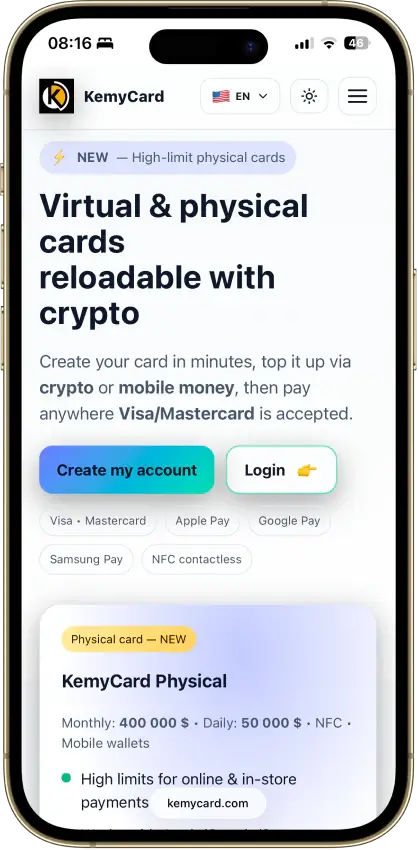
KemyCard mobile hero section promoting virtual and physical cards reloadable with crypto, account creation, and high-limit physical card access.
Affiliate Disclosure

Disclaimer: CryptoSlate may receive a commission when you click links on our site and make a purchase or complete an action with a third party. This does not influence our editorial independence, reviews, or ratings, and we always aim to provide accurate, transparent information to our readers.

FAQ

Is KemyCard a real credit card, a debit card or a prepaid card?

KemyCard is a prepaid card. You load funds first through crypto or mobile money, then spend from that balance through a virtual card or a physical card.

Is KemyCard available in my country?

Availability varies by jurisdiction. KemyCard’s own signup flow notes that product availability and limits can depend on region and KYC or KYB checks, so access is not guaranteed everywhere.

Does KemyCard let me spend USDC or other stablecoins?

Stablecoin top-ups are supported. The exact token and network list is not publicly disclosed, so confirm support before sending funds.

Does using KemyCard create a taxable event?

It can. If your jurisdiction treats crypto-funded spending as a disposal, loading and spending through KemyCard may create a taxable event, and stablecoin use only lowers price volatility rather than removing the reporting work.

Does KemyCard work with Apple Pay or Google Pay?

Yes. The physical card is presented as compatible with Apple Pay, Google Pay, and Samsung Wallet, alongside NFC contactless use.

Can I use KemyCard for travel, hotels, or ATM withdrawals?

You can use the physical card for in-store spend and ATM withdrawals, but it still behaves like a prepaid product. That can create extra friction at hotels, gas stations, car rentals, and other merchants that rely on pre-authorizations, and ATM access is tighter than spend access because the cash-withdrawal limits are much lower.

What happens if a merchant refunds me or I need a chargeback?

Refund timing and the chargeback path are not clearly set out. Support may be able to help with account access, card status, or some balance issues, but the public process for disputes, reversals, and merchant chargebacks is not laid out in much detail.

Do I need to stake or hold a token to get the best rewards?

No. KemyCard does not present a cardholder rewards program, so there is no staking, token-holding, or tier-unlock requirement to think about.