
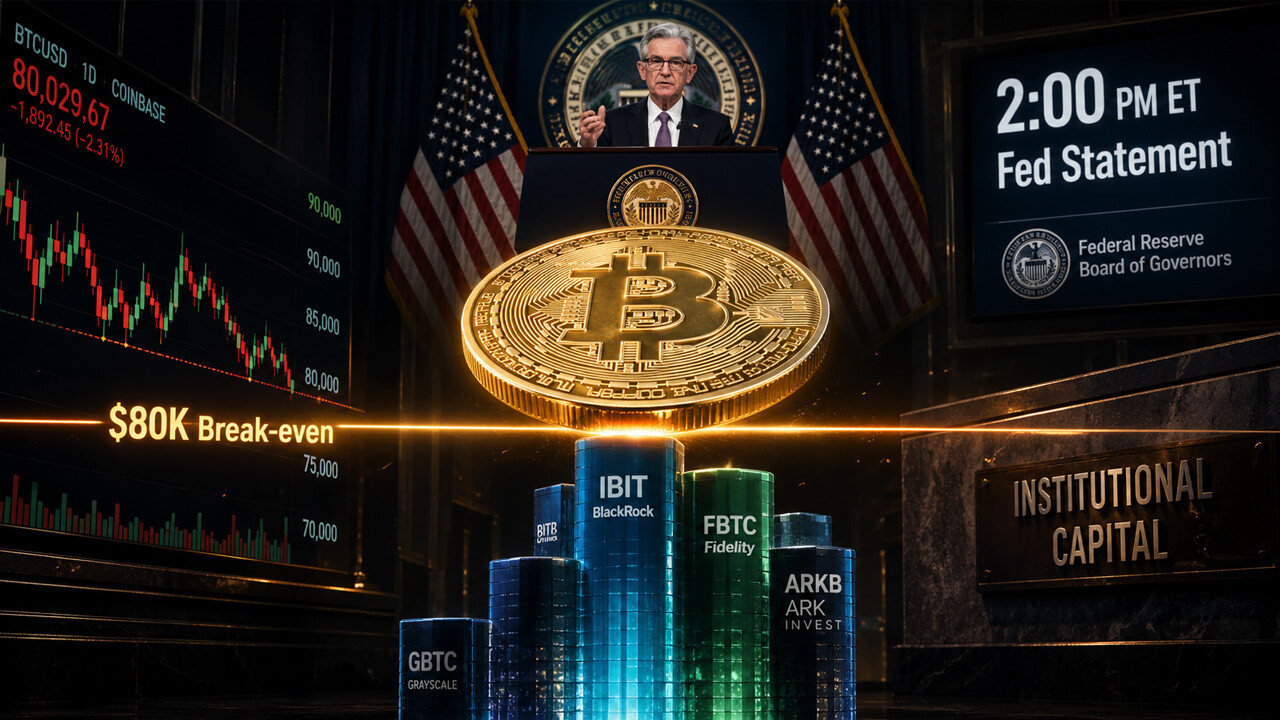


Bitcoin's rebound is running straight into one of the few events it can't price in advance. After climbing back toward $80,000 on the back of renewed institutional buying and a nine-day ETF inflow streak, BTC pulled back to around $76,500 on Tuesday before recovering early Wednesday to around $77,800 as the Federal Reserve began its two-day meeting in Washington.
The policy statement drops today, April 29 at 2 p.m. ET, followed by Chair Jerome Powell's press conference at 2:30 p.m.
The same rally that proved Bitcoin's resilience has now carried it into the exact zone where that resilience gets tested in earnest, with a large share of the investor base approaching break-even just as the Fed prepares to speak.
$80,000 is a behavioral breaking point
To understand why $80,000 is drawing so much attention, it helps not to think about it as a price target. Instead, look at it as a threshold that defines what a given investor decides to do next.
Bitwise's recent report identified a cluster of cost-basis measures sitting directly in the current price zone: the short-term holder cost basis near $80,000, the True Market Mean around $79,000, and the average Bitcoin ETF inflow cost basis in the same range.
This means that a meaningful portion of the investor base that's been holding through months of volatility is now approaching the point where it can sell without a loss.
When markets recover to break-even levels, holders face a genuine fork in the road.
They can treat the rebound as evidence that their conviction was warranted, hold their positions, and let the thesis play out over a longer horizon. Or they can use the recovery as the exit they've been waiting for, particularly if macro conditions feel too uncertain to justify continued exposure to a volatile asset.
Spot Bitcoin ETFs saw net inflows for nine consecutive trading days through April 24, adding about $2.12 billion since April 14, a run that suggests the institutional bid remains intact.
The question Wednesday's Fed decision will now have to answer is whether that bid survives the kind of macro event that has historically triggered “sell the news” behavior even when the actual policy decision lands exactly where markets expected it.
Why the institutional bid for Bitcoin has teeth
The most important structural development of the past two weeks has been the demand composition driving this rally.
Bitwise reported that global ETPs and corporate treasury programs accumulated roughly 92,900 BTC over a 30-day window while on-chain selling pressure slowed, suggesting that larger buyers have been steadily absorbing the supply that was rattling the market earlier in the year.
Whale holdings, a broad term for wallets carrying large positions that tend to belong to longer-term, higher-conviction participants, rose across the same period. Total net assets across US spot Bitcoin ETFs reached approximately $101 billion, equal to roughly 6.57% of Bitcoin's total market capitalization, which represents a meaningful deepening of institutional ownership relative to where things stood even six months ago.
What this means in practical terms is that the rally has a composition that's different from the short-covering spikes that have characterized earlier relief moves in 2026. It's being led by buyers who are unlikely to panic at the first sign of volatility, which lends the move a degree of structural support that shorter-term squeezes simply don't have.
That said, structural support and momentum are two different arguments, and momentum requires fresh buyers. The central risk into Wednesday is that the existing bid absorbs whatever selling emerges at break-even levels, but that's not the same as having enough incremental demand to push BTC cleanly through $80,000 and hold it there.
Powell's language is the real variable
The Fed has held rates at 3.50%–3.75% since March, and CME FedWatch data shows that 100% of traders expect another hold at the April 28–29 meeting.
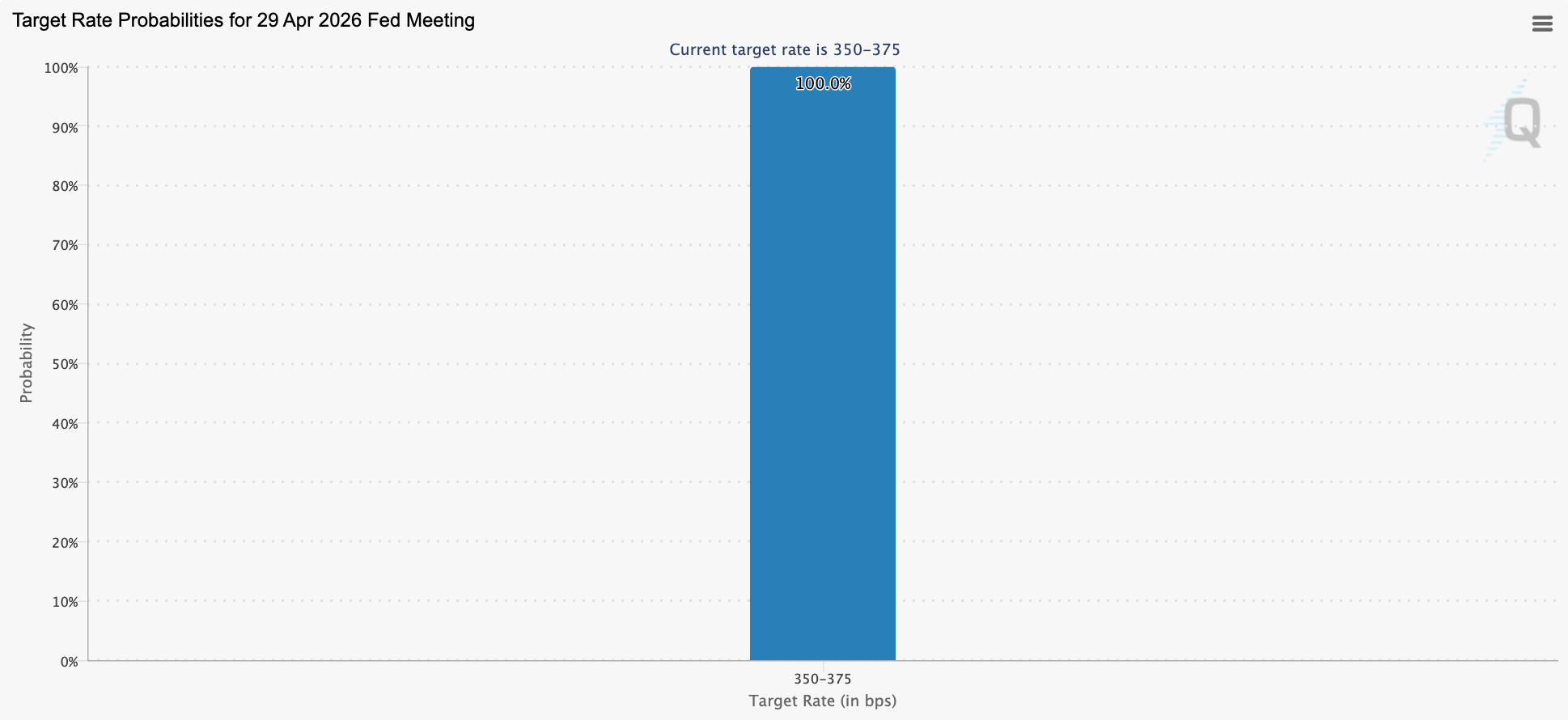
That near-certainty about the rate decision is, paradoxically, what makes Powell's language so consequential. With the outcome already priced in, the market's reaction depends entirely on how the Fed frames what comes next.
US inflation hit 3.3% in March, almost entirely driven by surging energy costs tied to the Iran conflict and the closure of the Strait of Hormuz. Core inflation, which strips out energy and food, came in at 2.6%, below expectations. The Fed is effectively navigating a split screen: headline numbers that look alarming and underlying numbers that argue for patience.
If Powell leans into the hawkish read of 3.3%, Bitcoin gets a macro headwind. If he leans into core's 2.6% and signals that the energy shock is temporary and geopolitically sourced, the market gets the permission it's been waiting for to extend the rally.
Any hint of a hawkish pause, defined as language that opens the door to future hikes, could send crypto into a cooling period, while an acknowledgment of neutral-rate dynamics could push Bitcoin past $80,000.
The Fed's rate decision lands the same afternoon that Microsoft, Alphabet, Meta, and Amazon all report Q1 2026 earnings after the close, with Q1 GDP, PCE inflation data, and the Employment Cost Index all releasing the following morning simultaneously, an incredible sequence of macro information that traders will be interpreting through whatever framework Powell's press conference established the night before.
There's also a longer-horizon variable that the immediate price action has somewhat hidden.
Kevin Warsh is set to become the first Federal Reserve chair with disclosed crypto holdings when Powell's term ends on May 15, and his policy instincts are already being read as more hawkish than his predecessor's on balance-sheet management.
As CryptoSlate has reported, that combination of personal proximity to the asset class and a macro worldview that markets read as structurally tighter creates genuine ambiguity about what the post-Powell era means for Bitcoin: ambiguity that's getting deferred into May but hasn't disappeared.
Bitcoin has recovered enough to test the market's conviction this week, and Wednesday's Fed decision will determine whether that conviction translates into a genuine breakout or another failed run at the level where sellers have been waiting patiently since the start of the year.
Mentioned in this article





Editorial credits