
Part 1 Advanced The Market Maker’s Exchange Checklist (Liquidity, Latency, and Risk Controls) Market makers and HFT desks: evaluate exchanges on execution quality, liquidity, latency, fees, margin, and security — with a WhiteBIT walkthrough. Open guide Raydium Crypto Exchange Review
Raydium fits non-U.S. self-custody users who want deep Solana token access, low on-chain swap fees, and more than a simple swap screen. Permissionless pools bring more token-quality risk, and the official docs exclude U.S. residents while offering no published exchange-wide proof-of-reserves framework. That keeps it distinct from many other crypto exchanges built around fiat onboarding and screened listings.
Not available in your region
Raydium is unavailable in your region.
Raydium Overview
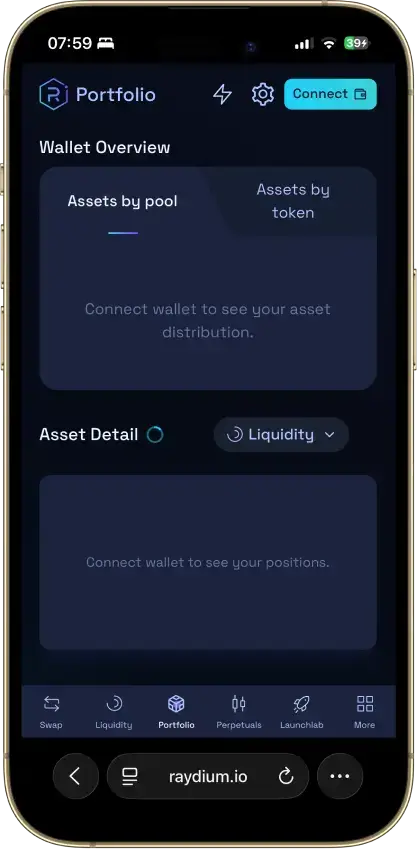
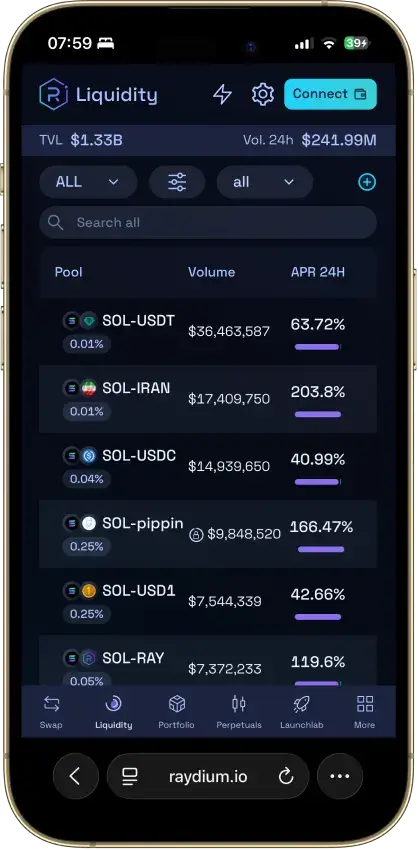
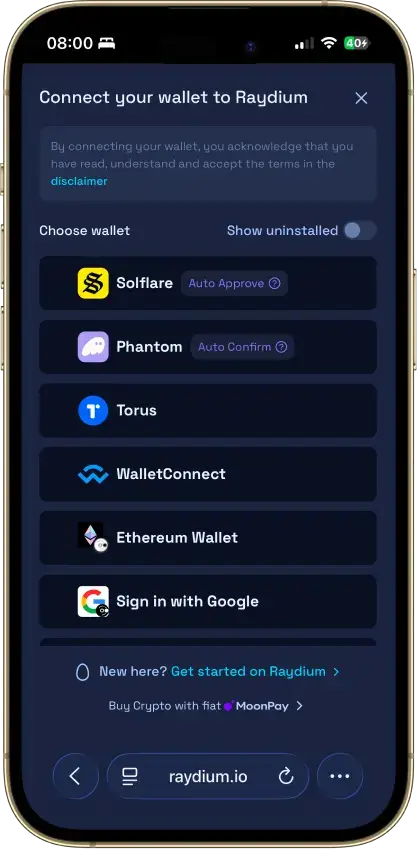
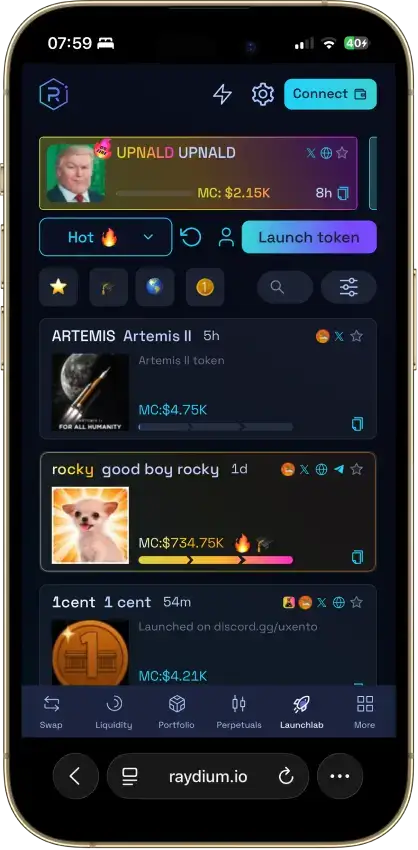
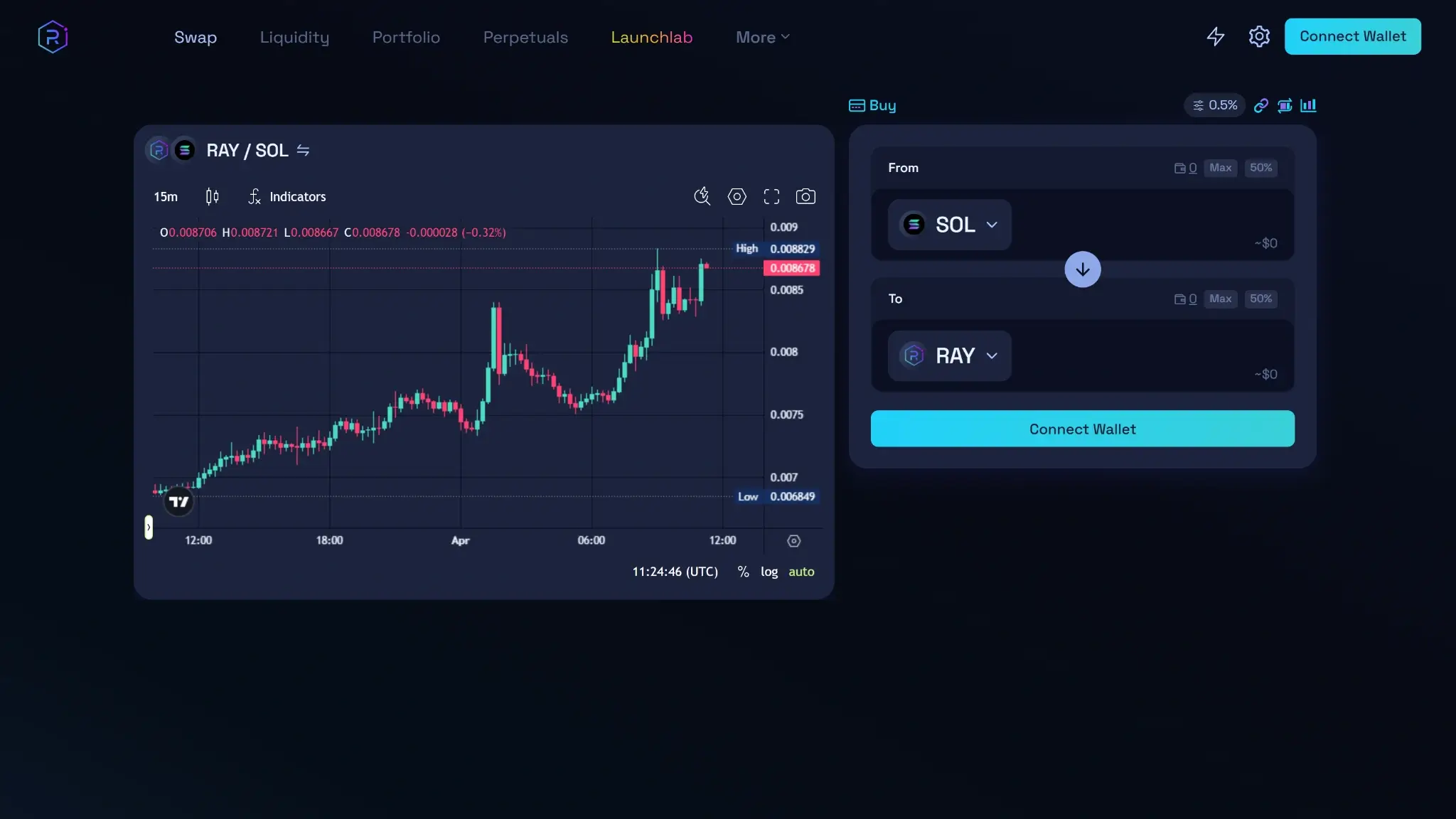
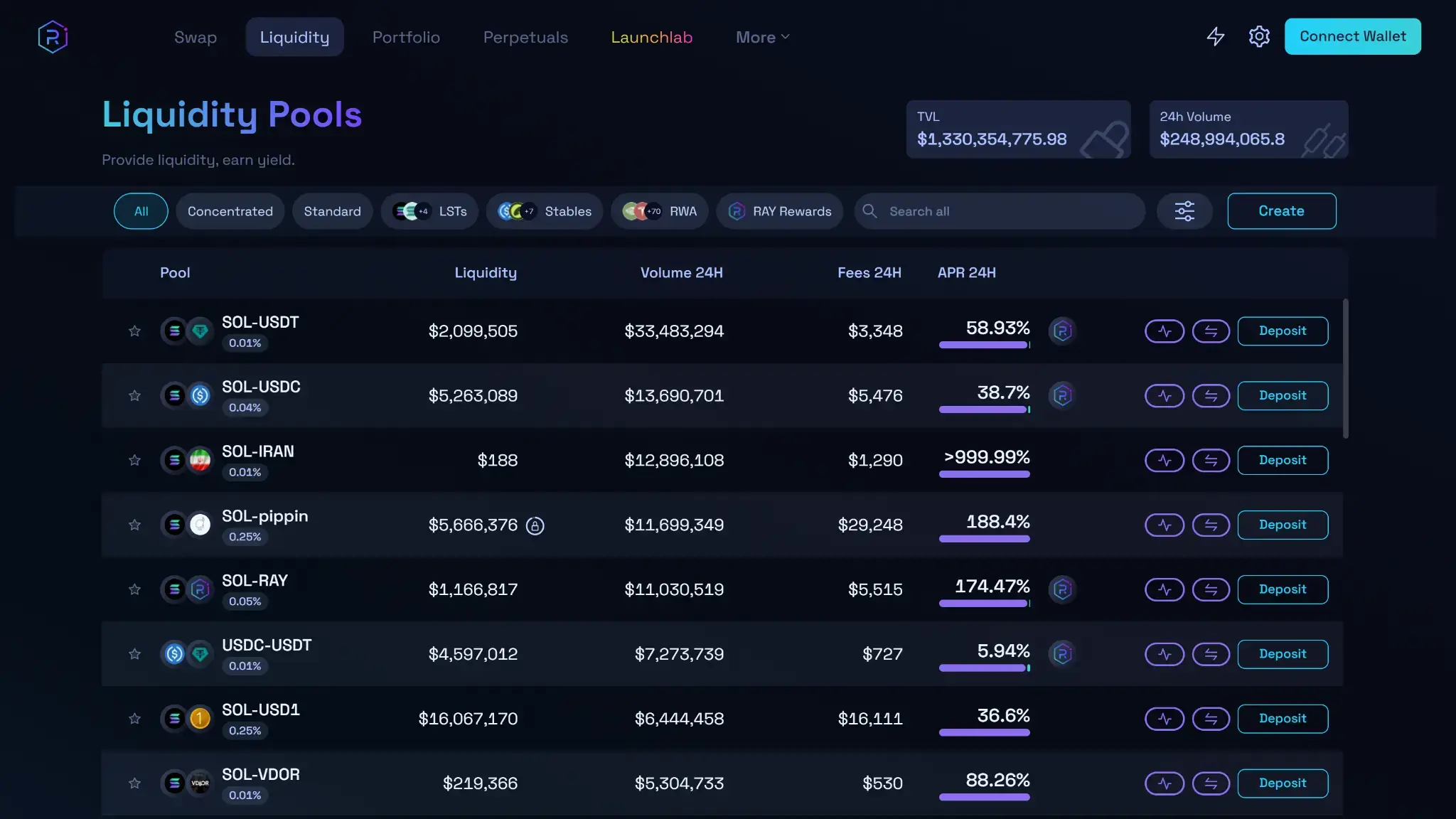
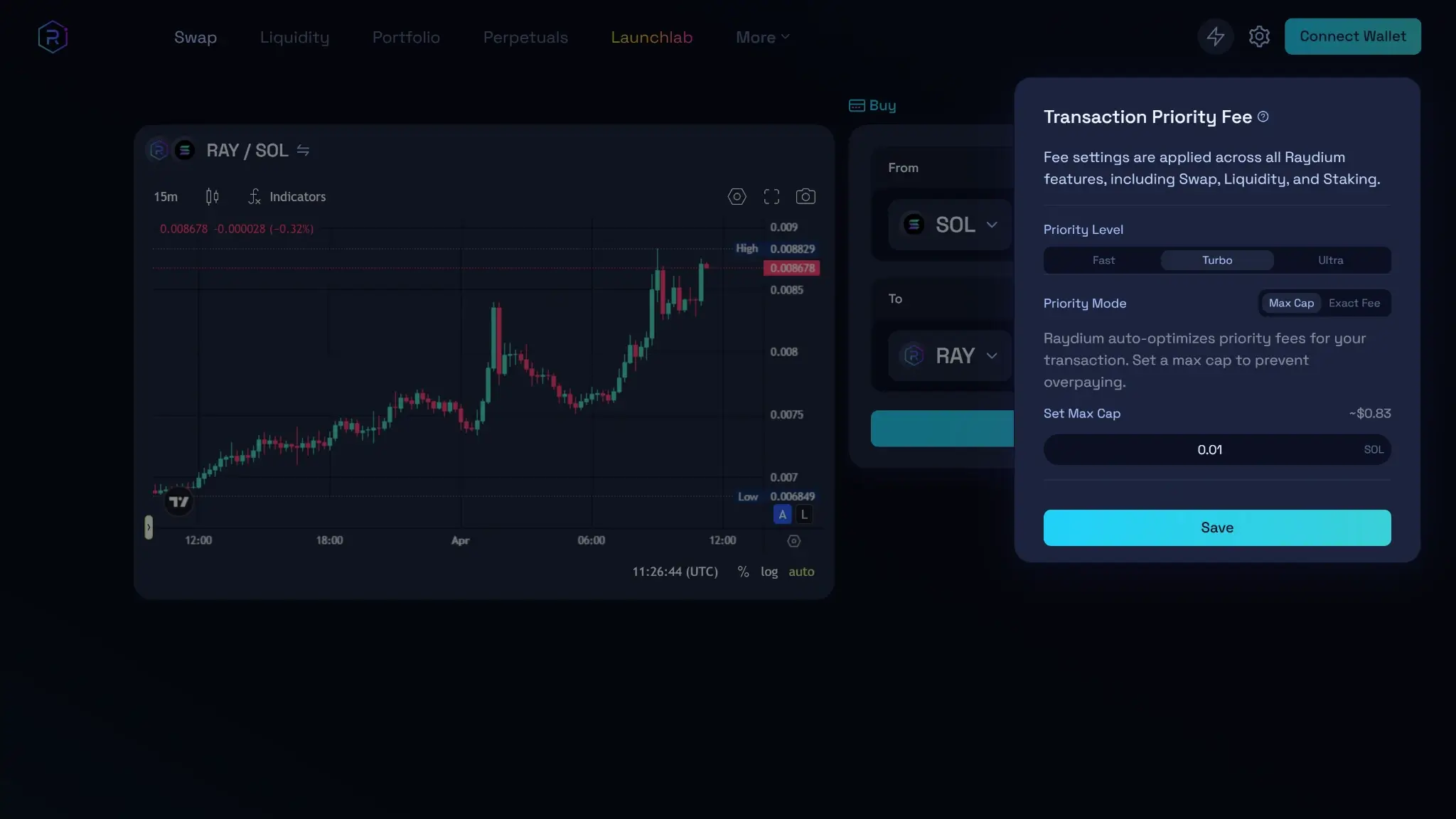
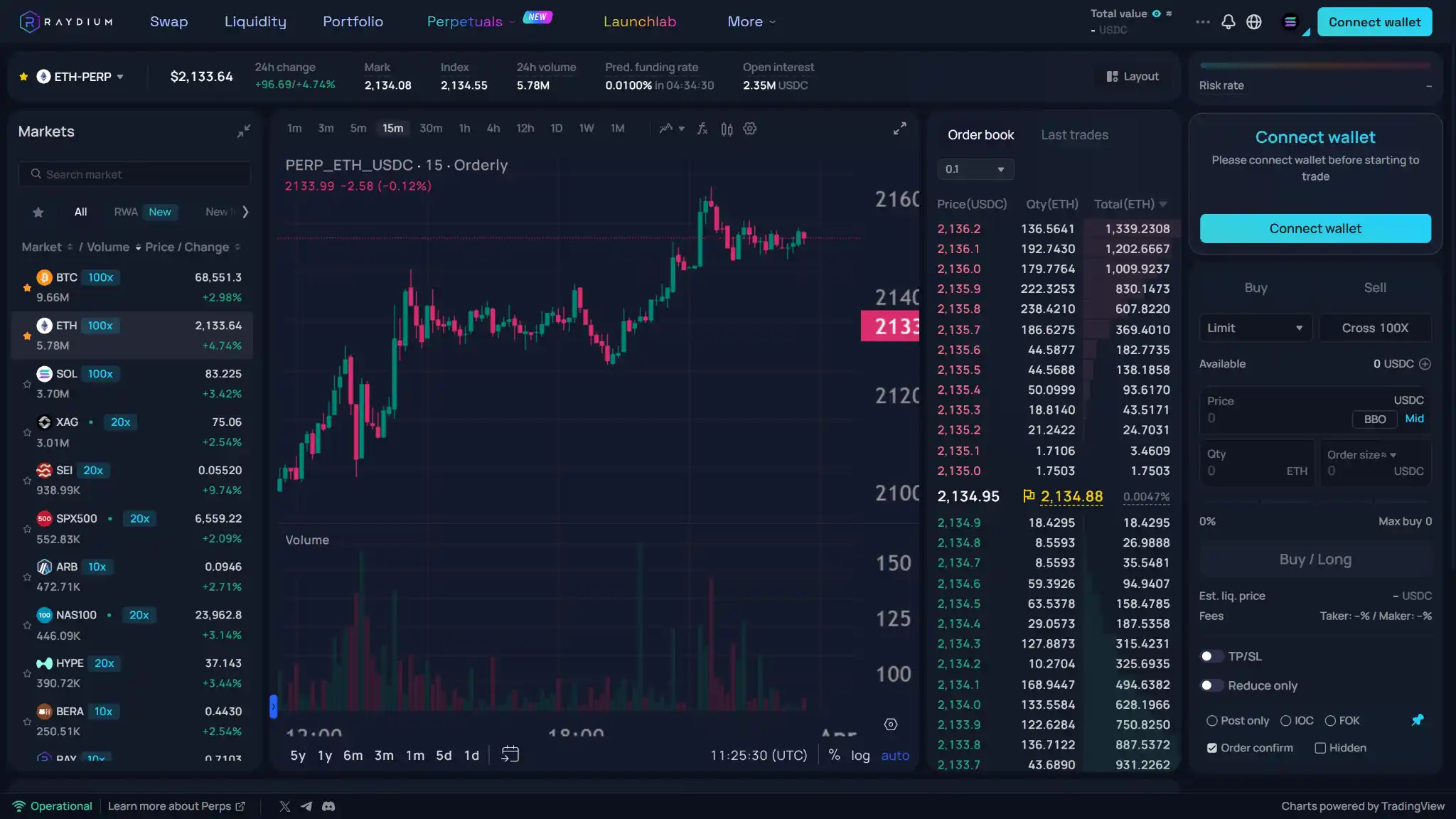
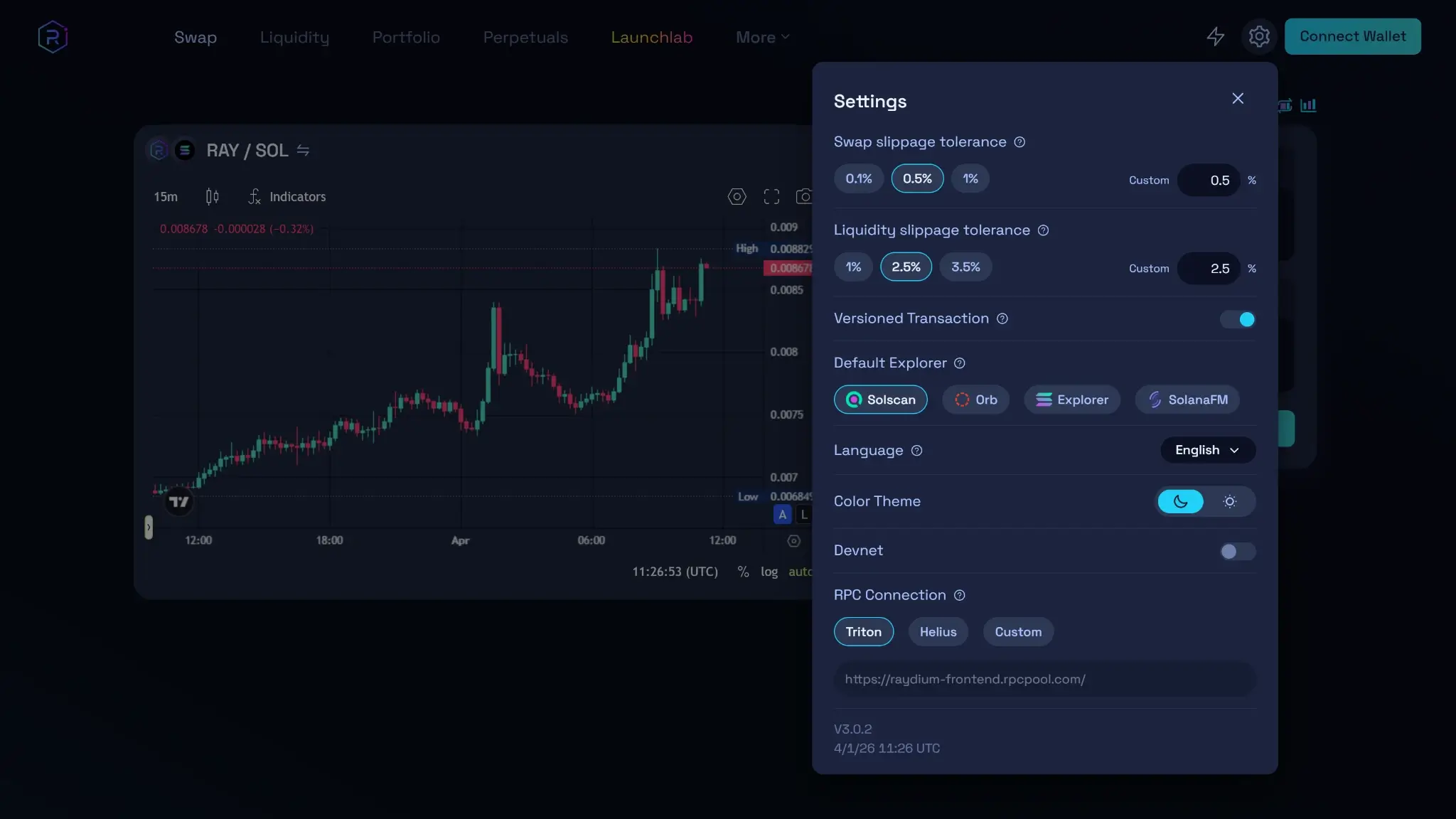
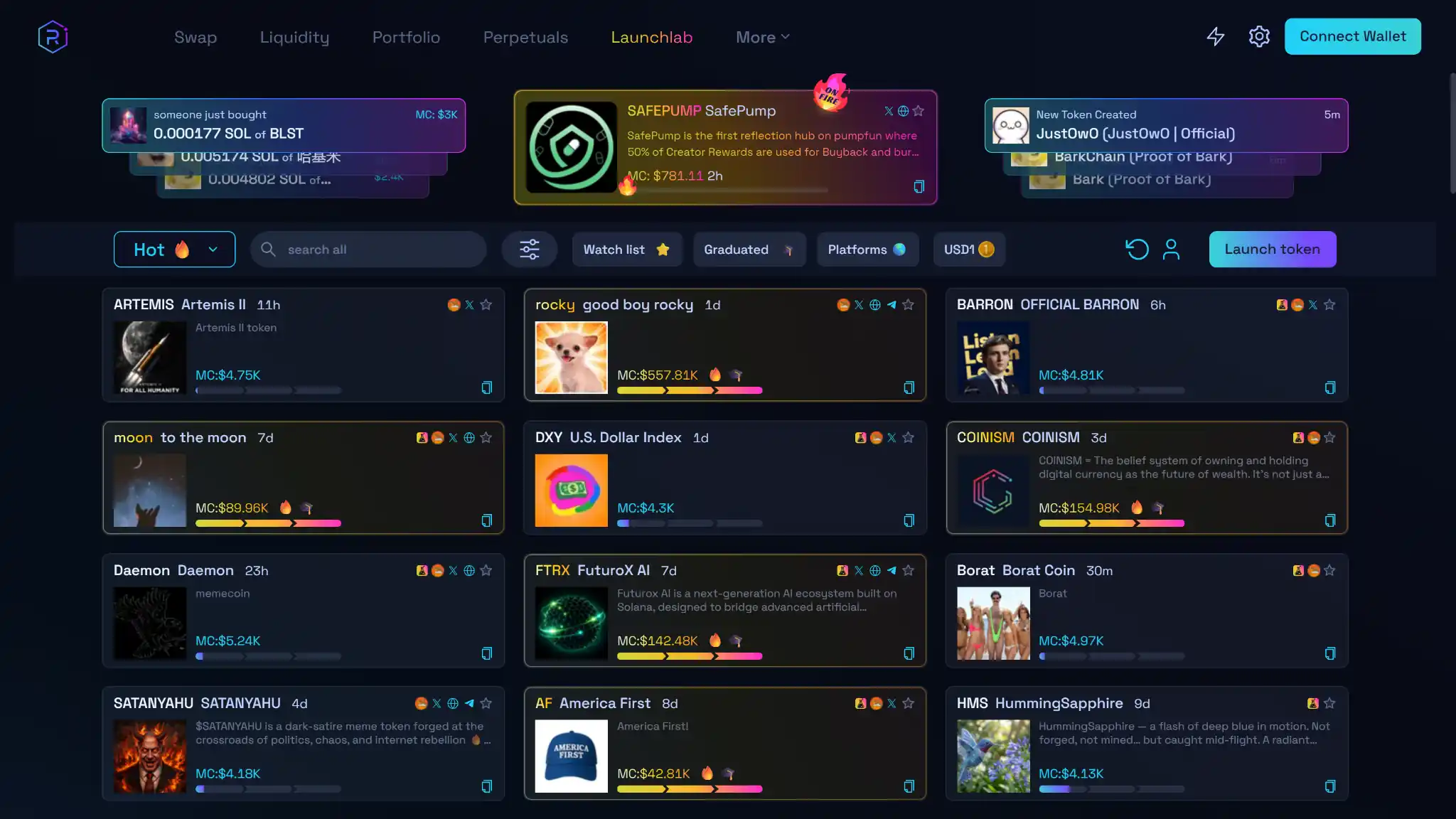
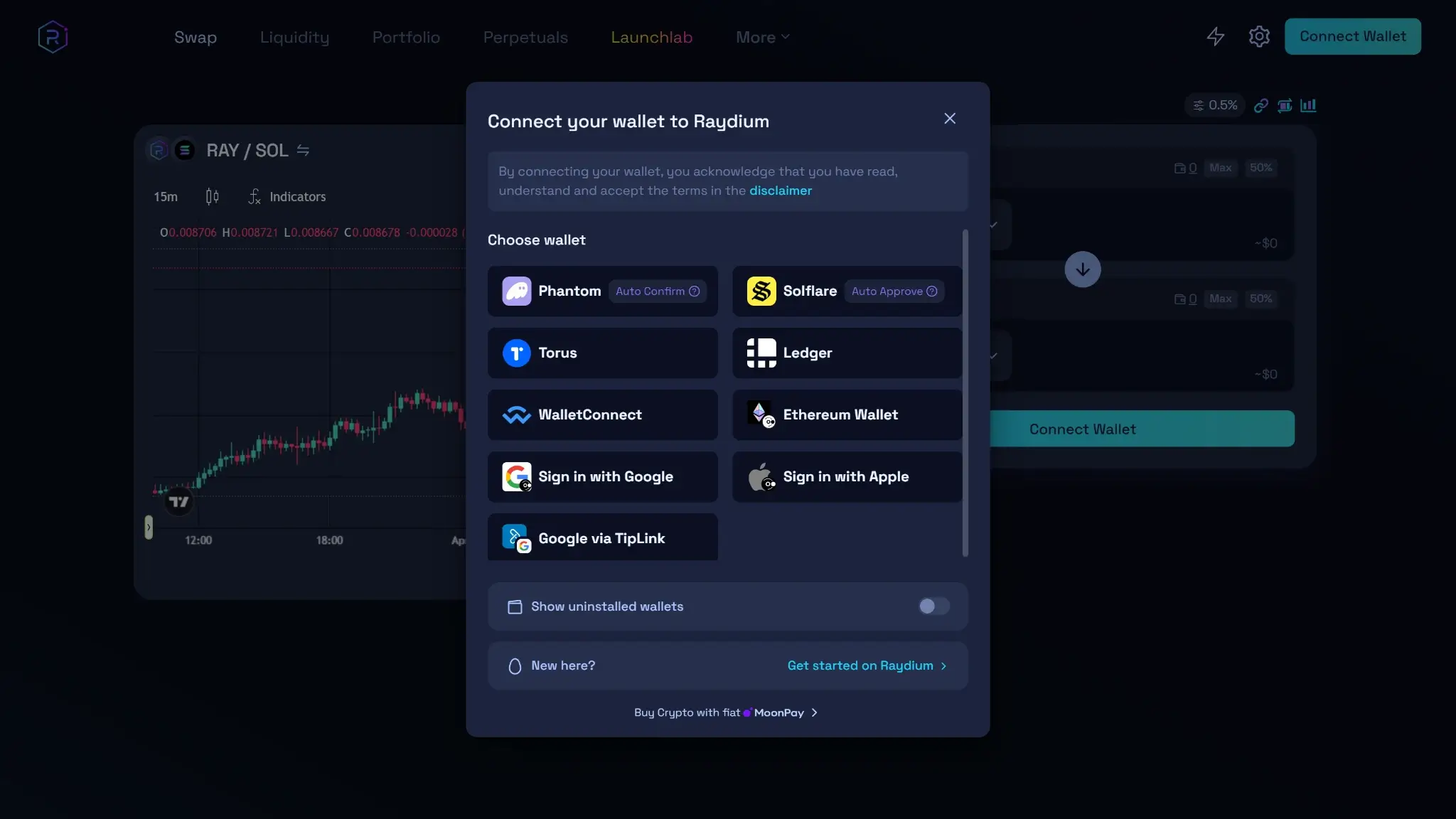
Raydium Screenshots

Raydium Pros and Cons
Pros
- Broad Solana product stack with swaps, perps, liquidity pools, LaunchLab, and yield tools.
- Swap fees start at 0.01%, and perps charge 0 bps maker with tiered 2–4.5 bps taker fees.
- Self-custody design means users keep control of wallet assets instead of pre-funding a custodial exchange account.
- Raydium publishes a long audit trail across Kudelski, OtterSec, MadShield, Halborn, and Sec3.
- Public APIs, SDK resources, and Devnet endpoints are available for builders and advanced users
Cons
- U.S. residents are excluded by the official disclaimer and perps documentation.
- Permissionless listings increase scam-token and contract-address risk.
- No published exchange-wide proof-of-reserves or liabilities attestation.
- Operating entity and jurisdiction disclosures are thinner than at major centralized exchanges.
Is Raydium Worth It?
Raydium is strongest for traders who already move around Solana by wallet and want one place for swaps, LPs, perps, staking, farms, and LaunchLab. It sits close to where a large share of permissionless Solana liquidity and new-token activity actually appears, which is the clearest reason to use it over a simpler swap app.

The compromises come from that same design. The U.S. block is absolute in the current docs. Entity and reserves disclosures are thinner than at a regulated exchange. The market is also built from permissionless pool creation rather than a curated listings committee. Traders who want screened listings, fiat-native onboarding, and exchange-style transparency will probably feel more comfortable elsewhere. Users who want a more all-in-one retail setup can also compare that model with the Crypto.com exchange review.
Who Is Raydium Best For

Raydium suits intermediate to advanced non-U.S. users who already trade from a self-custody Solana wallet and want more than simple swaps. The ideal user is comfortable checking token contracts, moving between pools and perps, and managing on-chain risk. It also fits more active and fee-sensitive traders who care about low published swap fees, zero-maker perpetual pricing, and direct access to new Solana market activity.
A secondary good-fit user is a builder, liquidity provider, or token-launch participant who wants Raydium’s broader Solana infrastructure instead of a basic exchange app. It is a poor fit for true beginners, who will usually be better served by beginner-friendly exchanges, cautious low-risk users, and anyone who needs U.S. access, bank funding, curated listings, or stronger centralized disclosure and customer-protection standards.
Raydium Fees and Pricing
The first step is to separate pool-based swaps from perps. Raydium does not price spot trading like a centralized exchange with one flat maker-taker schedule. For swaps, pricing comes from the pool you trade against, the route the app selects, your slippage setting, and the small Solana network fee needed to confirm the transaction. The only published volume-tier fee ladder applies to perpetuals, which route through Orderly.
| Method | Pricing Note |
|---|---|
| Spot swaps | Pool fee 0.01%–4% + Solana network fee |
| Perps | 0 bps maker · 2.0–4.5 bps taker |
| Fiat on-ramp | Variable through MoonPay |
| Perps withdrawal | 1 USDC |
For spot users, the most important fee point is that Raydium swaps are pool-based rather than account-based. Official docs say swap fees range from 0.01% to 4% depending on pool type and configuration, and Solana network fees are usually about 0.0001–0.001 SOL per transaction. Final execution costs change with the token pair, route depth, slippage setting, and congestion.

Perps are easier to benchmark. Raydium publishes 0 bps maker on limit orders, while taker fees start at 4.5 bps and fall to 2.0 bps at the top tier based on trailing 30-day volume. That makes the perps side more competitive for active traders than the swap side is for casual retail users trying to compare headline fees across exchanges.
Withdrawal costs do not reduce to one flat number here. Fiat on-ramp and off-ramp costs are less transparent because Raydium uses MoonPay for card purchases, bank transfers, and bank cash-outs. The current docs explain how to access those flows, but card and bank costs run through MoonPay, so pricing depends on the payment route rather than a Raydium fee card. On the withdrawal side, standard spot assets remain in your wallet, so there is no separate custodial withdrawal fee in the normal DEX flow beyond network costs. Perps are different and currently list a 1 USDC flat withdrawal fee charged by Orderly.
The current RAY staking docs focus on staking flow and rewards, not on a separate platform commission. Users should still expect normal network costs when staking or unstaking, and LP or farm users also need to factor in pool fees, price impact, and impermanent-loss risk rather than looking only at the headline trading fee.
There are a few practical ways to lower costs here. On perps, use limit orders where possible to access the 0 bps maker rate. On swaps, favor deeper pools and tighter slippage settings on liquid pairs instead of trading thin permissionless pools. It is also usually cheaper to fund a wallet directly and use Raydium on-chain than to rely on card or bank flows where MoonPay adds variable pricing. We captured these fee details on Mar. 31, 2026.
VIP Tiers and Fee Discounts
Spot swaps do not come with an exchange-wide VIP ladder in the way a CEX would. The only clear public fee ladder in current docs is the perpetuals taker schedule tied to trailing 30-day volume.
| Tier | 30-Day Volume | Maker | Taker |
|---|---|---|---|
| Base | Below $500k | 0 bps | 4.5 bps |
| Mid | $5M+ | 0 bps | 3.0 bps |
| Top | $80M+ | 0 bps | 2.0 bps |
This ladder applies to perps only. Spot swap fees are not reduced by a VIP ladder or native-token discount in the current app flow.
Deposits, Withdrawals, KYC and U.S. Availability
Raydium’s funding flow is split across wallet trading, MoonPay, and perps, so there is no single cashier schedule. Spot access is wallet-based and non-custodial. MoonPay handles fiat on-ramp and off-ramp flows. Perpetuals use an Orderly-powered account layer with its own collateral and withdrawal rules. The result behaves less like a traditional exchange cashier and more like a wallet hub with attached service rails.
| Flow | How It Works | Limits |
|---|---|---|
| Spot | Fund your own wallet and trade on-chain | Limits depend on the product layer and payment route |
| Fiat | MoonPay handles card buys, some bank-linked purchases, and cash-outs where supported | Dynamic by region, method, and verification |
| Perps | Fund a perps account with supported collateral after a wallet signature | Asset-specific caps apply |
For wallet-only spot use, there is no custodial deposit or withdrawal menu in the usual CEX sense. You connect a compatible Solana wallet, fund it yourself, and trade directly against on-chain pools. For fiat, Raydium currently points users to MoonPay for card purchases, bank transfer buys, and bank cash-outs. For perps, first-time users create a separate perps account with a wallet signature, deposit supported collateral, and settle PnL before withdrawing profits.
Geo Access and Entity Mapping
| Region | Availability | Notes |
|---|---|---|
| United States | Not available | Official docs exclude U.S. residents |
| Prohibited jurisdictions | Not available | Sanctioned and restricted jurisdictions are listed in the docs |
| Other supported regions | Spot, LPs, staking, LaunchLab, and perps | Perps still depend on the restricted list and wallet-based access |
For U.S. readers, the answer is simple: Raydium is not available under the current official disclaimer. The U.S. block appears broad, with no state-level carve-out or limited-access mode in the current materials. Outside the prohibited list, access is broader, but Raydium still does not map products by country with the legal-entity detail a regulated CEX would normally publish.
Registration and Onboarding
For spot use, there is no traditional email-and-password exchange signup. Raydium’s current onboarding flow tells users to set up a Solana wallet, keep some SOL for transaction fees, connect that wallet at raydium.io, and start using the app. Users starting from scratch should compare crypto wallet options and the best Solana wallets before connecting. Current onboarding is wallet-first, without Apple, Google, or email-based sign-in.
That also means KYC does not appear at the wallet-only spot layer in the way it would on a centralized exchange. The trade-off is that your security setup depends heavily on your wallet choice and your own signing hygiene. Raydium recommends wallet options such as Phantom wallet, Solflare wallet, Backpack, and Jupiter, and tells users to keep at least 0.05 SOL in-wallet to avoid failed transactions.
Perps onboarding adds one extra step. First-time users must create a perps account by signing once from their wallet, then fund that account with supported collateral. If you use MoonPay for fiat, MoonPay can separately prompt for personal details and ID checks. Depending on the transaction and the account limit requested, that can extend to liveness checks, proof of address, or source-of-wealth documentation.
Fiat Rails by Region
Raydium does not need a full banking grid the way a centralized exchange does because fiat access is secondary and routed through MoonPay. In supported non-U.S. regions, MoonPay can provide card buys, some bank-linked methods, and bank cash-outs, including SEPA in parts of Europe and Faster Payments in the UK. For most users, the cheapest path is still to fund a compatible Solana wallet elsewhere and use Raydium on-chain.
Withdrawal Networks and Fees
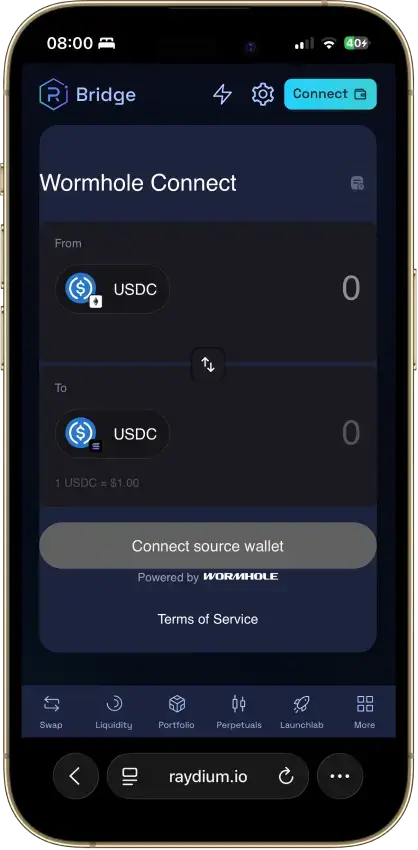
Raydium’s direct wallet flow is Solana-native, so network support looks different from a centralized exchange withdrawal page. External-chain support is clearest on the perps side, where the docs publish supported collateral routes rather than a classic withdrawal network menu.
| Route | Fee Model | Typical Timing | Notes |
|---|---|---|---|
| SOL on Solana | Network only | Usually seconds to under a minute | Core wallet funding route |
| USDT on Arbitrum or BSC | Network only | Usually minutes | Lower-cost perps collateral route |
| USDT on Ethereum | Network only | Usually minutes | Higher gas at peaks |
| ETH on Ethereum, Base, or Arbitrum | Network only | Usually minutes | Supported for perps collateral |
When multiple routes exist, the cheapest option is usually to avoid Ethereum mainnet unless you specifically need it. On Raydium perps, Arbitrum or BSC versions of USDT are usually more practical than Ethereum, while spot-first users will often pay least by staying fully inside Solana.
Verification Levels and Withdrawal Limits
Raydium does not publish named KYC tiers the way a centralized exchange does. A simpler way to read the product is by layer: wallet-only spot use, wallet-signed perps access, and MoonPay compliance for fiat rails.
| Layer | Verification | Limits |
|---|---|---|
| Spot wallet use | None at the Raydium layer | No unified Raydium limits published |
| Perps account | One-time wallet signature | Asset- and product-specific limits apply |
| MoonPay fiat rails | ID-based verification, with enhanced review in some cases | Dynamic by region, method, and account status |
The main review risk sits with MoonPay, not Raydium’s wallet-only spot flow. MoonPay says account limits depend on verification status and jurisdiction. Payment-method limits reset on rolling daily or monthly windows, and extra documents can be required before higher limits or withdrawals. The standard wallet flow does not mention a whitelist requirement or a travel-rule step. We reviewed these access, funding, and verification details on Mar. 31, 2026.
Is Raydium Safe? Security, Custody and Proof of Reserves
We assessed Raydium’s custody model, user-facing security controls, insurance language, proof-of-reserves posture, smart-contract audits, and material incident history. The security record is better documented at the protocol level than at the account level. Raydium publishes audits, a live bug bounty, and multisig controls, but it lacks the account-layer safeguards, insurance language, and liabilities attestation seen at larger custodial venues.

Controls
Raydium does not use a standard exchange login model, so Raydium itself does not add account-layer tools such as 2FA, passkeys, withdrawal allowlists, anti-phishing codes, or slow-withdrawal vaults. For wallet-only spot use, security depends mostly on the wallet you connect and the transactions you approve. That is a feature for self-custody users, but it also means Raydium does less hand-holding than a major CEX.
What Raydium does publish is protocol-level control information. The docs say all program upgrade and admin authority sits under a Squads multisig, larger updates can go through extra whitehat review, and current docs say upgrade authority sits with a Squads multisig and is not protected by a timelock. The trust-and-safety docs also repeatedly warn users to verify the official domain, check token mint addresses, and review each wallet signature carefully because Raydium is fully permissionless.
Most meaningful user protections here sit at the wallet layer rather than inside default Raydium account settings. If your wallet supports hardware signing, biometrics, spending limits, address books, or simulation warnings, those controls matter more than anything built into the Raydium interface itself.
Custody and Insurance
Raydium is fundamentally a self-custody product, not a custodial exchange account. For standard spot use, assets remain in your connected wallet until you approve a transaction, and once funds enter a pool, farm, or other smart contract, they are governed by on-chain program logic instead of a centralized omnibus balance. On the perps side, Raydium says users still retain control of funds while using Orderly-powered infrastructure, but the product introduces a separate account layer and collateral workflow that is more complex than plain wallet swaps.
Current Raydium materials do not outline client-asset insurance, crime-policy coverage, or specie-style protection. They also do not say that crypto balances are covered against hacks, theft, or insolvency. Any bank-partner or payment-partner protection on a fiat rail does not mean on-chain crypto balances, LP positions, or perps collateral are insured.
Fiat access adds another layer of separation. Raydium routes fiat buys and bank cash-outs through MoonPay, so any safeguarding, compliance, or bank-partner treatment for fiat sits with that third-party stack rather than with Raydium’s core DEX model.
Proof of Reserves or Audits
Raydium does not provide an exchange-wide proof-of-reserves report, liabilities tree, or user-verifiable inclusion tool. There is no official PoR hub or recurring attestation cadence, and there is no liabilities attestation comparable to what some centralized exchanges now offer. It also does not rely on public-company financial statements or audited corporate accounts as a substitute.
What Raydium does publish is protocol-security evidence. The current security docs list audits from Kudelski, OtterSec, MadShield, Halborn, and Sec3 across the AMM, CLMM, staking, Burn & Earn, LaunchLab, and CPMM codebase. Raydium also runs a live Immunefi bug bounty with critical smart-contract rewards up to $505,000. That is meaningful security disclosure, but it is not the same thing as exchange-wide reserves and liabilities transparency.
Incidents and Remediation
Raydium has been hacked before. The main material security event in its history remains the Dec. 16, 2022 exploit. In its official post-mortem, Raydium said an attacker gained access to the Pool Owner admin account for Liquidity Pool V4 and exploited eight constant-product pools, with about $4.4 million in funds affected. Concentrated liquidity pools and RAY staking were not affected.
Raydium’s initial response was to revoke the compromised authority and move it to a new account held on a hardware wallet. It then upgraded the AMM V4 program through Squads multisig, removed several admin parameters, and shifted remaining admin functions to the multisig. In early 2023, Raydium also published a phased compensation plan and claim portal process for affected liquidity providers.
The reviewed sources do not point to a later incident post-mortem of similar scale. That is a positive sign, but it does not erase the importance of the 2022 incident because it showed that privileged-access design mattered as much as smart-contract code quality.
How to Verify PoR Yourself
There is no exchange-wide proof-of-reserves report for users to verify. Users can review public smart-contract audits, multisig and treasury addresses, and official program addresses, but those checks do not prove liabilities coverage or account-level solvency the way a real PoR attestation would.
Status Page and Incident History
The reviewed official docs do not point to a dedicated public Raydium status page. For security history, the clearest official sources remain the protocol security pages and Raydium’s own exploit and remediation posts.
| Month Year | Event | Impact | Resolution |
|---|---|---|---|
| Dec. 2022 | Admin-key exploit on Liquidity Pool V4 | About $4.4 million affected across eight constant-product pools. CLMM and RAY staking were not affected | Compromised authority revoked, moved to hardware wallet control, AMM V4 upgraded via Squads multisig, and admin parameters reduced |
| Jan. 2023 | Compensation plan and claim portal rollout | Affected LPs needed a formal restitution path after the exploit | Raydium opened phased claims and used treasury plus team reserves to compensate eligible positions |
Supported Assets and Markets
Raydium’s market breadth comes from permissionless Solana pools rather than a curated listings desk. The headline coin count needs context because raw catalog size is not the same thing as practical trading depth. Third-party market data currently tracks roughly 2,771 coins and 5,819 pairs on Raydium. The official docs also say users can swap any token pair on Solana because liquidity is permissionless. That gives traders access to far more long-tail assets than most centralized exchanges, especially around new Solana launches, memecoins, and the wider flow of Solana news.

A large coin count does not mean careful curation. Raydium does not screen listings the way a centralized exchange does, so the catalog includes a large tail of thin, risky, or low-quality tokens. Practical trading depth is much stronger in major SOL and stablecoin routes than in the long tail, and cautious users should treat the raw asset count as access breadth rather than a quality signal.
Stablecoin support is strong where it matters, but it also works differently across products. On spot, USDC and Tether (USDT) are the most important quote assets, and Raydium’s CLMM model is explicitly positioned as a good fit for stable pairs. On perps, USDC remains the settlement currency, while supported collateral currently includes USDT on Ethereum, Arbitrum, and BSC, plus YUSD on Ethereum and BSC.
Fiat market access is much weaker than the asset count may suggest. Raydium does not run native USD, EUR, or GBP order books, so there are no traditional fiat spot pairs in the app. Fiat access comes through MoonPay on-ramp and off-ramp flows instead of a built-in exchange order book.
U.S. users do not get reduced catalog access or limited market parity. They get no official access at all under the current disclaimer. International users therefore see the full practical catalog, while U.S. retail users should treat Raydium as unavailable rather than partially supported.
RAY affects the protocol’s economics more than user market access. Holding Raydium (RAY) does not appear to unlock lower trading fees or VIP tiers in the current docs, but they do say 12% of all trading fees are used for RAY buybacks, and the token remains central to staking and treasury design.
Listings and Delistings Policy
Raydium does not run a centralized listings policy in the usual exchange sense because its market structure is permissionless. The official trade FAQ says anyone can create a pool and list a token, and the current pool-creation and LaunchLab docs make the same point. In practice, that means new assets can appear quickly without the review queue, announcement cadence, or listing standards a centralized exchange would normally publish.
Launches are rolled out in two main ways. Anyone can create a pool directly, and anyone can launch a token through LaunchLab. In the current LaunchLab docs, new tokens go live immediately on a bonding curve and then migrate into a Raydium AMM pool once the raise target is hit.
The current materials do not set out a formal delisting policy, centralized review framework, or user-notice timetable for removing spot assets. That is consistent with Raydium’s design. Tokens are more likely to fade through low liquidity, abandoned pools, or community disuse than through a formal delisting announcement, which puts more responsibility on the user to verify contract addresses and liquidity before trading.
App, UX and Customer Support
Raydium’s interface is wide, modular, and clearly built around a connected wallet rather than a custodial account dashboard. Navigation is consistent across swap, liquidity, portfolio, perps, and LaunchLab, performance claims lean on fast Solana execution rather than formal UX metrics, localization appears limited in the reviewed sources, and support is community-led through docs, GitBook AI, Discord, and Telegram rather than phone or ticket-first enterprise channels.

UI and Navigation
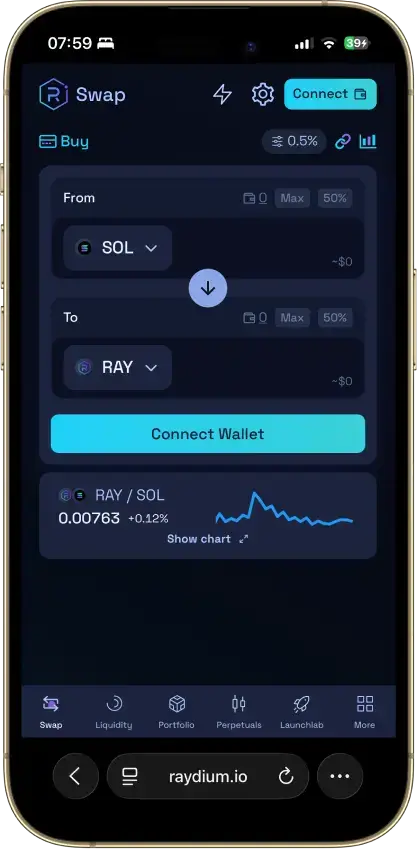
Raydium’s menu structure is easier to learn than its product depth. The main navigation keeps the core tasks visible at the top level: Swap, Liquidity, Portfolio, Perpetuals, LaunchLab, and a smaller “More” menu for secondary tools. That keeps a wide product set from feeling scattered, even though Raydium covers far more than a basic DEX swap page.
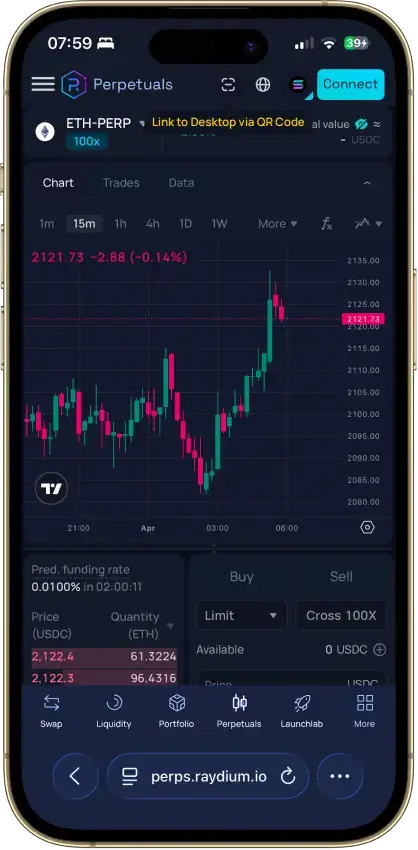
The desktop flow is especially clear on the high-intent pages. The swap view pairs a standard two-token trade ticket with charting and routing controls. The liquidity page adds searchable pool tables, filter chips for pool types and themes, and one-click deposit actions. The perps layout is much denser, but it is still legible, with a left market rail, central chart, right-side order ticket and order book, and lower tabs for positions, fills, and history.
Where Raydium becomes less intuitive is around product complexity rather than menu structure. LaunchLab, liquidity management, and perps each ask the user to understand different mechanics, and the permissionless market design means the UI can surface a large amount of noisy long-tail content. The search bars, chip filters, pool tabs, and watchlist-style controls help, but the experience still expects more self-direction than a beginner-focused exchange app.
Localization and accessibility signals are modest in the reviewed sources. The current interface and docs do not point to a language selector, dedicated accessibility settings, or detailed accessibility commitments. The current interface uses a consistent dark theme, large tap targets on key actions, and clear visual separation between modules, but there is not much published evidence of deeper accessibility tooling.
Mobile App
Raydium’s own docs describe the product as a web app available directly at raydium.io, with “no downloads, no installs.” In the reviewed official sources, there is no Raydium-run iOS App Store or Google Play listing. That matters because third-party app-store listings using the Raydium name do exist, and the official trust-and-safety docs warn that raydium.io is the project’s only domain and that lookalike links are scams.
Mobile access is therefore browser-first and wallet-dependent. Raydium’s docs recommend wallet apps such as Phantom, Solflare, and Jupiter on iOS and Android, so mobile usage is best understood as a connected mobile-wallet experience rather than a native Raydium mobile app. That setup is workable for swaps and basic position checks, but it is less elegant for dense tasks like perps trading, LaunchLab discovery, or active liquidity management.
The reviewed official materials present Raydium as a web app rather than a native mobile app. That means there is no official app-store release cadence, native notification framework, or Raydium-level biometric or PIN control to assess. Those controls sit at the wallet layer instead. Mobile reliability is also more sensitive to wallet-browser compatibility, RPC performance, and transaction-signing behavior than it would be in a fully native exchange app.

Reliability and Status Page
The reviewed official docs do not point to a dedicated public Raydium status page or formal uptime archive. That is a gap compared with larger centralized exchanges, especially for users who want a clean incident history before connecting a wallet or moving collateral.
Raydium does publish troubleshooting guidance inside the docs. The current trade FAQ flags common operational issues such as insufficient SOL for fees, slippage failures, timeouts when transactions do not land, and Ledger-specific signing problems. That is useful, but it is not the same as a proper status page with incident timestamps and resolved-event history.
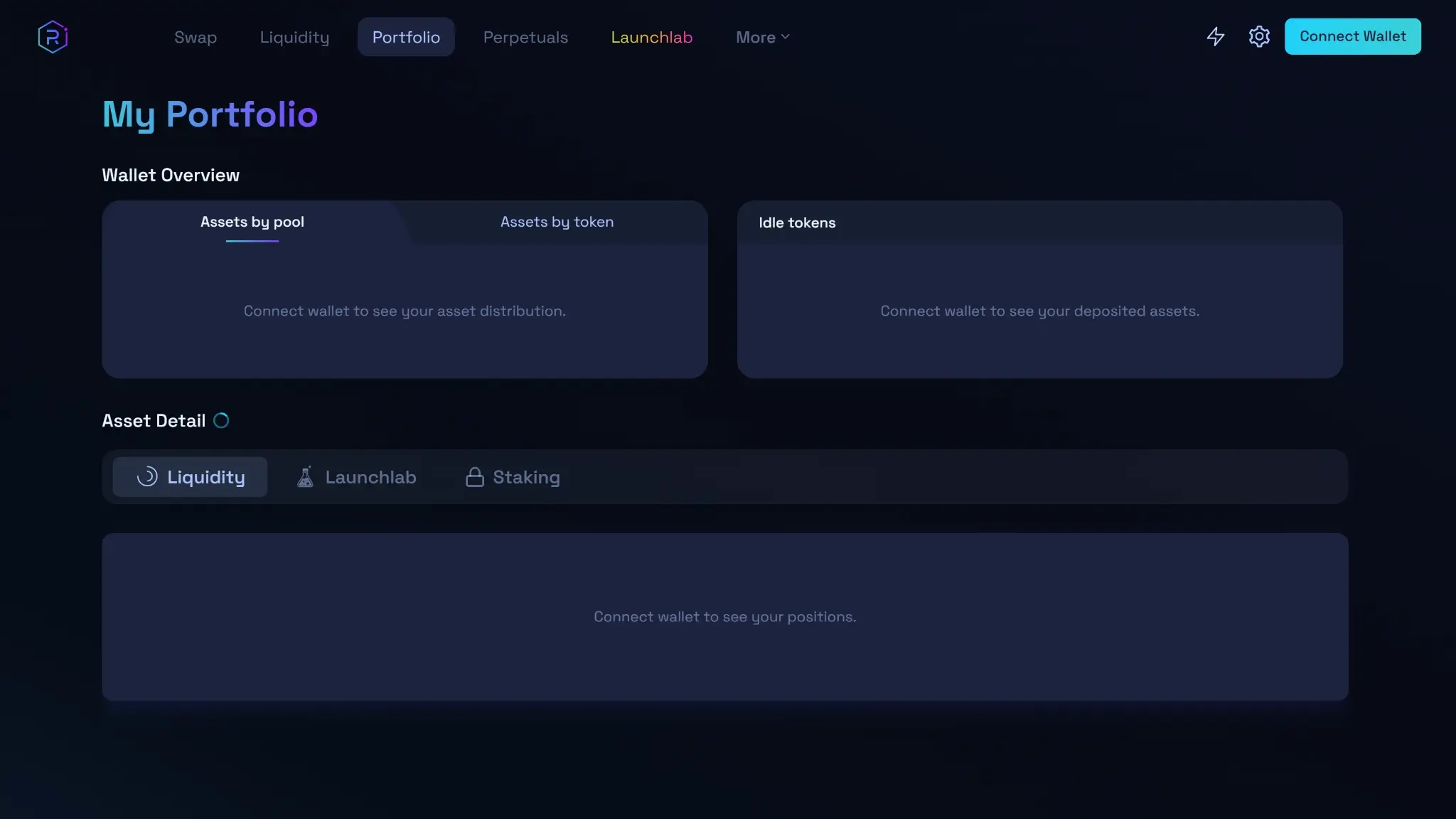
In the product walkthrough screenshots captured for this review, Raydium did surface an in-app “System Maintenance” widget inside the perps and portfolio interfaces. The notice used UTC timing and listed a scheduled maintenance window, which is better than having no in-product warning at all. The limitation is that there is no public archive or standalone status URL that lets users review older operational incidents in one place.
| Month Year | Event | Impact | Resolution |
|---|---|---|---|
| Apr. 2026 | Scheduled system maintenance notice shown in-app | Perps and related account features were flagged as temporarily unavailable during a stated UTC maintenance window | Maintenance window and timing were shown in the interface itself. No public archive found in reviewed sources |
Customer Support
Support is community-led and self-serve rather than built around a standard exchange help desk. The official docs point users to the Help Center, GitBook AI assistant, Discord, and Telegram. The trust-and-safety pages also say Discord and Telegram are available for 24/7 support. The reviewed official sources point users toward docs, Discord, and Telegram rather than a phone line, formal support email, or complaint desk.
That support model is enough for basic product questions, failed transactions, or token and pool confusion. It is less helpful when the problem sits outside Raydium itself, such as a wallet issue or a MoonPay review, because the recovery path moves across multiple providers.
The docs do not spell out language coverage or formal response-time service levels. What Raydium does provide well is self-serve coverage: the Help Center, onboarding guides, trust-and-safety pages, API docs, product FAQs, and official social links are all easy to find from the docs hub. The support flow also lacks a formal complaint or ombudsman-style escalation path for unresolved disputes.
For support, use only the official routes linked from Raydium’s docs and trust pages. In practice, that means starting from raydium.io or docs.raydium.io, then using the official Discord or Telegram links surfaced there rather than links shared in comments, DMs, or third-party app stores.
Features That Matter on Uniswap
Raydium is built around Solana trading, liquidity, and launch activity rather than a broad exchange-app model. It also skips the retail add-ons that some centralized platforms package alongside trading, such as crypto card options. The features that matter most are perps, RAY staking and liquidity rewards, self-custody wallet access, public developer tooling, and LaunchLab’s token-launch system.
Derivatives and Leverage Controls
Raydium Perps is a live perpetual futures product rather than a simple leveraged swap tool. Users can go long or short without owning the underlying asset, and current docs say leverage can reach up to 100× depending on the market. The product uses cross-margin only and one-way mode, so you cannot run separate isolated positions or hold both a long and a short in the same market from one account.
Collateral is broader than just USDC, but the accounting is still conservative. Raydium says users can deposit USDC, native SOL, and USDT as collateral, while profit and loss is calculated and settled in USDC. This setup fits active traders who already keep Solana-native assets on-chain, though it is still less flexible than a full derivatives venue with isolated margin, hedge mode, and a deeper liquidation-settings menu.
Availability is the main gate. Perps are not available in the U.S. and are limited to users outside Raydium’s prohibited-jurisdiction list. KYC is not presented like a standard CEX derivatives onboarding flow. First-time users create a perps account with a wallet signature, then fund collateral. Raydium highlights several core risk controls. These include funding payments, market-dependent leverage caps, and cross-margin liquidation mechanics. The docs also make clear that losses can exceed the margin attached to one position because collateral is shared across the account.
Staking and Rewards
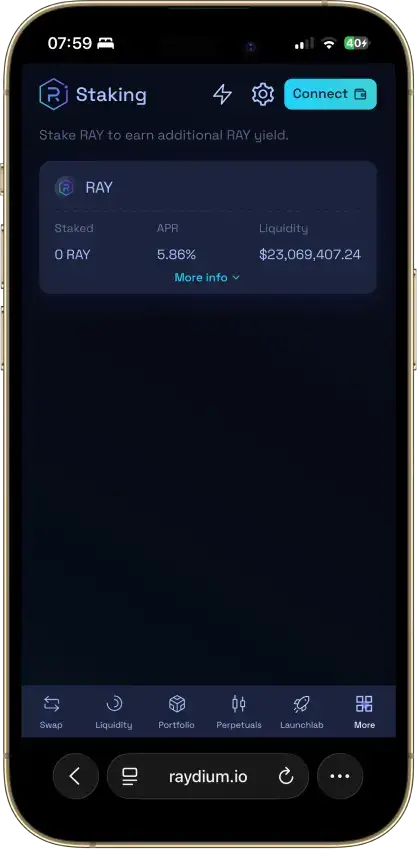
Raydium’s staking and rewards story is narrow but still important. The clearest native staking product is RAY staking, where users stake RAY to earn additional RAY rewards. The current docs show a simple stake and unstake flow from either the Staking tab or the Portfolio page.
The broader yield stack matters more than pure token staking. Raydium’s docs frame liquidity provision as a core earn product, with LPs earning swap fees and, in eligible pools, extra farm emissions. The liquidity FAQ says users can withdraw liquidity at any time. For constant-product pools, LP tokens staked in a farm need to be unstaked first. For CLMM positions, users withdraw directly from the position instead.
These rewards are easier to use well if you already understand pool mechanics, APR variability, and impermanent-loss trade-offs. It is less suitable for passive users looking for fixed-term earn products, guaranteed yields, or a simple centralized “Earn” tab with broad asset coverage.
Wallet and Self-Custody Options
Raydium is a self-custody product first. It is a connect-your-own-wallet product rather than a proprietary custodial wallet account, and it does not hold a user’s spot balance in the way a centralized exchange does. Instead, users connect an external wallet and approve actions from there.
The key and recovery model therefore depends on the wallet you choose, not on Raydium itself. Raydium’s current onboarding materials point users toward wallets such as Phantom, Solflare, Backpack, and Jupiter. Its wallet-connect prompts also show options like Ledger support through wallet integrations. That setup gives users direct dApp connectivity and control over signing, but it also pushes more operational risk onto the user.
For spot activity, the fee model is mostly network-driven. You need Solana (SOL) in-wallet to pay Solana transaction fees, and current docs repeatedly warn users to keep some SOL available to avoid failed transactions. This wallet-first structure will feel most natural to experienced self-custody users who want direct control and composability. It is much less comfortable for beginners who prefer password recovery, centralized account support, or simplified asset management.
API and Programmatic Trading
Raydium’s developer tooling is one of its more credible differentiators. The current docs publish Raydium API v3 for spot, pool, token, farm, and routing data, plus a separate Perps API v1 for perpetual market data. Both have public Swagger documentation, and Raydium also exposes Devnet endpoints for testing.
The limitation is that these are primarily protocol and market-data interfaces rather than a full authenticated trading stack. Raydium’s docs describe the public APIs as read-only and recommend the SDK with gRPC examples for users who need more real-time monitoring, such as tracking new pool creation. There is no FIX support, no granular authenticated permission scopes, and no classic institutional API key-management layer.
These APIs are most useful for teams tracking pool creation, routing data, farm stats, and perp market data. They fit builders, dashboards, bots, and ecosystem integrators better than institutions that need a full execution stack. It is less complete for institutions that want mature execution APIs, account permissions, IP allowlists, or enterprise operational controls similar to a centralized exchange prime desk.
Other Notable Features
LaunchLab is one of the clearest reasons Raydium stays central to early Solana token activity. It is not a side add-on. It is part of the platform’s core market structure. LaunchLab lets users launch tokens through a bonding-curve model, then migrate that liquidity into a Raydium AMM pool once the raise target is hit. The current docs also say launches can happen in a fast JustSendit mode or through a more customizable standard flow.
Raydium still matters because a lot of Solana liquidity is organized through its pool stack. Between CLMM, CPMM, legacy AMM v4, permissionless farms, and Burn & Earn, the platform is not just a place to trade tokens. It is one of the places where Solana tokens get launched, routed, and warehoused for liquidity. That is why the product feels closer to market infrastructure than to a beginner-friendly exchange app.
Final Verdict
Raydium is strongest when your trading starts on Solana and stays there. You can move from a LaunchLab migration to a swap, LP position, RAY stake, or perp trade without leaving the same interface. That is a more specific advantage than a generic low-fee DEX pitch. The trade-offs come from the same structure. Raydium is a weak fit for U.S. users, cautious beginners, and anyone who wants curated listings, fiat-first access, or exchange-style disclosure around reserves, insurance, and support. If you are comfortable with wallet signing, permissionless pools, and Solana-native market structure, the platform makes more sense.
Overall Score
6.8PROS
- Broad Solana product stack with swaps, perps, liquidity pools, LaunchLab, and yield tools.
- Swap fees start at 0.01%, and perps charge 0 bps maker with tiered 2–4.5 bps taker fees.
- Self-custody design means users keep control of wallet assets instead of pre-funding a custodial exchange account.
- Raydium publishes a long audit trail across Kudelski, OtterSec, MadShield, Halborn, and Sec3.
- Public APIs, SDK resources, and Devnet endpoints are available for builders and advanced users
CONS
- U.S. residents are excluded by the official disclaimer and perps documentation.
- Permissionless listings increase scam-token and contract-address risk.
- No published exchange-wide proof-of-reserves or liabilities attestation.
- Operating entity and jurisdiction disclosures are thinner than at major centralized exchanges.

Disclaimer: CryptoSlate may receive a commission when you click links on our site and make a purchase or complete an action with a third party. This does not influence our editorial independence, reviews, or ratings, and we always aim to provide accurate, transparent information to our readers.

FAQ
Is Raydium safe?
Raydium publishes more protocol-security evidence than many smaller DeFi apps, but it is not a low-risk exchange in the traditional sense. Raydium has been hacked before through the Dec. 2022 exploit, and the current materials do not say that crypto losses are insured. The project does publish multiple audits, a live bug bounty, and multisig controls.
What are Raydium fees?
Raydium does not use one flat spot fee schedule like a centralized exchange. Swap fees depend on the pool and currently range from 0.01% to 4%, plus Solana network fees. There is also no single Raydium spread figure because execution costs change by route and liquidity. Perps are clearer, with 0 bps maker fees and 2.0–4.5 bps taker fees by 30-day volume.
Does Raydium require KYC?
Raydium’s wallet-only spot flow does not currently use a standard KYC gate. You connect a compatible wallet and trade on-chain. KYC becomes more relevant when you use MoonPay for fiat rails, because MoonPay can request personal details, ID, liveness checks, proof of address, or source-of-wealth documents depending on the transaction and limit requested.
Which coins does Raydium support?
Raydium offers broad access to Solana-native and long-tail tokens rather than a curated exchange coin list. Recent market data tracks about 2,771 coins and 5,819 pairs. USDC and USDT are the most important stablecoins in the ecosystem, but the permissionless catalog also includes many thin or higher-risk assets that need extra contract verification.
How long do withdrawals take on Raydium?
The answer depends on which Raydium flow you mean. For wallet-native spot use, there is no custodial withdrawal queue, so transfers depend mostly on network confirmation and can settle in seconds on Solana. MoonPay off-ramp timing varies by payment method and verification. Perps withdrawals are less clearly published and do not come with one simple exchange-style SLA.
Is Raydium available in the U.S.?
No. Raydium’s current disclaimer says the protocol is not available to U.S. residents, and the reviewed docs do not publish a reduced U.S. mode or state-by-state exception list. U.S. users should treat Raydium as unavailable rather than assuming only a few features are blocked.
Does Raydium offer staking or rewards?
Yes, but the rewards model is more DeFi-native than exchange-like. Raydium offers RAY staking, liquidity-provider fees, and farm incentives on eligible pools. It is best suited to users who understand APR variability, pool mechanics, and impermanent-loss trade-offs, rather than users looking for simple fixed-term Earn products.
How can I lower fees on Raydium?
The most reliable ways to lower costs are practical rather than promotional. On perps, use limit orders where possible to access the 0 bps maker rate. On spot, trade deeper pools with tighter slippage settings, stay on Solana where possible, and avoid expensive convenience rails when a direct wallet funding route will do the same job more cheaply.