The crypto market has been evolving rapidly, with Bitcoin ETFs emerging as a focal point of interest among institutional investors. The launch of the ProShares Bitcoin Strategy ETF (BITO) marked a significant milestone in this journey. As the first U.S. Bitcoin futures ETF, BITO represents a pivotal development in the integration of crypto into mainstream financial markets. This report delves into the nuances of Bitcoin ETFs, with a specific emphasis on BITO, exploring its implications for the broader crypto market and potential investors.
BITO’s debut was a testament to the growing investor appetite for cryptocurrency-based products and a reflection of the changing regulatory landscape surrounding digital assets. By offering exposure to Bitcoin through futures contracts, BITO provides a regulated avenue for investors to gain exposure to Bitcoin’s price movements without the complexities of direct cryptocurrency ownership. This approach has opened new doors for both retail and institutional investors, allowing them to participate in the Bitcoin market through a familiar investment vehicle.
In the past several months, there has been a growing anticipation for the approval of a spot Bitcoin ETF in the United States. A spot ETF, differing from BITO’s futures-based approach, would offer direct exposure to Bitcoin’s actual spot market prices. The potential approval of such an ETF is expected to have a profound impact on the market, possibly enhancing liquidity, providing more direct price exposure, and potentially attracting a new wave of investors.
In this report, CryptoSlate will dive deep into the performance of BITO to understand if it could serve as an indicator for the future performance of a spot Bitcoin ETF. By examining BITO’s market reception, price movements, and overall impact on the cryptocurrency landscape, we seek to provide insights into how a spot Bitcoin ETF might fare in similar market conditions. The report will not only shed light on BITO’s significance but also project the implications of a spot Bitcoin ETF in the evolving narrative of crypto investments.
Overview of the ProShares Bitcoin Strategy ETF (BITO)
Launched on Oct. 18, 2021, BITO is distinguished as the world’s first and largest Bitcoin-linked ETF in the U.S. Its primary aim is to generate returns corresponding to the performance of Bitcoin. However, it is important to note that BITO invests in Bitcoin futures rather than directly in Bitcoin itself. This means that while the ETF seeks to track Bitcoin’s returns, there is no guarantee of an exact match.
BITO’s operation through Bitcoin futures offers investors a unique blend of liquidity and transparency typical of an ETF without necessitating a crypto exchange account or wallet. This approach makes it more accessible to a broader range of investors accustomed to traditional investment platforms.
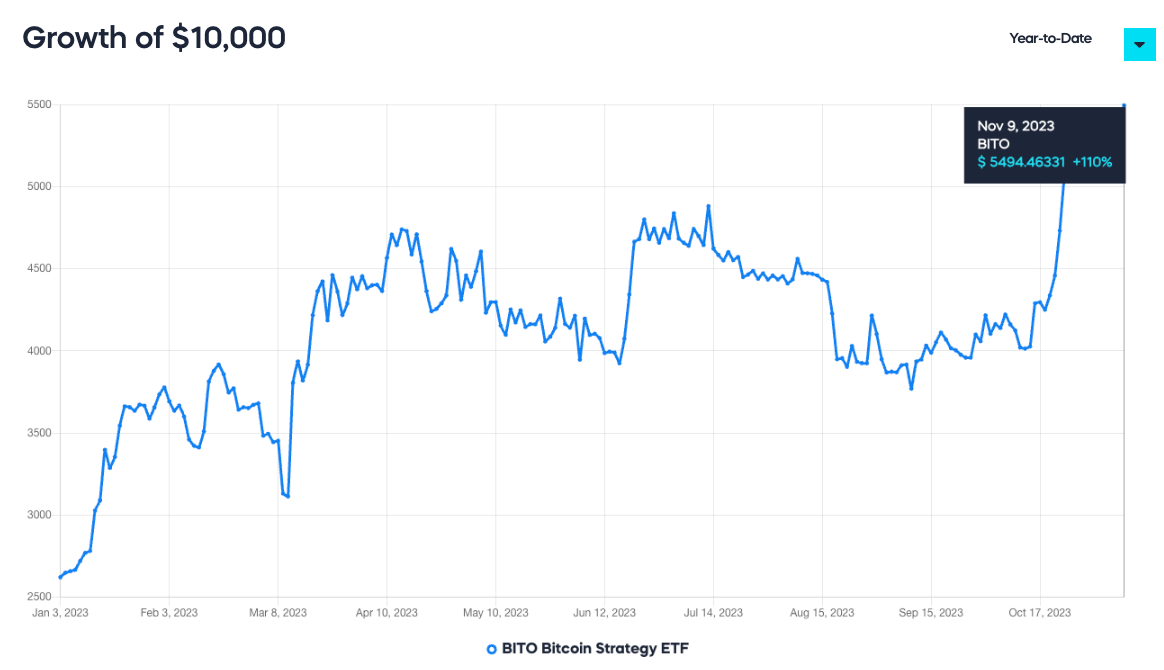
As of Nov. 9, 2023, the market price of BITO has seen a 33% return in one month, 23% in three months, and a 110% year-to-date return.
Graph showing the return on BITO in 2023 (Source: BITO)
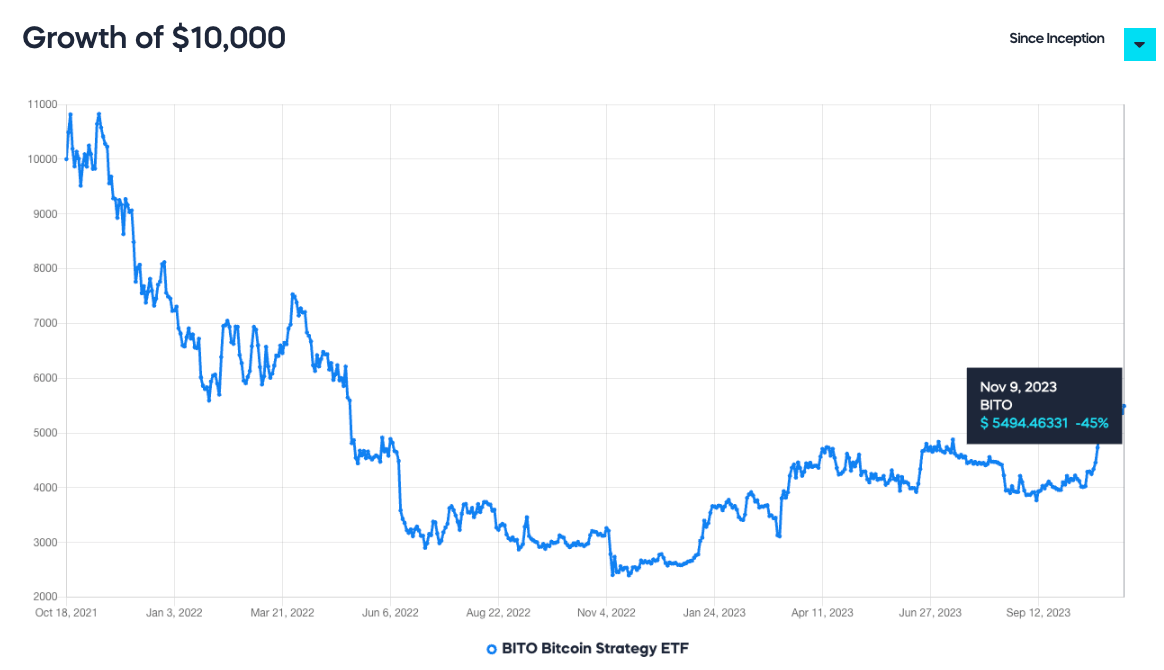
However, despite these impressive short-term gains, it has experienced a decline of -27.49% since its inception.
Graph showing the return on BITO since the ETF’s inception in October 2021 (Source: BITO)
Similarly, the Net Asset Value (NAV) of BITO shows a 28.10% return over one month, 17.25% over three months, and 99.29% year-to-date, with a comparable inception-to-date decline of 27.48%.
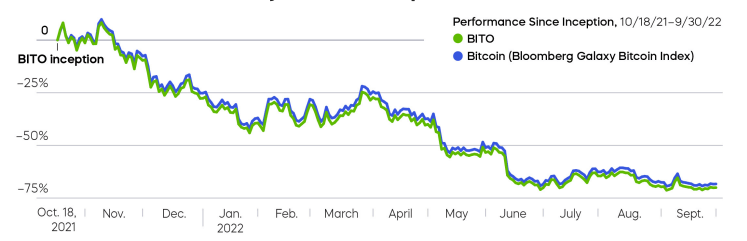
For the year ended May 31, 2023, BITO had a total return of -15.27%, compared to the -14.55% total return of the Bloomberg Galaxy Bitcoin Index, which had a volatility of 60.34%. The fund’s performance is closely tied to the return of spot Bitcoin, the reference asset for the Bitcoin futures it holds. Other factors influencing BITO’s performance include the management costs of holding and replacing futures contracts as they approach maturity, fund fees, expenses, transaction costs, and the impact of interest earned on cash investments.
Graph comparing BITO to the performance of Bloomberg’s Bitcoin Galaxy Index from October 2021 to November 2023 (Source: BITO)
How does BITO stand against traditional ETFs and other crypto investment vehicles
The ProShares Bitcoin Strategy ETF (BITO) has shown incredible performance this year, especially compared to traditional ETFs and other crypto investment vehicles like Grayscale Bitcoin Trust (GBTC).
As of November 2023, BITO has demonstrated significant growth, with a year-to-date daily total return of 110.85% and a one-year daily total return of 127.66%. This performance highlights the high volatility and potential for substantial gains characteristic of crypto-related investments, which are generally higher than traditional ETFs that track more stable assets.
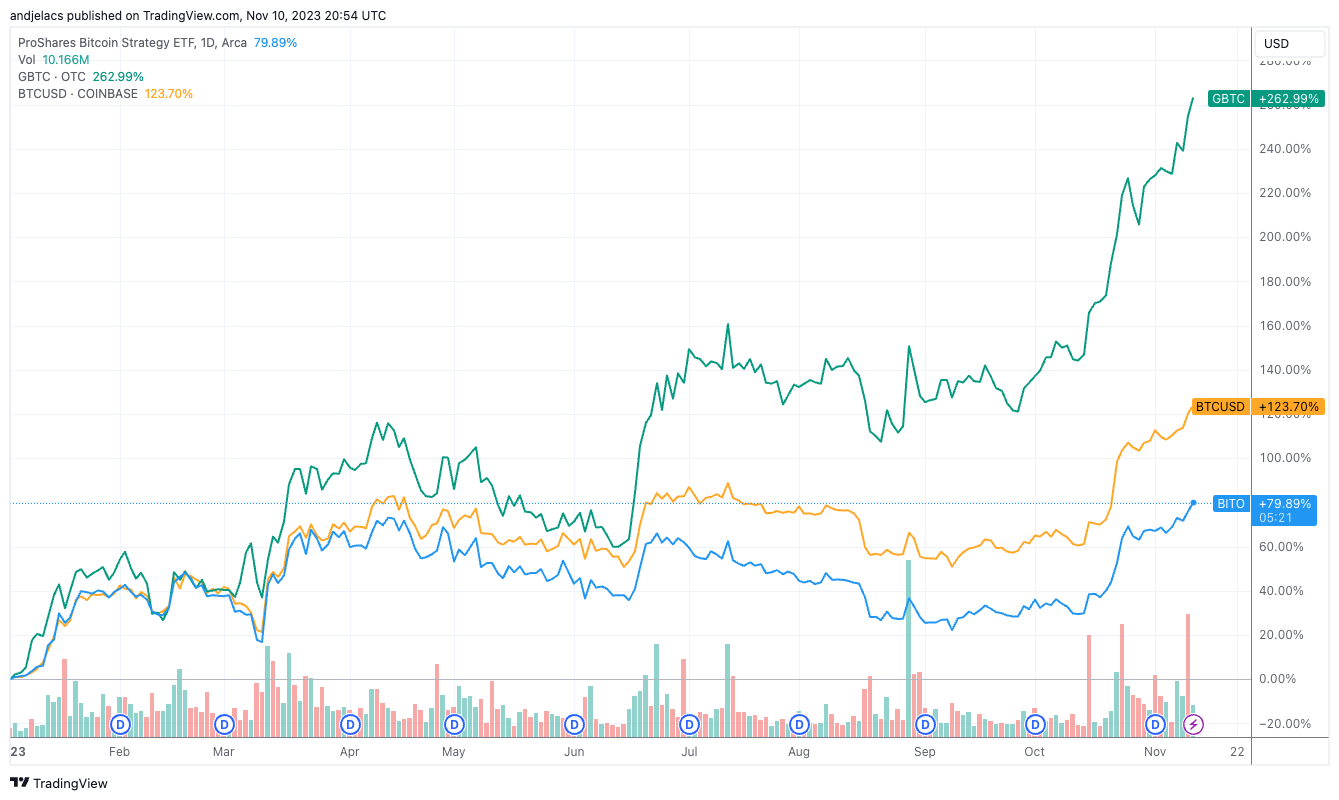
Comparatively, Grayscale Bitcoin Trust (GBTC) has seen an equally impressive surge, with its shares increasing by 263% in 2023, reaching $29.75. This substantial growth outpaces some of the best-performing traditional stocks. It indicates the high investor interest and optimism in crypto investment vehicles, particularly those like GBTC that offer direct exposure to Bitcoin.
Graph showing the percent return on Bitcoin (BTC), GBTC, and BITO in 2023 (Source: TradingView)
BITO’s performance fares well even when compared with direct investment in Bitcoin. As of Nov. 9, 2023, the price of Bitcoin stands at $36,768.42, marking a 133.6% increase from the previous year.
While BITO’s performance has been impressive, it’s eclipsed by the gains seen in GBTC and direct Bitcoin investments, which have shown even greater growth in 2023. These differences underscore the varied risk and return profiles across these investment types, with BITO offering a middle ground between traditional ETF stability and the high volatility of direct cryptocurrency investments.
A potential spot Bitcoin ETF: Prospects and comparisons
The launch of a potential spot Bitcoin ETF in the U.S. presents a stark contrast to existing futures-based ETFs like BITO. Understanding the differences between these two types of ETFs and speculating on the performance of a spot Bitcoin ETF requires a multi-faceted approach, considering regulatory aspects, market liquidity, and investor behavior.
Futures-based ETFs like BITO invest in futures contracts rather than directly in Bitcoin. This means they track the future price expectations of Bitcoin, not its current market price. The performance of BITO is influenced by factors like the cost of rolling futures contracts and the futures market’s contango or backwardation. In contrast, a spot Bitcoin ETF would invest directly in Bitcoin, reflecting its real-time price and offering more direct exposure to its actual market movements. This could result in a performance that more closely mirrors the immediate supply and demand dynamics of Bitcoin.
The regulatory landscape for these ETFs is also a crucial factor. Futures-based ETFs have been more readily approved by regulators, most likely due to the maturity and regulation of futures markets. However, a spot Bitcoin ETF faces more significant regulatory hurdles, primarily due to concerns over market manipulation and the lack of oversight in spot crypto markets on centralized exchanges. Approval of a spot Bitcoin ETF would indicate a significant shift in regulatory attitudes towards digital assets in general and legitimize BTC over other cryptocurrencies.
In terms of market liquidity, a spot Bitcoin ETF could significantly enhance liquidity for Bitcoin. By providing an accessible avenue for traditional investors to enter the crypto market, it could increase capital inflow into Bitcoin, leading to greater price stability and reduced volatility.
Investor behavior towards a spot Bitcoin ETF could differ from that towards futures-based ETFs. Given the direct exposure to Bitcoin’s price, a spot ETF could attract investors seeking a more straightforward and transparent way to invest in Bitcoin, including a broader demographic, like those currently hesitant to engage with crypto exchanges or futures contracts.
Finally, the performance of a spot Bitcoin ETF would likely be more volatile than traditional ETFs but could offer higher potential returns, mirroring the high-risk, high-reward profile many associate with Bitcoin. This could appeal to investors looking for exposure to BTC’s potential upside while staying within the regulated framework of traditional securities.
Investor sentiment and outlook
Surveys and expert opinions have shown a growing interest in Bitcoin ETFs, with investors increasingly looking for regulated and accessible ways to gain exposure to cryptocurrencies.
Many institutional investors seem keen on investing in a Bitcoin ETF, citing the ease of access and regulatory oversight as key advantages. This sentiment is echoed by retail investors who are attracted to the potential of Bitcoin as an investment asset but are wary of the complexities and risks associated with direct cryptocurrency investments. Approving a futures-based ETF like BITO has already garnered considerable interest, suggesting that a spot Bitcoin ETF could witness even higher demand, given its direct exposure to Bitcoin prices.
Experts in the financial sector are generally optimistic about the potential market trends that a spot Bitcoin ETF approval could trigger. They forecast that the approval could lead to a significant capital inflow into the Bitcoin market, potentially increasing its liquidity and market capitalization. This could also lead to a broader acceptance and integration of Bitcoin into traditional investment portfolios.
However, there are concerns about increased volatility and speculative trading, which could be amplified by the entry of more investors into the market. Some experts caution that while a spot Bitcoin ETF could bring more stability through regulated investment channels, it could also expose the market to rapid capital movements based on broader economic trends and sentiment shifts.
Nonetheless, the general outlook is that approving a spot Bitcoin ETF would be a significant milestone in integrating cryptocurrencies into the mainstream financial market. It is expected to attract a diverse range of investors, from those seeking diversified portfolios to those specifically interested in digital assets. The market is likely to respond with increased activity, but this will also come with heightened scrutiny and the need for robust risk management strategies.
Conclusion
BITO’s journey highlights investor interest in accessible, regulated ways to gain exposure to Bitcoin’s price movements without the intricacies of direct cryptocurrency handling. The success and challenges faced by BITO are instrumental in shaping the expectations and regulatory considerations for future Bitcoin ETFs, especially a potential spot Bitcoin ETF.
Looking ahead, the implications for Bitcoin ETFs are profound. A spot Bitcoin ETF, if approved, could revolutionize the cryptocurrency investment landscape, offering more direct exposure to Bitcoin’s market price. It could attract a broader investor base, enhance market liquidity, and possibly usher in a new era of cryptocurrency integration into mainstream finance. However, this advancement is contingent on navigating the complex regulatory environment and addressing concerns around market stability and investor protection.
In conclusion, the analysis of BITO sheds light on the current state of Bitcoin ETFs and sets the stage for what could be a pivotal shift in the cryptocurrency market with the advent of a spot Bitcoin ETF. This development would represent a significant milestone in the maturation of cryptocurrencies as a recognized asset class within the global financial system.