

Overview
Introduction
Bitcoin is a digital currency that lets people transfer value online without a bank, using a public network with a fixed supply.
Bitcoin launched in 2009 and has become the best-known crypto asset in the world. The protocol sets a hard cap of 21 million coins, which is a core part of its scarcity story. Current spot context is available through and live Bitcoin market data.

Key Takeaways
- What it is. Bitcoin is a peer-to-peer monetary network where anyone can hold and send value with software instead of a central payment operator.
- Why it matters. Bitcoin combines scarce digital supply with global transferability, giving users an alternative settlement system outside traditional banking rails.
- Main risk or limitation. Bitcoin remains highly volatile and user mistakes in self-custody can be permanent, so new users need risk controls before treating it as long-term savings.
How Bitcoin Works
Bitcoin runs on a public blockchain that records transfers in ordered blocks. Thousands of nodes around the world keep copies of the ledger and validate the same rules. No central company controls who can send transactions or who can run a node. Consensus comes from open software and economic incentives, not from a single administrator.
The accounting model is based on unspent transaction outputs, usually called UTXOs. Instead of updating one account balance in place, each transaction consumes older outputs and creates new ones. This design helps nodes verify ownership and prevents double spending without a central database lock. Users who want terminology first can review the UTXO model definition as a companion.
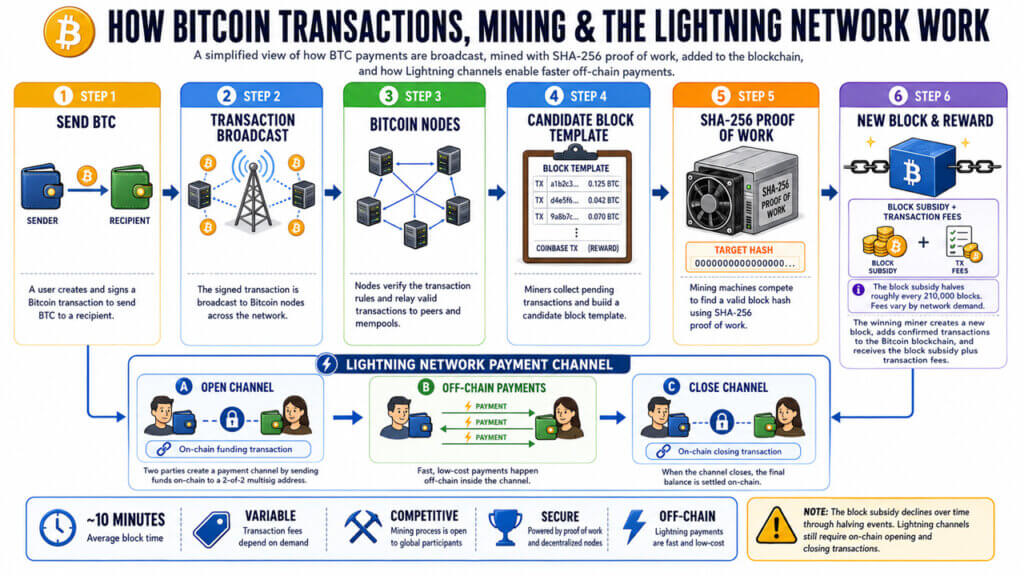
At a high level, transaction flow works like this: a wallet signs a transaction with the sender's key and broadcasts it to the peer network. Nodes check signatures and basic validity rules, then relay valid transactions into mempools. Miners pick transactions from the mempool, build candidate blocks, and compete to add the next block.
That competition uses proof of work. Miners repeatedly hash block header data with SHA-256 until one finds a hash below the current target. The winner broadcasts the block. Other nodes verify it and extend their local chain. This costly race is what makes rewriting recent history expensive for attackers.
Bitcoin blocks arrive roughly every ten minutes over long periods. After a transaction is included and followed by more blocks, reversing it gets progressively harder because an attacker would need to reproduce and overtake the cumulative work. For everyday users, this is why confirmation depth matters when sending large amounts.
Bitcoin also has second-layer systems for faster, lower-value payments. The Bitcoin layer-two scaling guide explains how the Lightning Network can settle many payments off-chain and then net-settle on Bitcoin. That does not replace the base chain. It extends usability while relying on Bitcoin for final settlement and dispute resolution.
Who Created Bitcoin?
Bitcoin was introduced by Satoshi Nakamoto, a pseudonym that still has not been tied to a confirmed real-world identity. Satoshi published the Bitcoin whitepaper on October 31, 2008, then released early software that bootstrapped the network in January 2009. The first block, often called the genesis block, marked the start of a new monetary experiment.
The project came out of a longer cypherpunk tradition that explored digital cash and privacy-preserving systems. Earlier ideas such as b-money and Hashcash shaped the design space that Bitcoin eventually combined into a working system. Bitcoin's key breakthrough was aligning those ideas into an incentive model that could survive on the open internet.
Early contributors tested and improved the software in public mailing lists and forums. Hal Finney, one of the first well-known developers to run the code, received the first recorded peer-to-peer Bitcoin transfer from Satoshi. Over time, more maintainers joined and the codebase became a broader open-source project.
Satoshi stepped back from public communication around 2010 to 2011 and handed repository control to other developers. Bitcoin continued without a founder in the room, which is part of why many users treat it as a protocol rather than a company product. For background on the identity mystery, see the Satoshi Nakamoto profile.
What Gives Bitcoin Its Value?
Bitcoin is not backed by government guarantees, commodity redemption, or issuer cash flows. Its value comes from market demand for a scarce and transferable digital asset whose supply rules are visible in code. The protocol cap of 21 million BTC is a constant that anyone can independently verify by running a node.
Scarcity alone is not enough. Bitcoin also has network effects. By 2026, BTC has active spot markets on major global exchanges and regulated ETP rails in the US, which gives it deeper liquidity channels than most smaller tokens. For users, that usually means tighter execution and broader custody support when entering or exiting positions.
The settlement properties matter too. Bitcoin can be transferred globally without needing approval from a card network or bank clearing window. Final settlement still takes time, but users can move value across borders and jurisdictions with one common protocol. For those new to blockchain vocabulary, this distributed ledger primer explains why shared state can exist without one operator.
Gold is the usual comparator because both assets are scarce and not directly tied to one government's monetary policy. Portability and divisibility favor BTC, while gold keeps advantages in physical tangibility and millennia of social history. Fiat currency enters the discussion for a different reason: central banks manage supply and policy to meet macroeconomic goals. Those systems solve different problems, so direct comparison has limits.
Bitcoin in 2026: ETFs, Institutional Adoption, and Market Growth
Bitcoin's market structure changed when the US Securities and Exchange Commission approved spot bitcoin ETP listings on January 10, 2024, as documented in the SEC spot ETP statement. That decision opened regulated exchange-traded access for a much broader investor base.
Flows followed quickly, but the exact numbers move with BTC price and fund flows. BlackRock's iShares Bitcoin Trust ETF reported about $61.16 billion in net assets as of April 29, 2026. IBIT also carried a 0.25% sponsor fee and traded on Nasdaq, which makes it one of the clearest examples of Bitcoin exposure moving into normal brokerage infrastructure.
Corporate treasury ownership also became part of the Bitcoin story. Strategy, formerly MicroStrategy, reported 818,334 BTC on its Bitcoin purchases page in late April 2026. That concentration does not make Strategy “Bitcoin itself,” but it does make corporate balance-sheet demand a major market narrative.
The practical takeaway is straightforward. Bitcoin is no longer only a self-custody asset used through wallets and exchanges. In 2026, users can access BTC through spot markets, custody platforms, corporate treasury proxies, and regulated exchange-traded products. Each route has a different custody model, tax path, fee layer, and failure point.
Price narrative also shifted after Bitcoin first traded above $100,000 in December 2024, a milestone visible in long-range Bitcoin market charts. Milestones do not remove volatility, but they do affect market psychology, media coverage, and policy attention.
Regulatory context outside the US also evolved. In the EU, MiCA sets separate regimes for token issuers and crypto-asset service providers, but Bitcoin has no identifiable issuer. ESMA's MiCA Q&A states that crypto-assets without an identifiable issuer do not fall within Title II white-paper requirements, while service providers that offer Bitcoin trading, custody, or transfer services can still fall under MiCA's service-provider rules. That means European Bitcoin access is increasingly shaped by regulated venues and custody services rather than issuer-style obligations on Bitcoin itself.
El Salvador's policy stance also became more nuanced. The IMF noted in February 2025 that legal reforms made private-sector Bitcoin acceptance voluntary as part of the country's program commitments, according to the IMF Executive Board announcement. Bitcoin can coexist with formal regulation, but legal treatment still differs by jurisdiction and can change with macro constraints.
Users focused on product selection can review bitcoin ETF options and compare structure, fees, and custody model before choosing exposure.
Bitcoin ETF vs Buying Bitcoin vs Self-Custody: What Is the Difference?
The main decision is not only whether to buy Bitcoin. It is how to hold the exposure. The right route depends on whether the user wants price exposure, easy selling, on-chain control, or long-term custody.
The five most common routes each carry different trade-offs:
| Route | What the User Actually Gets |
|---|---|
| Spot Bitcoin ETF | Brokerage-traded shares tied to BTC price. Good for simple portfolio exposure, but not for on-chain transfers. |
| Exchange balance | Convenient buying, selling, and fiat withdrawal. The user depends on the exchange for custody and account access. |
| Hot wallet | Direct BTC control through a phone or desktop wallet. Better for small working balances, but exposed to device and phishing risk. |
| Hardware wallet | Stronger long-term self-custody. The user must protect the seed phrase, test recovery, and avoid fake wallet prompts. |
| Multisig setup | Multiple keys are required to move funds. Useful for larger balances, shared control, or inheritance planning, but harder to manage. |
For a small first purchase, an exchange or ETF may be simpler than rushing into cold storage. For meaningful long-term BTC, self-custody becomes more important because the user controls the keys instead of relying on a platform. The main mistake is treating these routes as interchangeable.
The 21-Million Cap and Halving Schedule
Bitcoin's supply cap is fixed at 21 million coins. New coins enter circulation through block rewards paid to miners, and that reward is cut in half every 210,000 blocks. This event is called halving, and it is one of Bitcoin's most important monetary rules.
The subsidy started at 50 BTC per block and has declined in four steps:
- 25 BTC per block in 2012
- 12.5 BTC per block in 2016
- 6.25 BTC per block in 2020
- 3.125 BTC per block after the April 2024 halving
Each step slows new issuance while preserving the same consensus rules for everyone running the network.
This schedule defines issuance, not price. Market demand still determines what each BTC is worth. That distinction matters because many casual explanations mix protocol mechanics with trading narratives.
Halving also changes miner economics over time. As the subsidy declines, transaction fees are expected to play a larger role in long-run security spending.
The next halving is expected around 2028 based on block production pace. Much later, when the subsidy reaches effectively zero, miners will rely entirely on fees. That future state is often discussed as a stress test for Bitcoin's fee market depth and settlement demand.
Is Bitcoin Anonymous or Traceable?
Bitcoin is not fully anonymous. Every transaction is recorded on a public blockchain that anyone can inspect.
The table below shows common misconceptions alongside what is actually true:
| Claim | Reality |
|---|---|
| Bitcoin is anonymous | Bitcoin is pseudonymous. Wallet addresses are visible, even if names are not. |
| No one can track Bitcoin | Transactions can be traced, especially when linked to exchange accounts. |
| Using a wallet hides identity | Wallets do not hide activity. Identity can still be connected through exchanges or behavior patterns. |
| Privacy tools make Bitcoin untraceable | Some tools improve privacy, but they add complexity and are not perfect. |
If Bitcoin is bought through a regulated exchange, identity verification can link a real person to wallet activity. Over time, transaction patterns can also reveal behavior even without direct identity data.
For users who care about privacy, the key point is not whether Bitcoin is anonymous. The real question is how much information is exposed at each step, including buying, sending, and storing BTC.
Bitcoin Risks and Limitations
Bitcoin has real strengths, but the trade-offs are real too. Price volatility is the risk most new users feel first. Multi-month drawdowns can be severe, and leverage can turn normal market swings into forced liquidations.
Custody is the second major risk. If you hold your own keys, you control your funds without counterparty dependence. You also own the operational burden. Lost seed phrases, compromised devices, or phishing attacks can lead to irreversible loss. A private key security primer should come before moving meaningful value.
Counterparty risk still exists when users leave funds on exchanges or lending platforms. Platform failures in past cycles showed that account balances can become inaccessible when governance and risk controls fail. Self-custody reduces one class of risk and introduces another, so the right setup depends on user skill, threat model, and amount at stake.
Regulatory risk is ongoing. Rules are clearer in some regions than others, and policy can shift after elections, court decisions, or macro stress. MiCA improved cross-border clarity in the EU, but global treatment remains fragmented. Users who move across jurisdictions need to track local tax and reporting obligations.
Energy use remains a structural criticism of Bitcoin's proof-of-work architecture. The Cambridge Bitcoin Electricity Consumption Index provides methodology-based estimates that many analysts use as a baseline. Debate continues over energy mix, curtailment, and grid impact, but high power use is a permanent part of Bitcoin's security design.
Transaction irreversibility is another limitation. Once confirmed, transfers cannot be undone by customer support. That property is a feature for censorship resistance and a risk for user error. New users often underestimate this until they send a test transaction to the wrong address.
Can You Stake Bitcoin and Earn Interest on BTC?
Bitcoin does not have native staking in the same way Ethereum, Solana, or Cardano do. Bitcoin uses proof of work, so regular BTC holders do not validate blocks by locking coins and earning protocol staking rewards.
Some platforms use the phrase “Bitcoin staking” for newer products built around external protocols, time-locked outputs, lending, wrapped BTC, or exchange earn programs. These products can offer yield, but they are not the same as simply holding BTC in a wallet. The table below breaks down what to check before using any of them:
| Yield Route | What to Check First |
|---|---|
| Native Bitcoin staking | Not supported by Bitcoin's base consensus. |
| Exchange earn product | Check custody, eligibility, reward asset, lockup, and withdrawal rules. |
| Babylon-style BTC staking | Check whether rewards are paid in BTC or another token, and whether funds become time-locked. |
| Wrapped BTC in DeFi | Adds bridge, custodian, smart contract, and chain risk. |
| Bitcoin lending | Adds borrower, platform, liquidation, and counterparty risk. |
A more accurate framing: Bitcoin itself does not pay staking rewards, but some third-party or protocol-based products let BTC holders seek yield with extra risk attached.
How to Buy and Store Bitcoin
For most beginners, the process starts with venue selection. Compare supported regions, fees, liquidity, and withdrawal policies, then choose an exchange that fits your jurisdiction and risk tolerance. A practical starting point is to compare crypto exchanges and narrow your options before opening an account.
Once you have chosen a venue, the next step is onboarding and funding. Most regulated exchanges require identity verification, then allow bank transfer, card purchase, or stablecoin deposit. After funding, you can place a market or limit order depending on how much execution control you want.
Storage decisions matter as much as entry price. Keeping BTC on an exchange is convenient but increases platform risk. Moving BTC to a personal wallet lowers counterparty risk and raises user responsibility. New users should review the wallet setup guide before choosing hot versus cold storage.
A simple operating pattern is to separate spending and savings wallets. Keep small working balances in a hot wallet and larger long-term holdings in cold storage. Back up seed phrases offline and test recovery before moving large amounts.
For retirement-focused exposure instead of direct self-custody, evaluate Bitcoin IRA accounts and compare custodial terms, fee structure, and withdrawal constraints against holding BTC directly.
What Happens If You Lose Your Bitcoin Wallet or Seed Phrase?
Bitcoin self-custody removes the bank or exchange from the middle, but it also removes password reset. If a user controls the keys, access depends on the seed phrase, private keys, passphrase, wallet setup, and recovery instructions.
The table below shows the main failure point for each setup:
| Setup | Main Failure Point |
|---|---|
| Exchange account | The account can be frozen, hacked, restricted, or inherited only through the platform's process. |
| Single hardware wallet | One lost or stolen seed phrase can decide everything. |
| Seed plus passphrase | Stronger against theft, but heirs can be locked out if the passphrase is not documented safely. |
| Multisig wallet | Reduces single-key failure, but recovery instructions must be clear and tested. |
| ETF or brokerage product | Easier estate handling, but the user owns fund shares, not spendable on-chain BTC. |
Do not store a seed phrase in email, cloud notes, screenshots, or a will that becomes public during probate. A better setup gives heirs enough information to know Bitcoin exists, where it is held, and who can help, without exposing the private keys too early.
For larger balances, run a recovery test with a small amount before trusting the setup. A backup that nobody can understand under stress is not a backup.
Bitcoin versus Other Cryptocurrencies
Bitcoin and the broader crypto market are related but not identical. Bitcoin's core role is neutral settlement and scarce digital value storage. Many other networks optimize for different goals, such as smart contract execution, tokenized application ecosystems, or high-throughput payments.
Ethereum is the clearest comparison point because it dominates programmable finance and on-chain applications, while Bitcoin prioritizes base-layer conservatism and monetary credibility. Their design goals overlap in some markets, but their base-layer priorities are different.
Bitcoin Cash is a separate network created by a 2017 fork over scaling design choices. It increased block size to pursue lower on-chain transaction fees, while Bitcoin kept a smaller block policy and pushed some scaling to second layers. The naming overlap can confuse beginners, but BTC and BCH are different assets with different security and liquidity profiles.
In many institutional portfolio frameworks, Bitcoin is treated as the core crypto allocation, while smaller tokens are framed as sector or technology exposures. That framing is not universal, but it helps explain why Bitcoin often anchors risk discussions even for investors who hold multiple assets.
Users comparing protocol architectures can continue with the blockchain mechanics and layer-two scaling primers in the related terms section below.
FAQ
Who invented Bitcoin?
Bitcoin was introduced by Satoshi Nakamoto, a pseudonym used by the person or group that published the 2008 whitepaper and launched the network in 2009. The identity remains unconfirmed, and no public claim has passed broad scrutiny. For practical users, the important point is that Bitcoin continued to operate after Satoshi stepped away.
How many bitcoins are there?
Bitcoin has a fixed maximum supply of 21 million coins. New BTC is issued through miner block rewards, and that issuance rate declines on a preset halving schedule. This means supply growth slows over time rather than stopping abruptly. The cap itself is a protocol rule, while market demand determines the price of each coin.
Is Bitcoin legal?
Bitcoin is legal to own or trade in many jurisdictions, but rules vary by country and sometimes by state or province. The key differences usually involve tax treatment, licensing of exchanges, and reporting obligations for users and businesses. Before buying or moving funds across borders, check local guidance from your tax authority and financial regulator.
What is bitcoin halving?
Bitcoin halving is the scheduled event that cuts miner block rewards in half every 210,000 blocks, which is roughly every four years. It is one of Bitcoin’s core monetary controls because it slows new issuance predictably. Halving does not force a price direction, but it changes supply flow and miner revenue dynamics each cycle.
What is a Bitcoin wallet?
A Bitcoin wallet is software or hardware that manages the cryptographic keys used to authorize BTC transactions. It does not store coins the way a bank app stores dollars. Wallets can be custodial, where a provider controls keys, or self-custodial, where you control keys and recovery. That choice defines your convenience and failure risks.
Can Bitcoin be hacked?
The Bitcoin protocol itself has remained operational since launch, and there is no known way to mint arbitrary BTC by breaking its consensus rules. Most real-world losses happen at the edges, including phishing, malware, poor key backups, and exchange breaches. In practice, user security posture and custody setup matter more than protocol-level attack headlines.
Can you buy less than one Bitcoin?
Yes. Bitcoin is divisible, so a user can buy a small fraction instead of one full BTC. The smallest unit is called a satoshi. For small purchases, check the platform spread, trading fee, and withdrawal fee because those costs can matter more than the purchase size.
Do I own actual Bitcoin if I buy a Bitcoin ETF?
You own ETF shares, not spendable BTC in your own wallet. A spot Bitcoin ETF can give price exposure through a brokerage account, but it does not give you private keys, direct withdrawals, or on-chain payment ability.
Can you stake Bitcoin?
Bitcoin does not support native staking because it uses proof of work, not proof of stake. Some platforms use the term Bitcoin staking for Babylon-style products, lending, wrapped BTC, or exchange earn programs. Those products add extra rules and risks, so they should not be treated like simple wallet ownership.
Is Bitcoin private?
Bitcoin is pseudonymous, not fully anonymous. Transactions are recorded on a public blockchain. If BTC is bought through a regulated exchange, identity checks and transaction history can connect a person to wallet activity.
How much does it cost to send Bitcoin?
The Bitcoin network fee changes with demand for block space. A wallet usually estimates the current fee before sending. Exchange withdrawal fees are separate from network fees, so check both before moving BTC.
Is Lightning the same as Bitcoin?
No. Lightning is a second-layer payment system built around Bitcoin. It can make small payments faster and cheaper, but it does not replace Bitcoin’s base chain. Users still need a wallet or service that supports Lightning.
What happens if I lose my seed phrase?
If you self-custody Bitcoin and lose the only valid recovery phrase or private key, there may be no way to recover the BTC. If you use a passphrase, multisig setup, or hardware wallet, your recovery notes must explain the full setup clearly enough to restore access.
Is it too late to buy Bitcoin?
No one can know that from price alone. A better question is whether Bitcoin fits the user’s time horizon, risk tolerance, custody skill, and local tax rules. A small recurring buy can reduce timing pressure, but it does not remove volatility or guarantee profit.