
Overview
Introduction
Solana is a public blockchain that lets people send money, trade assets, run apps, and earn staking rewards without going through a bank or centralized platform. It is built for speed and low fees, and it has become one of the more active networks for DeFi, stablecoin payments, and consumer crypto apps.
If you are new to crypto and trying to understand what Solana actually is and whether it is worth your attention, this guide covers the basics: what the network does, what SOL is used for, how staking works step by step, how Solana compares to Ethereum, and what risks to take seriously before putting money in.

Key Takeaways
- What it is. Solana is a public blockchain built for fast, low-cost apps and digital asset transfers.
- Why it matters. Solana matters because it has become a major venue for DeFi, stablecoin payments, wallets, and consumer crypto apps.
- Main risk or limitation. Solana’s main limitation is that high performance depends on reliable validator software, congestion handling, validator distribution, and secure app design.
What Is Solana Used For Today?
Most people encounter Solana through a wallet. That wallet holds SOL, SPL tokens, stablecoins, or NFTs, and it signs transactions when the user swaps, sends, stakes, or connects to an app. For a developer, the network looks different: it is a programmable environment where apps are deployed as programs and app state lives in accounts.
The reason Solana supports so many small, frequent actions is its fee structure. Fees are low enough that trading a small position, sending a stablecoin payment, or minting an NFT does not cost more in fees than the action is worth. That low-cost design is what makes it practical for DEX trading, liquid staking, memecoins, stablecoin transfers, tokenized assets, and mobile wallets.
Solana's current main uses include:
- Sending SOL and tokens between wallets
- Trading on decentralized exchanges like Jupiter and Raydium
- Minting and transferring NFTs
- Staking SOL to earn rewards
- Running and using DeFi apps for lending, borrowing, and liquidity
- Building payment products and consumer apps
CryptoSlate also tracks the wider Solana token ecosystem, which includes projects built on or associated with the chain. That ecosystem is broader than SOL alone. SOL is the network asset, while the Solana ecosystem includes wallets, exchanges, lending apps, market makers, NFT tools, payment processors, and infrastructure providers.
How To Earn Solana
There is no single path to earning SOL. Some methods pay native SOL rewards directly from the protocol. Others issue liquid staking tokens, and some route through third-party products where the reward mechanics, custody model, and withdrawal timing are outside Solana's protocol entirely.
The table below compares the main methods, how each works, and the primary risks involved.
| Method | How It Works | Native Or Third-Party? | Main Risk |
|---|---|---|---|
| Native SOL staking through validator delegation | Move SOL into a stake account and delegate it to a validator. Rewards are based on inflation, total SOL staked, validator uptime, and validator commission. Source | Native protocol | Validator performance, commission, activation timing, wallet security, and SOL price volatility |
| Liquid staking | Deposit SOL into a stake pool and receive a liquid token such as JitoSOL or mSOL. Stake pools are on-chain programs that issue SPL tokens representing ownership in pooled stake. JitoSOL and mSOL are the most established liquid staking tokens on Solana. Solana, Jito, Marinade | Third-party protocol | Smart-contract risk, pool strategy risk, liquidity risk, slippage, and the token trading away from expected SOL value |
| Exchange staking or Earn products | Centralized platforms may offer SOL staking or Earn products. Coinbase, Kraken, and Binance all support SOL staking or Earn deposits, with eligibility and terms varying by region and product. Coinbase, Kraken, Binance | Third-party custodial | Custody risk, regional limits, platform fees or commissions, withdrawal delays, and rewards that are not guaranteed |
| DeFi lending or liquidity pools | Solana DeFi apps may let users lend SOL-related assets, deposit collateral, or provide liquidity to automated market maker pools. Kamino offers lending and liquidity products, while Orca and Raydium run liquidity pools that can pay trading fees. Kamino, Orca, Raydium | Third-party DeFi | Smart-contract risk, liquidation risk, impermanent loss, variable demand, and pool-specific liquidity risk |
| Developer grants or hackathons | Builders can apply for Solana Foundation grants or compete in Colosseum-run Solana hackathons. These are competitive funding routes for projects, not passive rewards for holding SOL. Solana Foundation, Solana hackathons, Colosseum | Ecosystem funding | Competitive selection, milestone requirements, changing program terms, and funding that may not be paid in SOL |
| Testnet faucets | Devnet and Testnet tokens are for development and are not real mainnet SOL. Faucets do not provide spendable SOL. Faucet, clusters | Native testing infrastructure | Scam faucets, phishing links, and confusing test SOL with mainnet SOL |
One category that does not appear in any table is airdrops. Airdrops are project-specific and unpredictable. If you pursue one, check the claim link against the project's official domain, read the wallet warnings, and confirm the claim rules. Any request for a recovery phrase, private key, or wallet-draining approval is a security threat, not a reward.
If you are new to liquid staking specifically, it is worth understanding how it differs from native staking before committing funds to a pool.
How To Stake Solana
Native Solana staking means delegating SOL to a validator so that validator's votes carry more weight in Solana's proof-of-stake process. Delegation does not hand the validator ownership or custody of your tokens. The SOL stays in a stake account, which is separate from a normal wallet account.
Understanding Stake Accounts
A stake account has two authority roles. The stake authority handles delegation and deactivation actions. The withdraw authority handles withdrawals and authority changes. Each stake account can delegate to only one validator at a time, so if you want to spread stake across multiple validators, you need multiple stake accounts. Most wallets handle this behind the scenes, but it is useful to understand the structure before you start.
Choosing a Validator
Validator choice directly affects your rewards and your contribution to network decentralization. When comparing validators, look at:
- Commission rate (the percentage of rewards the validator keeps)
- Vote performance and uptime history
- Skip rate (how often the validator misses its turn as leader)
- Decentralization contribution (whether the validator is already in the top-heavy portion of stake)
- Reputation and team transparency
A low commission rate is not automatically better. A validator with 0% commission and poor uptime can produce weaker results than one with 5% commission and consistent vote performance.
Activation, Deactivation, and Timing
Stake changes do not happen instantly. Solana runs on an epoch schedule, with each epoch lasting roughly two days. Activation and deactivation complete at epoch boundaries. In normal conditions, your stake activates at the next epoch. If there is unusually large network-wide movement, the 25% per-epoch cap on stake activation and deactivation can push the timing out further.
How Rewards Are Calculated and Paid
Rewards come from Solana's inflationary issuance and validator voting activity. They are computed once per epoch, issued in the first block of the following epoch, and deposited directly into the stake account. From there, they are automatically re-delegated as active stake. Validator commission is deducted at the same time rewards are issued.
What About Slashing?
There is currently no in-protocol slashing on Solana. This is different from some other proof-of-stake networks where misbehaving validators can have stake destroyed. That does not mean staking is risk-free. Validator performance, uptime, wallet security, and app security are all real considerations. Liquid staking adds smart-contract and liquidity risk on top. Exchange staking adds platform custody risk, eligibility restrictions, potential withdrawal delays, and rewards that are not guaranteed.
Step-by-Step Staking Flow
Once you understand the mechanics, the process itself is straightforward. Most wallet-level staking flows follow these seven steps:
- Choose a compatible wallet or staking platform.
- Fund the wallet with SOL.
- Pick a validator or staking product.
- Delegate or subscribe.
- Monitor rewards and validator performance.
- Undelegate or redeem when needed.
- Wait for any required deactivation or withdrawal period.
One practical detail beginners often miss: keep a small amount of SOL unstaked at all times. A wallet with all SOL delegated cannot pay for later transactions until it receives additional SOL. Even a small reserve of 0.05 SOL covers most routine fee needs.
How Solana Works Without Slowing Every App Down
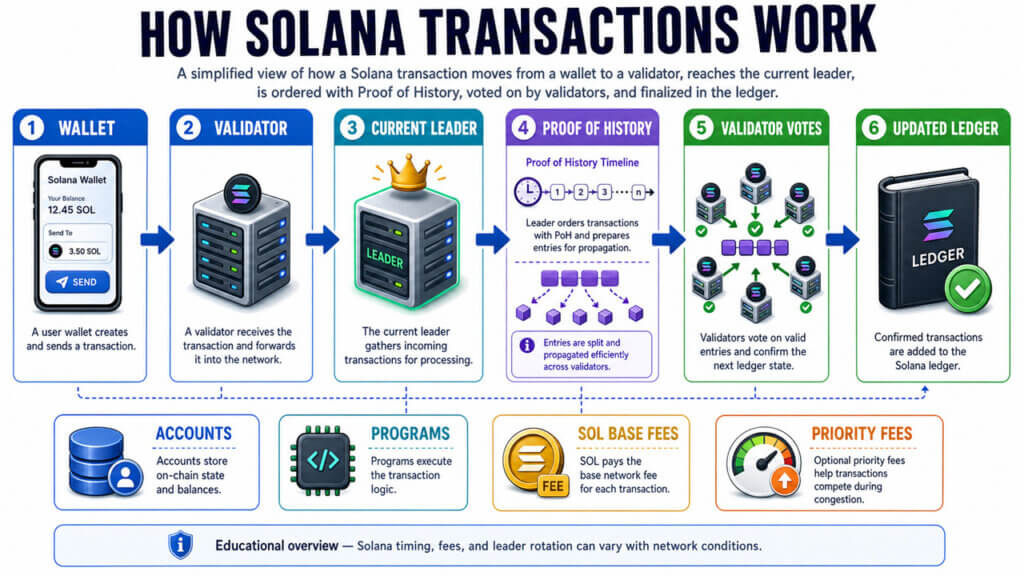
Solana reduces the coordination work validators need before they order and process transactions. A Solana cluster is a set of validators that work together to process client transactions and maintain the ledger. Validators receive entries from leaders, vote on valid entries, and store data as part of the network’s replication process.
This flow is easiest to picture as a wallet instruction moving into a validator set, then to the scheduled leader, then back through validators that check entries and update the ledger. SOL pays the base fee for the action, while an optional priority fee can help the transaction compete during congestion.
Proof of History Is a Clock, Not the Whole Consensus System
Proof of History creates a verifiable order of events before validators finalize the ledger. Many blockchains spend time agreeing on which event happened first. Solana reduces that communication burden by giving validators a shared sequence they can verify.
Solana still uses stake-weighted validator voting. The network uses Proof of Stake, and validator votes are weighted by the amount of stake delegated to them. Proof of History helps with ordering, while proof-of-stake voting helps decide which blocks become part of the ledger.
Accounts and Programs Let Apps Run in Parallel
Solana’s app model looks different from Ethereum’s account model. An account is the fundamental data unit for storing state, with each account identified by a 32-byte address. Programs are executable accounts that contain sBPF bytecode — programs are stateless while mutable state lives in separate data accounts.
A Solana transaction declares which accounts it will read and write. When two transactions touch different accounts, the runtime can process them without waiting for one shared global state path. App developers still need careful program design because account ownership, account locks, compute budgets, and program upgrade authority all sit inside the security model.
Fees Are Low, but Priority Fees Still Matter
Every Solana transaction requires a fee paid in SOL. The fee has two parts: a base fee and an optional prioritization fee. The base fee is paid per signature, while the prioritization fee is priced in micro-lamports per compute unit and can increase a transaction’s scheduling priority.
Low fees do not remove block-space competition. During heavy demand, apps can attach priority fees to compete for scheduling. The base fee is split, with 50% burned and 50% paid to the validator, while the prioritization fee goes to the validator.
SOL, Fees, and Network Economics
SOL is the native asset of Solana. Users need SOL for transaction fees, native staking actions, and stake-weighted validator voting. Apps can use SPL tokens and stablecoins, but SOL remains the asset that keeps the base chain’s fee and incentive system running.
Staking rewards come from inflationary issuance distributed to delegated stake accounts and validator vote accounts. Base fees are split between burns and validators, while priority fees go to validators. Those mechanics make SOL both a usage asset and part of the network’s validator incentive model.
Buying SOL and storing SOL are separate decisions. CryptoSlate’s crypto exchange rankings can help compare access, fees, liquidity, and regional availability before purchase. CryptoSlate’s crypto wallet rankings and Solana wallet shortlist cover the custody decision after purchase.
Solana’s Ecosystem: DeFi, Payments, Wallets, and Consumer Apps
Solana's usage profile has shifted considerably over the past two years. Early narratives focused on NFT volume and raw transaction speed. Today the network is used more heavily for DeFi trading, liquid staking, memecoin activity, wallet UX improvements, stablecoin payments, and tokenized assets. These categories share a common thread: they rely on frequent, small, or time-sensitive transactions that become impractical when fees are high.
Stablecoins and Payments
The stablecoin and payments story is now one of Solana's more significant use cases. Total stablecoin supply on Solana held near $15 billion through February 2026, and the network processed $650 billion in stablecoin transactions that month. Institutions and fintechs including SoFi, Gusto, Visa, PayPal, Stripe, Western Union, and Fiserv have tested or built payment products on the network.
That does not mean every payment will move to Solana. It means Solana has become one of the chains institutions test when they need cheap settlement, high transaction volume, or stablecoin UX that feels close to instant.
DeFi
DeFi is still central to what happens on Solana day to day. Jupiter handles swap routing. Raydium runs liquidity pools. Jito and Marinade operate liquid staking. Kamino covers lending and leveraged liquidity. Drift handles perpetuals. Together these apps show how the network is used for trading, staking, borrowing, routing, and liquidity.
The same app activity also creates risk. DEX users can lose money to scam tokens, thin liquidity, phishing links, smart-contract bugs, or slippage even when the base chain works correctly. If you are new to automated market makers, understanding how they work before depositing into a liquidity pool reduces the chance of unexpected losses.
Wallets
Wallets shape most of the user experience on Solana. Phantom and Solflare made the network easier to use for non-developers, with cleaner transaction previews and mobile-first design. Self-custody still carries real responsibility, however. A good wallet makes signing clearer, but it cannot make a malicious approval safe or recover a lost recovery phrase.
CryptoSlate's crypto wallets rankings are a good starting point. Reviews of Phantom and Solflare cover the two most commonly used Solana wallets.
What Makes Solana Different From Ethereum
Solana and Ethereum are both public smart-contract networks, but they make different design choices. Ethereum prioritizes a large security base, a mature app ecosystem, and a layered scaling model. Solana tries to keep more activity on one high-performance base layer, using a design that expects validators and infrastructure providers to handle heavy throughput.
The user-facing difference is usually fees and speed. Solana apps often feel faster and cheaper for frequent actions. Ethereum apps can feel more expensive on the base chain, although layer-2 networks reduce that cost. The architectural difference is deeper. Ethereum’s ecosystem leans on multiple execution environments across L2s, while Solana concentrates more execution on one chain.
Neither design is automatically better for every task. Solana’s approach can make apps feel smoother, especially trading and payment apps. Ethereum’s approach has deeper liquidity in many sectors and a longer security record, but users often need to understand L2s, bridges, and gas markets.
The useful question is not “Which chain wins?” It is “Which network fits the task?” Solana may fit fast wallet-native interactions, small payments, and active trading. Ethereum or an Ethereum L2 may fit apps that depend on Ethereum liquidity, long-running protocol history, or specific compliance and custody routes.
Main Risks: Outages, Validator Concentration, and App-Level Exposure
No blockchain is without risk, and Solana's risk profile is specific enough to be worth understanding before committing funds.
Network Reliability
Solana's most visible historical weakness has been reliability. Mainnet Beta block finalization halted on February 6, 2024 at 09:53 UTC, with consensus resuming at 14:55 UTC, an outage of roughly five hours. As of April 28, 2026, the live status page showed all systems operational and 100% uptime for Mainnet Beta and RPC nodes over the trailing 90 days. That 90-day window is not a guarantee. A high-performance chain can still face congestion events, software bugs, validator coordination issues, or app-level failures.
Client Diversity
One path toward reducing single-implementation risk is client diversity. Firedancer is a new validator client for Solana built from scratch. Frankendancer is a hybrid client that combines parts of Firedancer with parts of the existing Agave client. As of the time of writing, the full Firedancer client is not yet ready for production use and has no releases. Frankendancer is available on testnet and mainnet-beta.
Protocol Upgrades
SIMD-0326, known as Alpenglow, is a proposal to replace Solana's current consensus protocol (Proof of History and TowerBFT) with a new system. It was under review when checked. Treat it as a proposal, not a live feature.
Validator Concentration
Solana's proof-of-stake model gives more influence to validators with more delegated stake. Heavy concentration in a small number of large validators is a different kind of risk from software reliability. When choosing a validator for staking, checking stake distribution matters, not just commission rates.
App-Level Risks
Many day-to-day losses on Solana happen at the app layer, not the protocol layer. Scam tokens, phishing links, bad wallet approvals, thin DEX liquidity, and poorly designed DeFi strategies have cost users far more collectively than network outages. These risks exist on every chain but are worth naming explicitly because beginners often assume a fast, cheap network means lower risk overall.
How To Get Started With Solana Safely
Separate the steps of learning, buying, and taking custody before moving any real funds. Doing all three at once is where most mistakes happen.
Step 1: Understand what you are buying. SOL is a network asset, not a savings account. Its price moves with the broader crypto market, and nothing about staking or DeFi removes that underlying price risk.
Step 2: Choose where to buy. CryptoSlate's crypto exchange rankings compare access, fees, liquidity, and regional availability. If you are in the US, UK, or EU, the available options differ in terms of regulation and features. Reviews of Coinbase, Kraken, and Binance cover three of the most commonly used platforms in detail.
Step 3: Choose where to store it. If you plan to self-custody, CryptoSlate's Solana wallets shortlist is a better starting point than downloading the first result in an app-store search. A newer user may prefer a clean mobile wallet with strong transaction previews. A more experienced user may want hardware wallet support or deeper approval controls.
Step 4: Test before committing. Send a small amount first. Confirm the address, the network, and the fee prompt. Move additional funds only after the test transfer arrives. Solana transactions are fast and irreversible.
Step 5: Keep a fee reserve. Always leave a small amount of SOL unstaked in your wallet. A wallet with all SOL delegated cannot pay for later transactions. Even a few cents worth of SOL covers most routine fees.
Step 6: Confirm before approving. Before connecting a wallet to any app, check the domain against the project's official site. A recovery phrase or private key request from any app or website is a red flag with no exceptions.
Teams building or trading around Solana should also understand market infrastructure. CryptoSlate's exchange guides cover liquidity, latency, and risk controls for more advanced needs.
FAQs
Can you earn SOL without buying it?
Yes, but the available routes are limited. Native staking requires SOL first, so it does not create a starting balance. Builders may qualify for ecosystem funding through grants or hackathons, and some third-party products pay SOL-denominated rewards. Testnet faucets only issue Devnet or Testnet SOL for development and do not provide spendable mainnet SOL.
How do you stake Solana?
To stake Solana natively, use a compatible wallet, keep enough SOL for fees, choose a validator, and delegate SOL from a stake account. The stake activates on Solana’s epoch schedule. Exchange staking uses a platform product instead of direct wallet delegation, so custody, eligibility, fees, and withdrawal rules depend on that provider.
Is liquid staking SOL the same as native staking?
No. Native staking delegates SOL directly to a validator through a stake account, and rewards are paid in SOL to that account. Liquid staking deposits SOL into a stake pool and gives you a token such as JitoSOL or mSOL. That token can be used in DeFi, but it adds smart-contract and liquidity risk.
How long does it take to unstake SOL?
Native SOL unstaking depends on Solana’s epoch schedule. Stake changes finish at epoch boundaries, with each epoch lasting about two days. In normal conditions, funds often become withdrawable after the next boundary, but large network-wide activation or deactivation can extend the process beyond one epoch.
Are Solana staking rewards guaranteed?
No. Solana staking rewards depend on inflationary issuance, total active stake, validator vote performance, validator commission, and protocol conditions. Exchange staking and liquid staking add provider or smart-contract mechanics. Provider-managed products generally do not guarantee rewards either, which is a useful baseline.