OG is Crypto.com's U.S.-focused prediction platform. It gives users access to CFTC-regulated event contracts through Crypto.com Derivatives North America (CDNA) via OG technology. Sports are the hub, but OG also supports non-sports categories. It fits those who want a consumer-style app for regulated sports contracts with straightforward USD funding. But it is still a new platform, fully KYC-gated, and less reliable once you move outside the busiest markets.
Multiple USD funding rails, including instant deposit, ACH, wire, PayPal, Venmo, debit card, Apple Pay, and Google Pay.
Early exits are available before settlement when opposing liquidity exists
Sports coverage goes beyond winners into spreads, totals, player markets, futures, and parlays
Trade cost, payout, and fees are visible before order confirmation
Available on iOS, Android, and web, with portfolio tracking, chat, and leaderboard features built in
Cons
Full KYC and U.S.-only access create immediate signup friction
Early exits are not guaranteed because closing still depends on another participant taking the other side
Orders use immediate-or-cancel logic, so larger trades can fill only partly and the rest is canceled
Cash withdrawals are ACH-only, which is narrower than the deposit side
No public API or historical data access for model-driven or bot-based trading
Who OG Is Best For — And Who Should Skip It
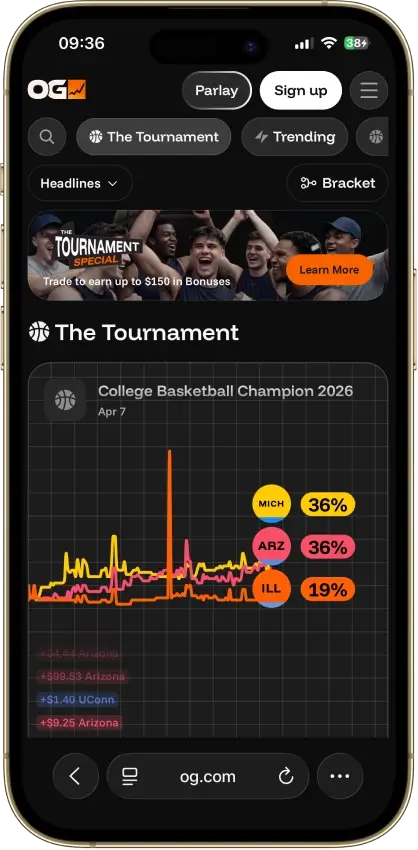
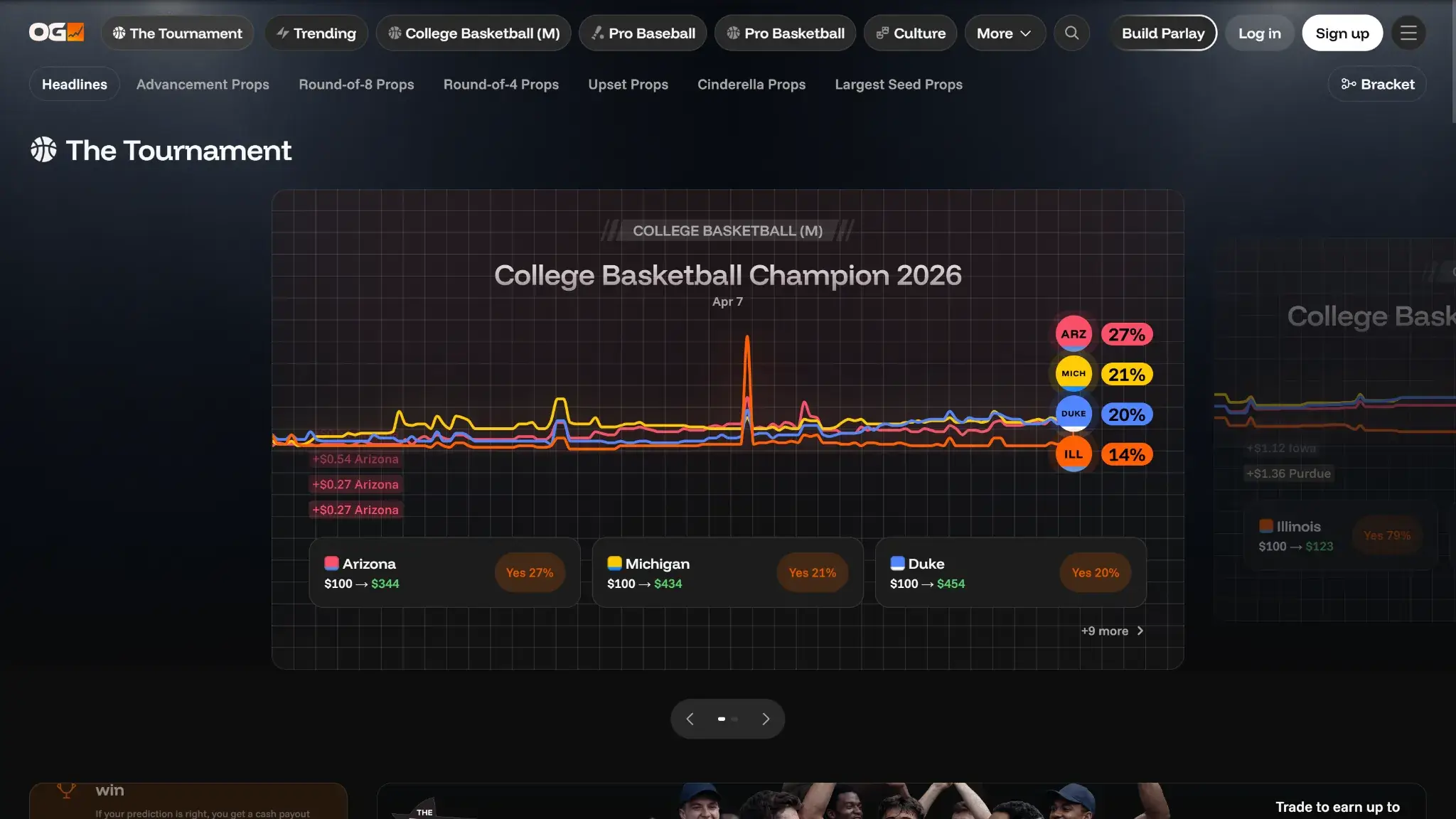
OG The Tournament page on desktop showing college basketball champion odds, chart visualization, headline tabs, and bracket button on a dark interface.
OG fits best when the goal is trading on a U.S. regulated prediction market with a polished app or web interface, with sports as the hub. It fits less well when the priority is automation, crypto-native access, or low-friction signup.
User Type
Fit
Why
Casual Event Trader
Medium
The interface is clean and funding is easy, but full KYC and real-money trading rules add friction right away.
It uses USD rails and regulated account onboarding, not wallets, stablecoins, or onchain settlement.
API Or Bot User
Low
There is no public API or historical data layer for systematic trading workflows.
User Who Wants Fast Fiat Withdrawals
Medium
Funding can be fast, but withdrawals run through ACH to a linked bank account.
User Who Wants Low KYC Friction
Low
Full identity verification is required before trading.
User Who Wants Clear Regulation
High
Trading runs through a CFTC-regulated venue, which is one of OG's clearest advantages.
OG is best for U.S. users who want regulation, smooth funding, and a more polished front end, with sports as the flagship category rather than the only category. It makes the most sense for those trading mainstream games, tournament markets, and other events where activity is concentrated.
Those who want deep liquidity across every market, low signup friction, or tools for automated trading should look elsewhere. OG works best as a regulated prediction market with sports as the hub; it also supports politics, economics, culture, and other live categories.
What Is OG And How Does It Work?
OG is the app and web layer users interact with, while the underlying event contracts trade through Crypto.com | Derivatives North America. In practice, that means a consumer-facing front end sits on top of regulated sports contracts priced in dollars.
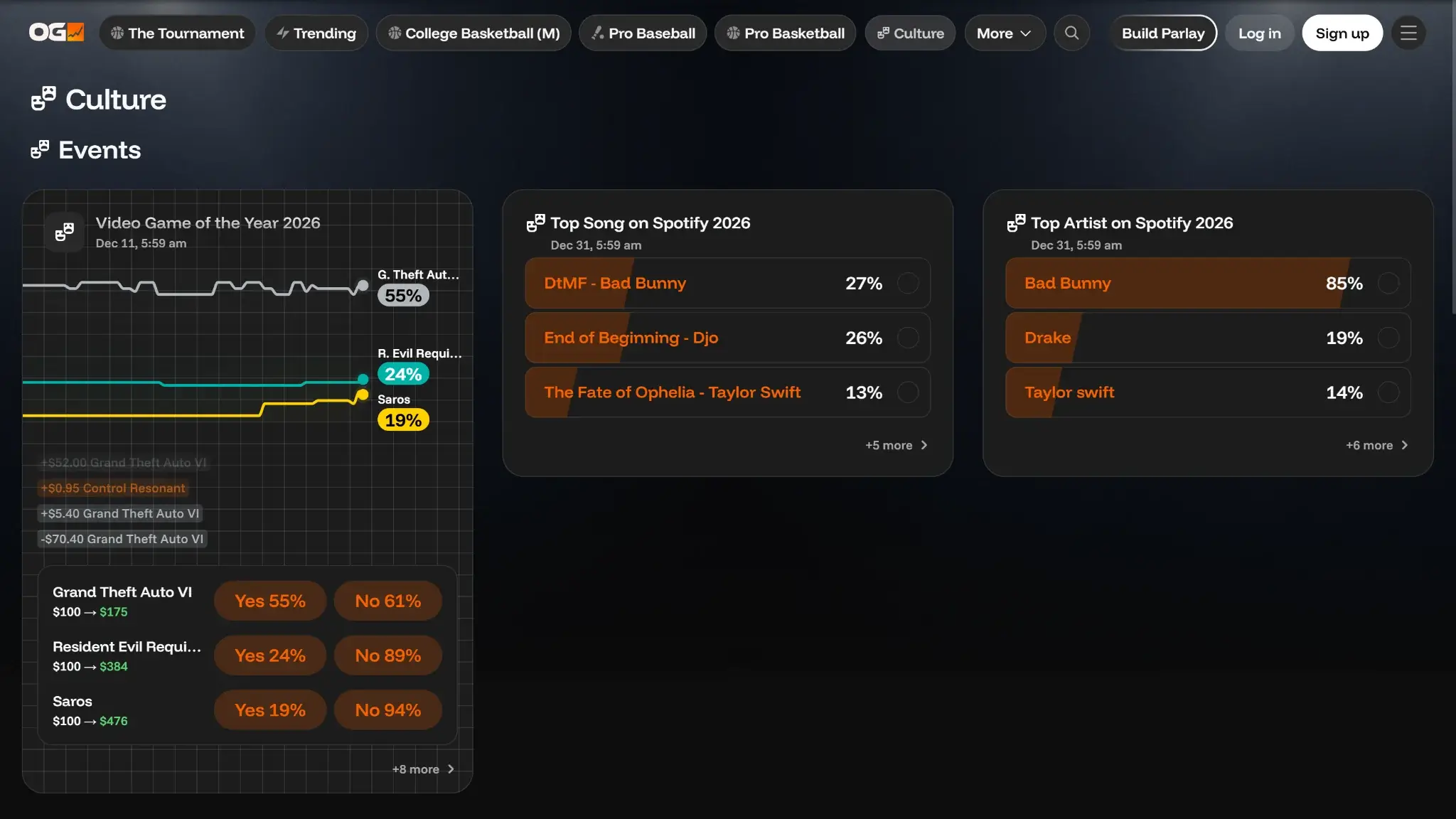
OG culture predictions page on desktop showing video game of the year, top Spotify song, and top artist markets with odds cards on a dark interface.
Contracts trade between $0 and $1 and reflect the market's view of an outcome. Each winning contract pays $1 at settlement, while a losing contract pays $0. Risk is capped at the amount paid to enter the trade plus fees.
Positions do not need to be held to final resolution. OG allows early exits before settlement, but only when there is a live price and another participant is willing to take the other side.
Sports are the natural hub on OG, but the platform is not sports-only. The platform centers on:
Game and title winners
Spreads and totals
Player performance markets
Tournament and season futures
Parlays with up to four pre-match legs across different games
The basic operating model is simple: fund a USD account, buy Yes or No exposure on a listed real-world outcome, and either sell before settlement or hold until the contract resolves. The interface looks consumer-friendly, but the mechanics are still those of a real order-book market with fees, liquidity constraints, and formal settlement rules.
Access, Eligibility and Account Setup
OG uses a standard platform account rather than a separate brokerage account, but access is still tightly controlled. A verified U.S. account is required before trading, and the main friction comes from location gating, identity checks, and the extra steps needed to open and fund the USD wallet.
Trading AvailabilityU.S. prediction markets on web, iOS, and Android.
Unsupported JurisdictionsOutside the U.S. and New York
Age Requirement18+
KYC LevelFull KYC
Account Type NeededStandard OG account; an existing Crypto.com login can link automatically
Bank, Wallet or Broker Setup NeededUSD wallet required; linked bank account is needed for ACH withdrawal and useful for instant deposit; no separate broker account is needed for current trading
Geolocation or Device ChecksYes; unsupported locations are blocked from trading
Time to First TradeMinutes in the best case, but longer if review, proof of address, or manual verification is triggered
Setup friction is moderate. The flow itself is simple, but the approval checks are stricter than the clean app design suggests. The biggest drag is full KYC plus location gating, not the actual deposit process.
Market Coverage and Contract Design
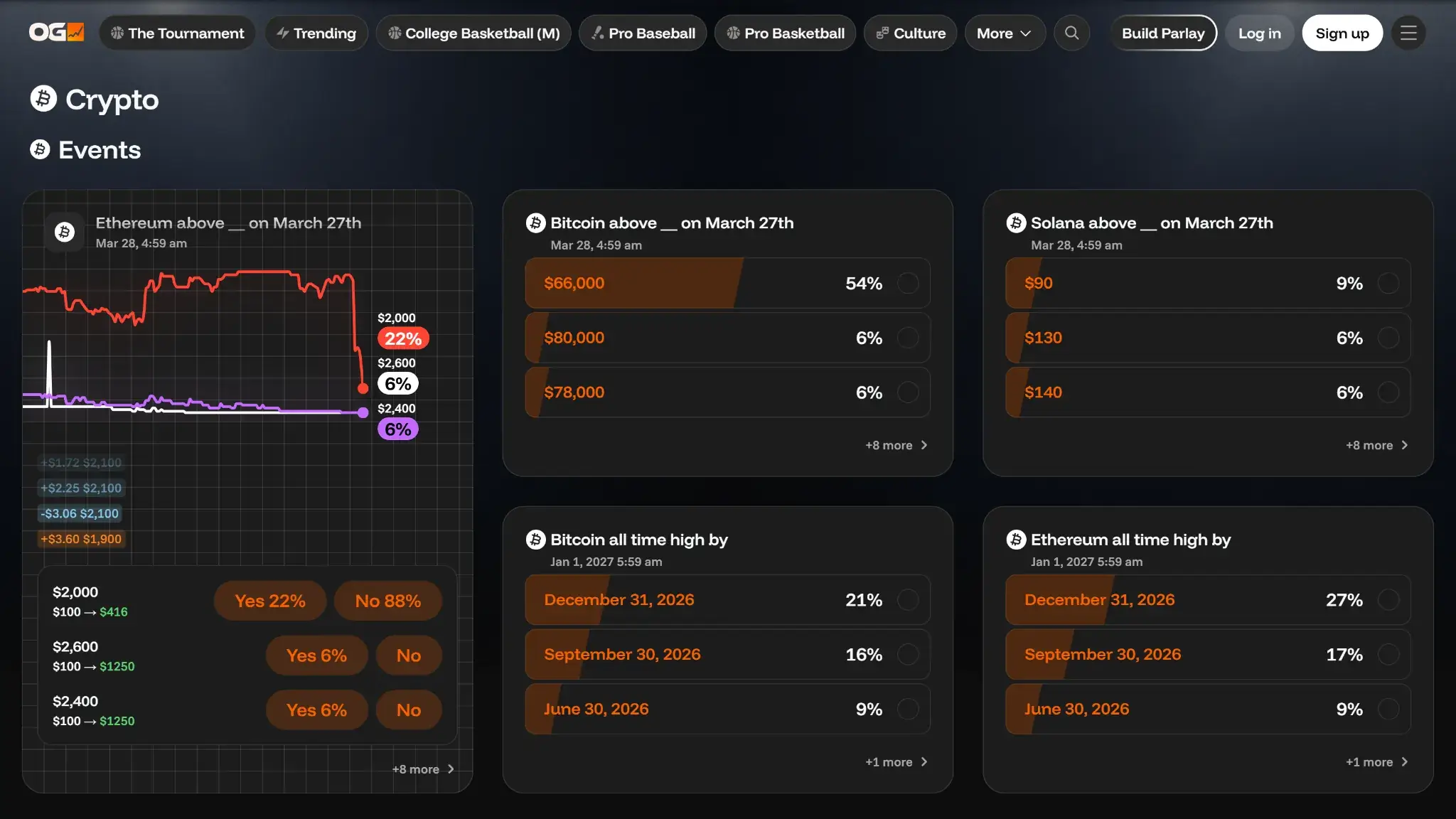
OG crypto predictions page on desktop showing Ethereum, Bitcoin, and Solana event markets with odds cards on a dark interface.
Compared with broader rivals, OG is still sports-led, but it is not sports-only. OG’s own materials explicitly cover sports, politics, economics, and culture, and the live site currently also lists Crypto, Financials, Companies, and Climate.
It concentrates on sports-specific formats such as spreads, totals, player props, futures, and parlays. That gives it more shape for sports trading than many newer entrants, but it also means those looking for politics, macro, or crypto event trading should not expect OG to do the same job as broader platforms.
Category
What Is Covered
How Deep It Is
Important Gaps Or Caveats
Sports
Pro Football, Pro Basketball, College Basketball, Pro Baseball, Hockey, Tennis, Golf, MMA, soccer competitions, F1, and other headline events
Strongest area on the platform, with winners, spreads, totals, props, futures, and parlays
Depth still depends heavily on event prominence, and quieter markets can thin out fast
Politics
Supported
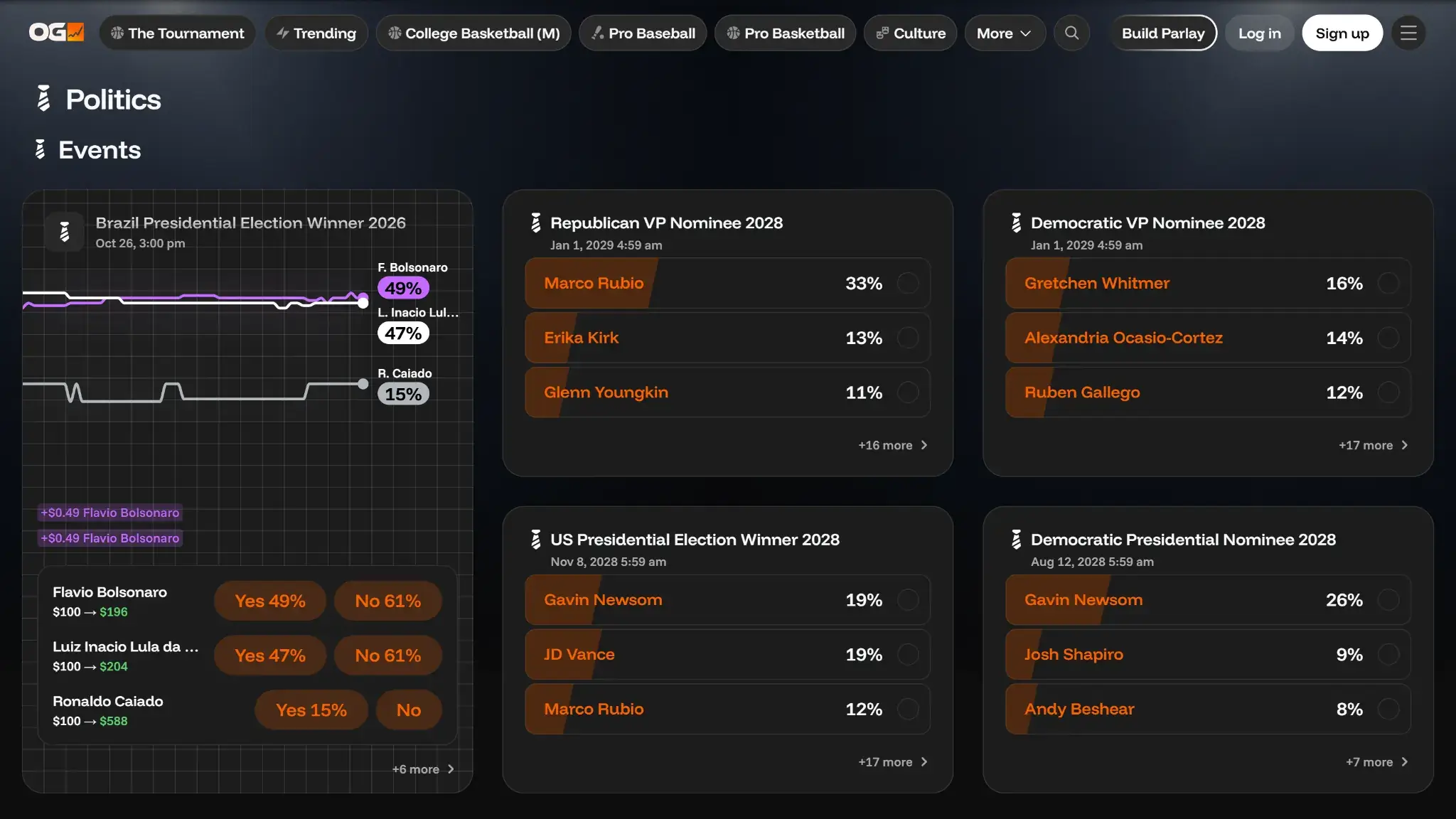
Election winner, presidential nominee, and party control for the U.S. Senate and House
Focuses heavily on sports-related event contracts
Macro / Economics
Supported
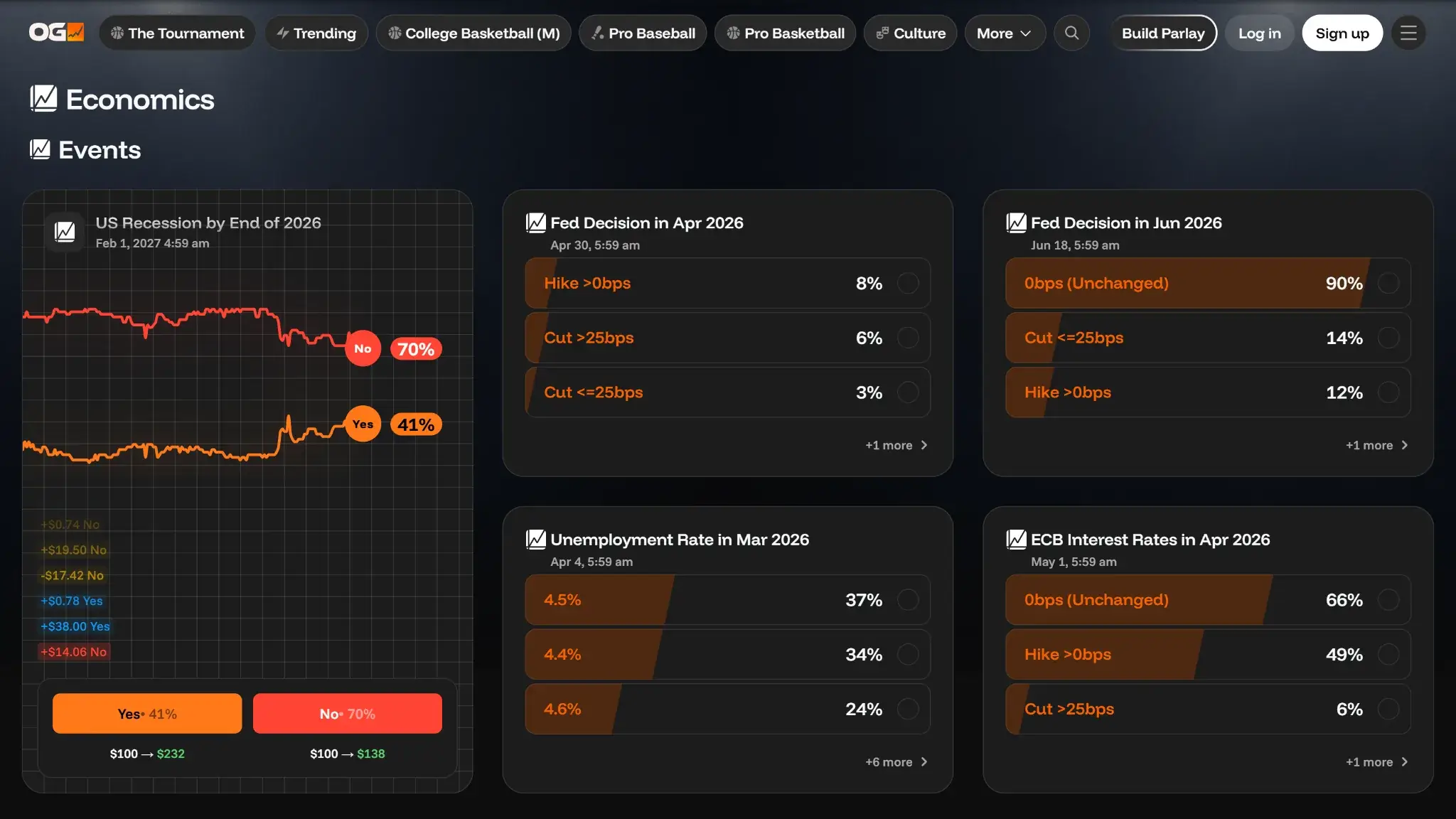
OG lists economics markets including CPI, unemployment rate, and Fed interest-rate decisions.
Focuses heavily on sports-related event contracts
Crypto / Finance
Supported
Limited to basic Bitcoin, Ethereum and Solana related price events
Focuses heavily on sports-related event contracts
Culture / Entertainment
Supported
Limited to three events at the time of writing
Platform's focus is heavy on sports-related event contracts
Other Categories
Supported
Companies and Climates categories are available with only a few event contracts
OG should be treated as a sports-first platform, not a broad event marketplace
OG is narrow, but it goes deeper in sports than in anything else. That trade-off can work well if sports are your main focus. It is a stronger fit for sports trading than a platform that covers everything but executes poorly. Outside sports, the coverage drops off fast.
OG economics predictions page on desktop showing recession, Fed decision, unemployment, and ECB rate markets with odds cards on a dark interface.
Contract Design Notes
Binary Yes / No Markets — Yes. This is the default structure across the platform.
Multi-Outcome Markets — Not in a true exchange-style ladder. OG usually breaks outcomes into separate binary contracts rather than one clean mutually exclusive market set.
Range Or Bracket Markets — Supported indirectly through spreads, totals, and player threshold markets, but still expressed as binary contracts.
Short-Dated Or Intraday Markets — There are useful fast markets around games, props, and live events, especially on headline matchups. But the depth is not evenly strong across all of them.
Longer-Dated Markets — Yes. Tournament winners, season outcomes, and other futures give OG more than just same-day game exposure.
Speed Of New Listings — Better around scheduled sports calendars than around surprise events. The product is tuned for known slates, playoffs, and major competitions.
Market Wording Quality — Generally clear because the market types are familiar, but player rules, tie rules, and cancellation handling still need attention before trading.
The market mix feels genuinely useful for sports users because it offers more than a basic winner-only product. But that usefulness is concentrated. Those who do not mainly want sports exposure will find the catalog narrow rather than versatile.
OG politics predictions page on desktop showing election and nominee markets with odds cards on a dark interface.
Liquidity, Order Book and Execution Quality
OG is tradable mainly on tentpole events. Once you leave the homepage, the experience becomes less reliable, especially for anyone who needs size, precise entries, or a dependable early exit.
Depth on Major MarketsUsually best on headline games, major tournaments, and popular props where two-sided interest is highest
Depth on Quieter MarketsCan get thin quickly, with missing quotes and weaker ability to exit early
Bid-Ask Spread BehaviorMore stable on major events, but can widen as markets get quieter or closer to resolution
Limit OrdersNot Supported
Instant Buy / Market-Style ExecutionYes. Orders execute immediately at the best available price levels
Partial FillsYes. Unfilled size is canceled because orders use immediate-or-cancel logic
Exit Before ResolutionYes, but only when another participant is available to take the other side
Visible Volume / Open InterestNot Available in a way that helps serious order-book planning
Position LimitsYes. Maximum open position limits apply per event
Slippage RiskReal on larger orders and thinner markets because fills can move across multiple price levels
OG feels liquid enough where mainstream sports attention clusters, especially around big pro games and major tournament windows. It gets much thinner in quieter props, secondary events, and any market where two-sided interest fades. The same event can also be priced differently from rivals, which matters most to anyone trading size, chasing live moves, or trying to exit efficiently in thinner books.
Fees and Total Cost to Trade
OG is fine for casual users but more expensive for active traders once you include repeated per-contract fees and slippage. The explicit fee schedule is simple. The harder part is that thin books can make the real cost meaningfully higher than the headline fee.
Cost Component
What Users Pay
When It Applies
Notes
Trading Fee
$0.02 per $1 contract to open; $0.02 per contract to close before expiry
On entry and on early exit
Percentage cost is heavier on low-priced contracts and frequent round-trips
Spread Or Slippage Cost
Varies by market depth
When the book is thin or orders walk across price levels
This can matter more than the explicit fee on quieter or live markets
Deposit Fee
$0 from OG across ACH, wire, instant deposit, PayPal, debit card, Venmo, Apple Pay, and Google Pay
When funding the account
Banks, card issuers, or payment providers can still charge separately
Withdrawal Fee
$0 from OG for ACH withdrawals
When cashing out to a linked bank account
ACH is the only cash-out rail, and external bank fees can still apply
Network Or Gas Fee
Not Applicable
Not Applicable
OG is not funded through onchain wallets
FX Or Conversion Fee
Not Applicable for standard USD use
Not Applicable
Trading and funding are built around USD
Subscription Or Premium Fee
None
Not Applicable
VIP status exists, but it is not required to use the platform
Third-Party Provider Fee
Varies
When external banks, cards, or payment providers impose charges
This is where the true funding cost can move above zero
The fee schedule itself is easy to understand. The real cost question is whether you trade low-priced, thin, or fast-moving markets. Casual users on major events will mostly notice the flat contract fee. Active users will care more about slippage, partial fills, and the cost of entering and exiting repeatedly.
Funding, Settlement and Cash-Out Flow
Costs are only one side of the experience. The other side is how money moves through the platform, when balances become usable, and how long it takes before profits turn into actual cash in a bank account.
How Money Gets In: Users fund a USD wallet through instant deposit, ACH, wire, PayPal, debit card, Venmo, Apple Pay, or Google Pay. Bank links run through Plaid for instant deposit and ACH withdrawal.
When Buying Power Becomes Usable: Instant deposit credits funds within seconds and makes them tradable right away. Other funded cash becomes usable once it lands in the USD wallet.
What Happens When A Contract Resolves: Winning contracts pay $1 per contract at settlement, losing contracts pay $0, and early exits realize profit or loss at the executed close price.
When Funds Become Withdrawable: Settled cash can remain subject to holds. The biggest example is instant deposit, where funded balances are not withdrawable for 7 business days.
How Money Actually Reaches The Bank Account Or Wallet: Cash leaves through ACH only and goes to a linked bank account. There is no crypto wallet cash-out path here.
A market can resolve quickly, your balance can update soon after, and you still may not have withdrawable cash the same day. On OG those are three separate clocks. Resolution speed tells you when the contract result is known. Balance update speed tells you when the wallet reflects that outcome. Actual cash-out speed depends on holds, ACH timing, and whether the funded balance is already clear for withdrawal.
Resolution Rules, Market Integrity and Disputes
OG is mostly clear on normal sports markets, but edge cases still matter. Winner, spread, and total contracts are easy to follow, and settlement usually comes soon after the official result is confirmed. The main risk is ties, player replacements, canceled events, and other cases where special rules change the payout.
That makes OG usable for serious sports trading, but not something to trade on autopilot. Most disputes should stay limited on major markets, but a user can still misread a contract by assuming every sports market settles like a standard bet. It is worth checking the tie, cancellation, and player-status rules before trading props, parlays, or delayed events.
If an event is postponed, canceled, or not completed within 48 hours of its originally scheduled start time, CDNA treats it as a Canceled Event; if a draw or tie occurs with no tie outcome listed, both Yes and No holders receive $0.50 per contract and opening fees are not refunded.
Security, Custody, Privacy and Trust
The main trust sits with the exchange and with your own account security habits. This is a custodial setup, so funds stay inside the platform stack rather than in a self-custody crypto wallet. The bigger risks are platform custody, thin market structure, and special settlement rules.
Account security is stronger than a basic email-only setup because 2FA is supported and required for withdrawals. But the privacy trade-off is real because full KYC, banking links, identity checks, and location controls are part of the product. The platform has regulatory oversight behind it, which helps, but serious users still need to treat custody and execution risk as more important than pure app design.
UX, Apps, Automation and Data Access
OG feels built mostly for casual mobile use, with enough web support for normal desktop trading. It does not feel built for research-heavy workflows or automation.
Surface Or Tool
Availability
Notes
Web App
Yes
Full trading access through browser
iOS App
Yes
Core app surface
Android App
Yes
Core app surface
Desktop App
No
No separate desktop client
Watchlists And Alerts
No
Not Available
API Access
No
No public trading API
WebSocket Or Live Market Feed
No
No user-facing market data feed for automation
Historical Data Access
No
Not Available
Trade History Export
No
Not Disclosed as a usable export tool
The layout is clean and the order ticket is easy to follow. Fees, payout, and position view are clear enough for normal users, and the portfolio screen is useful. But the product is weak for bot workflows, research, or deep desk-based trading because it lacks API access, export depth, and structured market data.
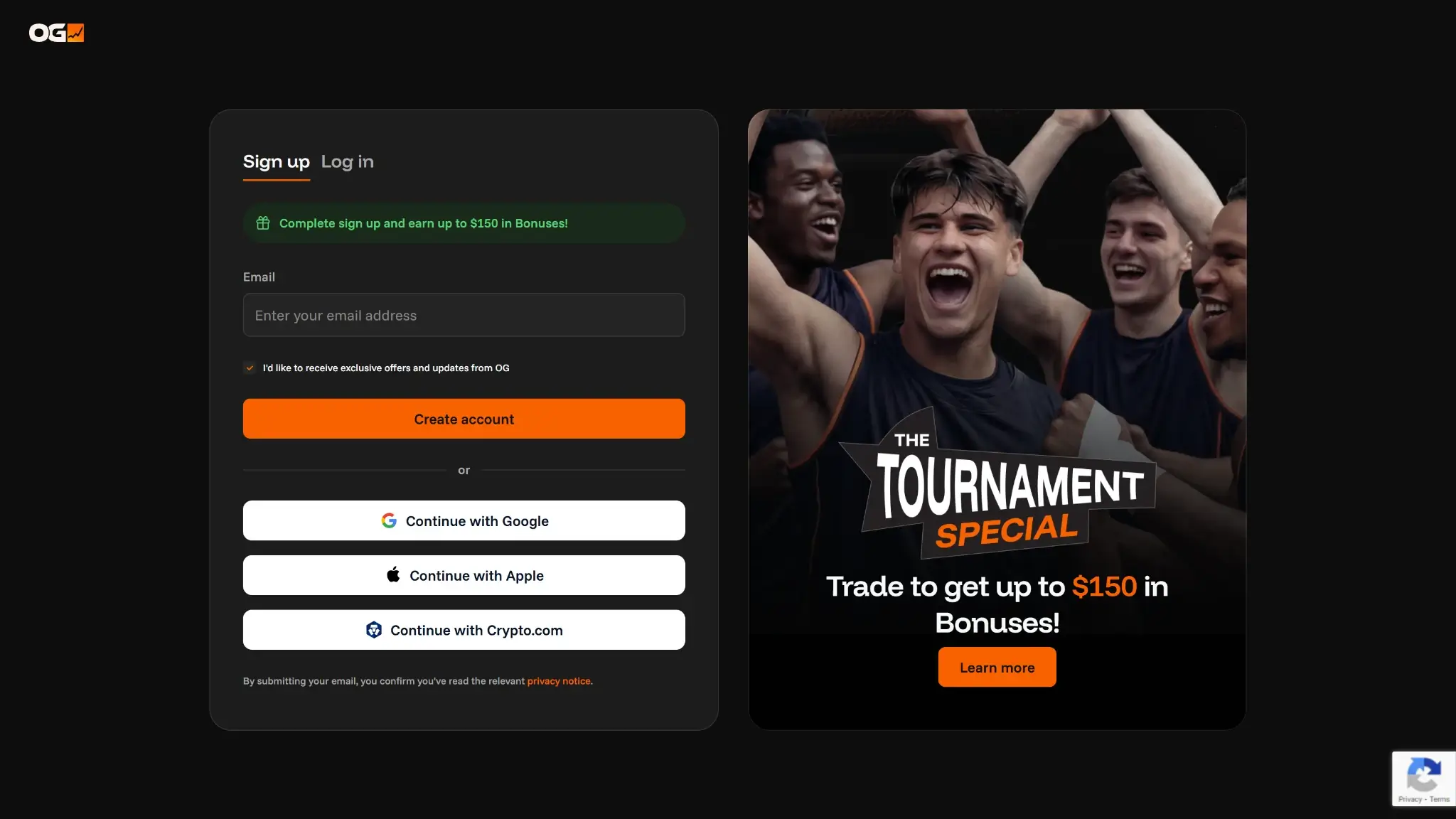
OG sign up page on desktop showing account creation form, email field, bonus message, and social sign-up buttons beside a promotional tournament image.
The UX helps with basic trading decisions, not advanced workflows. It looks polished and works well for normal use, but the design is stronger than the data tools behind it.
Taxes, Statements and Record-Keeping
Record-keeping looks manageable for casual users, but still manual for active ones.
Tax Forms: U.S. persons who traded contracts during the tax year may be issued Form 1099-B.
Account Statements: Not Disclosed as a major reporting feature.
CSV Or Export Quality: Not Available.
Cost-Basis Visibility: Basic trade history and settled positions are visible in the portfolio.
What You Still Track Yourself: Entry price, exit price, fees, realized gains, and any records needed for tax filing.
A casual user with a small number of trades can work through this. An active trader will likely find it annoying because the platform does not appear built around strong export and reporting tools.
Customer Support, Limits and Incident Handling
The help center covers more ground than the human support side. You can usually find the rule or funding page you need, but that is different from getting a fast manual fix.
Help Center: Yes, through help.og.com and the in-app help flow.
Status Page: Yes, through the platform status page.
Community Channels: Limited. Social channels exist, but they are not a strong user-support layer.
Self-Exclusion Or Cooldown Tools: One-button lock is available. Self-exclusion is Not Disclosed.
Account Limits: Deposit and withdrawal limits vary by rail and user level.
Position Limits: Yes. Position limits apply by event.
What Support Can Actually Fix: Onboarding issues, bank-linking problems, 2FA reset, access errors, and account closure.
What Support Cannot Reverse: Market outcomes, normal fills, or the loss from a bad trade.
Support looks workable, not exceptional. The help center does a lot of the heavy lifting, while human support seems most useful for access, funding, and account problems rather than trade disputes.
Final Verdict
OG sits at 7.0, and the score reflects a product that does its best work in a narrow lane. The funding rails are genuinely flexible - instant deposit, ACH, PayPal, Venmo, Apple Pay, Google Pay, and debit card all in one place. Sports coverage goes deeper than a basic winner market, with player props, futures, and parlays up to four legs. What holds it back is liquidity outside major events is unreliable, there are no limit orders, partial fills are discarded rather than queued, and the 7-business-day hold on instant deposits means fast funding does not equal fast withdrawal. The non-sports categories exist but are thin enough that anyone treating OG as a broad event market will be disappointed. It works as a regulated sports trading app with a clean interface. It does not yet work as the perfect all-around prediction market.
Multiple USD funding rails, including instant deposit, ACH, wire, PayPal, Venmo, debit card, Apple Pay, and Google Pay.
Early exits are available before settlement when opposing liquidity exists
Sports coverage goes beyond winners into spreads, totals, player markets, futures, and parlays
Trade cost, payout, and fees are visible before order confirmation
Available on iOS, Android, and web, with portfolio tracking, chat, and leaderboard features built in
CONS
Full KYC and U.S.-only access create immediate signup friction
Early exits are not guaranteed because closing still depends on another participant taking the other side
Orders use immediate-or-cancel logic, so larger trades can fill only partly and the rest is canceled
Cash withdrawals are ACH-only, which is narrower than the deposit side
No public API or historical data access for model-driven or bot-based trading
Affiliate Disclosure
Disclaimer: CryptoSlate may receive a commission when you click links on our site and make a purchase or complete an action with a third party. This does not influence our editorial independence, reviews, or ratings, and we always aim to provide accurate, transparent information to our readers.
FAQ
Is OG legal where I am?
OG is built for the United States only, excluding New York. Even inside the U.S., access still depends on location controls, so availability can fail if you are in a blocked jurisdiction. It is worth checking access before funding the account, especially if you travel often or live near a state border.
Does OG require KYC?
Yes. Full identity verification is required before you can trade. Basic signup is quick, but trading access depends on approval of your identity details and, in some cases, extra documents. That makes OG much less flexible than platforms with lighter onboarding.
Can I sell before the market resolves?
Yes. You can close early before settlement, but only if there is enough opposing liquidity at that time. That means the feature exists, but the exit is not guaranteed in thin markets. On major games this is more realistic, while on quieter markets you may have to hold to settlement.
How long does it take to actually withdraw winnings from OG?
That depends on both settlement and funding holds. Even after a market resolves, cash-out can still be slowed by ACH timing or the 7-business-day hold tied to instant deposits. In other words, winning a market does not always mean same-day access to cash. The contract can settle fast while the bank withdrawal still takes longer.
Why is the same event priced differently on OG and Polymarket?
Each platform has its own user base, liquidity pool, fee structure, and market rules. Even when the event looks the same, the order books are separate, so the price can differ. That gap can be small on major events and much wider on thinner ones. Users who compare prices across platforms may find better entries or exits elsewhere.
How are disputed, clarified, or voided markets handled on OG?
Most normal sports markets settle off the official result. If an event is canceled, tied, delayed, or changed in a way that affects the contract, special settlement rules can apply. That matters most on props, parlays, and player-related markets, where edge cases are more common. The safest approach is to check tie, cancellation, and replacement rules before trading.
Does OG offer an API and historical data?
No. OG does not offer a public API or a strong historical data layer for outside analysis or bots. That makes it a weak fit for quant users, model-driven traders, and anyone who wants to backtest pricing. It works better as a manual trading app than as a research or automation platform.
Are parlays and player markets available on OG?
Yes. OG supports player markets and pre-match parlays, which is one reason it feels more sports-specific than many rivals. Parlays can include up to four legs, but they come with extra rule sensitivity around ties, cancellations, and unavailable prices. Player markets also need closer reading because status changes and sport-specific settlement rules can affect the outcome.