Coinbase prediction markets sit inside the main Coinbase account flow, but they are not just another crypto trading tab. This is a regulated event-contract market with full onboarding, U.S.-only availability, and a separate predictions balance that works differently from your standard Coinbase cash balance.
Uses the same Coinbase account instead of a separate market login
Supports both USD and USDC for prediction trades
Lets you sell open contracts before final resolution
Works on mobile app and web, with portfolio tracking in both
Cons
Available only to U.S. residents, with Nevada excluded
Requires full KYC plus suitability-style financial onboarding
No public API or built-in historical market data access
Position limits can cap how much you can hold in a market
Coinbase prediction markets bring regulated event contracts into the main Coinbase account experience, which makes them an easy entry point for U.S. users who already keep funds on the platform. They suit those who want to trade markets with USD or USDC without leaving the Coinbase ecosystem, but they still need a separate Coinbase Financial Markets predictions account and approval. But the trade-off is tighter eligibility, full onboarding checks, and a payout flow that can feel slower than the app balance suggests.
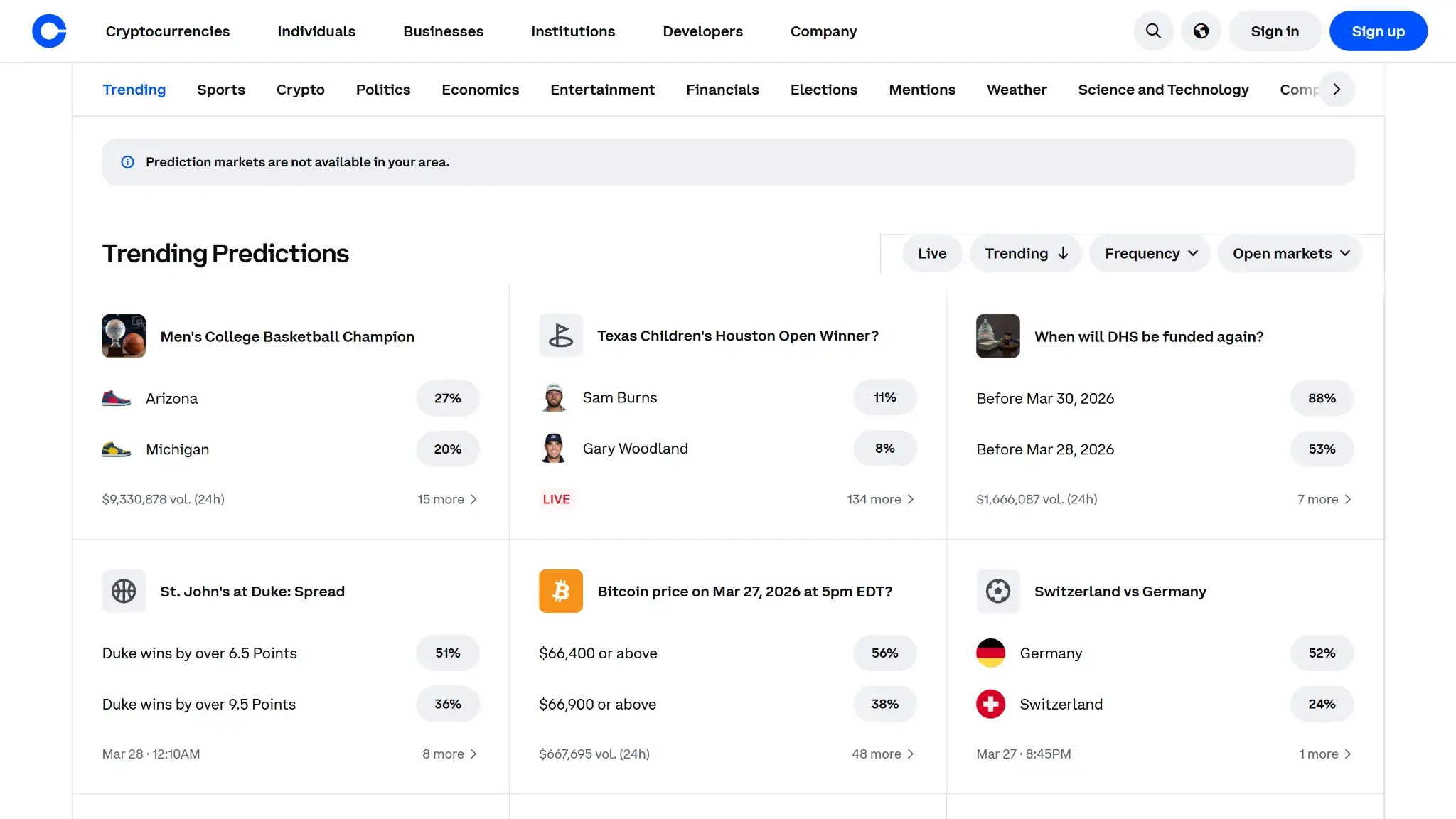
Coinbase Predictions trending page showing featured prediction markets across sports, crypto, and politics on desktop.
Who Coinbase Prediction Markets Are Best For — And Who Should Skip Them
Economics, financials, and company-event markets fit the product well
Crypto-Native Trader
Low
It runs through full Coinbase onboarding, not wallet-based or onchain access
API Or Bot User
Low
Public API and historical data access are not available
User Who Wants Fast Fiat Withdrawals
Medium
Winnings can be reused for predictions quickly, but off-platform cash-out is slower
User Who Wants Low KYC Friction
Low
SSN or TIN, identity checks, and financial background review are part of onboarding
User Who Wants Clear Regulation
High
The product runs through Coinbase Financial Markets under CFTC and NFA oversight
This platform suits existing Coinbase users in the U.S. who want event markets in a familiar app and care more about regulated access than advanced trading tools. It also makes more sense for casual or medium-frequency trading than for highly active, execution-heavy strategies.
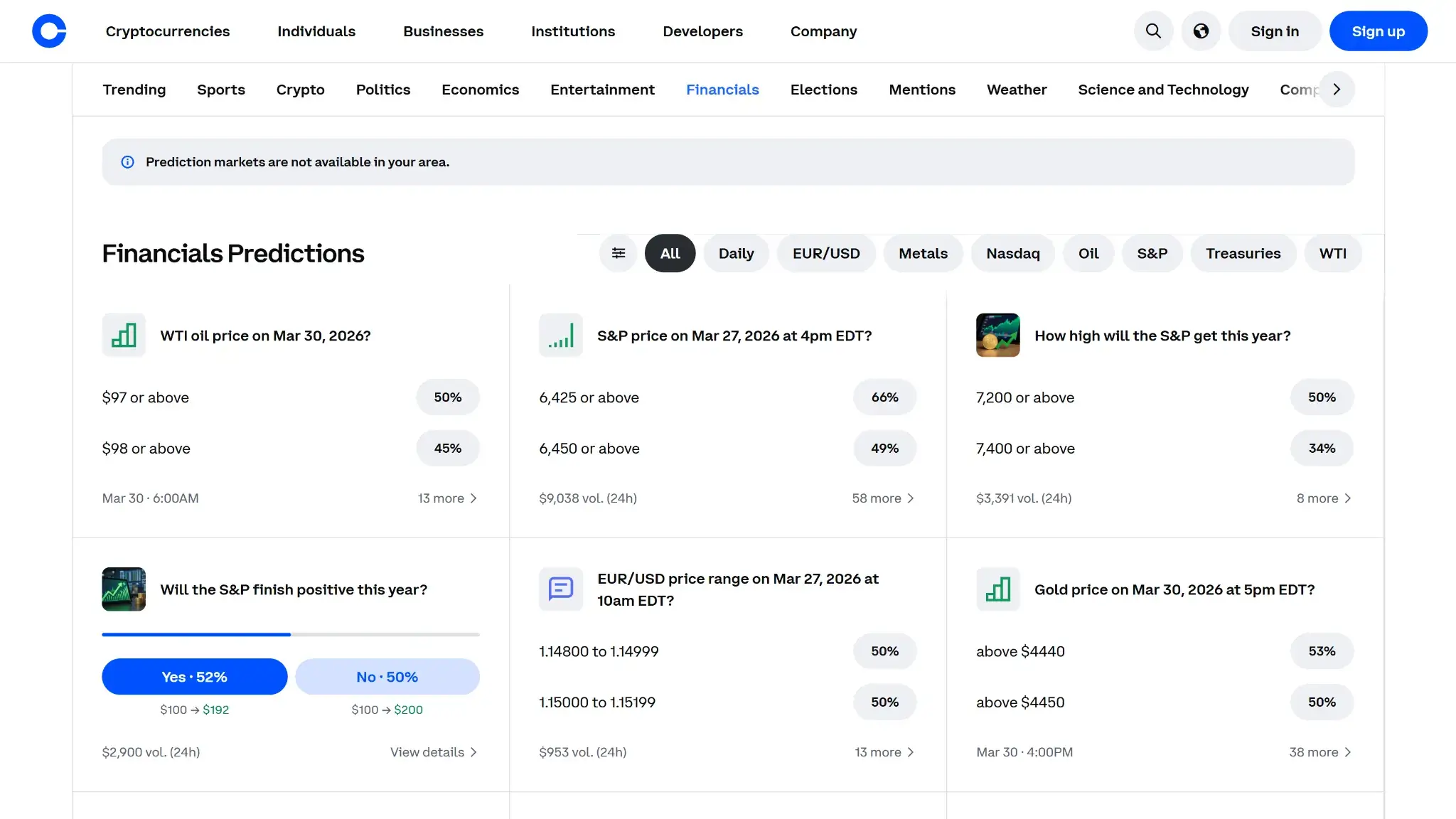
Coinbase Predictions financials page showing oil, S&P, EUR/USD, and gold prediction markets with market odds on desktop.
Users who want international access, lower identity friction, direct API access, or faster movement from settled winnings to withdrawable cash should go for alternatives. It is also a weaker fit for those who prefer crypto-native prediction markets or want deeper sports-market tooling.
What Are Coinbase Prediction Markets And How Do They Work?
Coinbase prediction markets are yes-or-no event contracts offered inside the broader Coinbase account experience. You apply through Coinbase, complete the required onboarding, move funds into a predictions balance, and then buy contracts on an outcome.
Contract pricing follows market activity. A higher contract price means the market is assigning a higher chance to that outcome. A winning contract pays $1, minus any fees. A losing contract pays $0.
You do not have to hold every position until final resolution. Coinbase prediction markets let you sell early while the market is still open. It gives you a way to lock in gains, cut losses, or exit before the event is settled.
The platform is built for mainstream event markets that fit a regulated U.S. retail flow, not for open-ended user-created markets or onchain speculation.
The basic flow is simple: fund the predictions balance with USD or USDC, buy a yes-or-no contract, then either sell before close or wait for resolution. The main thing to understand is that trading, settlement, and withdrawal happen in different steps. That makes the money flow less direct than a standard spot trade.
Access, Eligibility and Account Setup
Coinbase prediction markets are easy to find if you already use Coinbase, but they are not instant-access trading. You need a standard Coinbase account first, then a separate Coinbase Financial Markets application that checks identity, residency, and financial suitability before prediction trading is enabled.
Trading AvailabilityAvailable through approved Coinbase accounts in the U.S. on app and web
Unsupported JurisdictionsNevada for new prediction trading; non-U.S. residents are not eligible
Age Requirement18+
KYC LevelFull KYC
Account Type NeededCoinbase account plus approved Coinbase Financial Markets predictions access
Bank, Wallet or Broker Setup NeededActive Coinbase account required; fund from Coinbase primary USD or USDC balances; no external broker or self-custody wallet needed
Geolocation or Device ChecksU.S. residency and account-location checks apply; traveling abroad does not remove access; device-specific restrictions are Not Disclosed
Time to First TradeVaries; fastest for already verified Coinbase users, slower if identity or suitability review needs manual approval
Setup friction is moderate to heavy. The biggest drag is the regulated application layer, not the funding step. You need U.S. residency, SSN or TIN, photo ID, and answers on employment, trading experience, income, and net worth before you can trade.
If a user no longer resides in the U.S., Coinbase Financial Markets can liquidate active contracts and close open orders.
Market Coverage and Contract Design
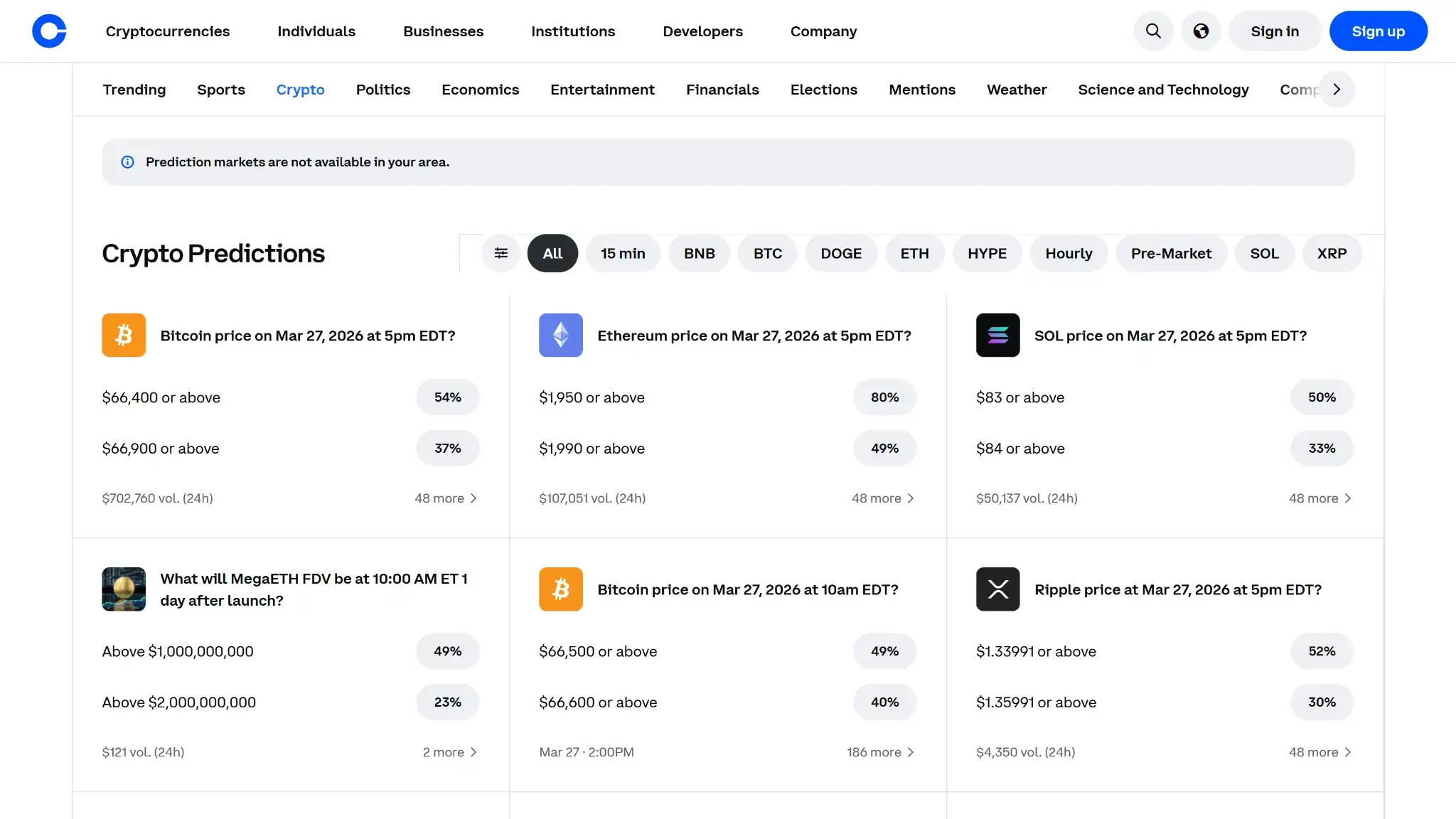
Coinbase Predictions crypto page showing Bitcoin, Ethereum, Solana, and XRP prediction markets with category filters on desktop.
Coinbase prediction markets look broad at first glance, and they do cover much more than one narrow niche. The platform spans sports, politics, crypto, economics, companies, weather, science and technology, social topics, and media mentions. But compared with direct competitors, the coverage is uneven. Kalshi still looks deeper across regulated U.S. categories, especially in politics, economics, and headline sports volume.
Polymarket remains broader and faster on niche and breaking-event coverage. PredictIt is much narrower overall, but it is still more concentrated around politics. Coinbase sits in the middle: broader than a politics-first prediction markets, more disciplined than a crypto-native open market, and strongest where headline events overlap with the existing Coinbase user base.
Category
What Is Covered
How Deep It Is
Important Gaps Or Caveats
Sports
College basketball, NBA, NHL, golf, soccer, and other popular sports
Medium
Useful around major events, but not as dense as a sports-first market venue
Politics
Elections, Congress control, political leadership, and mentions-style contracts
Medium
Broader than a single-topic politics board, but not as deep as a politics-led specialist
Macro / Economics
Fed decisions, economic releases, layoffs, and weather-linked macro events
Medium To High
One of the stronger non-sports areas, but still more curated than exhaustive
Crypto / Finance
Crypto price targets, short-dated crypto moves, company, and financials markets
High
This is the clearest natural fit, but it still runs in a regulated binary format rather than a crypto-native trading model
Culture / Entertainment
Awards, pop culture, games, and event-driven entertainment markets
Low To Medium
Coverage is present, but depth can thin out fast outside major moments
Other Categories
Weather, science and technology, companies, social, and mentions
Medium
Broad labels do not always mean deep listings in every subcategory
Crypto, finance, and macro headlines feel closest to the platform’s natural audience, while sports and politics are useful without clearly leading the category. Coinbase can list fast-moving contracts, but the menu still feels curated and disciplined rather than constantly sprawling.
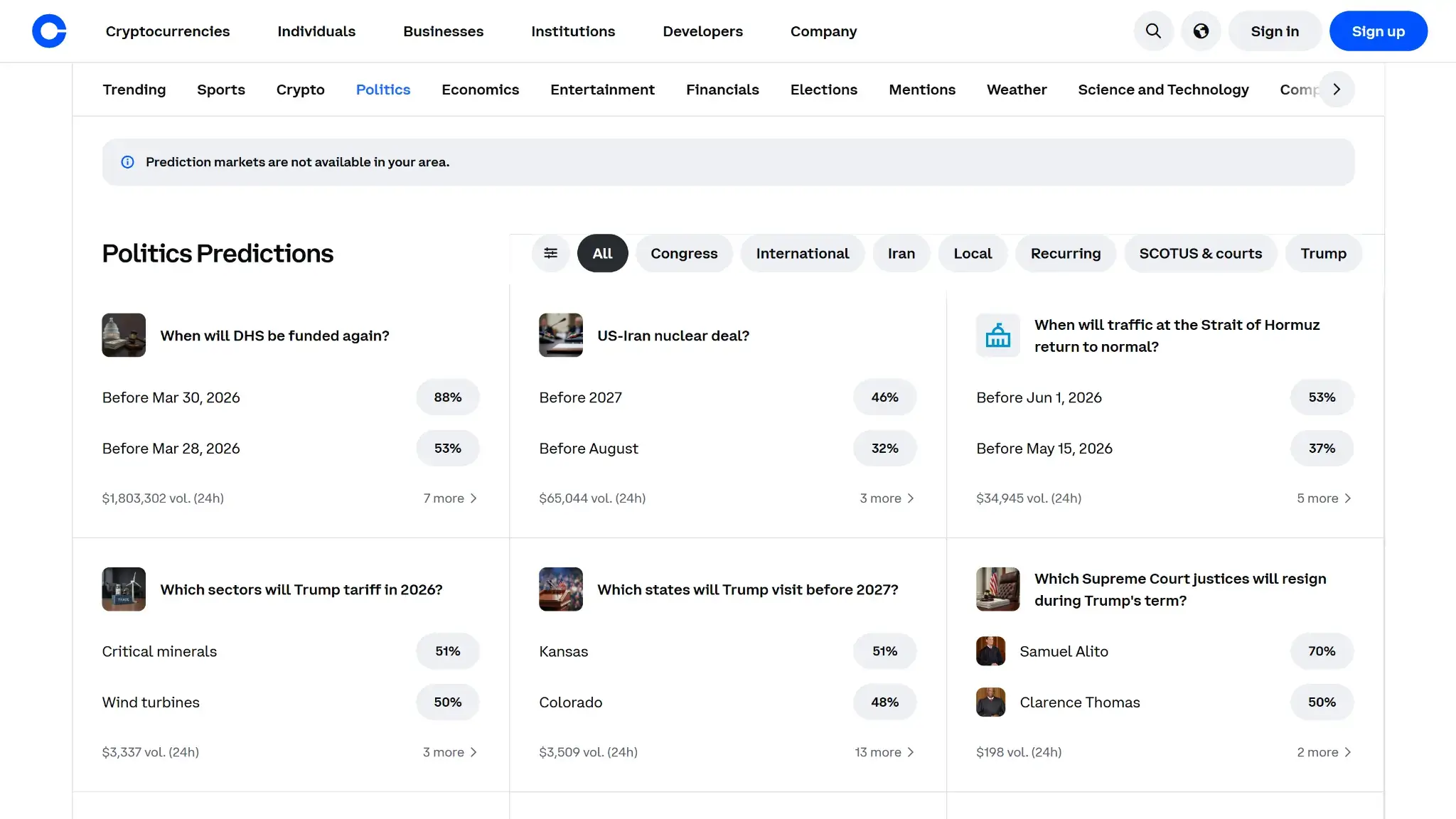
Coinbase Predictions politics page showing political prediction markets, topic filters, and market odds on desktop.
Contract Design Notes
Binary Yes / No Markets — Yes. This is the default structure across the platform.
Multi-Outcome Markets — Handled mostly as sets of mutually exclusive yes-or-no contracts rather than one richer multi-outcome order screen.
Range Or Bracket Markets — Supported in a limited way through threshold and target-style binaries, not as a true scalar ladder.
Short-Dated Or Intraday Markets — Present, especially in crypto and some sports, including very short-dated timing and target markets.
Longer-Dated Markets — Supported for elections, company events, awards, and other longer-horizon headline questions.
Speed Of New Listings — Faster than a slow legacy venue, but still more curated than Polymarket on breaking stories.
Market Wording Quality — Generally clear, with rules and source-of-truth language on the contract page, but you still need to read the resolution terms closely.
The market mix is genuinely useful if you want a regulated, mainstream event menu inside Coinbase, especially around crypto, finance, and major headline events. It is less convincing if you want the deepest politics board, a constant stream of niche listings, or a sports menu dense enough to replace a specialist exchange.
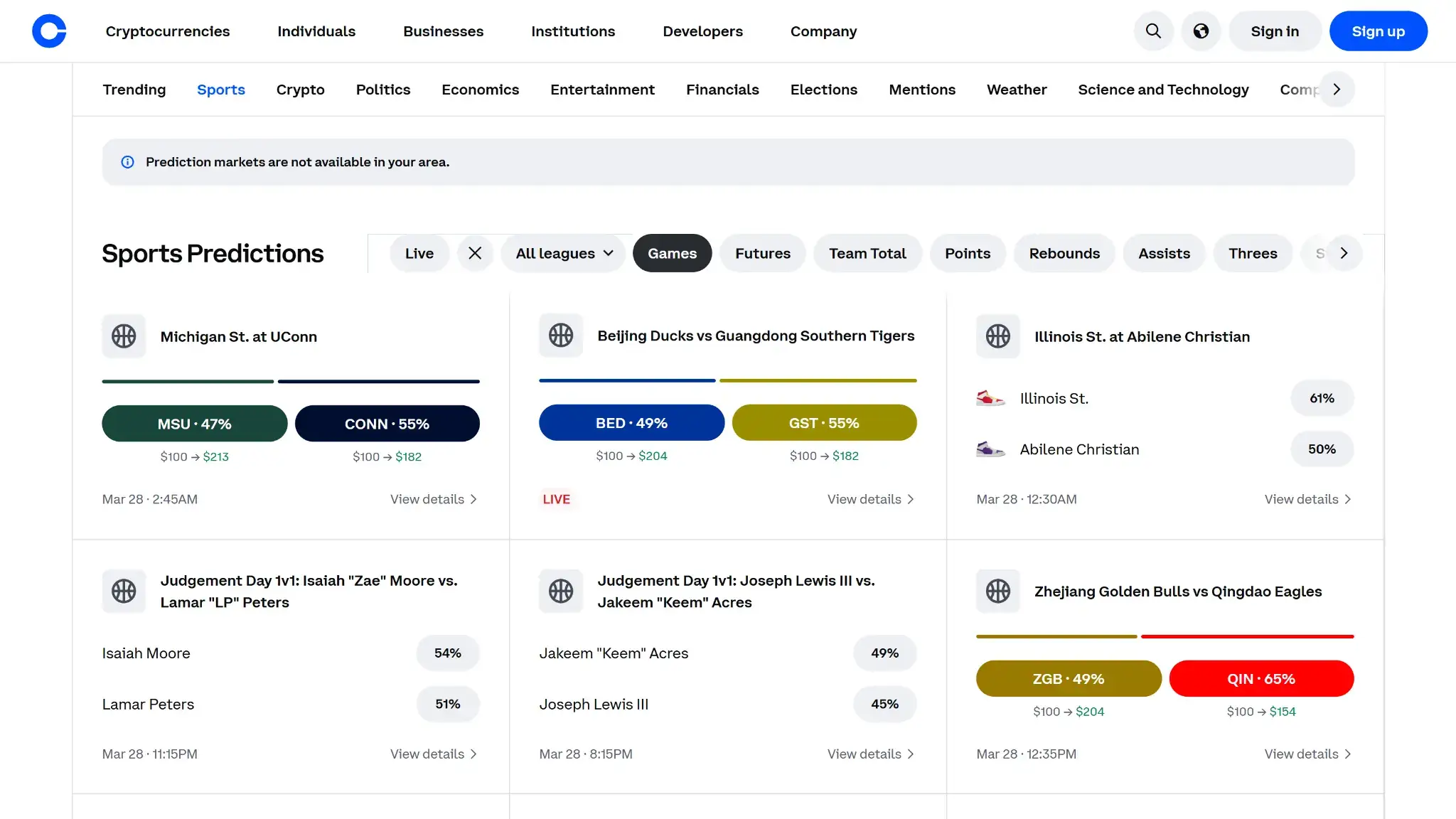
Coinbase Predictions sports page showing live sports prediction markets, game cards, league filters, and event odds on desktop.
Liquidity, Order Book and Execution Quality
Coinbase prediction markets are tradable mainly on newsworthy events. The product looks usable on major crypto, macro, political, and headline sports markets, but depth becomes harder to trust once you move away from the promoted contracts and broader category labels.
Depth on Major MarketsUsually workable on headline markets, but larger orders can still be split across multiple sellers and prices
Depth on Quieter MarketsHarder to judge and more likely to thin out once you leave the main event flow.
Bid-Ask Spread BehaviorNot disclosed
Limit OrdersOpen orders exist
Instant Buy / Market-Style ExecutionYes. Purchases start at the best price available.
Partial FillsYes. Large orders may be split across multiple sellers at different prices
Exit Before ResolutionYes. Users can sell open contracts before the market closes
Visible Volume / Open InterestLimited
Position LimitsYes. Per-market limits apply and include both filled contracts and open orders
Slippage RiskModerate on larger or quieter markets because fills can happen across several sellers and price levels
The platform feels most liquid where public attention is already high, especially around crypto, macro, and major event-driven markets. It gets thinner once you move into less-popular contracts. That's where the same headline can price differently from rivals because venue user bases, listing timing, and contract wording do not line up perfectly.
Fees And Total Cost To Trade on Coinbase Prediction Markets
Coinbase prediction markets are fine for casual users but complex for active traders. Fees are shown on the order page before you place a trade, which helps in the moment, but there is no simple public fee card that makes venue-level cost comparison easy.
Cost Component
What Users Pay
When It Applies
Notes
Trading Fee
Disclosed before each trade; exact public rate card Not Disclosed
On buys and sells
Prediction trades include transaction fees
Spread Or Slippage Cost
Varies by market depth
On entry and on early exit
This becomes the main hidden cost in quieter contracts
Deposit Fee
Varies by Coinbase funding method
When adding cash to the main Coinbase account
Not a separate prediction-market fee
Withdrawal Fee
Varies by Coinbase cash-out method
When moving money from the primary account to a bank, card, or other rail
Not prediction-market-specific
Network Or Gas Fee
Not Applicable for on-platform prediction trades
Only if you later move crypto off-platform
Prediction markets themselves do not settle onchain
FX Or Conversion Fee
Varies if you convert assets into USD or USDC first
When funding from non-eligible balances
Avoidable if you already hold USD or USDC
Subscription Or Premium Fee
No separate subscription required
Not Applicable
No prediction-market access subscription is required in public materials
Third-Party Provider Fee
Varies by payment rail
When using linked payment methods or instant cash-out options through Coinbase
Depends on the wider Coinbase funding path, not the contract itself
The cost picture looks light if you already hold USD or USDC, trade mostly liquid headline markets, and cash out through low-friction Coinbase rails. It gets more expensive when you convert assets, trade thinner contracts, or rely on paid instant cash-out methods. The main blind spot is not necessarily high headline fees, but that total cost is harder to compare up front than on a platform with a clear public schedule.
Funding, Settlement and Cash-Out Flow
This is where Coinbase prediction markets create the most confusion in real use. Funding is simple if you already use Coinbase, but resolution, balance updates, and actual cash-out do not happen at the same time.
Step
Typical Speed
Common Friction
Deposit
Immediate to several business days
Depends on funding method and Coinbase cash holds
Buying Power Availability
Immediate if using already available USD or USDC; slower if funds are on hold
Payment-method holds and unsettled balances
Contract Settlement
At market close once the result is confirmed
Final confirmation can take longer if the source of truth is still being verified
Balance Becoming Withdrawable
Every two hours from 6am to 4pm ET on business days after payout is processed
No automatic transfer on weekends, U.S. bank holidays, or outside the transfer window
Withdrawal Request
Usually immediate to initiate once funds hit the main Coinbase account
You must wait for the auto-transfer from predictions first
Funds Arrival
Instant to around 30 minutes for eligible instant cash-outs; 1 to 5 business days for ACH; 1 to 3 business days for wire
Depends on the selected Coinbase cash-out rail and bank or provider timing
These steps move on different clocks. A market can resolve first, then your balance can update for prediction trading, and only after that can the funds move back to your main Coinbase account for withdrawal. Actual cash-out usually takes longest, because it still depends on the transfer window and the withdrawal method you use.
Prediction winnings become immediately reusable inside the Prediction Market USD balance, but off-platform withdrawal still waits for the scheduled auto-transfer window back to the primary account.
Resolution Rules, Market Integrity and Disputes
Coinbase prediction markets are mostly clear, but they can still get tricky at the edges. Most yes-or-no contracts are easy to read, and the payout logic is simple. Each market uses a defined outcome source and usually settles soon after the result is confirmed. The bigger risk comes from contracts tied to exact wording, timing, or media mentions, where a small detail can change the result.
Most users are unlikely to struggle with plain event markets. Confusion is more likely on novelty or headline-driven contracts, especially when the wording leaves room for interpretation. That makes disputes more of an edge-case problem than a daily one. For serious use, this platform works best on clearly written markets with little room for doubt.
Security, Custody, Privacy and Trust
The main trust sits with the broker and the broader Coinbase account system, not with a wallet setup or smart contracts. Funds used for prediction trading move through Coinbase Financial Markets and then back to the main Coinbase account, so users do not control private keys or self-custody the trading balance.
Account protection relies on the standard Coinbase login stack, including two-step verification and device checks, while the privacy trade-off is meaningful because prediction access requires identity data and financial-suitability information.
CFTC oversight and NFA membership add a real layer of external validation. The main trust risk comes from platform custody, changing access rules, and unusual markets that may be harder to resolve cleanly. For most users, account security and market structure matter more here than smart-contract risk or payout math.
Recent Incidents And Reputation Issues
A 2025 insider-assisted customer-data theft exposed personal information for a subset of Coinbase users and led to reimbursements for users tricked into sending funds to attackers. That was not specific to prediction markets, but it still matters because prediction trading runs through the same account and identity layer.
Another issue came from a speech-based market tied to a Coinbase earnings call. Because the contract depended on what an executive would say, the person at the center of the market could influence the result. That exposed a weakness in novelty contracts tied to company speech.
UX, Apps, Automation and Data Access
Coinbase prediction markets feels built mainly for casual mobile use, with web support for those who prefer a larger screen. It is not built for automation or research-heavy desk trading.
Surface Or Tool
Availability
Notes
Web App
Yes
Full market access through the browser experience
iOS App
Yes
Core prediction trading and portfolio tracking are available
Android App
Yes
Core prediction trading and portfolio tracking are available
Desktop App
No
Browser-based access only
Watchlists And Alerts
No
No dedicated prediction-market watchlist or alert layer stands out
API Access
No
No public prediction-market API is available
WebSocket Or Live Market Feed
No
No public live prediction feed is exposed for users
Historical Data Access
No
No public prediction-market historical dataset is available
Trade History Export
No
Position and transaction views exist, but export tooling is limited
The interface is easy to scan for casual trading. Rule visibility is decent once you open a contract, and the portfolio view makes open positions and payouts easy to follow. Charting is limited, data depth is thin, and the product is not built for bot workflows, research pipelines, or serious cross-market tracking.
Coinbase sign up page on desktop showing account creation form with email field, Continue button, Google sign up, Apple sign up, and sign in link on a dark background.
The UX helps simple decision-making more than it improves serious trading. It looks polished, but the polish comes from the broader Coinbase app experience, not from unusually deep market tools.
Taxes, Statements and Record-Keeping
Coinbase gives you enough to track occasional trades, but it does not feel built as a purpose-made prediction-market reporting tool.
Tax Forms: Coinbase Taxes and IRS forms are available.
Account Statements: Monthly and custom statements are available.
CSV Or Export Quality: CSV exists, but prediction-market exports are limited.
Cost-Basis Visibility: Fill price, payout, and profit are visible.
What You Still Need To Track Yourself: Early exits, open positions, fees, and slippage.
The process is painless for light users who place a handful of trades and already keep the rest of their activity inside Coinbase. It gets more annoying for active traders, anyone closing positions early across many markets, or those who want clean prediction-market exports without extra reconciliation.
Customer Support, Limits and Incident Handling
Help content is easier to find than direct human support. Routine guidance is solid, but anything more serious runs through the wider Coinbase support system.
Help Center: Covers onboarding, trading, payouts, balances, and account closure.
Live Chat And Tickets: Available through Coinbase Support and the main Contact Us flow.
Status Page: Tracks major service outages and incidents across Coinbase.
Account And Position Limits: Funding holds, security reviews, and per-market position limits can all affect access.
What Support Can And Cannot Fix: Support can help with access, onboarding, and payout visibility. It cannot reverse trades, market losses, resolved outcomes, or bank-side delays.
Support is good enough for account problems, but not for trading mistakes. Its value is in fixing access issues, not undoing a bad market decision.
Final Verdict
Coinbase prediction markets is the most convenient regulated option for U.S. users already on Coinbase, but convenience is doing most of the work here. The product is real and regulated, but it trails Kalshi on exchange depth and Polymarket on market breadth and data access. The cash-out flow, the scheduled transfer window, and the absence of any API or historical data suggest a product built for occasional retail use rather than active trading. The insider-data breach and the earnings-call contract episode both point to trust risks that sit outside the prediction market itself but run through the same account layer. At 6.5/10, it earns its score by being accessible and regulated, not by being good at prediction markets specifically.
Uses the same Coinbase account instead of a separate market login
Supports both USD and USDC for prediction trades
Lets you sell open contracts before final resolution
Works on mobile app and web, with portfolio tracking in both
CONS
Available only to U.S. residents, with Nevada excluded
Requires full KYC plus suitability-style financial onboarding
No public API or built-in historical market data access
Position limits can cap how much you can hold in a market
Affiliate Disclosure
Disclaimer: CryptoSlate may receive a commission when you click links on our site and make a purchase or complete an action with a third party. This does not influence our editorial independence, reviews, or ratings, and we always aim to provide accurate, transparent information to our readers.
FAQ
Is Coinbase prediction markets legal where I am?
This product is available only in one country: the United States. Nevada is excluded, so Nevada residents cannot open new prediction trading access. If you are a U.S. resident and travel abroad, access does not automatically disappear just because you are outside the country for a period of time. The real check is your U.S. residency and account eligibility, not just your current location on a trip.
Does Coinbase prediction markets require KYC?
Yes. This product requires full identity verification, not just a light account check. You need a Coinbase account first, then a separate Coinbase Financial Markets application. That process can include SSN or TIN details, photo ID, and questions about employment, trading experience, income, and net worth. If you want fast access with minimal checks, this platform will feel restrictive.
Can I sell before the market resolves on Coinbase prediction markets?
Yes. Coinbase prediction markets lets you sell open contracts before the market closes. The trade can still be affected by current market depth and price changes at the time you exit. On quieter markets, your sale price may be worse than you expected. Early exit is useful, but it is not the same thing as guaranteed smooth liquidity.
How long does it take to actually withdraw winnings from Coinbase prediction markets?
It usually takes longer than the market result itself on Coinbase prediction markets. After a market resolves, winnings first become available inside the predictions balance. They then auto-transfer to your main Coinbase account every two hours from 6am to 4pm ET on business days. There is no automatic transfer on weekends, U.S. bank holidays, or outside that window. After the funds reach the main Coinbase account, the final timing depends on the cash-out method you use, such as instant cash-out, ACH, or wire.
Why is the same event priced differently on Coinbase prediction markets and Kalshi?
The same headline can price differently because the two platforms do not have the same user base, liquidity, timing, or contract wording. A market that looks similar at first glance may still resolve on slightly different terms. One platform can also react faster to news than the other, which changes the price in the short term. On thinner books, even modest order flow can move prices more than users expect. That is why price gaps can stay open even when the markets seem to ask the same basic question.
How are disputed, clarified, or voided markets handled on Coinbase prediction markets?
Most standard markets are simple enough that disputes are rare on Coinbase prediction markets. Each contract uses a defined outcome source, and most clear yes-or-no markets settle without much confusion. The bigger risk shows up on contracts tied to exact wording, timing, or media mentions. In those cases, the market rules matter more than the headline alone. Users should treat clarification and void risk as an edge-case issue, but still read the resolution rules before entering any market that looks even slightly ambiguous.
Does Coinbase prediction markets offer an API and historical data?
No public prediction-market API is available on Coinbase prediction markets. There is also no public historical data feed built for research or bot workflows. That makes the platform weaker for active traders who want to model, scrape, or compare markets in a structured way. The interface is fine for manual trading and position review, but not for automation-heavy work. If API access and data history matter to you, platforms like Polymarket or Kalshi are a better fit.