China’s economic shift and its implications for crypto
CryptoSlate's latest market report dives deep into shifts in China's economic policies and the effects it could have on the global financial and crypto markets.
China has been a cornerstone in shaping the global financial narrative. Its rapid ascent over the past few decades has not only propelled China to the forefront of global economies but has also intertwined its fate with that of numerous nations, making its economic health a matter of global significance.
Recently, however, the dragon seems to be catching its breath. The Chinese economy is currently navigating a maze of challenges, with indicators pointing towards a slowdown. One of the most glaring signs of this shift is the depreciation of the yuan. Historically stable and backed by robust economic performance, the yuan’s recent decline has raised eyebrows in financial capitals across the world. This is further compounded by China’s evolving stance on U.S. Treasurys, a critical component of its foreign reserves and a significant indicator of its confidence in the U.S. economy.
Given the intricate web of global finance, where traditional and digital assets often intersect, China’s economic dynamics have profound implications for the cryptocurrency market.
In this report, CryptoSlate dives deep into these potential ripple effects, exploring how shifts in China’s economic policies and performance could affect the crypto market.
Macro environment
China’s economic narrative in recent years has been one of unparalleled growth, innovation, and integration into the global market. However, the current phase paints a more nuanced picture, with the nation grappling with a discernible economic deceleration. This slowdown, while anticipated by some economists given the country’s rapid expansion, has been more pronounced than expected and has been influenced by a confluence of factors.
The ongoing trade war with the U.S. has significantly impacted China’s export-driven economy. Tariffs and trade restrictions have curtailed its access to key markets, affecting manufacturing and exports.
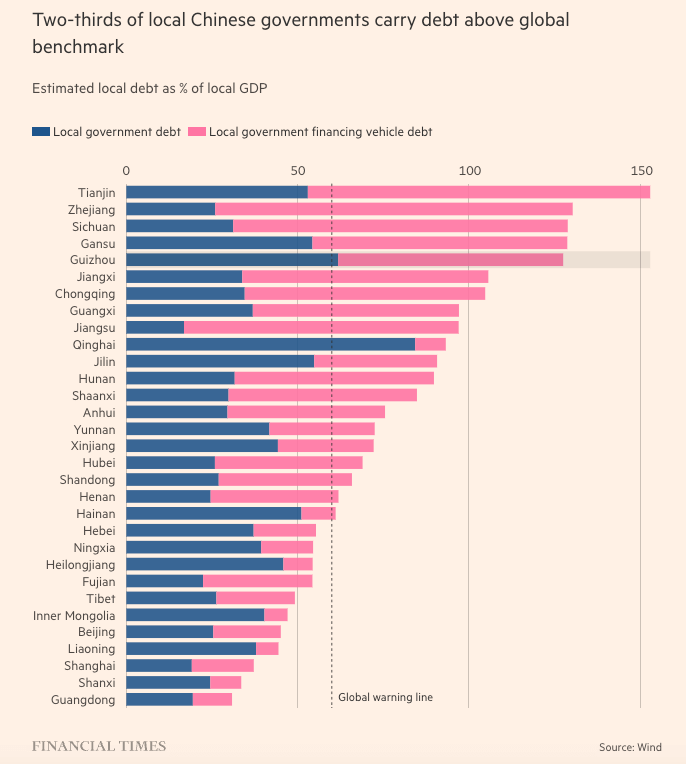
China’s corporate and local government sectors have accumulated substantial debt over the years. This burgeoning debt has raised concerns about potential financial risks and systemic vulnerabilities.
Chart showing the estimated local debt of Chinese provinces as percent of local GDP (Source: FT)
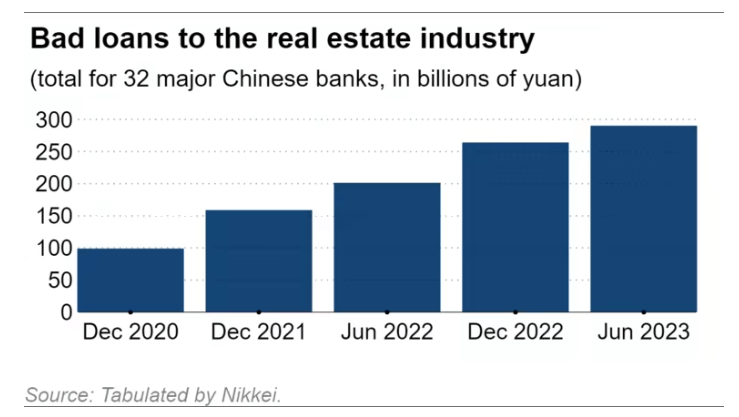
The real estate market, once a pillar of China’s economic growth, has shown signs of strain. Major property developers, like Evergrande, are facing liquidity challenges, leading to reduced consumer confidence in the sector.
Chart showing bad loans to the real estate industry at 32 major Chinese banks (Source: Nikkei Asia)
In response to these challenges, China’s central bank has been proactive. Measures such as interest rate cuts, reserve requirement ratio reductions, and targeted liquidity injections have been implemented to stimulate economic activity and restore investor confidence.
However, China’s economic trajectory doesn’t exist in a vacuum. Its slowdown has broader implications for the global economy. As a major trade partner for numerous countries and a key player in global supply chains, any shift in China’s economic health can ripple across global markets, affecting trade balances, commodity prices, and investor sentiment worldwide.
Currency dynamics
The yuan holds a pivotal position in the global currency markets. The yuan’s trajectory is not just a reflection of China’s domestic economic health but also an indicator of broader global economic trends and sentiments.
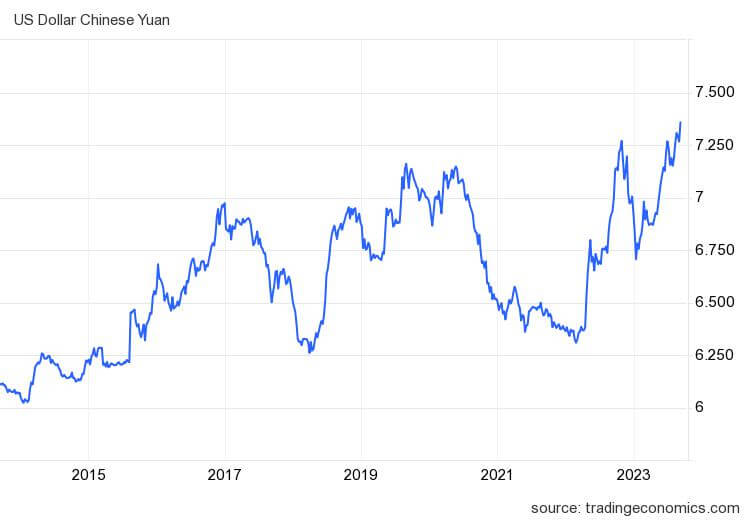
The yuan has been steadily making its mark on the international stage. In recent years, efforts have been made to internationalize the yuan, with its inclusion in the International Monetary Fund’s Special Drawing Rights (SDR) basket being a significant milestone. This move was a testament to China’s growing influence in global finance. However, the currency’s recent depreciation has raised concerns about its stability and the potential for capital outflows from China.
Graph showing USD/CNY from 2013 to 2023 (Source: TradingEconomics)
China’s state-owned banks play a crucial role in managing the yuan’s value. Under the guidance of the People’s Bank of China (PBOC), they have been actively intervening in the foreign exchange markets. By selling U.S. dollars and purchasing yuan, they aim to stabilize and bolster the currency’s value. This intervention is a strategic move to prevent rapid depreciation, which could lead to capital flight and further economic instability.
The yuan’s depreciation has far-reaching implications. For one, it makes Chinese exports more competitive, potentially leading to trade imbalances with other nations. Additionally, a weaker yuan can trigger concerns of a potential currency war, where nations competitively devalue their currencies to gain trade advantages. Such dynamics can lead to increased volatility in global currency markets.
Furthermore, emerging markets, many of which are closely tied to China’s economic fortunes, might feel the pressure on their currencies as investors seek refuge in perceived safer assets. The ripple effects of the yuan’s movements can also influence global investment strategies, commodity pricing, and even the monetary policies of other central banks.
China’s relationship with U.S. debt
Historically, China has been one of the largest foreign holders of U.S. Treasurys, underscoring the two superpowers’ intertwined economic fates.
For decades, China has accumulated vast reserves of U.S. Treasurys. This accumulation was strategic; it helped China keep its currency, the yuan, pegged to the dollar, ensuring export competitiveness. Moreover, being seen as a safe-haven asset, U.S. government bonds provided China with a secure and liquid investment avenue for its foreign exchange reserves.
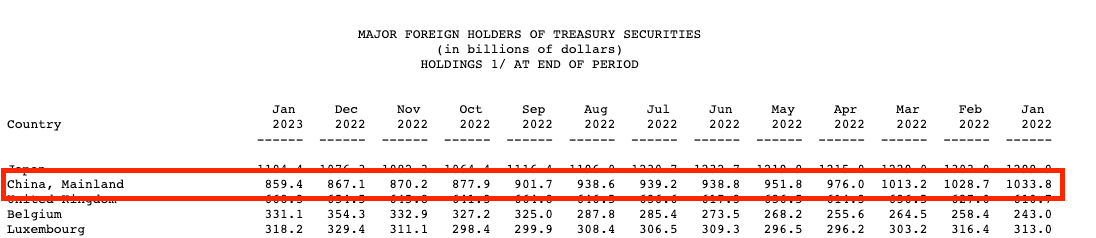
However, recent trends indicate a shift. China has been gradually reducing its holdings of U.S. debt. Reports suggest that China has been offloading U.S. Treasurys at an accelerated rate, a move that some interpret as a response to trade tensions. In contrast, others see it as a broader strategy to diversify reserves and reduce dependency on U.S. assets.
Screengrab showing China’s holdings of Treasury securities from January 2022 to January 2023 (Source: U.S. Treasury)
China’s divestment from U.S. Treasurys can have several implications. Firstly, a significant reduction in demand for U.S. debt could lead to rising interest rates. Higher interest rates might increase borrowing costs for the U.S. government and American consumers, potentially slowing economic growth.
Furthermore, if China’s selling is perceived as a lack of confidence in the U.S. economy or a strategic move in geopolitical chess, it could increase market volatility. Other foreign investors might reevaluate their U.S. debt holdings, leading to broader financial market uncertainties.
Implications for the crypto market
The crypto market is not immune to the broader economic dynamics of major global players like China. As traditional financial systems and digital assets become increasingly intertwined, the ripples from China’s economic landscape can create waves in the crypto ecosystem.
China’s economic dynamics can influence cryptocurrency prices in several ways. For instance, economic uncertainties or perceived instabilities in traditional markets might drive investors towards decentralized assets like cryptocurrencies, viewing them as potential hedges against traditional market downturns. Conversely, positive economic indicators or stringent regulatory measures from China could deter investments in the crypto space, leading to price corrections.
Furthermore, China’s stance on cryptocurrency mining and trading plays a pivotal role. Any regulatory shifts, be it crackdowns on mining operations or easing trade restrictions, can have immediate and pronounced effects on global cryptocurrency supply, demand, and prices.
Investors, always on the lookout for signals, often use China’s economic indicators as a barometer for broader market health. A robust Chinese economy might instill confidence, leading investors to take on riskier assets, including cryptocurrencies. On the other hand, negative indicators, such as declining GDP growth or rising debt levels, might push investors towards safer assets, potentially moving away from the volatile crypto market.
However, the decentralized and global nature of cryptocurrencies also means that they can serve as alternative investment avenues when traditional markets face uncertainties. For instance, if the yuan continues to depreciate, some investors might pivot to cryptocurrencies as a means to diversify portfolios and hedge against currency risks.
Conclusion
China’s current economic trajectory, marked by a discernible slowdown, is not an isolated phenomenon. It’s influenced by a myriad of factors, from trade tensions with the U.S. to internal challenges like burgeoning debt levels and a cooling property sector. The yuan’s depreciation and China’s evolving stance on U.S. Treasurys further complicate this, signaling potential shifts in the global economy.
The repercussions of these economic dynamics are far-reaching. In traditional finance, China’s actions and policies can influence global interest rates, trade balances, and investment strategies. In the crypto space, China’s economic health and regulatory stance can sway prices, trading volumes, and investor sentiments.
For the global financial and cryptocurrency markets, this means a period of heightened vigilance. Investors, policymakers, and stakeholders must be attuned to China’s economic indicators and policy shifts and be ready to adapt and respond. The interconnectedness of today’s financial systems ensures that a ripple in one part of the world can create waves elsewhere.