PancakeSwap works best when your funds already sit in a wallet and you want one place to swap, deploy liquidity, earn on CAKE, and access a few higher-risk tools. Compared with more retail-style exchange products, it stretches well beyond simple swaps with 10-chain access, perpetuals, and CAKE.PAD, though that range also leaves more risk-checking with the user and far less hand-holding than a typical retail exchange.
Available across 10 chains, with swapping, liquidity, rewards, perpetuals, prediction, lottery, and CAKE.PAD in one interface.
Non-custodial by design. PancakeSwap says users keep 100% ownership of their crypto.
Low core swap fees on EVM v3, with fee tiers starting at 0.01%.
Social login lowers setup friction by creating a browser-based self-custodial wallet without a seed phrase at signup.
Cons
PancakeSwap does not run a dedicated customer support desk. Help is routed through docs and community channels.
Asset coverage is broad, but there is no fixed published catalog and permissionless pools raise token-quality risk.
Fiat access depends on third-party on-ramp providers, which adds pricing and regional variability.
U.S. availability is product-dependent, and the current Terms of Service exclude U.S. users from Initial Farm Offerings.
Is PancakeSwap Worth It?
Yes, if you already know your way around a wallet and want one place to handle more than just token swaps. PancakeSwap is strongest when you use it as a hub rather than a single-purpose tool. It brings swaps, liquidity management, CAKE rewards, crosschain routing, and higher-risk products like perpetuals under one roof. For users who move between swaps, liquidity, and rewards, having those tools in one place is more useful than chasing a single standout feature. The base swap fees on supported pools also stay low enough to keep it useful for routine DeFi use.
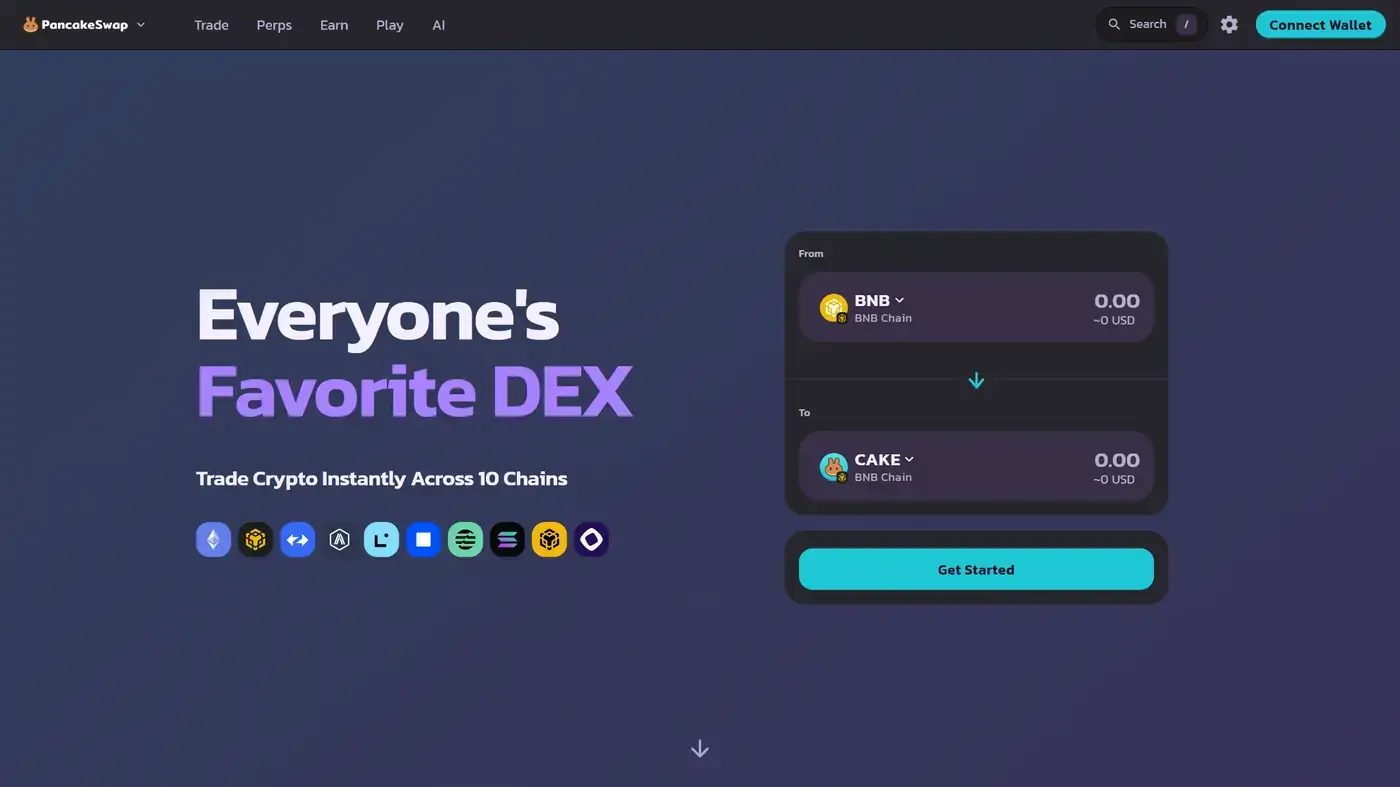
PancakeSwap desktop hero section showing Everyone’s Favorite DEX, a multi-chain swap widget, and supported chain icons.
The weak spots appear as soon as you need more guardrails. Users who want curated listings, clearer U.S. boundaries, or a real support desk will probably find it frustrating. Brand-new users can also make expensive mistakes here faster than they would on a custodial exchange. PancakeSwap suits people who already check networks, approvals, routes, and token quality before they click confirm.
Who Is PancakeSwap Best For?
PancakeSwap suits intermediate and advanced onchain users. It fits people who already keep funds in self-custody and move across multiple networks. It also fits traders who care about low swap fees and DeFi users who want liquidity and rewards in the same interface. The best fit is an active user who will actually use modules beyond a one-off swap. It also suits people with a higher risk tolerance because more of the safety work stays with the user.
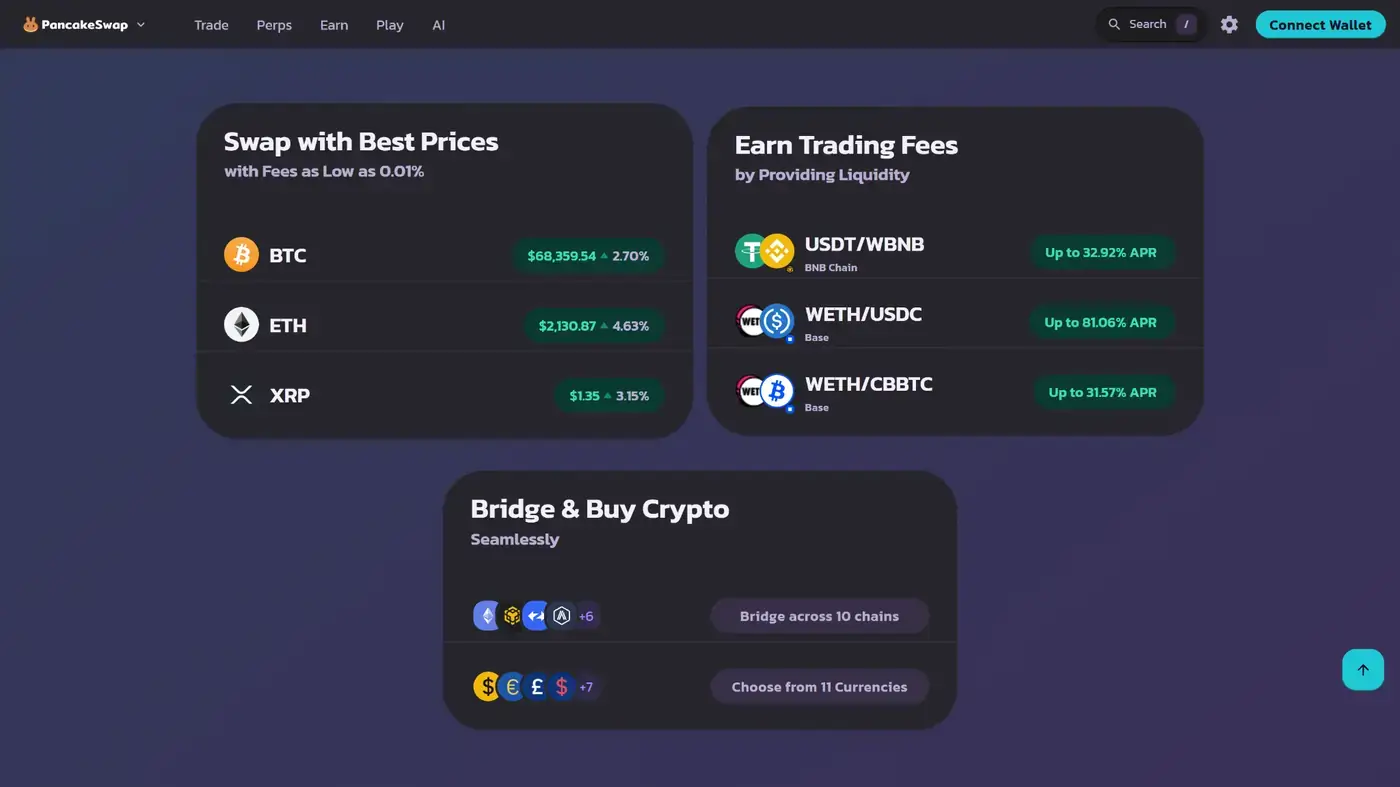
PancakeSwap desktop feature section highlighting swap prices, liquidity fee earnings, and bridge and buy crypto options.
A second good-fit group is curious but not fully advanced users who are willing to start small and stick to well-known assets. Social login makes that first step easier. The weakest fit is the classic beginner. That user usually wants a clear fiat path, support on demand, and a cleaner sense of what is or is not available in the U.S., so more beginner-friendly options will usually make more sense. It is also a poor match for anyone who prefers curated listings, lower product complexity, or a more controlled trading environment. People who mainly want crypto cards that are easier to use day to day are usually looking for a more custodial product.
Raydium Fees and Pricing
Fee capture for this section is Mar. 31, 2026. For most users, PancakeSwap trading fees are low on the swap side and much higher on the fiat-entry side. PancakeSwap is cheapest when you already have assets on-chain. Its main swap product does not use a classic maker-taker schedule. On EVM V3 pools, the published fee tiers are 0.01%, 0.05%, 0.25%, and 1%. V2 pools use a fixed 0.25%, while StableSwap fees vary by pool. Crosschain swaps do not carry a separate PancakeSwap fee, but users still pay the trading fees inside the route plus any bridge costs.
Simple buy or sellNot published as one flat schedule. Spot swaps are route- and pool-based, while Buy Crypto is preview-based through third-party quotes.
Advanced maker or takerNot applicable for core spot swaps. Perpetuals V1 lists 0.02% maker and 0.07% taker.
Card depositProvider-based. Current on-ramp rates run from 2.49% to 5.5%, and PancakeSwap says it adds a 1% service fee.
Bank transferProvider-based. Current bank-transfer rails run from 0.99% to 3.95%, and PancakeSwap says it adds a 1% service fee.
Crypto withdrawalNo platform withdrawal fee in the centralized-exchange sense. Users pay network gas, and bridge routes can add bridge fees.
Maker-taker pricing only really matters on the perpetuals side. The main swap page does not use a normal maker-taker ladder. In practice, the PancakeSwap spread sits inside pool routing or partner previews, and the PancakeSwap withdrawal fee is usually just network cost rather than a platform charge.
That makes the simple buy flow the expensive part of the product, not the swap page itself. Buy Crypto quotes are built around partner pricing, and the spread is effectively wrapped into the preview you see before checkout rather than shown as one permanent house schedule. In practice, card purchases are the most expensive route, while supported bank-transfer rails are usually the least painful fiat entry point.
If you look past spot and into trading products, PancakeSwap splits pricing by engine. Perpetuals V1 is the closest thing to a conventional maker-taker model, with 0.02% maker and 0.07% taker fees. Perpetuals V2 uses chain-based opening and closing fees instead. Those charges are 0.05% on Arbitrum and 0.08% on BNB Chain, opBNB, and Base, plus a 0.02% FX fee and a separate execution fee. There is no meaningful base-tier versus top-tier ladder for the core DEX because the main swap interface prices by route, not by user volume.
The earn side has its own costs too. For the CAKE pool, PancakeSwap currently lists a 2% charge on flexible staking rewards, plus a 0.1% withdrawal fee if you unstake within 72 hours of your last deposit. That matters less for casual users, but it is still part of the real cost picture if you plan to park CAKE on the platform.
The easiest ways to keep costs down are simple. Come in with your own onchain funds when possible, because the wallet-to-swap route is much cheaper than buying through fiat partners. Check the route details before confirming, since PancakeSwap shows the exact fee section for the current swap. When you do need fiat access, bank-transfer rails are usually cheaper than cards, and lower-fee networks matter more than brand loyalty once you start moving funds between chains.
VIP Tiers and Fee Discounts
PancakeSwap does not publish a real public VIP ladder for its main swap product. There is no 30-day volume schedule for spot swaps, no subscription plan that lowers the standard swap fee, and no exchange-style tier system that rewards heavier spot traders with progressively lower pricing.
The clearest fee-linked discount appears on Perpetuals V1, where paying trading fees in CAKE reduces the 0.02% maker and 0.07% taker fees by 5%. That is a product-specific discount, not a platform-wide fee program. It does not change Buy Crypto quotes, and it does not create a cheaper volume tier for the main spot swap flow.
Deposits, Withdrawals, KYC and U.S. Availability
PancakeSwap does not publish one clean exchange-style funding schedule because the core product is a wallet-to-protocol interface, while fiat access sits behind third-party on-ramp partners. That makes the funding picture less tidy than it would be on a regular exchange. You can fund the app either by connecting your own wallet or by using Buy Crypto, but PancakeSwap does not publish a built-in fiat off-ramp in the current docs.
Payment Method
Minimum Deposit
Minimum Withdrawal
Maximum Withdrawal
Connected wallet assets
Not published
Not applicable
Not applicable
Buy Crypto via partner card or bank transfer
Usually above $30 equivalent
Not applicable
Usually below $10,000 equivalent, depending on token and provider
Crosschain route
Route-dependent
Not applicable
Route-dependent
Fiat off-ramp from PancakeSwap
Not published
Not available
Not available
PancakeSwap does not publish one clean limits schedule because the wallet flow, crosschain flow, and Buy Crypto flow all work differently.
Geo Access and Entity Mapping
Region or Country
Operating Entity
What Is Available
Notes
U.S.
Not clearly disclosed
Core wallet-based use and partner-led Buy Crypto where supported
Product access is feature-specific. USD on-ramp is not available for Base, Arbitrum, or Linea in the current Buy Crypto docs.
EU or EEA
Not clearly disclosed
Core wallet-based use plus partner-led Buy Crypto
SEPA funding is available through supported providers, but methods vary by provider and country.
UK
Not clearly disclosed
Core wallet-based use plus partner-led Buy Crypto
Faster Payments support exists through supported providers.
RoW
Not clearly disclosed
Core wallet-based use plus partner-led Buy Crypto in select regions
Provider coverage, fiat methods, and identity checks vary by local rules and payment rail.
PancakeSwap itself is publicly reachable as a DEX interface. Its fiat rails behave more like a marketplace of partner options than a house banking stack. Most region limits show up through provider availability, supported chains, and product-specific restrictions rather than through one master country list on the main app.
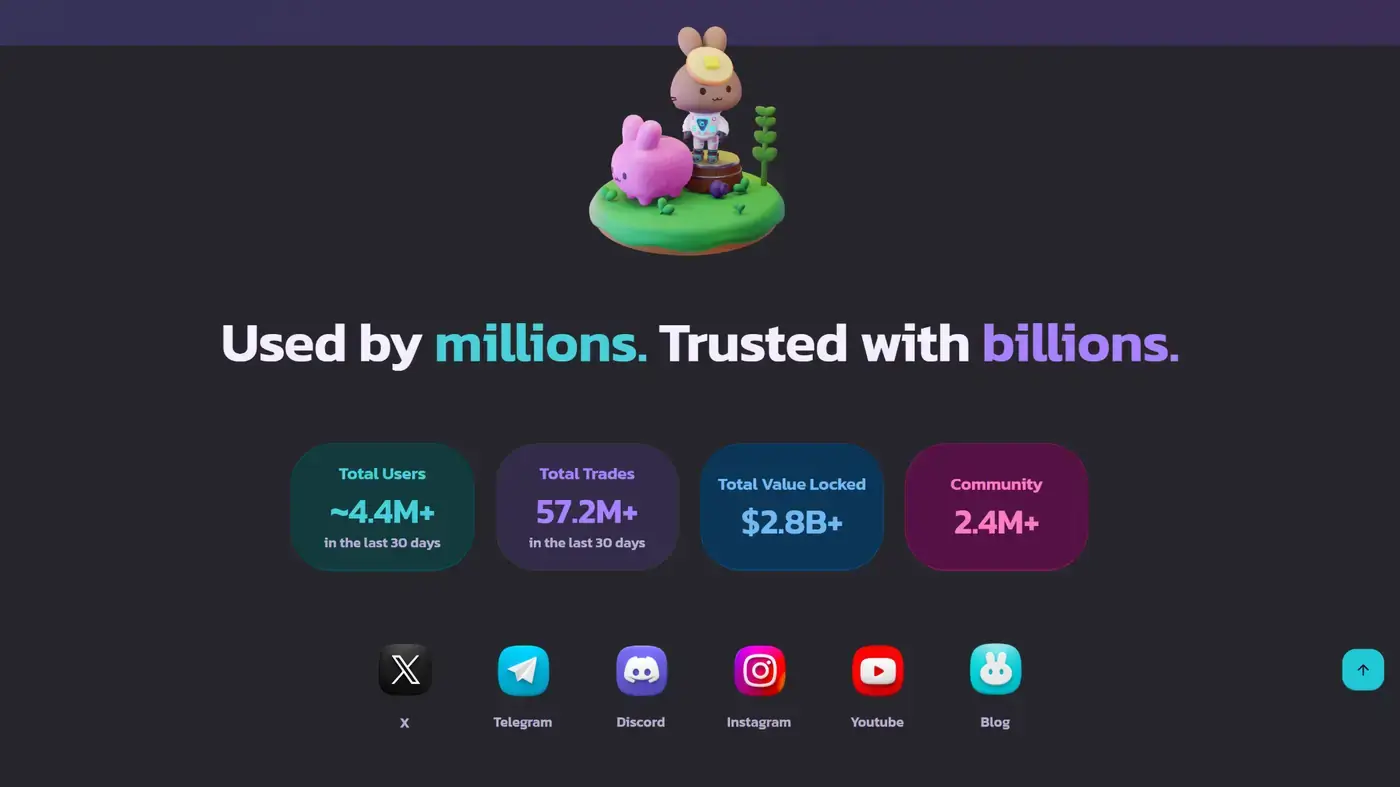
PancakeSwap desktop stats section showing user, trade, total value locked, and community figures with social media links.
Registration and Onboarding
For standard swapping, there is no normal account registration flow. PancakeSwap’s product docs say you can swap with no registration or account at all. The default path is simply to connect a wallet and use the protocol.
For people who do not want to start with a seed phrase, social login is the easier entry point. You click Connect Wallet, choose social login, and sign in with Google, X, Telegram, or Discord. PancakeSwap then creates a self-custodial wallet in the background. After first login, it prompts you to set a recovery password. That step is optional, but the docs recommend it and say the prompt returns if you skip it.
KYC does not appear in the normal swap flow. It shows up when you use Buy Crypto, and PancakeSwap says the level of identity evidence depends on the provider, the payment method, and the payment amount. Social-login sessions last 30 days. That wallet also stays limited to PancakeSwap. It does not behave like a portable wallet you can export, import, or connect broadly through WalletConnect.
Fiat Rails by Region
This table reflects on-ramp availability through PancakeSwap partners, not a native PancakeSwap banking stack.
Region
ACH
SEPA
Faster Payments
Wire
Cards
PayPal
Notes
U.S.
Not clearly published
—
—
Not clearly published
Yes
Yes, partner-dependent
Cards are the main verified rail. MoonPay also supports PayPal and Venmo in supported U.S. regions.
EU or EEA
—
Yes
—
Not clearly published
Yes
Yes, partner-dependent
SEPA is available through MoonPay, Mercuryo, and Transak, with timing that depends on bank and provider.
UK
—
Not clearly published
Yes
Not clearly published
Yes
Yes, partner-dependent
Faster Payments is supported through MoonPay and Transak.
RoW
Varies
Varies
Varies
Varies
Yes
Varies
Cards have the widest footprint. Local methods depend on provider and country.
For most cost-sensitive users, the practical low-cost funding route is bank transfer through whichever provider supports SEPA or Faster Payments in their region. Cards are faster, but they are clearly more expensive.
ACH, wire, and PayPal support sit with payment partners rather than with PancakeSwap itself. The current docs do not show a native ACH or wire stack, and PayPal appears only through some supported third-party providers.
Often the cheapest EVM-native route on PancakeSwap-supported chains.
ETH ERC-20
Network only
About 5–15 minutes
Gas varies with network load.
USDT ERC-20
Network only
About 5–15 minutes
More expensive than lower-fee chains for small transfers.
USDT TRC-20
Not supported on the chains listed in PancakeSwap’s current docs
Not applicable
Tron is not part of PancakeSwap’s supported chain list in the current docs.
Crosschain route
Trading fee plus bridge fee, with no extra PancakeSwap fee
Usually seconds to under a minute
Across failures are refunded in about 90 minutes to 2 hours. Relay refunds can be about a minute on supported routes.
When several routes are available, the cheapest move is usually to avoid Ethereum mainnet for small transfers and use a lower-fee supported chain such as BNB Chain, Base, Arbitrum, or Linea when the token and destination both support it.
Verification Levels and Withdrawal Limits
PancakeSwap does not publish named account levels the way a centralized exchange does. The closest thing to a levels model here is the split between wallet-only use, social login, and provider-led Buy Crypto checks.
Level
Required Documents
Fiat Deposit Limit
Fiat Withdrawal Limit
Crypto Withdrawal Limit
Typical Review Time
Core wallet-based use
None from PancakeSwap
Not applicable
Not applicable
Not published as a platform limit
Immediate once wallet is connected
Social login wallet
Social account login, optional recovery password
Not applicable
Not applicable
Not published as a platform limit
Immediate once social login succeeds
Buy Crypto via partner
Provider-specific identity evidence based on payment mode and amount
Provider-specific
Not available through PancakeSwap
Not applicable
Provider-specific
That means most of the friction sits with the fiat partner rather than with the DEX itself. The docs also do not publish one clean house schedule for PancakeSwap withdrawal limits, a travel-rule style transfer screen for standard swaps, or a whitelist requirement for the core flow. Capture date for this operational section is Mar. 31, 2026.
Is PancakeSwap Safe? Security, Custody and Proof of Reserves
PancakeSwap is best read as a non-custodial protocol interface rather than a balance-custody exchange. PancakeSwap security depends as much on the wallet you use and the contracts you approve as on the interface itself. This section focuses on the parts that matter most to users: custody, platform-side controls, insurance language, audits, and any material security or custody incidents that are publicly documented.
Controls
PancakeSwap’s strongest control is structural rather than procedural. The product overview says it does not hold user funds when you trade, so the first layer of security is still the wallet you bring to the app. For standard wallet users, that means the most important protections sit in MetaMask, Rabby, Binance Wallet, or whichever wallet you connect rather than in PancakeSwap itself.
Inside PancakeSwap’s own docs, the clearest platform-side protections are open-source contracts, verified contracts on explorers, multisig use for contracts, timelocks, a public audits page, and an active bug-bounty program. The current bug-bounty schedule offers rewards of up to $1 million for critical smart-contract or blockchain bugs.
The newer social-login flow adds its own set of controls, but they are still lighter than a centralized exchange account stack. PancakeSwap says those wallets use a 2-of-2 key-share system, sessions last 30 days, and users can add a recovery password for device recovery. The missing pieces matter too. There is no exchange-style withdrawal allowlist, no vault mode, no slow-withdrawal queue, and no platform-wide anti-phishing code for core swaps. Those protections are either optional and wallet-specific, or they do not exist in the usual exchange sense.
PancakeSwap also offers MEV Guard on BNB Chain, which is an optional private RPC path meant to reduce frontrunning and sandwich attacks. That is a useful trading protection, but it is not a substitute for wallet hygiene or contract-risk review.
Custody and Insurance
PancakeSwap custody is straightforward because the platform does not hold your trading balances in the usual exchange sense. Its official docs say the platform does not hold your funds when you trade and that you keep 100% ownership of your crypto. In practice, that means there is no pooled exchange balance sitting under PancakeSwap’s control in the way users would expect on a custodial exchange.
For normal wallet users, private keys stay with the wallet provider and the user. For social-login wallets, PancakeSwap says it does not store wallet-related key shares, while Privy stores encrypted shares as part of the embedded-wallet architecture. That is still self-custody, but it is not the same thing as running a fully portable wallet with export and import controls.
Insurance is where the language gets thinner. PancakeSwap’s FAQ still references CertiK Shield insurance alongside older security audits, but there is no current exchange-wide insurance program, crime policy, or specie policy published for user balances. In practical terms, PancakeSwap is not insured in the way a custodial exchange might market insured balances. Even if a payment partner or bank partner has its own regulated protections, that would not mean your crypto on PancakeSwap is insured.
Proof of Reserves or Audits
There is no proof-of-reserves framework here in the usual exchange sense because PancakeSwap is not holding customer account balances on its own balance sheet. There is no published Merkle tree, liability attestation, user-verifiable solvency page, or other proof-of-reserves workflow that would make sense for a custodial venue.
The more relevant trust signal is the audit trail. PancakeSwap’s official audits page lists multiple smart-contract audits across core products, including Infinity Core and Infinity Periphery in 2024, Exchange V3 in 2023, MasterChef V3 in 2023, and older audits covering cross-chain farming, StableSwap, prediction, lottery, and earlier exchange contracts. That is useful, but the limitation is obvious. Audits are point-in-time reviews of specific code, not a live solvency check and not a guarantee that no later vulnerability exists.
Incidents and Remediation
There is no current official incident archive that cleanly logs past security events, root causes, and post-mortems. That is a real transparency gap compared with larger centralized exchanges and some mature DeFi protocols.
The clearest material incident publicly documented during this review was an October 2025 compromise of PancakeSwap’s Chinese-language X account. It is also the clearest source behind recent public claims that PancakeSwap was hacked. Public reporting said the account was used to push a fraudulent token promotion and malicious links. The response was account-level rather than protocol-level. Users were warned not to click links from that account while PancakeSwap worked with X to resolve it. The official materials do not document user fund losses from that incident.
How to Verify PoR Yourself
There is no true proof-of-reserves flow to verify because PancakeSwap is not a custodial exchange with customer liabilities on its own balance sheet. The closer substitute is to review the latest audit page, confirm that you are on the official domain, check the verified contract links from official docs, and treat any connected wallet or bridge action as a user-side risk decision rather than as an insured account transfer.
Status Page and Incident History
PancakeSwap does not link a public official status page. For security-related transparency, users are mainly left with the docs, official social channels, and public warnings rather than a dedicated incident archive.
Month Year
Event
Impact
Resolution
Oct. 2025
Chinese-language PancakeSwap X account compromised
Users were exposed to phishing-style posts and a fraudulent token promotion from that social account
PancakeSwap warned users not to interact with the account and worked with X to recover it
Mar. 2026
No official public security-status page verified
Harder to track past security or custody incidents in one place
Users need to rely on docs, community warnings, and public updates instead
Supported Assets and Markets
Listed assetsNot published as a fixed count
Fiat currenciesNo true fiat-pair market structure in the core DEX
StablecoinsUSDT, USDC, DAI, and other chain-dependent stablecoins
Major market typesSpot swaps, crosschain swaps, perpetuals, liquidity markets, and token-launch access through CAKE.PAD
U.S. catalog parityNot published as a separate U.S. catalog
PancakeSwap is broad in practice, but not in the way a centralized exchange is broad. There is no clean official PancakeSwap coin list with one published asset count, partly because the swap side is permissionless. The easier way to think about asset support here is liquidity access, not a house catalog. If a token has liquidity, users can often access it by contract address even when it is not surfaced in a default list. That gives PancakeSwap much wider long-tail reach than a curated venue. It also leaves more token-quality filtering with the user.
Stablecoin support is much easier to verify than anything resembling fiat pairs. Official docs clearly reference USDT, USDC, and DAI across crosschain swaps, liquidity requirements, and perpetuals collateral pools, with support varying by chain. The core quote side is also onchain rather than fiat-based. If you are looking for PancakeSwap fiat pairs, the answer is limited. The core DEX does not run a normal USD, EUR, or GBP market board. PancakeSwap’s own token-indexing rules instead highlight common pair assets like WBNB, WETH, USDT, USDC, DAI, BTCB, and CAKE depending on chain.
In market-type terms, PancakeSwap goes beyond simple spot swaps. The main live trading stack includes token swaps, crosschain swaps, and two perpetuals engines. Perpetuals V1 runs as an order-book product on BNB Chain, Ethereum, Arbitrum, and Solana, while Perpetuals V2 is live on BNB Chain, Arbitrum, Base, and opBNB. The current docs do not show a standard margin product or options venue, so PancakeSwap should not be treated like a full centralized derivatives exchange.
U.S. access is less about a smaller published coin catalog and more about feature-by-feature practical access. There is no separate reduced U.S. listing universe published for standard swaps. The bigger differences show up in product-specific restrictions, token-launch eligibility, and partner-led fiat access. Core swap access appears broader than the fiat and launch layers, but PancakeSwap does not publish a clean U.S. parity table that would let users compare every market side by side.
CAKE still shapes the market structure even when it is not the direct asset being traded. It matters for fee burn, treasury flows, launch access through CAKE.PAD, and some perpetuals fee discounts. That makes it more important than a simple branding token, even though PancakeSwap does not use CAKE to gate a classic spot VIP ladder.
Listings and Delistings Policy
PancakeSwap does not use a normal centralized-exchange listing process for most spot assets. PancakeSwap listings work more like layered visibility than like a formal exchange committee process. Its business-partnership docs say anyone can list a token on the exchange by adding liquidity, and users can also add tokens manually by entering the contract address. Default-list inclusion is more selective. The same docs say projects are typically added to the extended token list if they host Farms, while some others are chosen by the core team. Earlier guidance also ties default-list access to launches through a Syrup Pool or IFO, which is now functionally replaced by CAKE.PAD.
That means launches are rolled out in layers rather than through one master listings page. Permissionless pool access comes first, default or extended list visibility comes later if the project meets PancakeSwap’s own criteria, and bigger launch campaigns now run through CAKE.PAD. On the delisting side, there is no formal universal PancakeSwap delisting policy published for spot assets, but PancakeSwap does communicate meaningful support changes publicly. One clear example is its 2025 notice about sunsetting support on Polygon zkEVM.
App, UX and Customer Support
PancakeSwap feels more like a broad DeFi control panel than a focused retail exchange app. The navigation is modular, performance depends partly on wallet and provider stability, localization is much stronger in docs and community channels than in formal support, and the help model is still community-led rather than ticket-desk-led.
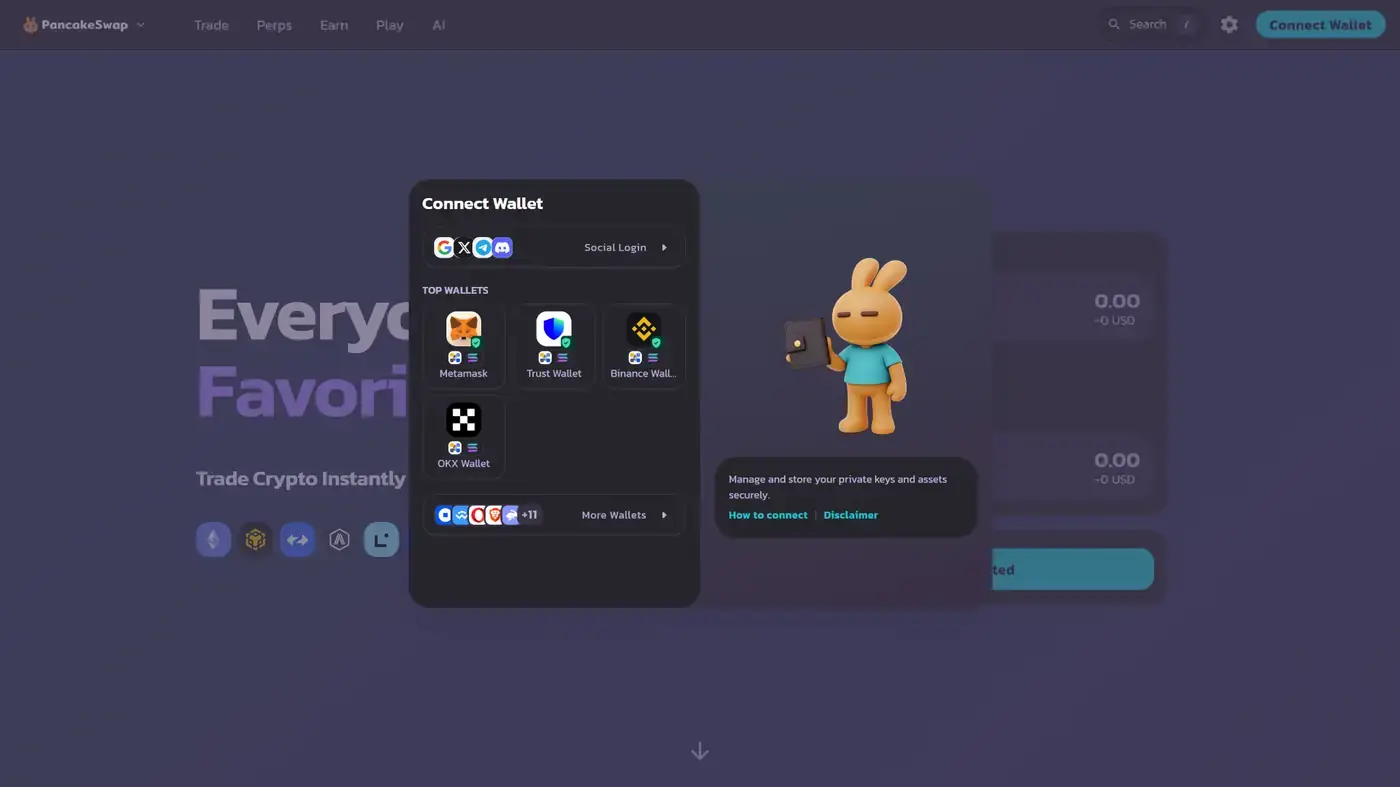
PancakeSwap desktop wallet connect modal showing social login, top wallet options, more wallets, and security help links.
UI and Navigation
The PancakeSwap UI works best when you already know which job you came to do. The main architecture breaks actions into distinct paths rather than forcing everything through a single dashboard. Swap remains the obvious entry point, but liquidity, farms, perpetuals, prediction, and governance are easy to reach once you are inside the app. That helps repeat users move quickly without hunting through layers of menus.
On desktop, the trade surface handles more than one level of complexity. A basic user can connect a wallet and swap. A more active user can move into route details, limit orders, TWAP, PancakeSwap X, liquidity positions, or perpetuals without leaving the core experience. Newcomers may still find it crowded. Too many modules sit close together, and some advanced tools depend on partner systems or chain-specific rules that only become clear after a few clicks.
What makes the interface work is task separation, not minimal design. The swap page is still the anchor, and the docs confirm that PancakeSwap X is built directly into that familiar flow and enabled by default when available. The rougher edges show up when a feature pushes you into an external FAQ or a chain-specific instruction page. That makes the product feel more like a toolkit than a polished one-path exchange. On localization, PancakeSwap clearly supports multiple languages at the docs and community level, but it does not publish a formal accessibility statement or documented accessibility standard for the app itself.
Mobile App
PancakeSwap’s official docs do not point to a first-party iOS or Android trading app. Instead, they route users toward mobile browsers, supported third-party wallets, and browser-based social login. The mobile experience is real, but it is web-first rather than app-first.
For users who want the lowest-friction mobile setup, PancakeSwap’s social-login wallet works directly in desktop or mobile browser and supports six EVM networks. Sessions can last 30 days, and the docs say signless transactions are possible during an active session. That helps on mobile, but it is not the same thing as having a native exchange app with push alerts, a defined app-store release cadence, or built-in biometric controls. PancakeSwap does not link a branded trading app in its current docs, so there is no app-store naming, release cadence, or native notification layer to assess here.
Mobile reliability is also more sensitive to the wallet stack than on a custodial exchange. The connection guides and troubleshooting pages make clear that mobile issues often show up as wallet-browser conflicts, unsupported chain errors, or provider problems rather than as a normal exchange outage.
Reliability and Status Page
PancakeSwap publishes a useful troubleshooting archive, but no public official status page is linked in the current materials. The docs are good at explaining recurring user-side failures, but they are not a real live-ops monitor for degraded performance, delayed routing, or service incidents.
The troubleshooting pages do give a fair picture of the most common operational pain points. Swap failures can come from low liquidity or slippage settings, provider errors can block connection, unsupported chain settings can stop transactions, and browser setups with multiple wallet extensions can break profile creation or wallet connection. Those workarounds are useful, but users still have to self-diagnose more than they would on a conventional exchange.
Month Year
Event
Impact
Resolution
Mar. 2026
No public official status page verified
Harder to track live operational issues or degradation in one place
Users rely on troubleshooting docs, wallet checks, and community channels
Mar. 2026
Multiple-wallet browser conflicts documented in troubleshooting guides
Can break username checks, profile creation, or wallet connection flow
Docs recommend removing extra wallet extensions, reconnecting, or retrying in another environment
Mar. 2026
Low-liquidity and slippage errors documented as recurring swap issues
Transactions can fail or require manual tolerance changes
Docs recommend smaller trade sizes, route review, and higher slippage where appropriate
Customer Support
Support is where PancakeSwap feels least like a traditional exchange. The official help page says there is no dedicated support service. Instead, users are pushed toward the help center, troubleshooting guides, general FAQ, Telegram communities, and Discord.
In practice, support still means community channels rather than a staffed live chat desk. There is no published phone channel, email helpdesk, or formal complaint path. What PancakeSwap does have is a structured community layer. The official community page lists an English Telegram, an announcements channel, and Discord. It also links multiple localized Telegram groups. Those include Japanese, Chinese, Indonesian, Vietnamese, Spanish, Nigerian, Russian, Portuguese/Brazilian, Filipino, Indian, and Korean communities. Telegram users are told to post in the correct topic. Discord users can use a ticket system or the general channel.
Recovery for access issues also depends on the product you are using. For normal wallet users, PancakeSwap cannot recover access because it does not control the wallet. For social-login users, the official docs say you can recover on a new device with the same social account and your recovery password. If you lose both, the wallet cannot be recovered. That is a meaningful operational risk, not a minor footnote.
Use only the official help center, official Telegram links, and the official Discord link published in PancakeSwap’s docs. PancakeSwap says it does not offer support in direct messages, and admins will never ask for your private key or recovery phrase.
Features That Matter on Uniswap
PancakeSwap feels closer to a stacked DeFi workspace than to a normal exchange homepage. People tend to use it for the combination of perps, CAKE earning, wallet connection, and launch access rather than for one flagship screen. Perpetuals matter if leverage is the point. CAKE earning matters if capital is likely to stay inside the ecosystem. Social-login wallets matter if the user wants an easier first step into self-custody. CAKE.PAD matters if token launches are part of the draw.
Derivatives and Leverage Controls
Perpetuals are not a side feature here. Anyone comparing PancakeSwap with platforms built more around perps should treat this as a real product line, not a side tab. PancakeSwap runs two live perpetuals engines. V1 is the order-book product, available on BNB Chain, Ethereum, Arbitrum, and Solana, and the docs describe it as faster because trades are settled off-chain inside the engine before users withdraw back to their wallet. V2 is the onchain version, live on BNB Chain, Arbitrum, Base, and opBNB, with liquidity coming from the ALP pool rather than an order book.
The leverage ceiling is high even by crypto standards. V2 supports Classic Mode up to 250x and Degen Mode up to 1001x across its supported chains. That does not make the product better for most users, but it does show who PancakeSwap is trying to serve with this feature. That direction was also visible in PancakeSwap’s tokenized stock futures launch. V2 also removes the separate deposit-and-withdraw flow. That keeps it closer to the rest of the self-custody experience.
The underlying mechanics matter more than the headline leverage. V2 uses ALP-based liquidity and the docs say pricing draws from Pyth, Binance Oracle, and Chainlink to reduce manipulation and thin-liquidity issues. On Arbitrum, the documented collateral set for ALP includes USDC.e, USDT, DAI, ETH, and BTC. There is no clean U.S.-specific perpetuals eligibility matrix or dedicated KYC ladder for perps in the current docs, so access should be treated as feature-specific rather than assuming global parity.
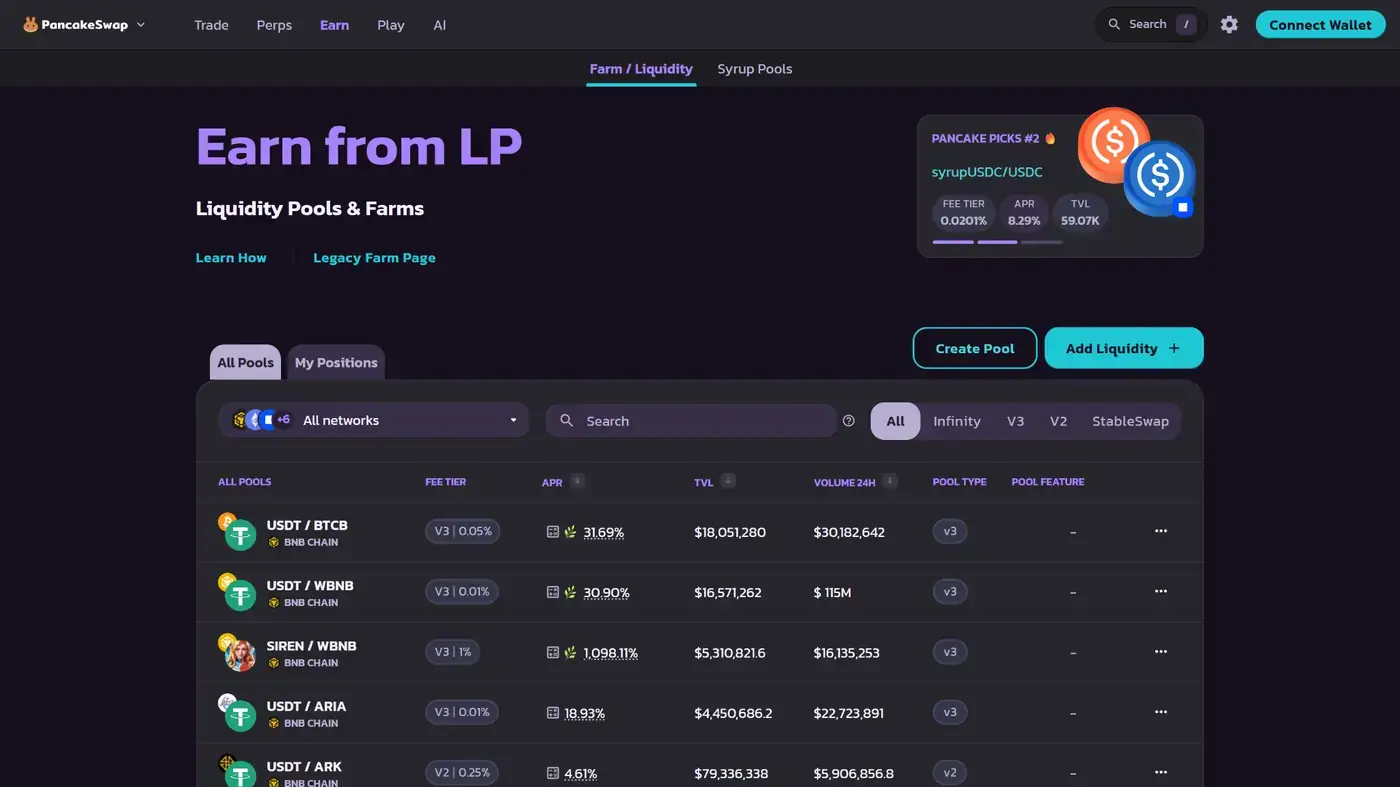
PancakeSwap desktop Earn from LP page showing liquidity pools, APR, TVL, volume, and pool management actions.
Staking and Rewards
Rewards on PancakeSwap split into two practical buckets: Syrup Pools for simpler CAKE-based staking and Farms for users willing to manage liquidity positions. Syrup Pools are the easier starting point. The docs describe them as the simplest way to earn on PancakeSwap, and current materials show both flexible and fixed-term CAKE staking paths.
Flexible CAKE staking is the more liquid option, but it is not free. PancakeSwap’s own pool docs show a 2% fee on flexible staking rewards and a 0.1% withdrawal fee if you unstake within 72 hours of your last deposit. Fixed-term staking is the higher-commitment version. The FAQ says users can choose lock durations from one to 52 weeks, and rewards cannot be harvested during the lock period.
Farms are more powerful but also more demanding. On standard EVM farms, you provide a two-token liquidity position and earn CAKE, which means you take on impermanent-loss risk in exchange for higher reward potential. Infinity farms go a step further by removing a separate staking step for eligible liquidity positions and distributing rewards automatically by epoch. That setup suits users who are already comfortable managing ranges, fees, and position health. PancakeSwap does not publish a formal regional carve-out for these reward products.
The main attraction is simplicity. You can start without handling a seed phrase on day one. The docs say it uses a 2-of-2 key-share model, works across BNB Chain, Ethereum, Base, Arbitrum, Linea, and opBNB, and can be used in desktop or mobile browser. At the same time, it cannot import external wallets, does not support export by default, and cannot connect to other dApps through WalletConnect. In other words, it is easier to start with, but it is still narrower than a normal portable wallet.
Social login works best as a first-step wallet, not as a long-term hub for every kind of user. It works well for someone who wants to try PancakeSwap without building a full wallet stack on day one. Power users will still be better served by an external wallet, especially if they move across other dApps, care about portable keys, or want their own security workflow. Gas and transaction costs also stay chain-dependent, so the cheapest setup still depends more on the network you use than on the wallet path itself.
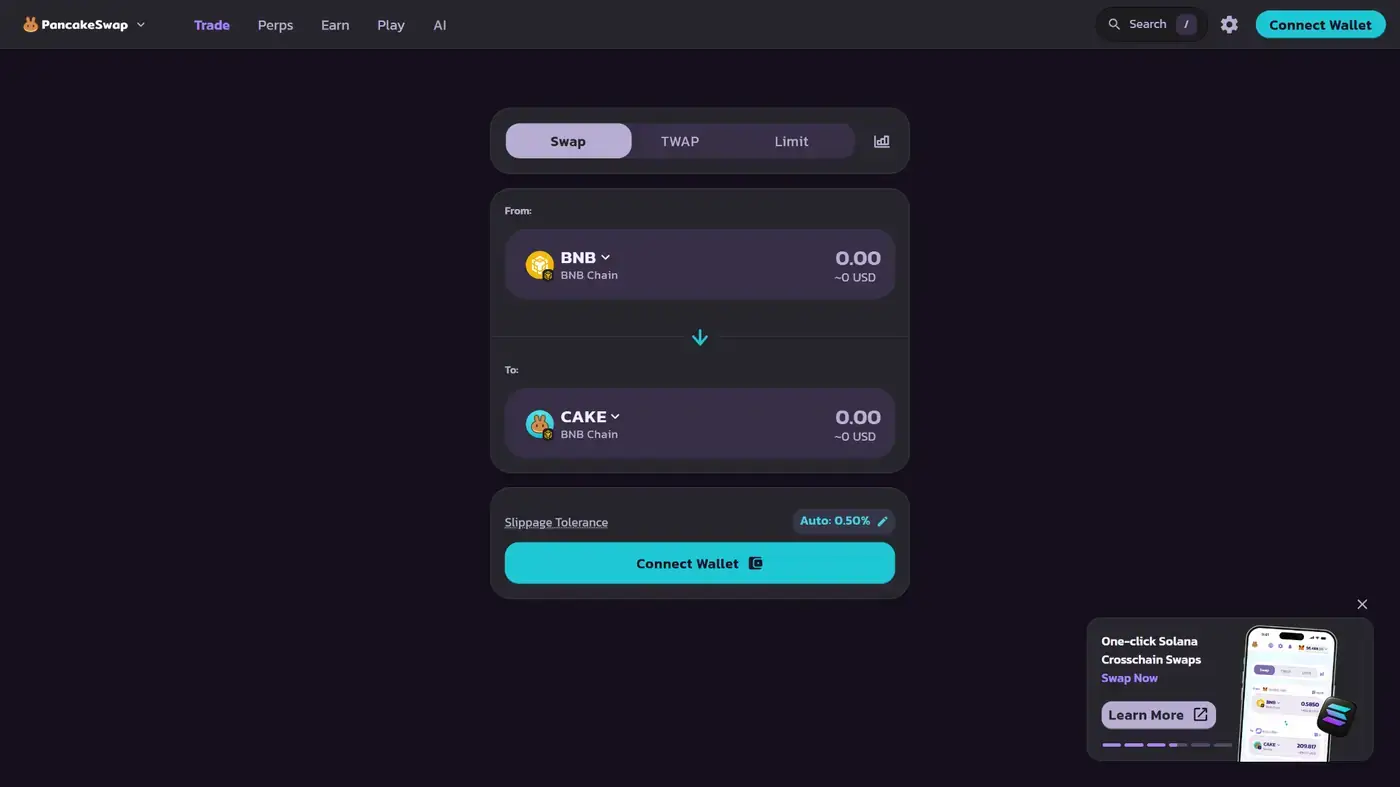
PancakeSwap desktop swap interface showing a BNB to CAKE trade setup, slippage tolerance, and connect wallet button.
API and Programmatic Trading
PancakeSwap looks stronger as a builder platform than as an institutional trading API venue. The developer docs point to public GitHub repositories for the frontend, smart contracts, SDKs, and the subgraph, which makes the stack more open than most centralized exchanges. Because the frontend, contracts, SDKs, and subgraph are public, teams can build integrations, analytics, routing tools, and custom front ends without reverse-engineering the product.
That missing layer matters if you expect brokerage-style trading infrastructure. There is no classic exchange API model with account-level permission scopes, API keys, FIX connectivity, or a formal sandbox that would make this feel like a pro brokerage stack. PancakeSwap is useful for developers who want protocol access and open-source tooling. It is not positioned like a traditional exchange for institutional algo traders.
Other Notable Features
CAKE.PAD is one of the clearest signals that PancakeSwap sees itself as an ecosystem, not just a venue. The docs describe it as the successor to the older IFO model, built around early token access with CAKE commitments and no staking or lock-up requirement just to participate. Users can commit any amount of CAKE, claim project tokens after the event, and deal with vesting only if the specific event includes it.
CAKE.PAD is also tied closely to CAKE economics. PancakeSwap says 100% of CAKE.PAD participation fees are burned, and the fee schedule only applies if the event is oversubscribed. That links CAKE.PAD more directly to CAKE utility than the lighter launch features you see on many rival platforms.
Prediction and Lottery still matter too, even if they are not central for every reader. Prediction runs on five-minute rounds, while Lottery remains a CAKE-based jackpot-style product. Together with CAKE.PAD, they make PancakeSwap feel less like a stripped-down trading tool and more like a broad onchain ecosystem that happens to have exchange-like features at its center.
Final Verdict
PancakeSwap is built for people who already use wallets comfortably and expect to move between swaps, liquidity positions, rewards, crosschain transfers, and perps in the same session. Its strongest points are how much it covers, how cheap the core swap layer stays, and the fact that it remains non-custodial from the start. Help still comes mainly through docs, Telegram, and Discord, fiat access depends on outside providers, and the open asset model puts more quality-control work on the user. People who want a simpler retail experience, clearer U.S. boundaries, or more hand-holding will probably do better elsewhere.
Disclaimer: CryptoSlate may receive a commission when you click links on our site and make a purchase or complete an action with a third party. This does not influence our editorial independence, reviews, or ratings, and we always aim to provide accurate, transparent information to our readers.
FAQ
Is PancakeSwap safe?
PancakeSwap is safer to think of as a self-custody protocol than as a custodial exchange. The core point is that it does not hold your trading balances, which removes exchange solvency risk but leaves wallet security, token risk, and bridge risk with the user. Audits, multisig controls, MEV Guard, and a bug bounty help, but they do not remove those user-side risks.
What are PancakeSwap fees?
PancakeSwap does not use one flat fee model across the whole product. Core spot swaps are pool-based, with EVM v3 fee tiers at 0.01%, 0.05%, 0.25%, and 1%, while Buy Crypto uses partner quotes that are much more expensive. Perpetuals have their own pricing too, so the cheapest path is usually arriving with your own onchain funds.
Does PancakeSwap require KYC?
For normal wallet-based swapping, there is no published PancakeSwap KYC step in the core flow. The identity checks show up when you use partner-led fiat on-ramp services, and PancakeSwap says the level of verification depends on the provider, payment method, and payment amount. That means KYC is more tied to fiat access than to the core swap flow.
Which coins does PancakeSwap support?
PancakeSwap does not publish one clean exchange-style coin list, so there is no fixed official asset count to quote. In practice, access is broad because the swap side is permissionless and users can often add tokens by contract address. Stablecoins like USDT, USDC, and DAI are clearly part of the current product mix, but support still varies by chain.
How long do PancakeSwap withdrawals take?
There is no normal exchange withdrawal queue because PancakeSwap is non-custodial. Standard swaps settle at chain speed into your wallet, while crosschain routes usually complete in seconds to under a minute under normal conditions. If a crosschain route fails, refund timing depends on the provider, with some documented cases taking about a minute and others closer to 90 minutes to two hours.
Is PancakeSwap available in the U.S.?
PancakeSwap’s core interface is publicly reachable in the U.S., but it does not publish a clean U.S. product-parity table. In practice, the limitations show up in partner-led fiat rails, chain support inside Buy Crypto, and feature-specific restrictions like the current Initial Farm Offering terms. U.S. users can usually access more on the wallet side than on the fiat side.
Does PancakeSwap offer staking or rewards?
Yes. The main reward paths are Syrup Pools for CAKE staking and Farms for users who provide liquidity. Flexible CAKE staking is easier to manage, while Farms ask more from the user because they introduce liquidity-position management and impermanent-loss risk. The choice mostly comes down to whether you want simpler CAKE yield or deeper exposure to PancakeSwap’s DeFi stack.
How can I lower fees on PancakeSwap?
The simplest way is to avoid the fiat on-ramp unless you really need it. Buy Crypto is much more expensive than arriving with your own onchain assets. It also helps to review route details before confirming a swap and to use lower-fee supported chains instead of Ethereum mainnet for smaller transfers when the asset and destination give you that choice.
Disclaimer: CryptoSlate may receive a commission when you click links on our site and make a purchase or complete an action with a third party. This does not influence our editorial independence, reviews, or ratings, and we always aim to provide accurate, transparent information to our readers.