Robinhood Prediction Markets is one of the easiest ways for existing Robinhood users to trade real-money event contracts in the U.S., but it works best as a convenient add-on, not a full-featured trading venue. It suits mobile-first traders who already use Robinhood for funding and want quick access to markets across sports, politics, economics, and culture without opening a separate account elsewhere. The main strength is account and funding convenience. The trade-off is that the product is still more limited than it first appears: trading is app-only, state access is not fully uniform, and execution quality still depends on outside exchange liquidity.
Tax reporting is weaker than regular brokerage products
Who Robinhood Is Best For — And Who Should Skip It
Robinhood makes the most sense when convenience outweighs trading depth. The better test is whether your workflow fits a mobile-first broker add-on with regulated event contracts and moderate setup friction.
Category
Fit
Why
Casual Event
High
The app-based flow is simple if you already keep funds inside Robinhood.
Sports
Medium
Sports markets are available, but the product still feels more like a derivatives feature than a sportsbook.
Macro Or Economic
High
Economics and financial contracts fit traders who already think in probabilities.
Crypto-Native
Low
There is no wallet-based access, onchain settlement, or crypto-native tooling.
API Or Bot
Low
Robinhood does not disclose a dedicated event-contract trading API.
Fast Fiat Withdrawals
Medium
Payout proceeds are withdrawable within 2 business days of the final trade or settlement date.
Low KYC Friction
Low
Full identity checks and derivatives approval add extra friction.
Clear Regulation
High
The product runs through a CFTC-regulated setup rather than an offshore or gray-market structure.
The best-fit user is an existing Robinhood user who wants real-money event contracts inside the same app they already use for stocks or options. If you trade mostly from your phone and care more about convenience than advanced tooling, the fit is strong.
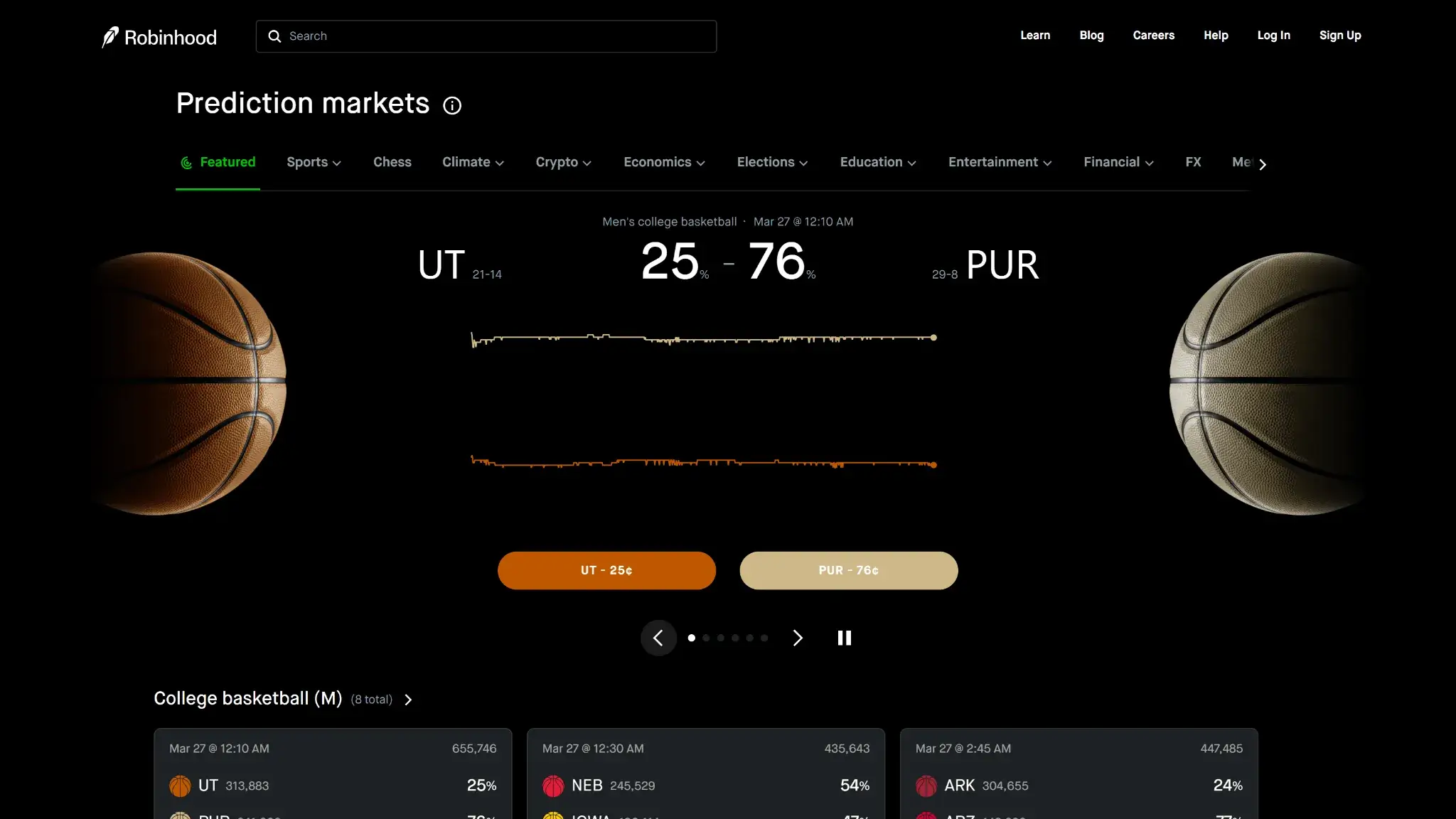
Robinhood desktop featured prediction market for a men’s college basketball game between UT and Purdue, showing live odds and matchup cards.
You should look elsewhere if you want desktop trading, automation, lighter KYC, or cleaner tax handling. Robinhood also becomes less appealing if your strategy depends on deeper liquidity or faster cash movement after markets settle.
What Is Robinhood And How Does It Work?
Robinhood Prediction Markets is a real-money event-contract feature inside the Robinhood app. It is not a separate exchange account and not a crypto-native market.
You access it through Robinhood, then trade contracts tied to real-world outcomes. Prices usually range from $0.01 to $0.99. Standard settlement is $1 for the correct side and $0 for the incorrect side, but some edge cases can use other payouts.
Here is the basic model:
Users trade Yes or No contracts on real-world events.
Contract prices show an approximate probability, not an exact one. On some contracts, Yes and No can add up to about $1.01 because $0.01 is built into the price.
You can usually sell before final resolution if the market is still open and someone is willing to take the other side.
Markets cover sports, politics, economics, crypto, culture, companies, and other news-driven categories.
In practice, Robinhood feels most like a broker add-on. It does not behave like a full trading venue, a sportsbook replacement, a crypto-native order book, a social prediction app, or a research tool.
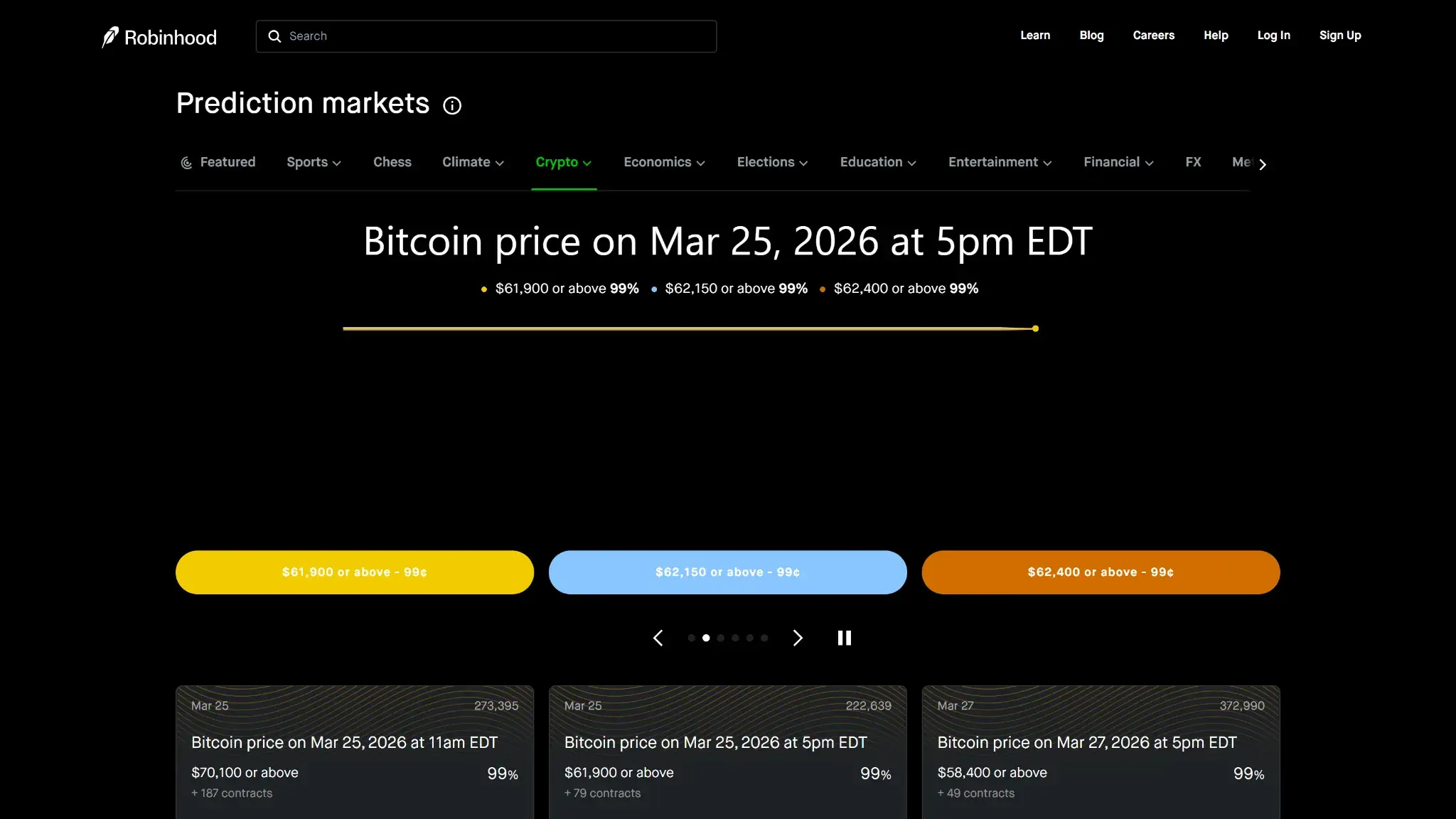
Robinhood desktop prediction markets page for Bitcoin price on March 25, 2026 at 5pm EDT, showing three price targets and a market chart.
Access, Eligibility and Account Setup
Robinhood’s access model is straightforward on the surface but more layered in practice. You need to be in a supported U.S. jurisdiction, old enough to trade, fully verified, and approved for Robinhood Derivatives before you can place your first event-contract trade.
Trading AvailabilityU.S. only in supported states through the Robinhood app
Unsupported JurisdictionsMaryland for event contracts; Nevada for new sports event contracts; other restrictions may vary by contract
Account Type NeededIndividual Robinhood account plus Robinhood Derivatives approval
Bank, Wallet or Broker Setup NeededRobinhood brokerage setup with linked bank funding; no external wallet needed
Geolocation or Device ChecksState-based eligibility checks apply; trading is app-only
Time to First TradeUsually same day if your account is already funded and approved; longer if derivatives approval is still pending
The biggest drag is not identity verification by itself, but the extra derivatives approval layer and the fact that access can change by state and by contract type.
Market Coverage and Contract Design
Robinhood’s real market coverage is broader than a sports-only add-on, but it is still less deep than dedicated prediction venues. Compared with Kalshi or Polymarket, the hub feels more curated and more mainstream.
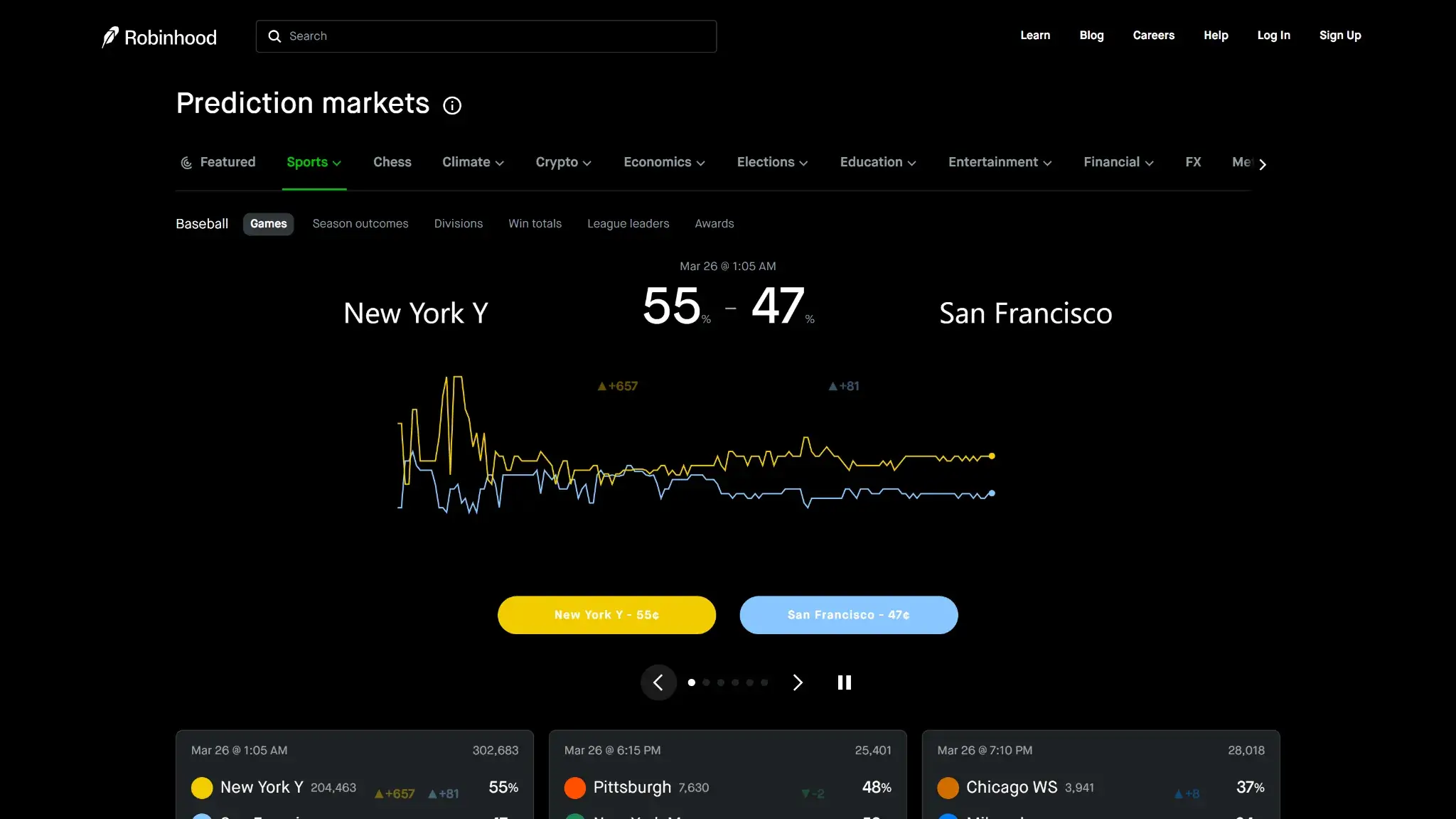
Robinhood desktop sports prediction market for a New York Y versus San Francisco baseball game, with odds, chart, and game cards below.
The product is strongest where Robinhood and its partners can line up clear, high-interest contracts, especially sports and headline macro events. Once you move into culture, company, or specialty topics, breadth is there on paper, but depth is less reliable.
Category
What Is Covered
How Deep It Is
Important Gaps Or Caveats
Sports
Game winners, spreads, totals, player contracts, preset combos, and some custom combos
High on headline leagues and major events
Still more curated than a full sportsbook menu, and access is not uniform by state
More selective than crypto-native rivals and not built for endless niche political boards
Macro / Economics
Fed decisions, economic indicators, and scheduled macro events
Medium To High on tentpole releases
Coverage is strongest around big calendar events, not between them
Crypto / Finance
Crypto, companies, financials, and market-linked questions
Medium
Useful range, but not a full finance-first event board
Culture / Entertainment
Awards and major pop-culture events
Low To Medium
Usually event-driven rather than deep year-round
Other Categories
Climate, health, tech & science, and world events
Low To Medium
Good variety, but depth can be thin once you leave headline stories
Robinhood is strongest in sports and scheduled macro events, fast enough to add major headline markets, but still slower and more disciplined than crypto-native rivals. That makes it easier to browse than a sprawling venue, but less appealing if you want to find smaller markets early.
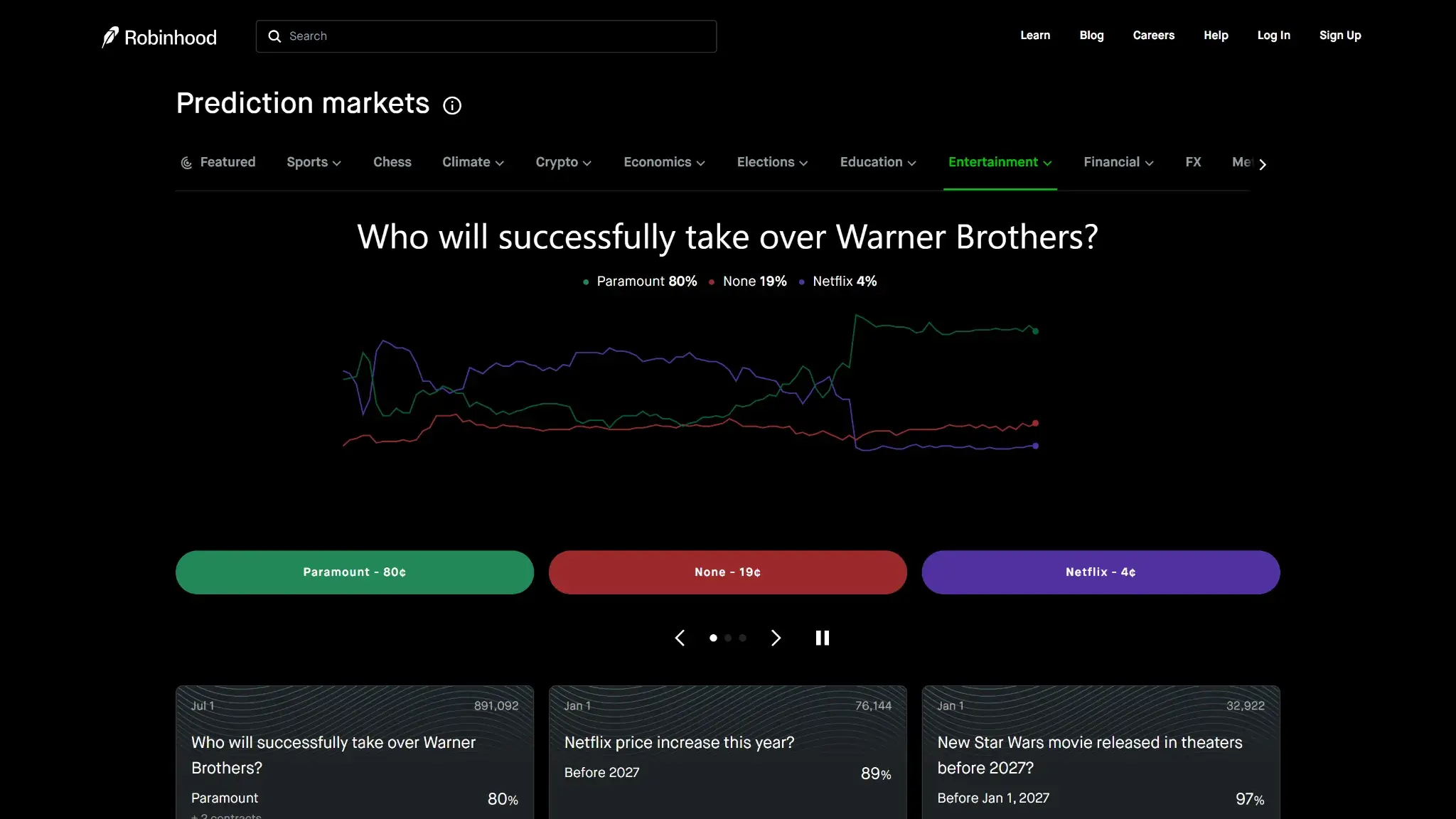
Robinhood desktop entertainment prediction market asking who will successfully take over Warner Brothers, comparing Paramount, None, and Netflix.
Contract Design Notes
Binary Yes / No Markets — Yes. These are still the default and the cleanest format on the platform.
Multi-Outcome Markets — Only partly. Robinhood can cover mutually exclusive outcomes through separate contracts and sports combo structures, but this is not its cleanest design strength.
Range Or Bracket Markets — Yes in limited form. Totals, spreads, upper-bound, and threshold-style contracts are supported.
Short-Dated Or Intraday Markets — Better than at launch, especially in sports and live-event setups, but still concentrated in big events rather than a deep intraday board.
Longer-Dated Markets — Yes for major elections, macro decisions, and other scheduled events, but not with the same long-tail variety as dedicated exchanges.
Speed Of New Listings — Faster now than a normal broker feature would suggest, but still more curated than crypto-native platforms.
Market Wording Quality — Usually clear on simple contracts. Sports combos and specialty contracts need closer reading.
For real users, the market mix is useful if you mostly trade major events and want contracts that stay readable. It is less useful if you want constant long-tail choice, elegant multi-outcome boards, or the feeling that every category is equally alive.
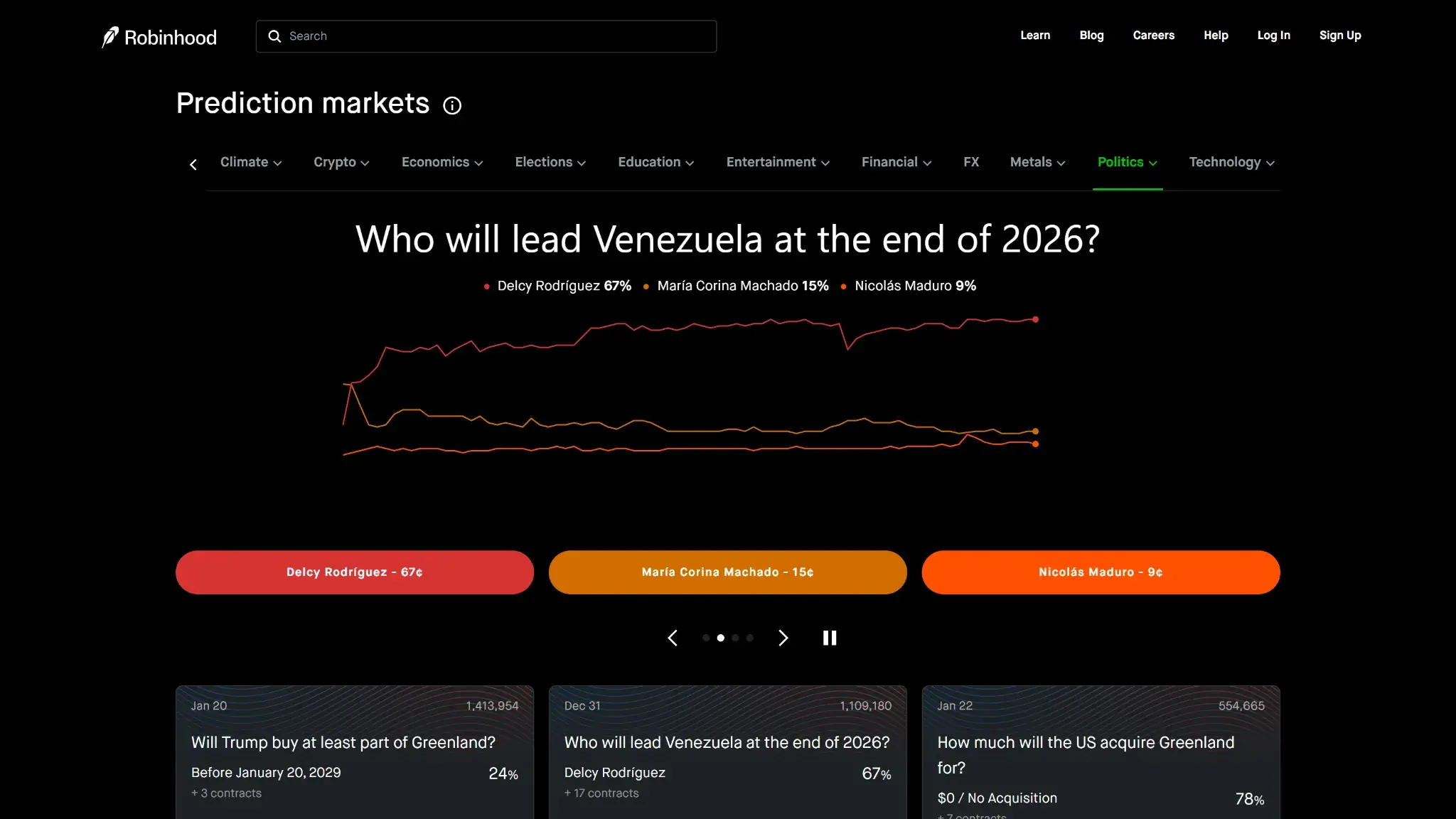
Robinhood desktop politics prediction market asking who will lead Venezuela at the end of 2026, with odds for Delcy Rodriguez, Maria Corina Machado, and Nicolás Maduro.
Liquidity, Order Book and Execution Quality
Robinhood is tradable mainly on major events. It works when the market is active and visible, but it gets shallow much faster once you leave the headline board.
Depth on Major MarketsDecent depth on popular sports, macro, and political events. Retail-size orders are usually workable, but depth can drop outside peak interest.
Depth on Quieter MarketsBooks thin out fast. Smaller orders fill more slowly, and bigger tickets can move price or sit unfilled.
Bid-Ask Spread BehaviorSpreads are usually tighter on major markets and wider elsewhere. Spread cost can matter more than the stated fee.
Limit OrdersSupported. Useful for price control, but patience is often required and full fills are not guaranteed.
Instant Buy / Market-Style ExecutionNo true market orders. Limit orders only. Contract orders can be IOC or GTD, and dollar orders are IOC only for opening trades.
Partial FillsSupported. Common when your size is larger than available liquidity at your price.
Exit Before ResolutionSupported, but it still depends on another trader being there when you want out.
Visible Volume / Open InterestNot Clearly Disclosed. True liquidity can be harder to judge before sending size.
Position LimitsVaries by contract and can interrupt larger thesis trades.
Slippage RiskLower on active boards, higher on thin or fast-moving markets. Timing and order type make a real difference.
Robinhood is most liquid on promoted sports contracts, major macro events, and the biggest headline markets. It gets thinner in quieter categories, where the same event can also price differently from rivals because liquidity is fragmented across separate pools. In those thinner books, queue position and faster repricing matter more, so casual users who tap straight into instant execution should care most.
Fees and Total Cost to Trade
Robinhood is fine for casual users but not as cheap as the headline simplicity suggests. The explicit contract charges are easy to understand, yet spread and slippage can matter more than the posted fee once you move off active markets or trade in and out frequently.
Cost Component
What Users Pay
When It Applies
Notes
Trading Fee
$0.01 Robinhood commission per contract traded
Each contract trade
If you close early with another trade, you pay again on that trade
Spread Or Slippage Cost
Variable
Any time you cross the book instead of posting patiently
This is the biggest hidden cost on thinner markets
Deposit Fee
$0 from Robinhood
Standard bank transfers, instant bank deposits, and debit card funding
Bank-side limits or holds can still matter
Withdrawal Fee
$0 standard bank withdrawal; 1.75% instant withdrawal ($1 min, $150 max); $25 outgoing wire
Can be an exchange fee, often about $0.01 per contract, or a spread built into the price
Robinhood’s own commission is simple, but total trading cost depends on the exchange. You may see either an exchange fee or a spread built into the price. Active traders should care more about spread, slippage, and repeat entry-and-exit costs than the headline commission number, while standard ACH users can keep money-movement costs low by avoiding instant cash-out and wires.
Funding, Settlement and Cash-Out Flow
Getting money in and out is one of Robinhood’s real advantages, but the full transactions are slower in practice. The key point is that funding the account, settling the contract, and actually receiving cash at your bank are three separate steps.
How money gets in — You fund your Robinhood account with a linked bank transfer, instant bank transfer, debit card transfer, or wire. Event contracts then draw on the linked Robinhood account and Robinhood Derivatives setup rather than on a separate wallet.
When buying power becomes usable — Settled Robinhood cash is usable right away. Instant Deposits may unlock some pending funds, but Robinhood says they generally cannot be used for highly volatile event-contract trades. In practice, users may need to wait 2 to 4 business days for deposits to settle before using them for event contracts.
What happens when a contract resolves — Once the event ends and the exchange determines the outcome, standard settlement is $1 for the correct side and $0 for the incorrect side. Some edge cases can use other payouts. If you exit before resolution, the trade still goes through the normal settlement process rather than turning into instant cash.
When funds become withdrawable — Payout proceeds are available for withdrawal within 2 business days of the final trade or settlement date.
How money actually reaches the bank account or wallet — After funds are back in your available Robinhood balance, you can withdraw by standard bank transfer, instant withdrawal for a fee, or wire if available. There is no external crypto wallet cash-out path for this product.
Step
Typical Speed
Common Friction
Deposit
Minutes to 5 business days, depending on rail
Bank verification, transfer limits, and reversal risk
Buying Power Availability
Same day for settled cash; often 2 to 4 business days for deposits used for event contracts
Instant Deposits may not work for highly volatile event-contract trades
Contract Settlement
When the event settles
Source delays, bank holidays, and exchange processing
Balance Becoming Withdrawable
Within 2 business days of final trade or settlement date
Funds may still be moving back through the account stack
Withdrawal Request
Instant option or same business day submission for standard ACH
Eligibility checks, cutoffs, and daily limits
Funds Arrival
Instant for eligible paid withdrawals; usually 1 to 3 business days for standard ACH
Fee for speed, plus normal bank processing lag
Buying power usually updates the next business day after the event settles, unless U.S. banks are closed. Actual withdrawal availability can still take up to 2 business days from the final trade or settlement date, and the bank-transfer step can add more time after that.
Resolution Rules, Market Integrity and Disputes
Rule quality is mostly clear but edge-case sensitive. Simple contracts are usually readable, but serious users still need to pay attention to the source agency, exact wording, and exchange-specific handling when a market gets messy.
Resolution Source — Contract outcomes follow the rules of the listing exchange and the source named in the event details.
Rules Clarity — Usually good on plain Yes or No markets. Less clean on specialty sports structures, threshold markets, and markets tied to delayed official data.
Clarification Process — The event page and linked exchange rules do most of the work. This is workable, but it is not the same as having a very retail-friendly in-app rules explainer for every edge case.
Dispute Or Challenge Path — There is no especially visible retail-first dispute ladder. In practice, the path runs through Robinhood support and the exchange rulebook rather than a simple in-app appeal flow.
Void Or Cancel Policy — Possible under exchange emergency powers, source-data issues, or contract changes. A market can be halted, modified, or canceled under exchange rules.
Split Or Partial Resolution Handling — Not a core retail feature. Any adjusted handling appears contract-specific and rulebook-driven rather than standardized across the app.
Settlement Pace — Usually prompt once the outcome is clear, but delays can happen when source data is late or banks are closed.
Main Edge-Case Risk — Source-agency delays, wording around thresholds and combos, and trading halts that stop users from exiting when they want to.
A real user is unlikely to misunderstand a simple headline market, but the risk rises once the wording gets more technical or the source data is delayed. Disputes do not look like a daily problem, yet they are material enough that serious traders should read the event details before sizing up. Robinhood feels safe enough for serious use on straightforward contracts, but not so simple that you can ignore the fine print.
Security, Custody, Privacy and Trust
This is a centralized, fully KYC product, so the bigger risks are platform control, liquidity, and rule handling rather than wallet security.
Where Funds Sit — Inside Robinhood’s brokerage and derivatives setup, not in a user-controlled wallet.
Who Controls Them — Robinhood entities and partner clearing infrastructure handle custody and settlement.
How Accounts Are Protected — Identity checks, 2FA, and device approvals help, but account security still depends partly on the user.
Privacy Trade-Offs — Meaningful. This is a full-KYC financial account.
External Validation — Robinhood Derivatives is regulated by the CFTC and is an NFA member.
Main Risk — Market structure and operational dependency outweigh custody risk.
Robinhood is strongest on funding, regulation, and basic account protection. The main risk is dependence on centralized systems and exchange rules, especially when markets get thin, delayed, or disputed.
UX, Apps, Automation and Data Access
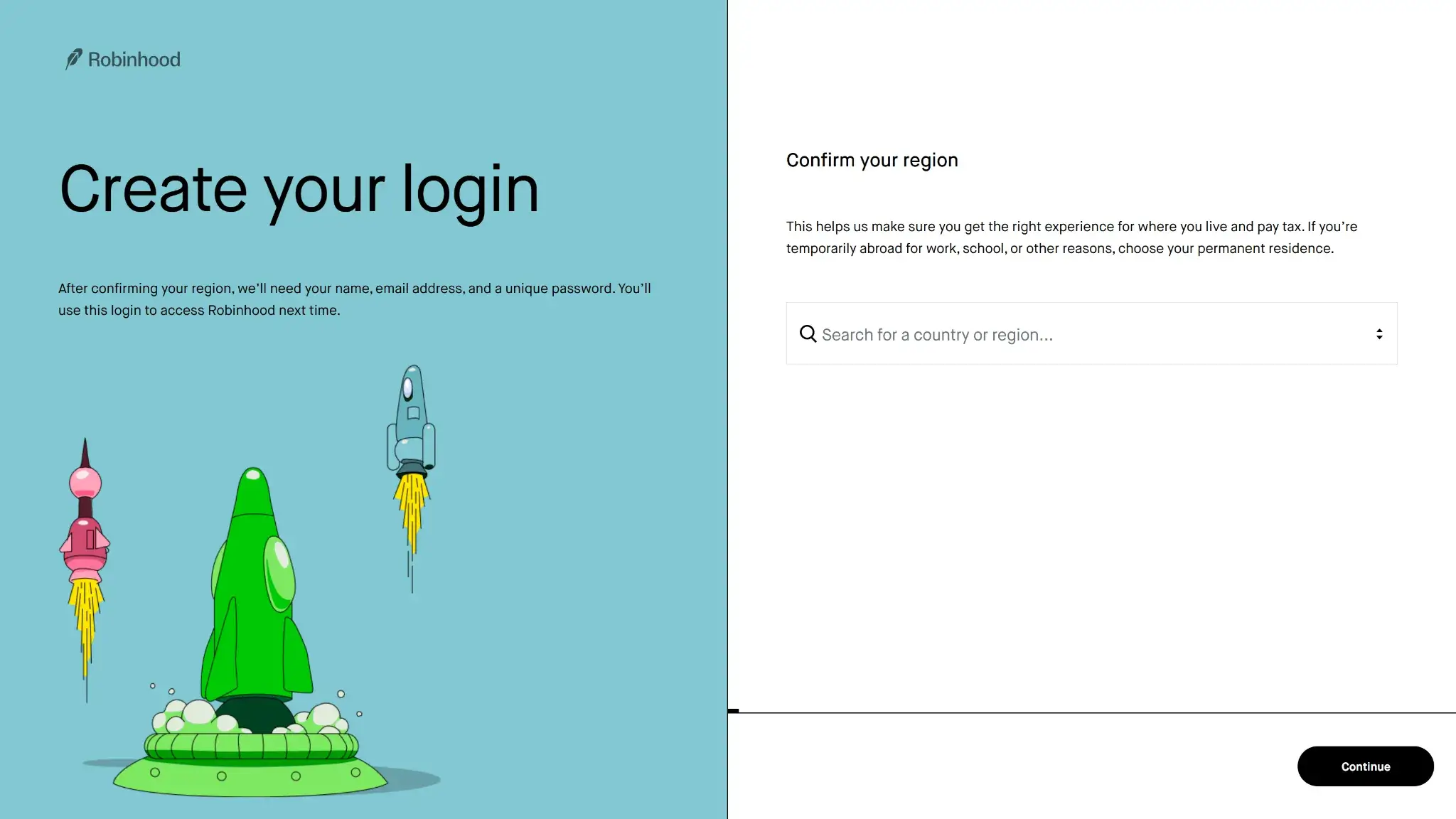
Robinhood desktop signup screen showing region confirmation, country search field, and Continue button next to a Create your login illustration.
Robinhood is built mainly for casual mobile use. It looks smooth in-app, but it is not designed for active desk-based trading or automation-heavy workflows.
Surface Or Tool
Availability
Notes
Web App
No
Event contracts are not tradable on web classic
iOS App
Yes
Main event-contract surface
Android App
Yes
Main event-contract surface
Desktop App
No
Not available on Robinhood Legend
Watchlists And Alerts
Yes
Alerts are supported, but watchlists do not cover event contracts
API Access
No
No event-contract trading API disclosed
WebSocket Or Live Market Feed
No
Not offered as a public event-contract tool
Historical Data Access
No
No robust historical event-market dataset disclosed
Trade History Export
Yes
Event Contracts Annual Statement is available, but it is summary-level
The app is clean and easy to navigate, but the tools are basic. Charts and pricing are readable enough for casual use, rule visibility is decent once you open the event details, and the order ticket is simple. Portfolio visibility is fine for open positions, but the product is weak for research, analytics, and bot workflows.
The UX helps with basic decision-making because it reduces friction, but it does not add much depth. It looks polished, but it is not especially powerful.
Taxes, Statements and Record-Keeping
Record-keeping is manageable for casual users but messy for active ones. Robinhood gives you enough to reconstruct the year, but not the kind of clean tax workflow that makes high-volume trading painless.
Tax Forms — No 1099 is issued for event-contract trades.
Account Statements — Robinhood provides an Event Contracts Annual Statement with contract name, closing date, total costs, proceeds, fees, commissions, and profit or loss.
CSV Or Export Quality — Weak for event contracts. The annual statement is useful, but it is not a full research-grade export.
Cost-Basis Visibility — Partial. You get totals on closed contracts, but not a great lot-by-lot workflow inside the product.
What Users Still Have To Track — Final tax treatment, any needed reconciliation with other records, and anything beyond the annual summary view.
Reporting is least painful for occasional traders with a small number of closed positions. It gets annoying fast if you trade actively and want cleaner exports, clearer tax treatment, or less manual cleanup.
Customer Support, Limits and Incident Handling
The Help Center covers the basics well, but human support is still more general Robinhood support than a dedicated prediction-market desk.
Help Center — Yes. Available on Robinhood Support and inside the app, including the main event-contract article.
Live Chat — Yes. Available through Robinhood Support.
Email Or Ticket Support — Yes. [email protected] is used for account help, and in-app support requests are standard.
Status Page — Partly. The old status page is retired; live outage updates point users to @AskRobinhood, plus RSS and support links.
Community Channels — Not Available. There is no official prediction-market community forum.
Self-Exclusion Or Cooldown Tools — Not Disclosed for event contracts.
Account Limits — Standard funding, withdrawal, and account-review limits still apply.
Position Limits — Varies by contract.
What Support Can Actually Fix — Access issues, account reviews, funding problems, app trouble, and general order-status questions.
What Support Cannot Reverse — Market outcomes, exchange rules, normal price moves, or already settled contract results.
For most users, support is good enough for setup and account issues. It is less reassuring when the problem is really about market structure, rule interpretation, or a bad fill that came from thin liquidity rather than a platform bug.
Robinhood Is Best When Convenience Outweighs Depth
Robinhood Prediction Markets is best for existing Robinhood users who want regulated, real-money event contracts inside a familiar mobile app. The main reason to choose it is convenience: funding, position tracking, and cash movement all fit naturally into a Robinhood account. The main reason to avoid it is that the product still feels limited once you care about desktop trading, deeper liquidity, or cleaner reporting. Before you fund the account, confirm that your state is supported and that the contract type you want to trade is available there.
Final Verdict
Robinhood Prediction Markets is the most convenient regulated entry point for existing Robinhood users: USD funding, familiar app, CFTC-registered derivatives setup, and cash-out on normal bank rails. The product covers a broad range of categories and supports early exits. Where it falls short is depth, not access. Liquidity thins outside headline markets, trading is app-only, there is no API, and tax reporting stops at an annual summary. Solid for casual in-app trading, limited beyond that.
Tax reporting is weaker than regular brokerage products
Affiliate Disclosure
Disclaimer: CryptoSlate may receive a commission when you click links on our site and make a purchase or complete an action with a third party. This does not influence our editorial independence, reviews, or ratings, and we always aim to provide accurate, transparent information to our readers.
FAQ
Is Robinhood legal where I am?
Robinhood Prediction Markets is available only in the United States, and not in every state. Maryland residents cannot trade event contracts, and Nevada residents cannot trade new sports event contracts. Contract availability can also vary by market.
Does Robinhood require KYC?
Yes. You need full brokerage-style identity verification, and you also need approval for a Robinhood Derivatives account before trading event contracts.
How long does it take to actually withdraw winnings from Robinhood?
Yes. You need full brokerage-style identity verification, and you also need approval for a Robinhood Derivatives account before trading event contracts.
How long does it take to actually withdraw winnings from Robinhood?
Payout proceeds are available for withdrawal within 2 business days of the final trade or settlement date. After that, standard ACH can still take about 1 to 3 business days, while instant withdrawal is faster but costs extra.
Why is the same event priced differently on Robinhood and Kalshi or Polymarket?
Because the liquidity pools, participants, fees, and speed of repricing are not the same. Thin books and different trader mixes can create meaningful price gaps across platforms.
How are disputed, clarified, or voided markets handled on Robinhood?
The contract follows the rules of the listing exchange and the source named in the event details. Markets can be clarified, halted, modified, or voided under exchange rules when edge cases or source issues come up.
Does Robinhood offer an API and historical data?
Not for event-contract trading in any meaningful public way. There is no disclosed event-contract trading API, and reporting is closer to a year-end statement than a real historical research dataset.