Polymarket is still one of the strongest options for traders who want fast-moving event markets and do not mind crypto rails. Its biggest strength is activity in major markets. On large political, crypto, and macro contracts, prices update quickly, books are usually deeper than on smaller rivals, and selling before resolution is often possible. The trade-off is operational friction. Polymarket.com is the international platform and is not CFTC-regulated. U.S. access is through separate Polymarket US, a CFTC-regulated Designated Contract Market, with the U.S. app being rolled out via waitlist. Funding, withdrawals, and day-to-day use still feel more natural for crypto-native users than for people who want a bank-funded, broker-style account.
Broad coverage across politics, crypto, macro, sports, and culture
Fast repricing when news breaks
Can often exit before resolution
API access suits more active users
Cons
Access still varies by user and jurisdiction
Fiat cash-out is less convenient than broker apps
Smaller markets can feel thin quickly
Workflow still leans crypto-native
Regulation and reporting are not especially clean
Who Polymarket Is Best For — And Who Should Skip It
Polymarket is best for the those who wants active event trading more than financial-app simplicity. It fits people who already understand wallets, stablecoins, and fast-moving markets, and who care about price action, depth, and the ability to trade in and out before final resolution.
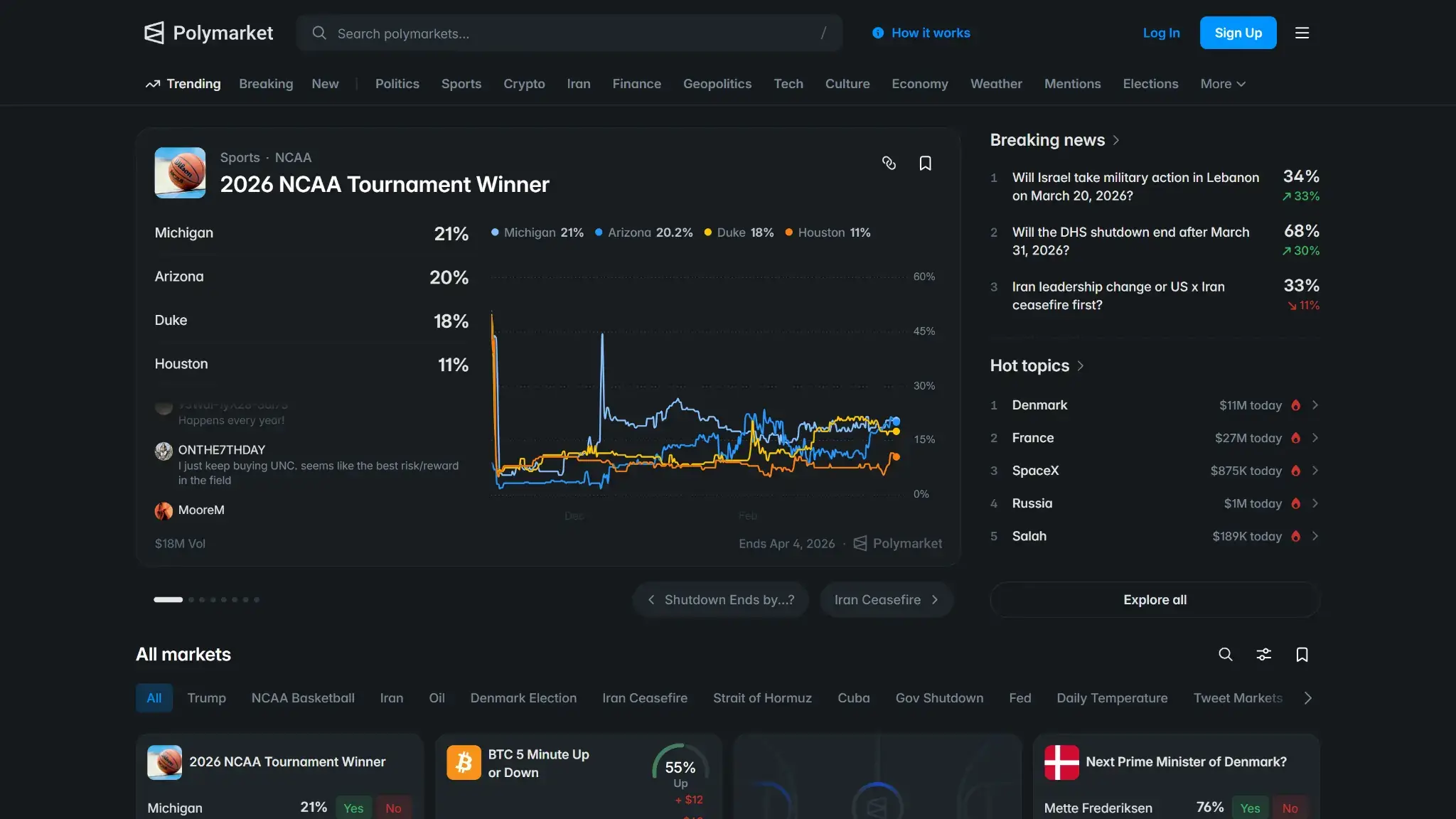
Polymarket desktop homepage showing the 2026 NCAA Tournament Winner market, market chart, trending topics, and all markets grid.
It is a weaker fit for the user who wants easy bank funding, low-friction withdrawals, and a platform that feels cleanly regulated at every step. If you want event exposure without crypto workflow, the rough edges show up early.
Category
Fit
Why
Casual
Medium
The core product is simple, but the funding and cash-out flow are less casual than they look
Sports
Medium
Sports markets exist, but Polymarket still feels broader and more news-driven than sports-first
Macro Or Economic
High
Macro and headline-sensitive markets are one of its stronger use cases
Crypto-Native
High
Wallet access, USDC.e funding, and a market-style workflow fit this user well
API Or Bot
High
API access and order-book structure make it one of the better fits for data-driven trading
Fast Fiat Withdrawals
Low
Settlement can be quick, but turning proceeds into fiat still adds friction
Low KYC Friction
Medium
Friction can be lower than on some regulated apps, but it is not friction-free
Clear Regulation
Low
Separate international and U.S. setups are less straightforward than a single regulated product
Polymarket fits best when live pricing and tradable depth matter more than simple account logistics. If convenience comes first, it will feel rougher than the strongest regulated alternatives.
What Is Polymarket And How Does It Work?
Polymarket is a real-money event market where users buy and sell contracts tied to specific outcomes. You are not buying a stock or fund. You are taking a position on whether something happens, and the contract settles according to the written market rules.
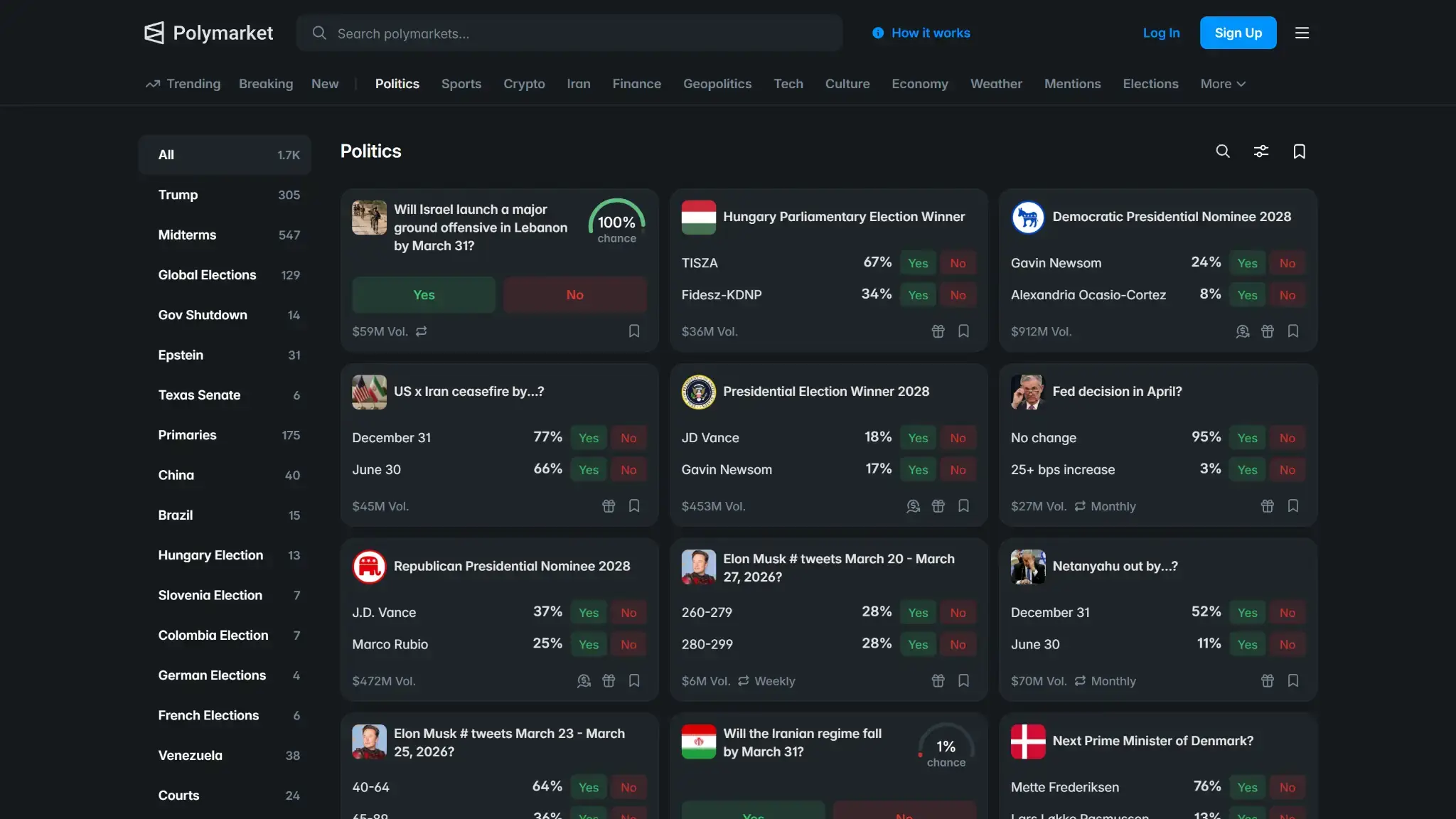
Polymarket desktop politics page showing political prediction markets, category filters, and live yes or no pricing cards.
Here is the basic model in practice:
Users access the platform through the web app, with funding centered on USDC.e and wallet-based flows
Most contracts trade between $0 and $1, with the price acting like an implied probability
You can usually exit before final resolution if the market still has enough liquidity
That structure makes Polymarket feel much closer to a crypto-native order-book venue than to a sportsbook or a traditional investing app. It works best in markets where new information keeps moving prices, especially politics, crypto, macro, culture, and other headline-heavy topics.
Access, Eligibility and Account Setup
Polymarket’s access model is easier than it used to be, but it still is not as clean as opening a normal broker account. The main setup drag comes from the mix of jurisdiction rules, funding method, and the fact that crypto rails still sit close to the center of the workflow.
Trading AvailabilityInternational users use Polymarket.com. U.S. access is through Polymarket US, with the U.S. app rolling out by waitlist.
Unsupported JurisdictionsVaries by jurisdiction
Age Requirement18+
KYC LevelVaries by account path and jurisdiction
Account Type NeededPolymarket account tied to supported funding and identity flow
Bank, Wallet or Broker Setup NeededCrypto wallet setup is still the most natural path; card and bank funding routes may be available depending on user flow
Geolocation or Device ChecksJurisdiction and access checks can apply
Time to First TradeFast if you already use wallets and USDC.e; slower if you need identity checks, funding setup, or waitlist access
Overall, setup friction is moderate. It is not hard for a crypto-native user, but it is not truly light either. The biggest drag is not understanding the contract. It is making sure your jurisdiction, funding route, and withdrawal path all line up cleanly before you trade.
Market Coverage and Contract Design
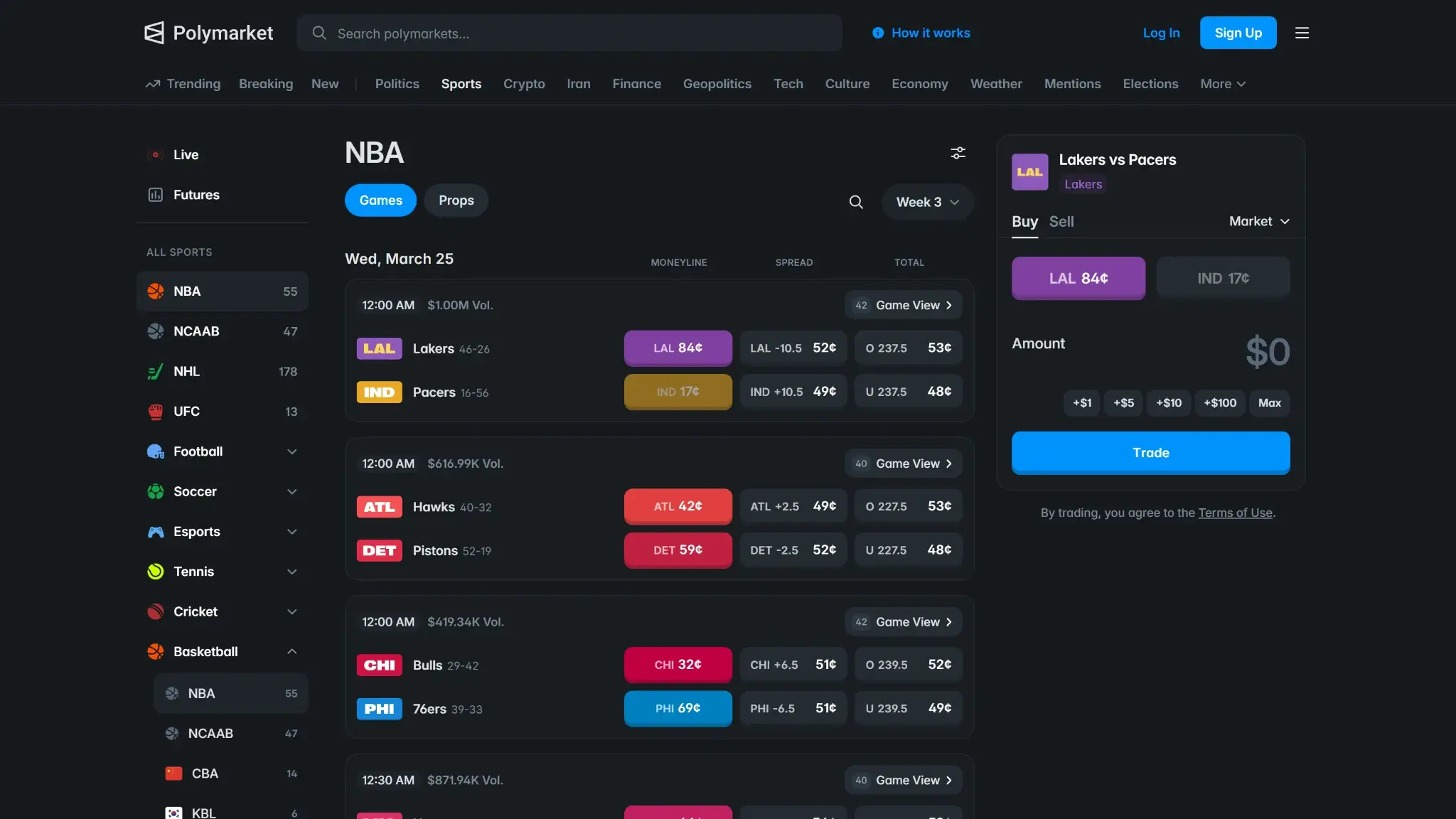
Polymarket desktop NBA page showing live basketball game markets, moneyline odds, spreads, totals, and the trade panel.
Polymarket has broader real market coverage than many prediction platforms, but that breadth is uneven. It is strong where public attention is high and new information lands often.
Major games, player outcomes, and headline event markets
Medium
Coverage exists, but it is not the platform’s clearest edge for every user
Politics
Elections, policy, appointments, geopolitics, and other live political questions
High
One of the strongest categories, but rule wording matters a lot in edge cases
Macro / Economics
Inflation, rates, growth, recession, and major market-linked questions
High
Better for event-style macro questions than for direct investing exposure
Crypto / Finance
Token prices, protocol events, ETF or listing questions, and market-moving crypto headlines
High
Strong fit for crypto-native users, but still headline-sensitive and uneven by topic
Culture / Entertainment
Awards, celebrities, media releases, viral stories, and internet-native events
Medium
Broad enough to be interesting, but depth can fade outside the biggest names
Other Categories
Tech, AI, weather, global news, and mixed one-off events
Medium
Useful variety, but many smaller markets are more watchlist material than serious trading venues
The category list is wide, but the best trading still sits in politics, crypto, and macro. Smaller categories are worth browsing, not always worth sizing.
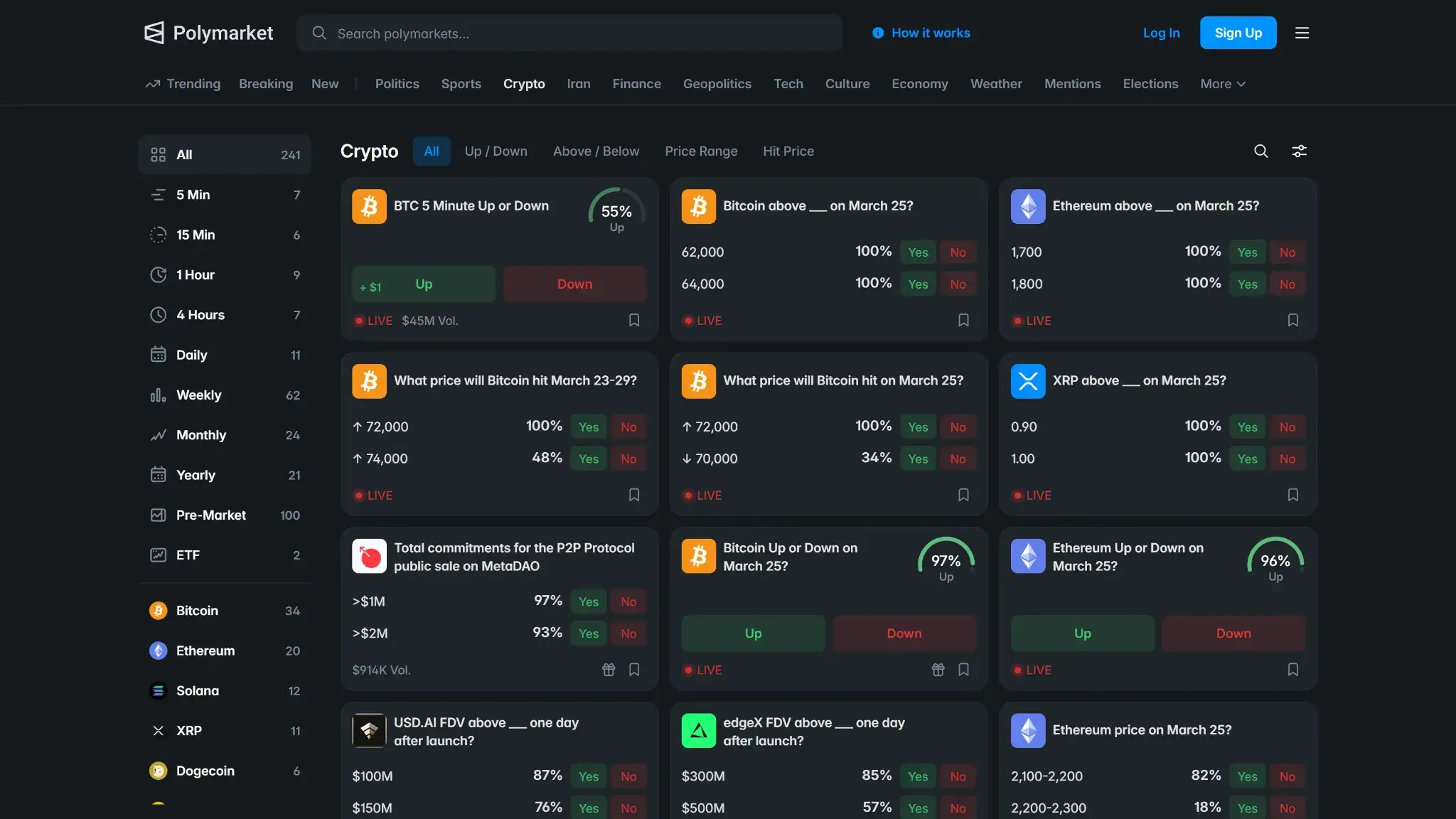
Polymarket desktop crypto page showing bitcoin, ethereum, solana, and XRP prediction markets with all, up or down, and price range filters.
Contract Design Notes
Binary Yes / No Markets — These are the default and still define the platform.
Multi-Outcome Markets — Supported in some markets and useful when outcomes are mutually exclusive, but they are not the whole product.
Range Or Bracket Markets — Available in selected markets, especially where a threshold or closing level makes sense.
Short-Dated Or Intraday Markets — Strong enough when a news cycle is hot, but the best fast markets still cluster around major events.
Longer-Dated Markets — Available and often useful for politics, macro, and longer-horizon crypto narratives.
Speed Of New Listings — One of Polymarket’s stronger traits. It tends to react quickly when attention shifts.
Market Wording Quality — Usually clear enough to trade, but users still need to check rules because wording and resolution source choice matter.
The market mix is useful when you stay in the categories that attract real trading activity. But it is most useful for traders who know where the real depth sits. If you treat every listed market as equally tradable, the platform will look better in the menu than it does in execution.
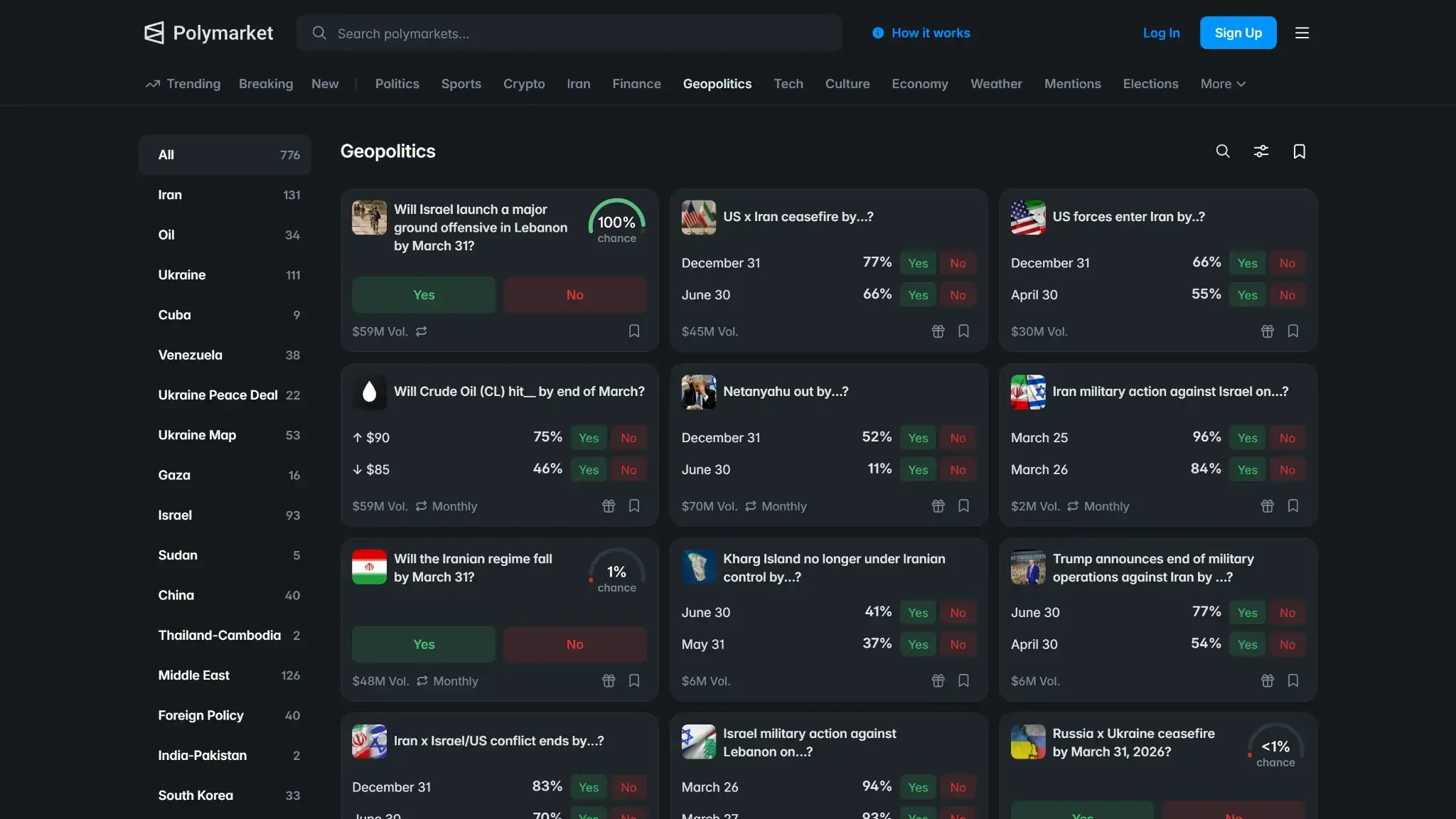
Polymarket desktop geopolitics page showing markets tied to Iran, Israel, oil, Ukraine, and other global conflict topics.
Liquidity, Order Book and Execution Quality
Polymarket is tradable on major events and headline markets, but it gets complicated once you move into quieter listings. Tradability drops quickly once you move away from the largest markets. The most active listings are also the ones most prominently surfaced.
Depth on Major MarketsOrder-book depth is strongest on top political, crypto, and major news markets, but it can fade quickly when attention moves.
Depth on Quieter MarketsBooks are much lighter outside the biggest names, and quoted prices can look better than real execution when you size up or try to exit.
Bid-Ask Spread BehaviorSpreads are tighter on active markets and wider on weaker ones, with pricing quality changing fast by event and time of day.
Limit OrdersSupported and useful for price control, but thin books can leave you waiting in queue.
Instant Buy / Market-Style ExecutionFast when liquidity is present, but shallow books raise the risk of paying up or exiting at a worse price.
Partial FillsPossible, especially on larger orders, which can leave entries or exits uneven.
Exit Before ResolutionUsually possible on active markets, but much harder once buyers and sellers thin out.
Visible Volume / Open InterestActivity is visible and helps show where attention sits, but headline volume does not guarantee clean execution.
Trading Size LimitsNo built-in cap
Slippage RiskLow on strong markets and higher on weak ones, where a small edge can disappear in the fill.
Polymarket is liquid where attention is already concentrated: major elections, major crypto headlines, and other tentpole events. It gets thin much faster in niche markets, longer-tail culture contracts, and one-off listings that never attract serious order flow.
The same event can also price differently from rivals, especially when user base, funding rails, or market wording differ. In thinner books, fast traders and bots perform better because queue position and reaction speed can change your fill quality. Casual users can mostly ignore that on the biggest markets. Active traders, API users, and anyone trading size should care a lot.
Fees and Total Cost to Trade
Most Polymarket markets are fee-free, but taker fees apply on fee-enabled markets. Spread, slippage, and money movement still matter a lot.
Cost Component
What Users Pay
When It Applies
Notes
Trading Fee
Usually 0%; on fee-enabled markets, effective rate ranges from about 0.00% to 1.56% on crypto and 0.02% to 0.44% on NCAAB or Serie A
When trading crypto, NCAAB, or Serie A markets with fees enabled
Highest around $0.50 contracts. On a $50 trade at $0.50, crypto is about $0.78 and NCAAB or Serie A is about $0.22. Minimum charged fee is 0.0001 USDC, with smaller amounts rounding to zero.
Spread Or Slippage Cost
Varies by market liquidity
Every trade, especially outside the most active books
This is often the real cost driver on weaker markets
Deposit Fee
No Polymarket deposit fee for USDC or USDC.e
When funding with supported crypto rails
Intermediaries may still charge.
Withdrawal Fee
No Polymarket withdrawal fee
When moving funds out
Withdrawals instant and free, but bridge or swap routing can still affect output or slippage.
Network Or Gas Fee
Blockchain network fee applies
When funding or withdrawing onchain
Can be minor or annoying depending on chain conditions
FX Or Conversion Fee
May apply when converting from fiat or card funding into usable balance
When using non-native funding routes
Users who start from fiat should expect more friction than crypto-native users
Subscription Or Premium Fee
None
Not applicable
This is not a subscription product
Third-Party Provider Fee
Possible
When card, bank, or off-ramp partners are involved
External provider cost can make the end-to-end flow pricier than it first looks
Trading can feel cheap when you already use USDC.e and stay inside liquid markets. It gets more expensive when books thin out or when you need extra funding and cash-out steps.
Funding, Settlement and Cash-Out Flow
This is where Polymarket feels most different from a broker-style app. The trading experience can be fast, but the money flow still depends on how you fund the account, how the market resolves, and what path you use to move value back into a wallet or bank account.
The process usually works like this:
Money gets in through wallet funding first, with card or bank-linked routes available in some flows.
Buying power is usually usable quickly once funds land and clear in the platform flow.
When a contract resolves, winning positions settle according to the market rules and losing ones go to zero.
After settlement, the balance typically becomes usable on-platform quickly, but not always instantly in practical cash-out terms.
Money then reaches your wallet directly, while bank access usually depends on an external off-ramp or linked provider flow.
Actual timing depends on where the funds are going and whether you are cashing out to a wallet or all the way to a bank account.
Step
Typical Speed
Common Friction
Deposit
Fast for crypto users
Funding path varies by user and may add conversion or verification drag
Buying Power Availability
Usually fast once funds are credited
Delays are more likely when identity, partner, or payment checks apply
Contract Settlement
Usually prompt after official resolution
Timing still depends on rule clarity and final resolution source
Balance Becoming Withdrawable
Often fast after settlement, especially with crypto
Withdrawable does not always mean spendable in bank-ready fiat right away
Withdrawal Request
Usually straightforward to a wallet
Friction rises when the goal is bank cash rather than crypto
Funds Arrival
Fast to wallet; slower to bank through off-ramp steps
External conversion and payout path create the biggest delay
Resolution speed is about when the market outcome is finalized. Balance update speed is about when your account reflects that result. Actual cash-out speed is about when value reaches the place you want to use it, especially a bank account. On Polymarket, those three moments can be close together for a crypto-native user and much farther apart for someone starting and ending in fiat.
Resolution Rules, Market Integrity and Disputes
Polymarket is mostly clear, but it is still edge-case sensitive. On simple markets, the rules are usually good enough for normal trading. The problems show up when timing, wording, or source choice leave room for interpretation.
Resolution Source — Markets point to a stated resolution source, and final settlement runs through the UMA Optimistic Oracle process.
Rules Clarity — Most straightforward markets are readable, but the title alone is rarely enough on more complex contracts.
Clarification Process — Additional context can be added when a market needs more interpretation.
Dispute Or Challenge Path — Anyone can propose an outcome, and disputes can escalate to a UMA vote.
Void Or Cancel Policy — Markets are usually pushed toward rule-based resolution rather than casual cancellation.
Split Or Partial Resolution Handling — Rare edge cases can produce non-standard outcomes.
Settlement Pace — Fast when undisputed, slower when challenged.
Main Edge-Case Risk — Trading a market whose wording or timing you only half understood.
The most common mistake is trading from the market title alone and skipping the written rules. Disputes should feel manageable on simple markets, but they matter more on political and wording-heavy contracts. The platform is usable enough for serious trading, but only if you treat rule quality as part of the trade.
Security, Custody, Privacy and Trust
The main trust sits with the wallet setup and the user’s own security habits. This is less a classic custody risk and more a user-security and execution-risk problem.
Funds usually sit in the user’s wallet or proxy wallet on Polygon, not in a plain broker cash account. That lowers custodian risk, but puts more responsibility on the user.
What matters most:
Where funds sit — in user-linked wallet infrastructure, not a simple broker ledger
Account protection — wallet hygiene and safe key handling matter a lot
Privacy trade-offs — onchain activity is public, and platform-side tracking still matters
External validation — public APIs and smart-contract audit coverage help
Main risk — user mistakes, thin liquidity, and edge-case resolution matter more than straightforward custody failure
Polymarket feels most trustworthy where transparency is strongest: visible market data, non-custodial design, and auditable infrastructure. The main risk still sits with user error and weak-market execution.
UX, Apps, Automation and Data Access
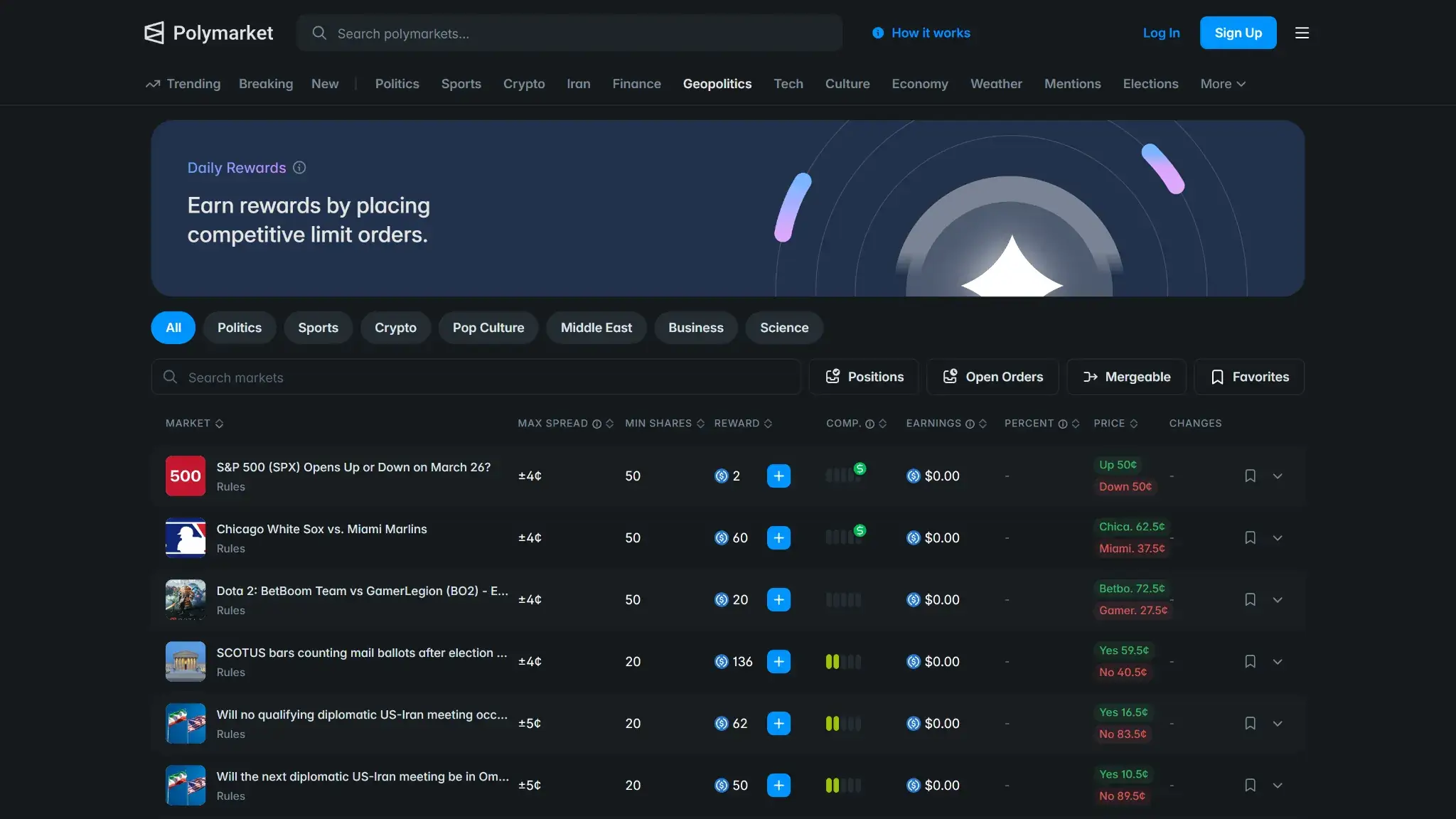
Polymarket desktop rewards page showing daily rewards for competitive limit orders with searchable market listings and position tools.
Polymarket feels built mainly for active desk-based trading and automation, with some support for casual use. It is more functional than polished.
Surface Or Tool
Availability
Notes
Web App
Yes
Main product surface
iOS App
Yes
Official app; U.S. access is through the U.S. app waitlist
Android App
Yes
Official app; U.S. access is through the U.S. app waitlist
Desktop App
No
Browser-based
Watchlists And Alerts
No
Not a major strength
API Access
Yes
Strong for active users
WebSocket Or Live Market Feed
Yes
Good for live market workflows
Historical Data Access
Yes
Available through APIs and related tools
Trade History Export
Yes
Accounting snapshot ZIP plus API trade and activity endpoints
Charts are good enough, and the order ticket is clear enough for active use. Rule visibility is decent, but users still need to read carefully. Portfolio views are usable, and the platform is much more bot-friendly than most casual prediction apps.
The interface is good enough to work with, but it does not solve the deeper issue of thin markets. The better the market, the better the UX feels.
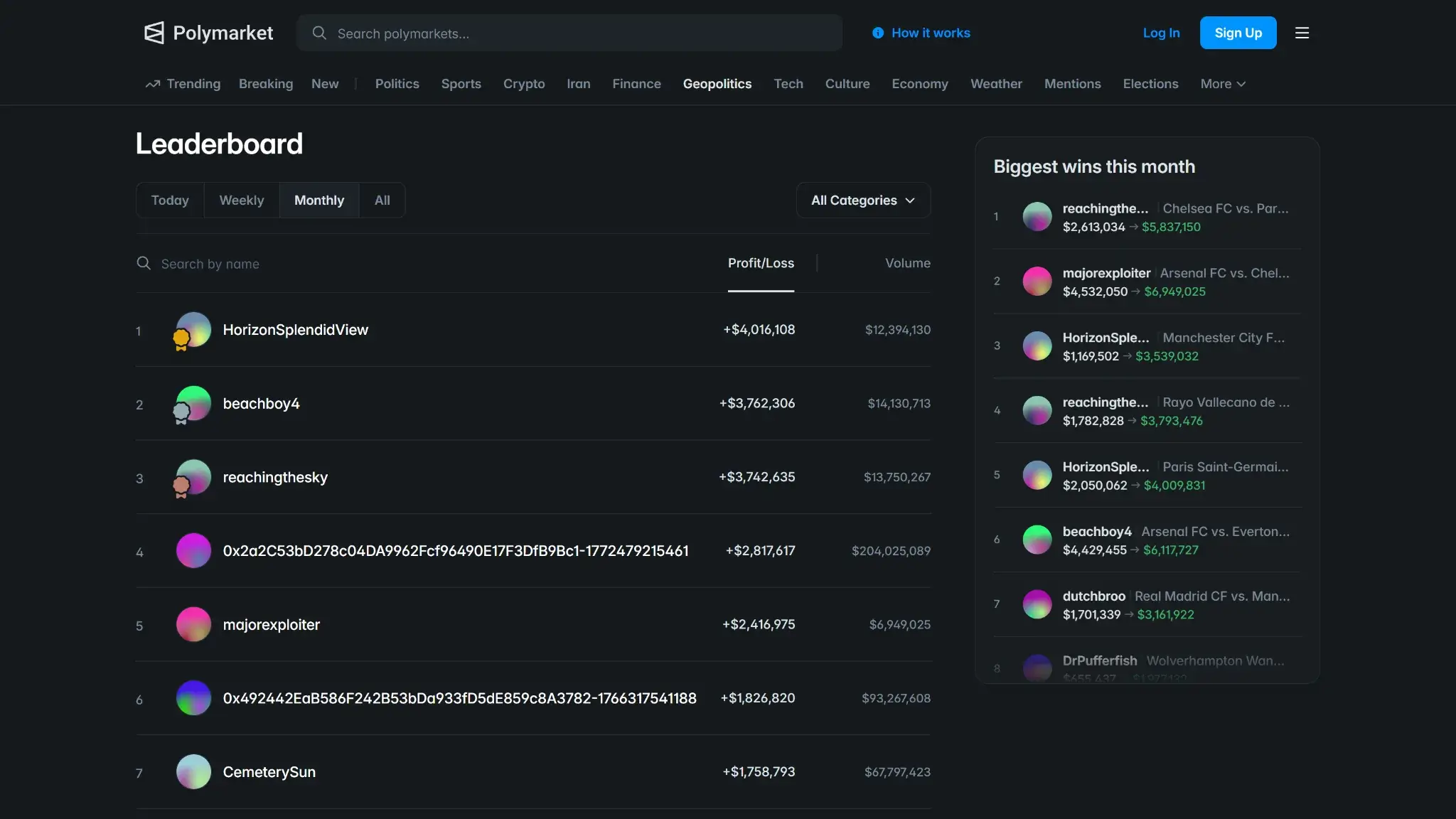
Polymarket desktop leaderboard page showing monthly profit and loss rankings and biggest wins this month.
Taxes, Statements and Record-Keeping
Record-keeping looks manageable for crypto-native users and messy for everyone else.
Tax forms are not as clean or standardized as a normal broker workflow
Account statements are less polished than traditional finance users may expect
CSV access exists through accounting snapshots, but reporting still feels manual
Cost basis is not presented in the cleanest way for tax-ready reporting
Users still need to track transfers, fills, conversions, fees, and off-ramp activity themselves
If you already use crypto tax tools, this is manageable. If you want near-ready tax paperwork from the platform itself, it will feel annoying fast.
Customer Support, Limits and Incident Handling
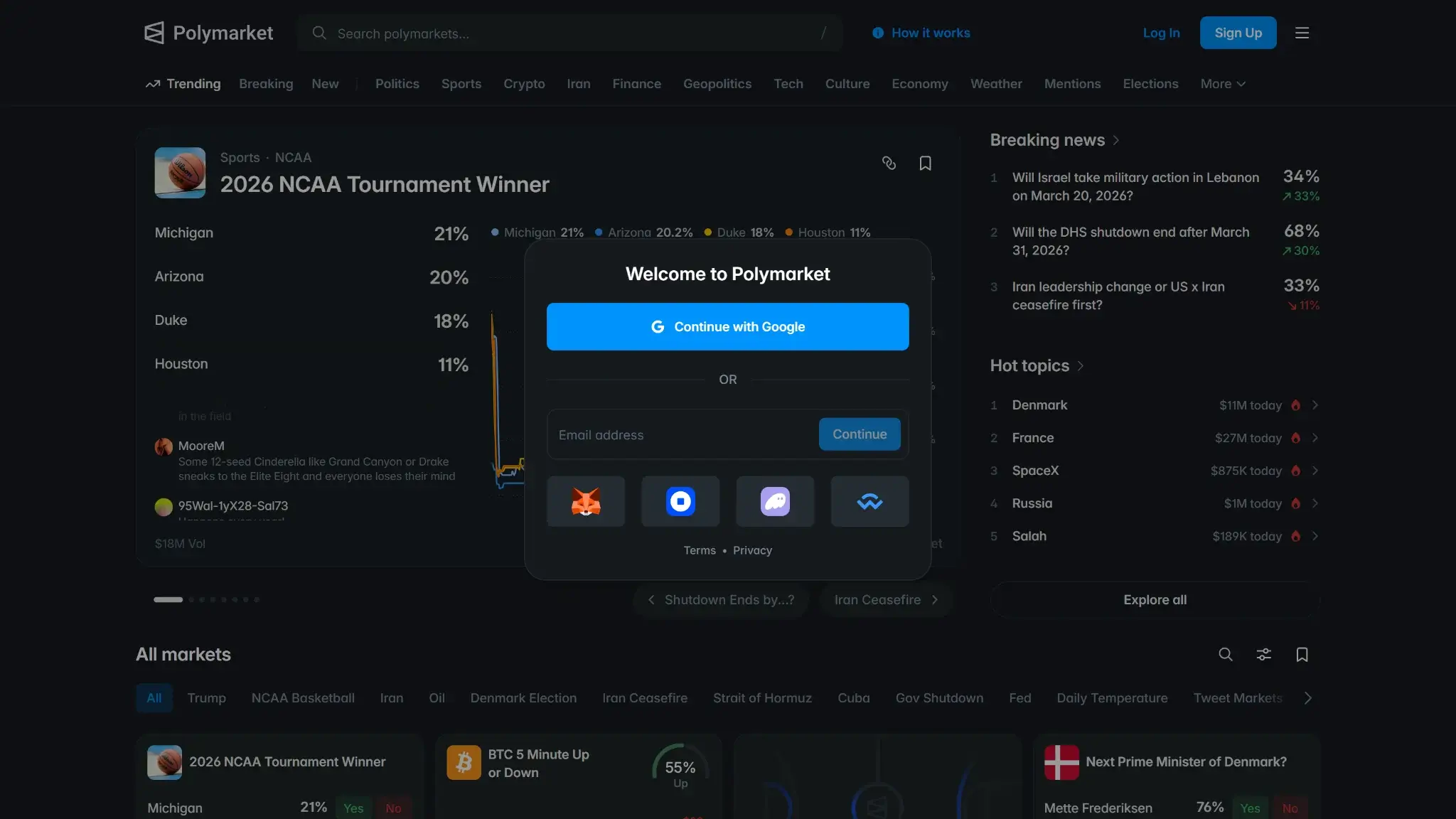
Polymarket desktop homepage showing the 2026 NCAA Tournament Winner market with a centered sign-up modal and breaking news sidebar.
The self-serve side is fairly strong, while live help feels less central.
Help center — strong for setup, funding, market rules, fees, API docs, and troubleshooting. Better for process questions than one-off exceptions.
Live chat — limited. If available, it feels more like a routing layer than true real-time trade support.
Email or ticket support — Website chat and Discord are the main support paths. Formal complaints go to [email protected]. Privacy requests go to [email protected].
Status page — useful for checking outages, degraded services, and maintenance instead of guessing whether the failure is on your side.
Community channels — Discord and social channels are useful for announcements, clarifications, and API discussion, but they are not formal account support.
Self-exclusion or cooldown tools — not a clear strength. Users who want strong responsible-gambling style controls may find this thin.
Account limits — can depend on funding path, geography, and account flow rather than one simple global rule.
Trading size limits — no built-in cap on Polymarket.com; real limit is balance and market depth.
What support can fix — account access issues, basic setup problems, product guidance, and some platform-side errors.
What support cannot reverse — bad trades, onchain transfers, fills caused by market movement, and user wallet mistakes.
The support setup is good enough for a crypto-native platform, but it is not high-touch. If you expect broker-style hand-holding, it will feel thin.
Polymarket Works Best When Liquidity Matters More Than Convenience
Polymarket is best for traders who want active event markets, broad topic coverage, and the ability to trade in and out before final resolution. The main reason to choose it is that, on major markets, it often feels more alive and tradable than weaker rivals. The main reason to avoid it is that funding, reporting, and cash-out still feel less convenient than on broker-style platforms. Before funding the account, verify that your jurisdiction, funding route, and cash-out path all work for your specific setup.
Final Verdict
Polymarket is the strongest prediction market for active traders who want broad event coverage, deep books on major markets, and the ability to exit before resolution. It covers politics, crypto, macro, and culture with more live pricing energy than most rivals. The trade-off is the workflow: funding runs on USDC and wallet rails, cash-out to fiat requires an off-ramp, and tax reporting is thin. If you are already comfortable with crypto infrastructure, it is the best option on the market. If you want bank funding and clean statements, it will feel rough from the start.
Broad coverage across politics, crypto, macro, sports, and culture
Fast repricing when news breaks
Can often exit before resolution
API access suits more active users
CONS
Access still varies by user and jurisdiction
Fiat cash-out is less convenient than broker apps
Smaller markets can feel thin quickly
Workflow still leans crypto-native
Regulation and reporting are not especially clean
Affiliate Disclosure
Disclaimer: CryptoSlate may receive a commission when you click links on our site and make a purchase or complete an action with a third party. This does not influence our editorial independence, reviews, or ratings, and we always aim to provide accurate, transparent information to our readers.
FAQ
Is Polymarket legal where I am?
For the international platform, order placement is blocked from Australia, Belgium, Belarus, Burundi, Central African Republic, Congo (Kinshasa), Cuba, Germany, Ethiopia, France, the United Kingdom, Iran, Iraq, Italy, North Korea, Lebanon, Libya, Myanmar, Nicaragua, the Netherlands, Russia, Somalia, South Sudan, Sudan, Syria, the United States, U.S. Minor Outlying Islands, Venezuela, Yemen, and Zimbabwe. Poland, Singapore, Thailand, and Taiwan are close-only, while Ontario plus Crimea, Donetsk, and Luhansk are also restricted. U.S. access is through separate Polymarket US, a CFTC-regulated Designated Contract Market, with the U.S. app being rolled out via waitlist.
Does Polymarket require KYC?
It depends on your jurisdiction and access path. The trading stack is still more crypto-native than broker-native, but users should not assume zero KYC in every flow.
Can I sell before the market resolves?
Yes. If the market still has enough liquidity, you can sell before final resolution and lock in gains or cut losses.
How long does it take to actually withdraw winnings from Polymarket?
On-platform balance updates can be fast once a market resolves, and wallet withdrawals can also be quick. The slow part is often the final off-ramp into spendable fiat, which depends on the external provider you use.
Why is the same event priced differently on Polymarket and Kalshi?
Different user bases, different funding rails, different liquidity, different contract wording, and different market depth can all move prices apart. Small price gaps usually reflect differences in liquidity, wording, and user flow rather than a clear mistake.
How are disputed, clarified, or voided markets handled on Polymarket?
Markets generally follow written rules and a stated resolution source. Disputes can escalate through the UMA Optimistic Oracle path rather than being casually voided.
Does Polymarket offer an API and historical data?
Yes. Polymarket offers public market data APIs, WebSocket feeds, price-history endpoints, and broader access for market, trade, and analytics workflows. Accounting snapshots are also available as ZIP downloads of CSV files.