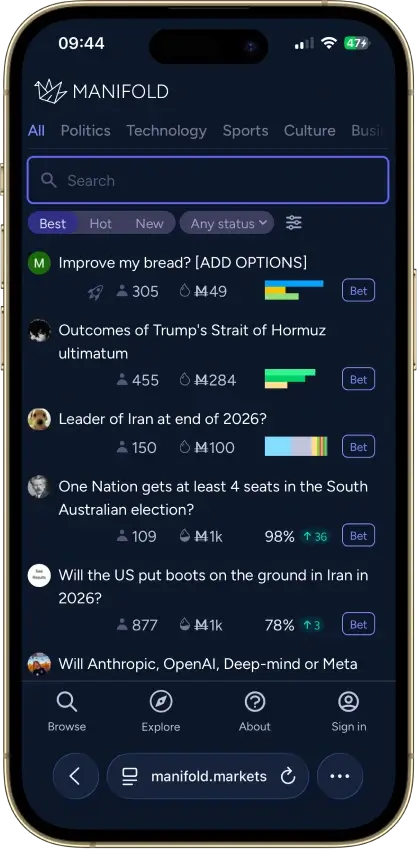
Manifold Markets is a pure play-money market built for forecasting, not cash payouts; Manifold ended its sweepstakes program in February 2025 and returned to a Mana-only model. Users trade with Mana, create their own markets, and track crowd odds across politics, AI, sports, culture, business, and many narrower topics that most rivals would never touch.
Age Requirement13+; minors generally need parent or guardian permission
KYC LevelNo KYC
Funding CurrencyMana (Ṁ)
Deposit MethodsNone required; optional card purchase for Mana
Minimum Deposit$0
Core Market CategoriesPolitics, Technology, Sports, Culture, Business, and Fun, plus user-created long-tail topics such as AI, economics, crypto, news/current events, research, and project management
Contract TypeBinary Contracts, Multi-Outcome Contracts, Range Contracts, Scalar Contracts
Users can create markets, so coverage goes far beyond standard politics or sports.
No KYC is needed to start, which removes most account setup friction.
The API, WebSocket feed, and bulk data access make it useful for research and bot workflows.
Mana has no cash value, so forecasting ideas can be tested without real-money risk.
Cons
There is no cash payout, so forecasting skill does not turn into withdrawable profit.
Market quality varies because creators write their own rules and often resolve their own markets.
Liquidity is uneven, especially outside the biggest topics and community clusters.
Loans and play-money incentives can distort pricing in weaker markets.
Who Manifold Markets Is Best For — And Who Should Skip It
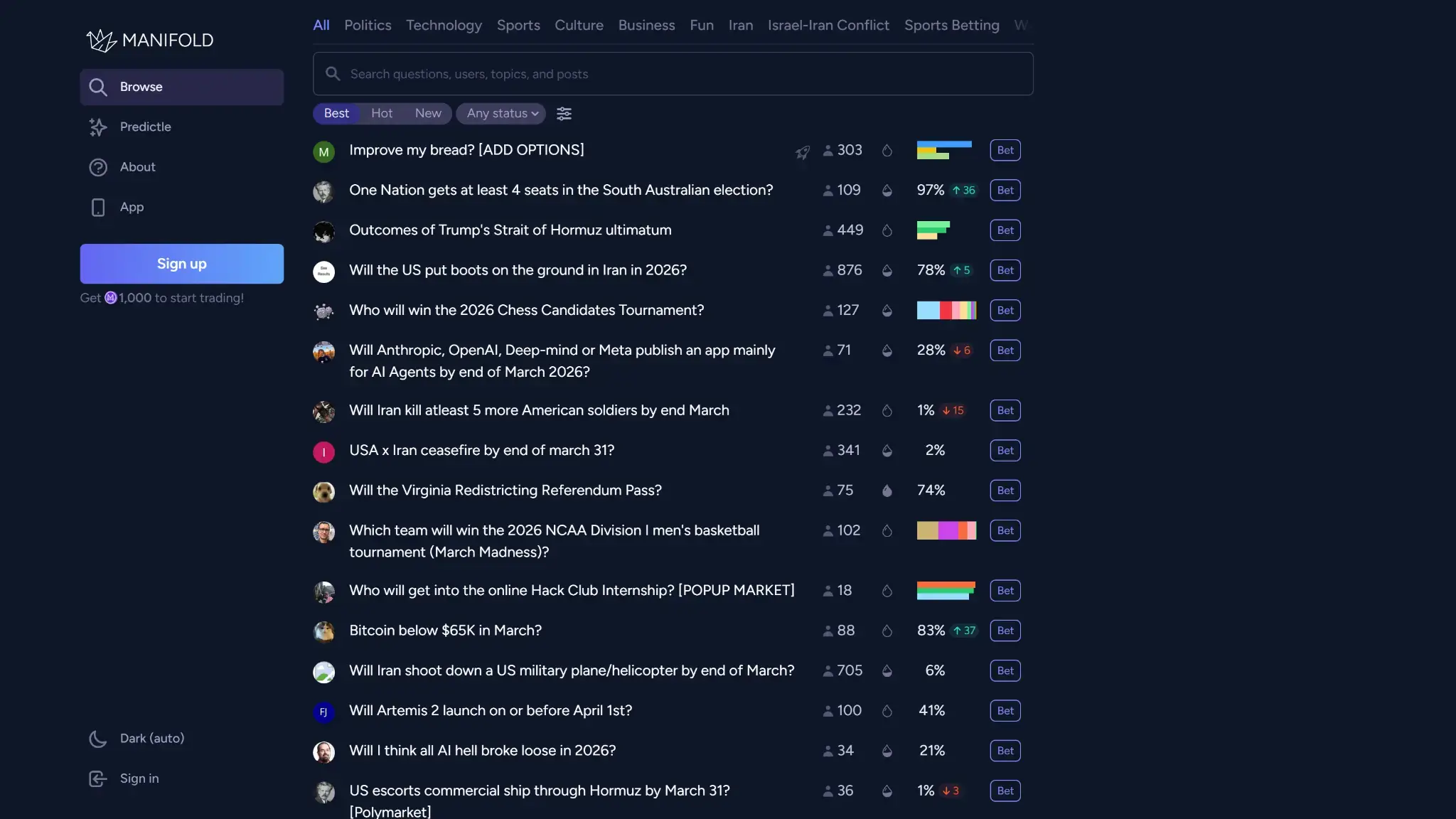
Manifold Markets homepage on desktop showing mixed trending prediction markets, search bar, category filters, and betting buttons in a dark interface.
Manifold Markets fits those who want flexible, low-friction forecasting more than those who want a polished trading venue. The real question is not whether it can be used. It is whether play-money forecasting with broad topic coverage is the goal, or whether a tighter real-money market with clearer market discipline is the better fit.
Reader Type
Fit
Why
Casual Event Trader
Medium
Easy to join and use, but no cash payout changes the incentive to keep trading.
The best fit is the user who wants to practice forecasting, follow niche questions, build research tools, or use market odds as a community signal rather than a cash market. It also fits those who care more about topic breadth and low signup friction than about formal protections.
Those who should look elsewhere are users who want clear regulation, stronger execution quality, tighter market rules, or actual money movement in and out. If payout, withdrawal speed, or strict market oversight matter most, Manifold Markets is the wrong product.
What Is Manifold Markets And How Does It Work?
Manifold Markets is a play-money prediction platform where users trade on future events with Mana. It is part forecasting site, part social platform, and part user-generated market system. Anyone can browse markets, and anyone with an account can create new ones.
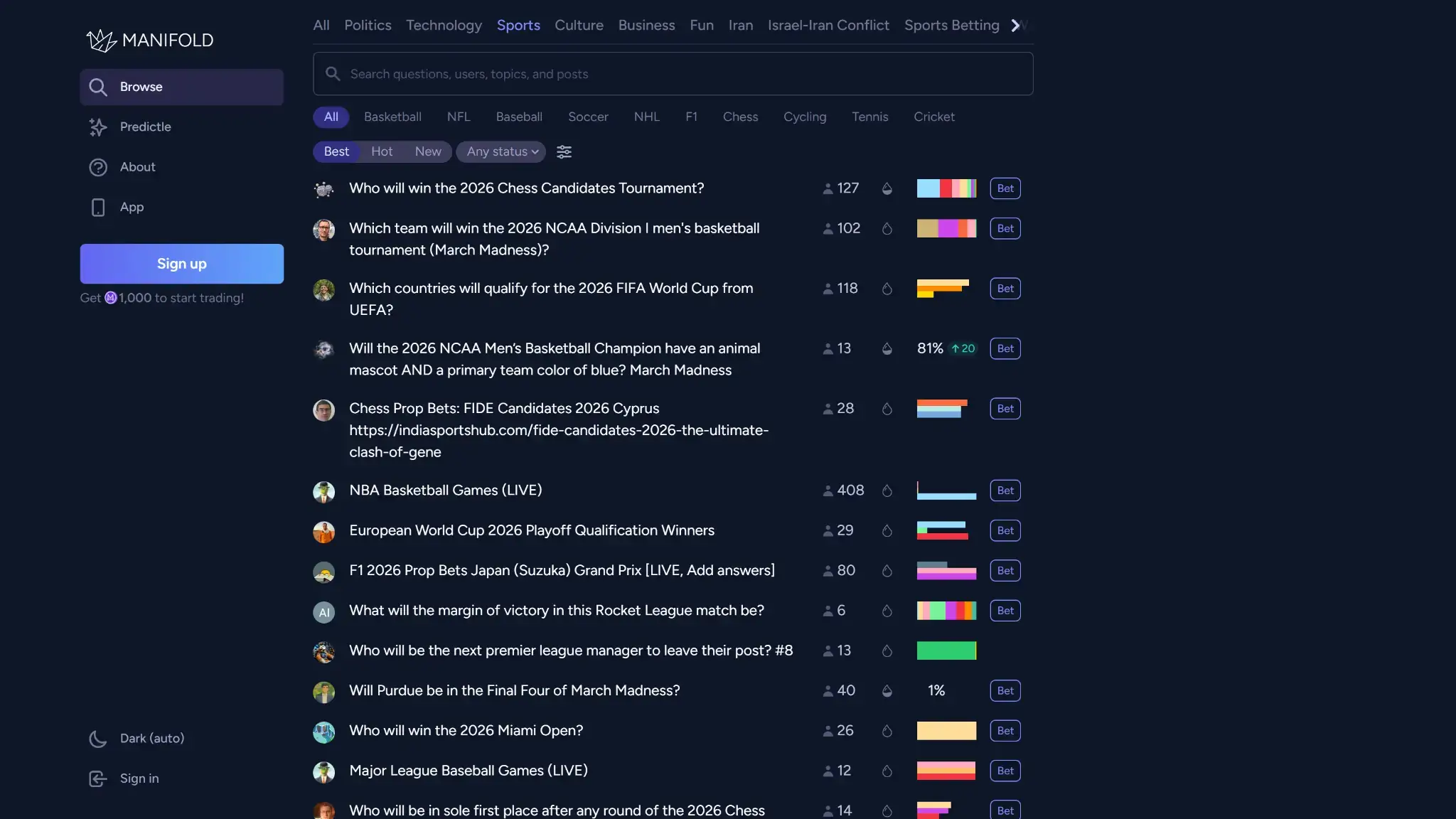
Manifold Markets sports page on desktop showing sports prediction questions, category filters, search bar, and betting buttons in a dark interface.
Contracts are priced as probabilities. In a simple yes-or-no market, a contract trading at 60% implies roughly a 60% market estimate for that outcome. Manifold uses a mix of limit orders and an automated market maker, so trades fill against open orders first and then against the AMM.
A winning share pays M1 at resolution. Profits come from buying when the implied probability looks too low, selling later at a better price, or holding until the market resolves in your favor.
Users can exit before final resolution by selling positions. That makes Manifold Markets more flexible than a simple forecast poll, but early exit still depends on market conditions. In thinner markets, prices can move more than expected.
Manifold Markets is actually built for:
User-created questions that would never appear on regulated venues
AI, tech, politics, and culture topics with active commenting and debate
Long-tail forecasting where breadth matters more than cash payout
Research, experimentation, and reputation-driven forecasting
The basic operating model is simple: users create markets, trade with Mana, move prices through buys and sells, and then the creator usually resolves the market, while Manifold retains ultimate discretion to resolve, re-resolve, cancel, or void markets.
Access, Eligibility and Account Setup
Manifold Markets has one of the lightest setup flows in this category. It is a play-money platform, so there is no brokerage account, no crypto wallet connection, and no full identity check just to get started. Setup is simple. The real friction is legal uncertainty, because the platform is easy to open but local rules may still limit use.
Trading AvailabilityPlay-money trading is broadly available online
Unsupported JurisdictionsVaries By Jurisdiction
Age Requirement13+; minors generally need parent or guardian permission
KYC LevelNo KYC
Account Type NeededStandard Manifold account
Bank, Wallet or Broker Setup NeededNone for normal use; payment card only if buying extra Mana
Geolocation or Device ChecksNot Disclosed
Time to First TradeUsually under a minute with Google or Apple sign-in
Setup friction is light. The biggest drag is not onboarding. It is jurisdiction clarity, because there is no clean platform-wide map of where local rules could create problems.
Market Coverage and Contract Design
Manifold Markets covers more topics than almost any direct competitor, but that breadth comes from user creation rather than tight platform curation.
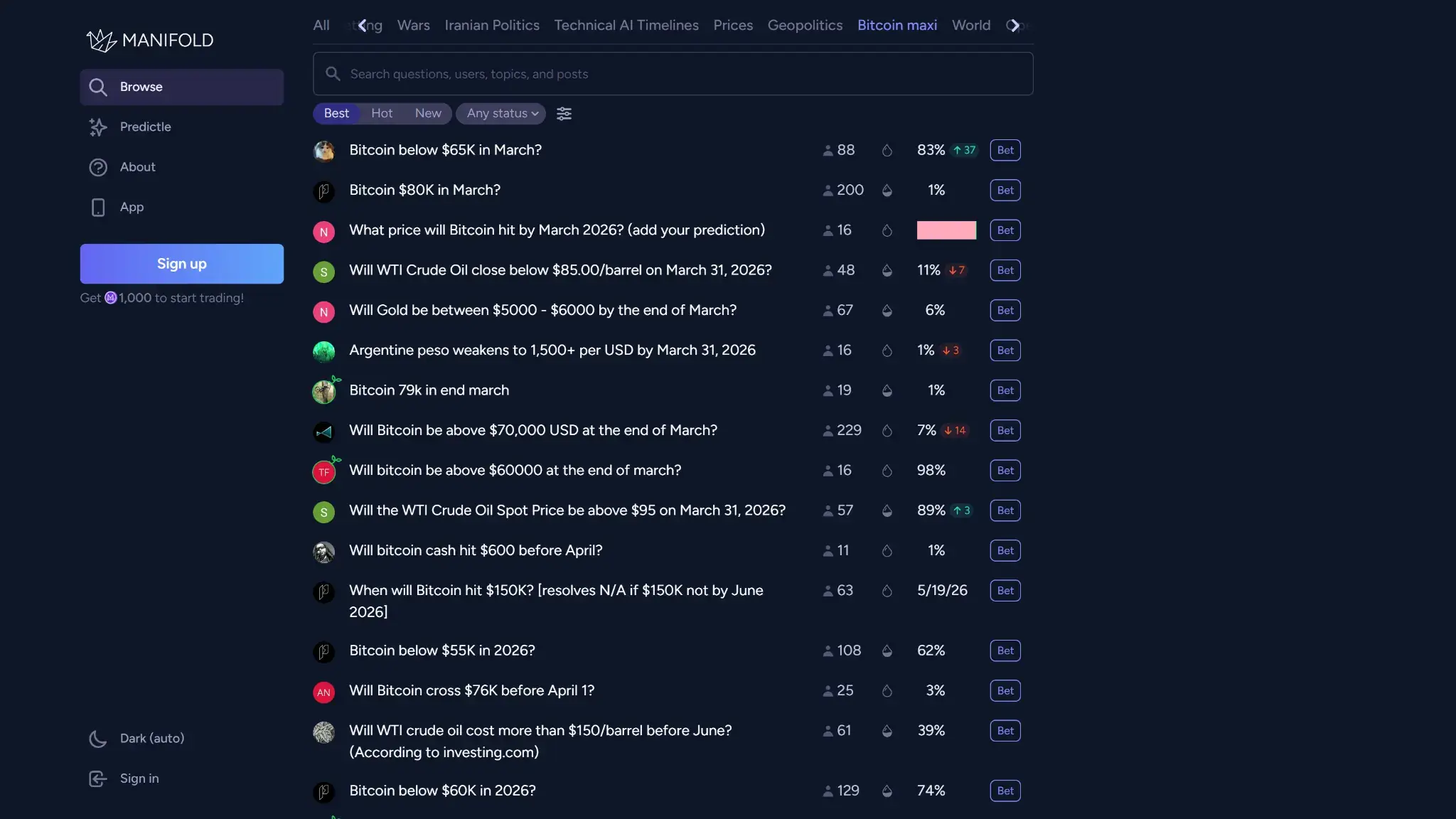
Manifold Markets Bitcoin predictions page on desktop showing Bitcoin and macro market questions, probability indicators, and betting buttons in a dark interface.
Compared with Kalshi, PredictIt, or Polymarket, it goes much wider and reacts faster to strange, niche, or early-stage questions. Compared with Metaculus, it feels more market-driven and social. It can surface useful odds on everything from AI timelines to sports and elections, but depth and quality depend heavily on which communities care enough to trade.
Category
What Is Covered
How Deep It Is
Important Gaps Or Caveats
Sports
Team sports, tournaments, player outcomes, and fast news-driven questions
Medium
Coverage is wide, but real depth and liquidity are inconsistent
Politics
Elections, parties, Congress, geopolitics, wars, and country-specific questions
High
Strong breadth, but wording and resolution quality vary by creator
Macro / Economics
Global macro, inflation, GDP, rates, business events, and economic releases
Medium
Useful for sentiment, but not disciplined like a regulated macro venue
Crypto / Finance
Bitcoin, price thresholds, crypto events, market moves, and business-linked questions
Medium
Better for discussion and crowd odds than serious execution
Culture / Entertainment
Awards, media, celebrities, music, internet culture, and fun markets
High
One of the busiest areas, but many markets are casual or joke-adjacent
Other Categories
AI, OpenAI, science, math, gaming, technical topics, personal markets, and project forecasts
Very High
This is where Manifold Markets is most distinctive, but quality is highly uneven
In practice, coverage is broad but uneven. Manifold is strongest in AI, tech, politics, and community-driven niches because users can launch markets fast. It is weaker where users need consistent depth, tighter rules, or reliable execution across similar events.
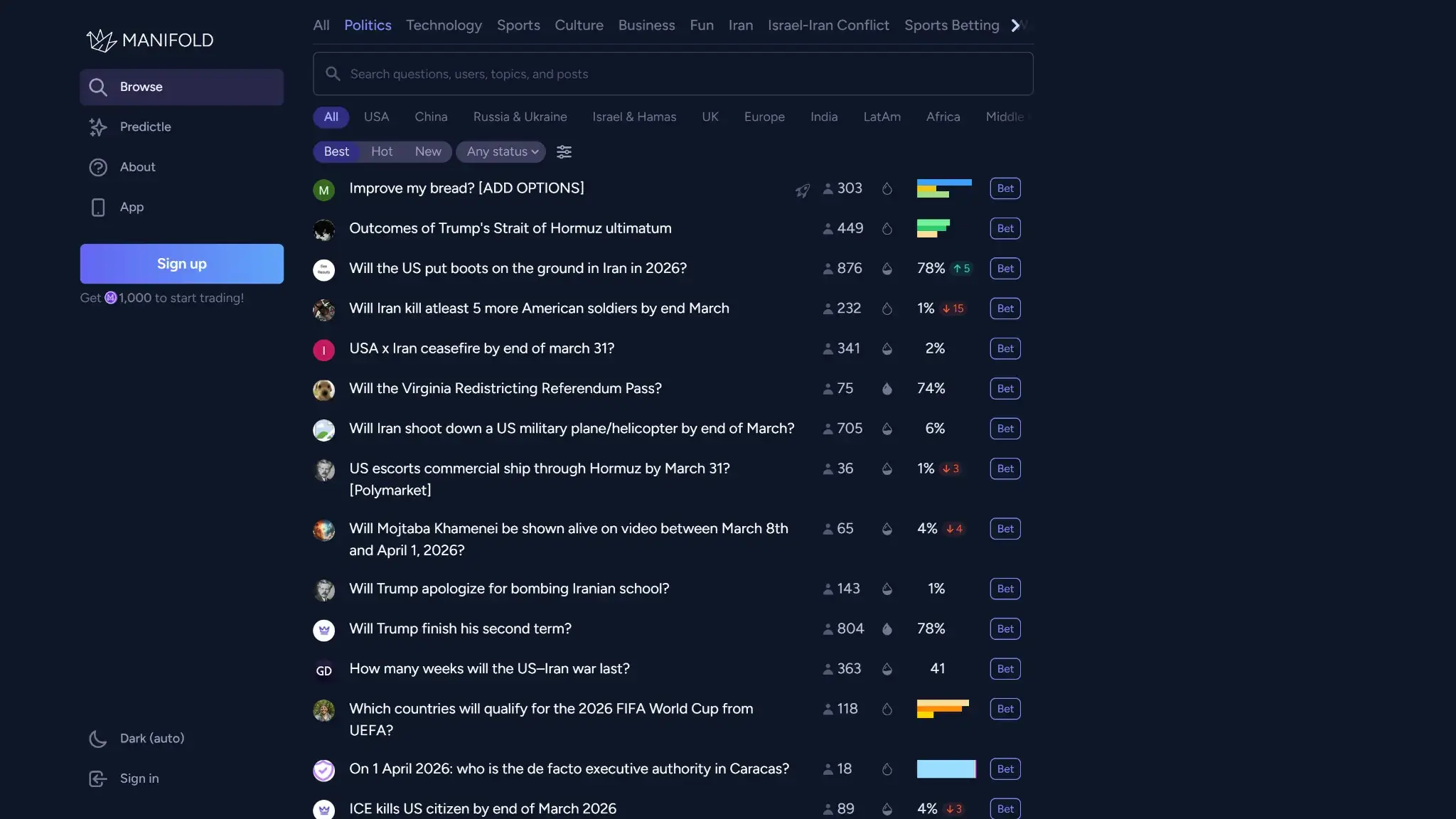
Manifold Markets politics page on desktop showing political prediction questions, topic filters, search bar, and betting buttons in a dark interface.
Contract Design Notes
Binary Yes / No Markets — Yes. These are the default and still the core format on the platform.
Multi-Outcome Markets — Yes. Multiple-choice markets are supported, including setups where answers sum to 100%.
Range Or Bracket Markets — Yes. Numeric and pseudo-numeric markets cover thresholds, ranges, and brackets.
Short-Dated Or Intraday Markets — Some. Fast markets appear quickly, but many stay thin outside major events.
Longer-Dated Markets — Yes. This is one of the platform’s strongest use cases, especially in AI, politics, and research topics.
Speed Of New Listings — Very fast. Users can create markets almost immediately when news breaks.
Market Wording Quality — Uneven. Some markets are clear and well structured, while others leave avoidable room for dispute.
For users who care about breadth, speed, and niche topic coverage, the market mix can be very useful. It is less useful for anyone who needs standardized contracts, tight governance, or steady tradability. The platform offers real range, but it still depends on knowing which markets deserve trust.
Liquidity, Order Book and Execution Quality
Manifold Markets is shallow once you leave the homepage. It is tradable on some major politics, AI, culture, and headline event markets, but execution quality falls off fast in quieter questions where there are fewer active traders and less meaningful liquidity.
Depth on Major MarketsUsually decent by Manifold standards, but still much thinner than real-money rivals.
Depth on Quieter MarketsOften shallow, with limited room for larger trades.
Bid-Ask Spread BehaviorNot a classic exchange spread, but effective entry and exit costs widen quickly in thin markets.
Limit OrdersSupported at chosen probabilities.
Instant Buy / Market-Style ExecutionSupported through limit orders first, then the AMM.
Partial FillsYes. Limit orders can fill partially and stay open.
Exit Before ResolutionYes, but exit quality depends heavily on market depth.
Visible Volume / Open InterestVolume, liquidity, bettor count, positions, and recent activity are visible, but there is no clean open interest view.
Position LimitsNo hard platform-wide limit is clearly disclosed for normal play-money trading.
Slippage RiskMedium on big markets, high on quieter ones.
Manifold Markets feels most liquid in the same places its community clusters hardest: major political questions, AI timelines, big cultural events, and a handful of headline markets that get constant attention.
Outside those headline markets, depth drops fast. Long-tail user-created markets can drift away from rival platforms because there is no real-money arbitrage pushing prices back into line. Fast traders and active limit-order users matter more there because they can react first to news and pick off weaker pricing. API users, active traders, and anyone trying to size up beyond small bets should care most.
Fees and Total Cost to Trade
Manifold Markets is clearly low-cost at the platform-fee level. Live trading fees are currently set to zero, but thin-market slippage still creates real cost once you move away from the busiest markets.
Cost Component
What Users Pay
When It Applies
Notes
Trading Fee
M0 on trades
When placing bets or selling shares
Current trading fees are set at zero. API comments are separate and cost M1.
Spread Or Slippage Cost
No fixed fee
When entering or exiting positions
Cost comes from AMM price impact and available limit-order liquidity, not from a posted spread schedule.
Deposit Fee
$0 to start; optional Mana packages at $5, $25, $100, or $1,000
When opening an account or buying more Mana
Mana top-ups are sold in fixed packages: M500 for $5, M2.5k for $25, M11k for $100, and M120k for $1,000.
Withdrawal Fee
Not Applicable
Not Applicable
Mana cannot be redeemed for cash.
Network Or Gas Fee
Not Applicable
Not Applicable
Manifold Markets is not an onchain trading venue for normal platform use.
FX Or Conversion Fee
Not Applicable
Not Applicable
There is no normal cash-out conversion loop.
Subscription Or Premium Fee
Plus M500; Pro M2,500; Premium M10,000
If users buy Manifold Membership
Membership pricing is fixed at those three levels.
Third-Party Provider Fee
Not Disclosed
When buying Mana
Checkout pricing is visible, but no separate processor surcharge is broken out.
In practice, the zero-fee headline matters less than slippage. Casual users will usually find costs low enough. Active users on thin markets will feel execution drag long before they hit a posted fee.
Funding, Settlement and Cash-Out Flow
Manifold Markets runs on Mana, not redeemable cash. Money can come in only if a user chooses to buy more Mana, but the normal user experience starts with free play-money balance and stays inside the platform.
Users get in by creating an account and receiving 1,000 Mana, or by buying extra Mana with a card.
Buying power is usable as soon as the free balance is credited or the Mana purchase clears.
When a contract resolves, winning shares pay out in Mana and losing shares go to zero.
Funds do not become withdrawable because Mana is not redeemable for cash.
No money reaches a bank account or wallet because there is no normal cash-out path.
Step
Typical Speed
Common Friction
Deposit
Instant for free starting balance; usually fast for Mana purchase
Optional payment step if topping up
Buying Power Availability
Usually immediate
Payment confirmation if purchasing Mana
Contract Settlement
When creator or moderators resolve the market
Delays can happen if rules are unclear or creator action is slow
Balance Becoming Withdrawable
Not Applicable
Mana is not withdrawable
Withdrawal Request
Not Applicable
No standard withdrawal flow exists
Funds Arrival
Not Applicable
No bank or wallet payout exists
A market can resolve fast and your Mana balance can update right away. That still does not create a payout path, because Mana stays inside the platform. The distinction is simple: markets can settle quickly, but there is no cash-out step at the end.
Resolution Rules, Market Integrity and Disputes
Manifold Markets is mostly clear but edge-case sensitive. Good markets are easy enough to trade, but rule quality depends a lot on the creator. The biggest risk is not platform-wide abuse. It is vague wording, delayed resolution, or a market that gives one person too much room to interpret the outcome.
Resolution Source — Usually the creator, with moderator intervention when needed.
Rules Clarity — Uneven. Some markets are precise, others are loose.
Dispute Path — Usually handled through comments and moderator review.
Void Or Cancel Policy — Canceled markets return Mana.
Partial Resolution — Supported for some binary and multi-outcome markets.
Settlement Pace — Fast when the creator is active, slower when a market is neglected.
Main Edge-Case Risk — Creator discretion on thin or poorly written markets.
That makes misunderstandings more common than on a tightly governed platform. Disputes are not constant, but they matter enough that serious users should stick to clearly written markets, active creators, and topics where the outcome is easy to verify.
Security, Custody, Privacy and Trust
Trust here comes down to two things: the platform itself, and how carefully you manage your account. The bigger risk is not someone stealing your funds. It is putting too much weight on markets that are poorly written, lightly traded, or resolved under pressure.
Mana is not held in a self-custody wallet (a wallet you control) or a brokerage account. It is a virtual currency balance the platform issues and manages, and Manifold reserves broad rights to adjust or remove it. Access runs through a standard username and password setup, so password strength and two-factor authentication matter more here than private keys or self-custody tools.
The privacy trade-offs are worth knowing upfront. Trades, comments, and public activity are visible by design, and public platform data can be licensed. The open-source codebase and public API add some transparency, but they do not change the fact that Manifold controls balances, handles moderation, and has final say on how markets resolve.
UX, Apps, Automation and Data Access
Manifold Markets is built for a mix of casual mobile use, browser-first forecasting, and lightweight automation. It is not a pro trading terminal, but it is one of the more accessible platforms for users who want both a social front end and a usable data layer underneath.
Surface Or Tool
Availability
Notes
Web App
Yes
This is the main product surface and still the best way to navigate the full platform.
iOS App
Yes
Good for browsing, trading, and notifications, but less efficient than web for heavy research.
Android App
Yes
Similar role to iOS, with mobile access and push-style engagement.
Desktop App
No
No dedicated desktop app. Browser use is the desktop experience.
Watchlists And Alerts
Yes
Users can follow markets and manage notifications, though this is not a pro-grade watchlist system.
API Access
Yes
Public API supports market, user, bet, comment, and portfolio data.
WebSocket Or Live Market Feed
Yes
Live feed support exists through WebSocket topics for bets, comments, markets, and contract updates.
Historical Data Access
Yes
Historical dumps and API endpoints make past market and trade analysis possible.
Trade History Export
No
There is no clear built-in CSV-style export flow, even though history is accessible through the API.
Charts are clear enough for casual forecasting, and the order ticket does a decent job showing bet amount, payout, and price impact before execution. Rule visibility depends on how well the creator wrote the market, which means the UX cannot fully solve market-quality problems. Portfolio visibility is good enough for normal use, and platform speed is generally fine for play-money trading. Where Manifold Markets really stands out is automation and research access. The API is open, the live feed is usable, and the historical data layer is much friendlier than most platforms in this category.
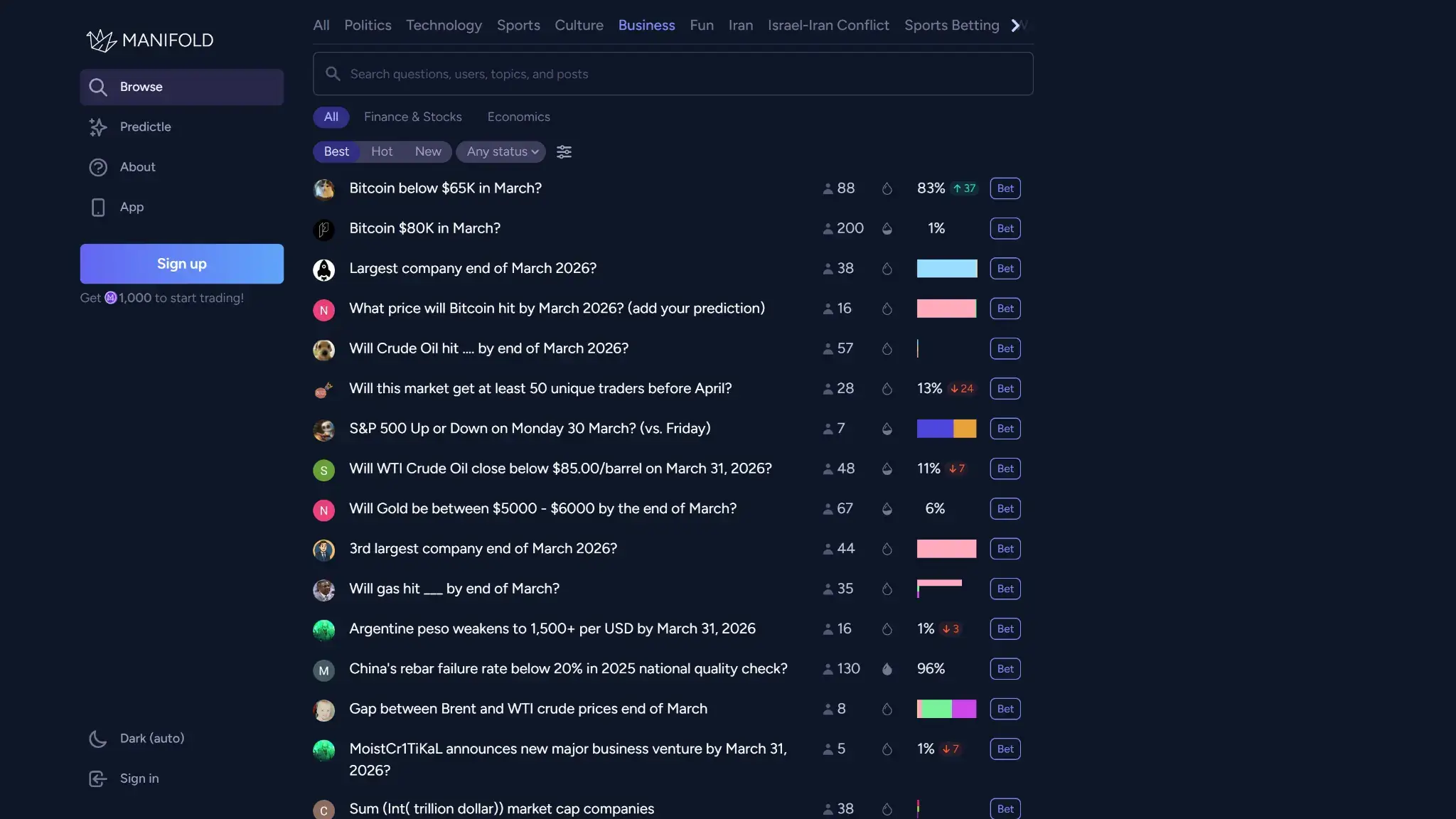
Manifold Markets business page on desktop showing finance and economics prediction questions, market probability bars, and betting buttons in a dark interface.
The interface helps more than it hurts. It makes discovery, trading, and data access easier, but it cannot fix thin markets or vague contract wording.
Taxes, Statements and Record-Keeping
Record-keeping is light if you use Manifold casually and never treat it like a formal trading ledger. Because Mana is play money, there are no tax forms for normal trading and no broker-style account statements.
Once you want real performance tracking, the work becomes manual. The API and data dumps are more useful than the built-in history view, and heavy users still need to track their own trades, performance, and Mana purchases.
Customer Support, Limits and Incident Handling
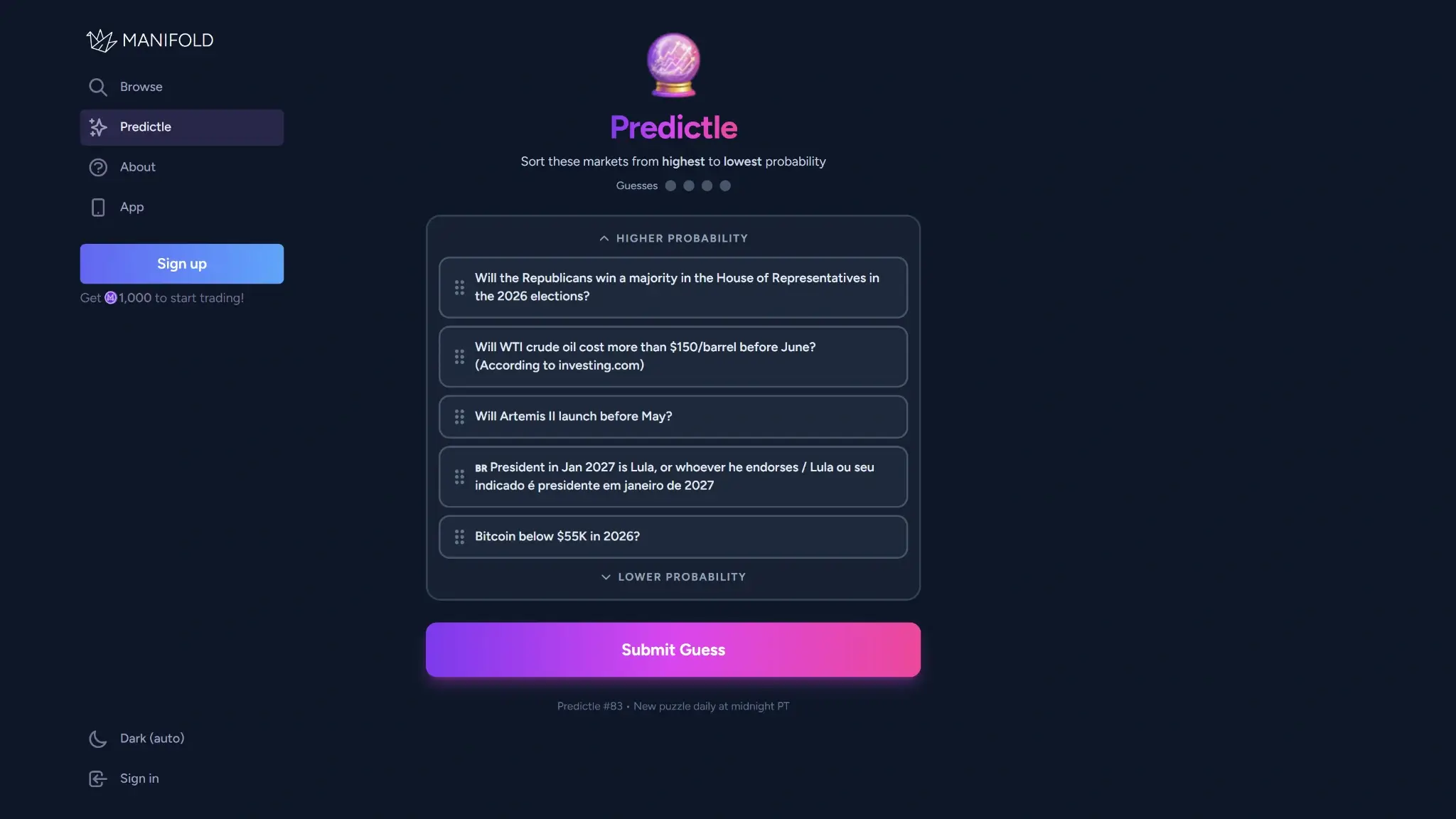
Manifold Markets Predictle page on desktop showing a probability ranking game with draggable market cards and a submit guess button.
Documentation is better than human support. The FAQ and docs on the main site and at docs.manifold.markets answer most basic questions, but direct help still leans on email, moderators, and community channels.
For platform issues, support runs through [email protected], with [email protected] for privacy matters and [email protected] for commercial data questions. There is no live chat or public status page, and there is no formal self-exclusion system. Most market-specific help happens in comments by tagging @mods. That setup can fix access issues, bugs, moderation problems, and some dispute cases, but it will not unwind every bad trade or overrule every creator decision.
Final Verdict
Manifold is the odd one out in this category. It has no cash payout, no KYC, no regulated structure, and no meaningful liquidity outside the markets its community actually cares about. What it does have is breadth, speed, and a public API that most regulated rivals cannot match. The play-money setup cuts both ways - it lowers the barrier to entry and lets users create markets on almost anything, but it also means prices can drift and stay wrong because there is nothing forcing correction. Market quality depends on whoever created and is resolving the contract, which ranges from rigorous to genuinely sloppy.
Users can create markets, so coverage goes far beyond standard politics or sports.
No KYC is needed to start, which removes most account setup friction.
The API, WebSocket feed, and bulk data access make it useful for research and bot workflows.
Mana has no cash value, so forecasting ideas can be tested without real-money risk.
CONS
There is no cash payout, so forecasting skill does not turn into withdrawable profit.
Market quality varies because creators write their own rules and often resolve their own markets.
Liquidity is uneven, especially outside the biggest topics and community clusters.
Loans and play-money incentives can distort pricing in weaker markets.
Affiliate Disclosure
Disclaimer: CryptoSlate may receive a commission when you click links on our site and make a purchase or complete an action with a third party. This does not influence our editorial independence, reviews, or ratings, and we always aim to provide accurate, transparent information to our readers.
FAQ
Is Manifold Markets legal where I am?
Manifold Markets does not publish a fixed country whitelist. Access is broad, but it still depends on local law. That means you should not assume availability just because the site opens in your region. There is no clean official list of eligible countries to rely on. The safest approach is to check local rules before you sign up or buy Mana.
Does Manifold Markets require KYC?
No KYC is required for normal use on Manifold Markets. You can sign up and start trading with Mana without uploading government ID or going through a brokerage-style approval flow. That is one of the platform’s biggest advantages over real-money rivals. It keeps account setup fast and simple. It also fits the fact that Mana is play money, not redeemable cash.
Can I sell before the market resolves on Manifold Markets?
Yes, you can sell before final resolution. That gives Manifold Markets more flexibility than a simple forecasting poll. But early exit quality depends on the market itself. On active markets, getting out is easier and price movement is more manageable. On thin markets, selling early can still be costly because slippage rises fast.
How long does it take to actually withdraw winnings from Manifold Markets?
There is no normal withdrawal process because Mana cannot be redeemed for cash. If you win a market, your balance updates in Mana after resolution. That balance stays inside the platform and can be used only for more trading, market creation, or other platform features.
Why is the same event priced differently on Manifold Markets and Polymarket?
The same event can price differently because the two platforms run on very different incentives and market structures. Polymarket uses real money, which attracts stronger arbitrage and pushes prices toward tighter alignment. Manifold Markets uses play money, so mispricings can last longer, especially on thinner questions. The user base is also different, which changes how news gets interpreted and traded.
How are disputed, clarified, or voided markets handled on Manifold Markets?
Most markets are resolved by the creator, and that is where many problems start. Clarifications are usually made in the description or comments while trading is still open. If a resolution looks wrong, users can push back in comments and moderators can step in. Markets can also be canceled, with Mana returned, when the setup breaks down badly enough. That system works best when the market is clearly written and the creator is active.
Does Manifold Markets offer an API and historical data?
Yes. Manifold Markets has one of the more useful public data layers in this category. The API covers markets, users, bets, comments, positions, and more, while WebSocket topics support live updates. Historical data is available through bulk data access and API endpoints. That makes the platform workable for research, dashboards, and lighter bot workflows.