Kalshi is one of the strongest prediction market options for people who want real-money event trading without relying on an offshore or legally unclear venue. It suits U.S.-first traders, hedgers, and active market participants who care about regulation, deep category coverage, and the ability to buy and sell before a market resolves. Kalshi is a CFTC-regulated exchange with better banking access and stronger trust signals than most crypto-native alternatives. The trade-off is friction. Onboarding is identity-heavy, access varies by jurisdiction, and you still need to read the rules closely because timing and eligibility details can matter.
Regulated U.S. exchange, not an offshore workaround
Stronger depth in flagship markets than many rivals
You can usually exit before resolution
Broad funding and cash-out options
Serious API, WebSocket, and historical-data access
Cons
Full KYC adds real setup friction
Access still depends on jurisdiction
Total trading cost is not always obvious
Thin markets can be hard to exit
Some contracts come with extra trading restrictions
Who Kalshi Is Best For — And Who Should Skip It
Kalshi is a strong fit for users who want a regulated place to trade real-money event markets with real order-book mechanics. It works especially well for U.S.-based users who want exposure to politics, macro, sports, or company event markets without relying on offshore crypto rails.
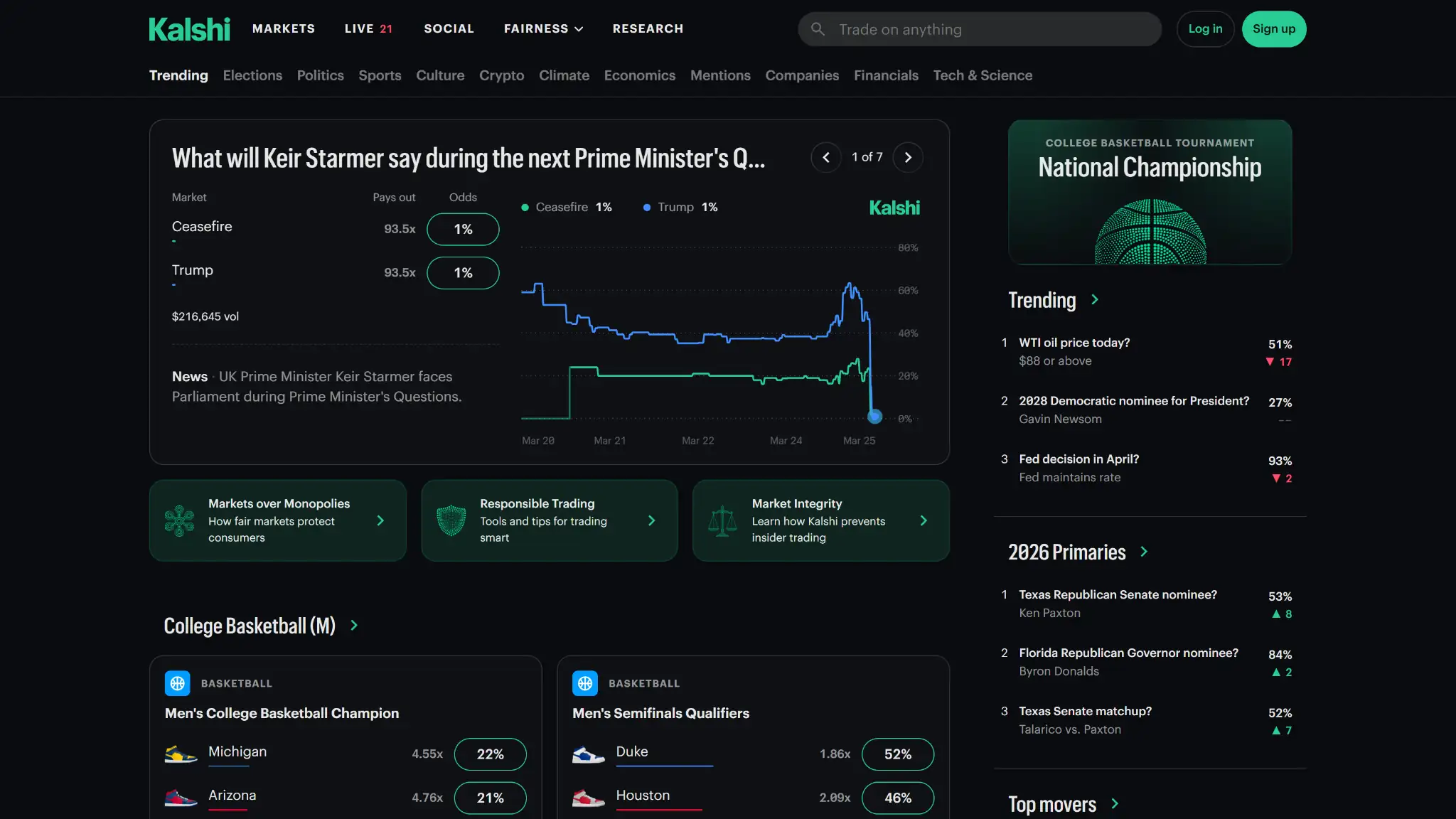
Kalshi desktop homepage showing a featured trending market, National Championship panel, trending lists, and college basketball market cards.
It is a weaker fit for anyone who wants instant, anonymous, low-friction speculation. If your priority is no-KYC onboarding, globally uniform access, or pure crypto-native trading flow, Kalshi will probably feel slower and more restrictive than the alternatives.
Category
Fit
Why
Casual Events
Medium
The interface is usable, but rules, fees, and identity checks make it more involved than a lightweight betting app
Sports
High
Sports coverage is broad, and major markets can carry strong volume and better exit liquidity than niche prediction apps
Macro Or Economic
High
This is one of Kalshi’s strongest use cases, with deep coverage across rates, inflation, jobs, oil, recession, and policy markets
Crypto-Native
Medium
Crypto access exists, but the product still feels like a regulated USD exchange rather than a crypto-first venue
API Or Bot
High
Public REST data, authenticated WebSockets, historical endpoints, SDKs, and FIX for qualifying members
Fast Fiat Withdrawals
Medium
Payout to cash balance is usually quick after settlement, but withdrawal speed still depends on method and deposit-hold rules
Low KYC Friction
Low
Full identity verification is a core part of the product, not an edge case
Clear Regulation
High
Regulation is one of Kalshi’s main advantages and a real reason to choose it over many rivals
Kalshi is a good fit if you want prediction markets to feel more like an exchange than a casual betting app. If you care most about speed, anonymity, and lighter account checks, another platform will likely suit you better.
What Is Kalshi And How Does It Work?
Kalshi is built like an exchange, not a social app or sportsbook-style front end. It is a CFTC regulated prediction market offering USD funding rails, a live order book, and a market menu that leans heavily into politics, macro, sports, weather, and company events.
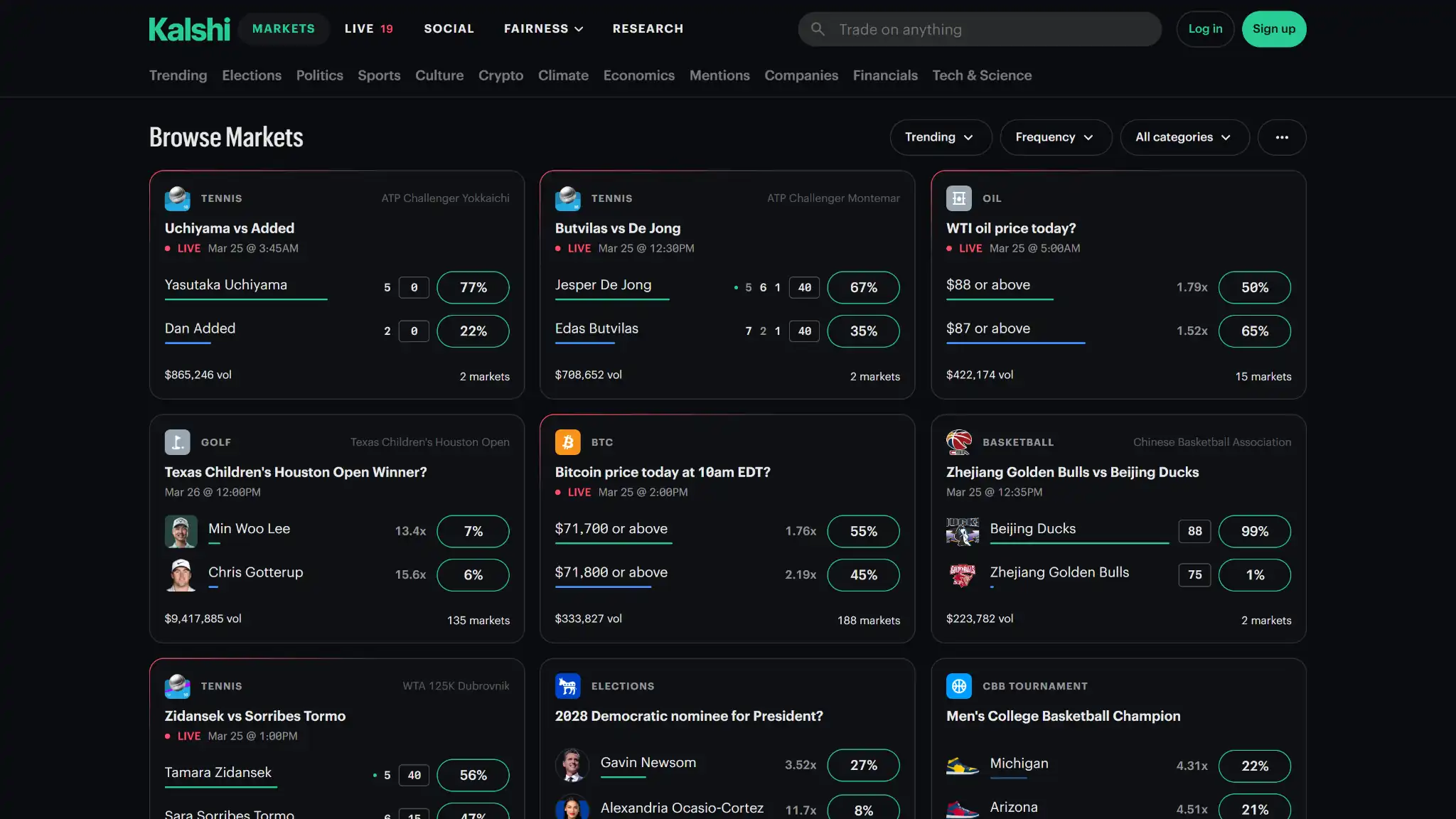
Kalshi desktop browse markets page showing live sports, oil, bitcoin, election, and college basketball market cards with filters at the top.
Here is the basic flow:
Open a verified account on web or mobile
Fund it in U.S. dollars
Buy or sell contracts tied to an event
Hold to resolution or exit early by trading out
Kalshi works as an order-book trading venue for real-money event contracts, with live bids, asks, and price discovery across sports, politics, macro, and other headline-driven markets. It can also be useful in terms of market data for those who want to follow monitor market sentiment around events based order-book activity.
Access, Eligibility and Account Setup
You need a verified account, you need to clear identity checks, and you need to be in a supported jurisdiction. The biggest setup drag is not learning the interface. It is getting through compliance and funding the account with a method that does not create extra wait time later.
Trading AvailabilityPrimarily built for U.S. users, with some non-U.S. access, but availability still depends on jurisdiction and policy
Unsupported JurisdictionsLong restricted list, including many sanctioned jurisdictions plus countries such as the UK, Canada, France, Australia, Singapore, China, UAE, and others
Age Requirement18+
KYC LevelFull KYC. Customer ID info is required before trading. Extra checks can include SSN, ID, watchlist review and manual review
Account Type NeededStandard verified Kalshi account
Bank, Wallet or Broker Setup NeededLinked payment method or transfer rail is needed; no separate broker account is required
Geolocation or Device ChecksCountry and travel eligibility matter. Access while abroad can be restricted
Time to First TradeSame day if verification clears quickly; longer if manual review, payment setup, or account restrictions slow things down
Setup friction is heavy by prediction-market standards. The biggest drag is the combination of full KYC, jurisdiction screening, and the fact that some funding methods can create extra withdrawal friction after you get money in.
Market Coverage and Contract Design
Kalshi’s market menu is broad enough to beat narrower rivals like PredictIt on category range, and it feels more like a standalone trading venue than Robinhood’s prediction-market layer.
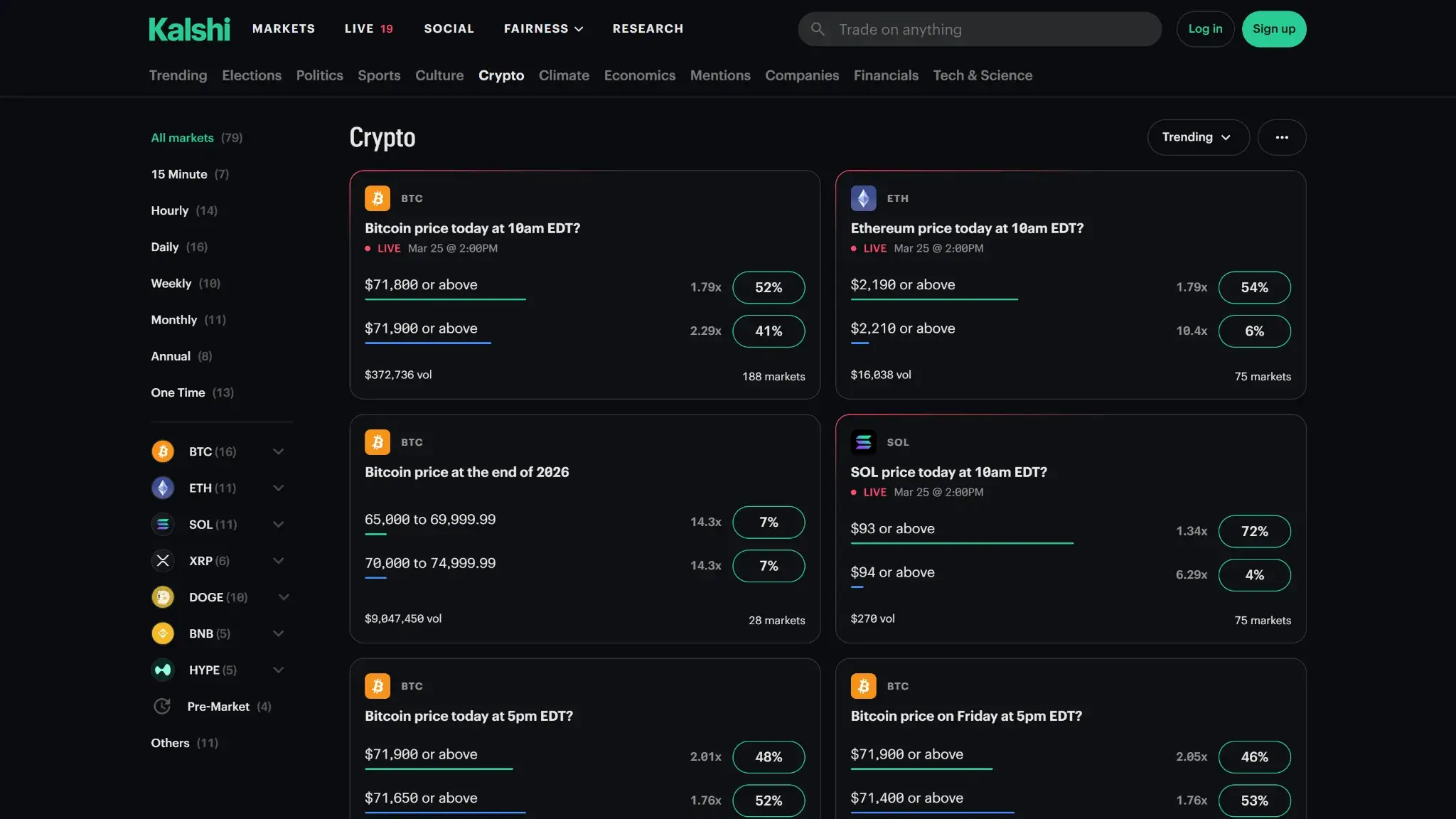
Kalshi desktop crypto markets page showing bitcoin, ethereum, and solana prediction markets with odds, live status, and market volume.
Against Polymarket, Kalshi is less crypto-native and usually less open globally, but it is more regulated, more banked, and generally more disciplined in how it structures contracts.
Kalshi covers a lot, but the depth is uneven. Politics, macro, and major sports are the strongest areas. Culture, weather, company headlines, and niche topical markets add breadth, but depth drops faster once you move away from flagship contracts.
Category
What Is Covered
How Deep It Is
Important Gaps Or Caveats
Sports
Team futures, games, tournaments, player and event-driven sports markets
High in major events
Depth falls off in smaller leagues and quieter markets; still not a sportsbook-style menu
Politics
U.S. elections, party control, nominees, legislative and government-outcome markets
High
Strongest category, but also the most compliance-heavy, with extra trading prohibitions on many contracts
Macro / Economics
Fed, inflation, payrolls, recession, oil, gas, unemployment, and policy-linked markets
High
One of Kalshi’s best categories, but rule timing and settlement sources matter a lot
Crypto / Finance
Bitcoin price targets, broader crypto moves, IPOs, company metrics, and some market-structure questions
Medium
Useful, but this is not a full crypto-native ecosystem and not a substitute for a crypto derivatives venue
Culture / Entertainment
Awards, media, TV, celebrities, music, and social-mention markets
Medium
Broad enough to be interesting, but depth can be inconsistent and event quality varies
Other Categories
Weather, climate, companies, tech and science, traffic, shipping, and other topical markets
Medium
Good for breadth and headline responsiveness, but many of these markets are more episodic than consistently tradable
If you care most about politics, macro, and major sports, the market mix feels real. If you want every category to have the same depth and tradability, it will feel less balanced.
Kalshi desktop elections page showing 2028 nominee and presidential election markets with candidate odds and volume.
Contract Design Notes
Binary Yes / No Markets — Yes. These are the default format and the core of the platform.
Multi-Outcome Markets — Yes, but usually as grouped sets of mutually exclusive binary contracts rather than one single multi-way contract.
Range Or Bracket Markets — Yes. Threshold and bracket-style structures are common, especially in macro, commodities, and price-target markets.
Short-Dated Or Intraday Markets — There are useful fast markets around speeches, data releases, weather, and daily closes, but the density is strongest on bigger headlines.
Longer-Dated Markets — Yes. Elections, year-end targets, recession calls, and long-horizon category markets are a real part of the mix.
Speed Of New Listings — Fairly fast on major news, but still slower and more disciplined than crypto-native platforms because the listing style is more compliance-aware.
Market Wording Quality — Usually solid, but not frictionless. The headline wording is often clear enough, while the real edge cases live in the rule text and source definitions.
The market mix is useful if you care most about politics, macro, and major sports. The weaker spots are the smaller categories, where markets exist but are not always deep enough to trade well.
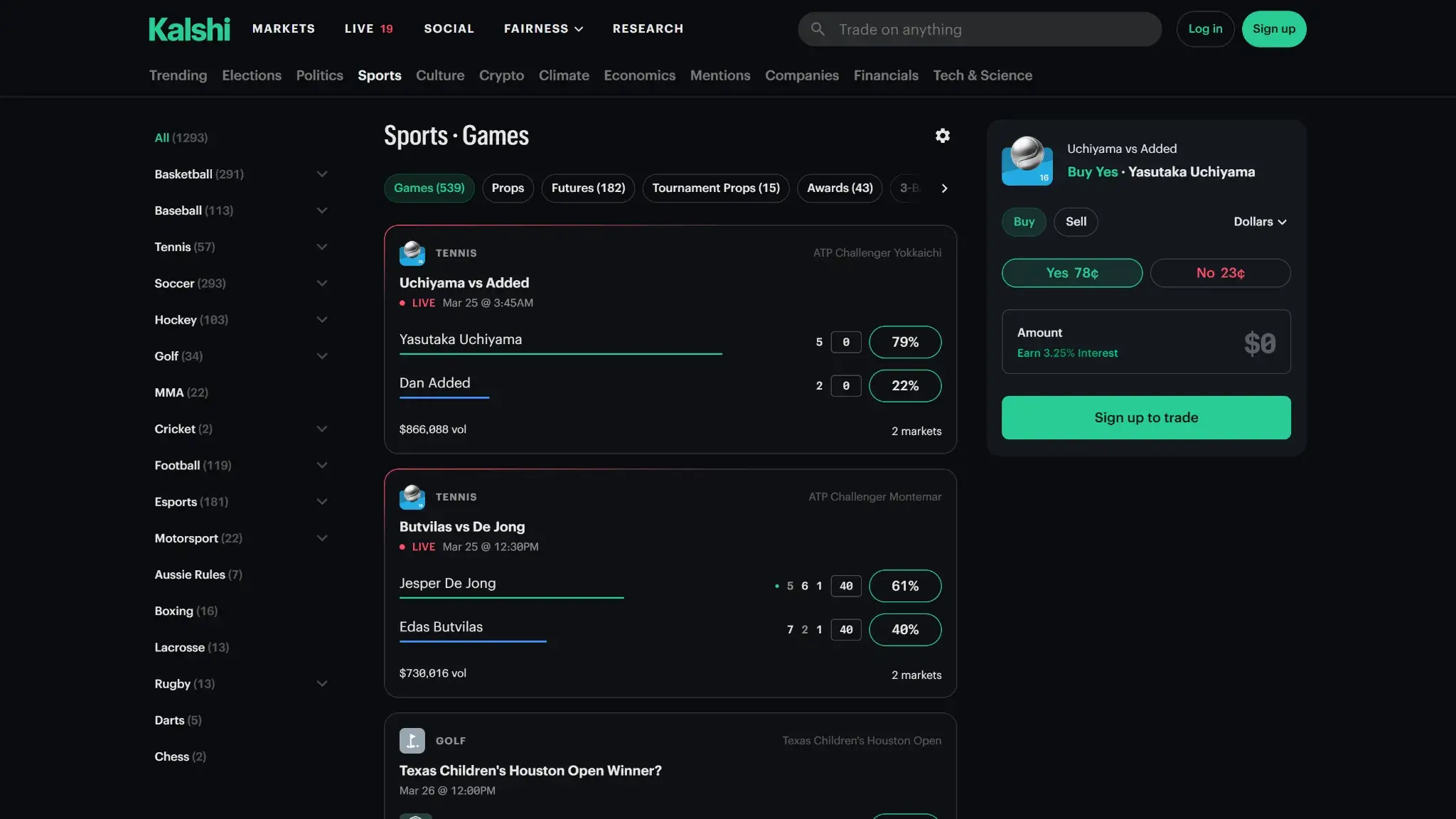
Kalshi desktop sports games page showing live tennis and golf markets with a trading panel on the right.
Liquidity, Order Book and Execution Quality
Kalshi is genuinely tradable in its strongest categories, but that liquidity is not evenly distributed. Major politics, sports, and macro markets can feel like real markets. Once you leave tentpole events, books get much thinner fast.
Depth on Major MarketsVisible depth; usually fine for normal trades, though news can move price fast
Depth on Quieter MarketsTradability drops quickly outside flagship events; exits get harder
Bid-Ask Spread BehaviorOften reasonable on major markets, wider on smaller ones; spread becomes a real cost
Limit OrdersBest tool for price control, but you may not get filled
Instant Buy / Market-Style ExecutionWorks well in active books, but thin books can lead to bad fills
Partial FillsCan help large orders, but may leave leftover size at a worse average
Exit Before ResolutionUsually workable on active contracts, less reliable in quiet markets
Visible Volume / Open InterestUseful for screening, but headline volume can hide weak top-of-book depth
Trading Size LimitsVary by market and account; larger traders can hit limits or controls
Slippage RiskUsually low on tentpole markets, higher in smaller books or fast news
Kalshi is liquid in elections, major sports, and big macro markets. It gets much thinner in smaller or quieter markets. The same event can trade at a different price on other platforms because each platform has its own order book, user base, and funding flow. In thin markets, faster traders and bots can react before manual users. That matters most if you trade short-term or place bigger orders.
Fees and Total Cost to Trade
Kalshi is reasonably priced on active markets, but it is not as cheap as the headline fee alone makes it look. The posted trade fee is usually modest. The bigger cost issues are spread, slippage, card funding, and some series-specific exceptions.
Cost Component
What Users Pay
When It Applies
Notes
Trading Fee
Standard taker fee = round up(0.07 x C x P x (1-P))
When your order matches immediately
For 100 contracts, the fee peaks around $1.75 at a $0.50 contract price
Spread Or Slippage Cost
Varies by market
On entry and exit
Often matters more than the fee once books get thin
Deposit Fee
ACH = $0; debit deposit = up to 2%; wire = no extra Kalshi fee
When funding the account
Your bank can still charge its own wire fee
Withdrawal Fee
ACH = $0; wire fees vary by bank; crypto may have processor fees
When cashing out
Wire withdrawals are not supported under $500,000
Network Or Gas Fee
Varies
On crypto deposits and withdrawals
Charged by Kalshi’s third-party processor, not always by Kalshi itself
FX Or Conversion Fee
Usually none for normal USD use
If conversion is needed
Not a main cost for most direct U.S. users
Subscription Or Premium Fee
$0
Not applicable
No membership fee
Third-Party Provider Fee
Varies
On crypto rails and FCM access
FCM customers may pay a different fee schedule
Kalshi has no settlement fee and no membership fee, and its base trading fee is usually small. Taker fees apply when you trade right away, maker fees only apply on some series and are lower, and a few contracts such as S&P 500 and Nasdaq-100 use special fee schedules. ACH is free, so the main extra costs usually come from card funding, crypto payment rails, and spread in thinner markets.
Funding, Settlement and Cash-Out Flow
This is where Kalshi feels more like a regulated financial account than a casual prediction app. The path from deposit to withdrawable cash is usually straightforward, but it is not always fast.
Here is the basic flow:
US users can fund with debit card (including Apple Pay and Google Pay), ACH, PayPal, Venmo, Cash App, crypto, or wire. International users can fund with debit card, wire, or crypto.
Buying power becomes usable once the deposit is credited or cleared under that method’s rules.
When a contract resolves, Kalshi settles it using the contract rules and the stated source agency.
Winning positions turn into cash balance, and that balance becomes withdrawable once settlement and any hold rules are satisfied.
The money then moves out through the selected withdrawal rail and arrives on a bank account, wallet, or other supported endpoint.
Hold rules depend on how you fund. Debit, Apple Pay, and Google Pay can go back to the same card once the deposit settles, but other withdrawal methods open 2 days later. ACH-funded dollars can be withdrawn 2 days after settlement, and for 90 days they can only go back to the bank account that was debited. PayPal and Venmo have no hold. Cash App is deposit only. A short hold can apply to crypto. Wires have no hold. Profit above the original deposit can be withdrawn right away.
Step
Typical Speed
Common Friction
Deposit
Varies by method
Provider review, verification, and rail-specific delays
Buying Power Availability
Often fast after a completed deposit
Clearing rules depend on the funding method
Contract Settlement
Usually soon after official outcome is confirmed
Source timing and contract-specific rules can slow finalization
Balance Becoming Withdrawable
Profits often right away; funded balance depends on method
Card timing, ACH return rule, crypto hold, compliance checks
Withdrawal Request
Usually simple once funds are eligible
Method restrictions can still block the fastest route
Funds Arrival
Varies by rail
Bank, wallet, card, or network timing sits outside the core trade itself
Those are three different clocks. A market can resolve quickly, your in-app balance can update soon after, and the actual cash-out can still take longer because the withdrawal rail and the original deposit method add their own delays.
Resolution Rules, Market Integrity and Disputes
Kalshi feels mostly clear but edge-case sensitive. On normal markets, the rules are good enough for serious use. The trouble starts when traders rely on the headline and skip the full rule text.
Resolution Source — Each market points to a source agency or official source in the rules.
Rules Clarity — Better than most rivals because markets show a rules summary, full rules, and timeline details.
Clarification Process — Users can request settlement from the market page, and support can escalate issues to the markets team.
Dispute Or Challenge Path — In practice, it goes through review by the markets team rather than a large public appeals process for retail users.
Void Or Cancel Policy — Not one simple universal rule. It depends on the contract. Some markets can close early, some can settle to last fair price, and some edge cases can use non-standard outcomes.
Split Or Partial Resolution Handling — Yes, in some cases. Combos and special cases can settle at values other than $0 or $1.
Settlement Pace — Most single markets settle within a few hours after the outcome is known. Combos can take longer.
Main Edge-Case Risk — Misreading the market title and missing the source, timeline, or special settlement rule.
A real user can misunderstand a market if they only read the headline and price. On standard yes/no markets, disputes look rare and manageable. They matter more in combos, player markets, and anything tied to delayed official data. Overall, the platform feels safe enough for serious use, but only if you treat the rules as part of the trade.
Security, Custody, Privacy and Trust
This is a centralized, fully KYC product, so the bigger risks are platform control, market rules, and execution in thin books rather than wallet security.
Where Funds Sit — Inside the Kalshi and Klear custody and clearing setup, not in a user-controlled wallet.
Who Controls Them — Kalshi entities and their clearing structure handle custody, settlement, and account access.
How Accounts Are Protected — Identity checks, onboarding verification, login 2FA codes, and card-issuer 2FA for card deposits and withdrawals are documented. Account safety still depends partly on the user.
Privacy Trade-Offs — This is a full-KYC financial account.
External Validation — KalshiEX is regulated by the CFTC as a designated contract market, and Kalshi Klear is a CFTC-registered derivatives clearing organization.
Main Risk — Market structure, operational dependency, and rule handling matter more than custody.
Kalshi looks strong on regulation, funding, and basic account protection. The bigger issue is that you are relying on a centralized platform and its rules if trading pauses, markets resolve late, or liquidity dries up.
UX, Apps, Automation and Data Access
Kalshi feels like a mix of casual mobile use, active desk trading, and real automation support. It is clean enough for normal users, but it is also one of the more serious prediction-market platforms for API-driven workflows.
Surface Or Tool
Availability
Notes
Web App
Yes
Main trading surface for most users
iOS App
Yes
Full mobile access
Android App
Yes
Full mobile access
Desktop App
No
Browser-based desktop use only
Watchlists And Alerts
Yes
Watchlist is available, and users can enable email or app notifications
API Access
Yes
Public REST data, SDKs, and FIX for qualifying members
WebSocket Or Live Market Feed
Yes
Auth required for live feeds and order-book updates
Historical Data Access
Yes
Historical endpoints are available through the API
Trade History Export
Yes
Users can download P&L and tax documents, though this is not a full pro-grade export workflow
Charts are clear enough for fast reading, but they are not the main reason to use Kalshi. The strong point of the UX is that rules, timeline, payout details, and order-book information are all visible in the same trading flow. The order ticket is simple for basic yes/no trading, portfolio visibility is good enough for normal users, and the platform is strong for research or bot workflows because the API, authenticated WebSockets, historical data, and SDKs are real features, not just a thin developer page. The weak spot is that you still need to click into the rules to understand some markets properly.
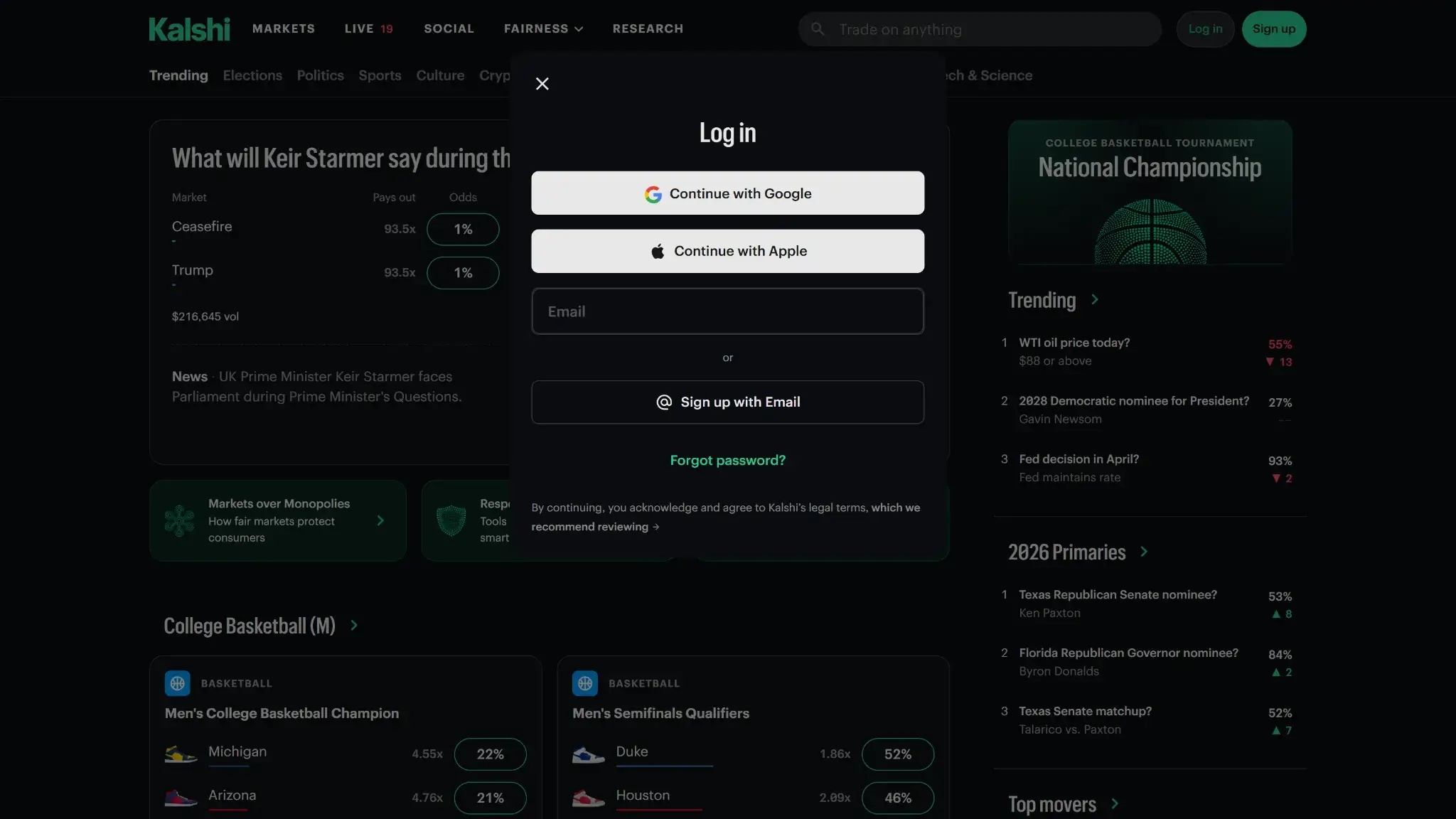
Kalshi desktop login modal showing Google, Apple, and email sign-in options over the homepage.
On active markets, it makes trading easier because the price, rules, and position data are easy to find in one place. The main mistake users can still make is trading too quickly without reading the market details.
Taxes, Statements and Record-Keeping
Record-keeping looks manageable, not automatic.
Tax forms are available if you hit the relevant IRS thresholds.
Kalshi has 1099-INT, 1099-MISC, 1099-B for crypto transfers, and 1099-DA through ZeroHash where applicable.
Account statements are decent for normal users because yearly P&L statements are available in Account → Tax Info.
Export quality is good enough for most retail users because you can download the P&L statement by year.
Cost basis is partly visible because Kalshi says it uses FIFO.
Users still need to track the final tax treatment themselves, plus any off-platform transfers or activity that does not cleanly fit the P&L statement.
The P&L view updates monthly, not in real time, so very recent activity may not show up yet.
This will feel fairly painless for casual users who mostly trade inside Kalshi and want a yearly statement to hand to a tax pro. It will feel more annoying for active traders, people using multiple funding rails, or anyone who wants cleaner real-time reporting and less manual cross-checking.
Customer Support, Limits and Incident Handling
The help content is clear and easy to find, while live support exists but still depends on routing through chat and email follow-up.
Live Chat — Yes. The fastest support route is the in-account messenger in the bottom-right corner while logged in.
Email Or Ticket Support — Yes. Chat replies also go to your account email, and security or unauthorized-access issues can be reported to [email protected].
Status Page — No clear official public status page was surfaced. The closest official tools are exchange status and announcements through the API/docs.
Community Channels — Yes. Kalshi links to Discord, Instagram, X, LinkedIn, and TikTok, but those are not substitutes for account support.
Self-Exclusion Or Cooldown Tools — Yes. The Responsible Trading page includes trading breaks, self-exclusion, and deposit caps.
Account Limits — Yes. Deposit limits and responsible-trading controls are available.
Position Limits — Yes, but they vary by market, account, and compliance rules rather than showing up as one simple universal cap.
What Support Can Actually Fix — Login issues, verification problems, payment or withdrawal issues, suspicious account activity, and general account troubleshooting.
What Support Cannot Reverse — A valid trade, normal market loss, or a final market outcome just because the user misread the contract.
The support setup is good enough for a regulated trading platform, but it is not unusually high-touch. The documentation does a lot of the work, and that is fine until you hit a time-sensitive issue and want a fast human answer.
Final Verdict
Kalshi is the most credible regulated option for U.S. traders who want real-money event markets on politics, sports, and macro without relying on offshore or crypto-native venues. It brings genuine liquidity to flagship markets, broad funding rails, and a serious API stack. But the friction is full KYC, jurisdiction restrictions, and contract rules that reward careful reading. For traders who want regulation and depth over anonymity and speed, it is the strongest option in this category.
Regulated U.S. exchange, not an offshore workaround
Stronger depth in flagship markets than many rivals
You can usually exit before resolution
Broad funding and cash-out options
Serious API, WebSocket, and historical-data access
CONS
Full KYC adds real setup friction
Access still depends on jurisdiction
Total trading cost is not always obvious
Thin markets can be hard to exit
Some contracts come with extra trading restrictions
Affiliate Disclosure
Disclaimer: CryptoSlate may receive a commission when you click links on our site and make a purchase or complete an action with a third party. This does not influence our editorial independence, reviews, or ratings, and we always aim to provide accurate, transparent information to our readers.
FAQ
Is Kalshi legal where I am?
Kalshi is clearly available in the United States. Outside the U.S., some users may be eligible, but they should verify before funding. Restricted jurisdictions by Kalshi include the UK, Canada, France, Australia, Singapore, China, UAE, Switzerland, Italy, Belgium, New Zealand, Russia, and many sanctioned jurisdictions.
Does Kalshi require KYC?
Yes. Kalshi uses full KYC. Customer ID information is required before trading, and extra checks can include SSN, government ID, watchlist review, and manual review.
Can I sell before the market resolves?
Yes. You can usually exit early by selling your position to another trader. That works best on active markets with real depth and is less reliable on thinner books.
How long does it take to actually withdraw winnings from Kalshi?
The contract itself often settles within hours after the official outcome is known, and profits can become withdrawable quickly after that. Actual cash-out still depends on the payment rail, and deposited funds may stay under method-specific hold rules.
Why is the same event priced differently on Kalshi and Polymarket?
Because they are different markets with different traders, funding rails, legal access, and liquidity. Even when the event is similar, the order books are separate, so prices do not have to match.
How are disputed, clarified, or voided markets handled on Kalshi?
Kalshi relies on contract-specific rules and the stated resolution source. Some markets can be clarified, closed early, or handled with special settlement rules. The main risk is not random disputes. It is missing an edge-case rule by only reading the headline.
Does Kalshi offer an API and historical data?
Yes. Public market data is available through REST endpoints without auth. WebSocket feeds require auth. Historical endpoints and SDKs are available, and FIX is available for qualifying members.