DraftKings Predictions is a broker-connected event-contract platform that now mixes binary markets with winner markets, futures, and player markets. The interface is easy to grasp, but the real frictions are access rules, full identity checks, funding limits, and settlement rules. It is a better fit for those who want a mainstream, regulated way to trade event contracts than for active traders chasing the best execution. It runs as a standalone web and mobile product under GUS III LLC d/b/a DraftKings Predictions, with Wedbush handling the futures commission merchant side.
Standalone app and web product inside a familiar DraftKings ecosystem
Regulated structure with Wedbush instead of a legal gray area
Positions can be sold before final resolution when liquidity is available
Category mix extends beyond sports into crypto, stocks, politics, business, and economics
Posted platform commission is $0.01 per contract per side
Cons
Market access changes by state and by category, especially for sports
Full KYC can reach into income, tax, and trading-experience checks
Predictions balances do not move freely across other DraftKings products
Unsettled funds and play-through rules can delay withdrawals or limit access to cash
No public API or easy historical-data path for bot-driven users
Who DraftKings Predictions Is Best For — And Who Should Skip It
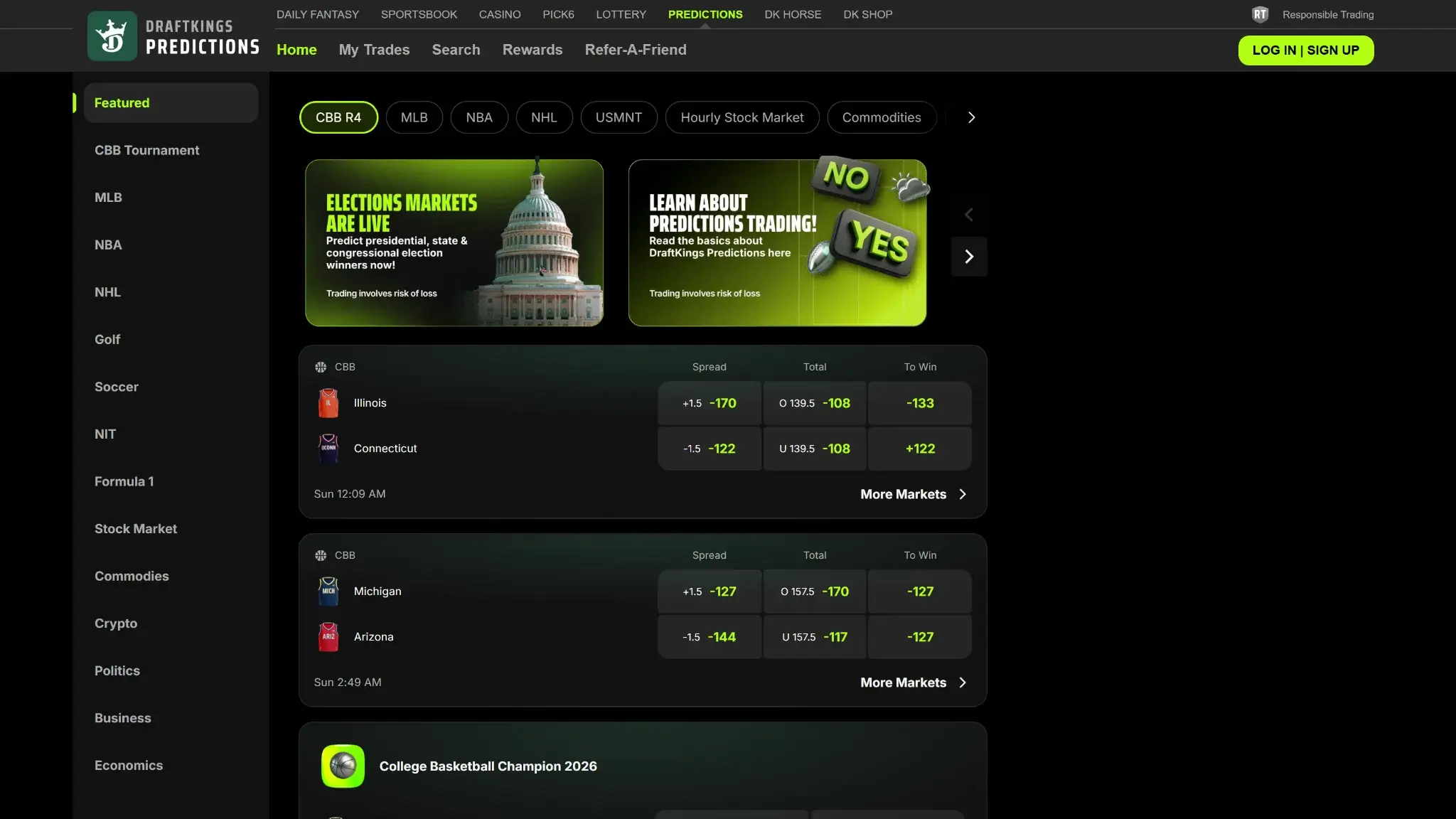
DraftKings Predictions featured homepage on desktop showing featured market cards, college basketball matchups, and sidebar category navigation.
DraftKings Predictions does not solve the same job for every type of user. The fit depends less on the headline fee and more on whether you want a U.S. regulated prediction market app with familiar navigation or a more open, data-heavy, lower-friction trading setup.
User Type
Fit
Why
Casual Event Trader
High
The contract layouts are easy to grasp, and the app feels closer to a mainstream consumer product than a trading terminal.
Sports markets are a core draw, but availability changes by state and not every location gets full sports access.
Macro Or Economic Trader
Medium
It covers stocks, commodities, crypto, business, and economics, but the product still feels retail-first rather than research-first.
Crypto-Native Trader
Low
There is no hot wallet-based flow, no stablecoin funding path, and no onchain settlement model.
API Or Bot User
Low
Public API and historical-data access are not part of the product’s core appeal.
User Who Wants Fast Fiat Withdrawals
Medium
Fiat rails exist, but unsettled funds, play-through rules, and method-based timelines add friction.
User Who Wants Low KYC Friction
Low
Full identity checks are part of the product, and onboarding can require deeper financial detail than casual users expect.
User Who Wants Clear Regulation
High
Regulation is one of the clearest parts of the product, with DraftKings Predictions as the introducing broker and Wedbush in the FCM role.
DraftKings Predictions fits best for those who already trust the DraftKings ecosystem and want a cleaner, more regulated path into event contracts without dealing with wallets, stablecoins, or onchain tools. It also makes more sense for those trading straightforward event contracts than for those building a data-heavy or automation-heavy workflow.
Those who should look elsewhere are active traders who care most about deep liquidity, broad state-by-state certainty on sports access, public data tools, or lower onboarding friction. It is also a weaker fit for those who want prediction market exposure with a normal brokerage cash account, because settled-funds rules and withdrawal checks add extra steps.
What Is DraftKings Predictions And How Does It Work?
Each market asks a yes or no question about a real-world event. You buy the side you want at the live price, and a winning contract settles at $1 while a losing contract settles at $0.
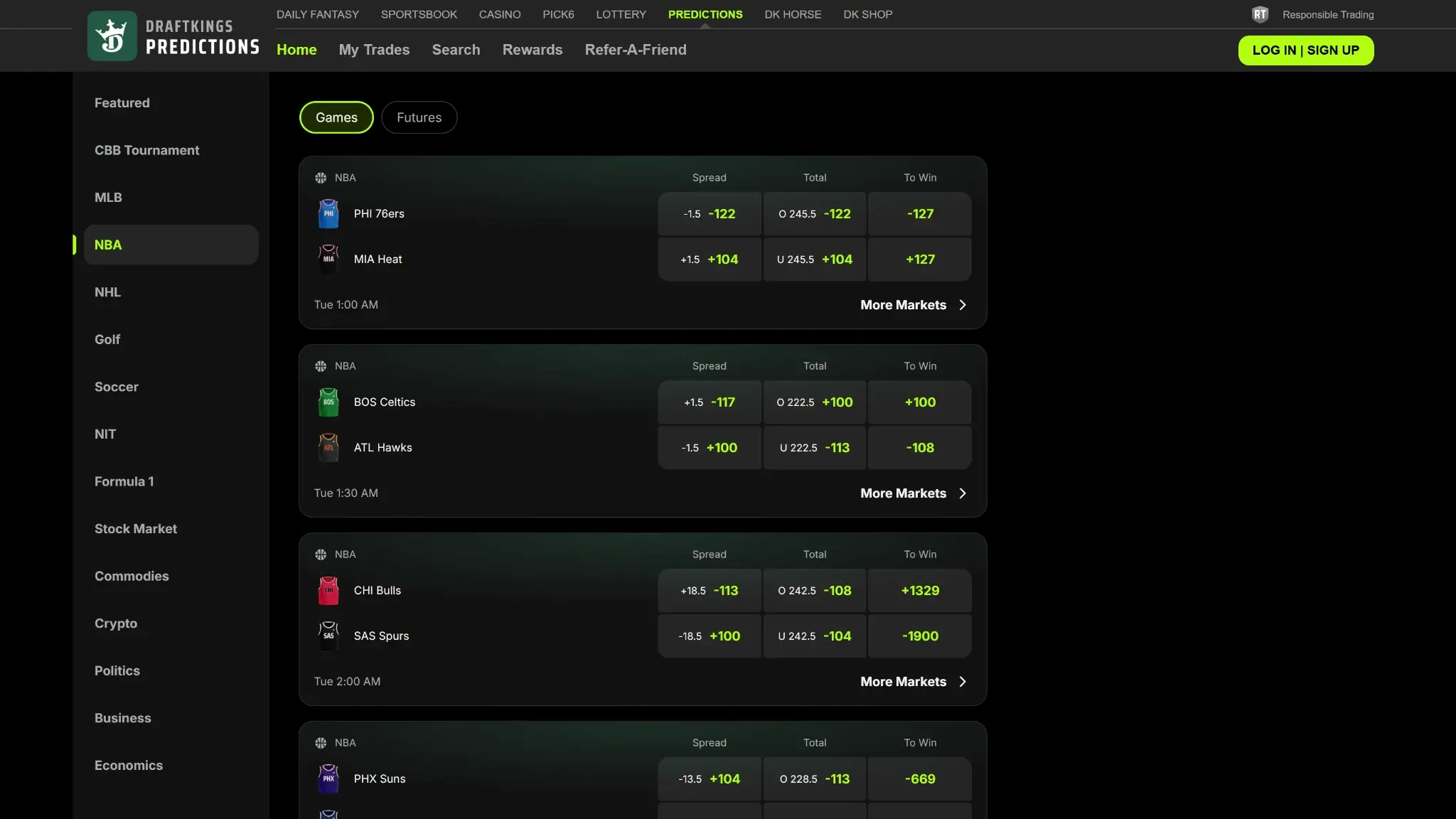
DraftKings Predictions NBA page on desktop showing basketball game markets, spread, total, moneyline odds, and sportsbook-style category navigation.
You do not need a crypto wallet or a separate brokerage account. The product uses a DraftKings interface, while the broker and exchange layer handle order routing, collateral, and settlement.
You can hold to settlement or sell before resolution if there is enough liquidity. In practice, the platform works best for headline sports, politics, crypto, and broad business or economic markets rather than niche long-tail contracts.
In real use, it behaves less like a bet slip and more like a simplified trading screen for regulated event contracts.
Access, Eligibility and Account Setup
DraftKings Predictions uses a consumer app front end, but access works more like a regulated financial product than a casual DraftKings add-on. The main friction points are state-by-state availability, full identity checks, physical-location checks, and the fact that money still needs to clear before some activity becomes possible.
Trading AvailabilityU.S. only; eligible access spans much of the country, with availability changing by physical location and market type
Unsupported JurisdictionsMaine and Ohio currently sit in the no-markets group; tribal land is not supported; several other states are limited to financial-only or no-sports access
Age Requirement18+
KYC LevelFull KYC
Account Type NeededDraftKings Predictions account under the DraftKings login stack, with product-specific onboarding and Wedbush-linked account setup
Bank, Wallet or Broker Setup NeededLinked payment method or bank funding is needed; no crypto wallet is required; no separate retail brokerage account is needed on the user side
Geolocation or Device ChecksYes; availability depends on physical location, and geolocation is used to verify eligibility
Time to First TradeCan be same day, but slower if identity review, geolocation checks, or deposit settlement holds delay funding
Setup friction is moderate. It is lighter than opening a traditional active-trading account, but heavier than a normal sportsbook-style signup because the biggest drag comes from full KYC, location-based market restrictions, and settled-funds timing.
Market Coverage and Contract Design
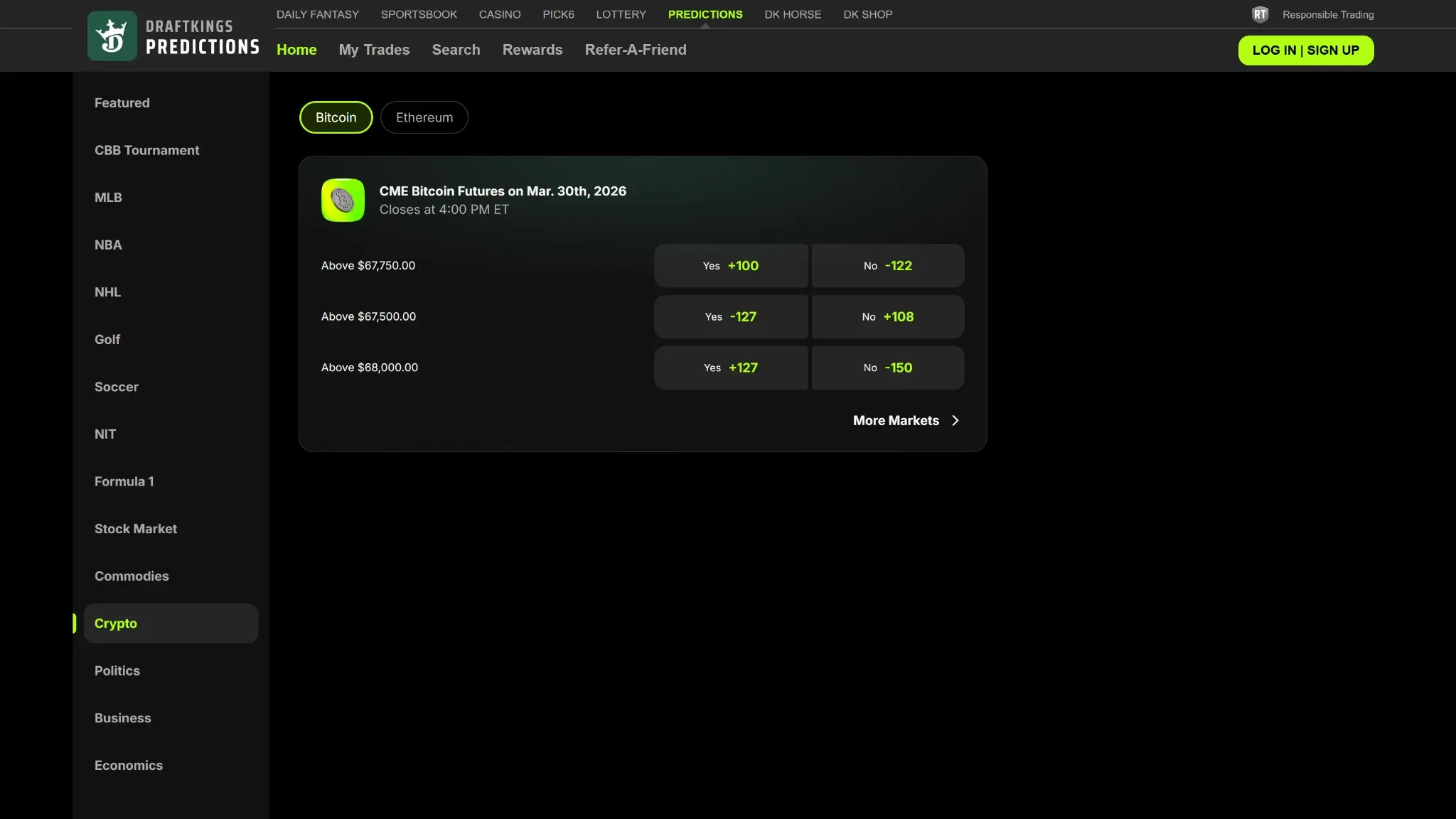
DraftKings Predictions crypto page on desktop showing Bitcoin futures event markets with yes and no odds on a dark interface.
DraftKings Predictions covers a mix of sports, politics, business, economics, crypto, commodities, and stock-market questions. That range is wide enough to make it feel like a real live product rather than a narrow pilot.
But compared with Kalshi, the long-tail depth still looks lighter, especially for niche politics, macro, and fast-breaking headline contracts. And compared with crypto-native prediction markets, it feels more controlled and easier for mainstream U.S. users, but slower and less expansive when new events break.
Sports availability is not uniform by state, and sports event contracts carry extra legal and regulatory uncertainty
Politics
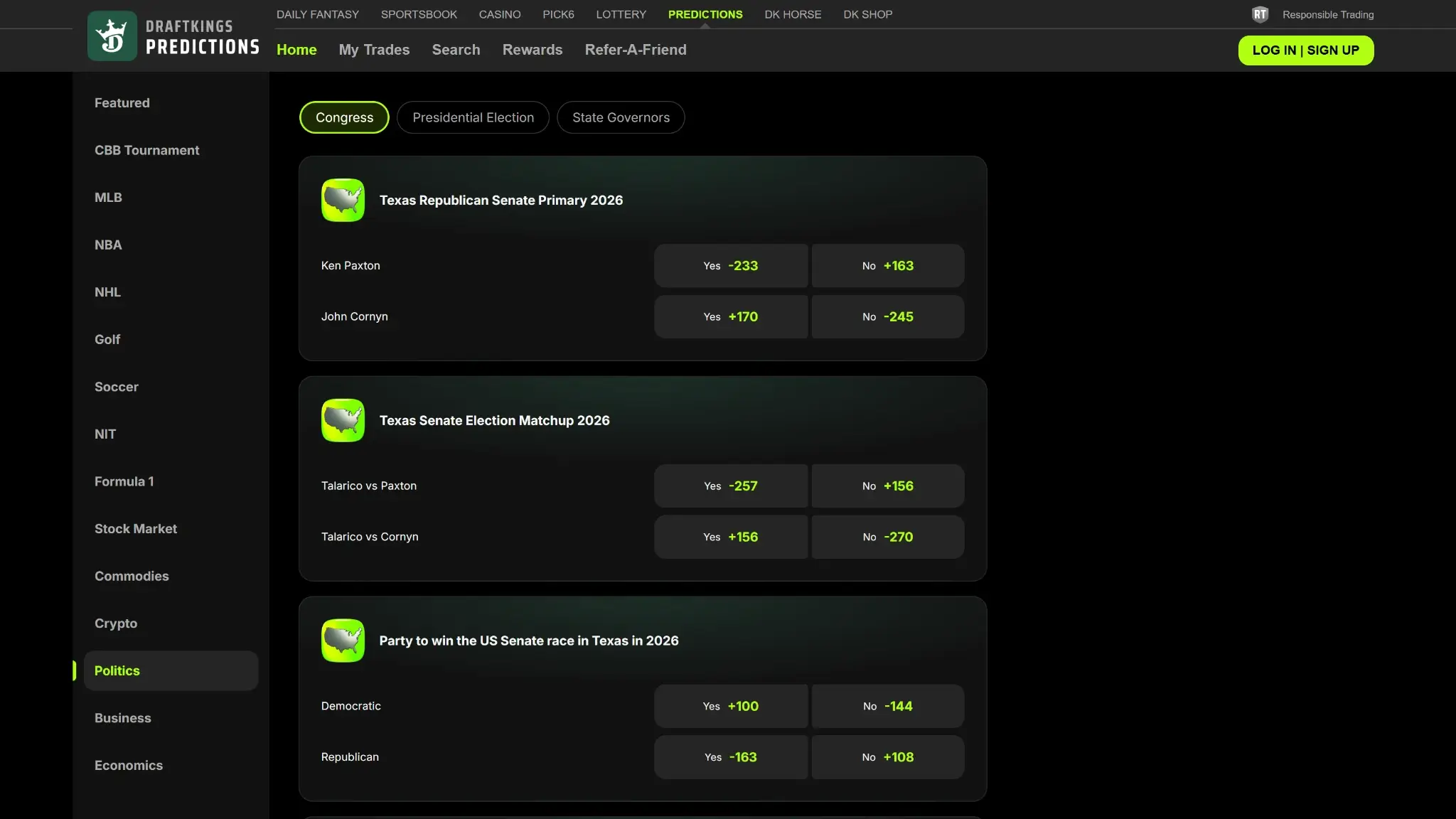
Politics category and election-focused markets
Medium
Broader than a token politics tab, but still lighter than the strongest politics-first rivals
Macro / Economics
Economics, business, and some event-style macro questions
Medium
More retail and headline-driven than institution-style macro coverage
Crypto / Finance
Crypto, stock market, and commodities
Medium
Useful for directional event questions, but not a substitute for continuous market exposure or advanced trading tools
Culture / Entertainment
Not a core menu category right now
Low
This is not a stable headline category in the current product mix
Other Categories
Business and other real-world headline events
Low To Medium
The category list is broader than the actual depth inside each bucket
Sports is the clearest volume driver, while finance-style topics add a second active category and politics rounds out the product. It still does not look equally strong across all categories. New markets also do not appear as quickly as they do on faster rivals, but the slower pace reduces some of the messier wording and settlement problems.
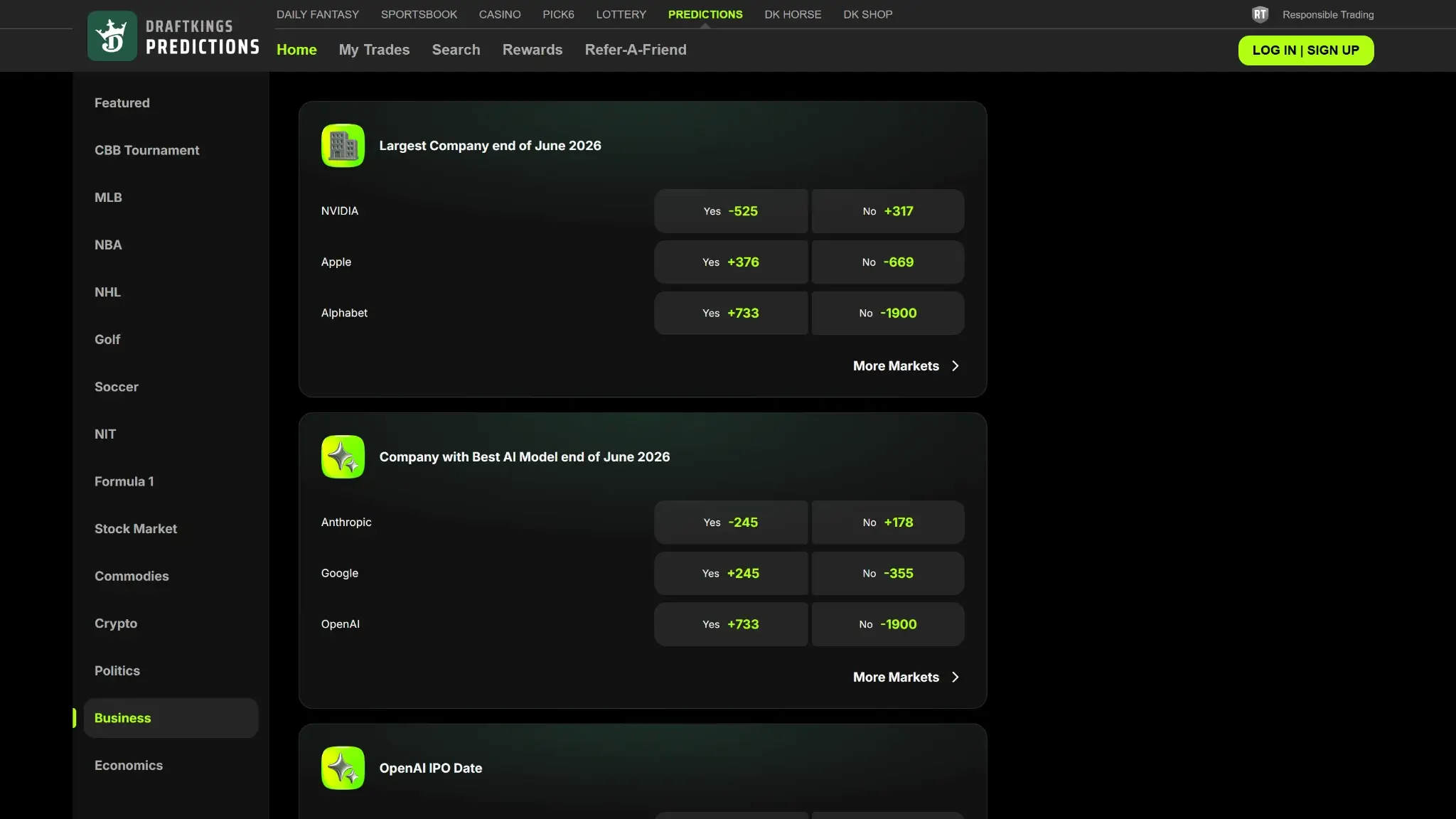
DraftKings Predictions business page on desktop showing company valuation, AI model, and OpenAI IPO prediction markets with yes and no odds.
Contract Design Notes
Binary Yes / No Markets — Yes. Binary contracts are still common, but they are no longer the whole product.
Multi-Outcome Markets — Live. Current examples include champion markets, primary markets, Oscars markets, and player markets.
Range Or Bracket Markets — Not a major visible format in the current product mix.
Short-Dated Or Intraday Markets — Live. Hourly stock-market contracts and timed commodity and crypto contracts are already on the platform.
Longer-Dated Markets — Yes, especially where politics, business, or economic questions can stay open longer.
Speed Of New Listings — Slower and more disciplined than crypto-native platforms.
Market Wording Quality — Usually clearer than more chaotic event markets, but users still need to read the settlement conditions closely.
The market mix is useful for mainstream users who want recognizable categories and a familiar app flow. It is most useful in headline sports and broad consumer markets, not in niche categories that depend on deeper coverage or faster listing speed.
DraftKings Predictions politics page on desktop showing Texas Senate and congressional prediction markets with yes and no odds on a dark interface.
Liquidity, Order Book and Execution Quality
DraftKings Predictions is tradable mainly on tentpole events. The homepage markets and bigger headline contracts are usable for casual trading, but once you move into quieter contracts, depth looks thinner and execution quality matters much more.
Depth on Major MarketsUsually good enough for small retail trades on headline sports and major event markets, but still below the strongest exchange-first rivals
Depth on Quieter MarketsIt gets thin quickly once you move beyond top sports, top politics, or obvious finance headlines
Bid-Ask Spread BehaviorSpreads are tighter on active markets and wider on lower-attention contracts
Limit OrdersNot a core part of the current consumer flow
Instant Buy / Market-Style ExecutionYes, but your fill depends on what is available in the book at that moment
Partial FillsYes. Orders can fill for less than the amount entered or remain incomplete
Exit Before ResolutionYes, but only if there is enough opposing liquidity at an acceptable price
Visible Volume / Open InterestLimited compared with more exchange-native rivals
Position LimitsYes. Platform and regulatory limits can apply
Slippage RiskModerate on active markets and much higher on thinner contracts or larger order sizes
It feels most liquid on headline markets and much thinner once you leave the main traffic lanes. That matters most for active traders, larger-size users, and anyone trying to trade in and out rather than hold to settlement.
Fees and Total Cost to Trade
DraftKings Predictions is cheap in theory. The posted commission is low, but the full cost to trade depends on exchange fees, spreads, and how often you need to enter and exit rather than hold to settlement.
Cost Component
What Users Pay
When It Applies
Notes
Trading Fee
$0.01 per contract per side
On buys and sells
This is the clearest posted platform fee
Spread Or Slippage Cost
Variable
When entering or exiting at the live market price
Often a bigger real cost than the headline commission in thinner markets
Deposit Fee
No platform deposit fee disclosed
When funding the account
Bank or card-side costs can still exist outside DraftKings Predictions
Withdrawal Fee
No platform withdrawal fee disclosed
When cashing out
Speed and method limits matter more than a posted platform charge
Network Or Gas Fee
Not Applicable
Not Applicable
This is not an onchain product
FX Or Conversion Fee
Not Applicable
Not Applicable
The product is USD-based
Subscription Or Premium Fee
Not Applicable
Not Applicable
No premium access layer is part of the current core product
Third-Party Provider Fee
Exchange fee varies by product
On each trade
Exchange fees sit on top of the $0.01 platform commission
For casual users making smaller trades on active markets, the fee profile is acceptable. For active traders, the all-in cost can climb faster than the headline pricing suggests because the real drag often comes from spread, slippage, and repeated round trips rather than the posted commission alone.
Funding, Settlement and Cash-Out Flow
This is where DraftKings Predictions starts to feel less like a simple DraftKings app and more like a regulated trading account. The steps are still easier than a traditional futures workflow, but money movement is not as instant or clean as the front end implies.
Deposit — Usually same day for card, ACH, or Apple Pay. Wires can take longer. Main friction: payment approval, jurisdiction limits, and account-name matching.
Buying Power Availability — Often same day, but not always fully settled. Main friction: fully collateralized trades can be rejected before funds settle.
Contract Settlement — Usually at or after event resolution. Main friction: disputes around the outcome source, rule wording, or event status can slow it down.
Balance Becoming Withdrawable — Not always immediate after resolution. Main friction: deposit settlement, play-through rules, bonus status, and eligibility checks.
Withdrawal Request — Quick to submit, but processing varies by method. Main friction: method availability, identity review, and payment-source rules.
Funds Arrival — Debit card can take up to 24 hours, Apple Pay about one day, wire and PayPal up to two days, and online banking up to five business days. Main friction: bank processing, method limits, and return or rejection delays.
The key distinction is that contract resolution, balance update, and actual cash-out are not the same thing. A market can resolve first, your account balance can update after that, and your money can still take longer to leave the platform and reach your bank depending on settlement status, withdrawal rules, and the payment method you use.
Resolution Rules, Market Integrity and Disputes
DraftKings Predictions feels mostly clear but edge-case sensitive.
Resolution Source — Official event outcomes and exchange-led settlement rules.
Rules Clarity — Usually clearest on straightforward threshold, side, winner, and player markets, but users still need to read the contract specs closely.
Clarification Process — Works best before entry, not after confusion starts.
Dispute Or Challenge Path — Limited from the user side and handled through platform, broker, and exchange processes.
Void Or Cancel Policy — Possible if a market is disrupted, restricted, or no longer valid.
Split Or Partial Resolution Handling — Not a major issue because the product is mostly binary.
Settlement Pace — Usually reasonable on clean outcomes.
Main Edge-Case Risk — Sports-related rule changes, legal restrictions, or messy official results.
Most users will understand the market if they read the wording carefully. Disputes should be manageable in normal cases, but sports and legal edge cases matter enough that serious users still need to read closely.
Security, Custody, Privacy and Trust
The main trust sits with the broker and exchange, not with a wallet or smart contract. Funds move through a regulated account structure, so the bigger concern is not losing keys. It is whether you can keep access, get paid out cleanly, and avoid trouble when a market turns messy.
Accounts are protected through full identity checks, geolocation controls, and standard account-security tools. The privacy trade-off is meaningful because onboarding can pull in SSN or TIN data, income, employment, tax details, and trading-experience information. For most users, the harder question is not wallet safety. It is whether the market structure and settlement process are strong enough for the size they want to trade.
UX, Apps, Automation and Data Access
DraftKings Predictions is built mostly for casual mobile use, with web access as a secondary surface. It is not built for automation or research-heavy workflows.
Surface Or Tool
Availability
Notes
Web App
Yes
Core product surface
iOS App
Yes
Standalone mobile access
Android App
Yes
Standalone mobile access
Desktop App
No
Web only on desktop
Watchlists And Alerts
Yes
Notification Preferences are present, and DraftKings uses in-app bell notifications
API Access
No
No public API
WebSocket Or Live Market Feed
No
Not part of the public toolset
Historical Data Access
No
No research-grade public history layer
Trade History Export
Yes
Statements and tax records are available, but tooling is limited
Charts and market views are clear enough for casual use, and the order flow is easy to follow. But the interface is light on data tools, weak for bot workflows, and not built for deep research.
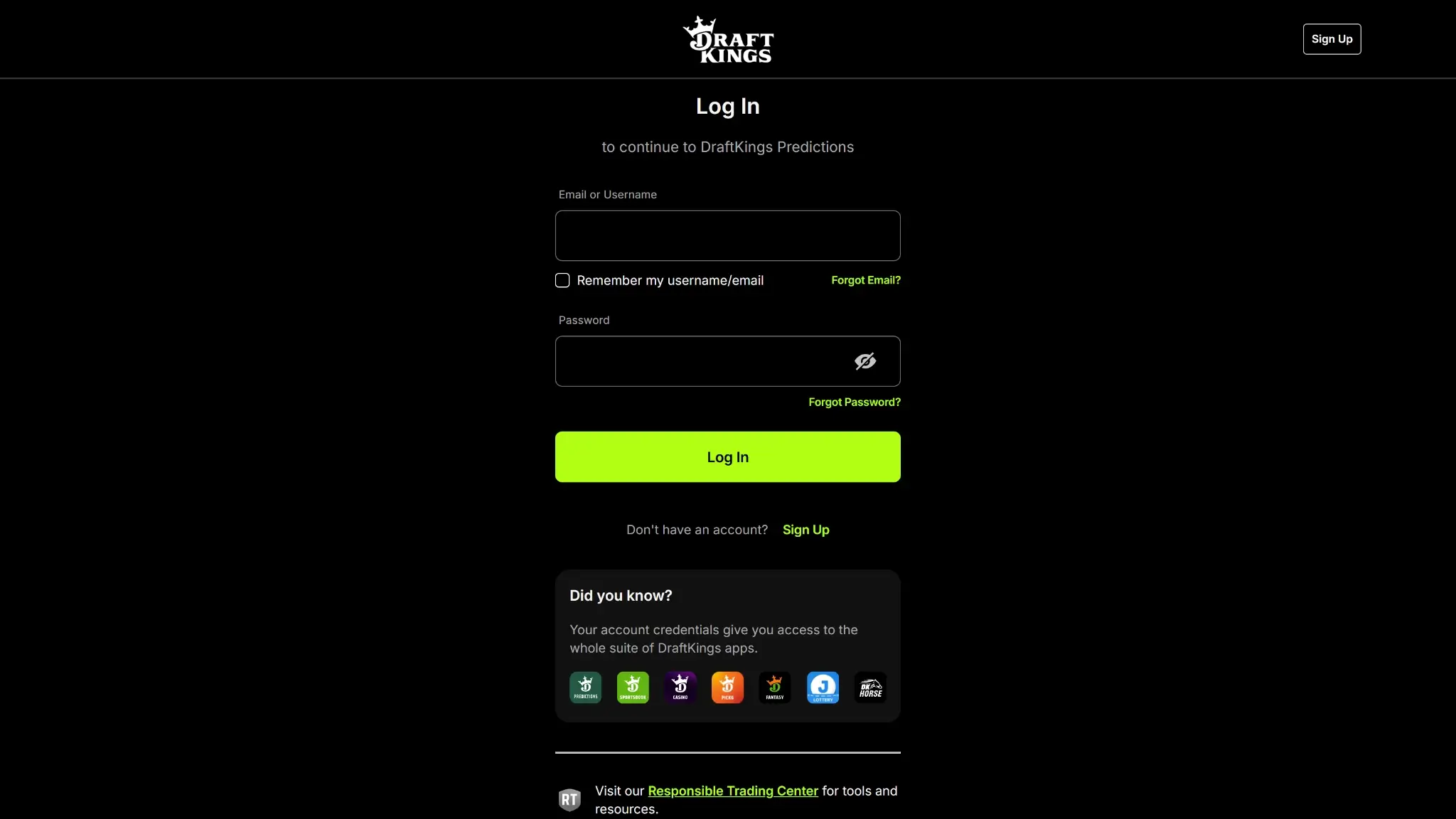
DraftKings Predictions login page on desktop showing email and password fields, Log In button, Sign Up link, and account access panel on a dark interface.
The UX helps with basic decision-making, but mostly by looking clean and familiar rather than by giving users strong trading or research tools.
Taxes, Statements and Record-Keeping
Record-keeping looks manageable, not clean.
Tax Forms — 1099 reporting can apply, and tax documents are available inside the account.
Account Statements — Statements are available, including from the account area and support flows.
CSV Or Export Quality — Limited. This is not a reporting-first platform.
Cost-Basis Visibility — Basic, but not strong enough for active users who want a clean tax-lot view.
What Users Still Track Themselves — Entry and exit prices, fees, realized gains or losses, and any cross-platform comparisons.
Casual users with a small number of trades should find reporting tolerable. Active users, frequent traders, and anyone who wants cleaner exports will find it more annoying than a brokerage-style reporting setup.
Customer Support, Limits and Incident Handling
The help center is easy to find and covers the main funding, withdrawal, and market questions. Human support is a different issue, and it cannot solve every trading problem.
Help Center — Available at the DraftKings Help Center and Predictions support pages.
Live Chat — Not available as a major Predictions support channel.
Email Or Ticket Support — Available through the contact flow and support email routes, including [email protected].
Status Page — No clear public status page.
Community Channels — No meaningful public community support channel for Predictions.
Self-Exclusion Or Cooldown Tools — Available through the Responsible Trading Center and DraftKings self-exclusion tools.
Account Limits — Funding access, unsettled funds, and responsible-trading controls can limit use.
Position Limits — Yes. Platform and regulatory limits can apply.
What Support Can Actually Fix — Account access, funding issues, withdrawal problems, document access, and basic trade support.
What Support Cannot Reverse — Completed fills, settled market outcomes, or exchange-level resolution decisions.
Support is fine for routine account issues, but it is not a safety net for bad entries, thin liquidity, or rule-driven settlements.
Final Verdict
DraftKings Predictions works as a regulated entry point for existing DraftKings users who want event contracts without learning a new platform, but that convenience comes with real costs. State-by-state access is uneven, sports markets are not available everywhere, tribal land is excluded, and Maine and Ohio get no markets at all. The funding flow adds more friction than the clean app design suggests - unsettled funds, play-through rules, and method-based hold periods mean a market can resolve and the cash still is not yours to withdraw. Liquidity thins out fast outside headline events, there are no limit orders, and the broker-routed structure adds an exchange fee layer on top of the posted $0.01 commission. It earns its place as a recognizable regulated product, but not much beyond that.
Standalone app and web product inside a familiar DraftKings ecosystem
Regulated structure with Wedbush instead of a legal gray area
Positions can be sold before final resolution when liquidity is available
Category mix extends beyond sports into crypto, stocks, politics, business, and economics
Posted platform commission is $0.01 per contract per side
CONS
Market access changes by state and by category, especially for sports
Full KYC can reach into income, tax, and trading-experience checks
Predictions balances do not move freely across other DraftKings products
Unsettled funds and play-through rules can delay withdrawals or limit access to cash
No public API or easy historical-data path for bot-driven users
Affiliate Disclosure
Disclaimer: CryptoSlate may receive a commission when you click links on our site and make a purchase or complete an action with a third party. This does not influence our editorial independence, reviews, or ratings, and we always aim to provide accurate, transparent information to our readers.
FAQ
Is DraftKings Predictions legal where I am?
DraftKings Predictions is a United States-only product. Even inside the U.S., access depends on your physical location at the time you use the platform, not just where you live. Some states get broader access, some are limited to financial-only markets, and some do not get markets at all. Tribal land is also excluded, so the practical answer is to verify your live location before you fund the account or try to trade.
Does DraftKings Predictions require KYC?
Yes, and the KYC burden is closer to a regulated financial account than to a casual signup on DraftKings Predictions. Basic identity checks are only the starting point. The platform can also require tax details, employment or income information, and trading-experience questions as part of the onboarding flow. Approval may take longer than a normal DraftKings product, and some users will hit more friction before they ever place a first trade.
Can I sell before the market resolves on DraftKings Predictions?
Yes, you can exit before final resolution on DraftKings Predictions. But that does not mean every position is easy to sell at a fair price. Your exit depends on there being enough liquidity on the other side of the market when you want out. On active headline markets, that is usually manageable for smaller trades. On thinner contracts, you may have to accept a worse price, wait longer, or hold the position to settlement.
How long does it take to actually withdraw winnings from DraftKings Predictions?
The withdrawal timeline is longer than the market-resolution timeline on DraftKings Predictions. A contract can resolve first, then your balance can update, and only after that does the withdrawal process really begin. Your money also needs to be fully settled and eligible for withdrawal, which can be affected by deposit status, payment-method rules, and account checks. After the request is approved, the final timing depends on the payout method you use.
Why is the same event priced differently on DraftKings Predictions and Kalshi?
The same event can trade at different prices because DraftKings Predictions and Kalshi do not share the same order flow, user base, or market depth. One platform may have more active traders, faster reactions, or tighter books at a given moment. Contract wording can also differ, and that alone can change how the market prices the event.
How are disputed, clarified, or voided markets handled on DraftKings Predictions?
If the event outcome on DraftKings Predictions becomes messy, delayed, restricted, or legally sensitive, the market may not settle the way a casual user expects. Contracts can be clarified, halted, voided, or settled under exchange-driven rules rather than market consensus. That does not mean disputes are constant, but it does mean serious users need to care about wording and settlement conditions before entering.
Does DraftKings Predictions offer an API and historical data?
No public API is part of the core product on DraftKings Predictions. It also does not offer the kind of research-grade historical data layer that active traders and bot users usually want. That makes the platform much weaker for automation, backtesting, and model-driven workflows. You can review account activity and tax documents, but that is not the same thing as a real market-data toolkit.