CryptoSlate's latest report dives deep into Polymarket's evolution, its pivotal role in high-stakes prediction events like US elections, and the implications of its controversies on its market position.
Polymarket, a decentralized prediction market platform, has emerged as a disruptive force in the intersection of blockchain technology and predictive analytics. The platform was built on the premise of crowdsourcing insights, which enables users to place bets on the outcomes of real-world events, ranging from political elections to sports and financial markets. By leveraging blockchain, Polymarket ensures transparency, immutability, and global accessibility.
Since its inception, Polymarket has drawn significant attention from both crypto enthusiasts and mainstream users, carving out a niche in the growing prediction market sector. However, its journey has not been without challenges, including regulatory scrutiny, legal controversies, and fluctuating user activity.
In this report, CryptoSlate will dive deep into Polymarket’s evolution, its pivotal role in high-stakes prediction events like US elections, and the implications of its controversies on its market position.
Polymarket's evolution
Polymarket was founded in 2020 by Shayne Coplan to create a decentralized prediction market that leverages blockchain technology to bring transparency and accessibility to speculating on real-world events.
Built on the Polygon blockchain, Polymarket is a non-custodial platform where users can trade outcomes through smart contracts. This architecture eliminates the need for intermediaries and ensures secure, automated market resolution, making Polymarket a significant departure from traditional prediction market platforms like PredictIt and Betfair.
From its early days, Polymarket sought to democratize access to prediction markets. Traditional platforms often face geographic and regulatory restrictions, which limit participation. Using blockchain technology, Polymarket allowed global users to trade on market outcomes without the same constraints.
For example, Polymarket’s decentralized structure enables permissionless access to users across jurisdictions, provided they have a crypto wallet. The platform supports USDC as its primary trading token, reflecting the broader crypto industry’s reliance on stablecoins for liquidity.
In its first few years, Polymarket gained significant traction due to its user-friendly interface and focus on topical, high-interest markets. During the COVID-19 pandemic, Polymarket saw a surge in activity as users traded on the likelihood of vaccine rollouts, lockdowns, and case numbers.
These markets highlighted the platform’s ability to engage users in timely and impactful events. By 2024, Polymarket had become a go-to platform for political betting, with the US presidential election drawing millions of dollars in trading volume. Notably, one anonymous whale placed $85 million in wagers on Donald Trump’s victory, a testament to the platform’s liquidity and appeal to high-stakes bettors.
Polymarket’s success is built on its ability to tap into the predictive power of crowdsourced trading activity. The markets on Polymarket reflect aggregated probabilities, allowing users to gain insights into public sentiment on diverse topics, from political outcomes to crypto trends. This capability has positioned Polymarket as more than just a betting platform; it is increasingly seen as a tool for forecasting and data analysis.
However, the platform has faced growing competition. Blockchain-based prediction markets such as Augur and Gnosis operate in the same space. Augur, for instance, pioneered blockchain prediction markets but has struggled with liquidity and user experience compared to Polymarket. Polymarket has outperformed many of its peers in adoption and engagement by focusing on usability and trending markets.
How Polymarket works
Polymarket operates on the principle of binary markets. Each market represents a real-world event with two possible outcomes — typically “Yes” or “No.”
Users can buy or sell shares that represent their predictions. The price of a share reflects the market’s collective probability of an outcome, with values ranging from $0 to $1. For example, if a share in an event’s “Yes” outcome is trading at $0.70, the market estimates a 70% probability of that outcome occurring.
Users earn profits by correctly predicting the outcome. If their prediction is correct, their shares settle at $1, yielding a profit proportional to their initial investment. Conversely, incorrect predictions result in a loss of the initial stake.
Polymarket offers two distinct types of markets — NegRisk (Negative Risk) and CTF (Conditional Token Framework) — that cater to different prediction and trading strategies. While both markets operate within the framework of decentralized prediction markets, they differ in purpose, structure, and the type of participants they attract.
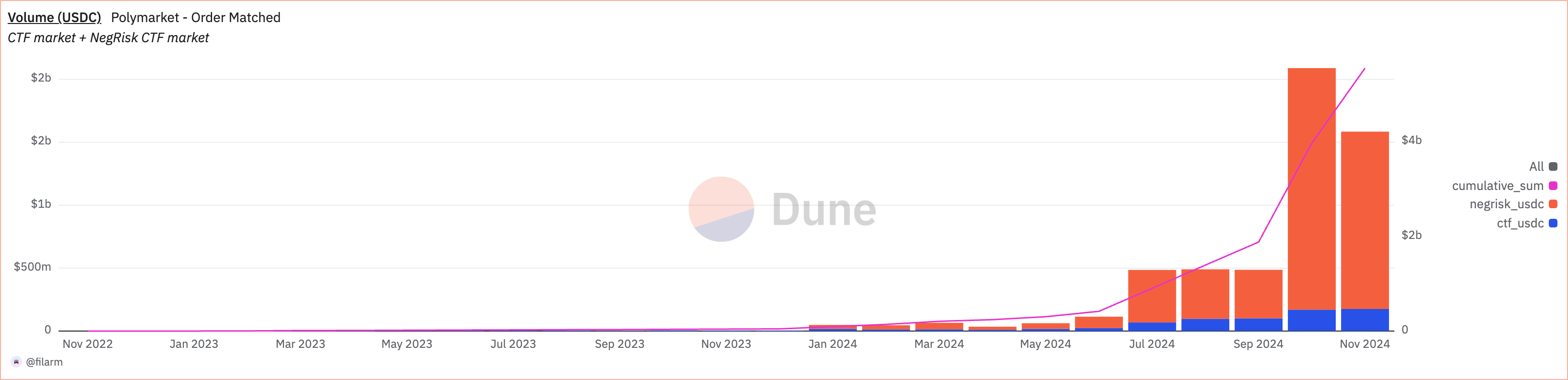
Distribution of trading volume across NegRisk and CTF markets from Nov. 2020 to Nov. 2024 (Source: Dune)
NegRisk markets allow users to hedge against potential losses by taking positions that offset risks. These markets focus on trading outcomes that users consider unfavorable or want to guard against. For example, a user might trade in a NegRisk market predicting a specific adverse event — such as an unexpected economic downturn or a political candidate losing — providing a financial safety net in case the undesired outcome occurs.
The key feature of NegRisk markets is that they cater to risk-averse participants. Users who have a vested interest in specific outcomes often use these markets to insure themselves against financial or reputational damage resulting from unfavorable events. For instance, businesses or investors might use NegRisk markets to hedge against regulatory changes or unfavorable macroeconomic shifts.
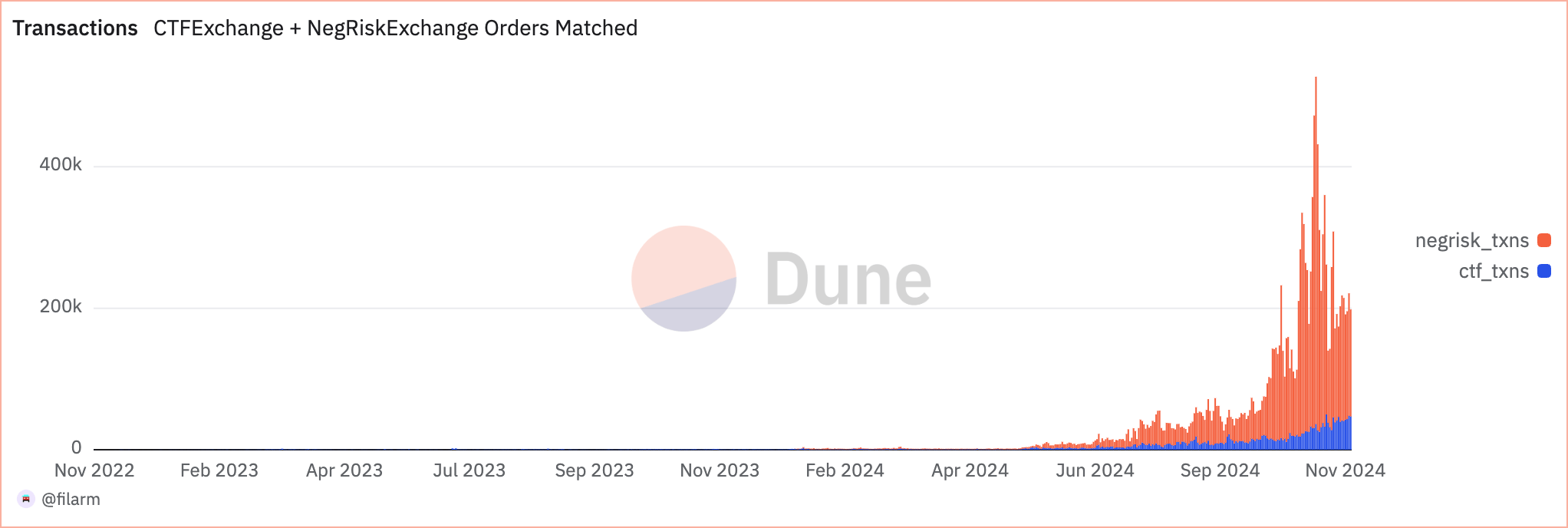
NegRisk markets tend to see higher transaction volumes when uncertainty or high-stakes events dominate public discourse, as seen in the sharp activity spikes during the 2024 US elections.
CTF (Conditional Token Framework) markets, on the other hand, operate on a more general prediction market model. These markets use conditional tokens to allow participants to trade shares representing binary outcomes (“Yes” or “No”) for various real-world events. For example, a CTF market might predict the winner of a sports tournament or whether inflation will exceed a specific level by the end of the year.
Graph showing the number of NegRisk and CTF transactions on Polymarket from November 2020 to November 2024 (Source: Dune)
Polymarket uses USDC for transactions, ensuring price stability and eliminating the volatility associated with native cryptocurrencies. The platform also employs oracles to resolve markets. These oracles verify the outcome of events and ensure that payouts are distributed according to the smart contract’s terms.
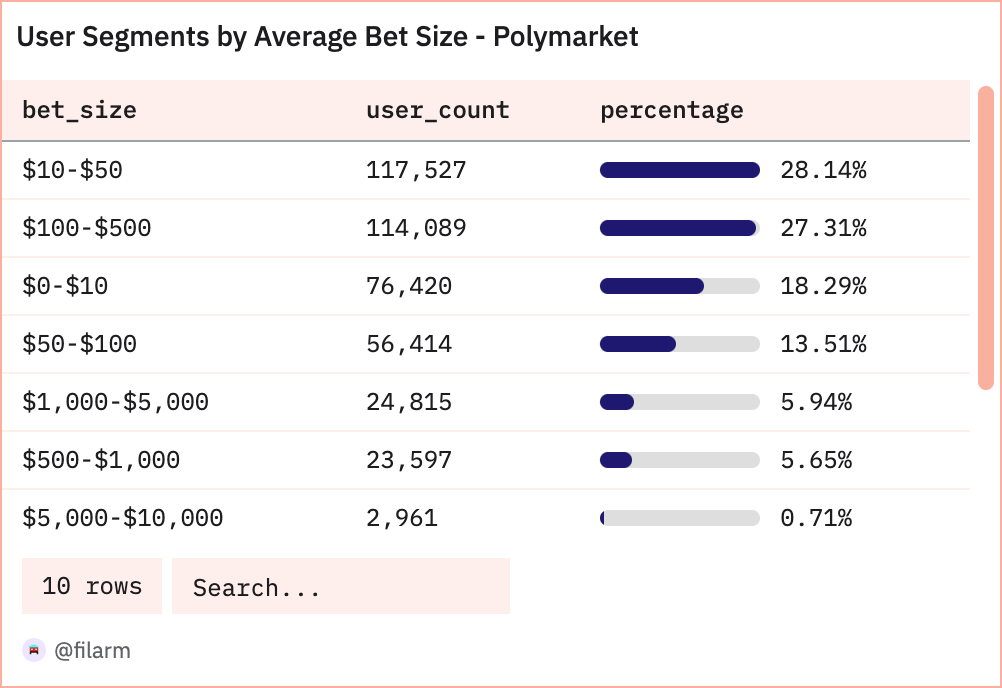
The largest segment of users bet between $10 and $50, accounting for 28.14% of total participants. Close behind, 27.31% of users place bets ranging from $100 to $500, indicating a significant number of mid-level traders. Meanwhile, smaller segments, such as those betting $5,000 to $10,000, represent just 0.71% of users. This distribution highlights Polymarket’s accessibility to a broad range of participants while showcasing the presence of high-stakes traders.
Table showing the distribution of Polymarket users across bet sizes on Nov. 22, 2024 (Source: Dune)
By November, the number of unique daily active wallets exceeded 40,000, driven primarily by interest in significant events like US elections. The overlapping usage of CTF (Conditional Token Framework) and NegRisk markets shows how users often diversify their participation across different market types.
Volume and users
Polymarket’s growth can be seen through its user activity, trading volume, and cumulative open interest.
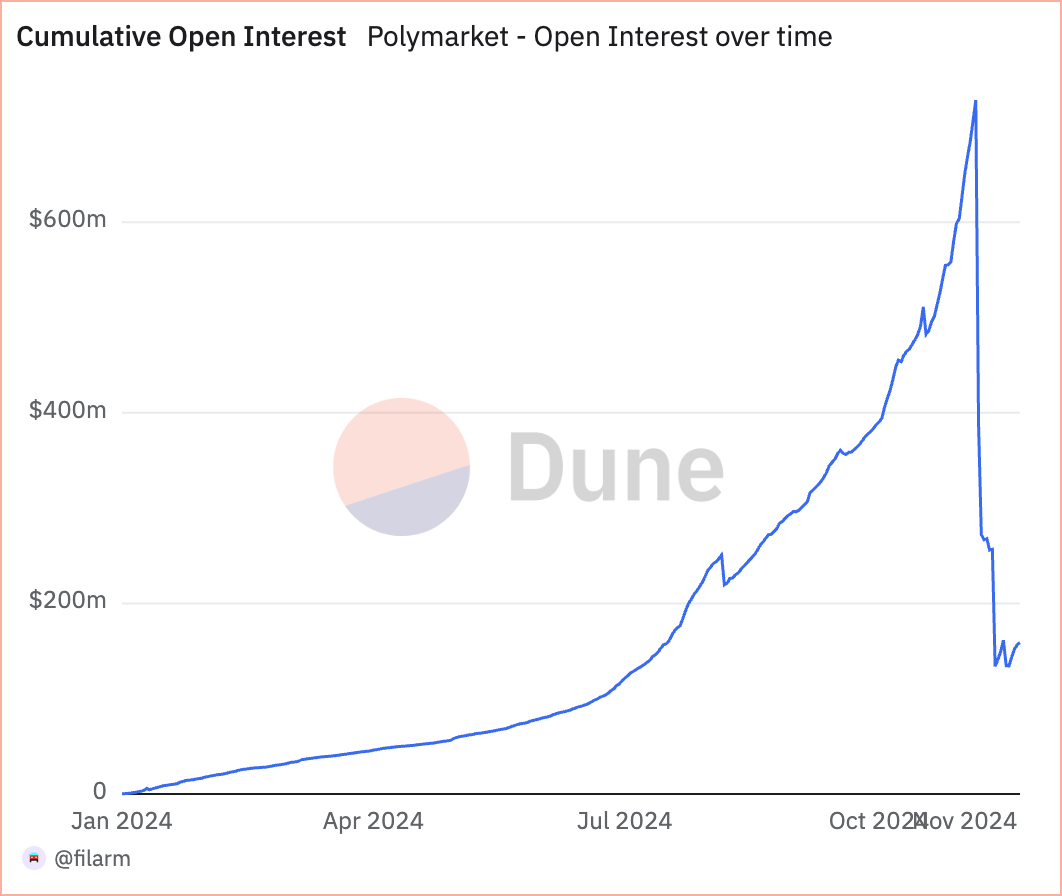
As illustrated below, Polymarket’s cumulative open interest surged significantly in 2024, peaking at over $600 million in November. This growth reflects the platform’s success in capturing market attention during major global events such as the 2024 US presidential election.
However, the sharp drop following this peak highlights the event-driven nature of Polymarket’s user engagement. Open interest fell by more than 60% immediately after the election, signaling a decline in activity once high-profile events concluded.
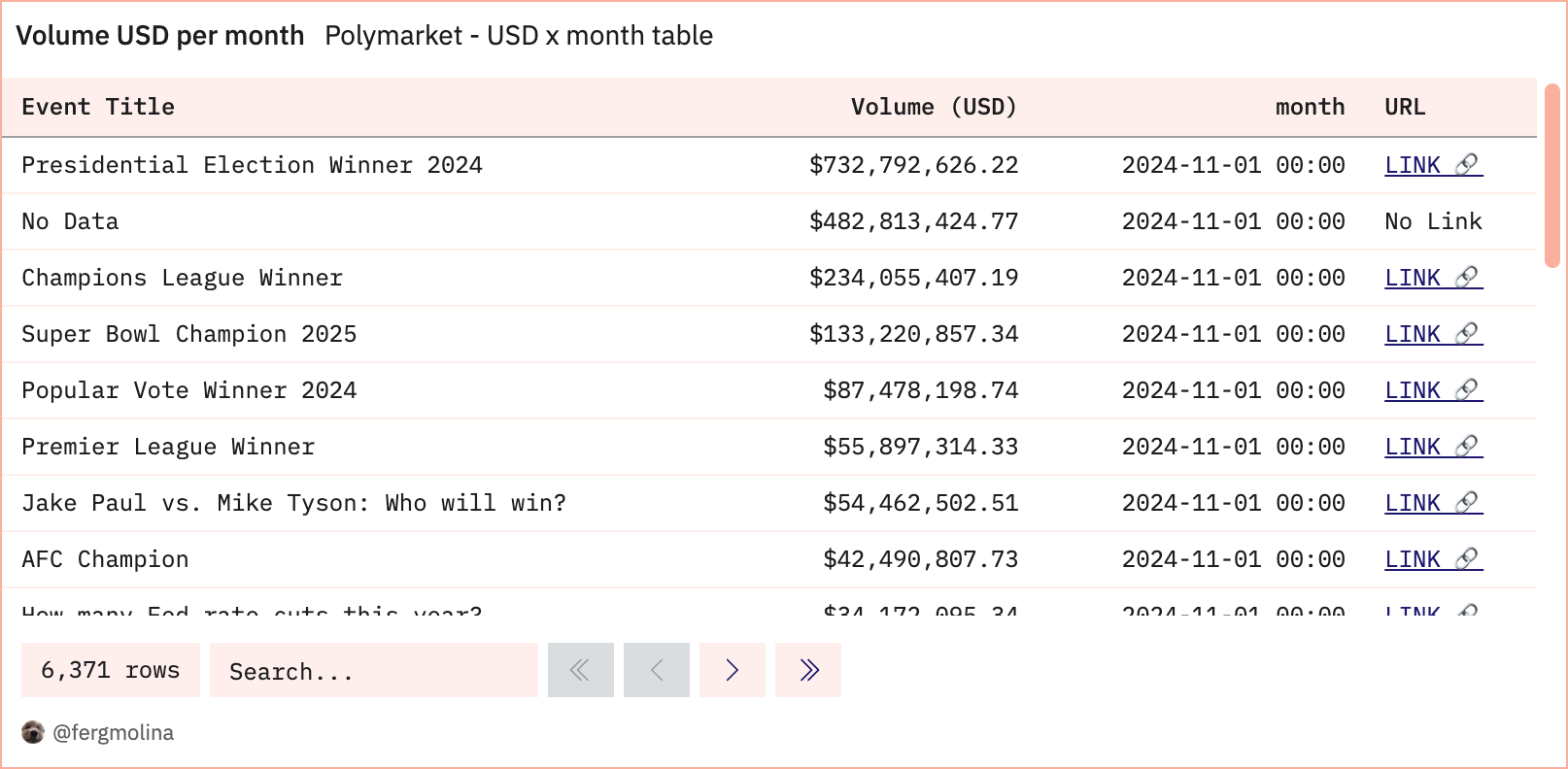
Table showing the distribution of Polymarket’s trading volume across markets on Nov. 22, 2024 (Source: Dune)
This cyclical behavior suggests that Polymarket’s success hinges on its ability to host relevant and timely markets that capture public attention. The post-event declines also underline the platform’s reliance on external catalysts to sustain trading volumes.
Graph showing the cumulative open interest on Polymarket from Jan. 1 to Nov. 21, 2024 (Source: Dune)
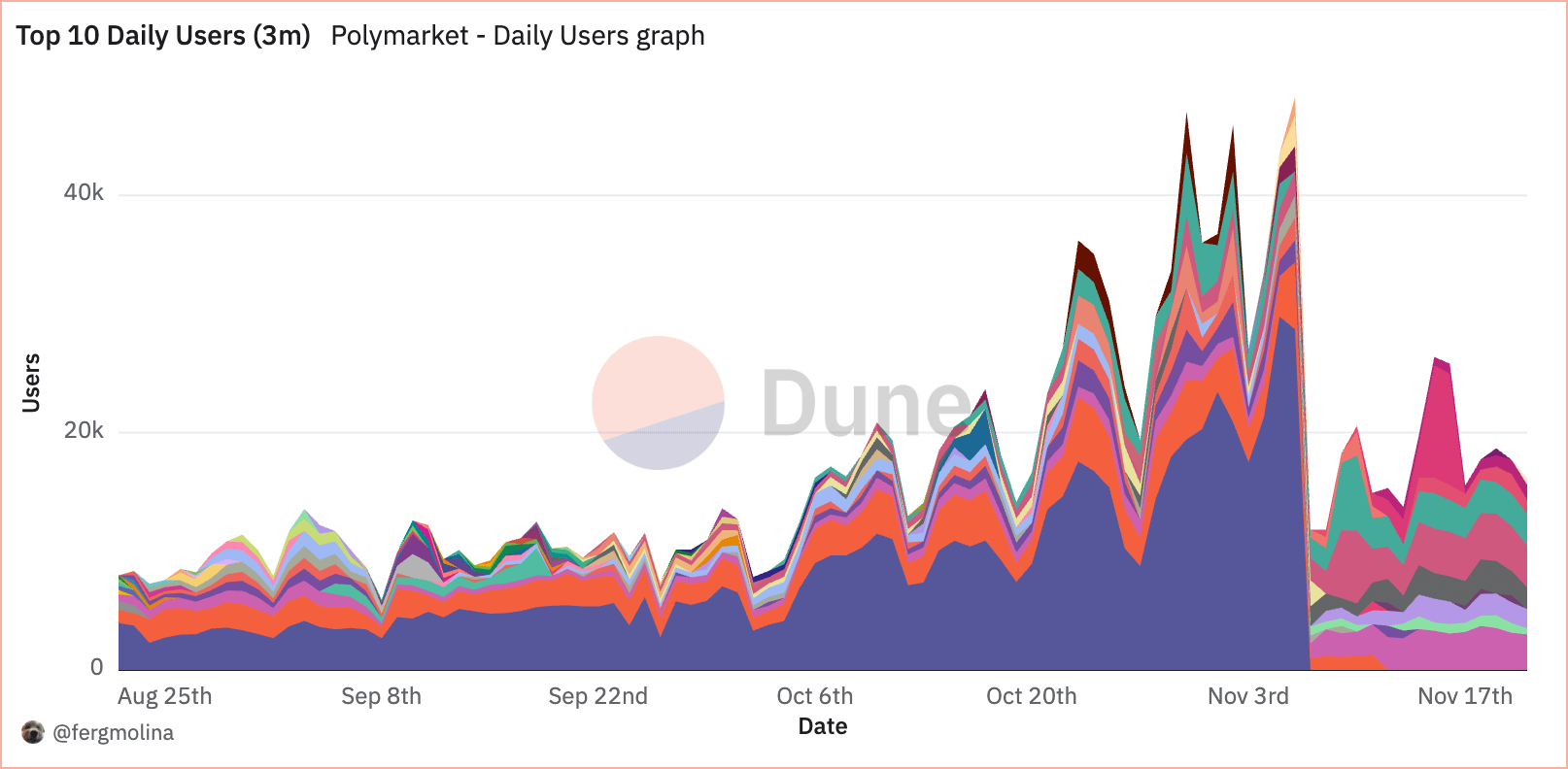
The number of daily users further supports this. User activity peaked during the election week, with spikes surpassing 40,000 users in a single day. This high concentration around political markets highlights Polymarket’s ability to aggregate interest during pivotal events while raising questions about its activity during non-election periods.
Chart showing the number of unique addresses on Polymarket from Aug. 22 to Nov. 22, 2024 (Source: Dune)
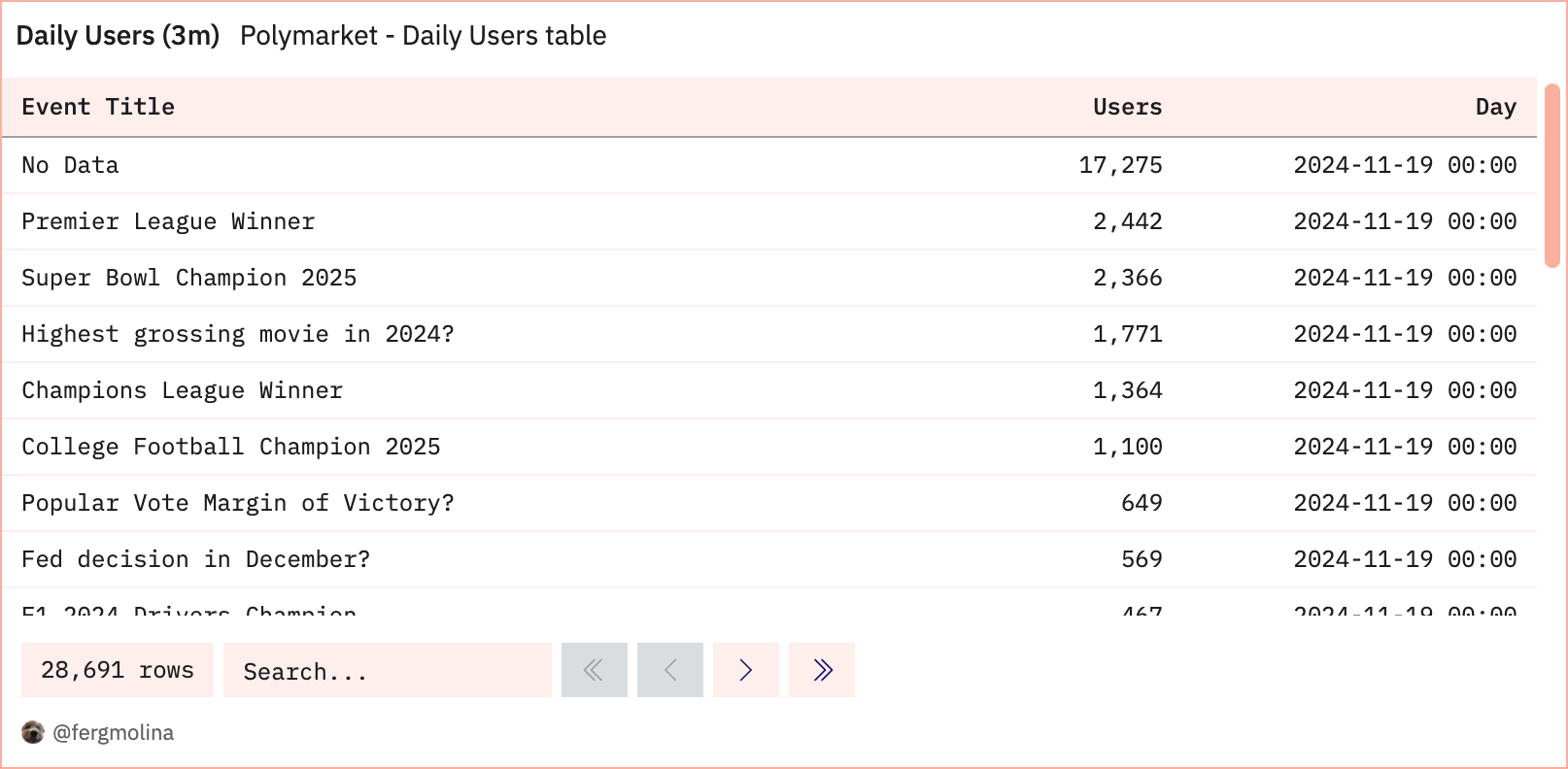
Following the election, the platform saw a drastic drop in users. As of Nov. 19, Polymarket recorded 17,275 active users across various markets. Popular markets included the “Premier League Winner” (2,442 users) and “Super Bowl Champion 2025” (2,366 users), showcasing Polymarket’s ability to diversify beyond political events into entertainment and sports predictions.
These numbers illustrate a broadening appeal but also suggest that user engagement is distributed unevenly, with specific markets dominating participation.
Table showing the distribution of daily active users on Polymarket across different markets on Nov. 19, 2024 (Source: Dune)
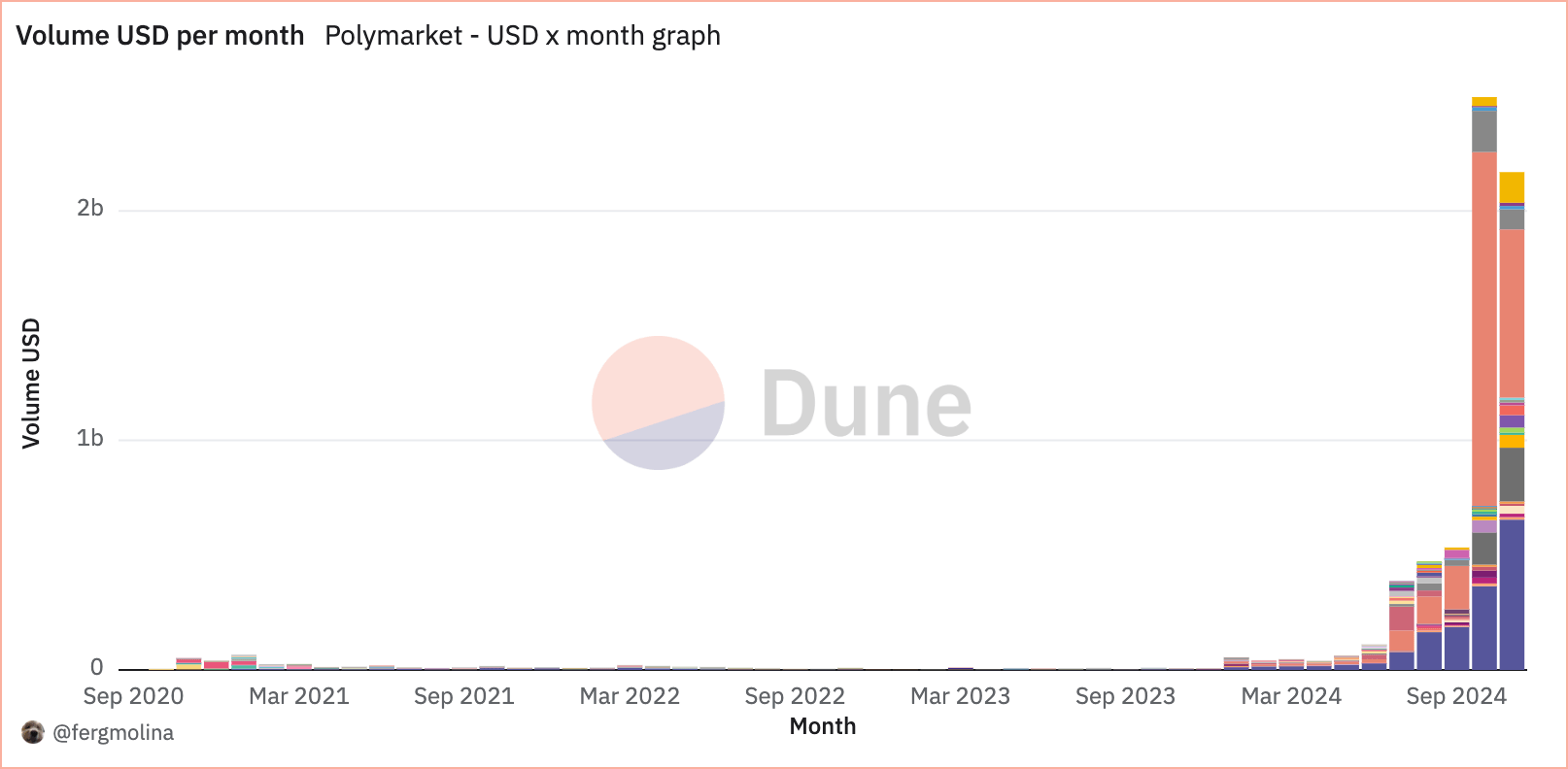
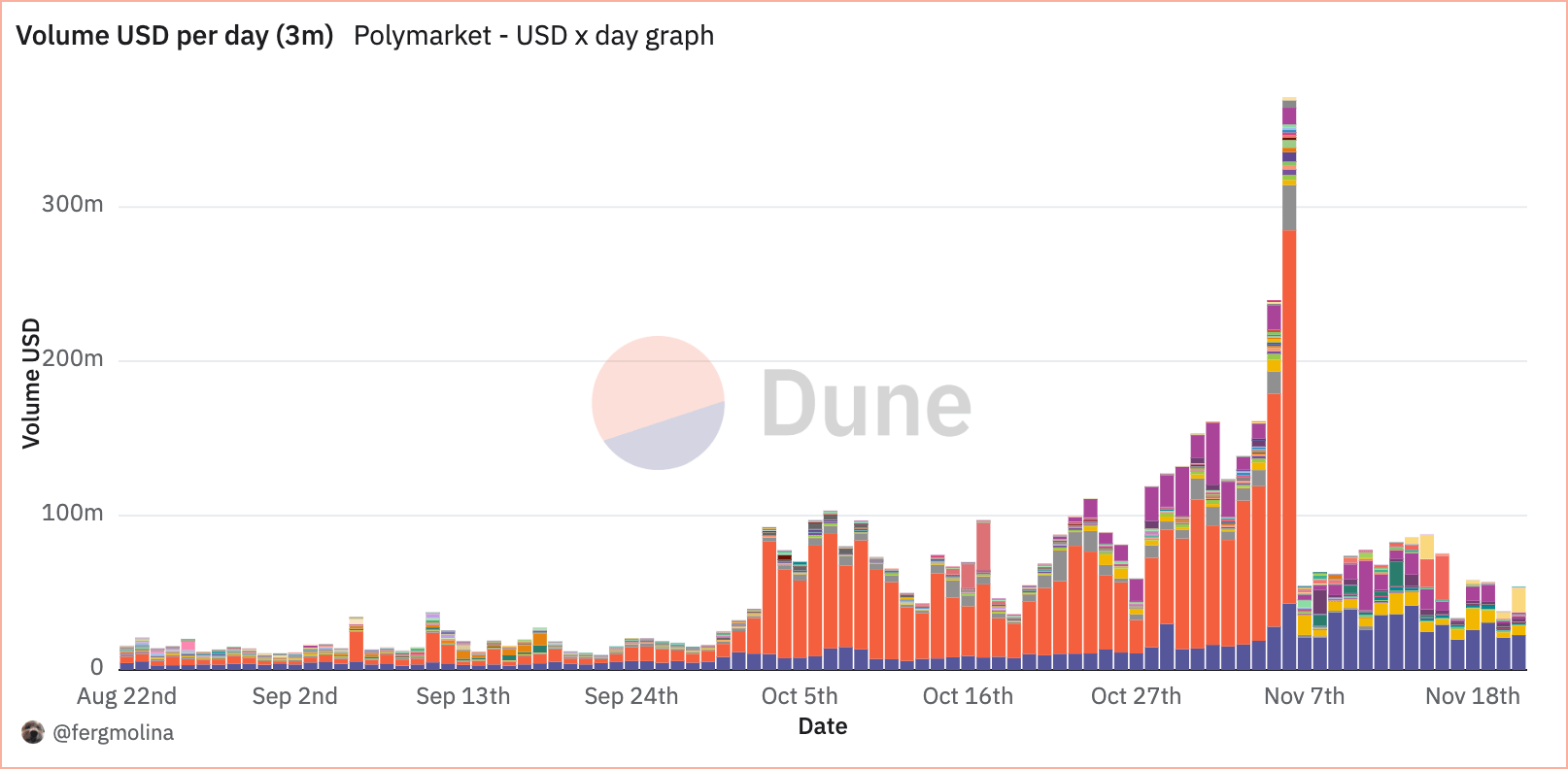
The total order volume on Polymarket exceeded $2 billion in 2024, as shown in the cumulative volume chart. Daily trading volume exceeded $300 million during peak election periods in early November. This reflects the platform’s scalability and ability to accommodate high-stakes bets, such as the $85 million wager on Donald Trump’s re-election.
Chart showing the total transaction volume on Polymarket from September 2020 to November 2024 (Source: Dune)
However, daily trading volumes exhibit a sharp decline following major events, with activity falling below $100 million per day in the weeks after the election. This reinforces the platform’s dependency on high-profile events to drive liquidity and illustrates the need for strategies to sustain activity during quieter periods.
Chart showing the total transaction volume on Polymarket from Aug. 22 to Nov. 22, 2024 (Source: Dune)
Controversies
Polymarket’s growth has not come without challenges. The platform’s decentralized nature and operation in a rapidly evolving regulatory environment have brought significant attention from authorities, raising questions about compliance and oversight.
The most notable controversy surrounding Polymarket came in November 2024, when the FBI raided the home of its CEO, Shayne Coplan. Law enforcement officials seized Coplan’s phone and other devices as part of an investigation into the platform’s operations.
Although specific details remain scarce, the investigation centers on whether Polymarket facilitated unregistered securities trading. This raid followed earlier legal challenges for the platform. In 2021, Polymarket settled charges with the US Commodity Futures Trading Commission (CFTC), paying a $1.4 million penalty for operating an unregistered event-based binary options market.
The legal scrutiny sheds light on a broader issue with decentralized prediction markets: the clash between the innovation of blockchain-based platforms and traditional regulatory frameworks. US securities laws, for example, are almost always at odds with the permissionless and borderless nature of platforms like Polymarket. The CFTC settlement and the FBI investigation show regulators are increasingly targeting platforms like these to establish clearer guidelines for DeFi applications.
Polymarket’s critics have also raised concerns about potential market manipulation and the influence of large traders. For example, during the 2024 US presidential election, an anonymous user reportedly placed $85 million in bets on Donald Trump’s victory.
While this high-profile bet demonstrated the platform’s liquidity, it also raised questions about the impact of large trades on pricing and market integrity. Critics argue that such trades could distort market signals, undermining the platform’s utility for predicting probabilities.
Polymarket’s defenders counter these criticisms by emphasizing the platform’s transparency and decentralized nature. Every trade on Polymarket is recorded on the blockchain, providing an immutable and publicly verifiable ledger of activity.
Supporters argue that this level of transparency surpasses traditional prediction markets and mitigates concerns about manipulation. Smart contracts also ensure that market resolutions are handled fairly and automatically, reducing the risk of human error or interference.
The controversies surrounding Polymarket reflect the growing pains faced by many blockchain platforms. As regulators continue to grapple with how to oversee decentralized systems, platforms like Polymarket are navigating uncharted territory. While these challenges present significant hurdles, they also highlight the importance of platforms like Polymarket in pushing the boundaries of what decentralized technologies can achieve.
Polymarket’s ability to address these challenges will likely determine its long-term viability. Regulatory compliance, in particular, will be critical as authorities increase their focus on the broader DeFi ecosystem.
At the same time, Polymarket must maintain user trust by ensuring that its markets remain transparent and free from manipulation. These dual challenges — regulatory scrutiny and maintaining market integrity — show how hard it is to operate at the intersection of blockchain technology and real-world applicability.
Conclusion
Polymarket has emerged as a pioneering force in the prediction market space, combining blockchain technology with real-world applicability. The data above shows Polymarket’s capacity to attract casual participants and high-stakes traders, as evidenced by its $2 billion in order volume and its ability to exceed 40,000 active wallets during peak periods. Its success during the 2024 US presidential election highlighted its scalability and value as a predictive tool.
However, Polymarket’s journey has been marked by significant challenges. From regulatory scrutiny to questions of market manipulation, the platform exemplifies the difficulties faced by decentralized systems operating in a traditional legal environment. The FBI’s investigation into Polymarket’s CEO and previous CFTC penalties underscore the pressing need for compliance in a rapidly maturing DeFi ecosystem.
Polymarket’s future hinges on its ability to address these challenges while maintaining its user base and market appeal. The platform will need to diversify its market offerings to sustain engagement during non-peak periods and continue investing in compliance and transparency to build trust among users and regulators. If it can successfully navigate this complex landscape, Polymarket is well-positioned to remain a leader in the prediction market industry, setting a precedent for the broader adoption of blockchain technology in real-world applications.