Hyperliquid suits experienced traders who want low fees, deep perp markets, and tools built for active execution. It is a poor all-purpose pick: the interface is restricted for U.S. users, fiat rails are limited, and the legal structure is thinner than on regulated exchange
Very competitive trading fees, with separate spot and perp schedules plus extra discounts from staking and referrals.
Strong pro feature set for a crypto-native venue, including spot, perps, vaults, staking, sub-accounts, agent wallets, and public API access.
Non-custodial design with native multi-sig support, public docs, public bridge-audit coverage, a bug bounty, and a live status page.
Fast native USDC bridge flow, with a 5 USDC minimum deposit and a $1 withdrawal fee to Arbitrum.
Cons
Not a practical fit for U.S. retail users because the official interface is restricted for U.S. users.
No ACH, card, or bank-transfer onboarding.
No official Hyperliquid app in any app store, and support mainly runs through docs, Discord tickets, and the official support form.
Retail entity mapping and jurisdiction disclosures are thinner than on more regulated exchanges.
Is Hyperliquid Worth It?
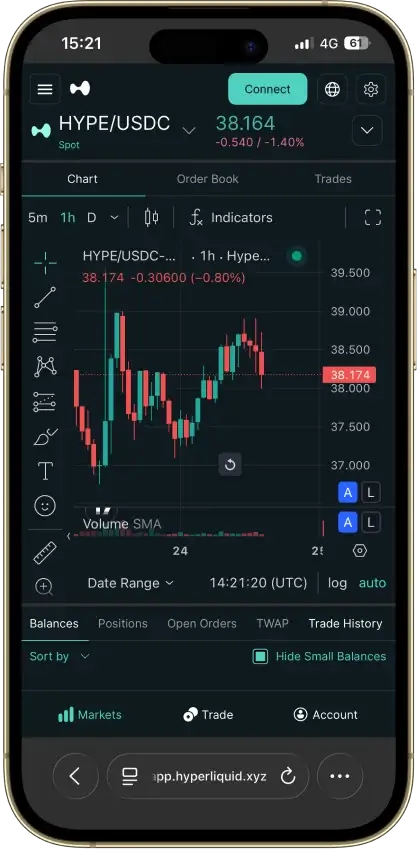
Hyperliquid is worth considering if you already understand crypto trading and want a venue built around onchain execution, low posted fees, and serious order tools. Perpetuals are the main draw, but the platform also adds spot markets, vaults, staking, sub-accounts, and API access in a way that feels closer to a trading system than a simple buy-and-sell app.
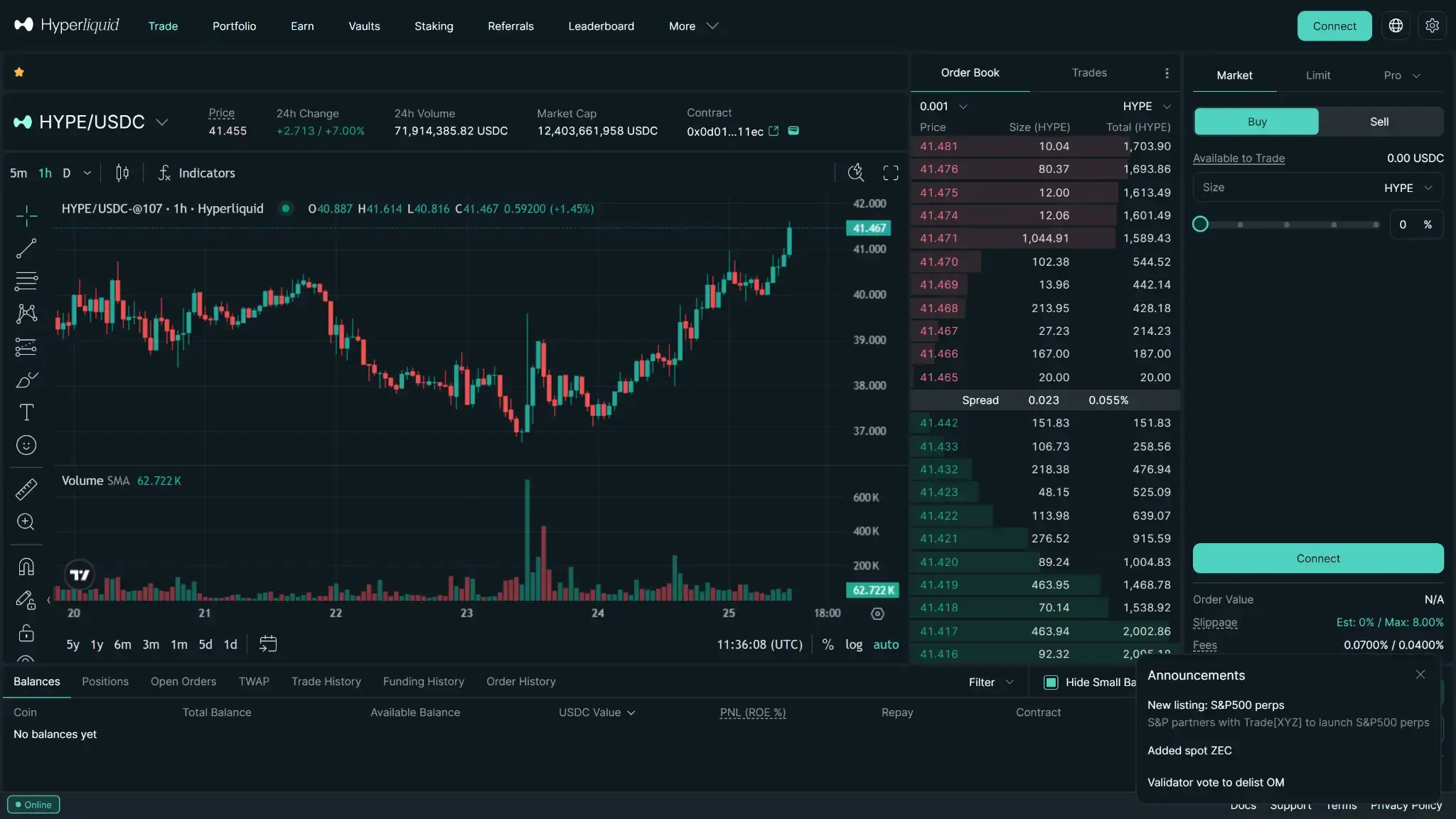
Hyperliquid desktop trading page showing the HYPE USDC chart, order book, market order panel, and balances section.
It is not a broad, beginner-friendly exchange. The official interface is restricted for U.S. users, fiat rails are limited, and the legal setup is less clearly explained than many retail users will want. If you want bank funding, heavier customer support, or a polished mainstream mobile experience, this probably is not your best fit.
Who Is Hyperliquid Best For
Hyperliquid suits traders who are comfortable funding with crypto, managing wallet connections, and trading perpetuals. It makes the most sense for users who care about execution, fee efficiency, advanced order controls, API access, and a broader onchain product stack rather than simple retail convenience. It also suits fee-sensitive traders with enough volume to benefit from the tiered schedule and staking discounts.
It can also work for secondary users such as crypto-native spot traders, vault users, and builders or automation-focused traders who want sub-accounts, agent wallets, or API-based workflows. It is a poor fit for true beginners, low-risk casual buyers, and most U.S. retail users. It is also a weak match for anyone who wants clear fiat on-ramps, more traditional customer support, or the comfort of a heavily disclosed retail exchange structure.
Simple buy or sellNo separate instant-buy fee. Spot trades use the order-book fee schedule instead of a retail spread-plus-fee widget.
Advanced maker or takerPerps: 0.015%–0.000% maker / 0.045%–0.024% taker before staking discounts. Spot: 0.040%–0.000% maker / 0.070%–0.025% taker before staking discounts.
Card depositNot supported in the public onboarding flow.
Bank transferNot supported.
Crypto withdrawalNative USDC withdrawals to Arbitrum cost $1 and do not require gas. Other network costs are not available.
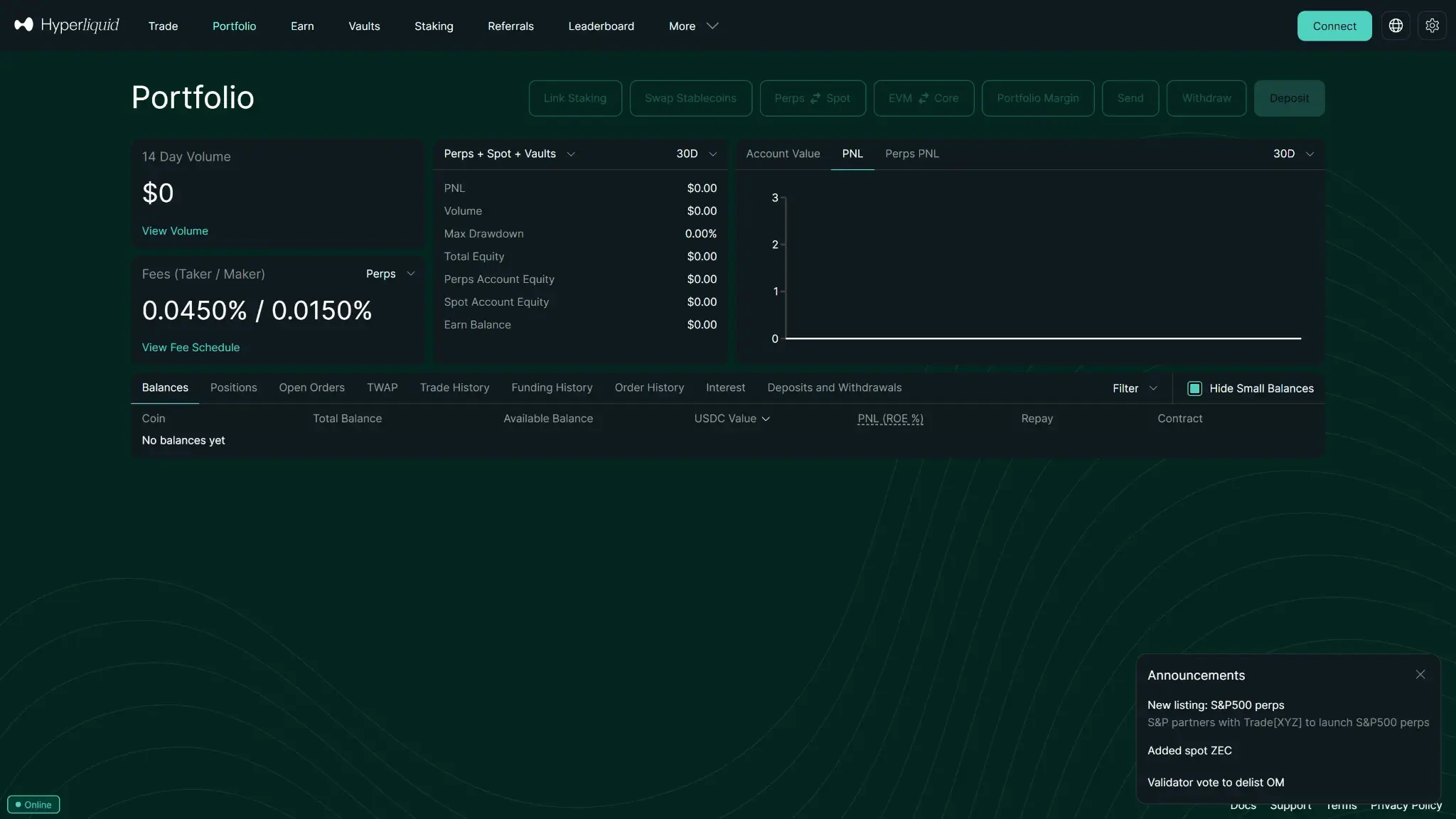
Hyperliquid does not use a separate beginner buy-crypto pricing model in its public trading flow. Costs are driven mainly by the order-book fee schedule, your rolling 14-day weighted volume, and any staking or referral discounts. Fee capture date for this review: March 20, 2026.
Base pricing is competitive if you actually trade. On the standard public schedule, perps run from 0.015% maker and 0.045% taker at the base tier down to 0.000% maker and 0.024% taker at the top tier. Spot runs from 0.040% maker and 0.070% taker at the base tier down to 0.000% maker and 0.025% taker at the top tier before staking discounts, with lower rates possible on some special spot-pair categories. Hyperliquid calculates tiers using 14-day weighted volume, not 30-day volume, and spot volume counts double toward your fee tier.
Operationally, the fee story is simpler than on fiat-heavy exchanges because the main funding flow is crypto only. Hyperliquid’s native bridge uses Arbitrum USDC, trading itself does not cost gas, and the withdrawal charge is the $1 fee for USDC withdrawals to Arbitrum. The trade-off is that there is no clean published bank, card, or regional fiat-fee schedule because those rails are not a core part of the official user flow.
There are a few real ways to lower costs. First, higher 14-day volume lowers your base maker and taker rates. Second, staking HYPE cuts trading fees by 5% to 40% depending on how much you stake. Third, using a referral code gives you 4% off fees on your first $25 million in volume. Advanced users can cut costs further in specific market structures, since spot pairs between two spot quote assets get 80% lower taker fees and aligned quote assets get 20% lower taker fees plus 50% better maker rebates.
If you use HYPE staking mainly for fee reduction, remember that staking has its own economics. Validators can charge commission to delegators, and unstaking back to spot takes seven days, so the fee discount is not perfectly liquid.
Hyperliquid has a real public fee ladder, but it does not use a 30-day VIP model. The official schedule is based on rolling 14-day weighted volume, with spot volume counting 2x toward the tier calculation.
Tier
14-Day Weighted Volume
Perps Maker / Taker
Spot Maker / Taker
Notes on Discounts or Exclusions
Base
0+
0.015% / 0.045%
0.040% / 0.070%
Starting schedule before staking or referral discounts
Tier 1
>$5M
0.012% / 0.040%
0.030% / 0.060%
First meaningful volume discount
Tier 2
>$25M
0.008% / 0.035%
0.020% / 0.050%
Stronger fee drop for active traders
Tier 3
>$100M
0.004% / 0.030%
0.010% / 0.040%
Mid-tier rates for very active users
Tier 4
>$500M
0.000% / 0.028%
0.000% / 0.035%
Zero maker fee starts
Tier 5
>$2B
0.000% / 0.026%
0.000% / 0.030%
High-volume desk tier
Tier 6
>$7B
0.000% / 0.024%
0.000% / 0.025%
Lowest public taker rates
The native-token discount is real, but it comes from staking HYPE, not simply holding it. Official staking tiers are Wood at more than 10 HYPE for a 5% trading-fee discount, Bronze at more than 100 HYPE for 10%, Silver at more than 1,000 HYPE for 15%, Gold at more than 10,000 HYPE for 20%, Platinum at more than 100,000 HYPE for 30%, and Diamond at more than 500,000 HYPE for 40%.
There is no subscription plan that changes trading costs. The core discount mechanics are volume, HYPE staking, and referral pricing. Hyperliquid uses one fee-tier system across spot, perps, and HIP-3 perps, sub-accounts share the master account’s fee tier, and vault volume is treated separately.
High-maker traders can also push maker fees below zero through separate maker-rebate tiers. If your 14-day weighted maker volume exceeds 0.5%, 1.5%, or 3.0% of total maker volume, the maker fee can move to -0.001%, -0.002%, or -0.003%. That matters more for market makers and execution-heavy desks than for typical discretionary traders.
Deposits, Withdrawals, KYC and U.S. Availability
Hyperliquid is a crypto-only funding environment, not a fiat-heavy retail exchange. The clearest supported deposit routes are native USDC on Arbitrum, BTC on Bitcoin, ETH or ENA on Ethereum, selected assets on Solana, MON on Monad, and XPL on Plasma.
The public docs do publish several minimum deposits, including 5 USDC on Arbitrum, 0.0003 BTC, 0.007 ETH or 120 ENA, 0.12 SOL for SOL deposits, 450 MON, and 60 XPL. What they do not package neatly is a full consumer-style funding and limits page with published minimum withdrawals, maximum withdrawals, named verification tiers, and region-by-region rail details.
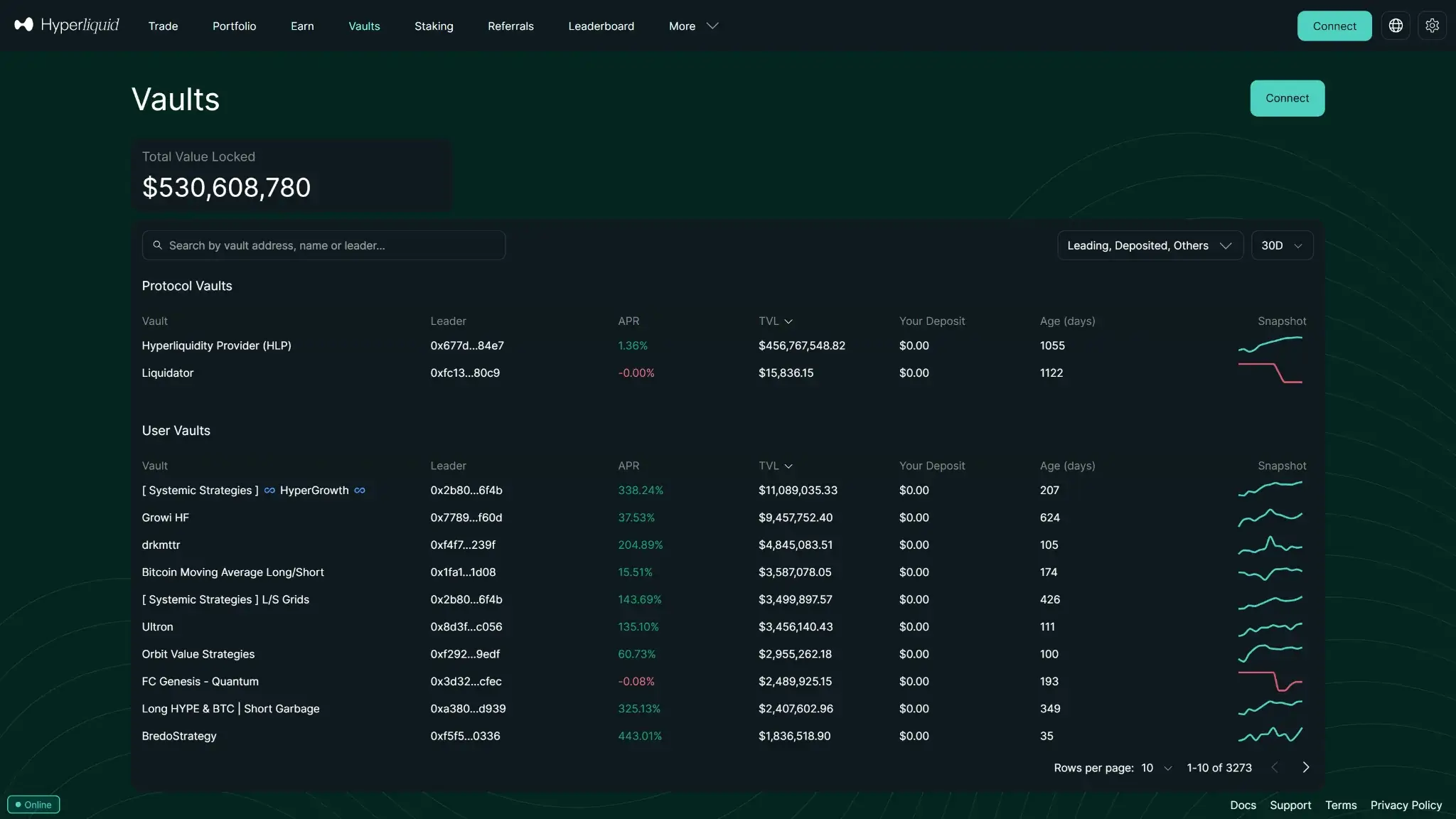
Hyperliquid desktop vaults page showing total value locked, protocol vaults, user vaults, APR, TVL, deposit data, and performance snapshots.
Geo Access and Entity Mapping
Hyperliquid does not publish a clean public entity map showing which company serves which country. Because of that, the table below focuses on what users can verify from public docs and from the official interface.
Jurisdiction or region
Published access signal
What we can say confidently
U.S.
U.S. access is restricted
Hyperliquid does not present itself as a normal retail option for U.S. users
Ontario, Canada
Ontario access is restricted
Ontario should be treated as restricted in at least some official Hyperliquid contexts
Sanctioned or embargoed jurisdictions
Cuba, Iran, Myanmar, North Korea, Syria, and certain Russian-occupied regions of Ukraine are restricted
These jurisdictions are explicitly restricted
Most other regions
No public country-by-country retail availability matrix
Availability is less clearly documented and may depend on the frontend and local law
At a practical level, U.S. retail users should treat Hyperliquid as unavailable. Whatever the protocol design may be, most readers will use the official frontend, and that is where access matters.
Registration and Onboarding
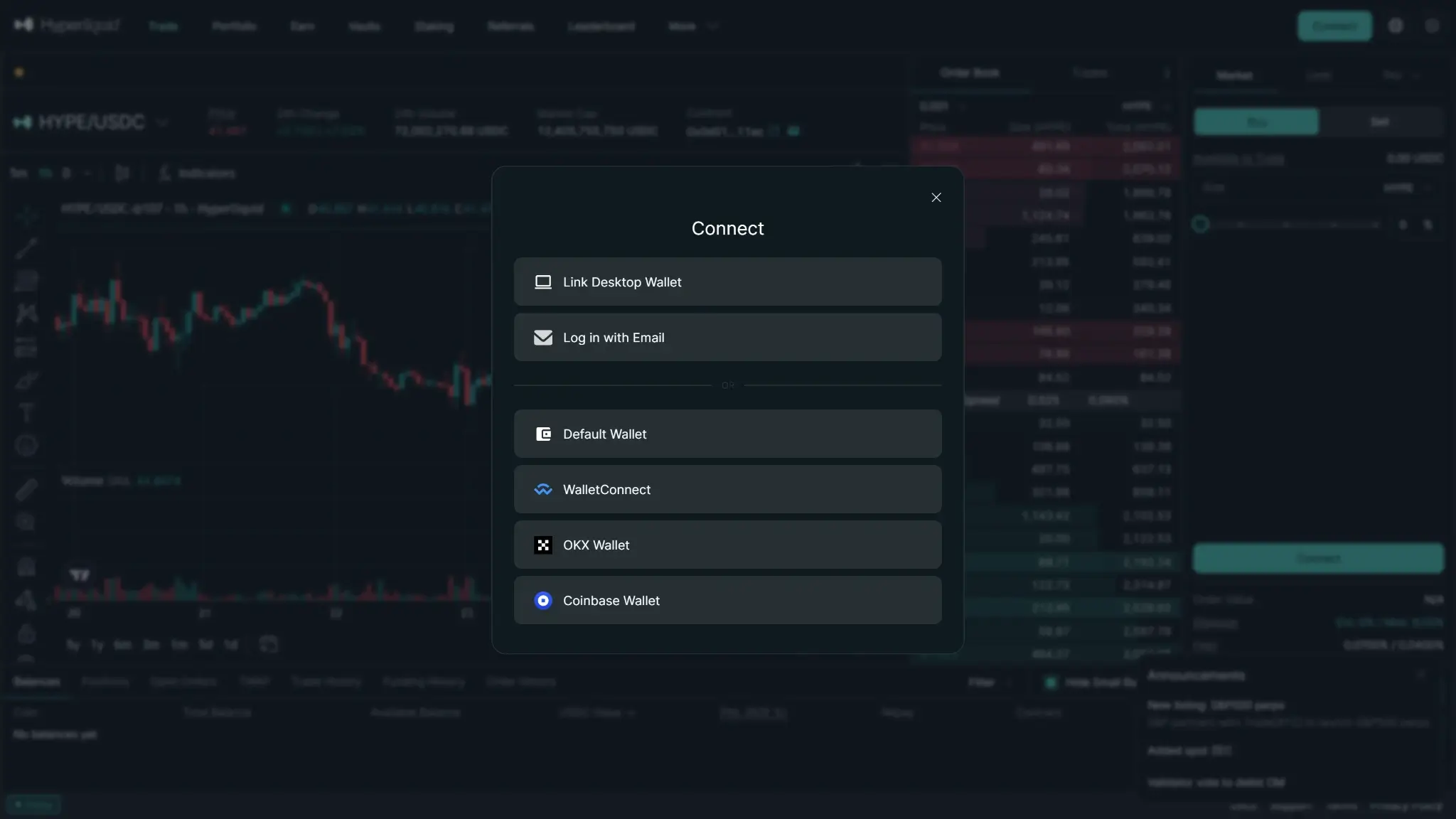
Hyperliquid offers two main onboarding paths. The first is wallet-based: connect an EVM wallet, approve the connection, then sign a gas-less Enable Trading action before funding. The second is email login: enter an email address, receive a six-digit code, and let Hyperliquid create a blockchain address tied to that login.
Funding remains crypto-first. The clearest routes are native USDC on Arbitrum, BTC on Bitcoin, ETH or ENA on Ethereum, selected assets on Solana, MON on Monad, and XPL on Plasma. If you deposit a non-USDC asset, the usual next step is to sell into USDC, USDH, or USDT depending on the market you want to trade.
Retail KYC is not presented as a standard step in the public trading flow. The docs do not show a typical verification ladder with named levels, document lists, or escalating withdrawal caps. That does not rule out extra checks in edge cases; it means Hyperliquid does not explain retail verification the way a centralized exchange usually does. Apple or Google one-tap sign-in also does not appear to be part of the core onboarding flow.
Fiat Rails by Region
Hyperliquid does not present meaningful retail fiat rails in its public onboarding flow. There is no clearly surfaced ACH, SEPA, Faster Payments, wire, card, or PayPal path for ordinary users in the way a centralized exchange would normally present them.
In practice, users are expected to arrive with supported onchain assets, often from a wallet, bridge, or another exchange. For eligible users, native USDC on Arbitrum remains the simplest and lowest-friction funding route.
Withdrawal Networks and Fees
Hyperliquid publishes clearer route support, minimum deposits, and deposit timing than it does a full withdrawal-fee schedule for every network. The table below reflects the most specific public data Hyperliquid provides.
Route
Supported asset(s)
Minimum deposit
Arrival estimate
Withdrawal details
Arbitrum
USDC only
5 USDC
Less than 1 minute
$1 withdrawal fee, no user gas required, and funds generally arrive in 3–4 minutes
Bitcoin
BTC only
0.0003 BTC
About 30 minutes
Withdrawals are supported, but Hyperliquid does not publish a clean public consumer fee-and-timing schedule
Ethereum
ETH, ENA only
0.007 ETH / 120 ENA
About 5 minutes
Withdrawals are supported, but Hyperliquid does not publish a clean public consumer fee-and-timing schedule
Withdrawals are supported, but Hyperliquid does not publish a clean public consumer fee-and-timing schedule
Monad
MON only
450 MON
About 1 minute
No clean public consumer fee-and-timing schedule published
Plasma
XPL only
60 XPL
About 1 minute
No clean public consumer fee-and-timing schedule published
USDC on Arbitrum remains the clearest and cheapest cash-out route because Hyperliquid publishes both the fee and a typical arrival window. The other routes are still useful, but the public docs are much better on supported assets and deposit timing than on consumer-style withdrawal schedules.
Withdraw sends funds to another blockchain. Send only moves tokens between Hyperliquid accounts. Confusing the two creates avoidable recovery problems. If you use Send when you meant to cash out to a centralized exchange, you can create avoidable recovery problems.
Verification Levels and Withdrawal Limits
Hyperliquid does not publish the kind of retail verification ladder many users expect. There are no named levels with clear document checklists, fiat limits, or maximum crypto withdrawal caps on a single page. That makes the platform lighter to join, but it also gives users less clarity before they fund.
For standard retail trading, the public onboarding flow does not present KYC as a clearly defined default step. At the same time, some foundation and validator-related programs do mention KYC or KYB, so it would be too aggressive to describe the broader ecosystem as completely verification-free.
Hyperliquid does not publish a travel-rule policy, a standard withdrawal allowlist requirement, or a fiat hold-period schedule for ordinary retail use. What Hyperliquid does spell out clearly is the operational side: supported funding routes, minimum deposits, the $1 native USDC withdrawal fee to Arbitrum, and the chain-specific handling for routes involving BTC, ETH, SOL, Monad, and Plasma. Capture date for this section: March 20, 2026.
Is Hyperliquid Safe? Security, Custody and Proof of Reserves
As of March 20, 2026, Hyperliquid looks safer when judged as a transparent, self-custody trading venue than when judged as a large regulated retail exchange. It publishes technical docs, bridge audits, a bug bounty, and a live status page, but users still take on smart-contract, bridge, oracle, validator, and market-structure risk. It also does not offer the kind of insurance language or reserve reporting many retail users expect.
Controls
Security starts with self-custody. Unauthorized activity usually points to a compromised wallet or key, which means your wallet setup matters more here than it would on an exchange with password resets and centralized recovery.
Native multi-sig on HyperCore is one of the stronger tools available to users. Hyperliquid supports built-in multi-sig actions without forcing users into a separate smart-contract wallet, which is useful for traders who want shared control or another signing layer. The app settings also include interface-level protections such as order confirmations and transaction delay protection, but those are only part of the picture.
What is missing matters too. Hyperliquid does not publish a retail security guide covering 2FA, passkeys, device management, session revocation, or withdrawal allowlists. There is also no user-facing slow-withdrawal vault similar to the security products some centralized exchanges offer. Hyperliquid’s anti-phishing guidance is mostly practical: use the official domain, ignore direct messages, and avoid fake app-store listings.
Custody and Insurance
Hyperliquid’s public language is clear that the platform is non-custodial. For wallet-based users, that means control of the key material stays with the user rather than moving into a standard omnibus exchange account.
The bridge adds another layer. Deposits to the Arbitrum bridge are credited after signatures from more than two-thirds of the staking power. Withdrawals are deducted from the L1 balance immediately, then signed by validators as separate transactions. The bridge also includes a dispute window, and cold-wallet signatures from two-thirds of the stake-weighted validator set are required to unlock the bridge if needed.
Insurance is where the offering looks thin. There are no broad crime-insurance, specie-insurance, or client-asset protection policy. They also do not give users a basis to treat Hyperliquid balances like insured bank cash. Any banking or payment partner relationship should not be read as meaning crypto balances are insured.
Email login adds another wrinkle. Hyperliquid’s onboarding flow lets users sign in by email and create a blockchain address that way, but the public materials do not explain that custody model in the same depth as the wallet-connected flow. The wallet-based route is the easier one to understand from a security perspective.
Proof of Reserves or Audits
Hyperliquid does not publish an exchange-wide proof-of-reserves page with liability matching, user-inclusion checks, or a published attestation cadence. Hyperliquid should not be described as offering classic proof of reserves in the same way some centralized exchanges do.
Hyperliquid publishes two Zellic audit reports for the bridge contract.
L1 staking logic was audited by Zellic. Hyperliquid also runs a public bug bounty with rewards in USDC, including critical-severity examples tied to user-fund loss or L1 failures.
That helps, but it is not the same as reserve verification. Audits and bug bounties improve confidence in specific code paths, especially around the bridge, but they do not prove liabilities, solvency, or full reserve coverage across the platform.
Incidents and Remediation
The public record does not show a confirmed hot-wallet hack, exchange-wide custody breach, or successful bridge exploit. The biggest trust issues instead come from market-structure and risk-control events.
The first major 2025 event was the ETH whale liquidation episode. Hyperliquid said there was no protocol exploit or hack, but the episode still mattered because a trader was able to withdraw margin from a very large leveraged position before liquidation, which led to a loss for the HLP vault. Hyperliquid’s reported response was to lower maximum leverage for larger BTC and ETH positions and raise maintenance requirements.
The second was the JELLYJELLY episode. This was not a custody breach either, but it became a major confidence hit because the market was delisted after suspicious activity, positions were force-closed, and the Hyper Foundation said users other than flagged addresses would be made whole.
Neither event reads like a standard exchange hack. Both still belong in a safety discussion because they show how the platform responds when leverage, liquidations, and thin markets collide.
How to Verify PoR Yourself
There is no exchange-wide proof-of-reserves workflow to run here. Hyperliquid does not publish a reserve attestation page, a liability snapshot, or a user-inclusion tool for a Merkle-style proof.
What users can verify instead are the bridge audit reports, the bug bounty terms, the live status page, and the onchain activity visible through Hyperliquid’s dashboards and explorers. Those are helpful transparency signals, but they are not a substitute for full proof of reserves.
Status Page and Incident History
Hyperliquid maintains a public status page covering the frontend, L1, and API. That is useful operationally, but it is not a substitute for a custody attestation or a detailed security postmortem.
Month Year
Event
Impact
Resolution
Mar 2025
ETH whale liquidation event, not described by Hyperliquid as a hack
HLP reportedly absorbed a loss of about $4 million after a very large leveraged ETH position unwound
Hyperliquid said there was no exploit and reduced maximum leverage for larger BTC and ETH positions
Mar 2025
JELLYJELLY market intervention and delisting, not a custody breach
HLP unrealized losses reportedly ballooned during a squeeze, and confidence was hit after validators voted to delist the market and close positions
Hyper Foundation said users other than flagged addresses would be made whole and the affected perp market was closed
In practice, Hyperliquid offers more system visibility and fewer consumer safeguards than a large regulated exchange. Experienced self-custody users will find that useful. Anyone who wants formal protections will not.
Hyperliquid Supported Assets and Markets
Listed assets100+ tradable assets on perpetuals, plus a growing spot layer
Fiat currenciesNone directly supported as fiat trading pairs
StablecoinsUSDC, USDT, USDH, plus additional permissionless quote assets
Major market typesSpot, perpetuals, builder-deployed perpetuals
U.S. catalog parityNot available through the official frontend
Hyperliquid offers broad market access for traders who want crypto-denominated products, not fiat-heavy retail pairs. The clearest official figure is on perpetuals, where Hyperliquid says it supports trading in 100+ assets. Spot is growing too, but the platform does not package that side of the market into one simple headline number.
If your priority is broad perp access and fast market additions, Hyperliquid is easy to take seriously. If you want deep fiat pairs, local currency support, and a mainstream spot catalog, it is not built for that job.
Stablecoin support is one of the more practical strengths. USDC is the clearest anchor across funding and collateral flows, USDT remains important in pricing conventions, and USDH shows up in account and market examples. Hyperliquid also supports permissionless quote assets, which broadens the market structure beyond a single dominant stablecoin.
There are no standard retail fiat pairs here. The platform is built around crypto-denominated quote and collateral assets rather than USD, EUR, or GBP markets. In practice, that means traders are choosing between stablecoin-based and permissionless quote-asset markets, not between local-currency trading pairs.
U.S. catalog parity is straightforward: the official frontend does not serve as a normal option for U.S. retail users. For eligible users outside the U.S., the deeper question is not whether Hyperliquid lists enough markets, but whether those markets are liquid enough and mature enough for the style of trading they want to do.
HYPE shapes this section too. It matters for fee discounts through staking, but it also influences how new markets come online. New permissionless quote assets require HYPE staking, while HIP-3 builder-deployed perpetuals require a large HYPE stake and come with their own collateral and market logic. HYPE is therefore part of the market structure, not just a discount token.
HIP-3 expands the market surface in a meaningful way. These builder-deployed perpetuals are permissionless, isolated-only, and priced differently from validator-run perps. Users pay 2x the usual validator-operated perp fees on those markets, while still keeping the normal sources of trading-fee discounts. That makes Hyperliquid broader than a standard perp venue, but it also means traders need to separate core markets from builder-run ones when thinking about quality and risk.
Listings and Delistings Policy
Listings and delistings feel closer to protocol governance than to a standard centralized-exchange listing desk. Hyperliquid says perpetual assets are added with community input and aims over time for a more decentralized, permissionless process. Spot deployment is already permissionless under HIP-1, and builder-deployed perpetuals are permissionless under HIP-3.
For validator-operated perps, delisting is handled by validator vote. If validators vote to delist an asset, the market settles to the one-hour time-weighted spot oracle price before the scheduled delisting time, open orders are canceled, and no new orders are accepted after settlement.
Hyperliquid also gives users a central place to track catalog changes through its announcements hub, which separates listings, delistings, and updates. A recent example is the validator vote to delist OM alongside multiple listing announcements for new perpetual markets. The broader point is that Hyperliquid’s market set can change quickly, and those changes can involve more governance and structural nuance than traders on a standard exchange may be used to.
App, UX and Customer Support
Hyperliquid’s interface is built for active traders, not first-time exchange users. The navigation is broad but workable once you understand the product, desktop performance feels fast, language support is better than on many chain-native venues, and support leans heavily on docs plus ticketing rather than live help.
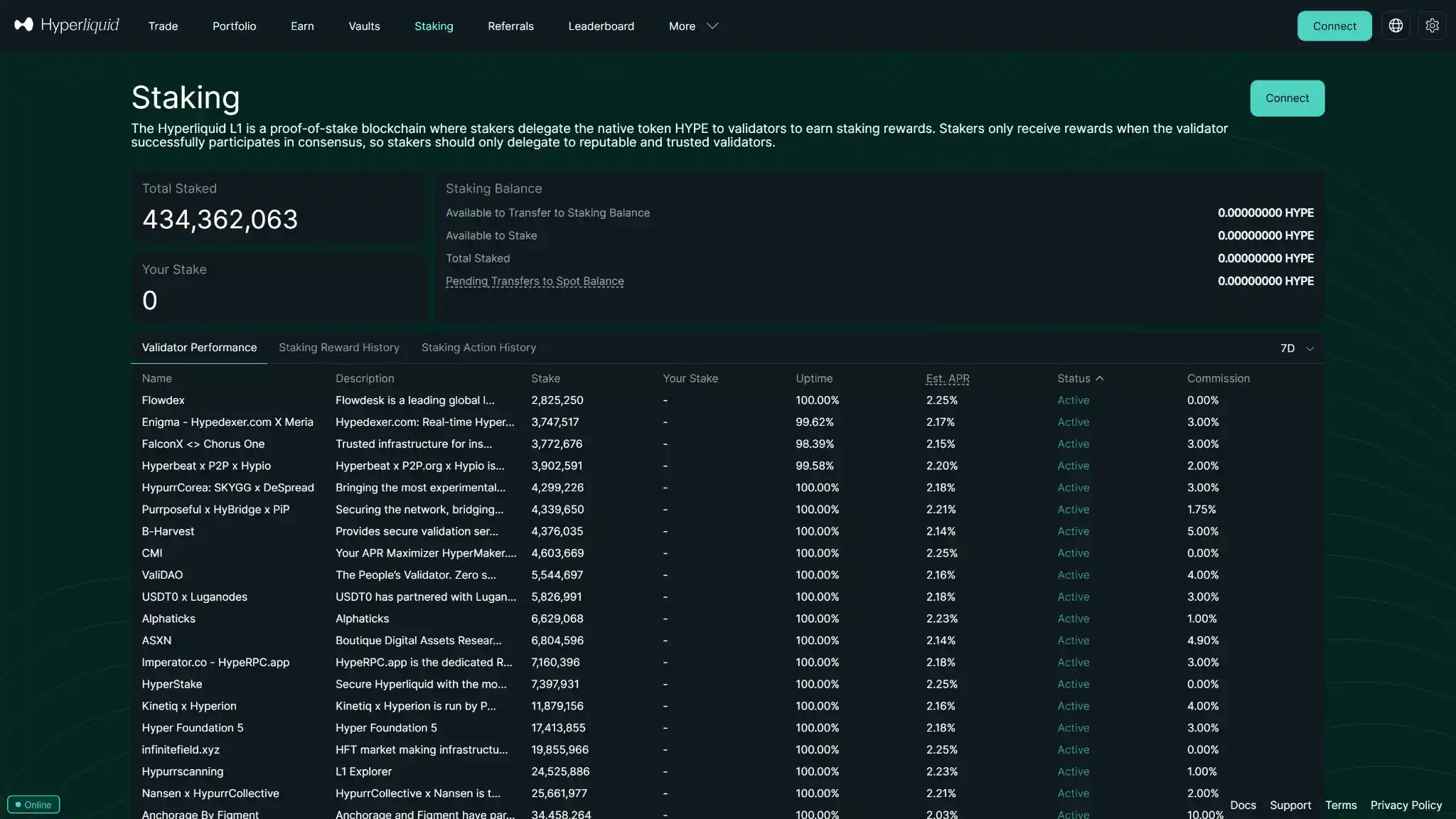
Hyperliquid desktop staking page showing total staked HYPE, staking balance, validator performance, estimated APR, and commission data.
UI and Navigation
Hyperliquid’s information architecture is expansive. The main navigation goes beyond Trade and Portfolio to include Earn, Vaults, Staking, Referrals, Leaderboard, and a wider tools layer under More. That reflects what Hyperliquid is trying to be: not just a perp terminal, but a fuller trading environment with room for vault users, API operators, and more active traders.
On desktop, the core flow is efficient once the account is funded. You can switch between spot and perp markets, choose from simple and advanced order types, and manage balances, positions, open orders, TWAP, trade history, and funding history from the same screen. Order book data, charts, and execution controls sit together in a way that makes sense for traders who monitor markets closely.
The upside of that density is speed. The downside is onboarding friction. Hyperliquid assumes users already understand terms like perps, unified balances, builder-deployed markets, staking balances, and vaults. Funding and account-management tools are easy enough to find, but they are not explained with beginners in mind. Even the difference between Send and Withdraw requires more attention than it should.
Advanced tools are easy to find once you know what you are looking for. The captured interface shows dedicated areas for API wallets, sub-accounts, multi-sig, funding comparison, builder approvals, announcements, and explorer activity. That is a clear plus for power users and a reminder that the product is designed around depth, not simplicity.
There are also useful localization signals. The interface supports multiple number formats and languages including English, Français, 简体中文, 한국어, and Español. Accessibility is still limited. Dense panels, smaller text, and chart-heavy screens will be harder for casual users than a simpler exchange layout.
Mobile App
Hyperliquid does not have an official iOS or Android app in the app stores. Any app claiming to be the official Hyperliquid app is a scam. Hyperliquid should be treated as a web platform first, whether on desktop or mobile browser.
That has trade-offs. Mobile users can still reach the core product without waiting for a stripped-down app, but there is no official app-store release cadence, no native-app roadmap, and no Hyperliquid-controlled biometric or PIN layer comparable to what a dedicated mobile app would offer.
Any biometric convenience mostly comes from the wallet or the device, not from Hyperliquid itself. If you connect through a wallet that supports Face ID, fingerprint unlock, or PIN protection, you can still use those controls. They just are not part of a native Hyperliquid app experience.
The lack of a native app also limits notification quality. Hyperliquid can surface updates through the interface, status page, and announcement channels, but it does not appear to offer the kind of polished push-notification system mainstream trading apps use for fills, alerts, and incidents.
Reliability and Status Page
Hyperliquid runs a public status page covering the Frontend, Hyperliquid L1, and API, with timestamps shown in UTC. Around the capture date, the page showed all systems operational with 100% uptime over the prior 90 days for the listed components.
That is useful, but it is still only one layer of operational transparency. The status page is best for confirming whether the interface, chain, or API are working as expected. It is not the place users will get a full explanation of market-policy decisions or broader trust issues.
The recent history shown on the page leans more toward operational notices and scheduled maintenance than toward a long list of user-facing incidents. One example around the capture period was a planned network upgrade expected to cause about 10 minutes of downtime before service returned to normal.
The practical benefit is simple: users have a live place to check system health before assuming a trade, deposit, or API issue is specific to their own account.
Customer Support
Customer support is functional, but it is not a premium service model. Hyperliquid tells users to start with the docs, then open a ticket through the official Discord server or the official Zendesk email form. The docs say responses can take up to 48 hours, with longer waits on weekends.
Hyperliquid does not appear to offer a public phone line, a live chat desk, or clearly published regional support coverage. Language coverage is also not clearly laid out in the public support materials. For most users, the real support stack is the docs, FAQs, status page, and formal ticket routes.
Recovery depends heavily on how the account is set up. For email-login accounts, the email-code flow is the first recovery path. For wallet-based users, there is far less centralized recovery because the platform is non-custodial. If a private key or seed phrase is compromised, support cannot simply reverse transactions the way a centralized exchange sometimes can.
Hyperliquid does not publish a formal complaints process. That fits the platform’s profile, but it is still a meaningful trade-off.
For help, stick to the official support guide, the official Discord ticket flow, the official Zendesk form, the official status page, and the official Hyperliquid domains. Ignore direct messages, avoid app-store lookalikes, and verify the full URL before connecting a wallet or signing anything.
Features That Matter on Hyperliquid
Hyperliquid is not trying to be a general-purpose retail app with every add-on under the sun. It is a trading stack built around perpetuals, spot, staking, vaults, and automation. The features that matter most are the ones that improve execution, capital efficiency, and system access for active traders.
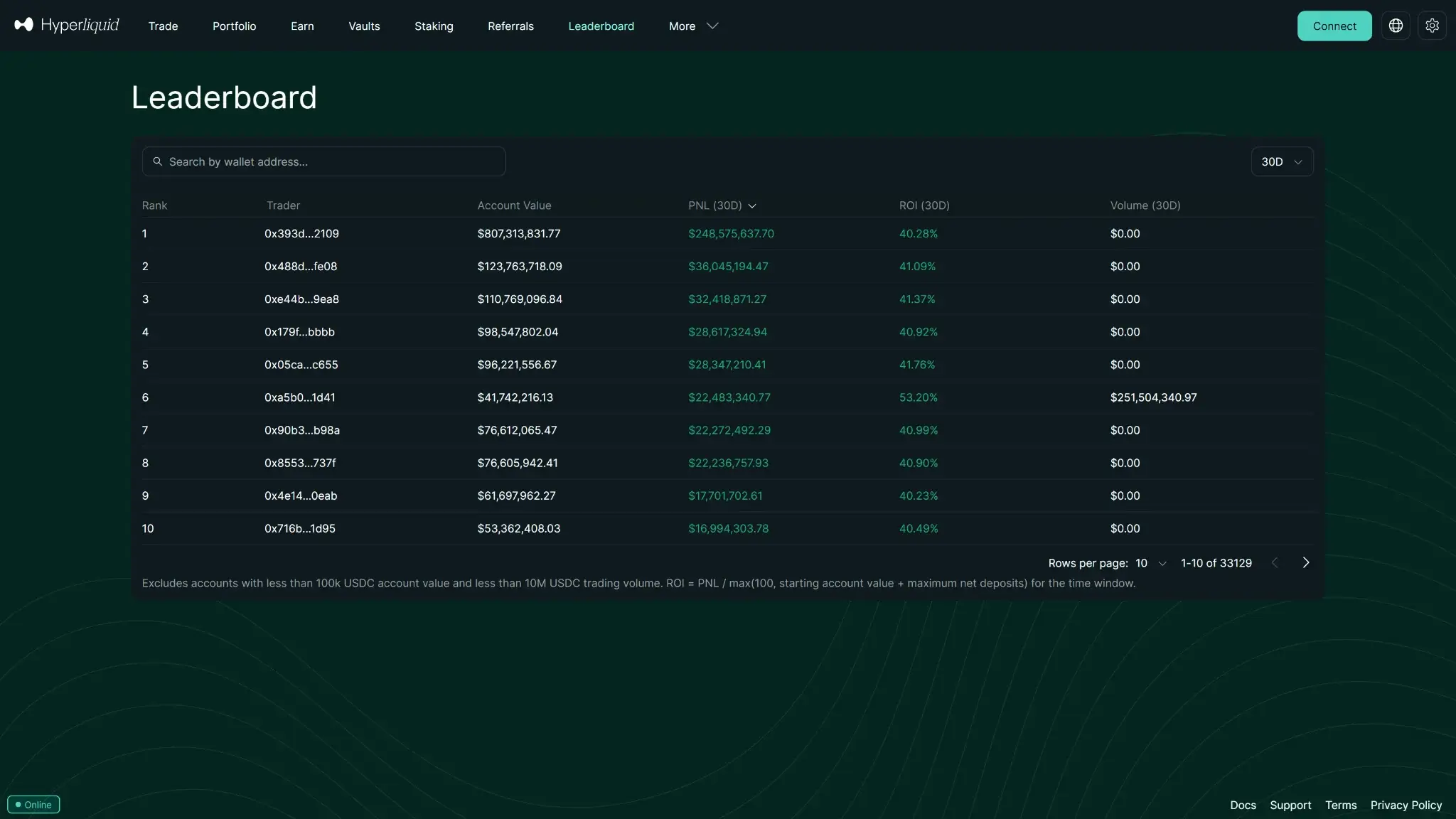
Hyperliquid desktop leaderboard page showing ranked trader accounts, 30 day PNL, ROI, account value, and trading volume.
Derivatives and Leverage Controls
Derivatives sit at the center of the Hyperliquid experience. The live product set includes validator-operated perpetuals and builder-deployed perpetuals under HIP-3. In other words, Hyperliquid is not only running its own perp venue; it is also opening part of that market layer to builders.
For the core markets, Hyperliquid supports trading in 100+ perpetual assets. Max leverage varies by asset, ranging from 3x to 40x, and margin requirements tighten as position size grows on larger names through margin tiers. BTC, for example, can reach 40x at lower notional sizes, while ETH can reach 25x and many alt markets cap lower.
Collateral and settlement are more nuanced than they first look. Hyperliquid’s standard perp model uses USDC-margined linear contracts, with oracle pricing often denominated in USDT even though collateral stays in USDC. A smaller set of USDC-denominated perpetuals exists where Hyperliquid spot is the primary liquidity source. Cross margin is the default, isolated margin is supported, and some assets or specialized market types are isolated-only.
The risk controls are worth understanding before trading. Maintenance margin is half of the initial margin at max leverage, liquidation thresholds vary by asset, and margin cannot be pulled freely from every position type. Large liquidations are first handled through the order book, and if that is not enough, backstop liquidation can route through the liquidator vault within HLP. Hyperliquid also supports the order controls active traders expect, including reduce-only orders, stop and take variants, scale orders, and TWAP execution.
U.S. access remains the biggest practical limitation. Even if derivatives are one of Hyperliquid’s strongest areas, the official frontend does not look like a normal option for U.S. retail readers. Retail KYC is also explained less clearly than it is on centralized exchanges, so Hyperliquid is better understood as an eligible-region derivatives venue than as a broadly available regulated retail platform.
Staking and Rewards
HYPE staking is one of the most important secondary features because it affects both network participation and trading costs. Staking happens inside HyperCore rather than through a consumer-style earn wrapper, and users delegate HYPE to validators. Validators produce blocks and receive rewards proportional to delegated stake, while delegators receive rewards net of any validator commission.
The reward structure is straightforward but not especially flexible. Rewards accrue every minute, distribute daily, and are automatically redelegated, so staking compounds by default. Delegations to a validator have a one-day lockup. After undelegating, balances return to the staking account, but moving HYPE from staking back to spot takes seven days through the unstaking queue.
This also ties directly into trading economics. Staked HYPE can lower trading fees by 5% to 40% depending on the staking tier, and one address’s staked HYPE can be linked to another address’s trading fees. That makes staking genuinely useful for active traders, but it is not a cash-like rewards balance you can move instantly.
Wallet and Self-Custody Options
Hyperliquid works best as a self-custody trading venue rather than as a traditional hosted exchange account. The cleanest setup is to connect a compatible wallet, enable trading with a gas-less signature, and fund the account with supported onchain assets. That gives users the clearest relationship to the platform’s non-custodial design.
The account model is more flexible than it first appears. Hyperliquid supports direct wallet connections, email-based onboarding that creates a blockchain address, sub-accounts, API wallets, and built-in multi-sig. Native multi-sig is especially notable because it adds shared signing controls without forcing users into a separate smart-contract wallet.
Supported funding routes span multiple chains and asset pairs, including Arbitrum USDC, BTC on Bitcoin, ETH or ENA on Ethereum, selected Solana assets, MON on Monad, and XPL on Plasma. The catch is precision. Hyperliquid is strict about the exact asset-network pair for each route, so the setup suits users who already understand bridges, wallets, and chain-specific deposits. It is much less forgiving than a beginner exchange account with broad fiat rails and simpler recovery flows.
Trading itself does not cost gas in the usual sense, but moving assets in and out still depends on the supported bridge or chain route. The clearest published cash-out path is native USDC to Arbitrum for a $1 fee. That setup makes sense for users who already live onchain, and much less sense for beginners who want everything abstracted away.
API and Programmatic Trading
Hyperliquid’s API stack is one of its strongest differentiators. The docs cover exchange and info endpoints plus WebSocket streams for real-time data, and both mainnet and testnet endpoints are publicly documented. That alone makes Hyperliquid more attractive to systematic traders than many exchanges that treat the API as an extra rather than a core product.
The design also looks serious enough for active automation. Agent wallets, also called API wallets, can sign on behalf of a master account or its sub-accounts. Hyperliquid documents nonce handling, batching suggestions, reconnect logic, asset IDs, and endpoint-specific mechanics in a level of detail clearly aimed at developers and automated trading teams. Testnet WebSocket endpoints are available, and the docs also cover HyperEVM RPC details separately.
There is no clear FIX-style institutional API in the public API docs, so the best description is that Hyperliquid offers a strong crypto trading API stack rather than a traditional institutional connectivity menu. For most advanced users, though, the mix of WebSocket feeds, documented exchange endpoints, API wallet scopes, sub-account support, and testnet access is enough to make the API a core reason to use the platform.
Other Notable Features
Vaults are the most important extra feature after perps, staking, and APIs. Hyperliquid supports both protocol vaults and user-created vaults. HLP, the Hyperliquidity Provider vault, is the flagship protocol vault. It provides liquidity, performs liquidations, supplies USDC in Earn, and accrues part of trading fees.
User vaults matter for a different reason. They let traders run strategies on behalf of depositors, and depositors share in profits or losses. Vault leaders receive a 10% profit share, while depositors can review metrics such as TVL, PnL, drawdown, and trade history. That gives Hyperliquid a managed-strategy layer, but one that is more transparent and more risk-forward than a simplified social-trading product.
HyperEVM is also worth mentioning, even if it is not yet the main reason most people use Hyperliquid. It extends the platform into a broader smart-contract environment where HYPE is the gas token and builders interact through JSON-RPC. The limitation is that there are currently no official frontend components for the EVM, so this still feels more like builder infrastructure than a polished consumer feature.
Two omissions are also worth noting. There is no exchange card here, so Hyperliquid is not competing through spending rewards or debit-style convenience. And while the points program mattered historically, it ended in 2024, so it should not be treated as a current reason to choose the platform.
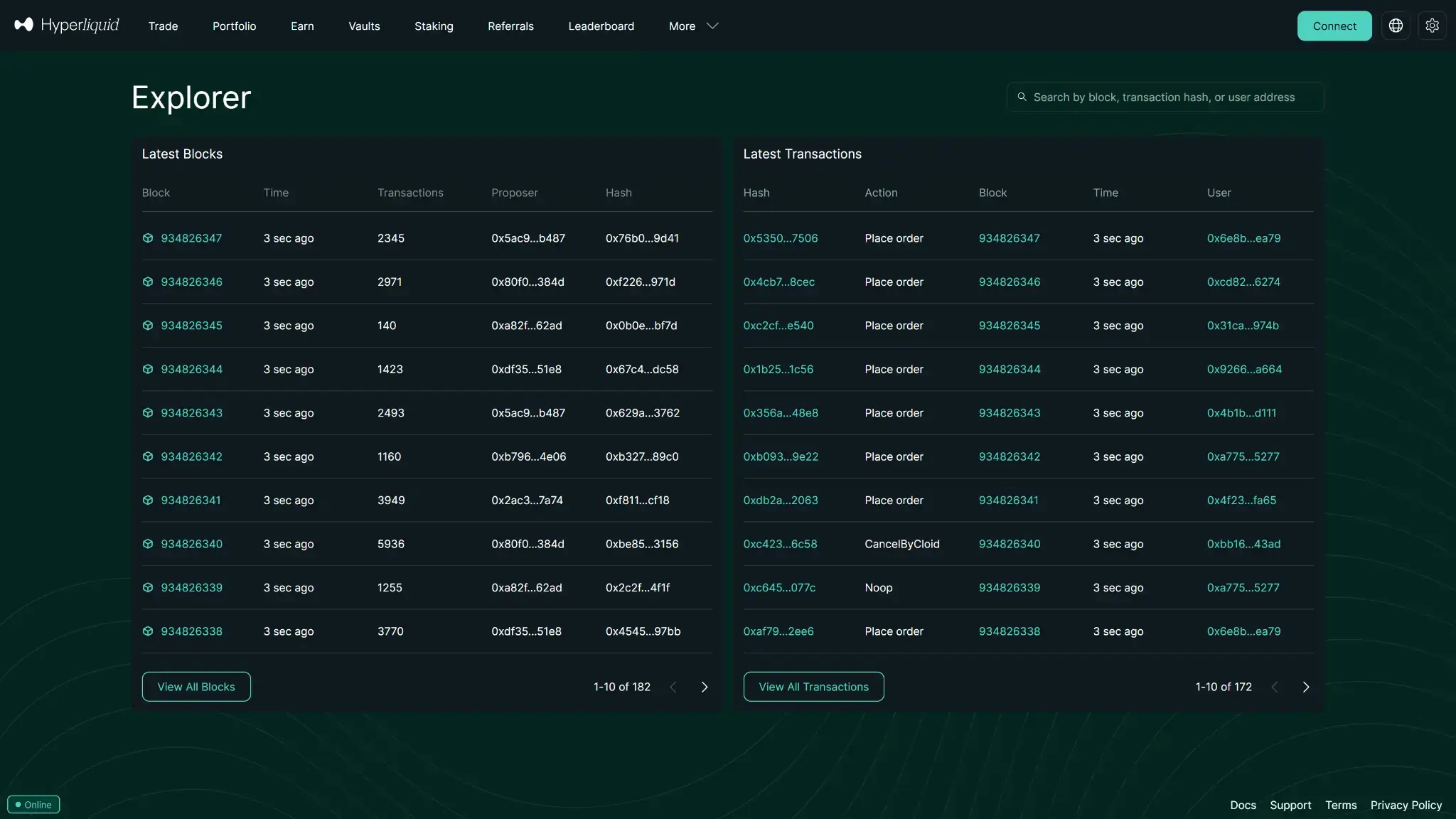
Hyperliquid desktop explorer page showing latest blocks, latest transactions, search bar, and block and user activity data.
Final Verdict
Hyperliquid is one of the more compelling choices for advanced crypto traders who want low fees, strong perpetuals, API access, and a broader onchain product stack built around execution rather than retail convenience. It suits users who are comfortable funding with crypto, managing wallet-based workflows, and accepting more responsibility for their own operational security. The main trade-offs are clear. Hyperliquid is a weak fit for U.S. retail users, beginners, and anyone who expects fiat rails, formal customer support, or a more traditional exchange structure. If your priority is crypto-native trading depth, it is easy to take seriously. If your priority is regulated retail convenience, it is much harder to recommend.
Disclaimer: CryptoSlate may receive a commission when you click links on our site and make a purchase or complete an action with a third party. This does not influence our editorial independence, reviews, or ratings, and we always aim to provide accurate, transparent information to our readers.
FAQ
Is Hyperliquid safe?
Hyperliquid is safer when judged as a transparent, self-custody trading venue than when judged against a large regulated retail exchange. It publishes audits, a bug bounty, and a live status page, but it does not present classic proof of reserves or broad insurance. That means users get more system visibility, but also fewer traditional consumer protections.
What are Hyperliquid fees?
Hyperliquid uses separate spot and perpetual fee schedules, and both get cheaper as your 14-day weighted volume rises. Staking HYPE and using a referral code can lower costs further, while the clearest published withdrawal charge is $1 for native USDC to Arbitrum. For active traders, the fee structure is one of the platform’s clearest strengths.
Does Hyperliquid require KYC?
Hyperliquid doesn’t have any KYC requirements in place for retail to trade perps. Although some public programs might require KYC or KYB, which suggests verification can still matter in parts of the broader ecosystem.
Which coins does Hyperliquid support?
Hyperliquid says it supports 100+ tradable assets on perpetuals, plus a growing spot layer. The exact spot count is less clearly packaged into a single headline number, so the practical strength is breadth in crypto-native markets rather than fiat-pair variety. For most users, the main appeal is the range of perp markets rather than local-currency trading.
How long do Hyperliquid withdrawals take?
Hyperliquid’s clearest published cash-out route is native USDC to Arbitrum, which the docs say usually lands in about three to four minutes. Other asset and network routes are less clearly summarized in one consumer-facing schedule, so timing can vary by chain and route. In practice, Arbitrum USDC is the easiest route to understand and plan around.
Is Hyperliquid available in the U.S.?
No. Based on the official interface and public docs, Hyperliquid is not a practical choice for U.S. retail users. Even though the protocol is often discussed in crypto-native terms, the user-facing app is restricted, which matters more for most readers than the protocol design alone. U.S. users should treat it as an unavailable retail option.
Does Hyperliquid offer staking or rewards?
Yes. Hyperliquid offers HYPE staking, and rewards accrue automatically while staked balances can also reduce trading fees by 5% to 40% depending on tier. The trade-off is that unstaking back to spot takes seven days, so it is not as liquid as a simple cash reward. It works better as a trading-cost tool than a flexible balance.
How can I lower fees on Hyperliquid?
The main ways to lower fees on Hyperliquid are trading more volume over the rolling 14-day window, staking HYPE, and using a referral code for a discount on your first $25 million in volume. Maker-heavy traders can also qualify for negative maker fees at higher activity levels. The biggest savings usually go to active users rather than casual traders.
Hyperliquid Labs
Disclaimer: CryptoSlate may receive a commission when you click links on our site and make a purchase or complete an action with a third party. This does not influence our editorial independence, reviews, or ratings, and we always aim to provide accurate, transparent information to our readers.