
Why has Bitcoin reached its ATH against major currencies but not USD?
Exploring Bitcoin's performance against major fiat currencies and the reasons behind its failure to exceed the previous all-time high in US dollars.


Introduction
This week, Bitcoin wiped out almost all of its losses since its November 2021 high, passing $62,000 and even topping $64,000 during US trading hours on certain exchanges. However, its ongoing struggle to surpass its all-time high of $68,000 overshadows this massive price increase. However, when measured against other fiat currencies, Bitcoin’s valuation has soared to new heights, surpassing almost all previous records.
This discrepancy in performance across different currency markets warrants a deeper analysis. Understanding these discrepancies can reveal the interplay between Bitcoin and the global economy, shedding light on the economic conditions influencing Bitcoin’s price.
In this report, CryptoSlate will dive deep into Bitcoin’s performance against major fiat currencies and the reasons behind its failure to exceed the previous all-time high in US dollars.
Bitcoin's price movements against major fiat currencies
BTC/EUR (Euro)
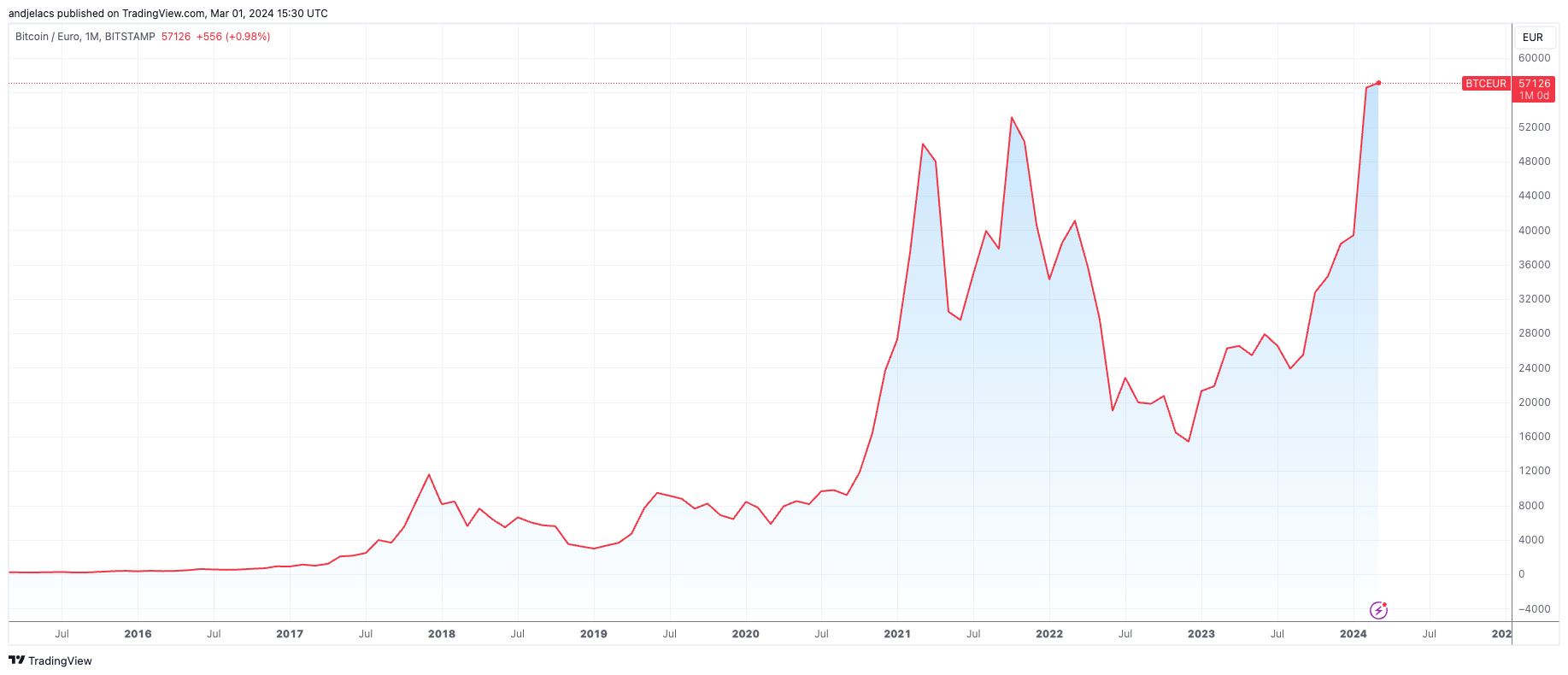
Bitcoin’s performance against the euro clearly indicates its growing prominence within the Eurozone’s financial ecosystem. Surpassing its previous all-time high (ATH), Bitcoin has been trading above 57,700 EUR since March 1, a significant leap from its November 2021 ATH of 53,200 EUR. This upward trajectory can be attributed to several economic factors within the Eurozone. Heightened inflation rates and monetary policy changes aimed at stimulating economic activity have propelled investors towards Bitcoin as a hedge against currency devaluation and inflationary pressures. This shift in investment strategy shows investors perceive Bitcoin as a digital safe haven in uncertain economic conditions.
BTC/JPY (Japanese Yen)
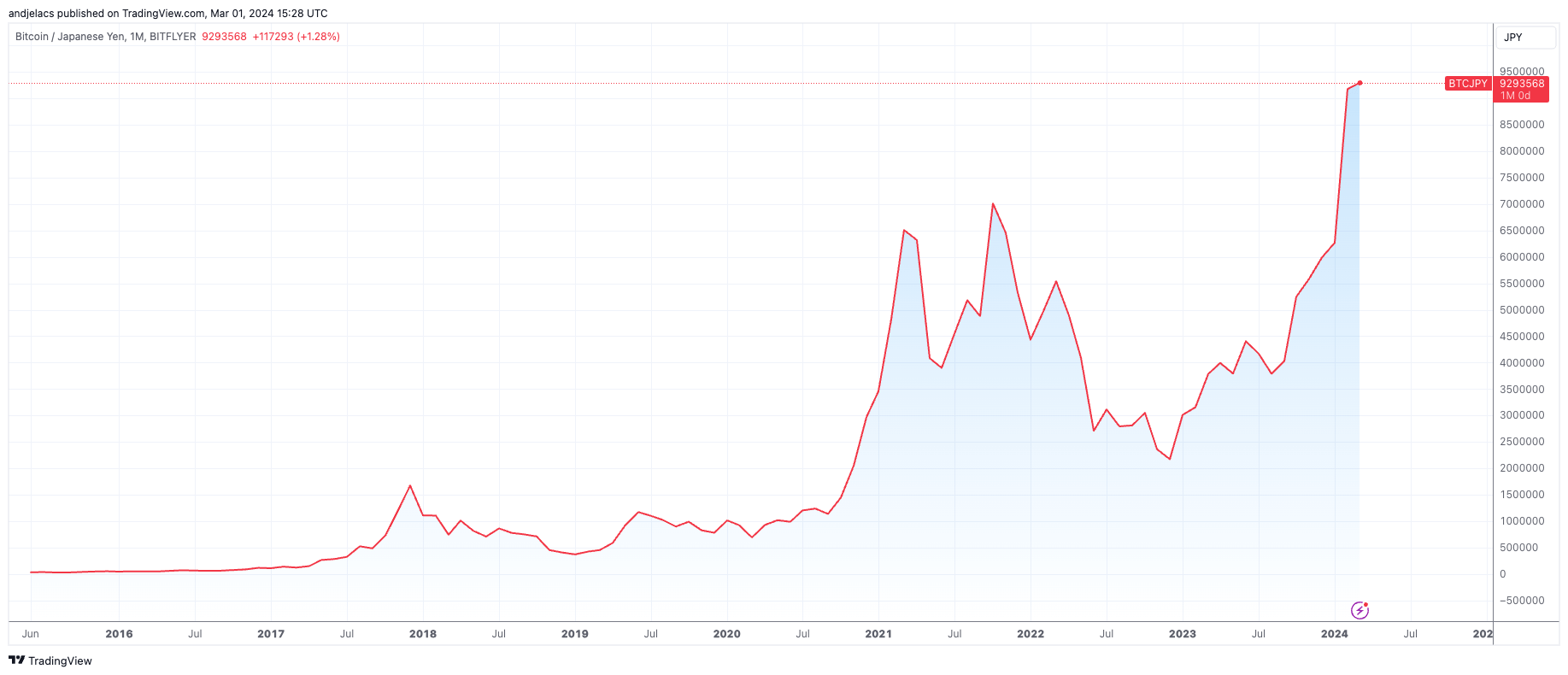
Against the Japanese yen, Bitcoin has also marked a new ATH, trading just below 9.4 million yen per BTC as of March 1. It represents a substantial increase from its early November 2021 peak of 7 million yen. Japan’s regulatory stance towards cryptocurrencies, characterized by a balanced approach that promotes innovation while ensuring investor protection, has played a pivotal role in this achievement. Such regulatory clarity has bolstered Bitcoin trading volumes and price action within Japan, demonstrating the impact of a conducive legal framework on crypto markets.
BTC/GBP (British Pound)
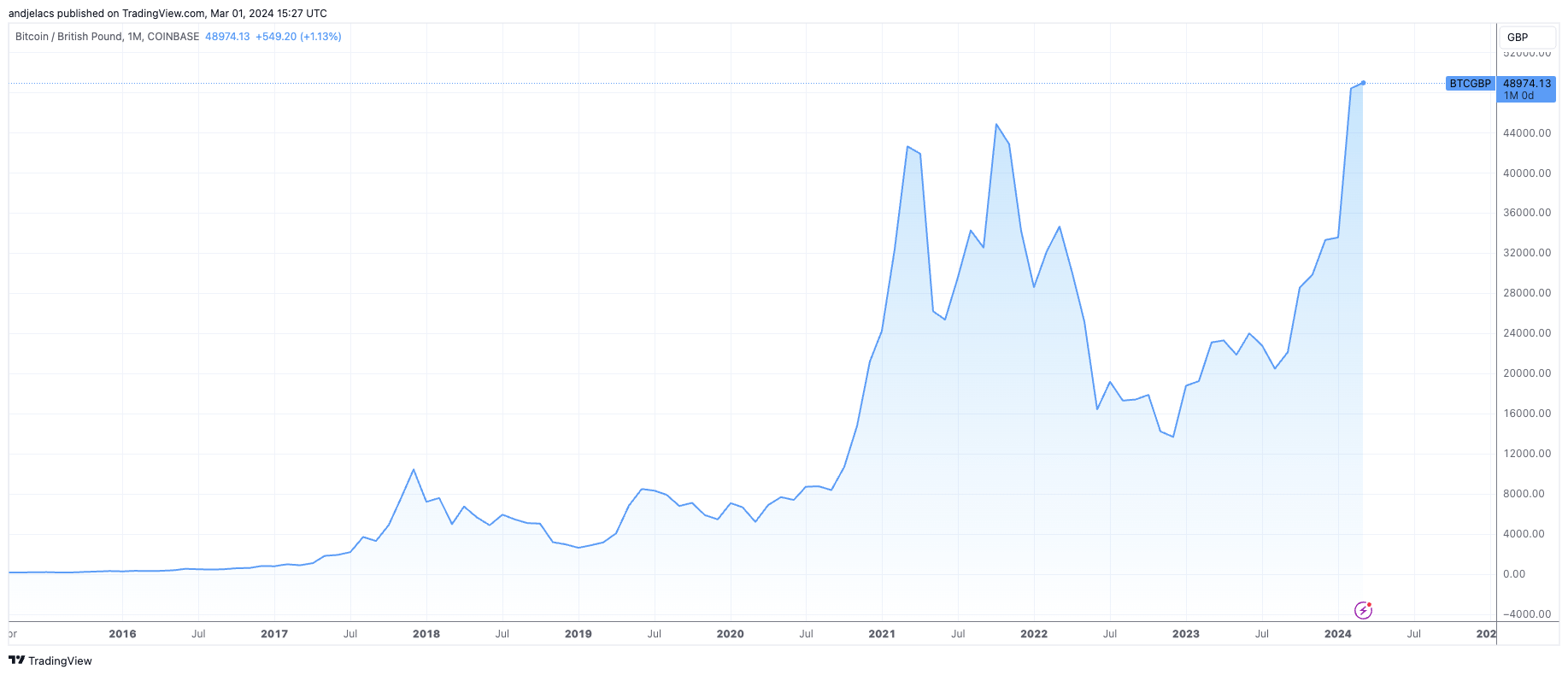
In the United Kingdom, BTC/GBP has reached an all-time high of 49,380 pounds, significantly surpassing its November 2021 ATH of 45,000 pounds. This remarkable performance can be partly explained by the aftermath of Brexit and ongoing geopolitical events, which have injected a degree of uncertainty into the UK’s economic landscape. In response, investors have increasingly turned to Bitcoin, seeking it as a stable store of value in times of geopolitical strife and financial volatility.
BTC/KRW (South Korean Won)
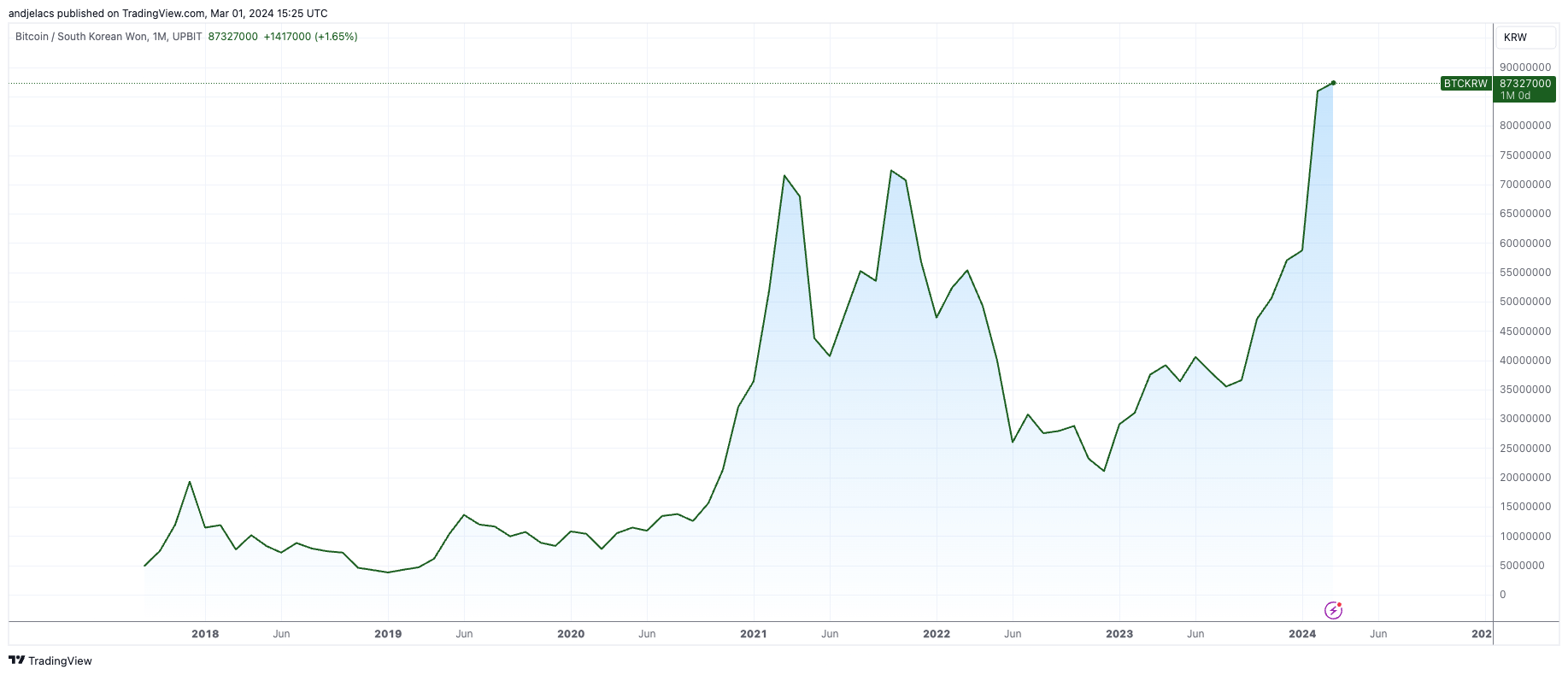
South Korea’s enthusiastic embrace of digital currencies is reflected in BTCKRW’s impressive climb to an ATH on March 1, passing 87.5 million won. It’s a stark contrast to its previous ATH in November 2021, which stood at 7.27 million won. The country’s regulatory framework, which supports crypto trading and ownership while ensuring robust consumer protection, has significantly contributed to this uptrend. South Korea’s approach has facilitated a thriving crypto market and highlighted the influence of regulatory environments on crypto adoption and valuation.
BTC/RUB (Russian Ruble)
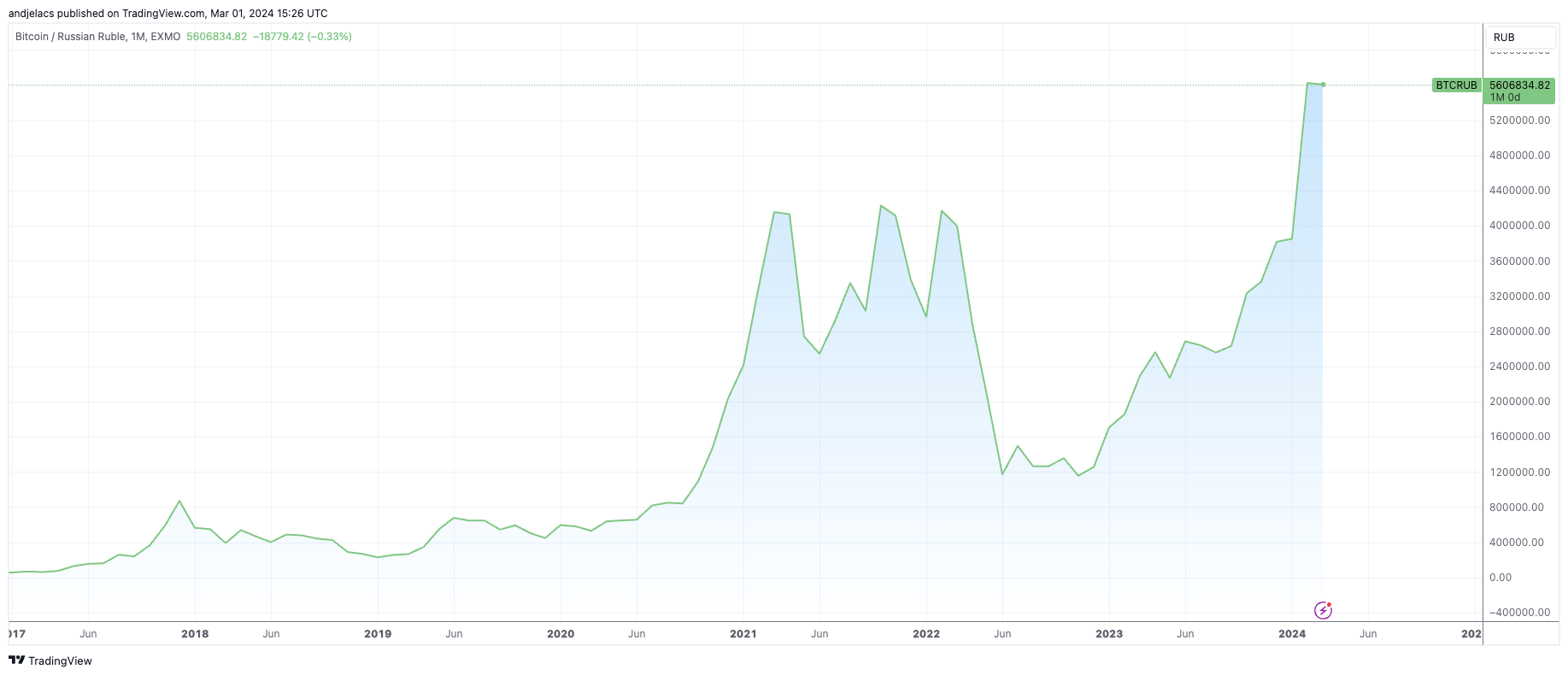
Bitcoin’s valuation in Russian rubles tells a story of rapid growth, reaching its ATH on February 28 at 5.63 million RUB, with a slight adjustment to 5.59 million RUB by March 1. This leap from its November 2021 ATH of 4.43 million RUB can be primarily attributed to the geopolitical tensions and economic sanctions facing Russia. These factors have accelerated Bitcoin’s adoption as both a means of circumventing financial restrictions and a reliable store of value amidst the ruble’s volatility. Bitcoin’s growing valuation in rubles shows how geopolitical and economic challenges can drive individuals and entities towards Bitcoin, reaffirming its status as a versatile and resilient asset in the global financial system.
Why Bitcoin failed to surpass its US dollar ATH
Bitcoin’s journey towards surpassing its all-time high (ATH) of $68,000 has been fraught with a complex interplay of market sentiment, regulatory developments, and technical disruptions.
Among the most significant developments has been the introduction of spot Bitcoin ETFs in the US on January 10, which marked a pivotal moment in the crypto market. These ETFs have attracted substantial institutional investment, recording unprecedented inflows and trading volumes. This influx of institutional capital has undeniably altered investment patterns within the crypto market, potentially increasing market liquidity and influencing Bitcoin’s price movements. The availability of Bitcoin through ETFs offers investors a regulated and accessible means of exposure to Bitcoin, which, in theory, could increase buying activity and support higher price levels.
However, despite the positive liquidity implications of ETFs, the crypto market has witnessed a notable decrease in over-the-counter (OTC) desk balances, signaling a supply crunch. This scarcity of available Bitcoin, particularly among large investors and institutional holders, has paradoxically both supported Bitcoin’s price by reducing sell-side pressure and contributed to its difficulty in breaching the $68,000 threshold. The heightened holding behavior among these investors, motivated by long-term value appreciation expectations, has effectively limited the market’s supply, creating a bottleneck at critical price points.
Adding to the complexity of Bitcoin’s price performance is the impact of technical issues at large exchanges, exemplified by the Coinbase outage during Bitcoin’s approach to $64,000. This incident, which prevented users from accessing their account balances, led to a tangible reduction in trading activity and a massive outflow from the exchange. Technical disruptions like these can create temporary price ceilings for Bitcoin by diminishing liquidity and trading volume, exacerbating the challenge of surpassing certain price milestones.
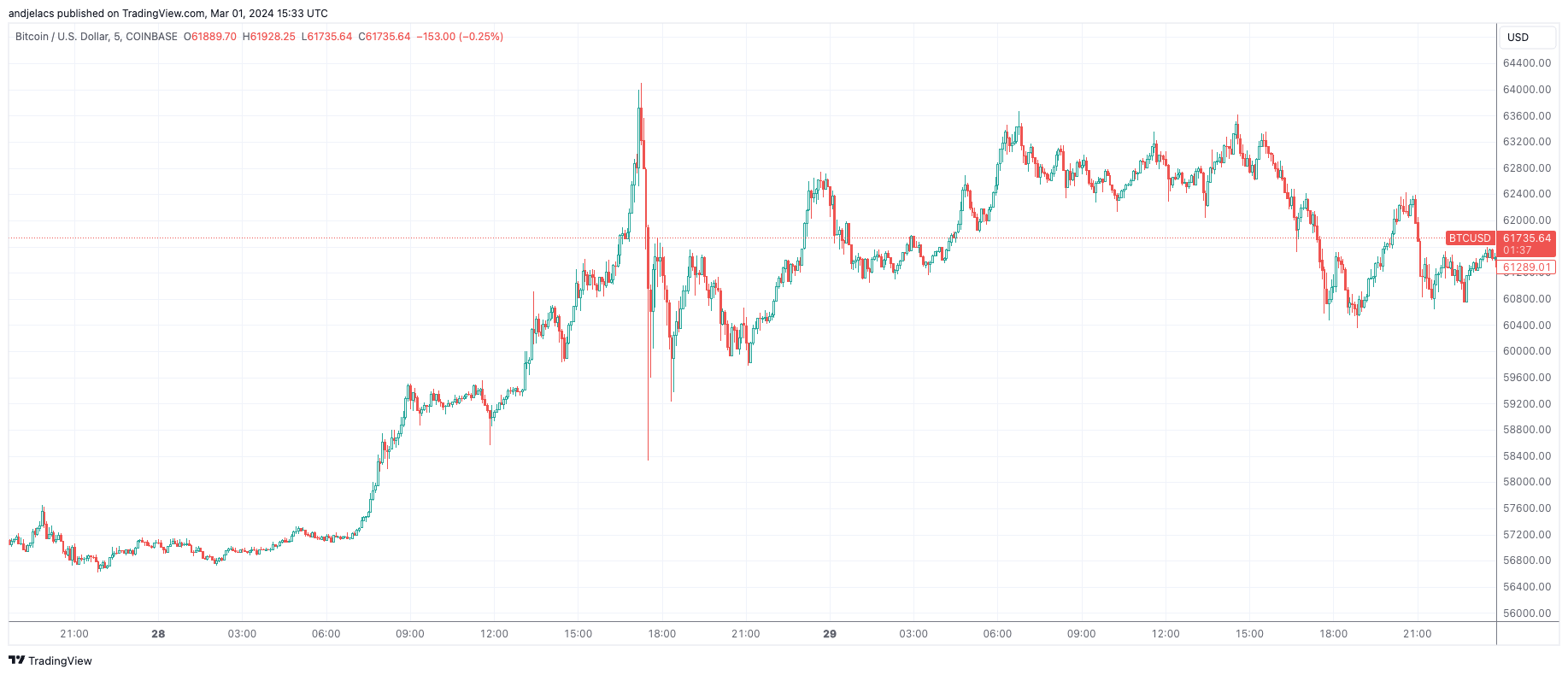
The spot Bitcoin ETFs and Coinbase outage are important because the role of the US market in Bitcoin’s price performance cannot be overstated. With a significant share of global trading volume and investor interest, market movements in the US have a pronounced effect on Bitcoin’s global valuation. The US market’s influence means that shifts in investor sentiment or regulatory changes within the country can affect Bitcoin’s price worldwide. However, the liquidity landscape in the US market, compared to more fluid markets in Asia, presents its own challenges. Liquidity variances between these regions can lead to price discrepancies and make it more challenging for Bitcoin to overcome psychological and technical resistance levels like the $68,000 mark.
Conclusion
While Bitcoin’s performance against the US dollar has seen it struggle to surpass its all-time high of $68,000, its valuation in terms of other major currencies, such as the EUR, JPY, GBP, KRW, and RUB, has reached unprecedented levels. This divergence highlights the nuanced impact of regional economic conditions, inflation rates, and geopolitical events on Bitcoin’s global market behavior.
The introduction of spot Bitcoin ETFs in the US has heralded a new era of institutional crypto investment, altering investment patterns and potentially enhancing market liquidity. However, this shift has been accompanied by a supply-side crunch, influenced by the holding behaviors of large investors and a decrease in over-the-counter (OTC) desk balances, adding complexity to Bitcoin’s price performance. Moreover, technical outages at major exchanges like Coinbase have temporarily constrained trading activity, further complicating Bitcoin’s attempt to break past significant price thresholds.
Looking ahead, predictions for Bitcoin’s price movements must consider the ongoing evolution of the global economic landscape, regulatory shifts, and technological advancements. Market volatility is likely to persist in the short term, influenced by investor sentiment, regulatory news, and macroeconomic indicators. Bitcoin’s price may continue to experience fluctuations as it continues its struggle to regain its all-time high.
More Market Reports


