Bitcoin is poised to surmount these challenges, yet the intricate and advanced nature of the existing crypto market could prolong its return to stability.
Bitcoin’s undervaluation has been a contended topic in the past several months, as bearish and bullish currents fight over the likelihood of a new rally.
Previous CryptoSlate analysis found that the likelihood of Bitcoin bottoming at $15,000 was pretty high, making its path toward $30,000 a clear accumulation zone. Historically, Bitcoin cycles tend to see a rally following heavy accumulation, prompting many to anticipate a bull run.
However, three years after posting its all-time high, Bitcoin is still up against significant obstacles. Aside from global geopolitical events, several internal industry trends and events could impede its further growth.
CryptoSlate’s latest market report dives deep into the four most bearish headwinds BTC could face in 2023 as it struggles to regain its ATH.
Binance
The collapse of FTX in November 2022 made Binance the largest and most popular cryptocurrency exchange in the market. However, the too-big-to-fail narrative that propelled FTX’s growth now looms over Binance as the market begins questioning the stability of industry giants.
Market analysts and traders alike are now increasingly worried about the consequences of having another large exchange fail. The tectonic shifts caused by Terra, Celsius, BlockFi, and Voyager culminated with FTX, dragging the entire crypto market cap to its three-year low.
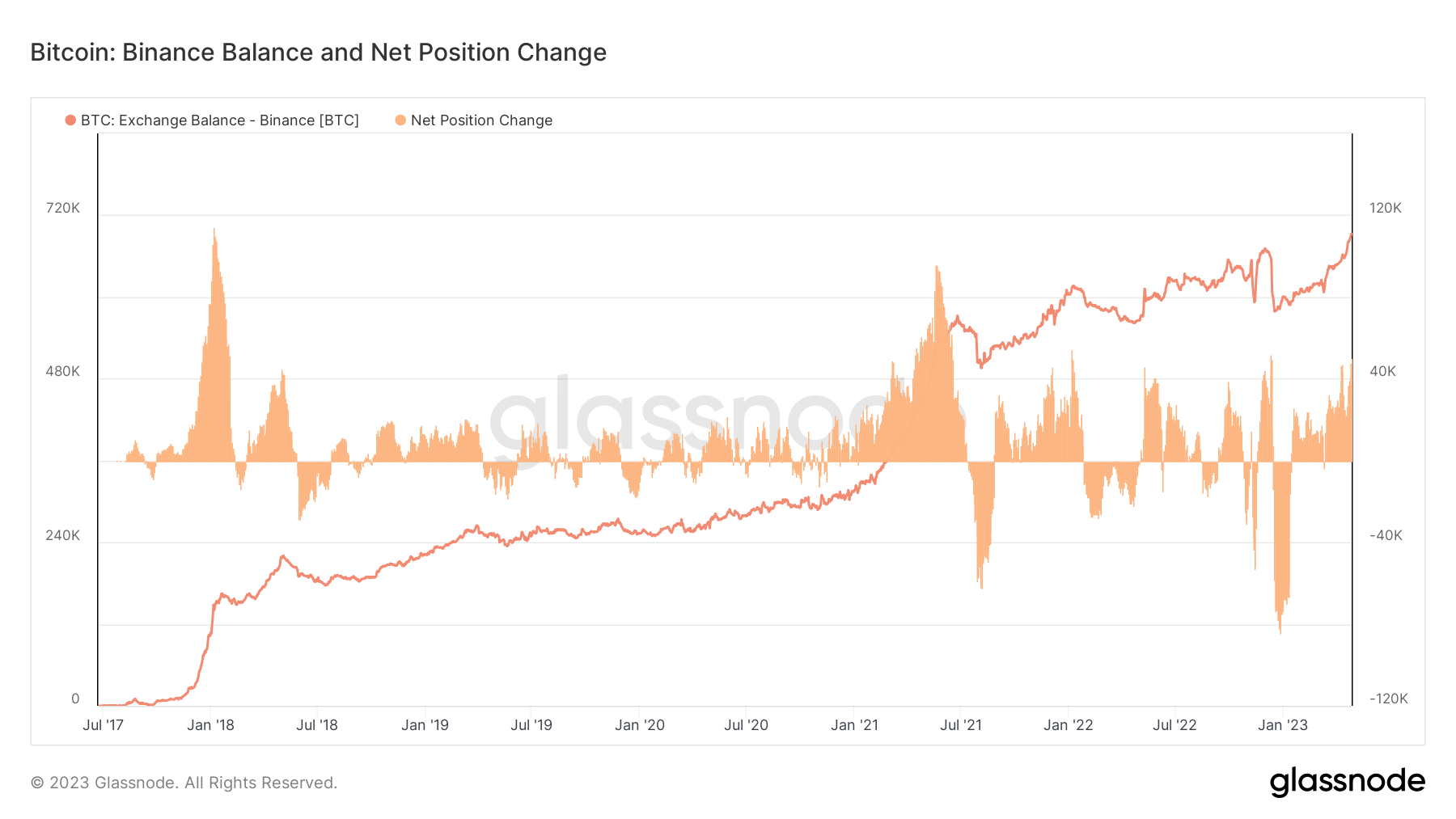
With over 629,000 BTC currently sitting on Binance, any issues the exchange faces could seriously affect the market’s liquidity.
The exchange’s issues with transparency and problems with maintaining the peg for BUSD have certainly shaken the market’s confidence. The regulatory issues Binance faced in the past few months also didn’t help.
In February, the Securities and Exchange Commission (SEC) issued a Wells notice to Paxos ordering it to stop minting BUSD. The SEC said the notice resulted from an investigation into the company’s relationship with Binance, which found “several unresolved issues” with Paxos’ relationship with the exchange.
In March, the Commodity Futures Trading Commission (CFTC) sued Binance and its CEO Changpeng Zhao for violating commodities regulations. The exchange was charged for allegedly facilitating trading and derivative orders for customers in the U.S.
Just days after the lawsuit, a bombshell Financial Times report alleged that Binance maintained “substantial ties” to China, despite the company’s claims it left the country in 2017.
All the regulatory hurdles Binance faced in the past six months negatively affected Bitcoin’s price. Trading volume on the exchange dropped every time while both BTC and stablecoin outflows increased significantly.
Graph showing the Bitcoin balance on Binance from July 2018 to April 2023 (Source: Glassnode)
If an exchange the size of Binance were to fail or experience a bank run, Bitcoin’s price would be quick to react. Just like FTX, Binance would bring the market to its knees. And while the likelihood of a total disaster remains low, additional regulatory pressure could impede Bitcoin’s growth.
The obstacles would most likely be short-lived, as the market would be equally as quick to correct any losses caused by Binance. Nonetheless, Binance’s struggles remain Bitcoin’s struggles.
USDT
Once considered the backbone of the crypto industry, stablecoins have seen their security questioned with the collapse of Terra’s controversial UST. The algorithmic stablecoin wiped out $60 billion in market capitalization in a matter of days, revealing the flimsy foundation it was built on.
And while “traditional” dollar-pegged stablecoins have a much stronger structure than UST, the increasingly frequent de-pegging they experienced made them a weak link in the crypto industry.
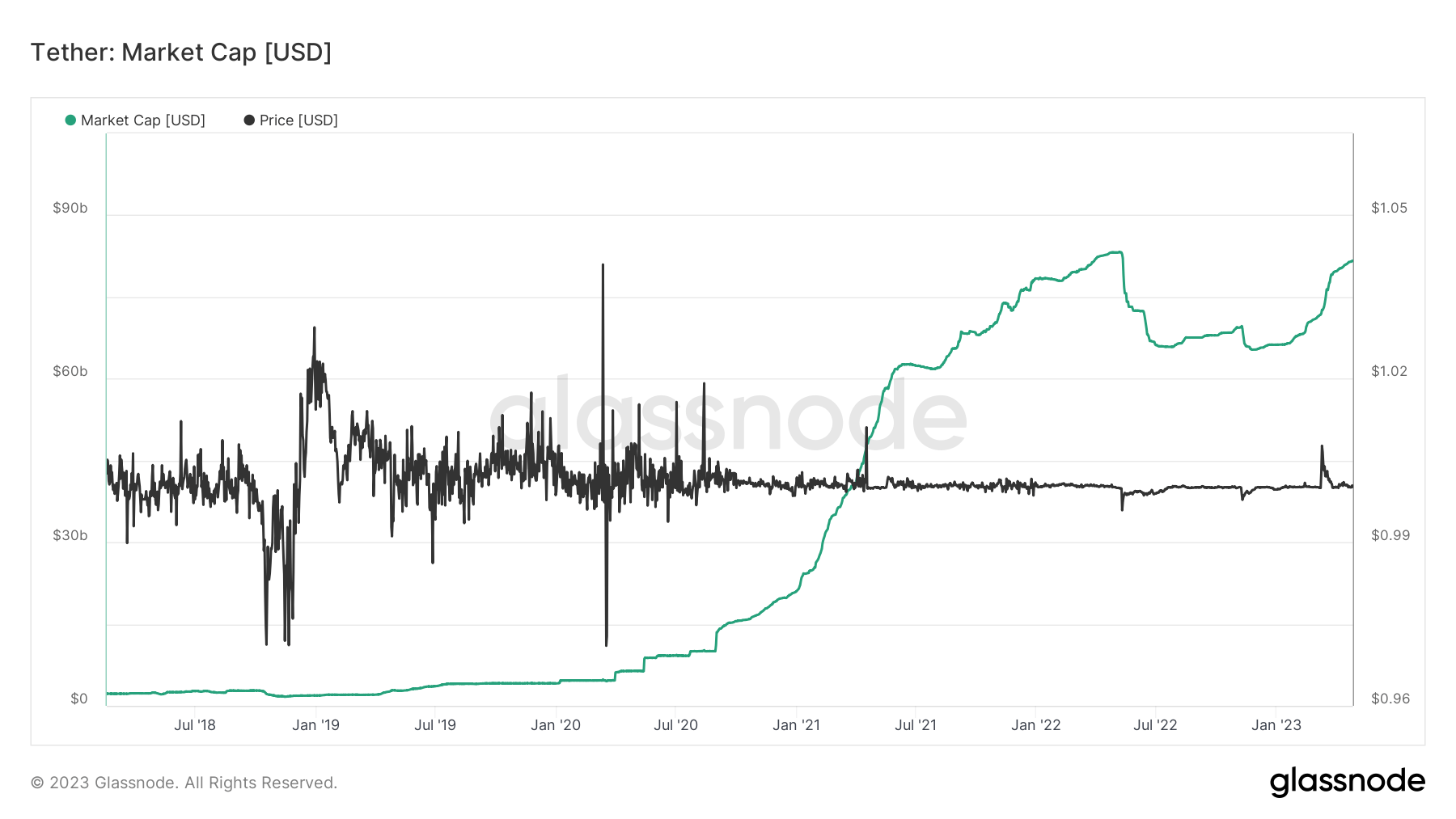
The largest stablecoin by market capitalization, Tether’s USDT represents the lifeblood of the market. Its $81.64 billion market capitalization is dwarfed only by its daily trading volume, which averaged around $30 billion at press time.
Graph showing the market capitalization and price of Tether’s USDT from 2018 to 2023 (Source: Glassnode)
The enormous amount of value settled through USDT makes it an essential market component. Any supply issues Tether experienced would significantly impact the industry as it would essentially drain liquidity from the market.
Tether’s lack of transparency has long worried investors. The company’s refusal to allow third-party audits of its holdings made many question its claims that USDT is fully backed. Tether is also currently involved in a lengthy lawsuit with the U.S. Department of Justice, which claims Tether’s backers and partners used fake documents and shell companies to open bank accounts.
Significant developments in ongoing lawsuits and legal actions against Tether will undoubtedly put its peg to the test. Bitcoin is quick to react to news regarding USDT, as BTC/USDT remains one of the most liquid trading pairs on the market.
And while a bank run on Tether remains unlikely, a drop in its market cap would put a quick stop to any bullish momentum Bitcoin gains.
Depending on the size and scope of the crisis USDT sees, it might take a while before the market absorbs the shocks and corrects.
Regulation (or lack thereof)
While cryptocurrencies were created as an antidote to the heavy regulation of traditional finance, the crypto market thrives in well-regulated environments. Industry leaders have long been lobbying for clear but fair laws, asking governments to recognize the potential of cryptocurrencies and make them more accessible to the public.
However, the current global regulatory landscape is far from fair and even farther from clear.
In the U.S., which makes up the most significant part of the global crypto market, cryptocurrencies are being increasingly targeted by regulators. Some politicians running for office have even based much of their platform on bringing the crypto industry down.
A lack of precise regulation in the U.S. creates an unstable business environment for companies, creating a volatile market that hurts investors. Regulatory actions taken by the SEC and the CFTC are often criticized for their ineffectiveness in protecting the market. Brad Garlinghouse, the CEO of Ripple, said U.S. regulators were stifling innovations in the space, echoing previous calls from other industry executives like Brian Armstrong and Jeremy Allaire.
This regulation-by-enforcement approach, missing from other large markets like Japan, Singapore, Australia, the U.K., and Switzerland, has become the norm in the U.S. House Republicans accused Gary Gensler, the Chairman of the SEC, of being overly aggressive in his enforcement actions while failing to address the SEC’s jurisdiction over digital assets clearly.
With the U.S. home to many institutional investors, increased regulatory uncertainty could drastically reduce their confidence in Bitcoin.
Further enforcement action against companies such as Tether, Ripple, or Coinbase would only add fuel to the fire, impeding Bitcoin’s growth. The chance of regulation causing a prolonged bear market is relatively low. Still, government-wide efforts to de-bank the industry and reduce crypto mining would undoubtedly put additional pressure on Bitcoin’s price.
Forced sellers
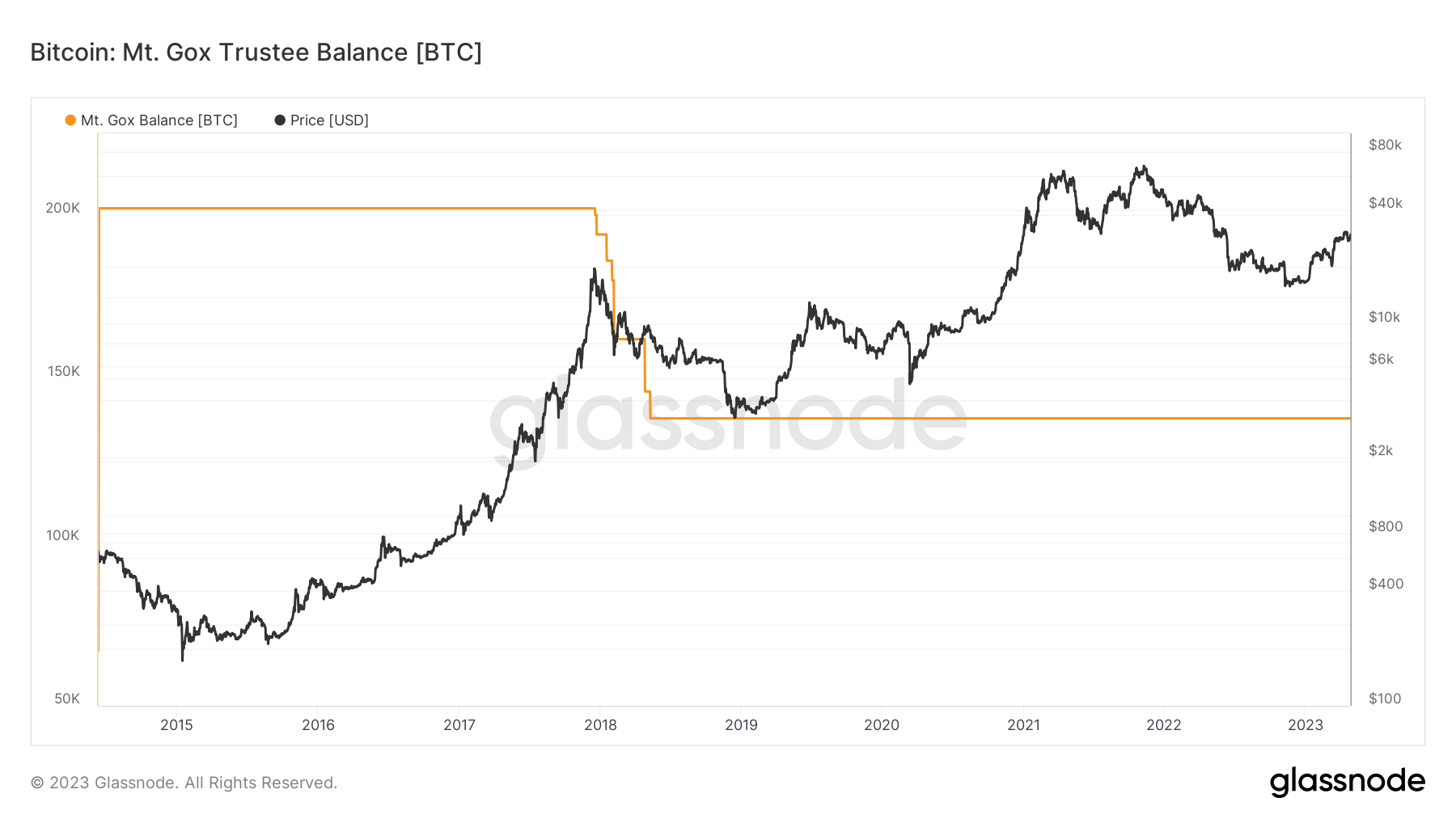
The increasing number of dormant coins has been worrying analysts for a while. While some of those coins belong to inactive whale addresses and aren’t likely to move anytime soon, some are part of the Mt. Gox litigation and could have a considerable impact on the market.
The now-defunct cryptocurrency exchange was hacked in 2014, leading to the loss of around 850,000 BTC. Mt. Gox filed for bankruptcy protection from creditors in April 2014, leaving its customers embroiled in a lengthy litigation battle to recover their funds. Following the hack, the exchange was left with roughly 142,000 BTC, 143,000 BCH, and 69 billion Japanese yen.
Graph showing the amount of BTC held in addresses controlled by Nobuaki Kobayashi, the trustee overseeing the Mt. Gox civil rehabilitation proceedings (Source: Glassnode)
Most of the recovered Bitcoins will be returned to the customers who own them. However, Mt. Gox trustees are yet to establish the exact date of the payout for most creditors, creating quite a bit of uncertainty in the market.
Only two of Mt. Gox’s largest creditors have so far chosen an early lump sum payment option. The payment is scheduled for September 2023 and will see the creditors receive 90% of their recoverable funds in BTC.
Other creditors will have to wait for the civil rehabilitation litigation to end. The litigation process has been going on for nine years and could take another 5 to 9 more, given CoinLab’s lawsuit against Mt. Gox.
Some investors and legal experts believe creditors could see their funds returned sometime in 2023. Combined with the lump sum release of Bitcoinica and MGIF’s funds, the market could be flooded with Bitcoins.
The FOMO from a future Bitcoin rally most likely won’t be able to absorb the selling pressure, which could result in a notable drop in its price.
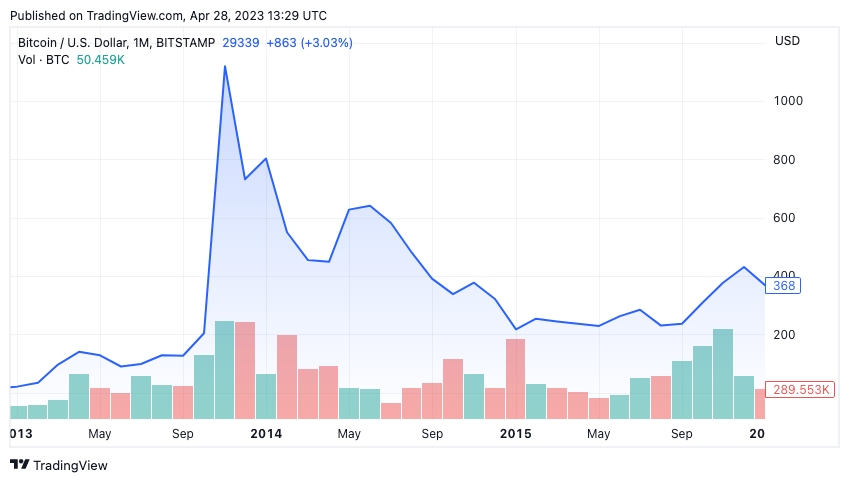
Some analysts believe Mt. Gox creditors are unlikely to sell their holdings, as they have long been able to sell their claims to hedge funds. While it’s likely that some creditors would continue to hold onto their BTC, it’s more likely that many will go on to liquidate. At the time of Mt. Gox’s bankruptcy, Bitcoin’s price hovered around $450 and has since appreciated by over 6,340%.
Graph showing Bitcoin’s price between 2013 and 2016 (Source: CryptoSlate BTC)
Conclusion
With numerous indicators pointing to the end of the crypto winter, it’s easy to overestimate Bitcoin’s ability to regain its ATH. The size of the crypto market pushes its correlation to traditional markets and global politics higher, adding additional factors that contribute to its price.
Focusing only on the crypto industry reveals additional setbacks. Bitcoin faces a myriad of bearish headwinds that create strong resistance to another rally.
A new crisis with a large centralized exchange such as Binance would quickly put a stop to any rally, no matter how much liquidity gets pumped into the market. That same liquidity could easily be threatened by instability at Tether and see billions wiped out from the market.
The selling pressure from tens of thousands of Bitcoins hitting the market would dilute any strength Bitcoin accumulates in the coming months and years.
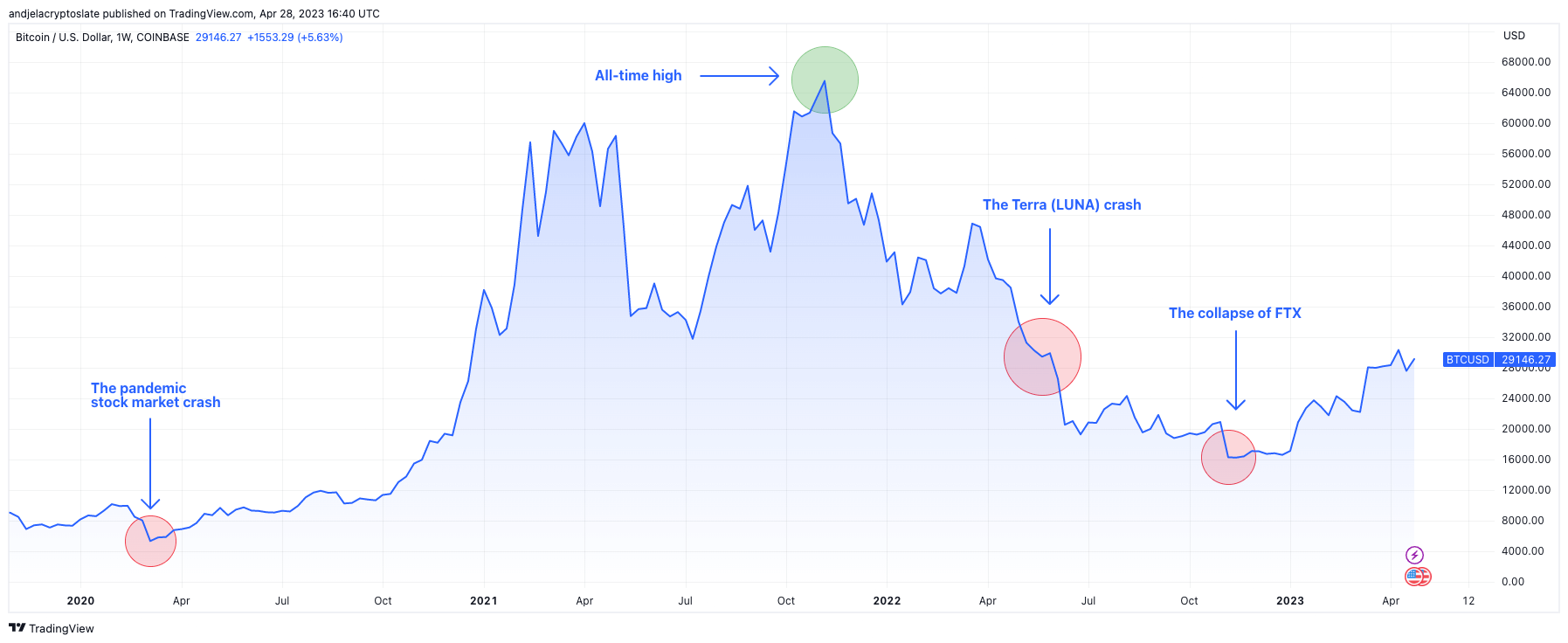
But, no matter how bearish these currents are, it seems likely that the market will eventually be able to absorb them. Zooming out shows that Bitcoin quickly recovered from every major setback it faced — from the stock market crash in March 2020 and the collapse of Terra to the crash of FTX.
Graph showing Bitcoin’s price in relation to major events in the industry from 2020 to 2023 (Source: TradingView)
Bitcoin will most likely overcome all of these obstacles. However, the complexity and maturity of the current crypto market mean that it might take longer to get back on track.