
The fluctuating correlation between Bitcoin and gold
CryptoSlate's latest market report dives deep into the factors driving the Bitcoin-gold correlation.


Introduction
The correlation between Bitcoin and gold has become a topic of growing interest among investors, especially as Bitcoin matures and gains broader acceptance in the financial world.
Historically, the correlation between Bitcoin and gold has been inconsistent, influenced by various factors, including global economic events, central bank policies, and technological developments. For instance, during the COVID-19 pandemic, Bitcoin and gold saw significant price increases as investors sought safe havens amid economic uncertainty.
However, this correlation has not been stable. The correlation has sometimes been near zero or even negative, indicating that Bitcoin and gold do not always move in tandem. For example, in late 2021, as inflationary pressures increased and central banks hinted at tightening monetary policies, Bitcoin’s correlation with gold weakened significantly. This fluctuation in correlation illustrates the complexity of these assets and the factors that drive their prices.
As Bitcoin continues to evolve, so does its relationship with gold. The correlation between the two is influenced by macroeconomic conditions, investor sentiment, and the broader adoption of Bitcoin as both a speculative and a store-of-value asset. In this report, CryptoSlate will explore the factors driving the Bitcoin-gold correlation.
Historical correlation
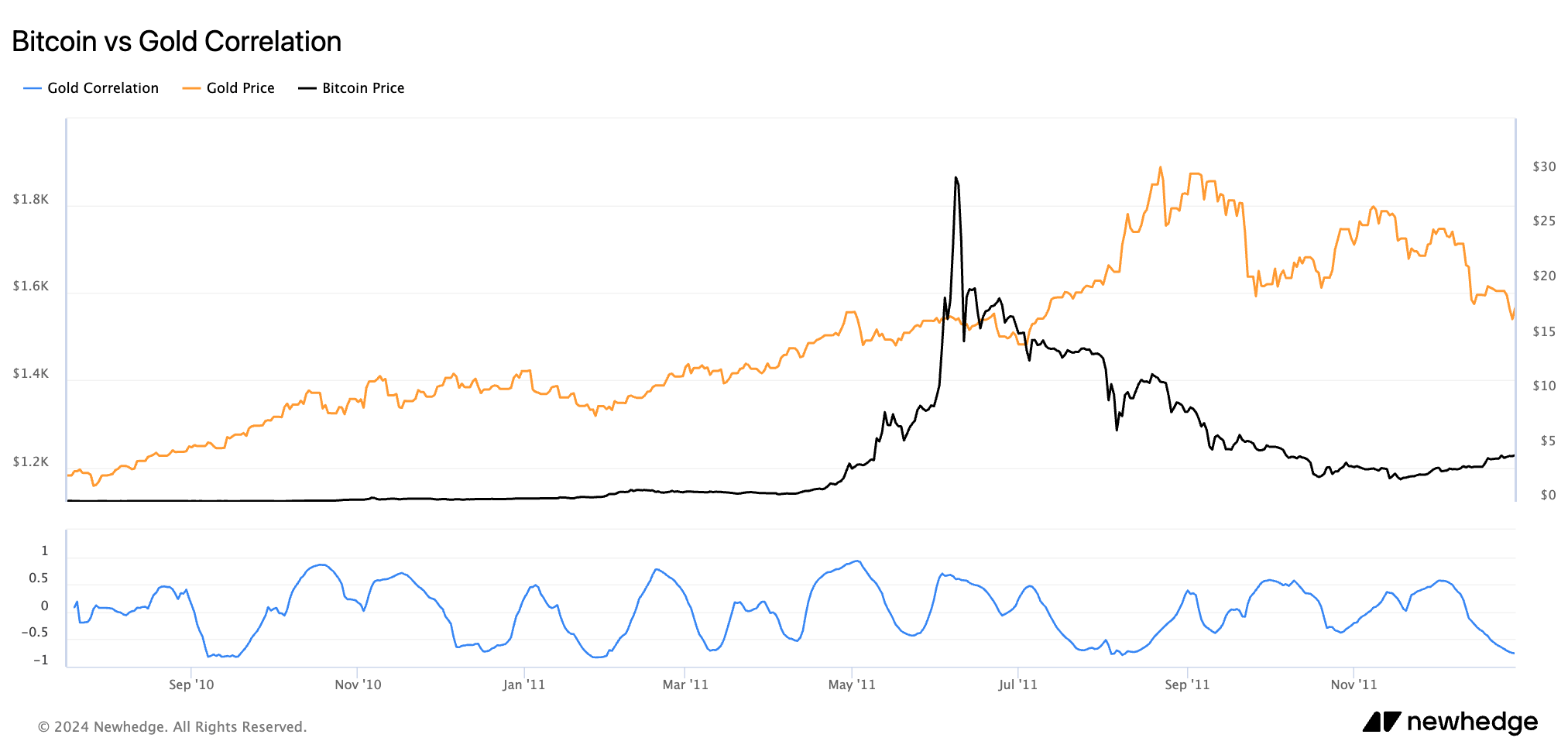
The relationship between Bitcoin and gold has evolved significantly since Bitcoin’s inception. Bitcoin was initially seen as a speculative asset with minimal correlation to traditional financial instruments, including gold. In its early years, Bitcoin’s price movements were primarily driven by internal factors such as technological advancements, regulatory news, and market sentiment within the relatively small crypto community. As a result, its correlation with gold—a long-established store of value—was almost negligible, with a correlation coefficient hovering around zero.
During its first few formative years, Bitcoin operated in a niche market largely disconnected from traditional financial systems. Investors primarily viewed it as an experimental digital currency rather than a viable store of value or an inflation hedge. On the other hand, gold continued to serve its traditional role as a safe haven, particularly during periods of economic stress. For instance, during the European debt crisis in 2011, gold prices surged as investors sought stability amidst financial turmoil, while Bitcoin remained largely unaffected by these macroeconomic events.
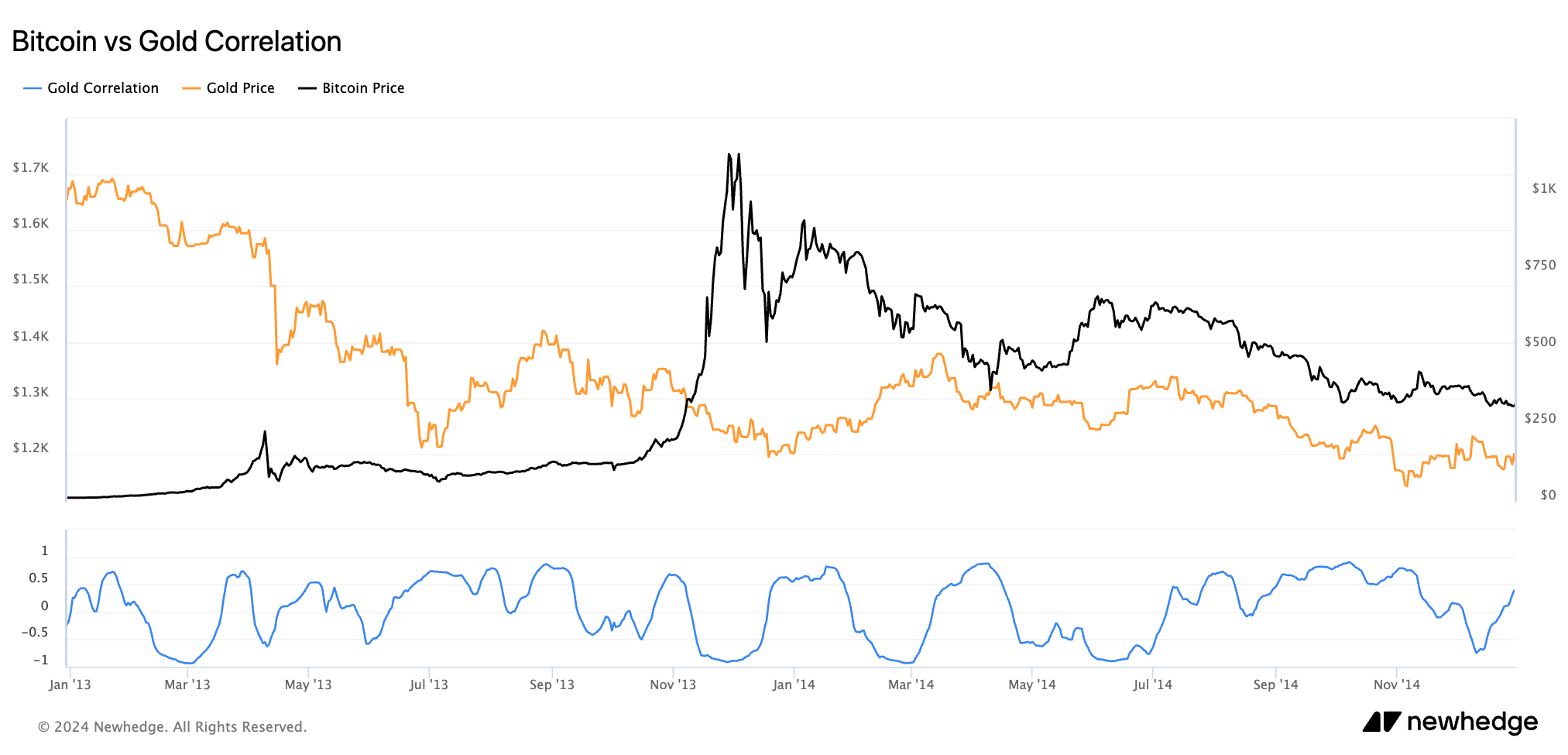
The first signs of a meaningful correlation between Bitcoin and gold emerged during the 2013 Cyprus banking crisis. As the Cypriot government proposed a bailout plan that included confiscating a portion of bank deposits, Bitcoin’s price surged, drawing comparisons to gold as a hedge against systemic risk. During this period, Bitcoin’s correlation with gold strengthened, reflecting its emerging role as a digital alternative to traditional safe havens. Although this correlation was still in its infancy, it marked the beginning of Bitcoin’s journey toward being recognized as “digital gold.”
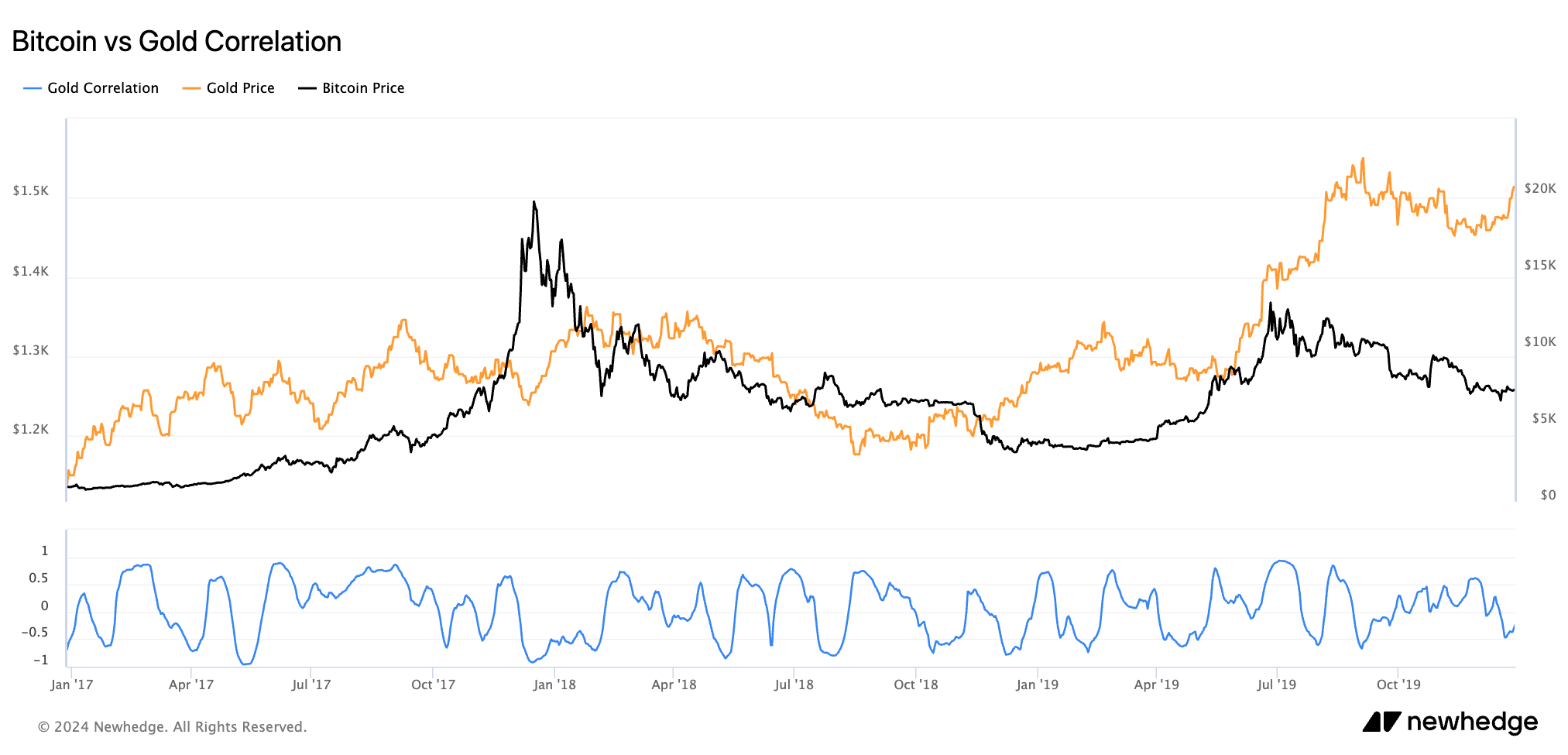
The 2016-2017 period marked another significant shift in the Bitcoin-gold correlation. As Bitcoin’s market capitalization grew exponentially, driven by increasing retail and institutional interest, its correlation with gold became more noticeable. According to a study published on ResearchGate, the correlation coefficient during this period reached approximately 0.2, indicating a weak but growing positive relationship. This trend was particularly evident during the 2017 market correction, where both Bitcoin and gold experienced increased demand as investors sought safe-haven assets amidst market volatility.
However, the correlation between Bitcoin and gold has not been consistent. For example, during the 2018 bear market, Bitcoin’s correlation with gold weakened significantly as BTC plummeted by over 80%, while gold remained relatively stable. This period highlighted Bitcoin’s vulnerability to speculative bubbles and its continued divergence from gold’s more stable performance. The correlation coefficient during this time dropped to near zero, illustrating the volatility and uncertainty that still surrounded Bitcoin as an asset class.
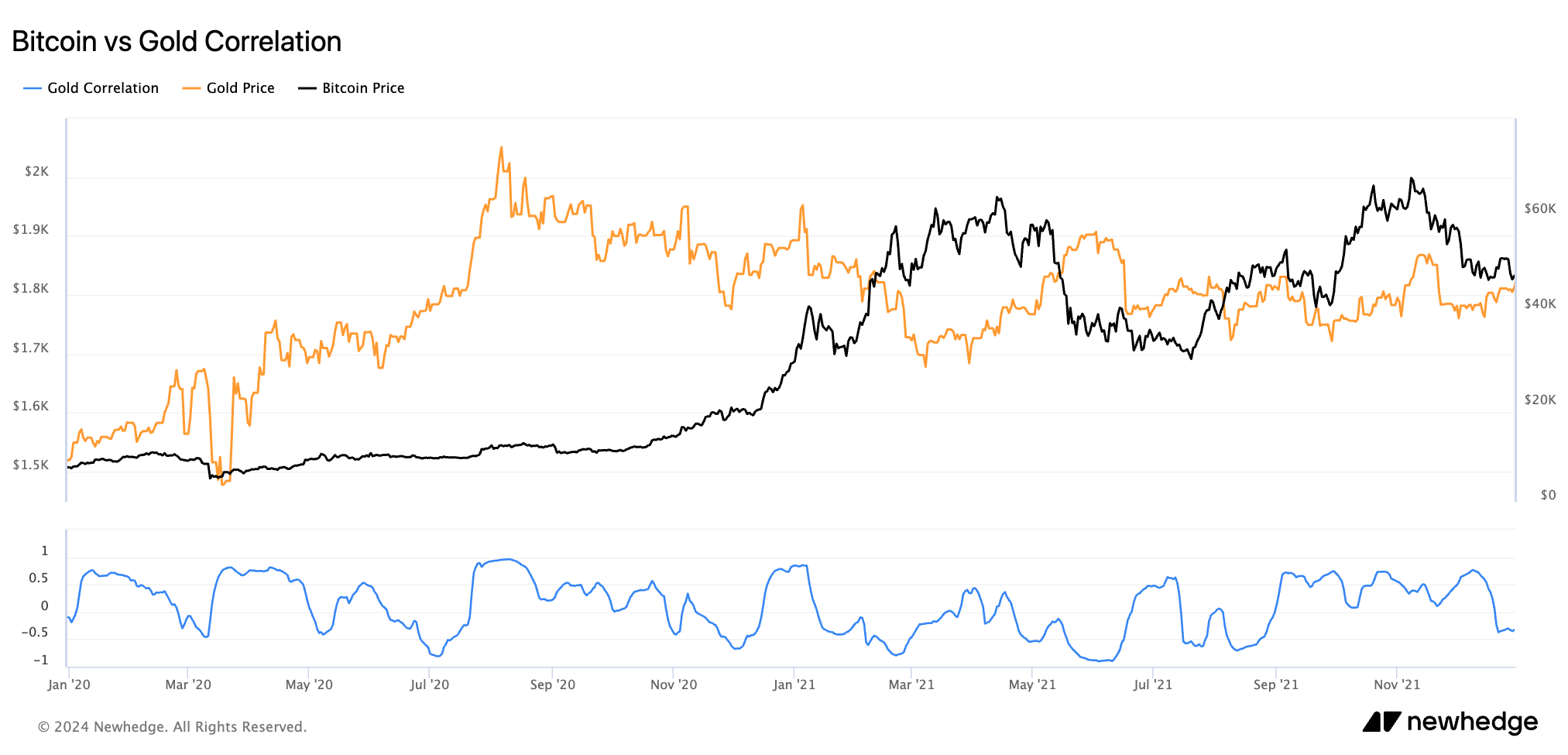
The onset of the COVID-19 pandemic in 2020 provided a unique case study of the Bitcoin-gold correlation. As global markets plunged in response to the pandemic, Bitcoin and gold saw significant price increases, with investors flocking to safe-haven assets. According to data from ScienceDirect, the correlation coefficient between Bitcoin and gold surged to 0.5 in the first quarter of 2020, one of the highest recorded correlations between the two assets. This period reinforced the perception of Bitcoin as a digital counterpart to gold, particularly during times of global economic uncertainty.
However, the correlation proved to be short-lived. By late 2021, as the global economy began to recover and central banks started to signal tighter monetary policies, Bitcoin’s correlation with gold again weakened. The divergence was particularly noticeable as inflation fears grew; while gold remained a favored hedge against inflation, Bitcoin’s price became more influenced by factors unique to the crypto market.
Factors influencing the correlation between Bitcoin and gold
Various macroeconomic, financial, and technological factors shape the correlation between Bitcoin and gold. Understanding these influences is essential for analyzing how these two assets interact, especially during periods of economic uncertainty.
Global economic events like recessions, inflation spikes, and geopolitical tensions have historically driven investors toward safe-haven assets like gold. Bitcoin, often compared to gold due to its fixed supply and decentralized nature, has also started to play a similar role in recent years. For instance, during the 2020 COVID-19 pandemic, Bitcoin and gold saw significant price increases as investors sought refuge from the economic fallout. The correlation between Bitcoin and gold surged to approximately 0.5 during the early months of the pandemic. This phenomenon, known as the “flight to safety,” shows how both assets are viewed as hedges against economic instability.
However, this correlation is not consistent across all economic events. The 2022 inflation spike in the US saw gold maintain its traditional safe-haven status while Bitcoin’s correlation with gold weakened. The divergence was driven mainly by Bitcoin’s sensitivity to regulatory developments and intra-industry issues, which did not affect gold.
Central bank policies, particularly those of the Federal Reserve, significantly impact the correlation between Bitcoin and gold. Periods of monetary easing, characterized by low interest rates and quantitative easing (QE), tend to increase demand for both assets as investors seek to protect against currency debasement and inflation. For example, following the 2008 financial crisis, the Fed’s aggressive QE programs led to rising inflation expectations, boosting demand for gold as an inflation hedge. By the time the 2020 pandemic-induced QE, Bitcoin had matured enough, so its correlation with gold became more pronounced as both assets benefited from similar macroeconomic tailwinds.
Interest rate changes also play a crucial role. As the Fed raises rates to combat inflation, the opportunity cost of holding non-yielding assets like gold and Bitcoin increases, which can reduce their attractiveness. During the 2022 tightening cycle, Bitcoin’s correlation with gold weakened as Bitcoin faced additional pressures from the broader crypto market’s volatility and regulatory scrutiny. This decoupling highlighted how Bitcoin’s market trends, influenced by factors beyond traditional macroeconomic conditions, can cause it to behave differently from gold.
The increasing maturity of the Bitcoin market and its adoption by institutional investors have also influenced its correlation with gold. As institutional investors allocate capital to Bitcoin, it becomes more intertwined with traditional financial markets, leading to periods where its price movements align more closely with gold. For instance, the growing adoption of Bitcoin by hedge funds, corporate treasuries, and even pension funds has contributed to a higher correlation with gold during specific periods of market stress.
However, Bitcoin’s evolving use case has also affected its correlation with gold. Initially viewed as a speculative asset, Bitcoin has increasingly been recognized as a store of value, similar to gold. This shift has led to periods where the correlation strengthens, particularly during economic downturns. Yet, innovations in the crypto space, such as the development of Bitcoin ETFs, DeFi platforms, and other blockchain technologies, have also introduced new variables that can disrupt this correlation. For example, introducing Bitcoin futures ETFs in 2021 provided new avenues for market speculation, contributing to the breakdown of Bitcoin’s correlation with gold.
Conclusion
The fluctuating correlation between Bitcoin and gold raises important questions about Bitcoin’s potential as a safe-haven asset. While both Bitcoin and gold are often seen as stores of value, their correlation has been inconsistent, influenced by a variety of factors, including global economic conditions, market sentiment, and technological advancements. This variability complicates the narrative that Bitcoin can unequivocally be considered “digital gold.”
From a traditional financial perspective, gold has long been regarded as the ultimate safe haven, particularly during times of economic instability. Its status is supported by centuries of history, during which gold has consistently preserved wealth through various economic cycles. Bitcoin, on the other hand, is a much younger asset. Its market behavior has been characterized by extreme volatility, with price swings that far exceed those typically seen in gold. This volatility has led some traditional analysts to view Bitcoin as a speculative asset rather than a reliable store of value.
However, the increasing correlation between Bitcoin and gold during periods of economic stress suggests that Bitcoin is beginning to assume a role similar to that of gold in the eyes of some investors. For instance, during the early stages of the COVID-19 pandemic, Bitcoin’s correlation with gold surged, with both assets rising in tandem as investors sought protection from the economic fallout. Previous CryptoSlate analysis found the correlation coefficient between the two assets reached approximately 0.5 during this period, a significant increase compared to previous years.
The future correlation between Bitcoin and gold is likely to remain volatile. If inflationary pressures continue to rise and central banks maintain loose monetary policies, we may see periods where Bitcoin and gold move more closely together, particularly if Bitcoin’s narrative as a store of value continues to gain traction among institutional investors. However, Bitcoin’s ongoing evolution as a financial asset could also lead to periods where its correlation with gold weakens, especially if these innovations introduce new drivers of Bitcoin’s price independent of traditional economic factors.
More Market Reports


