
Analyzing the history of US debt and potential effects of a default on the crypto market
CryptoSlate's latest market report dives deep into the U.S. debt crisis, exploring past instances of debt failures and analyzing the implications a debt default could have on Bitcoin.

Introduction
The U.S. is currently engaged in heated negotiations about raising the debt ceiling, with political differences preventing the government from reaching a bipartisan decision.
With the debt ceiling serving as a fiscal control mechanism and a reflection of the country’s financial health, the eyes of the global market are all pointed to Capitol Hill.
The failure to increase the debt limit on time could trigger a government shutdown, a halt in public services, and even a default on government bonds. Given that U.S. Treasury securities are considered a safe haven asset, such a default could severely impact the global financial system.
However, understanding the intricacies of the ongoing debt ceiling crisis requires a historical lens. The genesis and evolution of the U.S. national debt, past instances of flirting with defaults, and the procedural complexities of raising the debt ceiling all play an essential role in the ongoing crisis.
In this report, CryptoSlate dives deep into this pressing issue, unpacking its history and examining its potential impact on the crypto market.
A brief history history of U.S. government debt
The origins of the U.S. government debt trace back to 1791, arising from financial obligations incurred during the Revolutionary War. Over the following centuries, the national debt has seen a steady expansion.
By February 2023, this debt had escalated to a formidable $31.5 trillion, reflecting an approximate growth of over 19000% in the last century.
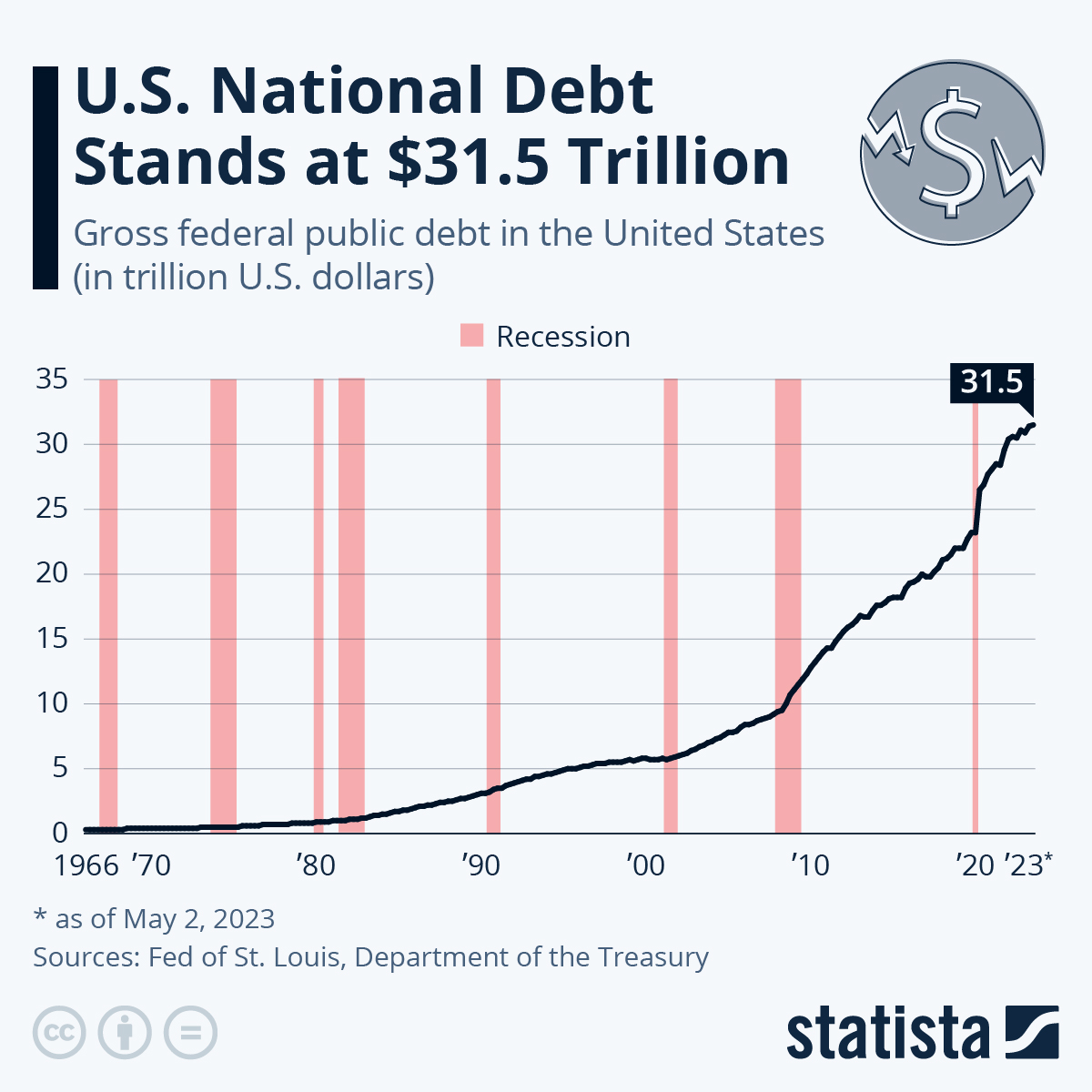
This astronomical growth can be attributed to many interlinked historical events, political decisions, and economic dynamics. From the fiscal demands driven by domestic and international conflicts to the strategic use of debt as an economic catalyst, the national debt has consistently played a significant role in formulating U.S. monetary policy.
The significance of U.S. debt on the global stage is tethered to the U.S. dollar’s status as the world’s leading reserve currency. The credibility of the U.S. government’s financial commitments, based on its pledge to service its debt, has fortified worldwide confidence in the dollar. This global trust has, consequently, established U.S. Treasury securities as the most stable asset class in the international financial system.
Flirting with debt defaults
The U.S. has largely avoided actual defaults on its debt obligations, well aware of the potential detrimental implications. Nevertheless, there were several instances when the U.S. came close to the precipice of default, adding a layer of context to the ongoing discussions around the debt ceiling.
The most notable episode occurred in 1979 when the U.S. fell into technical default on Treasury bills, primarily due to administrative hiccups and delays in transitioning to computerized processing systems. During this period, the Treasury failed to redeem $120 million in Treasury bills on time. Although the lapse was temporary, the immediate aftermath witnessed a rate hike, emphasizing the market’s sensitivity to such incidents.
In 1790, the U.S. faced its inaugural default when it missed a scheduled interest payment. This was primarily due to the logistical challenges in transferring authority from the old colonial governments to the newly established federal government.
Similarly, during the War of 1812, the U.S. government again stumbled upon the brink of default. In 1814, the war exerted substantial pressure on government finances, leading to a severe shortage of gold and silver, which constrained its ability to service its debt.
Perhaps the most impactful incident occurred in 1933 when the government, grappling with the Great Depression, chose to discontinue the convertibility of dollars into gold for its creditors. This decision resulted in a partial default as it altered the payment terms without the creditors’ consent, causing significant market instability.
The bureaucracy of raising the debt ceiling
The process of raising the debt ceiling illustrates the bureaucratic challenges that underscore this key aspect of U.S. economic policy.
The debt ceiling is a legal limit Congress sets on the total amount of debt that the U.S. Treasury can issue to the public and other government agencies. Raising the debt ceiling doesn’t create new debt but allows the Treasury to fund existing legal obligations of the U.S. government, such as social security and tax benefits, military salaries, interest on the national debt, and numerous other commitments.
The mechanism for raising the debt ceiling usually involves legislative action. Congress can increase, decrease, or maintain the debt ceiling, and they can also decide to suspend it for a period of time. The process can sometimes turn contentious, with political wrangling often intensifying as the debt limit approaches, which was notably seen in 2013.
In 2013, the U.S. faced a significant debt ceiling crisis, which was resolved unconventionally. The Treasury resorted to using “extraordinary measures” to avoid breaching the debt ceiling, a set of accounting techniques that essentially buys more time for the government to pay its bills. It involved suspending the issuance of certain types of debt and redeeming existing debt to free up borrowing capacity under the ceiling.
These extraordinary measures, while legally permissible, are finite resources. When exhausted, the Treasury is left with only incoming revenues to pay its obligations, potentially falling short of the amount needed and risking a default.
However, after lengthy political posturing and negotiations, Congress finally passed the “No Budget, No Pay Act of 2013.” This legislation temporarily suspended the debt ceiling from February 4, 2013, through May 18, 2013, allowing the Treasury to borrow funds to meet its obligations.
The current state of debt ceiling negotiations
As of May 25, debt ceiling negotiations stand at a critical juncture. The uncertainties surrounding the outcome have been stirring unease among investors and market watchers.
Negotiations between the Republican and Democratic parties are ongoing under the pressure of the approaching deadline. With the Democrats holding a slim majority in the Senate, the bipartisan consensus required to navigate this issue remains elusive. Although both parties recognize the grave implications of a default, ideological differences have led to a deadlock, with each side holding firm to their fiscal perspectives.
Republican representatives have staunchly advocated linking any debt ceiling increase to stringent spending cuts or significant budget reforms.
The Democrats, meanwhile, maintain that the need to raise the ceiling is a byproduct of past bipartisan decisions, arguing against the incorporation of partisan conditions. Under Secretary Janet Yellen’s guidance, The U.S. Treasury Department has initiated a series of “extraordinary measures” to prolong the deadline. These strategies involve a temporary suspension of certain investments, as well as redeeming or exchanging specific non-marketable Treasury securities.
Potential implications for the cryptocurrency market
Debt ceiling negotiations have had a noticeable impact on financial markets, including the cryptocurrency sector. In response to the rising tension, the U.S. Treasury yield curve, an important indicator of investor sentiment towards the American economy, has experienced considerable fluctuations.
The Treasury yield curve is a graphic representation of all U.S. Treasury securities ranging from short-term bills to long-term bonds. The shape of the yield curve provides valuable insight into investor expectations for future interest rates and the state of the economy. A normal yield curve is upward-sloping, showing investors demand higher yields for long-term bonds to compensate for the risk of holding them over a long period.
An inverted curve shows that short-term interest rates are higher than long-term rates. This indicates investors choose to buy long-term bonds despite low yields as they fear an economic downturn in the short term.
As of May 25, the U.S. Treasuries yield curve is in a steep downward slope, indicating growing fears over market stability.
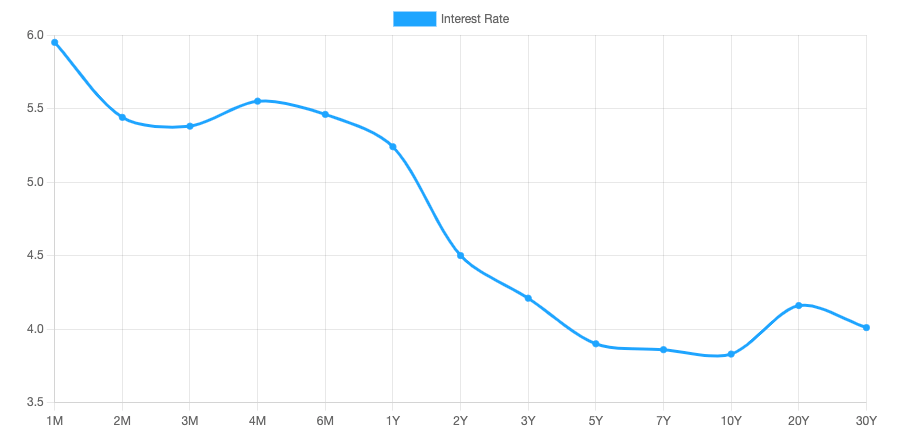
This fluctuation in U.S. Treasury yields inevitably influences the crypto market.
Earlier this week, news of a spike in U.S. Treasury yields caused a Bitcoin sell-off, pushing its price below $26,000. The dip came after weeks of sideways movement for Bitcoin, as it spent the better part of May trading in a tight range between $26,000 and $28,000.
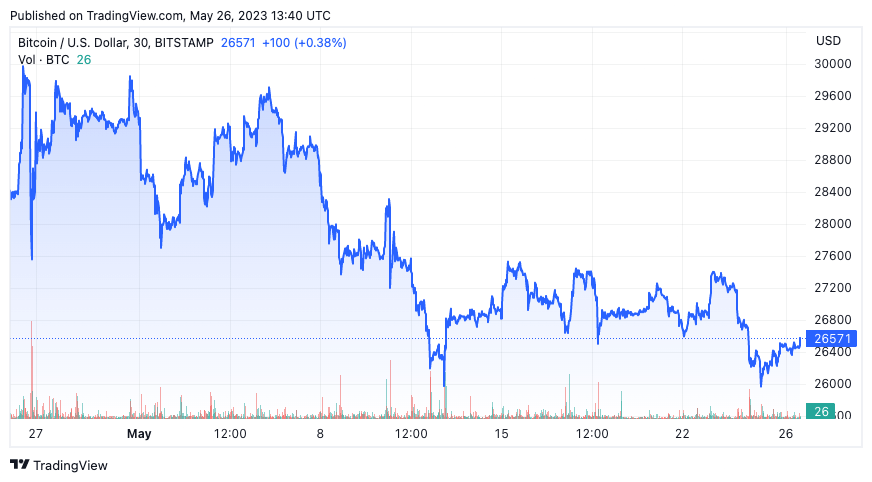
While short-lived, the dip caused $120 million in liquidations across the market in a single day, exposing the ripple effects of Bitcoin’s price volatility.
And while Bitcoin regained its losses and established new support at $26,000, the market is still uncertain. On-chain analysis showed several indicators pointing to the beginning of a bull cycle, but flat trading volumes suggest a cautious approach by traders.
In the event of a U.S. debt default, the potential fallout on the crypto market could be substantial. The initial reaction would likely be a sell-off as investors seek refuge in cash or less volatile assets.
However, in the medium to long term, a debt default could have a positive impact on Bitcoin and the rest of the market. A recent Bloomberg survey found that professional and retail investors rank Bitcoin among the top three assets to purchase as a hedge against a hypothetical debt default scenario.
Conclusion
No matter the outcome, the ongoing U.S. debt ceiling crisis will have a profound effect on economic, political, and social factors. As negotiations hang in the balance, the implications for financial markets, including cryptocurrency, could be substantial.
The crisis is set to drive novel trends and shifts in the global market, exposing the current system’s inherent vulnerabilities. With Bitcoin at its forefront, the cryptocurrency market will certainly feel the ramifications of the crisis. The market is mature enough to feel the pressure of the U.S. financial system but still young enough to be able to adapt to new market dynamics.
The U.S. has been walking the debt tightrope for centuries. As we stand at the precipice of a potential default, the global market watches, and crypto holds its breath.
More Market Reports


