Digital vs. tangible: A deep dive into gold and spot Bitcoin ETFs
CryptoSlate's latest market report dives deep into the unique characteristics and investment potentials of gold and spot Bitcoin ETFs to understand their market impact.
Exchange-traded funds (ETFs) have become a cornerstone in modern investment strategies, offering the flexibility of stock trading with the diversified exposure of mutual funds.
By design, ETFs track an index, commodity, bonds, or a basket of assets like an index fund, yet trade on exchanges like a stock. This unique blend of accessibility and diversification has propelled their popularity, attracting both retail and institutional investors to the asset class.
It took over a decade before ETFs found their way to the crypto industry. The novelty of digital assets, their volatility, and lack of maturity in the market made crypto ETFs a tough product to sell to investors. However, as the market matured and more institutional investors became interested in the developing world of digital assets, spot Bitcoin ETFs were introduced in the US.
The journey toward approving Spot Bitcoin ETFs in the United States has been a protracted one, fraught with regulatory scrutiny and investor anticipation. Unlike their counterparts, which might represent equities or physical commodities, Spot Bitcoin ETFs seek to offer direct exposure to Bitcoin’s price movements. The primary hurdles to their approval stemmed from concerns over market manipulation, liquidity, and the robustness of the underlying Bitcoin market infrastructure.
To fully understand the importance and impact spot Bitcoin ETFs can have, we must compare them to gold ETFs. In this report, CryptoSlate dives deep into the unique characteristics and investment potentials of each ETF type to understand the broader implications of these similar yet starkly different trading products.
The mechanics of ETF creation
The creation of exchange-traded funds (ETFs) involves a detailed and structured process pivotal to their operation and impact on the financial markets. At the heart of this process are authorized participants (APs), typically large financial institutions or market makers, who play a crucial role in ensuring the liquidity and market efficiency of ETF shares. The APs create new ETF shares and redeem them for the underlying assets, ensuring the alignment of the ETF’s market price with its net asset value (NAV).
For gold ETFs, the creation process involves the APs purchasing the physical gold that corresponds to the ETF’s investment objective and then delivering this gold to the ETF’s custodian in exchange for ETF shares. This mechanism allows gold ETFs to reflect the value of the physical gold held in trust minus the ETF’s expenses. The redemption process works similarly but in reverse, with APs returning ETF shares to the fund in exchange for the equivalent amount of physical gold.
In contrast, the creation and redemption mechanism for spot Bitcoin ETFs involves a digital asset rather than a physical one. The process for spot Bitcoin ETFs requires the APs to purchase Bitcoin and then transfer it to the custodian of the ETF. Given the digital nature of Bitcoin, this process comes with a set of unique challenges, particularly regarding custody and regulatory compliance. Custody issues revolve around ensuring the secure storage and handling of Bitcoin to prevent theft, loss, or other security breaches.
Regulatory considerations are even more complex, requiring compliance with financial regulations that are still evolving to accommodate cryptocurrencies. These include complying with anti-money laundering (AML) and securities laws, as well as meeting the standards set by regulatory agencies such as the SEC.
The complexity of handling digital assets like Bitcoin and the regulatory hurdles made the creation of spot Bitcoin ETFs a challenging endeavor. The custody solutions have to ensure the physical security of the coins while providing a clear legal framework that defines the ownership and transfer of these assets in a way that regulators find acceptable. This has led to a cautious approach from regulatory bodies, requiring ETF providers to demonstrate robust and secure mechanisms for asset custody and management.
The contrast in the creation process between gold and spot Bitcoin ETFs shows the differences between traditional and digital asset markets. While gold ETFs leverage well-established mechanisms for the handling of physical assets and make their creation much more straightforward, spot Bitcoin ETFs have to navigate the complexities of incorporating digital assets into the financial system. This involves overcoming significant technical and security challenges while pioneering regulatory pathways that reconcile the decentralized nature of cryptocurrencies with the structured requirements of financial markets.
Trading and market impact
To understand how gold and spot Bitcoin ETFs operate and impact the market, it’s important to analyze how these products are traded. Like individual stocks, these ETFs are traded on exchanges, offering investors the flexibility to buy and sell shares during trading hours at market-determined prices. This trading mechanism is central to the appeal of ETFs, combining the diversification benefits of mutual funds with the accessibility and liquidity of stocks.
Liquidity refers to the ease with which assets can be bought or sold in the market without affecting their price. High liquidity is synonymous with a stable, efficient market where transactions can occur smoothly and with minimal slippage. For gold ETFs, liquidity is generally high due to the longstanding market presence and widespread investor interest in gold as a stable investment commodity. This high liquidity facilitates tighter spreads between the buy and sell prices and a closer alignment of the ETF’s market price with its net asset value (NAV).
In contrast, spot Bitcoin ETFs operate in a more volatile market environment. The inherent volatility of Bitcoin can lead to wider spreads and more significant discrepancies between the ETF’s market price and its NAV. This volatility is a double-edged sword; it can enhance potential returns but also increases the risk of market price deviations from NAV, known as premiums or discounts. Premiums occur when the ETF’s market price is higher than its NAV, often indicating strong buyer demand. Discounts, conversely, suggest selling pressure or investor skepticism, with the market price falling below the NAV.
These premiums and discounts are crucial indicators of investor sentiment. For gold ETFs, premiums might indicate a surge in demand for gold as a safe-haven asset, whereas discounts could suggest weakening investor confidence in gold’s value stability. For spot Bitcoin ETFs, premiums could signal bullish market sentiment towards Bitcoin, while discounts may reflect concerns over regulatory developments, security issues, or broader market trends.
Premiums and discounts not only affect the immediate trading strategy but also provide insights into broader market perceptions and the underlying asset’s demand-supply equilibrium. For spot Bitcoin ETFs, navigating this landscape requires a keen understanding of crypto market fluctuations and regulatory shifts. Gold ETFs involve monitoring macroeconomic indicators and geopolitical events that influence gold prices.
The ETFs' influence on the underlying asset market
The proliferation of ETFs has significantly influenced the markets of their underlying assets. Providing greater market participation, these products enabled investors to gain exposure to assets that might otherwise be out of reach due to various barriers, such as high entry costs and storage issues.
Screengrab showing the price of gold CFDs before and after the launch of the first gold ETF in 2004 (Source: CryptoQuant)
In the case of gold, the advent of gold ETFs has democratized access to this precious metal, allowing investors to partake in the gold market without the need to physically hold the asset. This ease of access has broadened the investor base, not just among individual investors but also institutional ones, leading to increased liquidity and potentially stabilizing effects on gold prices. Historically, the launch of major gold ETFs has been associated with significant inflows into the gold market, reflecting heightened investor interest, which, in turn, can drive up the price of gold by increasing demand.
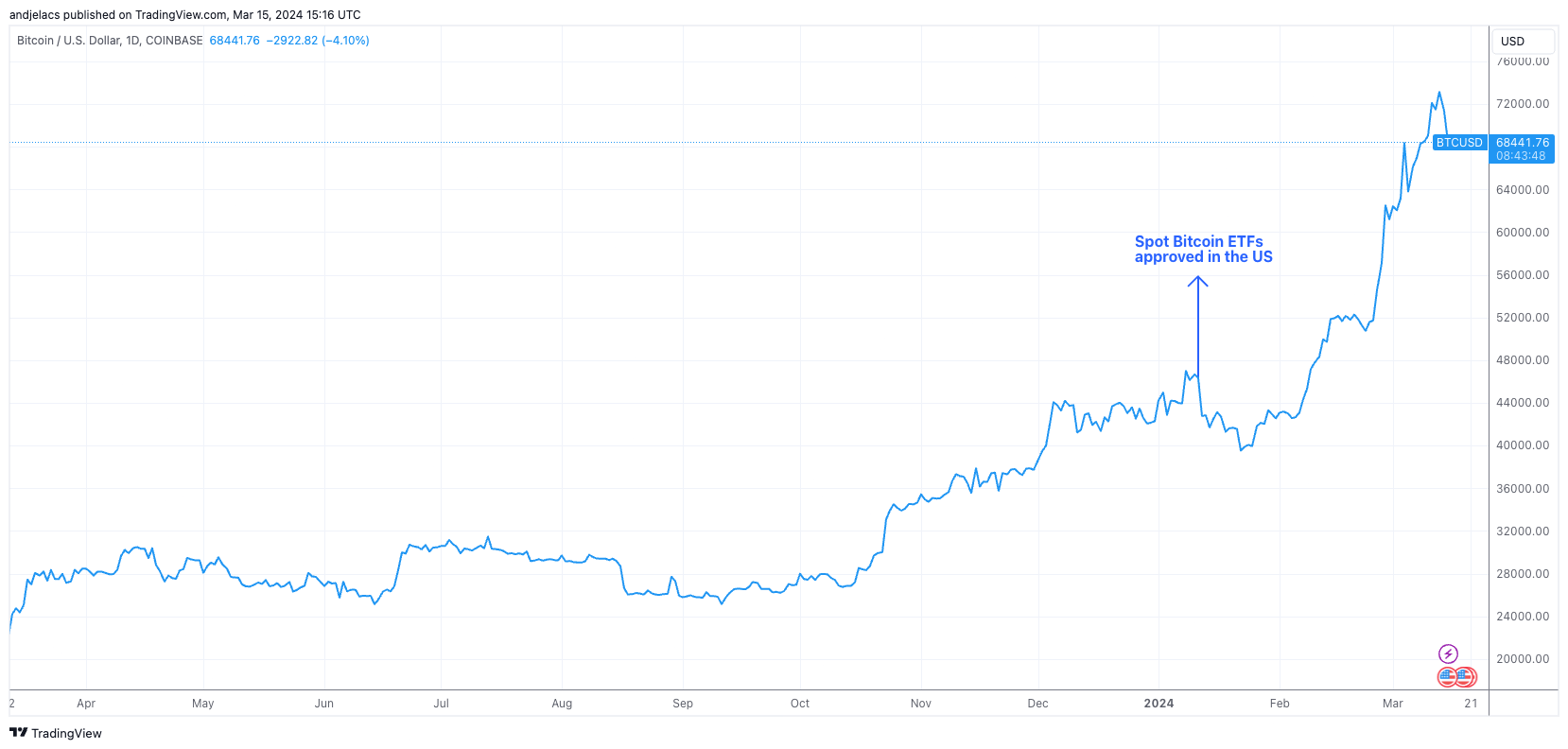
For Bitcoin, the narrative is somewhat parallel but also distinctly nuanced due to the digital nature of the asset and the regulatory environment surrounding cryptocurrencies. The anticipation and eventual approval of Spot Bitcoin ETFs have been seen as critical milestones within the crypto community, signaling a growing acceptance of Bitcoin as a legitimate investment asset. Such ETFs offer a direct impact on Bitcoin’s market by potentially increasing demand, as they provide a safer and regulatorily compliant pathway for traditional and institutional investors to invest in Bitcoin.
Graph showing BTC price before and after the launch of spot Bitcoin ETFs in the US on Jan. 11, 2024 (Source: TradingView)
Beyond the direct financial implications, the existence of ETFs also carries concerns regarding market sentiment, accessibility, and potential for market manipulation. Enhanced accessibility and increased investment in these assets through ETFs can lead to heightened sensitivity to market sentiment, where positive news can lead to rapid inflows of capital, and negative news can prompt swift outflows. Additionally, the concentration of trading activity within ETFs could raise concerns about market manipulation, where large trades could disproportionately affect the underlying asset’s price.
This is especially true for the newly launched spot Bitcoin ETFs, notably BlackRock’s IBIT and Fidelity’s FBTC. Given the size and the market impact of the two institutions, a significant increase or decrease in daily flows can destabilize the ETFs market and the spot market.
Nevertheless, the role ETFs play in the market of their underlying assets cannot be overstated. By offering regulated, liquid, and accessible means of investment, ETFs affect the immediate pricing and liquidity of their underlying assets and the broader perception and acceptance of these assets within the global investment landscape.
Conclusion
The creation process of ETFs presents a stark contrast between the traditional, tangible asset of gold and the digital, decentralized nature of Bitcoin. While gold ETFs involve the physical handling and storage of gold, requiring robust security and logistical planning, spot Bitcoin ETFs navigate the complex landscape of digital asset custody and the regulatory challenges that are unique to crypto.
Gold ETFs, backed by a long history and widespread acceptance, typically enjoy high liquidity, leading to narrower spreads and minimal deviations from the NAV. In contrast, the nascent and volatile nature of BTC can result in wider spreads for spot Bitcoin ETFs, alongside more significant premiums or discounts to NAV, reflecting the fluctuating investor sentiment towards cryptocurrencies.
The market impact of these ETFs shows their potential to influence the underlying assets. Gold ETFs have broadened market access, allowing a wider range of investors to participate in gold investments, which can stabilize and potentially increase gold prices. Spot Bitcoin ETFs, however, represent a significant step toward mainstreaming Bitcoin investment, promising to enhance liquidity and price stability but introducing new challenges in market manipulation and regulatory scrutiny.
Considering the current state of the market, two divergent futures can be envisioned based on the data available. On the one hand, the continued popularity and maturity of spot Bitcoin ETFs could usher in a new era of crypto adoption, drawing in substantial institutional investment and stabilizing Bitcoin’s market presence. This scenario would likely create a positive feedback loop, increasing demand and liquidity and potentially elevating Bitcoin’s status as a recognized asset class alongside traditional investments like gold.
However, the unique challenges facing spot Bitcoin ETFs—ranging from regulatory hurdles to concerns over market manipulation and the inherent volatility of digital assets—could temper their growth when compared to gold.