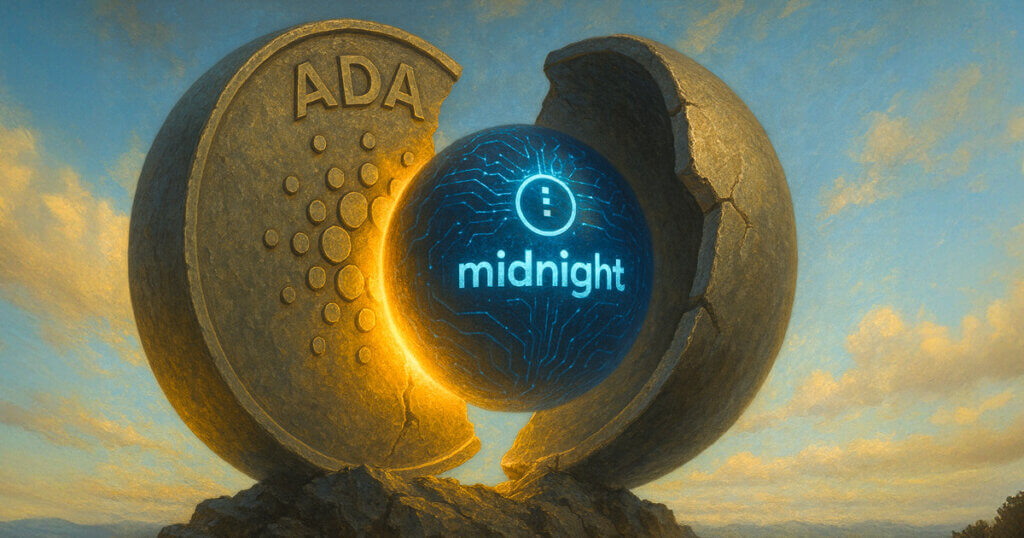
The Midnight Foundation declared its network live on Mar. 29, with the genesis block dated Mar. 17.
That launch gives Cardano's community its first production test of Charles Hoskinson's argument that public blockchains cannot reach regulated finance, identity, and business use unless the infrastructure itself embeds privacy and compliance from the start.
Cardano enters that test in an unusual position: a market cap above $9.1 billion, 672 active developers per Electric Capital data, and a DeFi footprint that hasn't matched the valuation's weight.
DefiLlama shows roughly $134 million in total value locked, about $47 million in stablecoins, and less than $2,000 in daily chain fees.
The gap between Cardano's perceived scope and its on-chain activity persists. Midnight's premise is that privacy-first infrastructure can attract a class of users and use cases that Cardano's base layer never targeted.
| Metric | Figure in article | Why it matters |
|---|
| Market cap | Above $9.1 billion | Shows Cardano carries large market expectations |
| Active developers | 672 | Suggests a meaningful builder base already exists |
| DeFi total value locked | Roughly $134 million | Indicates limited financial activity relative to valuation |
| Stablecoins on Cardano | About $47 million | Shows modest settlement/liquidity footprint |
| Daily chain fees | Less than $2,000 | Suggests restrained day-to-day economic usage |
| Core takeaway | Large valuation + developer base, but relatively light on-chain finance | Sets up Midnight as a test of whether privacy/compliance can close the gap |
Hoskinson framed Midnight at launch as an addition to a generational arc: Satoshi gave sound money, Ethereum gave programmability, Cardano brought governance and interoperability, and Midnight returns identity and privacy.
Institutional stablecoin volume reached $1.22 trillion, yet only 0.0013% settled on private rails, per Aleo's 2025 Privacy Gap Report.
RWA.xyz now tracks about $26.67 billion in distributed tokenized assets, with McKinsey projecting that tokenized financial assets could reach around $2 trillion by 2030.
At that scale, privacy becomes a market-structure issue. Public ledgers expose positions, counterparties, and reserve data in ways that regulated compliance frameworks cannot readily accommodate.
Midnight's architecture targets that friction directly. Its key building blocks enable institutions to demonstrate compliance or solvency without broadcasting sensitive data that would render transparent chain participation commercially untenable.
Compact, a TypeScript-influenced smart contract language, provides enterprise developers already familiar with TypeScript with a direct onboarding path to the network.
The dual-token NIGHT/DUST model adds further structural logic: separating governance and security (NIGHT) from transaction costs (DUST) provides enterprises with predictable operating economics.
This token model eventually abstracts crypto exposure away from end users entirely, a feature that compliance-driven buyers often value over cryptographic architecture alone.
A specific bet in a crowded category
Other protocols are also betting on the privacy-plus-compliance pitch.
Aztec combines a public and private smart contract state with client-side proving. Namada advances selective disclosure and privacy for viewing keys. Aleo recently announced USAD, a privacy-by-default stablecoin built on the same institutional gap rhetoric.
The field has become a genuine competitive cluster, and Midnight's edge sits in a specific combination: Cardano-linked validator selection that accounts for SPO stake delegation, NIGHT's initial launch on Cardano mainnet, and Lace wallet support added in early March.
| Network | Privacy model described in article | Compliance / disclosure angle |
|---|
| Midnight | Privacy-first infrastructure; shielded/unshielded assets; private proofs | Selective disclosure; compliance and solvency can be demonstrated without exposing sensitive data |
| Aztec | Public and private smart contract state with client-side proving | Implied compliance-friendly privacy posture |
| Namada | Privacy with viewing keys | Selective disclosure |
| Aleo | Privacy-by-default positioning | Institutional privacy-gap framing; USAD stablecoin |
Those linkages give Midnight access to Cardano's existing staking infrastructure and builder base that competitors cannot replicate.
The network opens on a federated operator model, consisting of names such as Google Cloud, Blockdaemon, MoneyGram, Pairpoint by Vodafone, eToro, Worldpay, and Bullish running block production from day one.
Each brings a different theory of where regulated on-chain finance goes next. Midnight bets that a Cardano-adjacent, enterprise-first operator model gets there first.
The federated operator set is both a design choice and a constraint. A curated infrastructure environment lowers the trust bar for regulated institutions evaluating deployment, as they can verify who operates the network before committing sensitive workflows to it.
Google Cloud's role is infrastructure and node operation. MoneyGram is exploring a confidential payment network settlement with regulatory trust, acting as both a node operator and an active collaborator in the network's early phase.
CryptoSlate Daily BriefDaily signals, zero noise.
Market-moving headlines and context delivered every morning in one tight read.
5-minute digest 100k+ readers
Monument Bank represents the clearest near-term product case: the bank wants to bring up to £250 million in tokenized retail deposits onto Midnight in a first phase, drawing from £7 billion in deposits managed for more than 100,000 customers.
Worldpay is running a stablecoin payments proof of concept using USDG, while Bullish is building a proof-of-reserves tooling on the privacy layer.
Each of those arrangements sits at the proof-of-concept stage, and the Midnight team said in January it was still compiling a definitive inventory of applications targeting the launch window.
A separate restraint applies to token metrics. NIGHT traded above $1 billion in market cap in late January 2026, but CoinGecko placed it at nearly $731 million as of Mar. 30.
That earlier episode measured attention, and treating it as evidence of sustained network adoption would misrepresent the data.
Broader community-driven block production is scheduled for later in 2026, which gives decentralization skeptics a clear opening: the network is asking observers to trust a curated launch environment before it has proved decentralized demand.
What to expect
In the bull case, Monument discloses visible issuance milestones over the next 90 days, and at least one of Worldpay, Bullish, or MoneyGram publishes a production milestone or public demo.
| Test area | Bull-case signal | Bear-case signal | Why it matters |
|---|
| Monument Bank | Visible issuance milestones tied to tokenized deposits | No visible issuance progress | Most concrete near-term product case in the article |
| Worldpay / Bullish / MoneyGram | Public demo, production milestone, or clear workflow in use | Announcements remain exploratory | Shows whether enterprise names become real usage |
| Application pipeline | Named live apps or credible launch-window deployments | Pipeline stays thin through mid-2026 | Distinguishes infrastructure readiness from adoption |
| Institutional traction | Regulated-finance use cases begin moving on-chain | Interest stays at proof-of-concept stage | Tests whether privacy/compliance actually unlocks new demand |
| Network structure | Progress toward broader community-driven block production later in 2026 | Federated launch becomes a lasting criticism | Determines whether enterprise trust and decentralization can coexist |
| Cardano ecosystem impact | Midnight starts pulling in builders and institutions beyond Cardano’s base-layer activity | Activity stays narrative-driven, not usage-driven | Measures whether Midnight expands Cardano’s orbit |
| NIGHT market cap | Retests the $1 billion-plus range alongside real adoption signals | Token price becomes the only visible traction point | Keeps token metrics secondary to network usage |
| Bottom line | Architecture turns into measurable adoption | Thesis remains technically credible but commercially unproven | Frames the verdict readers should watch for |
Midnight begins to function as the first credible bridge between Cardano's infrastructure and regulated on-chain finance, pulling in builders and institutions that transparent ledgers have never served.
Additionally, NIGHT retests the $1 billion-plus range as Midnight becomes the dominant new narrative for Cardano's broader orbit.
In the bear case, the application pipeline stays thin through mid-2026. Enterprise commitments result in announcements before live application deployment. The federated launch draws more criticism from participants focused on decentralization.
Midnight still carries technical credibility but fails to establish product-market fit in its stated institutional target, and the privacy-and-compliance thesis never graduates from architecture to an adoption record.
Hoskinson can now point to a full stack running from Cardano's governance and interoperability layer to Midnight's identity and privacy layer.
The verdict will come later, from the applications builders deploy, the deposits Monument actually tokenizes, and the workflows the institutional operators commit to past the launch window.
Mentioned in this article