

CryptoSlate does not provide investment, legal, or tax advice. Crypto assets are high-risk and can lose value. Confirm availability, fees, custody rules, and legal status in your jurisdiction before using any exchange, wallet, or payment service.
Overview
Introduction
XRP is the native digital asset of the XRP Ledger, a public blockchain built for fast, low-cost payments. It is not a stablecoin or a company share, and it cannot be mined. A standard XRP transaction settles in three to six seconds and costs a fraction of a cent.
XRP comes up in the same breath as Ripple, but the two are not the same thing. XRP is the asset. The XRP Ledger is the network it lives on. Ripple is a private company that builds payment products using the ecosystem.

Key Takeaways
- XRP is the native asset of the XRP Ledger, used for fees, account reserves, and value transfers across the network.
- The XRP Ledger supports fast settlement, a native decentralized exchange, token issuance, and low transaction costs without mining.
- XRP cannot be staked natively. Products marketed as XRP staking are third-party earn or lending products.
- XRP carries market, custody, validator-list, issuer-concentration, and jurisdictional legal risks.
What Is XRP and Why Does It Exist?
XRP was created to move value inside the XRP Ledger quickly and cheaply. It has no claim on Ripple's revenue, no dividend, and no redemption mechanism. It is simply a digital asset that can be held in any XRP Ledger account and transferred peer-to-peer without a bank or payment processor.
The XRP Ledger was designed specifically around payments and settlement. It supports transactions denominated in XRP, fiat-linked tokens, and other issued assets, and it settles those transactions in roughly three to six seconds. That speed comes from the network's consensus model, which skips the energy-intensive mining process used by Bitcoin.
Bitcoin relies on proof of work and a fixed issuance schedule tied to mining. Ethereum uses proof of stake and ETH is used for gas, staking, and settlement. XRP is not mined or staked. It existed in full at the moment the XRP Ledger launched and is used to pay small network costs, activate accounts, and move value.
That said, XRP can still be volatile. Its price moves for reasons that have little to do with payment utility, including market liquidity, exchange access, regulatory headlines, Ripple-related announcements, and broader crypto cycles. What XRP does technically and how it trades in the market are two different things.
XRP, Ripple, and the XRP Ledger
One of the most common points of confusion with XRP is how the asset, the network, and the company relate to each other. They are three separate things, and conflating them leads to real misunderstandings about risk, ownership, and supply.
| Term | What It Means | Why It Matters |
|---|---|---|
| XRP | The native digital asset of the XRP Ledger | Pays fees, funds account reserves, and can move directly between XRP Ledger accounts |
| XRP Ledger | The public blockchain network where XRP exists | Processes transactions, supports issued assets, and includes a native DEX |
| Ripple | A private company that builds payment and liquidity products | Uses XRP and XRPL in some products, funds ecosystem work, and remains a major named entity around XRP |
All 100 billion XRP were created at the launch of the XRP Ledger. No new XRP can be created. The founders gifted 80 billion XRP to Ripple, which then placed 55 billion of those into on-ledger escrows designed to release supply on a predictable schedule.
That history is part of why XRP is debated. Some people focus on the open network and its validator system. Others focus on Ripple's early allocation, escrow position, and role in enterprise adoption. Both points are legitimate. Ripple's activity can influence perception, liquidity, and legal attention around XRP, even though Ripple does not control the ledger itself.
How XRP Transactions Work
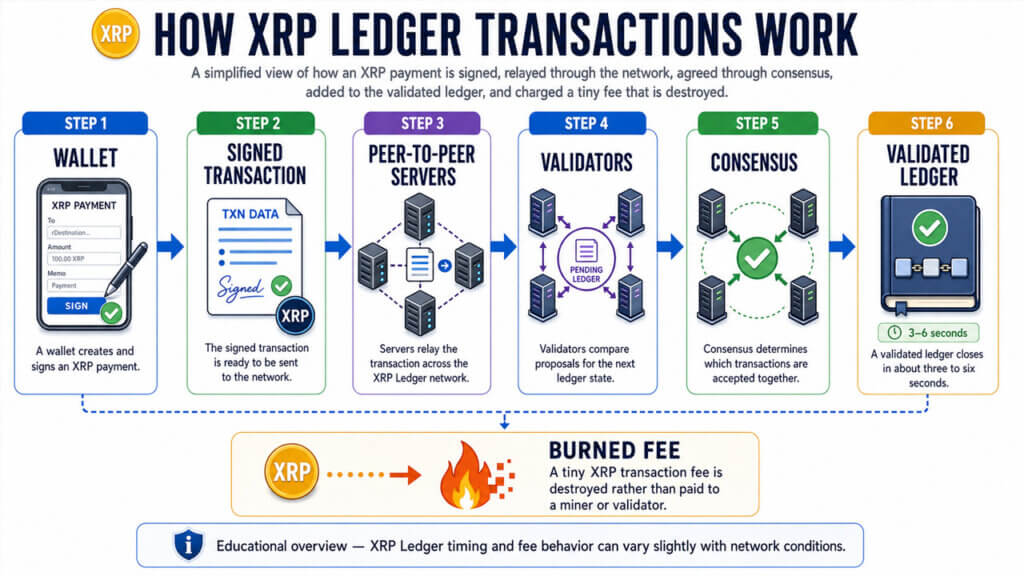
An XRP transaction starts when an account signs a payment with its private key. That signed transaction is then relayed across the XRP Ledger's peer-to-peer network, where validators evaluate whether it is valid and agree on the next version of the ledger.
| Stage | What Happens |
|---|---|
| Signing | A wallet signs a transaction with the account’s private key |
| Relay | XRP Ledger servers share the transaction across the peer-to-peer network |
| Validation | Validators evaluate candidate transactions and proposed ledger changes |
| Consensus | Servers compare proposals from trusted validators until the network agrees on a ledger version |
| Settlement | A validated ledger closes and the transaction becomes final on the ledger |
The XRP Ledger does not use mining. Instead, it uses a consensus process where each server maintains a Unique Node List, or UNL, which is a list of validators it trusts not to collude. That list determines whose votes a server counts during consensus. The result is a network that can finalize transactions in seconds without requiring anyone to solve computational puzzles.
That model is faster and cheaper than proof-of-work systems, but it has a different security shape. The health of the network depends on validators being diverse and genuinely independent. Server operators who choose a validator list are effectively choosing who they trust, which means the decentralization of XRP Ledger is a function of how broadly those lists are distributed across independent parties.
XRP Transaction Flow Diagram
What XRP Is Used For
XRP has four practical uses on the XRP Ledger: paying transaction fees, funding account reserves, moving value between accounts, and acting as bridge liquidity inside payment paths.
Transaction fees are the most mechanical of these. Every transaction destroys a small amount of XRP rather than paying it to validators. This prevents spam and avoids creating a fee market where validators profit from transaction revenue, which is one of the clearest design differences between XRP and most smart-contract networks.
Account reserves are a related concept. To use the XRP Ledger, every account must hold a minimum amount of XRP. This reserve cannot be spent, but it can be unlocked if the account is closed. The reserve system keeps the ledger from being flooded with dormant accounts.
For peer-to-peer payments, XRP can move directly between any two XRP Ledger addresses without a bank, card network, or intermediary. The receiver only needs a valid XRP Ledger address and control of its private key.
XRP can also serve as bridge liquidity. In a payment path involving two assets with no deep direct market, XRP can fill the gap, connecting the two sides of the trade through the XRP Ledger's native decentralized exchange. XRP is not required for every XRPL payment, but it is always available as the protocol-layer bridge asset.
For live price data, CryptoSlate's XRP price page tracks market cap, volume, exchange listings, and related news.
How To Earn XRP
XRP does not have a native staking reward system. The XRP Ledger's consensus protocol does not pay validators for their work, and there is no new XRP issuance to distribute as rewards. That means every route to earning XRP goes through either direct payment or a third-party product.
Here is how those routes break down:
| Method | How It Works | Native Or Third-Party? | Main Risk |
|---|---|---|---|
| Exchange Earn products | Binance XRP Earn offers flexible or locked options — subscribe with XRP and review APR, lockup, and eligibility before committing. KuCoin Earn also lists XRP under flexible and fixed terms. Binance XRP Earn KuCoin Earn | Third-party exchange product | Custody risk, changing rates, regional limits, withdrawal restrictions |
| Savings or lending accounts | Nexo XRP Savings offers flexible and fixed-term options, daily payouts on flexible savings, and rates that vary by product and loyalty tier. Nexo XRP Savings | Third-party custodial product | Counterparty risk, platform solvency, lockups, variable rewards |
| XRPL AMM liquidity | A liquidity provider can deposit assets into an XRP Ledger AMM and receive LP tokens. AMM trading fees are a source of passive income for liquidity providers and can be redeemed through LP tokens. XRPL AMM docs | Native XRPL DeFi route | Price divergence, liquidity risk, LP token handling, issued-asset freeze risk |
| Direct payment in XRP | A person or business can earn XRP by accepting it as payment for work, sales, or services. Direct XRP payments are a one-transaction transfer between accounts with no intermediaries. XRPL direct XRP payments | Native payment activity | Price volatility, tax records, wrong address or destination tag |
| Faucets or giveaways | Treat faucets and giveaway claims as a cautionary category, not a recommended earning route. Many purported XRP giveaways are scams, and no legitimate promotion requires sending crypto first. Ripple giveaway warning | Third-party and usually unverified | Phishing, malware, tiny payouts, send-first scams |
Yields, eligible countries, minimum balances, lockups, and withdrawal rules can change, so check the provider's current product page before depositing XRP.
Developer grants and hackathons can also pay builders in XRP, but these are program-specific and not a standing earning route. XRPL Grants applications were closed as of early 2026, with new programming expected later in the year.
Can You Stake XRP?
No. XRP cannot be staked natively on the XRP Ledger. The network does not use proof of stake, and validators receive no XRP rewards for validating ledgers. There is also no new XRP issuance that could fund staking payouts, since the entire supply was created at launch and can only decrease over time as fees are burned.
Products marketed as “XRP staking” are generally custodial earn products, crypto liquidity lending products, promotional reward campaigns, or DeFi yield products involving XRP or wrapped XRP. The reward comes from a platform, borrowers, market makers, liquidity fees, or a campaign budget, not from XRP Ledger consensus.
Before using any XRP yield product, check the risk label. Custodial products add custody and counterparty risk. DeFi routes add liquidity, bridge, and issuer risk. Rewards can change without notice, fixed-term products lock funds, and withdrawals can be delayed or restricted. The label “staking” does not change the underlying mechanics.
XRP Supply and Tokenomics
XRP has a fixed maximum supply of 100 billion units. The XRP Ledger does not create new XRP through mining rewards, staking rewards, or inflationary issuance. Supply can decline slowly because network transaction costs are destroyed.
Every transaction must destroy a small amount of XRP to protect the ledger from spam and denial-of-service attacks. The current minimum cost for a standard transaction is 0.00001 XRP, also called 10 drops, and costs can rise when network load increases.
XRP accounts also have reserve requirements. A reserve is a minimum amount of XRP that must remain in an account or be set aside for certain ledger objects. The current Mainnet base reserve is 1 XRP and the owner reserve is 0.2 XRP per item, and reserve settings can change through fee voting.
These small costs matter because XRP is not only a speculative asset. It is also the unit that keeps account creation, transaction submission, and ledger objects economically bounded. A person who wants to use XRPL directly needs enough XRP for fees and reserves, even when the payment or token activity involves another asset.
XRP Ledger Features Beyond Payments
The XRP Ledger was built for payments, but it includes more than basic value transfers. Three features stand out: a native decentralized exchange, automated market makers, and issued assets through trust lines.
The native DEX lets accounts trade XRP and issued tokens without deploying a smart contract. It supports an unlimited number of currency pairs, which are tracked on demand as trades happen. This is different from most DEX platforms where liquidity pools and contracts need to be set up in advance.
Automated market makers on the XRP Ledger work through two-asset pools. Liquidity providers deposit assets and receive LP tokens in return. Those LP tokens can be redeemed for a share of the pool plus accumulated trading fees. The AMM is built into the protocol, not an external application, which keeps it accessible without additional contracts or token approvals.
Issued assets work through trust lines. A trust line is an account-level relationship that lets one account hold a token issued by another. This is how fiat-linked tokens, stablecoins, and other tokenized balances exist on the XRP Ledger. An account can only hold an issued asset if it has an active trust line to the issuer, which gives users control over which non-XRP assets they accept but also adds a setup step compared to basic XRP transfers.
XRP Regulation and Legal Status
XRP’s legal status depends on jurisdiction, transaction type, and the way the asset is offered or sold. The most watched case was the U.S. Securities and Exchange Commission’s civil enforcement action against Ripple Labs, Bradley Garlinghouse, and Christian Larsen.
In May 2025, a U.S. district court ruling held that Ripple’s institutional XRP sales constituted unregistered offers and sales of investment contracts, while other secondary offers and sales did not.
On Aug. 7, 2025, the SEC announced a joint stipulation dismissing the SEC appeal and Ripple cross-appeal. The dismissal resolved the civil enforcement action, with the final judgment imposing a $125,035,150 civil penalty against Ripple and an injunction remaining in effect.
That does not make XRP legally identical in every market. It means the high-profile U.S. case reached a procedural endpoint, with the final judgment left in place. Exchanges, brokers, funds, and payment companies still have to evaluate XRP under local rules, product rules, custody obligations, and compliance policies.
XRP Risks and Limits
XRP carries several distinct risk categories. Understanding them separately is more useful than treating XRP as either safe or risky as a blanket judgment.
Price volatility is the most immediate risk. XRP can move sharply in both directions, and payment utility does not remove market risk. Liquidity, exchange listings, legal developments, macro conditions, and sentiment can all affect price independent of any change in network usage.
Custody risk depends on how XRP is held. Exchange custody means depending on the exchange for access, security, and withdrawals. Self-custody means controlling the key material and taking on the risk of losing it. CryptoSlate's XRP wallet guide covers cold, hot, mobile, and XRPL-native wallet options.
Validator-list risk is specific to XRP Ledger's consensus model. The network does not depend on mining power or staked coins, but it does depend on validator-list diversity. If a significant share of the network's servers trust the same small group of validators, the decentralization argument weakens. This risk is different from Bitcoin mining concentration or Ethereum validator concentration, but it is real.
Supply perception is a persistent market concern. The fixed 100 billion cap is clear, but Ripple's escrow releases and early allocation still factor into how market participants evaluate XRP. This does not make the supply unlimited, but distribution and release timing remain part of the asset's market story.
Adoption risk is the most strategic. XRP's payment use case requires banks, fintechs, or payment companies to actively choose it over stablecoins, correspondent banking upgrades, central bank systems, or other blockchains. Ripple has enterprise relationships, but adoption still competes with other routes, and XRP usage has no guarantee of growth.
How to Get Started With XRP
Start with the market data before choosing a product. CryptoSlate's live XRP market data shows price, volume, market cap, exchanges, and related news in one place.
For buying, compare platforms by jurisdiction, fees, liquidity, custody controls, and withdrawal support. CryptoSlate's crypto exchange rankings and beginner exchange picks are better starting points than choosing by brand recognition alone. The how to buy XRP guide walks through the specific steps.
For storage, decide whether you need self-custody, exchange custody, cold storage, mobile access, or XRPL-specific tools like trust lines. If you want to spend or borrow against XRP through a card product, CryptoSlate's XRP card options compare regional access, fees, conversion rules, and custody flow.
Before moving any real amount, do a small test transaction first. Confirm the address, network, tag requirements, wallet reserve, and exchange withdrawal rules. XRP settles quickly, but incorrect sends can still be difficult or impossible to reverse.
FAQs
Can you stake XRP?
No. XRP cannot be staked natively because the XRP Ledger does not use proof of stake and validators do not receive XRP rewards for validation. Any product calling itself XRP staking should be checked carefully. The reward usually comes from a third-party earn, lending, promotional, or DeFi product, not XRPL consensus.
How can you earn XRP?
You can earn XRP by accepting it as payment, using a third-party exchange Earn or lending product, or providing liquidity in an XRPL AMM. These routes are not native staking. Availability, eligibility, reward rates, lockups, and withdrawal rules can change, so check the current product terms before depositing or committing XRP.
Are XRP staking products real staking?
Usually no. Most “XRP staking” offers are custodial Earn products, crypto lending accounts, promotional rewards, or DeFi yield products that use XRP or wrapped XRP. The platform may pay rewards, but the XRP Ledger is not distributing validator or staking rewards. The main question is where the yield comes from and who controls the assets.
Can XRP be earned from faucets?
Faucets may exist, but they are not a reliable or recommended way to earn XRP. Payouts are usually tiny, and unverified faucet or giveaway sites can create phishing, malware, and send-first scam risk. A legitimate reward should not require sending XRP first or giving away seed phrases or private keys.
What is the safest way to hold XRP while earning rewards?
There is no risk-free way to earn rewards on XRP. Self-custody removes exchange custody risk, but it usually means giving up third-party yield. Custodial earn products add counterparty and withdrawal risk, while DeFi routes add liquidity and smart-contract or bridge risk. The safest approach is to compare the reward with the risk before committing funds.