

A Hong Kong-listed company wants to attract more than 10,000 BTC into a regulated asset management strategy, a target worth roughly $760 million at current prices.
While the number itself is jaw-dropping, it's the strategy's structure that reveals the true scope of this plan. Hong Kong is trying to become a place where large pools of Bitcoin capital can sit under local rules, inside a familiar financial system, without forcing Asian investors to rely on US ETFs or offshore exchanges for every serious allocation.
Li Lin, the founder of HTX (formerly Huobi), plans to move a trading system and investment team from his family office, Avenir Group, into Hong Kong-listed Bitfire Group. Bitfire is preparing a regulated Bitcoin-denominated strategy called Alpha BTC, with CEO Livio Weng saying the firm aims to attract more than 10,000 BTC from investors.
The strategy is expected to use derivatives tied to Bitcoin or BlackRock’s IBIT. Avenir has become one of Asia’s largest holders of US Bitcoin ETF exposure through a $908 million IBIT position.
As you can clearly tell from the size of this position, Asian capital already owns quite a bit of Bitcoin through Wall Street. Some of it sits in US ETFs, some sits with offshore platforms, and some is held by listed companies, family offices, and crypto-native investors who know the asset well but still need a structure their banks, auditors, boards, and regulators can understand.
Bitfire’s pitch is aimed at that gap: bring the capital closer to home, place it inside Hong Kong’s regulated market, and turn Bitcoin exposure from a side-door trade into something closer to local financial infrastructure.
Hong Kong wants the wrapper, not just the asset
The easiest way to understand the importance of this strategy is to separate Bitcoin from the wrapper around it.
Bitcoin itself trades globally. Anyone can look at the same price, send the same asset, and settle on the same network. But large investors rarely interact with it that directly. A family office, listed company, fund manager, or wealthy individual usually needs custody, execution, risk controls, audited statements, legal responsibility, and an involved regulator with clear guidelines.
That's why spot Bitcoin ETFs became such a powerful product in the US. They let investors buy Bitcoin exposure through a brokerage account, using familiar securities-market rails, with large asset managers and regulated custodians in the middle.
CryptoSlate has covered how Hong Kong-linked capital has already used that route, including the earlier disclosure of a $436 million IBIT position by Laurore Ltd. The US ETF wrapper solved one problem for global capital by making Bitcoin easier to own through traditional finance. However, it placed a large share of that access in the US market.
Hong Kong’s version is about local control over the wrapper. A regulated Hong Kong vehicle can speak to Asian investors in their own time zone, under regional rules, through a market they already use for equities, structured products, wealth management, and family-office capital. For a professional investor in Hong Kong, Singapore, Taiwan, and even mainland China, this affects which lawyers review the product, which banks touch the money, which courts have jurisdiction, and which government agencies regulate it.
Hong Kong has spent the past two years preparing for that role.
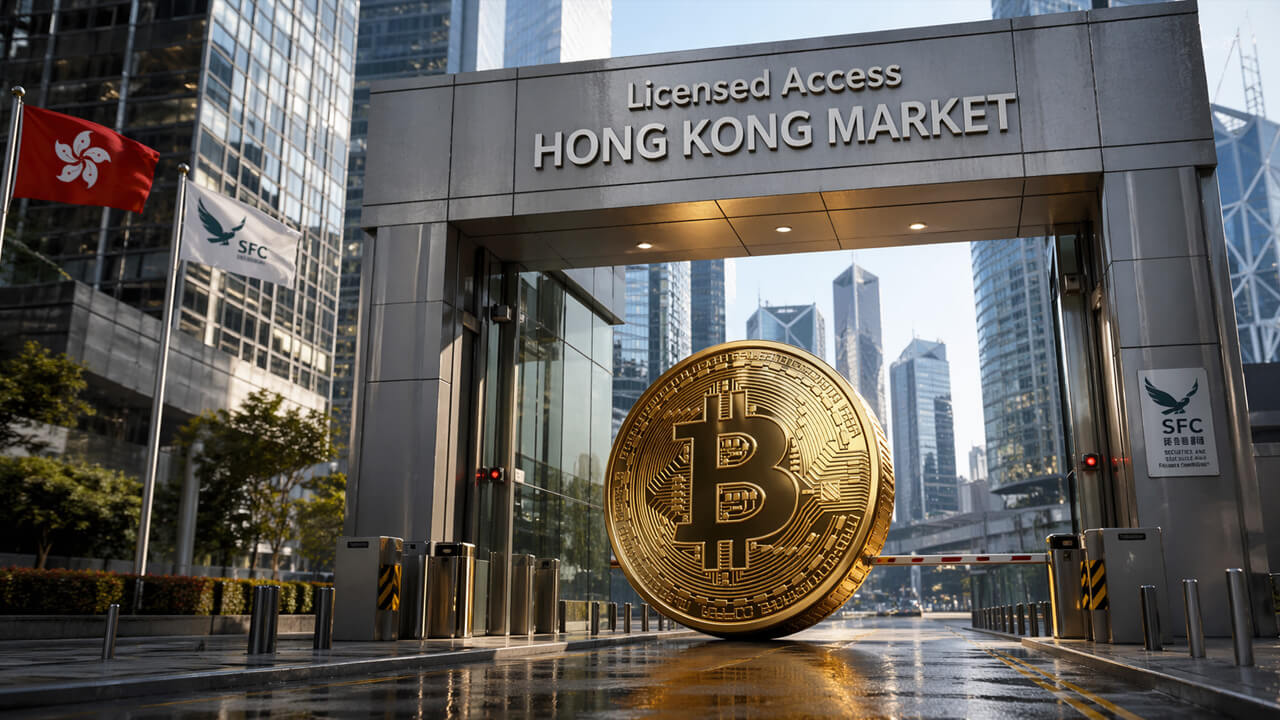
Its Securities and Futures Commission has licensed virtual asset trading platforms, expanded the room for regulated products, and tried to improve market liquidity by allowing licensed platforms to connect with global order books under new rules. In November, the SFC said it would let locally licensed platforms share global order books with overseas affiliates, a practical concession designed to make Hong Kong’s crypto market less isolated and more useful for serious capital.
The city is also focusing on stablecoins. Hong Kong passed a stablecoin bill in May 2025, creating a licensing framework for fiat-referenced issuers, and the regime went live in August of the same year. Standard Chartered, Animoca, and HKT were among the early names moving around the regulated HKD stablecoin race. Even though stablecoins sit in separate corners of the market, they point in the same direction as these Bitcoin derivatives: Hong Kong wants trading venues, stablecoin issuers, asset managers, and listed vehicles to operate under a rulebook it controls.
That gives Alpha BTC more weight than a standard product launch has. It's the biggest part of an even bigger effort to convert crypto from an offshore activity into regulated capital formation.
Bitcoin is global, but Bitcoin access is getting local
Bitcoin’s original promise was borderless money, but the largest pools of capital entering it now like borders around their exposure. They want a regulator, a listing venue, a custody arrangement, a legal claim, and a manager they can call when something goes wrong.
This causes a pretty tricky split: the asset can move globally in minutes, while the institutional structures around it move through local law, local politics, and local market habits.
That's where we'll see the geographic competition begin.
The US has dominated regulated access to Bitcoin through ETFs, with BlackRock’s IBIT serving as the symbol of Wall Street’s control of the trade. Offshore exchanges still dominate much of retail and derivatives activity, especially for users who want speed, leverage, and looser access.
Hong Kong is now trying to capture the third lane: Asian capital that wants regulated Bitcoin exposure without depending on US market infrastructure.
But why is this happening now? Hong Kong is competing for relevance as a financial center while Singapore, Dubai, the US, and Europe all build their own digital-asset regimes.
China’s mainland crypto restrictions remain strict, making Hong Kong’s role delicate yet very useful. It can serve as a controlled offshore venue for financial experimentation that Beijing would never allow at full scale. Hong Kong already launched spot crypto ETFs in 2024, expanded exchange licensing, pursued stablecoin rules, and explored broader virtual-asset products as part of a deliberate hub strategy.
There are limits to this, of course. A $760 million target is large enough to get attention, but minuscule next to the US ETF complex. Derivatives-based strategies carry their own risks, especially when returns depend on options, basis trades, volatility, and market timing. Hong Kong also has to manage the political tension between its crypto ambitions and Beijing’s discomfort with fast offshore digital-asset expansion. We've seen that play out last year when Chinese regulators reportedly asked some brokerages to pause real-world asset tokenization activity in Hong Kong.
Still, the direction Hong Kong is taking is pretty clear. Bitcoin adoption is entering a phase where the main problem is no longer whether institutions can buy the asset, but which system they use when they do.
If more Asian capital is held through Hong Kong-regulated structures, flows may start reacting to Hong Kong policy decisions, Asian wealth-management cycles, regional liquidity, and local investor behavior. Price discovery could become less US-centered over time, especially if Hong Kong products grow beyond passive exposure into lending, derivatives, structured income, and treasury management.
Bitcoin may trade as one global asset, but access to it is being sliced into national and regional wrappers. A US investor buying IBIT, a Hong Kong family office allocating to Alpha BTC, and an offshore trader using perps may all be expressing a Bitcoin view, but they're all doing it through different financial systems. Those systems shape who can enter, how fast money can leave, and what happens when regulators get nervous.
This is also why Hong Kong’s stablecoin push is so important. CryptoSlate has reported on Asia’s attempt to build a counterweight to dollar-dominated crypto rails, while its regulation map
showed how 2025 turned crypto law from a patchwork of warnings into a working set of national regimes.
A Bitcoin capital pool, a stablecoin license, a licensed exchange, and a listed asset manager all do separate things. Put them together, and they start to look like a local market structure.
Hong Kong’s wager is that Asia has enough Bitcoin demand to support those structures locally. The next phase of Bitcoin adoption will most likely be shaped by the financial systems those buyers choose. If Hong Kong succeeds, Asia will start building its own capital pool around Bitcoin, with its own rules, its own flows, and its own claim on the market.

Bitcoin is +0.79% over the past 24 hours and currently sits at rank #1 by market cap.
Mentioned in this article


Editorial credits