Exodus is a convenience-first self-custody hot wallet for people who want to manage everyday crypto activity across desktop, mobile, and browser. It suits users who want portfolio tracking, swaps, staking, NFTs, and light web3 access in one place more than they want a security-first setup from day one. Its biggest strength is that it brings portfolio tracking, swaps, staking, NFTs, and light web3 access into one interface. Because it is still a hot wallet by default, device security, approval habits, and backup hygiene matter a lot unless you pair it with supported hardware.
Strong desktop experience for users who want a clearer portfolio view than most mobile-first wallets.
Broad everyday feature set, including swaps, staking, NFTs, and web3 access in one interface.
Core wallet use does not require a normal account sign-up.
Custom-token support across 21 networks gives the wallet more flexibility than a simple mainstream-asset wallet.
Hardware-wallet support adds a safer signing path on supported Ledger and Trezor setups.
Cons
It is still a hot wallet by default unless paired with supported hardware.
Traditional 2FA is not available.
The wallet is only partially open-source.
Recovery still relies on a classic single-seed model rather than MPC, social recovery, or a more guided backup system.
Buy, sell, and swap pricing depends on third-party routes and can be harder to predict than a flat-fee model.
Who Exodus Is Best For — And Who Should Skip It
Exodus makes the most sense for people who want a daily-use self-custody wallet with a strong desktop experience, broad mainstream asset support, and built-in tools for swaps, staking, NFTs, and light web3 activity. It also works well for users who want optional hardware support without giving up a familiar interface.
It makes less sense for people who want software-only storage for large long-term balances, the lowest-cost execution for frequent swaps, or a wallet built around full source transparency and account-style safeguards. It is also a weaker fit for anyone who expects exchange-style recovery options or traditional 2FA.
Best fit
Why it fits
Who should skip it
Why it is weaker
Users who want one wallet across desktop and mobile
The product is built around a simple cross-platform experience
Users who want cold storage by default
Exodus is still a hot wallet unless paired with supported hardware
Users who want simple self-custody without account sign-up
Core wallet use does not require a normal account
Users who want traditional 2FA
Exodus does not offer traditional 2FA
Users who want easy portfolio tracking and occasional swaps
The interface is designed for convenience and broad utility
Users who want the cheapest swap execution
Built-in swaps are convenient, but often not the lowest-cost route
Users who want a familiar interface with optional hardware support
Supported Ledger and Trezor setups improve key isolation
Users who want a fully open-source wallet stack
Exodus is only partially open-source
Users who want one wallet for mainstream assets, NFTs, and light web3 use
Exodus combines these tools in one interface
Users who want universal cash-out and identical support on every chain
Off-ramp access and feature support vary by provider, network, and region
What Exodus Is and How It Works
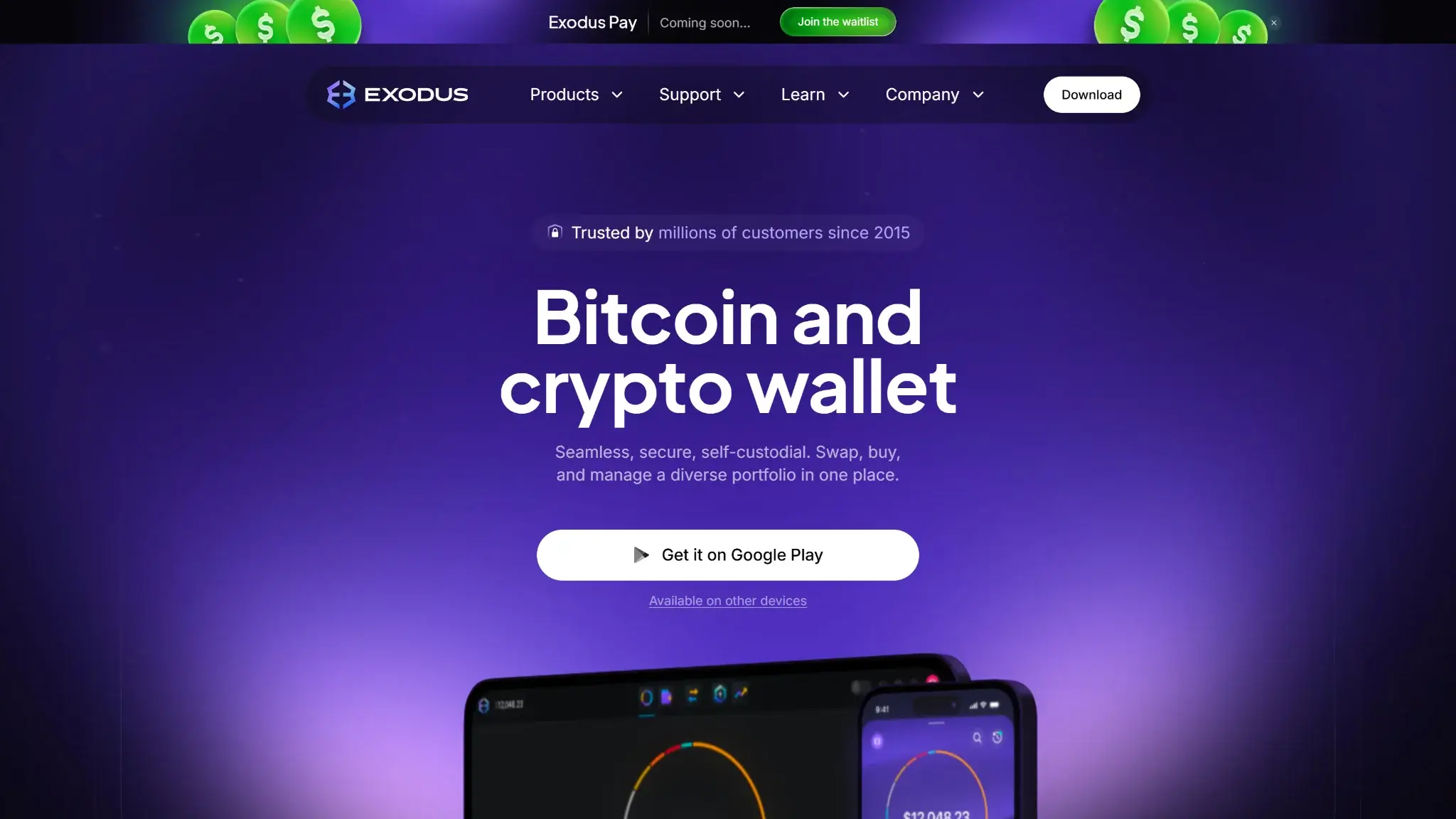
Exodus desktop homepage hero section promoting its Bitcoin and crypto wallet with a Google Play download button and device mockups.
Exodus is a self-custody software wallet built for desktop, mobile, and Chromium-based browser use. It started as a desktop wallet in 2015 and later grew into a broader wallet family with three main surfaces: Desktop, Mobile, and Exodus Web3 Wallet. It is built for everyday multi-chain self-custody in one interface, not for hardware-first cold storage or an exchange-style account.
Exodus is not a hosted account product. There is no standard username-and-password setup for basic wallet ownership, and the wallet is not a bank-style balance account. The wallet runs locally on the user’s device, while control stays with the user through a 12-word recovery phrase and, where supported, private key access.
Desktop is the strongest surface for portfolio visibility, asset management, and hardware-linked portfolios.
Mobile is better for quick access, transfers, and day-to-day convenience.
Exodus Web3 Wallet is the browser-extension layer for dApp connections, token management, and NFT activity on supported networks.
Feature support changes by surface, so Desktop, Mobile, Web3 Wallet, and hardware-linked portfolios do not all behave the same way.
Exodus Web3 Wallet can restore 12-word secret keys from Exodus, Phantom, and MetaMask, but Phantom and MetaMask addresses only restore when those addresses already have transaction history.
Users open Exodus through the app or extension and manage assets inside that interface. That includes holding crypto, receiving and sending funds, swapping assets, staking selected coins, viewing NFTs, connecting to web3 apps, and using supported buy, sell, and cash-out routes through third-party providers.
Transactions are approved inside Exodus when the wallet is used as software only. On supported Ledger and Trezor setups, the signing step moves to the hardware device, which gives users a safer approval flow while keeping the Exodus interface. As a result, users can keep the same everyday workflow while moving approvals to hardware on supported setups.
Exodus is clearly a non-custodial hot wallet. The user controls the recovery material, not a provider, and the wallet does not offer account-style recovery if that material is lost. You can recover the wallet without provider permission, but mistakes can still lead to permanent loss.
The recovery model is still fairly traditional. Exodus relies mainly on a 12-word recovery phrase, with some added flexibility through private key access and a Mobile encrypted secret-key backup option tied to the same OS family. That works well enough, but it is not the same as MPC, social recovery, or a provider-managed fallback path.
Wallet classHot software wallet
Who controls the keysUser
Recovery method12-word recovery phrase; Exodus Mobile also supports encrypted secret-key backup to iCloud or Google Drive protected with a passkey, limited to the same OS family
Can you export keys or seed?Yes, with limits. Private keys are visible on Desktop and Web3 Wallet; Mobile requires sync to Desktop first.
Portability to another walletEasy in principle through the 12-word recovery phrase or private keys, but partial in practice for some assets because derivation paths and multi-portfolio handling do not match everywhere
What happens if you lose the deviceYou can restore access with the 12-word recovery phrase. On Mobile, a valid encrypted secret-key backup can also help on the same OS family where that backup was created.
What happens if you lose the recovery methodWithout valid recovery data, there is no normal account-style recovery path. Losing or exposing the recovery phrase can mean permanent loss of control.
Who can help recover accessSupport can help troubleshoot, but it cannot restore the wallet without valid recovery data
Best use caseDaily self-custody, portfolio tracking, occasional swaps, and light web3 use
Exodus remains portable, but restores are not always seamless. If the app disappeared, the wallet would still be recoverable through the 12-word recovery phrase or private keys. The catch is that not every wallet handles the same derivation paths, asset support, or multi-portfolio setup the same way, so some restores may need private-key export instead of a simple phrase import.
Supported Assets, Networks and Compatibility
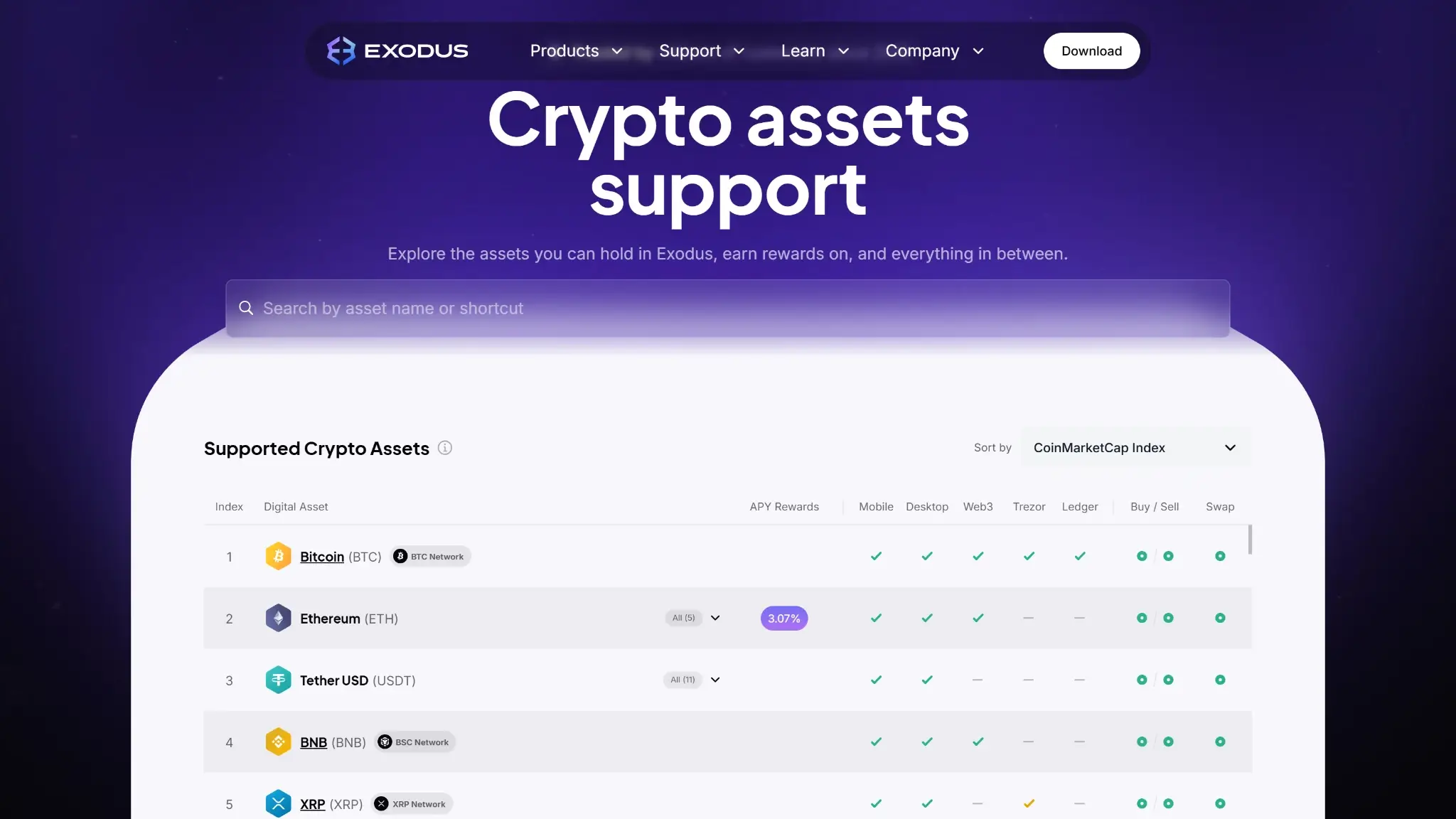
Exodus desktop supported crypto assets page showing the searchable asset list and support table for coins and tokens.
Exodus covers enough major chains and token types to work well as an everyday multi-chain wallet, but support is broad rather than uniform. It handles mainstream ecosystems well, yet the experience still changes by platform, token type, and hardware-linked setup.
Exodus is spread across several surfaces. Desktop, Mobile, Web3 Wallet, and hardware-linked portfolios do not all support the same actions, so support needs to be checked by platform instead of assumed across the whole wallet.
Major chains supportedBitcoin, Ethereum, Solana, BNB Smart Chain, Polygon, Arbitrum One, Optimism, Avalanche C-Chain, Base, Cardano, XRP Ledger, TRON, Algorand, and Tezos, plus broader support across 50+ networks
Token standardsNative assets plus custom tokens on 21 networks, including ERC20, BEP20, ASA, Cardano native tokens, SPL/Token-2022, TRC20, XRP Ledger tokens, and TON tokens
PlatformsWindows, macOS, Linux, iOS, Android, and Exodus Web3 Wallet for Chrome and Brave
Hardware supportTrezor on Desktop supports Model One, Model T, Safe 3, and Safe 5; Mobile supports direct integration with Safe 7; synced Trezor portfolios on Mobile are view-only for Model One, Model T, Safe 3, and Safe 5; Ledger in Exodus is Mobile only for Nano X and Flex
Connection methodsDesktop app, mobile app, browser extension, mobile web3 browser, WalletConnect v2, and supported hardware-wallet pairing
Notable gapsSupport is not identical across Desktop, Mobile, Web3 Wallet, and hardware-linked portfolios; TRON is not supported in Web3 Wallet; WalletConnect is not supported for Ledger in Exodus; Aurora, Flare, and Rootstock have light support in Web3 Wallet; Bitcoin ordinal NFTs are unsupported in-wallet
Mobile web3 access goes beyond basic WalletConnect. As of March 2026, the Mobile web3 browser covers Ethereum, Algorand, Arbitrum One, Avalanche C-Chain, Base, BNB Smart Chain, Cardano, Fantom, Optimism, Polygon, and Solana. Fantom support on these web3 surfaces is scheduled to end on August 1, 2026.
Web3 Wallet supports Bitcoin, Ethereum, Solana, Algorand, Arbitrum One, Aurora, Avalanche C-Chain, Base, BNB Smart Chain, Cardano, Fantom, Flare, Optimism, Polygon, and Rootstock. Aurora, Flare, and Rootstock are lighter-support networks, so balances appear correctly but full history handling is more limited inside the wallet. If an existing wallet is restored into Web3 Wallet, only assets on supported networks appear there, while unsupported-network assets remain accessible on Desktop or Mobile.
There are also chain-specific details that affect real use. Bitcoin multiple addresses are optional rather than automatic. XRP requires a base reserve and extra reserve for each token or Trust Line. Algorand tokens and ALGO NFTs require an opt-in transaction before receipt, and Cardano uses a non-standard derivation path in Exodus.
NFT support also comes with limits. Only still images display in the NFT Gallery. Some non-standard ERC-721 variants such as ERC-721A, ERC-721xyz, and ERC-721Enumerable are unsupported. That is enough for general wallet use, but it is not a complete NFT environment across every chain and hardware setup.
Core Features and Real-World Use Cases
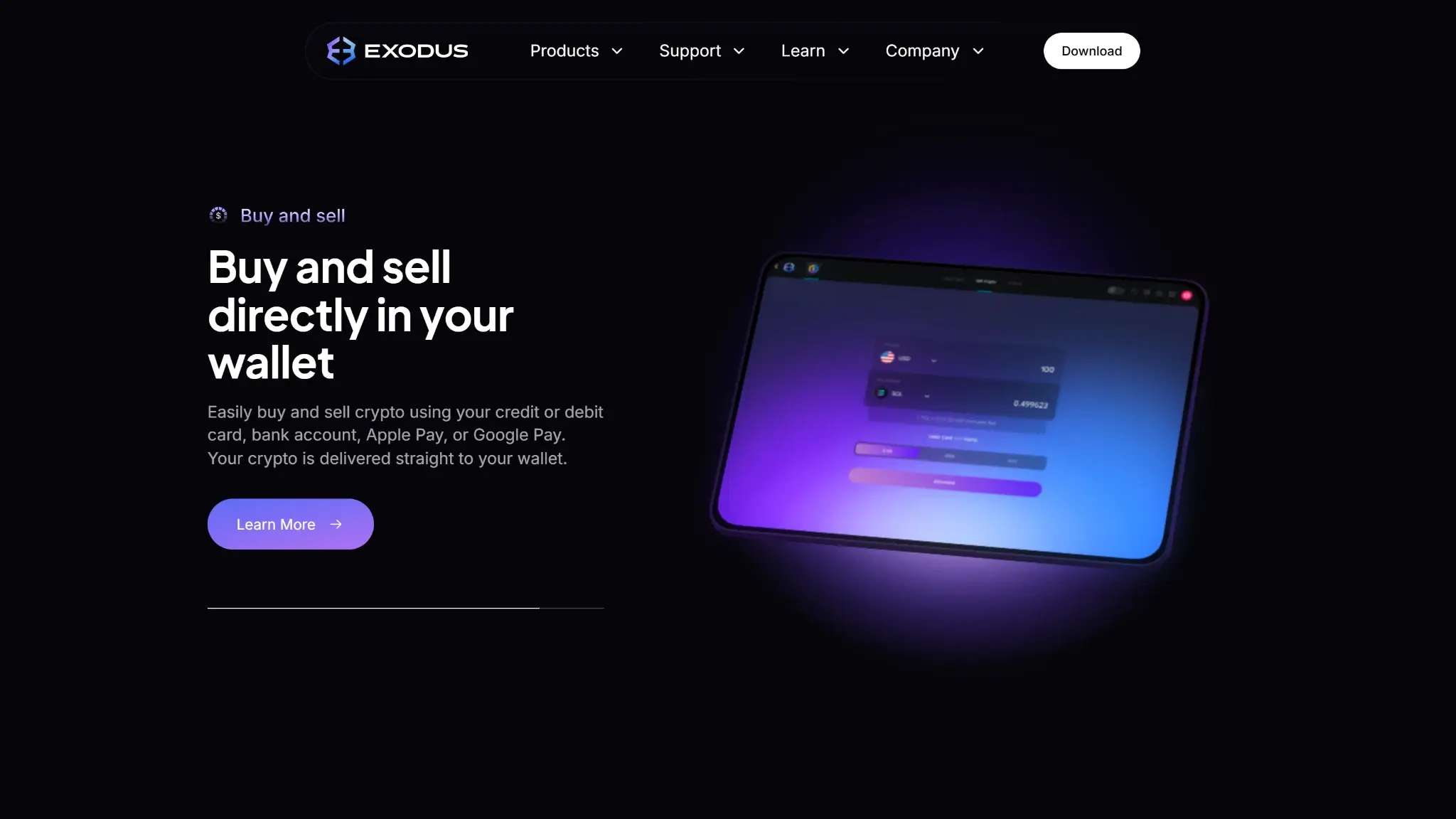
Exodus desktop buy and sell page showing in-wallet crypto purchases with card, bank account, Apple Pay, and Google Pay.
Exodus is broad and convenience-led. It works best for daily asset management, and it is less focused on deep security hardening. It feels like an everyday multi-chain wallet, not a power-user trading tool or a hardware-first storage setup. That makes it a better fit for users who want one interface for holding, moving, swapping, staking, and light web3 use, but it also means some features are uneven across Desktop, Mobile, Web3 Wallet, and hardware-linked portfolios.
Feature area
What users can do
How it works in practice
Key limitations, costs, or risks
Swaps and trading
Swap supported assets inside the wallet
Built-in wallet-to-wallet swaps route users through integrated swap flows without leaving Exodus
Total cost can include spread, provider pricing, route economics, minimums, and network fees; built-in swaps are often less competitive than exchange spot trading
Staking and earn
Stake selected assets including AXL, ETH, APT, ADA, ATOM, INJ, KAVA, MATIC, SOL, and XTZ
Staking support depends on the asset and surface; some assets are available on Mobile and Desktop, while ADA, MATIC, and SOL also extend to Web3 Wallet in supported cases
Asset support is much narrower than the full wallet asset list; lockups, unstake delays, and reward timing vary by chain; Trezor staking is not supported
dApp access and connectivity
Connect to web3 apps and manage supported on-chain activity
Exodus Web3 Wallet handles browser-based dApp access, while Exodus Mobile supports both a built-in web3 browser and WalletConnect by QR scan, pasted link, or mobile linking
Ledger in Exodus does not support WalletConnect; support is not identical across all surfaces; phishing and malicious approval risk still matter because Exodus is a hot-wallet environment
NFTs
Store and view supported NFTs
NFTs are handled through the wallet interface and gallery on supported networks
Only still images display in the NFT Gallery; some non-standard ERC-721 variants are unsupported; Trezor portfolios cannot manage NFTs in Exodus; Bitcoin ordinal NFTs are unsupported in-wallet
Exchange and account features
Buy crypto, sell crypto, and cash out where supported
Fiat access depends on third-party providers inside the wallet rather than a built-in exchange balance model. Current buy routes include Banxa, Blockchain.com Pay, BTC Direct, MoonPay, PayPal, Ramp Network, Robinhood Connect, and XO Pay. Current direct sell support is through MoonPay.
KYC can apply through providers; pricing, payout methods, and regional support vary; bank cash-out is not universal
Smart account, MPC, or passkey features
Use a passkey-protected Mobile backup flow, but not MPC or smart-account features
Exodus Mobile can back up an encrypted secret key to iCloud or Google Drive and protect that backup with a passkey
This is not MPC, social recovery, gas abstraction, or batched smart-account behavior; the backup flow is Mobile only and limited to the same OS family
The feature set works well for users who want one wallet for the tasks they actually do every week. The stronger parts are portfolio tracking, send and receive flows, supported swaps, selected staking, NFT viewing, and the option to connect a supported hardware device while staying inside the Exodus interface.
Friction shows up when Exodus relies on outside services or when support changes by surface. Buy, sell, and cash-out flows depend on third-party providers, and the broader web3 story is functional rather than deep. Exodus covers the basics well, but it is a better fit for smooth general use than for lowest-cost execution, full NFT tooling, or a more advanced account model.
Fees and Total Cost Of Ownership
Exodus does not charge a basic custody fee to hold assets, but the full cost picture is wider than that. Users still pay blockchain network fees when they move assets, and they can also face routing spreads, provider fees, and off-ramp charges depending on which wallet features they use.
Cost component
What users pay
When it applies
Notes
Device or wallet price
Wallet software is free for core use
Ongoing use
External hardware devices are a separate purchase if you choose a supported Ledger or Trezor setup
Shipping and import costs
Not applicable to Exodus itself
Not applicable
External hardware costs are outside the wallet software and are not disclosed here
Network fees
Variable
Sending, swapping, staking, and unstaking
Chain dependent; some networks allow fee adjustment
Swap spread or routing fee
Variable. Swap fee can start as low as 0.5%, but total cost depends on route, provider, liquidity, and network fees.
Swaps
Costs can include spread, route economics, liquidity conditions, provider pricing, and network fees
On-ramp fee
Variable by provider, region, payment method, and market conditions; shown before confirmation.
Buying crypto with fiat
Provider dependent and affected by country and payment method
Withdrawal fee
Variable by provider, region, payout method, and market conditions; shown before confirmation. Current direct sell in Exodus is through MoonPay.
Selling crypto or cashing out
Provider dependent; bank payout support is not universal
Subscription or premium fee
Not applicable
Not applicable
No subscription tier is described in the review
For ordinary holding and sending, the cost structure is straightforward. The software itself is free, while the user pays the blockchain when moving assets. Costs become more noticeable when Exodus is used as a convenience layer for swaps, staking actions, fiat purchases, or cash-outs.
For that reason, Exodus works well for holding, sending, and occasional in-wallet actions, but it is less appealing for users who care a lot about execution cost. The real question is whether the simplicity of built-in routes is worth paying more than you might pay through an exchange or another outside service.
Exodus is non-custodial, so keys are created locally and stay under user control, but it is not built like a security-first wallet. The wallet is still hot unless a supported hardware device handles signing. Most of the real risk sits at the device, approval, phishing, and backup level.
Key control modelNon-custodial; keys are generated locally and controlled by the user
Recovery model12-word recovery phrase, plus Mobile encrypted secret-key backup protected with a passkey on the same OS family
External validationPublic bug bounty and coordinated vulnerability disclosure through HackerOne; no clear public audit record for the whole wallet
Open-source statusPartial, not fully open-source
Anti-scam protectionsWeb3 warnings are present; scam guidance is explicit; phone and Telegram support do not exist; legitimate support will not ask for the 12-word phrase, password, private keys, or sync QR code
Incident postureMost day-to-day risk comes from user-side compromise or scam exposure. Exodus does maintain a public disclosure and bug bounty posture.
Exodus supports local security controls such as wallet passwords, passcodes, and biometrics depending on platform. Those tools help protect against casual local access, but they are not the same as traditional 2FA, and the wallet does not offer a full account-style approval stack. A polished interface can feel safer than it really is, so those controls should not be read as full protection against wallet compromise.
Web3 warnings help, but Exodus still lacks deeper approval management and built-in allowance control. It also does not have a clear public audit record for the whole wallet, which makes the security posture harder to assess than it would be with broader published validation.
Download verification is one useful safeguard. Desktop installers can be checked against official SHA256 release hashes, the release-hash list carries a PGP signature, and installers are signed with the official developer signature. That does not remove hot-wallet risk, but it does help users avoid fake or tampered downloads if they verify the installer before using it.
Private keys are visible on Desktop and Web3 Wallet, while Mobile requires sync to Desktop first. Mobile and Desktop on Windows and macOS block screenshots and screen recordings while private keys or the 12-word secret key are visible, but Web3 Wallet does not block screenshots when private keys are on screen.
Exodus is also not built around a normal account database. It can only access the information a user chooses to share with support. That improves privacy, but it also reinforces the normal self-custody rule: the provider cannot rescue funds just because the provider cannot see or control the wallet.
Backup, Recovery and Loss Scenarios
Recovery is one of the main limits here. Exodus is recoverable when the user keeps valid recovery data, but it still depends on the user doing that job properly. Support can explain steps and troubleshoot, yet it cannot reverse blockchain transactions or recreate missing recovery data.
Scenario
What usually restores access
What support can help with
When loss becomes permanent
Lost phone or lost computer
Restore the wallet with the 12-word recovery phrase on a new device; on Mobile, a valid encrypted secret-key backup can also help on the same OS family
Support can explain restore steps and basic troubleshooting
Loss becomes permanent if the device is gone and valid recovery data is also gone
Broken device
Restore from the 12-word recovery phrase, or use the Mobile encrypted backup path if it exists and the new device stays on the same OS family
Support can help with process questions, not with recreating backup data
Loss becomes permanent if the device fails and there is no valid recovery phrase or usable Mobile backup
Forgot local password, passcode, or biometric access
Valid recovery data remains the real fallback path
Support can help explain the recovery route, but cannot bypass the wallet’s local security for you
Loss becomes permanent if local access is lost and there is no valid recovery method
Lost or exposed recovery phrase
There is no account-style fallback if the recovery phrase is gone; if it is exposed, the wallet can be compromised
Support cannot replace a lost 12-word phrase or secure already exposed recovery data
Permanent loss or theft risk begins once the valid recovery method is gone or compromised
Overwrote an old Desktop wallet
Recovery can still work if the older wallet data has not been permanently erased
Support can explain recovery steps and wallet-file handling
On Desktop, old wallet backup files are only kept for 90 days after overwrite
Company shutdown or service outage
Funds remain recoverable through the 12-word recovery phrase or private keys in another self-custody wallet
Support cannot preserve access if services are offline and the user has no valid recovery data
Loss becomes permanent if recovery data is missing or the replacement wallet cannot handle the needed derivation path and private-key export is not available
Need to restore from a cloud-linked Mobile backup
Exodus Mobile can restore from an encrypted secret-key backup protected with a passkey
Support can explain the process and common errors
This path does not help if the backup was never created or if the restore falls outside the same OS family
If you keep valid recovery data, Exodus is recoverable. If you lose it, support cannot fix the problem. The wallet does add some convenience through its Mobile encrypted backup flow, but it does not offer a broader recovery system such as MPC or social recovery.
Users who expect account-style resets should pay close attention here. Exodus can help with setup issues, restore guidance, and wallet troubleshooting, but once the recovery path is gone, support has no way to restore ownership.
UX, Performance and Platform Support
Exodus is one of the cleaner mainstream self-custody wallets to use, especially on Desktop. The interface makes balances, portfolios, and common actions easier to follow than in many mobile-first wallets. That is useful for people who want visibility and convenience, but feature parity and deeper security controls are not equally strong across the product.
The main UX issue is not clutter. It is feature parity. Desktop is the strongest environment for portfolio visibility and hardware-linked portfolios, Mobile is the easiest for quick access and daily transfers, and Exodus Web3 Wallet handles browser-based dApp use. The split is manageable, but the wallet family does not feel identical across devices.
Platform
Availability
Notes
iOS
Yes
iOS 16+ on iPhone 8+ is the minimum; iOS 18+ on iPhone 11+ is the stronger fit for current use. Mobile also supports encrypted secret-key backup to iCloud with passkey protection.
Android
Yes
Android 10+ with 4 GB RAM is the minimum; Android 12+ with 6 GB RAM is the stronger fit. Mobile also supports WalletConnect and the built-in web3 browser.
Browser extension
Yes
Exodus Web3 Wallet is built for Chrome and Brave. It can restore 12-word wallets from Exodus, Phantom, and MetaMask, but Phantom and MetaMask addresses only appear when they already have transaction history.
Desktop
Yes
Desktop support covers macOS 12+ on Intel or Apple Silicon, Windows 10+ 64-bit on x64 only, and 64-bit Linux on major distributions using x64 CPUs. 8 GB RAM is the minimum target for stable performance.
Web app
No
Exodus is app and extension based rather than a browser-accessed hosted wallet.
Signing is clear enough for everyday use, and it gets better when a supported hardware device handles approvals. Software-only use is convenient and fast, but it does not provide the same isolation as hardware-backed signing. More advanced users may also notice that Exodus favors smooth general use over deeper approval tooling.
Day-to-day performance is good, but feature gaps across surfaces create more friction than raw speed does. Common support issues tend to be failed updates, broken local installs, unsupported tokens, and region-based cash-out limits rather than a wallet that is fundamentally hard to use. Crypto wallet beginners will usually find Exodus easier to navigate than more technical wallets, while more advanced users may outgrow it once they want deeper web3 defenses, richer NFT handling, or a more security-centered workflow.
Customer Support, Documentation and Incident Handling
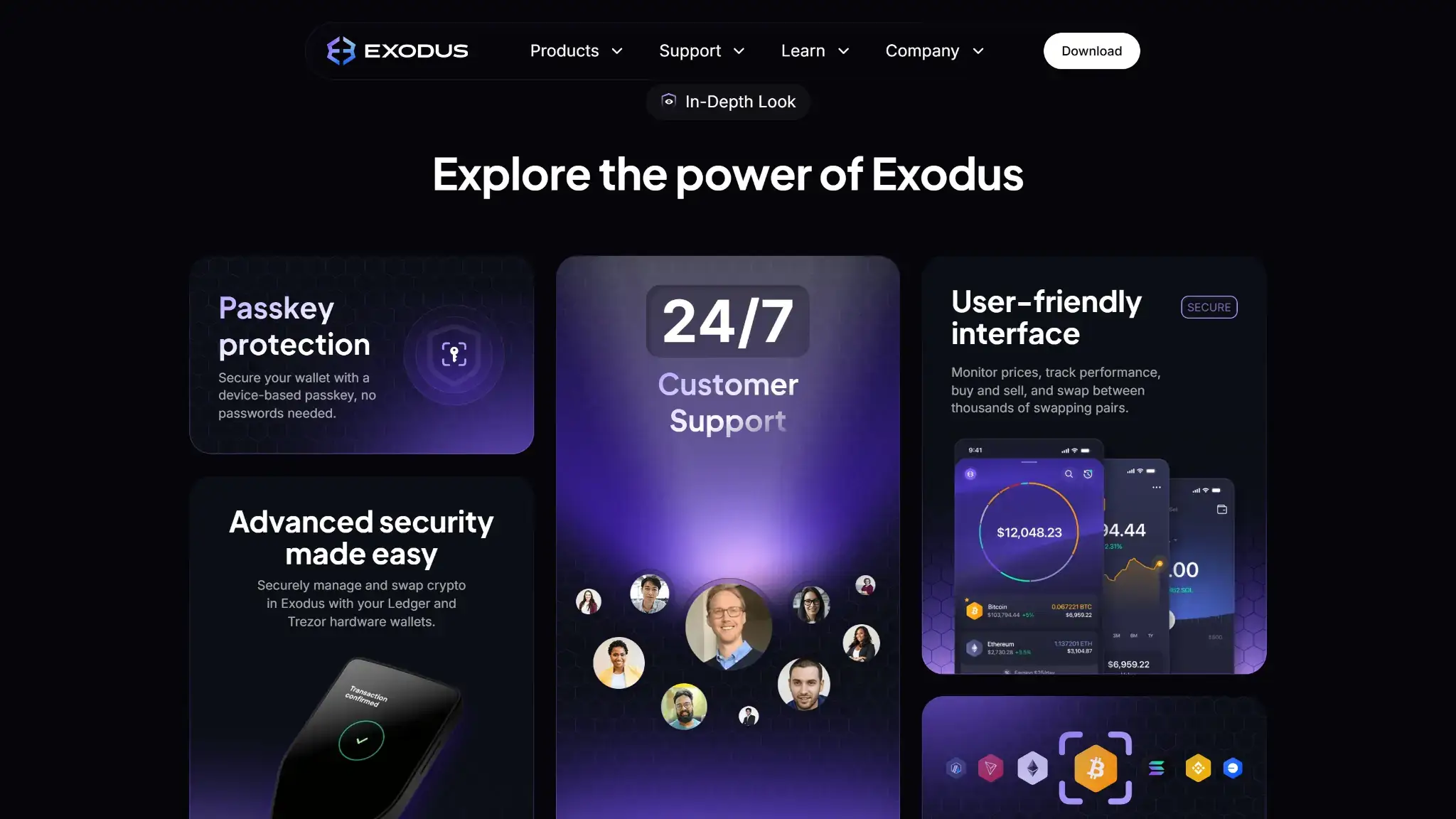
Exodus desktop features overview page highlighting passkey protection, 24/7 customer support, user-friendly interface, and hardware wallet security.
Exodus has extensive documentation. That matters because most support questions in self-custody are really about setup, recovery, chain compatibility, scam prevention, and feature limits rather than true account recovery. The help content covers setup, recovery, addresses, scams, swaps, taxes, staking, NFTs, hardware integration, and operating-system support, so it is more useful than a thin FAQ layer.
Human support still has clear limits. Exodus can help users understand features, troubleshoot wallet behavior, and point them away from scams, but it cannot reverse a confirmed on-chain transfer, restore a lost 12-word recovery phrase, or recover ownership after valid recovery data is gone. That line stays firm because Exodus is a non-custodial wallet, not a provider-controlled account.
Product updates, public community presence, and limited support routing
Official channels include X (@ExodusAssist for support, @exodus_io for updates), Discord, GitHub, YouTube, Reddit, Instagram, Facebook, and LinkedIn. Wallet-specific issues should still go to email.
Exodus handles incidents mostly through scam prevention and support guidance, not through account recovery. It gives clear scam guidance, warns users not to trust phone or Telegram impostors, and makes clear that real support will never ask for the 12-word phrase, password, private keys, or sync QR code. Many wallet losses come from fake support and phishing rather than from a direct wallet failure.
Final Verdict
Exodus is a polished everyday wallet for users who want broad multi-chain support and an easy cross-platform experience in one place. It is a strong fit for portfolio tracking, occasional swaps, selected staking, NFT viewing, and light web3 use. The trade-off is that it remains a hot wallet by default, with partial open-source visibility and fewer built-in safety controls than more security-focused alternatives.
Strong desktop experience for users who want a clearer portfolio view than most mobile-first wallets.
Broad everyday feature set, including swaps, staking, NFTs, and web3 access in one interface.
Core wallet use does not require a normal account sign-up.
Custom-token support across 21 networks gives the wallet more flexibility than a simple mainstream-asset wallet.
Hardware-wallet support adds a safer signing path on supported Ledger and Trezor setups.
CONS
It is still a hot wallet by default unless paired with supported hardware.
Traditional 2FA is not available.
The wallet is only partially open-source.
Recovery still relies on a classic single-seed model rather than MPC, social recovery, or a more guided backup system.
Buy, sell, and swap pricing depends on third-party routes and can be harder to predict than a flat-fee model.
Affiliate Disclosure
Disclaimer: CryptoSlate may receive a commission when you click links on our site and make a purchase or complete an action with a third party. This does not influence our editorial independence, reviews, or ratings, and we always aim to provide accurate, transparent information to our readers.
FAQ
Is Exodus custodial or non-custodial?
Exodus is non-custodial. The user controls the recovery phrase and, where supported, private-key access.
Is Exodus a hot wallet or a cold wallet?
Exodus is a hot software wallet by default because it runs on internet-connected devices. It becomes a stronger setup when a supported hardware device handles signing.
Does Exodus give you a seed phrase?
Yes. Exodus uses a 12-word recovery phrase, and Mobile also supports an encrypted secret-key backup option tied to the same OS family.
Is Exodus safe?
It can be reasonable for daily self-custody, but it is still a hot wallet. Device security, scam avoidance, approval habits, and backup hygiene all matter.
The wallet software itself is free. Users still pay network fees, and buy, sell, and swap features can include provider fees, routing spreads, and payout costs.
Does Exodus require KYC?
Not for core wallet use. KYC can apply when users rely on third-party buy, sell, or off-ramp providers.
What happens if you lose your device or recovery method?
If you lose the device but still have valid recovery data, you can restore the wallet. If you lose the recovery phrase or other valid recovery path, support cannot restore ownership for you.