Cover art/illustration via CryptoSlate. Image includes combined content which may include AI-generated content.
Circle, the issuer of USD Coin (USDC) stablecoin, saw its stock plunge 20% this week, erasing $5 billion in market capitalization in its steepest intraday drop since going public.
The sell-off happened on the same day Tether announced it had secured a ‘Big Four' accounting firm to undertake a full audit of USDT.
According to Mario Stefanidis of research firm Artemis, the sell-off was triggered by leaked regulatory drafts and unexpected wallet freezes, sending trading volume surging to 56.4 million shares. This is nearly four times the stock's 90-day average.
Yet, as the dust settles, a growing chorus of market analysts and institutional investors is calling the market’s reaction a severe miscalculation, arguing that the underlying fundamentals for the USDC issuer have never been stronger.
Circle's CRCL stock has posted a modest 3% recovery to $104 as of today's market open.
CLARITY Act yield rules hit a market already priced for little disappointment
The immediate catalyst was the reported arrival of new draft language for the highly anticipated CLARITY Act, which would ban passive stablecoin yield.
This means stablecoin users would be unable to earn rewards for simply holding a dollar-pegged token.
At the same time, exchanges and affiliated firms would be barred from offering yield, directly or indirectly, on stablecoin balances or through structures deemed economically equivalent to interest.
According to reports, activity-linked incentives would still appear to survive under the proposal, with US financial regulators, including the SEC and the US Treasury, given time to define the regulations.
The new text landed after a strong rally in Circle shares. The stock had climbed 170% from its February lows and had risen from $50 to $127 as investors responded to earnings, faster USDC growth, and optimism that regulated stablecoins would gain from tokenization, AI-linked payments, prediction markets, cross-border transfers, and 24/7 market structure.
At those levels, Circle was being valued for continued strength in reserve income, expanding adoption, and a smooth regulatory path.
However, the revised CLARITY language challenged one of the assumptions supporting that setup, especially for investors who had linked USDC growth to exchanges and brokers' ability to offer deposit-like rewards on idle balances.
Stefanidis said the market had repriced the entire stablecoin trade within hours. He said the draft exposed a business-model vulnerability, coming at a time when rates had already moved lower, and reserve yields were no longer offering the same support they had a year earlier.
According to him, the Fed's yield on reserves declined to 3.81% in the fourth quarter of 2025 from 4.49% a year earlier. That meant investors were already watching whether slower monetary support would weigh on reserve income before Washington’s latest draft added a new layer of uncertainty.
The selloff may have conflated Circle with its distributors
Meanwhile, several analysts argued the market’s first reaction to CRCL overlooked how Circle actually makes money.
Circle issues USDC, invests the reserves in short-duration US Treasurys and overnight repurchase agreements, and keeps the spread generated on those holdings. In the fourth quarter of 2025, its reserve income rose 60% from a year earlier to $711 million, driven by a 97% increase in average USDC supply.
Thus, its full-year 2025 revenue reached $2.7 billion, up 64%, while about 95.5% of revenue came from interest income on reserves.
Essentially, the bulk of the firm's revenue comes from interest earned on its reserves.
Given this, Bernstein analysts said CRCL stock investors should not conflate stablecoin issuers with distributors.
In their view, the proposed rules are aimed at platforms that pass yield through to users, not at issuers such as Circle that earn on reserve assets and do not directly pay holders for simply keeping tokens in their wallets.
That reading has led some investors to reach the opposite conclusion based on Tuesday’s price action.
Simon Dedic, managing partner of Moonrock Capital, argued the draft could strengthen Circle’s model by preserving its ability to retain reserve yield while narrowing the scope for others to compete on aggressive yield offers.
The Brian Armstrong-led exchange currently offers a yield of around 3.5% on USDC balances and shares a significant portion of its reserve income with Circle.
So, a narrower path for deposit-style incentives could force distributors like Coinbase to rework reward programs, loyalty systems, or activity-linked payments.
Market-moving headlines and context delivered every morning in one tight read.
5-minute digest 100k+ readers
Free. No spam. Unsubscribe any time.
Whoops, looks like there was a problem. Please try again.
You’re subscribed. Welcome aboard.
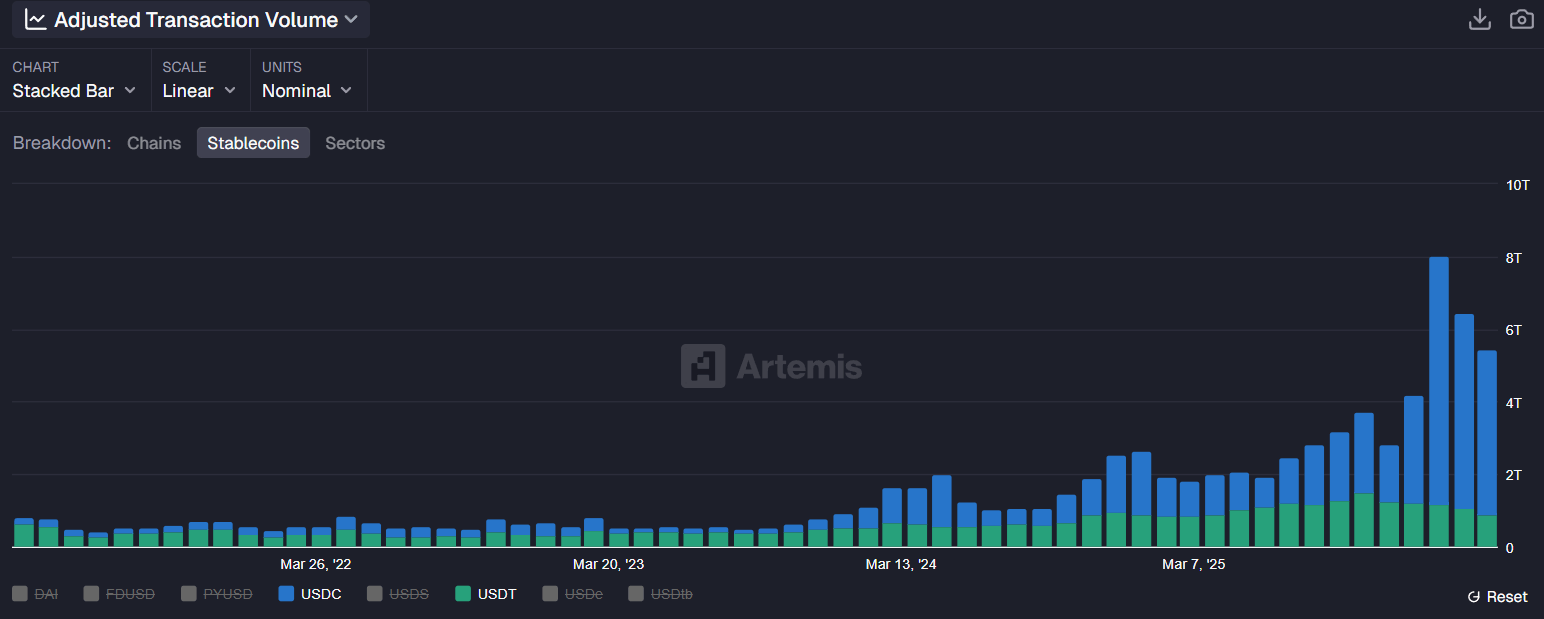
Data from Artemis shows that USDC circulation reached about $81 billion in late March, up from $76 billion at the end of 2025.
The asset's adjusted on-chain transaction volume totaled $6.8 trillion in the fourth quarter of 2025, more than double the level a year earlier.
USDC and USDT Adjusted Volume Ratio (Source: Artemis)
At the same time, the company has also been widening its commercial footprint. Circle recently announced an expansion into Africa through a partnership with Sasai Fintech and secured an integration with Intuit.
Those figures support the argument that USDC demand is no longer tied solely to passive yield, as other activities, such as cross-border settlement, trading collateral, and others, have all become larger parts of the stablecoin market.
That outlook also explains why Ark Invest stepped in during the selloff. Cathie Wood’s firm bought 161,513 Circle shares across ARKK, ARKW, and ARKF on Tuesday, a purchase worth about $16.34 million based on the closing price of $101.17.
Other pressures that shook confidence in Circle's CRCL stock
There are also arguments that the stock’s decline was amplified by two separate developments that added stress to an already fragile trading session.
The first was Tether’s move toward a full audit by a Big Four firm. The effort raised speculation that Tether could improve its standing in markets where Circle has benefited from being seen as the more tightly regulated and more trusted issuer.
Several investors read that as a possible challenge to one of Circle’s strongest positioning advantages in the US and Europe. Dedic argued:
“The race between Tether and Circle just got a lot more interesting.”
The second was Circle’s freeze of the USDC balances of 16 business hot wallets late Monday, disrupting operations at several exchanges, casinos, and foreign exchange platforms, including FxPro, Pepperstone, AMarkets, and HeroFX. The freeze was reportedly tied to a U.S. civil case whose details were not disclosed.
Blockchain investigator ZachXBT questioned the move, saying even basic onchain tools would have shown the addresses were operational business wallets handling thousands of transactions.
“In my 5+ yrs of investigations it could potentially be the single most incompetent freeze I have seen. This is what happens when you outsource your freezing decisions to literally any random federal judge instead of having a process”
What's next for Circle's CRCL?
For now, the market appears to be treating the draft's harshest possible interpretation as the base case. However, that may prove too severe.
Stefanidis noted that the policy direction is not entirely new because the Office of the Comptroller of the Currency (OCC) proposed implementation of the GENIUS Act pointed toward a regime in which payment stablecoin issuers could not offer interest or yield simply for holding tokens.
According to him, the argument in Washington is increasingly shifting toward what remains permissible around usage-based economics rather than whether passive interest-like rewards would survive intact.
Given this, analysts at Berinstein have maintained an Outperform rating on Circle with a $190 price target. At the same time, Clear Street also reiterated its buy rating for the stock and set a price target of $152.
Meanwhile, Bitwise CIO Matt Hougan argued that Circle's impressive position in the stablecoin market puts it at an advantage over the big banks that might enter the sector later.
Against that backdrop, he concluded that the stablecoin firm would be a $75 billion company by 2030.