Prop firms, also called proprietary trading firms, give traders access to company capital after a paid evaluation and split the profit. Traders keep 50% to 100% of what they make and risk only what they paid in fees. What separates one firm from another is not the split. It is the drawdown type, the consistency rule, the charges that land after the sticker price, and whether the firm has any evidence it pays. We score each firm below against those four things and print the score whether it flatters the firm or not.
Best Prop Trading Firms in 2026
- Evaluation fee
- Forex / CFD: From $32; Futures: From $154
- Max drawdown
- Forex / CFD: 8%; Futures: 1,500 USD
- Profit split
- Forex / CFD: 85%–90%; Futures: 90%
- Weekend holding on every CFD account
- Reserve's 1% consistency cushion, 51% not 50%
- No daily loss limit on the $25K Standard
- Evaluation fee
- From $20
- Max drawdown
- 3–6%
- Profit split
- 80%–90%
- Owned by Kraken's parent company, Payward
- Discloses its own conflicts in its terms
- Public payout leaderboard with totals
- Evaluation fee
- Forex / CFD: From $32.99; Futures: From $79.99
- Max drawdown
- Forex / CFD: Balance-Based Trailing (Closing Balance): 6%; Static (Initial Balance): 6–10%; Futures: 1,000–4,000 USD
- Profit split
- Forex / CFD: 70%–95%; Futures: 80%–95%
- Static loss floors on Stellar evaluations
- Flex removes funded consistency rules
- CFD and futures instant routes
- Evaluation fee
- Forex / CFD: From $59; Crypto: From $59; Futures: From $89
- Max drawdown
- Forex / CFD: 10%; Crypto: 6%; Futures: 2,000 USD
- Profit split
- Forex / CFD: 80%–90%; Crypto: 80%–100%; Futures: 80%
- Choice of raw or all-in spread feeds, free
- On-demand first CFD payouts
- Separate crypto accounts on 80+ assets
- Evaluation fee
- From EUR 79
- Max drawdown
- End-of-Day Trailing (Closing Balance): 10%; Static (Initial Balance): 10%
- Profit split
- 80%–90%
- Rules spelled out in more detail than any rival
- Repeatable free trial before you pay
- Selling evaluations longer than almost anyone
- Evaluation fee
- Forex / CFD: From $19; Futures: From $59
- Max drawdown
- Forex / CFD: 4–10%; Futures: 4%
- Profit split
- Forex / CFD: 50%–100%; Futures: 80%
- Funding traders since 2016
- Scaling ladder reaches $4,000,000
- High Stakes pauses on a daily breach
- Max drawdown
- 5–10%
- Profit split
- 80%–90%
- Trades run on your own Bybit sub-account
- Static maximum loss floor that never moves
- Split from 80%, up to 90% on One-Step and Two-Step
- Evaluation fee
- From $40
- Max drawdown
- 3–10%
- Profit split
- 80%–90%
- All 60 public payouts verified on Arbitrum
- Mirror trades across your own accounts
- Weekly stablecoin payouts from a $100 minimum
- Evaluation fee
- Forex / CFD: From $29; Futures: From $83
- Max drawdown
- Forex / CFD: Intraday Trailing (Real-Time Equity): 6–10%; Static (Initial Balance): 8–10%; Futures: Balance-Based Trailing (Initial Balance): 4%; End-of-Day Trailing (Initial Balance): 3–4%
- Profit split
- Forex / CFD: 90%–100%; Futures: 80%–100%
- Scaling ceiling of $4,000,000
- Aqua Elite adds $1,000 to $3,000 a month
- Ten CFD models and five futures types
- Evaluation fee
- Forex / CFD: From $23; Crypto: From $49; Futures: From $139
- Max drawdown
- Forex / CFD: Intraday Trailing (Real-Time Equity): 5–6%; Static (Initial Balance): 5–8%; Crypto: End-of-Day Trailing (End-of-Day Equity): 4%; Intraday Trailing (Real-Time Equity): 5–6%; Futures: 2,000 USD
- Profit split
- Forex / CFD: 60%–90%; Crypto: 70%–90%; Futures: 80%
- A missed payout deadline pays you 100%
- No reset fee on any of the 51 plans
- No arbitration clause or class waiver
- Evaluation fee
- From $29
- Max drawdown
- 6–10%
- Profit split
- 60%–90%
- No trailing model anywhere in the catalog
- Three platform options at no extra charge
- Free five-level scaling ladder, fully public
- Evaluation fee
- From EUR 0
- Max drawdown
- Intraday Trailing (Higher of Balance / Equity): 6%; Static (Initial Balance): 8–10%
- Profit split
- 80%–100%
- Most permissive rulebook in our 9-firm test
- Free $1K Challenge, a $0 evaluation
- Split reaches 100% at the third scale-up
- Evaluation fee
- From $40
- Max drawdown
- Static (Initial Balance): 6–10%; Trailing until 6% profit, then static (Real-Time Equity): 6%
- Profit split
- 50%–90%
- No deadline, minimum days or consistency rule
- Instant route doubles the balance at each 10%
- 1-phase floor locks for good at 6% profit
- Evaluation fee
- From $5
- Max drawdown
- Intraday Trailing (Real-Time Equity): 6–8%; Static (Initial Balance): 6%
- Profit split
- 80%–100%
- Cheapest entry we rate, $5 up front
- Reward Guarantee or they pay $1,000
- Eight account models, more than any rival
- Evaluation fee
- From $39
- Max drawdown
- End-of-Day Trailing (Closing Balance): 6%; End-of-Day Trailing (End-of-Day Equity): 4%; Static (Initial Balance): 4–10%
- Profit split
- 80%–90%
- Largest verified on-chain payout record we score
- 8 of 18 programs need no evaluation
- Smart Drawdown locks the floor after a 5% gain
- Evaluation fee
- From $5
- Max drawdown
- Intraday Trailing (Real-Time Equity): 6%; Static (Initial Balance): 6–8%
- Profit split
- 70%–95%
- 49 plans across eight families
- Catalyst ladder from $25,000 toward $1,000,000
- Crypto pairs well beyond BTC and ETH
CryptoSlate may earn a commission when you visit partner sites through links on this page, at no extra cost to you. Our rankings and reviews remain editorially independent and based on our published methodology. Read disclosure
Disclaimer: CryptoSlate may receive a commission when you click links on our site and make a purchase or complete an action with a third party. This does not influence our editorial independence, reviews, or ratings, and we always aim to provide accurate, transparent information to our readers.Prop Firm Comparison: The Best Prop Firms Scored
Sorted by CryptoSlate score. Every firm name links to the full review behind the number, and a drawdown cell naming more than one floor is written that way because the firm runs more than one across its range.
| Prop Firm | Launch year | Evaluation Type | Maximum Drawdown | Profit Split | First Payout |
|---|---|---|---|---|---|
 Blue Guardian Blue Guardian | 2021 (founded) | Forex / CFD: Two Step; Futures: Futures Evaluation | Forex / CFD: 8%; Futures: 1,500 USD | Forex / CFD: 85%–90%; Futures: 90% | — |
 Breakout Breakout | 2023 | One Step | 3–6% | 80%–90% | No waiting period at all. A payout can be requested as soon as net profit after the split clears $50, which can be the same day the account is funded. |
 FundedNext FundedNext | 2022 | Forex / CFD: Two Step, One Step, Instant; Futures: Futures Evaluation | Forex / CFD: Balance-Based Trailing (Closing Balance): 6%; Static (Initial Balance): 6–10%; Futures: 1,000–4,000 USD | Forex / CFD: 70%–95%; Futures: 80%–95% | — |
 FXIFY FXIFY | 2023 | Forex / CFD: Two Step; Crypto: One Step; Futures: Futures Evaluation | Forex / CFD: 10%; Crypto: 6%; Futures: 2,000 USD | Forex / CFD: 80%–90%; Crypto: 80%–100%; Futures: 80% | — |
 FTMO FTMO | 2015 | Two Step, One Step | End-of-Day Trailing (Closing Balance): 10%; Static (Initial Balance): 10% | 80%–90% | 14 calendar days |
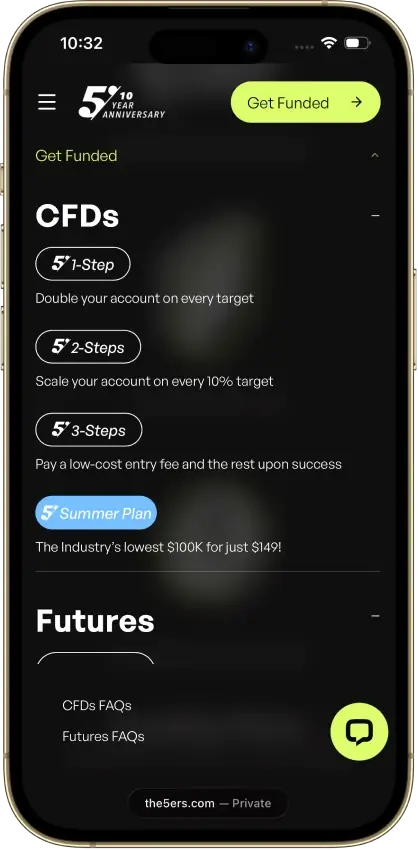
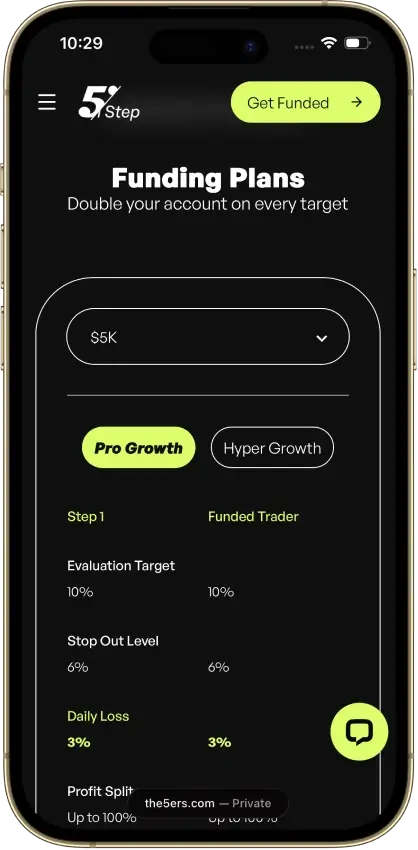
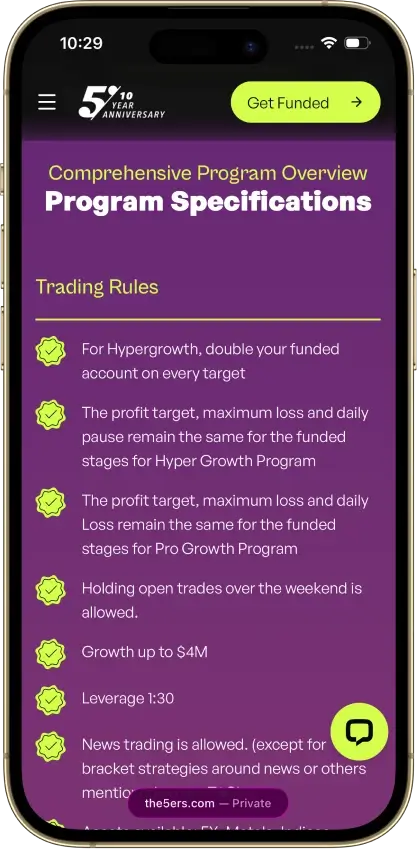
 The5ers The5ers | 2016 | Forex / CFD: One Step, Two Step, Three Step; Futures: Futures Evaluation | Forex / CFD: 4–10%; Futures: 4% | Forex / CFD: 50%–100%; Futures: 80% | 14 calendar days |
 HyroTrader HyroTrader | 2022 | Zero Step, One Step, Two Step | 5–10% | 80%–90% | As soon as the funded account is in profit |
 Velotrade Velotrade | 2026 | One Step, Two Step | 3–10% | 80%–90% | 14 calendar days |
 AquaFunded AquaFunded | 2023 | Forex / CFD: Two Step, Instant; Futures: Instant, Futures Evaluation | Forex / CFD: Intraday Trailing (Real-Time Equity): 6–10%; Static (Initial Balance): 8–10%; Futures: Balance-Based Trailing (Initial Balance): 4%; End-of-Day Trailing (Initial Balance): 3–4% | Forex / CFD: 90%–100%; Futures: 80%–100% | 14 calendar days |
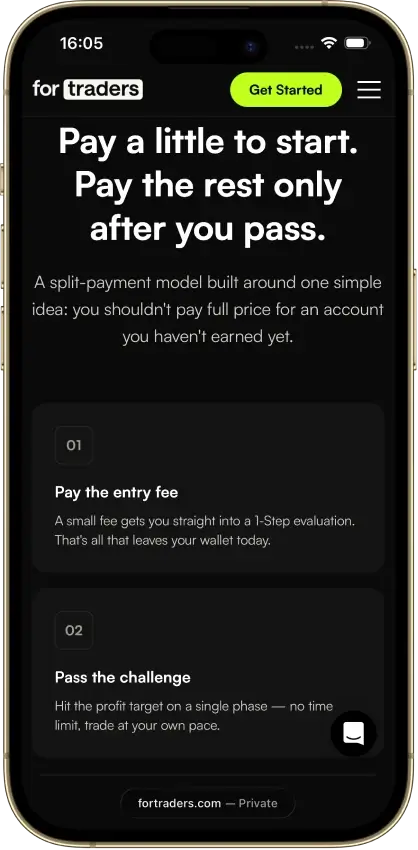
 For Traders For Traders | 2023 | Forex / CFD: One Step, Two Step, Three Step, Instant; Crypto: One Step, Instant; Futures: One Step, Instant | Forex / CFD: Intraday Trailing (Real-Time Equity): 5–6%; Static (Initial Balance): 5–8%; Crypto: End-of-Day Trailing (End-of-Day Equity): 4%; Intraday Trailing (Real-Time Equity): 5–6%; Futures: 2,000 USD | Forex / CFD: 60%–90%; Crypto: 70%–90%; Futures: 80% | 14 calendar days |
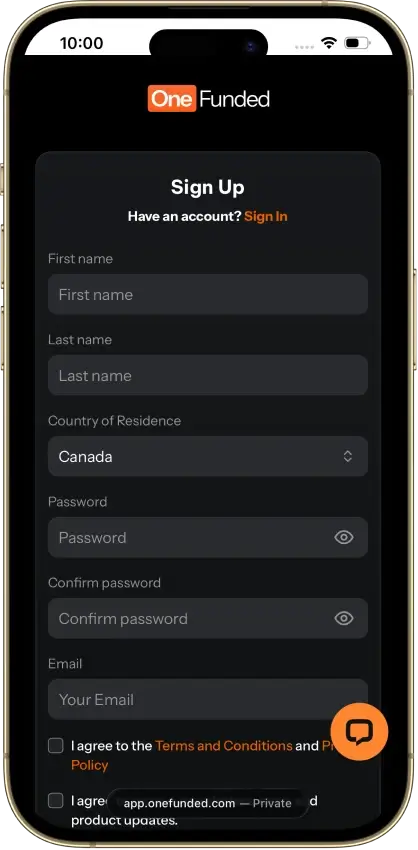
 OneFunded OneFunded | 2024 | Two Step, One Step, Instant | 6–10% | 60%–90% | 14 calendar days |
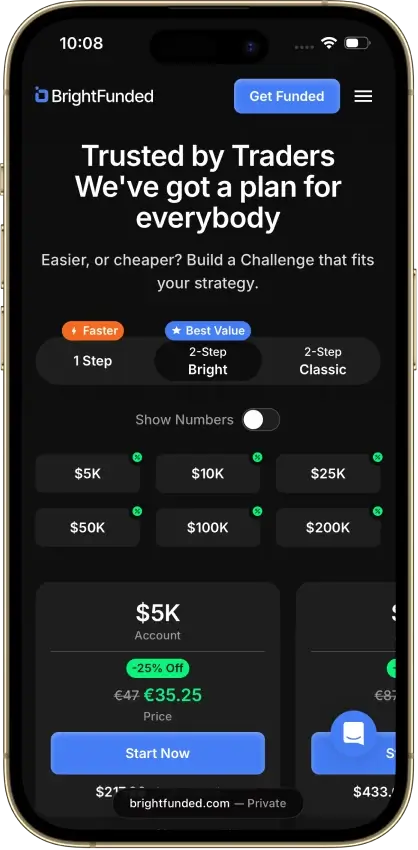
 BrightFunded BrightFunded | 2023 (founded) | One Step, Two Step | Intraday Trailing (Higher of Balance / Equity): 6%; Static (Initial Balance): 8–10% | 80%–100% | 30 calendar days |
 Crypto Fund Trader Crypto Fund Trader | 2024 | Two Step, One Step, Instant | Static (Initial Balance): 6–10%; Trailing until 6% profit, then static (Real-Time Equity): 6% | 50%–90% | 15 trading days |
 Goat Funded Trader Goat Funded Trader | 2023 | One Step | Intraday Trailing (Real-Time Equity): 6–8%; Static (Initial Balance): 6% | 80%–100% | 14 calendar days |
 Instant Funding Instant Funding | 2022 | Instant, One Step, Two Step | End-of-Day Trailing (Closing Balance): 6%; End-of-Day Trailing (End-of-Day Equity): 4%; Static (Initial Balance): 4–10% | 80%–90% | — |
 FundedElite FundedElite | 2023 | One Step, Two Step, Instant, A funded ladder of six to seven stages, each with its own paid reset | Intraday Trailing (Real-Time Equity): 6%; Static (Initial Balance): 6–8% | 70%–95% | — |
Two readings of cheapest are both honest, and they disagree. The lowest sticker price and the lowest cash out of pocket are different firms, because a pay-later route charges a small fee up front and an activation fee on passing that can exceed the price of buying an instant-funding account outright. A third reading, capital bought per dollar of fee, gives a third answer again.
The Best Prop Firms in More Detail
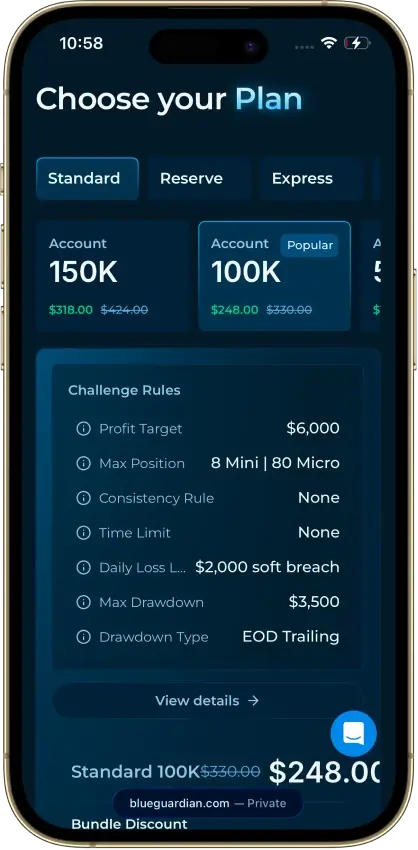
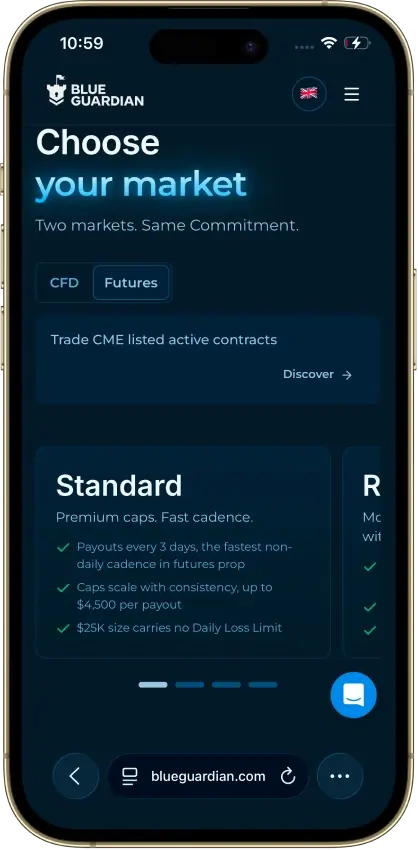
Blue Guardian
- Evaluation fee
- Forex / CFD: From $32; Futures: From $154
- Max drawdown
- Forex / CFD: 8%; Futures: 1,500 USD
- Profit split
- Forex / CFD: 85%–90%; Futures: 90%
Pros
- CFD entry fees start at $24
- Fee refund after the fourth CFD payout
- Up to 90% CFD profit split
- Instant CFD and futures funding
- $0 commission on indices and crypto
Cons
- Tighter CFD drawdown limits
- Guardian Shield can cut the split to 50%
- Funded CFD news window is restricted
- Funded leverage drops on some programs




Breakout
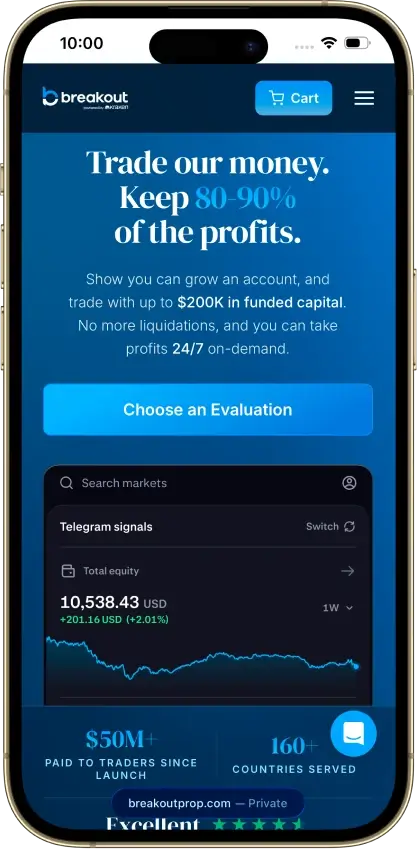
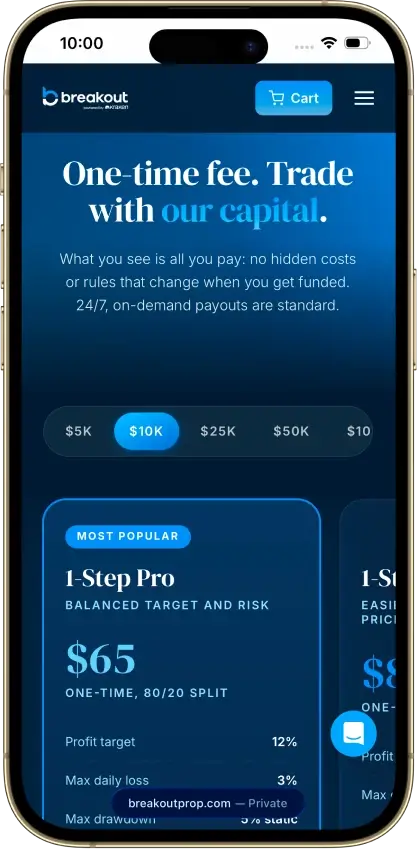
- Evaluation fee
- From $20
- Max drawdown
- 3–6%
- Profit split
- 80%–90%
Pros
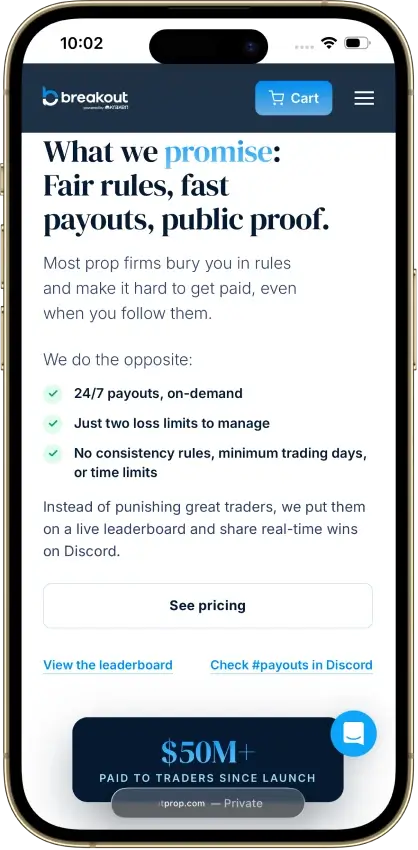
- Static drawdown on all three plans
- Payouts on demand 24/7, $50 minimum
- No consistency rule or minimum days
- News trading and weekend holds allowed
Cons
- Your order may never reach an exchange
- Evaluation fee is never refunded
- Leverage varies by coin, 2x on many alts
- No MetaTrader on either terminal
- Funded capital limited to $200,000 total

FundedNext
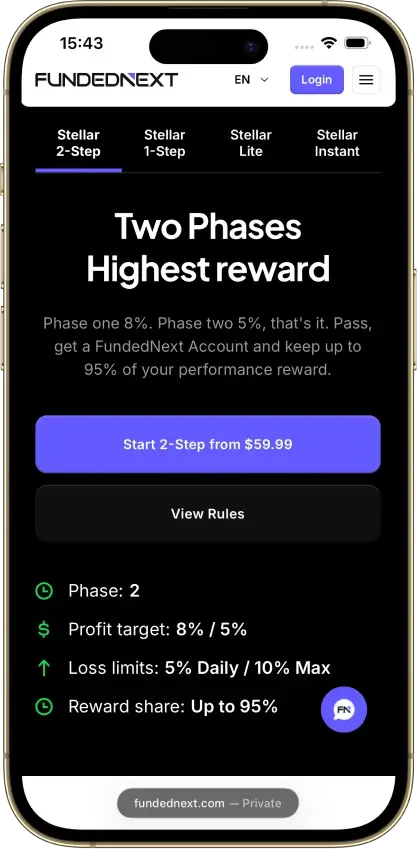
- Evaluation fee
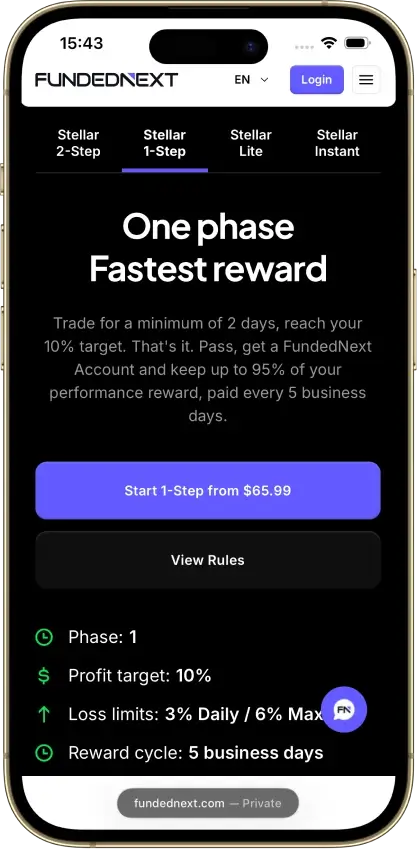
- Forex / CFD: From $32.99; Futures: From $79.99
- Max drawdown
- Forex / CFD: Balance-Based Trailing (Closing Balance): 6%; Static (Initial Balance): 6–10%; Futures: 1,000–4,000 USD
- Profit split
- Forex / CFD: 70%–95%; Futures: 80%–95%
Pros
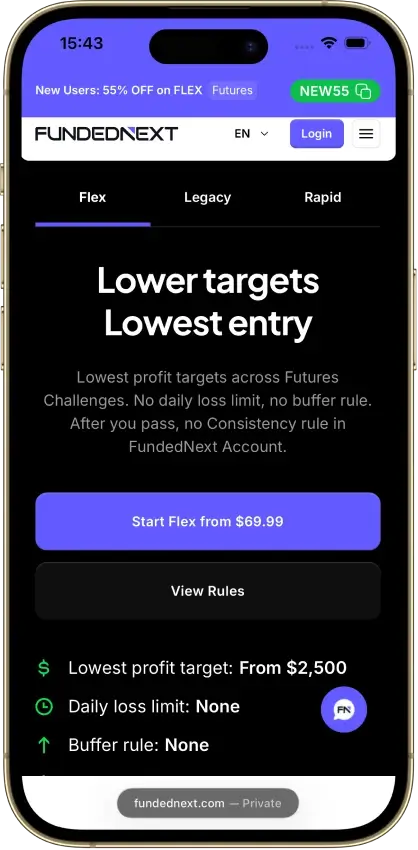
- Static overall loss on Stellar evaluations
- No funded consistency rule on Flex
- Tradovate, NinjaTrader and TradingView
- Lite standard challenge needs two days
- 2-Step fee return with first reward
Cons
- Flex limits requests to half the profit
- Flex concludes after five rewards
- Instant withdrawals shrink loss room
- Quick Strike can end funded CFD accounts
- Payout options cannot change after purchase


FXIFY
- Evaluation fee
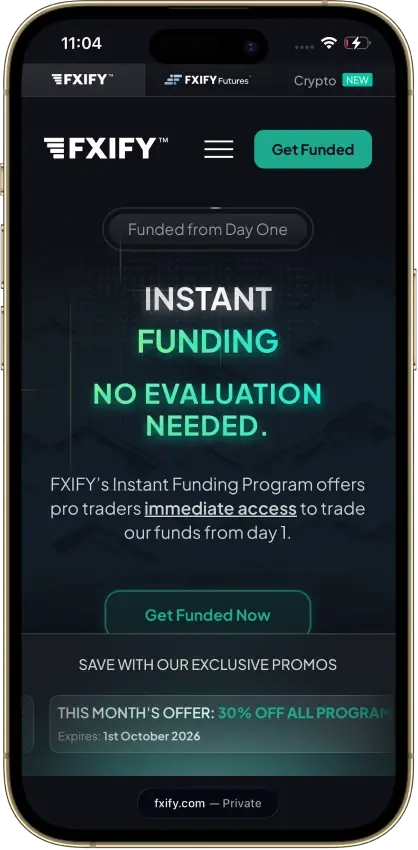
- Forex / CFD: From $59; Crypto: From $59; Futures: From $89
- Max drawdown
- Forex / CFD: 10%; Crypto: 6%; Futures: 2,000 USD
- Profit split
- Forex / CFD: 80%–90%; Crypto: 80%–100%; Futures: 80%
Pros
- Eight CFD account structures
- 60-day inactivity window
- CFD fees start below $40
- Fee refunds on most CFD programs
- TradingView as well as MT5 and DXTrade
Cons
- Monthly fee on Futures One Step
- Activation fee on Futures Standard
- Instant programs block news trading
- Only two futures program families
- Crypto and forex need separate accounts





FTMO
- Evaluation fee
- From EUR 79
- Max drawdown
- End-of-Day Trailing (Closing Balance): 10%; Static (Initial Balance): 10%
- Profit split
- 80%–90%
Pros
- Fee refunded in full at your first payout
- Static 10% max loss on the 2-step route
- No time limit on any evaluation
- 48,676 reviews, the largest base in prop
- MT4, MT5 and cTrader all supported
Cons
- Among the priciest evaluations anywhere
- 1-step floor rises, reset only by a payout
- 1-step fee is not refundable
- No weekend holding on Standard accounts





The5ers
- Evaluation fee
- Forex / CFD: From $19; Futures: From $59
- Max drawdown
- Forex / CFD: 4–10%; Futures: 4%
- Profit split
- Forex / CFD: 50%–100%; Futures: 80%
Pros
- Static drawdown on all five CFD programs
- No time limit to pass any challenge
- Entry from $19 for a 2-step $2.5K account
- Five CFD and two futures programs
- Overnight and weekend holding on CFD plans
Cons
- Refund terms conflict on its own page
- Futures drawdown trails, unlike CFD plans
- Splits start at 50/50 on two programs
- 30x leverage on three of five CFD plans
- Scaling resets the 14-day payout clock


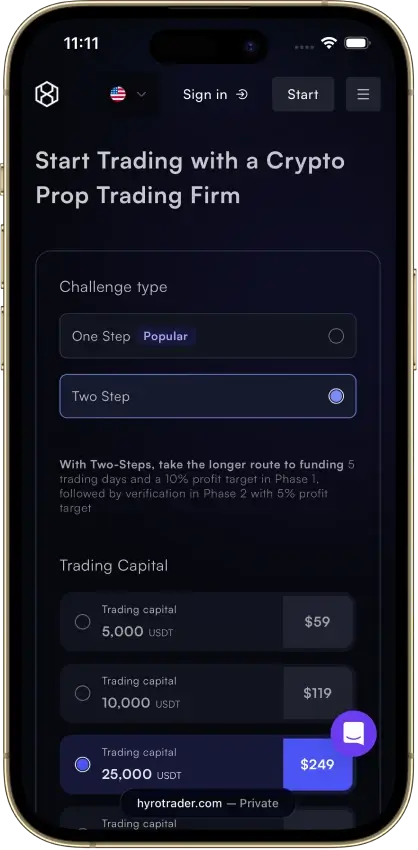
HyroTrader
- Max drawdown
- 5–10%
- Profit split
- 80%–90%
Pros
- No time limit on any evaluation phase
- No mandatory stop loss on any trade
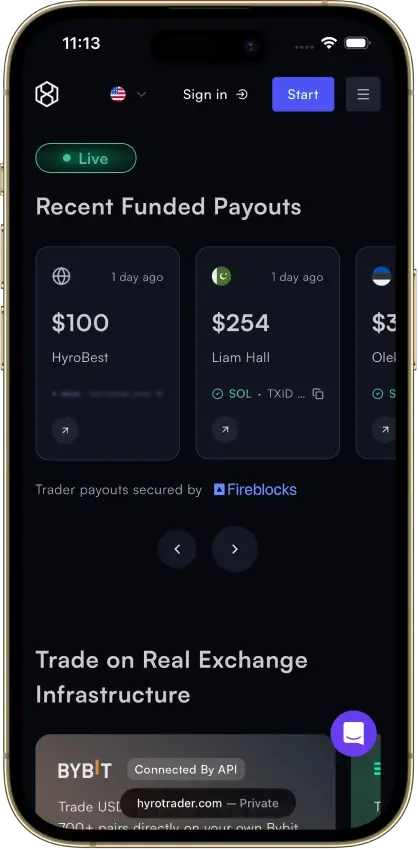
- Deposit returned with first payout (One-Step, Two-Step)
- Orders reach a live exchange order book
- Static daily drawdown on every challenge
Cons
- Forced withdrawal at 5%, excess forfeited
- API keys permit prohibited instruments



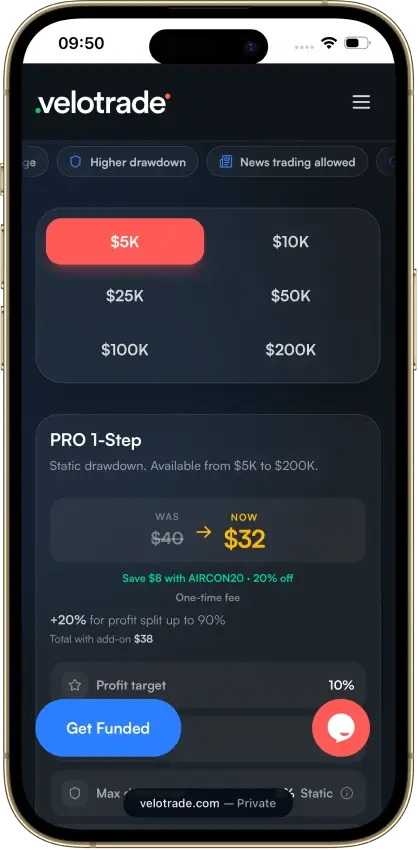
Velotrade
- Evaluation fee
- From $40
- Max drawdown
- 3–10%
- Profit split
- 80%–90%
Pros
- $40 entry, PRO cheapest at every size
- No time limit on any evaluation phase
- EAs and API allowed with no fee or approval
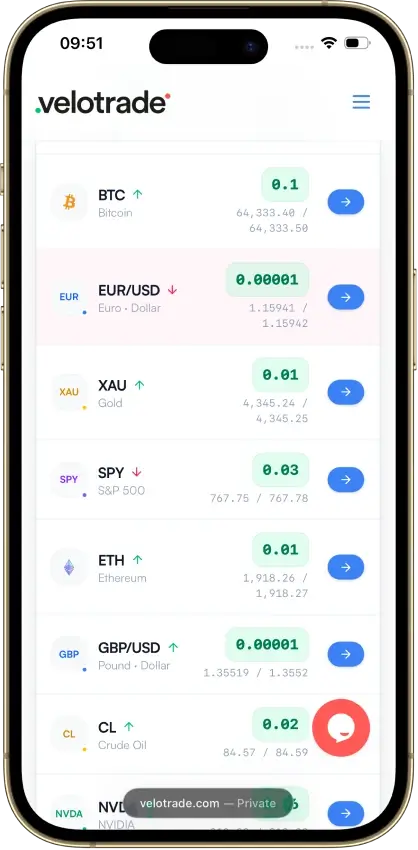
- 230+ instruments across five asset classes
Cons
- First two payouts limited to 20x the fee
- A trading day needs 0.8% realized profit
- 90% split is a paid add-on over 80% default




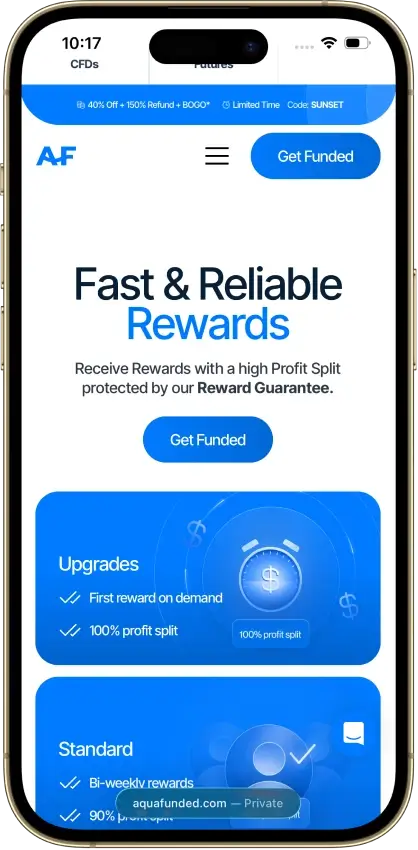
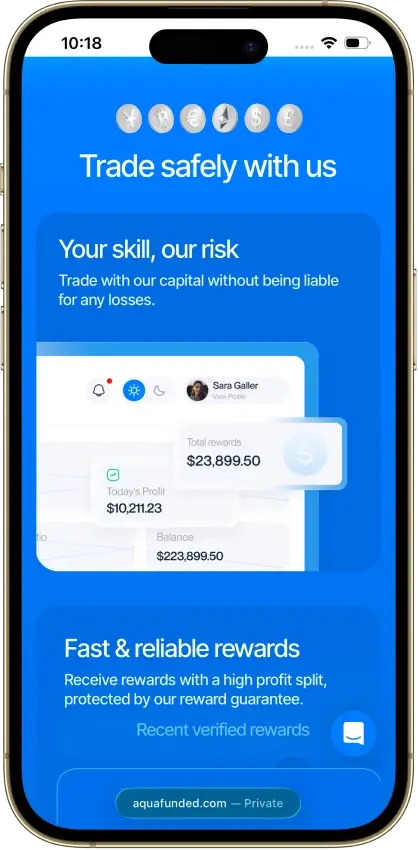
AquaFunded
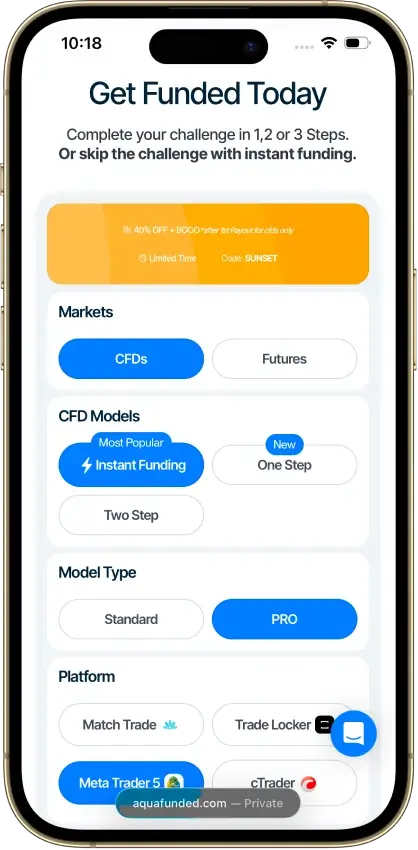
- Evaluation fee
- Forex / CFD: From $29; Futures: From $83
- Max drawdown
- Forex / CFD: Intraday Trailing (Real-Time Equity): 6–10%; Static (Initial Balance): 8–10%; Futures: Balance-Based Trailing (Initial Balance): 4%; End-of-Day Trailing (Initial Balance): 3–4%
- Profit split
- Forex / CFD: 90%–100%; Futures: 80%–100%
Pros
- 90% profit split on every CFD model
- $1,000 penalty if a payout misses 24 hours
- Three futures types have no daily loss limit
- Five of ten CFD models skip consistency
Cons
- The drawdown documents contradict themselves
- -2% floating loss closes the account for good
- The refund only lands on your fourth payout
- 30 days without a trade breaches funding


For Traders
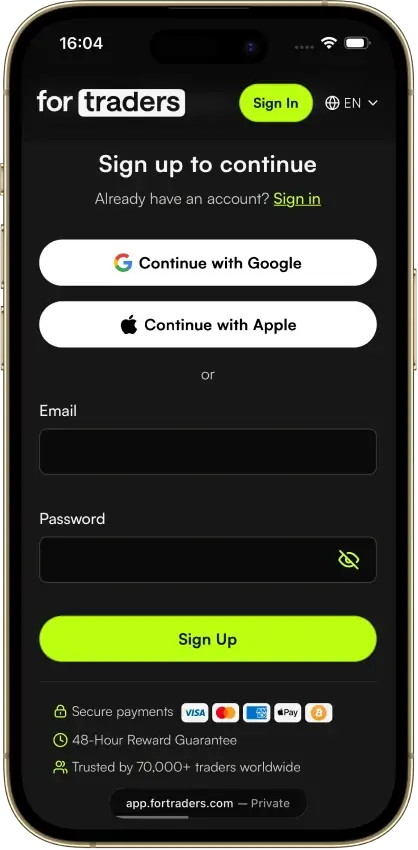
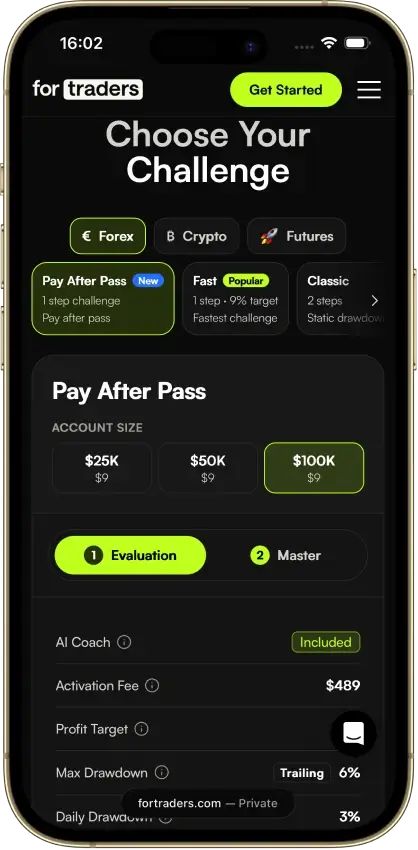
- Evaluation fee
- Forex / CFD: From $23; Crypto: From $49; Futures: From $139
- Max drawdown
- Forex / CFD: Intraday Trailing (Real-Time Equity): 5–6%; Static (Initial Balance): 5–8%; Crypto: End-of-Day Trailing (End-of-Day Equity): 4%; Intraday Trailing (Real-Time Equity): 5–6%; Futures: 2,000 USD
- Profit split
- Forex / CFD: 60%–90%; Crypto: 70%–90%; Futures: 80%
Pros
- No time limit except on Strike
- EURUSD from 0.1 pips raw spread
- 74 crypto pairs, traded 24/7
- $3 per lot forex, $0 on indices
- Evaluations listed from $23
Cons
- 5-second hold rule is not in the rulebook
- Activation fee falls due before KYC
- 3% buffer locked up on Forex Instant
- Checkout omits drawdown limits on 37 plans


OneFunded
- Evaluation fee
- From $29
- Max drawdown
- 6–10%
- Profit split
- 60%–90%
Pros
- UK company, English law and courts
- $29 entry on the two-step Value plan
- Core advertises a fee return at payout
- No consistency limit while evaluating up to $50K
Cons
- Add-on costs shown only at checkout
- Core/Value consistency limit starts when funded
- Forex lot is $3.50 on cTrader, $4.00 on MT5
- Instant has a 1% exposure limit and no refund





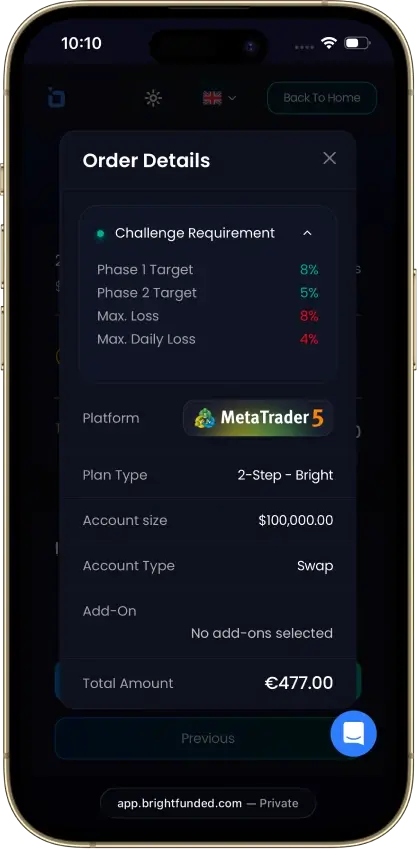
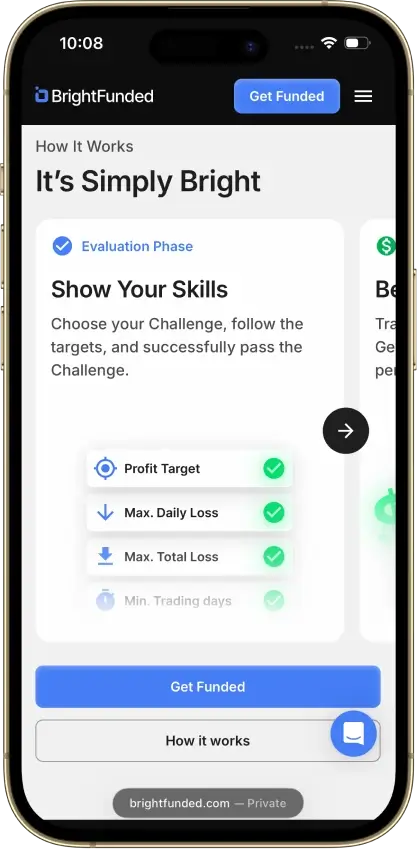
BrightFunded
- Evaluation fee
- From EUR 0
- Max drawdown
- Intraday Trailing (Higher of Balance / Equity): 6%; Static (Initial Balance): 8–10%
- Profit split
- 80%–100%
Pros
- EAs allowed on supported platforms
- Unlimited time on every evaluation
- $0.01 payout minimum, no firm fee
- Help center shows the drawdown math
- Payouts reported inside 24 hours
Cons
- 6% floor trails, checkout omits the type
- Default payout waits 30 days
- VAT appears only after buyer details


Crypto Fund Trader
- Evaluation fee
- From $40
- Max drawdown
- Static (Initial Balance): 6–10%; Trailing until 6% profit, then static (Real-Time Equity): 6%
- Profit split
- 50%–90%
Pros
- 715 crypto pairs and 900+ instruments
- 100x leverage advertised on every instrument
- Instant route skips the evaluation
- Up to 90% split with a paid upgrade
Cons
- On FINMA's warning list since August 2024
- Evaluation fee is never refunded
- 90% split and weekly payouts cost extra
- Registered as an education company




Goat Funded Trader
- Evaluation fee
- From $5
- Max drawdown
- Intraday Trailing (Real-Time Equity): 6–8%; Static (Initial Balance): 6%
- Profit split
- 80%–100%
Pros
- Fees refunded after the fourth funded payout
- $100 minimum payout, paid in 2 days
- Scales to $2M with up to 100% split
- Static floor, no consistency rule on 1 Step
Cons
- Up to three loss limits run at once
- Complaints cluster on payout denials
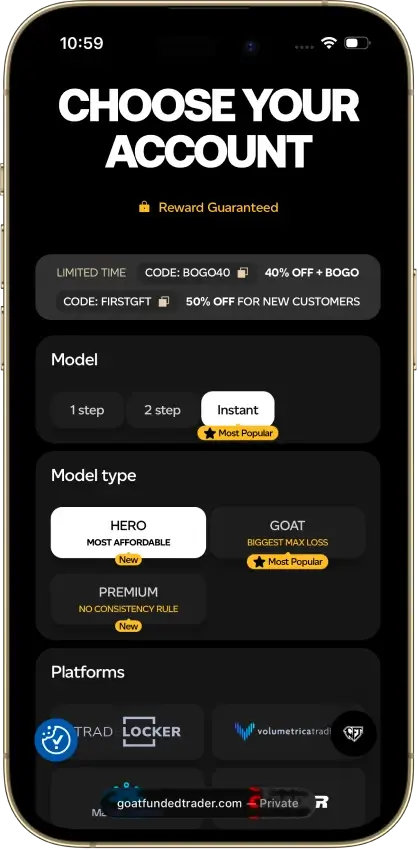
- Pay Later activation can top the Instant price




Instant Funding
- Evaluation fee
- From $39
- Max drawdown
- End-of-Day Trailing (Closing Balance): 6%; End-of-Day Trailing (End-of-Day Equity): 4%; Static (Initial Balance): 4–10%
- Profit split
- 80%–90%
Pros
- Payout-limit excess stays in the account
- Courts of England and Wales, no arbitration
- 50% of the reward on a first daily-loss breach
- Zero price variance across 101 combinations
- 18 programs from a $25 entry
Cons
- FCA Warning List includes the firm and its domain
- Paid 90% split revocable to a permanent 50%
- Most products gate payouts on a best-day rule
FundedElite
- Evaluation fee
- From $5
- Max drawdown
- Intraday Trailing (Real-Time Equity): 6%; Static (Initial Balance): 6–8%
- Profit split
- 70%–95%
Pros
- Entry from $23.40, among the cheapest we track
- Static drawdown on six of eight families
- No per-cycle profit limit on any of 49 plans
- Support speed praised in both review bases
Cons
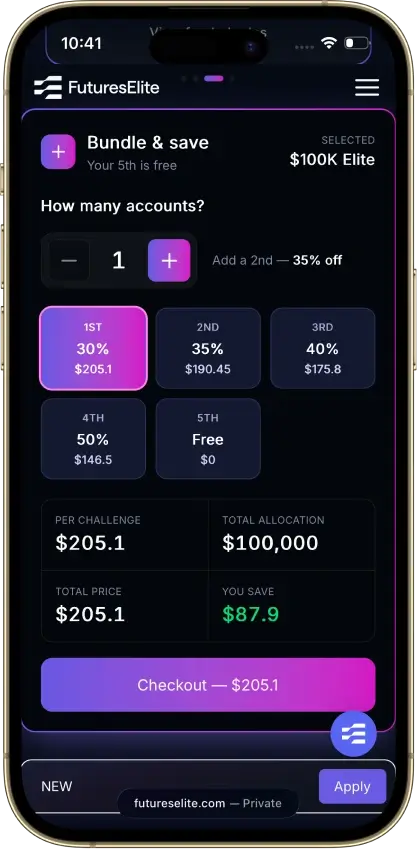
- Resets sold as free, fee on 48 of 49 plans
- Free retry carries a permanent 50% split
- Add-ons compound, $569 becomes $2,358
- Spreads, commission unit and swaps not listed




How We Rank
- Payout Reliability and Evidence 25% weight
Payout history, evidence and the conditions for receiving funds.
- Rules Fairness and Transparency 20% weight
Clarity and fairness of account rules and restrictions.
- Cost and Value 15% weight
Evaluation fees, refunds and the value of each program.
- Trading Conditions 15% weight
Markets, platforms, execution and trading limits.
- Profit Split and Scaling 10% weight
Profit sharing and paths to larger allocations.
- Firm Transparency and Stability 10% weight
Ownership, disclosures and operational stability.
- Support and Reputation 5% weight
Customer assistance and the firm’s public track record.
Every firm on this page is scored against the same seven weighted pillars and the same evidence rules. The payout pillar outweighs the rest, and any number a firm publishes about itself is logged as a claim rather than a verified result. Scores move when the evidence moves, so this order is not fixed.
What is a Prop Firm?
Prop trading firms sell access to a funded trading account and take a share of the profit made on it. The trader pays for an evaluation, trades to a profit target inside a set of loss limits, and on passing receives an account funded with the firm's capital. Profits are split, most commonly 80% to the trader. Losses stop at the loss limit, and the trader's downside is the fees paid, not the account balance.
Almost every retail funded account is a simulated environment. Orders execute against the firm's pricing feed, the balance is a number and the payout is money, and whether any given order reaches an outside market is a decision the firm makes and rarely shows. That is not by itself a mark against a firm. It is the reason the terms matter more than the platform, and the reason a firm that states plainly how it books trades scores above one that leaves it unstated.
What Prop Firms Actually Pay?
Every firm in this category publishes a payout total. Not one of them publishes an audited one. We classify payout evidence three ways, and the class is what the score reacts to.
- CLAIMED — the firm states it on a surface it controls. A homepage counter, a rewards page, an internal rating on an internal scale, or a review-platform profile the firm pays for and solicits reviews into, because there the firm selects the sample.
- REPORTED — traders state it, on a platform the firm does not manage. Trustpilot, Reddit, Discord, or a first-hand account given to us. Volume raises confidence and never changes the class.
- VERIFIED — we can point to a record the firm does not control. A regulator's register, a completed corporate transaction, a review platform's own enforcement notice, or a transaction we executed and hold the receipt for.
No firm here has VERIFIED evidence that it pays traders. The VERIFIED items that do exist establish something adjacent, including ownership, longevity or a purchase. Others are enforcement actions against the firm's own reputation data. First-hand payouts described by a reviewer sit in REPORTED, because a recollection is not a receipt, and that line is the reason the first-party purchase below clears the bar while a first-party payout does not.
Every claim in the second column is the firm's own, read from its public surfaces in August 2026.
| Firm | What the Firm Says It Has Paid | Class | Independent Evidence That Exists, and What It Establishes |
|---|---|---|---|
| FundingPips | Over $283M paid with zero denials, on its own rewards page | CLAIMED | REPORTED: Trustpilot 4.5 across more than 50,000 reviews, payout speed the recurring praise. REPORTED: the reviewer received repeat payouts over a year through Rise and crypto. Nothing outside the firm establishes the total |
| FundedNext | $336M+ paid out, plus a published 24-hour payout guarantee carrying a $1,000 penalty when missed | CLAIMED | REPORTED: Trustpilot 4.5 across more than 70,000 reviews. The guarantee is the checkable part, because it names a deadline and a penalty. A marketing total names neither |
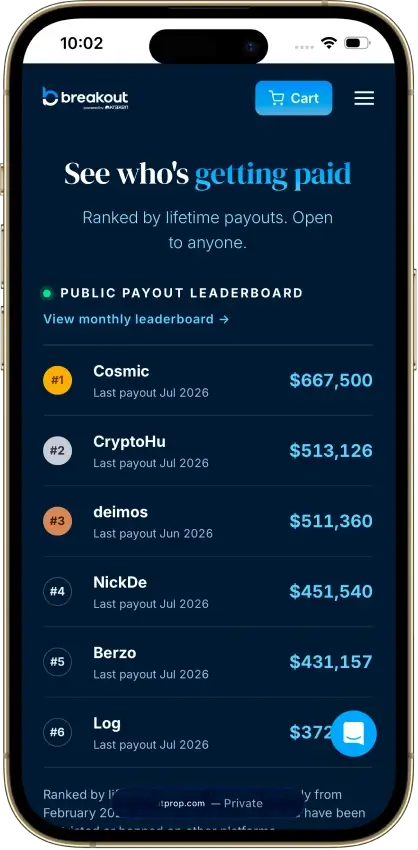
| Breakout | A public leaderboard naming individual traders with lifetime totals, top entry $667,500, updated monthly, stated to include traders restricted elsewhere. $50M+ since launch | CLAIMED | VERIFIED: Kraken completed its acquisition in September 2025, confirmed outside the firm. That establishes ownership, not payment. REPORTED: traders describing USDC arriving within hours |
| FTMO | $650M+ paid in rewards. The same surface also states $500M+, and states both 4.5M+ and 3.5M+ for the same trader count | CLAIMED | VERIFIED: continuous operation since 2015. CLAIMED: Trustpilot 4.8 across 48,676 reviews, on a paid profile the firm solicits reviews into, and has replied to none of the negative reviews, so the sample is firm-selected. Treat any single figure from this firm as approximate, because its own surface contradicts itself |
| The5ers | 4,376 payouts a month at a 16-hour average, on the homepage | CLAIMED | REPORTED: Trustpilot 4.7 across 33,614 reviews, 90% of them at five stars. REPORTED: payouts landing in 3 to 7 days, far more often than in 16 hours. REPORTED: waits beyond two weeks, and an account closed on an automated linking flag with the funds retained |
| AquaFunded | A 24-hour reward guarantee backed by a $1,000 penalty, measured in business hours on a Monday-to-Friday Dubai clock. Rated 9.4 out of 10 from 5k+ reviews, an internal figure on an internal scale presented in the visual language of a review platform | CLAIMED | VERIFIED: the Trustpilot profile carries no rating at all, with Trustpilot's own notice that it is unavailable after a guideline breach and that fake reviews were removed. VERIFIED: we bought an instant account and paid $36.13 in USDC, receipt held, which establishes the purchase and not the payout |
| Goat Funded Trader | $23,000,000+ paid, $2,180 average reward, 4.8 stars from 5k verified reviews. The same surface also shows 4.2 from 1,021, and claims both 1M+ and 250K+ traders | CLAIMED | VERIFIED: Trustpilot withdrew the rating after removing fake reviews. REPORTED: payouts refused on suspected coordinated trading, which is the dominant complaint theme |
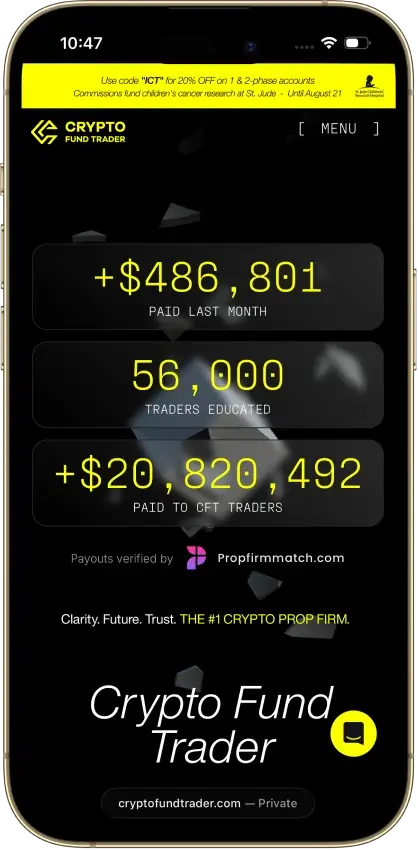
| Crypto Fund Trader | $20,820,492 paid to traders and $486,801 in the last month, on the homepage, with a third-party tracker cited as confirming the total | CLAIMED | VERIFIED: Trustpilot withdrew the rating after removing fake reviews. The third-party confirmation is cited by the firm on its own homepage, which leaves the total in the class it started in |
What the Fastest Payout Prop Firm Claims Are Worth
A firm quoting an average processing time is describing its own log, which nobody outside it can audit. A firm quoting a deadline with a stated penalty for missing it has written a term a trader can hold it to. A firm paying on demand with no cycle removes the question, because there is no queue to be slow in.
The number that matters more is the one before the stopwatch starts. A 24-hour guarantee attached to a 14-day first-payout window is a 15-day wait. A guarantee counted in business hours on a single city's clock pauses at weekends. A payout cycle that restarts every time an account scales resets the wait each time the trader succeeds. Read the cycle, the eligibility window and the clock the guarantee runs on before reading the processing time.
Regulatory Posture, and What a Warning Listing Does and Does Not Mean
Almost nothing in this category is financially regulated, and the firms say so in their own documents. The pattern repeats across the table: a marketing entity in a free zone, a service entity in a small offshore jurisdiction, a payments entity somewhere else, and a clause stating that the marketing entity carries out no regulated activity. Some are registered for education and training services instead of financial services, and describe a payout as a reward with eligibility conditions instead of an entitlement.
Crypto Fund Trader sits on FINMA's public warning list, added in August 2024 because its trading name is absent from the Swiss commercial register. The company behind that name was entered on the register five months before the listing, so what is unregistered is the name, not the company. FINMA's own position is that a listing does not make an activity unlawful, only that authorization is absent. That cuts both ways. It is weaker than a fraud finding and it has not been withdrawn. The full record is in the Crypto Fund Trader’s FINMA warning.
What a Payout Is, Contractually, Before It Is Income
The documents that govern these payments do not describe a share of trading profit. They describe a reward, paid on eligibility conditions, by an entity that states it carries out no regulated activity, on capital the trader never owned and positions the trader never held. The evaluation fee is written the same way, as a one-time service charge and not a deposit, which is why it is non-refundable by default. How any of that is treated for tax turns on the country, on the entity making the payment and on how the trader receives it, so it is a question for a tax professional before the first payout and not after the tax year closes.
Account Forfeiture, and the Terms That Take Profit Back
The failure mode traders underestimate is not a breached drawdown. It is a terms clause that closes a profitable account. Automated account-linking detection can close an account and retain the balance when it associates it with another account, and one trader reports exactly that at The5ers, REPORTED-class, with the burden of disproving the match falling on the trader. Coordinated-trading clauses do the same when several accounts hold correlated positions, and refused payouts on that ground are the dominant complaint theme at Goat Funded Trader. The5ers also forfeits all profit and closes the account for publishing private correspondence, which covers support tickets and chat logs, so a trader who takes a dispute public loses the balance being disputed.
Breakout's disclosures run the other way. They state that a funded trade may be recorded as an internal book entry with a hypothetical result calculated against it, or routed to a market maker or exchange, at the firm's discretion, with no way for the trader to see which happened. The same firm discloses that it earns a fee every time an evaluation trader fails and rebuys. The most disclosure and the most uncomfortable disclosure come from the same place, which is what disclosure looks like when it is genuine. The record is in the Breakout’s trade-routing disclosures.
What the Rest of This Comparison Set Does Not Print
Comparison pages in this category are paid by the firms they rank, and the scoring scales show it. The bottom of a competing table still reads as an endorsement, which means the ordering carries no information about the firms the page declines to criticize. A tracker that publishes a payouts database has the same problem in a different shape, because a database of numbers the firms supplied is a restatement, not a confirmation.
We print the low scores in the same table as the high ones, with the same columns filled in, and print the payout evidence underneath. That is the only reason the ordering above means anything.
How Prop Firms Make Money
Evaluation fees are the primary revenue line. Pricing is built around the repeat attempt and not the single pass, because a failed evaluation converts into another purchase. Activation fees, reset fees and checkout add-ons sit on top, and several are priced as a percentage of the evaluation fee, so they scale with account size.
Trading revenue is the second line. Commissions and spreads are charged on the funded account, and where a firm books a trade internally instead of passing it to a market, the losing side of that trade is income. The profit split is the third line and the smallest, because it only pays when the trader does. A firm's own disclosures state which of these it leans on, and reading them is the fastest way to work out whose success it is priced for.
How Prop Firm Evaluations Work
Every route to a funded account is one of four shapes, and the shape sets the difficulty far more than the profit target does.
Two-Step Evaluations
A challenge phase with a profit target near 8% to 10%, then a verification phase at roughly half that target, both inside the same loss limits. Two phases means two chances to breach, so the pass rate is lower than a single target implies. The compensation is that two-step programs carry the loosest rules on most price lists: static drawdown, no consistency rule, and the longest time allowance, often none at all.
One-Step Evaluations
A single phase to a higher target, usually 10%. It looks simpler and is frequently the harder product on the same price list. The tightening is not in the target. It is the daily loss limit dropping, the maximum loss switching from static to trailing, and a best-day or consistency rule appearing that the two-step does not carry. Compare the rule set, not the number of phases, across the firms selling one-phase evaluations.
Instant Funding Prop Firms, Also Sold as No-Evaluation or No-Challenge Accounts
No challenge at all. Pay, receive a funded account, start trading. Where a firm markets this as an account with no evaluation, the product is usually the same one. Instant funding prop firms are the most heavily governed product in this category, because the constraint moves from the evaluation into the account: the tightest drawdown floors, the lowest opening profit splits, live floating-loss limits that close the account on unrealized losses of 1% to 2%, weekend-holding bans, news-trading bans and the highest consistency percentages. Buying capital without an evaluation means paying for it in rules, and the sizes are usually capped well below the phased routes. The firms selling funded accounts outright are compared separately.
Three-Step and Staged Programs
Three phases with lower targets each, marketed as gentler. The extra phase adds another breach opportunity and lengthens the time to a first payout. Watch the plan name here, because on some programs the name describes the funded balance the account can reach after every step, not the balance it starts at. A program named for $20,000 that opens at $5,000 and steps through two stages is a $5,000 account until it is not.
Which Evaluation Type Suits Beginners
The route that suits a first funded account is the one with the fewest ways to lose it. That means a static floor, so a winning week cannot move the failure level closer. It means no consistency rule, so one good day does not block the payout. And it means no minimum trading days and no time limit, so nothing forces a trade that was not there. Two-step programs carry that combination most often, and the extra phase is what buys it. The route to avoid first is the cheapest instant account, because the tightest floors and the live floating-loss limits sit there, and a first-time funded trader is the one most likely to breach one by accident. The firms best suited to a first account are scored on exactly that.
What Prop Firm Rules Mean and Where They Bite
The drawdown floor is the single rule that decides whether a funded account survives a winning week. There are three behaviors and they produce completely different outcomes from identical trading.
How Prop Firm Drawdown Works: Static, Trailing and End-of-Day
Static. On a $50,000 account with a 5% static floor, the failure level is $47,500 for the life of the account. Trade it to $60,000 and the floor is still $47,500, so profit has bought $12,500 of room. Static is the only drawdown type where making money makes the account safer.
Trailing on live equity. On a $100,000 account with a 10% trailing floor, the floor opens at $90,000 and follows every new equity high, including unrealized ones. Run a position to $106,000 in equity and close it at $101,000. The floor has followed the peak to $95,400. The balance now reads $101,000 and the distance to failure has fallen from $10,000 to $5,600. Profit moved the floor closer. A variant of this trails only on closed-trade balance highs, so floating profit, breakeven closes and losing trades never move it, and on the same sequence that floor would sit at $90,900 instead of $95,400. Those two floors carry the same one-word label on most comparison tables.
End-of-day trailing. The floor recalculates once a day off the closing or midnight balance. On a $50,000 account with a $2,500 allowance, a day that runs to $53,000 intraday and closes at $52,000 sets tomorrow's floor at $49,500. The intraday high is ignored, which makes this gentler than live trailing and harsher than static.
Two extra behaviors sit on top of trailing floors and cost accounts regularly. Some floors rise permanently and reset only when a payout is withdrawn, and they reset to 90% of the initial capital instead of to the current balance, which makes withdrawing the only lever that ever moves the floor down. And some stop trailing at a set profit level and lock to the opening balance, so the account gets safer the moment it clears that threshold and is at its most fragile in the run-up to it.
Consistency Rules
A consistency rule caps how much of total profit any single day, or single position, may contribute. Under a 35% rule, a trader sitting on $8,000 of profit with a $3,000 best day is at 37.5% and outside the limit. Where the rule gates the withdrawal, the account survives and the payout is blocked until total profit reaches $8,572, at which point the same $3,000 day falls inside 35%. The rule does not punish losing. It punishes one good day, and it converts a fast profit into an obligation to keep trading.
The percentage is only half the rule. Check whether it applies per day or per position, whether it is measured in the evaluation or on the funded account or both, and whether breaching it gates the withdrawal or closes the account. Those three variables differ by model inside the same firm, which is why a single consistency figure rarely describes a whole price list, and each firm’s scoring breakdown lists the rule model by model.
Daily Loss Limits
A 3% daily loss limit on a $100,000 account is $3,000, measured from the balance at a fixed reset time. The failure most traders do not see coming is the definition mismatch: the reset-time balance usually excludes open positions, while the live equity check includes them. Carry a position $3,500 underwater through the reset and the account breaches the instant the clock rolls, on a trade that was inside the limit a minute earlier.
Minimum trading days carry a similar trap. On some programs a day only counts toward the minimum if it closes in profit, or in profit above a set percentage, so a week of flat sessions advances nothing.
What Forex Prop Firms Restrict That Futures Programs Do Not
A forex or CFD program prices its own account structure as an upgrade. A swap-free account is sold as a surcharge, commonly a percentage of the evaluation fee, and the same upgrade often cuts the leverage available on the account, so avoiding overnight interest is paid for twice. Weekend holding and trading around scheduled news releases are barred on the tightest models, which rules out a strategy built around a release before the drawdown ever comes into it. Futures programs replace all of that with a hard daily close a few minutes before the session settles. Every open position closes with it, so nothing is carried overnight and nothing is charged for carrying it.
Why a Firm's Published Rules May Not Describe the Model You Bought
A firm's public rules page usually describes one drawdown behavior with one worked example, and that example is often true of only the models it was written for. Cheap evaluations are frequently governed by the tighter rule and the rules page is frequently written around the flagship one. A trader can read a fixed 8% floor with a clean $100,000 to $92,000 example, buy the low-priced model on the same site, and be trading a 10% trailing floor instead.
Check the drawdown against the specific model name on the checkout, not against the rules page and not against the marketing. Where the drawdown column above gives a range or names more than one floor, that is exactly why, and each firm's scoring breakdown lists the models one by one.
What a Prop Firm Account Actually Costs Beyond the Sticker Price
The evaluation fee is the number every comparison table prints and it is rarely the total. A $10,000 evaluation sits low on most price lists, and the charges outside it can exceed the fee itself. At larger sizes the fee becomes one of several charges and the add-ons scale with it, because they are commonly priced as a percentage of the evaluation.
| Charge | What It Is | When It Lands | What It Does to the Total |
|---|---|---|---|
| Evaluation fee | The sticker price on the program selector | Before you trade | The headline number every comparison prints. It buys an attempt, not an account |
| Discount code | A percentage off the evaluation fee | Before you trade | Cuts the sticker price and touches nothing else on this table |
| Activation fee | A second charge levied when an evaluation is passed and the funded account is issued | On passing | The whole cost on pay-later routes. At larger sizes it can exceed the price of an instant-funding account bought outright |
| Reset fee | Another attempt after a breach, priced below a fresh purchase | On failure | Discounted by stage at some firms. Absent at others, which turns every breach into a full repurchase |
| Payout-cycle add-on | Shortens the wait between withdrawal requests | At checkout, and often only at checkout | Commonly 20% of the evaluation fee, and commonly absent from the selector where the headline price is displayed |
| Profit-split add-on | Raises the split above the standard rate | At checkout, and often only at checkout | Same pricing pattern. At some firms it cannot be added afterward at any price |
| Platform and account surcharges | A charge for a specific terminal, or for a swap-free account | At checkout | Flat fees for platforms. Swap-free is often a percentage surcharge that also cuts available leverage |
| Trading commission and swap | A per-side charge on every order, plus overnight funding or swap on positions held through the rollover | On every trade | The only charge that scales with activity instead of account size. Round trips in this category sit under 0.1% of notional, and an overnight hold adds funding on top |
| Payout processing charge | A percentage taken from the withdrawal after the split is applied | On every payout | An 80% split with a 2% processing charge pays 78.4% of the profit, permanently |
| Currency conversion charge | A percentage on profit realized in an instrument denominated outside the account base currency | On every payout | Driven by what you traded, not by what you paid in. A fee quoted in euros on a dollar account is a separate irritation with its own spread |
What the Arithmetic Looks Like
The pattern is easier to see on round numbers than on any live price list. Take an evaluation advertised at $1,000. Attach the two add-ons that appear at checkout on many programs, one shortening the payout cycle and one raising the split, each priced at 20% of the evaluation fee. The purchase is $1,400, and neither add-on appeared on the selector where the $1,000 was shown. Now apply a 2% processing charge on withdrawals. The 90% split bought with one of those add-ons delivers 88.2%, permanently. No single firm above charges every one of these, and the columns show which firm charges what.
A pay-later route charges a token amount up front and an activation fee on passing. That is deferred and conditional, not lower. It reduces what you risk before you know whether you can pass, and not what you pay once you have.
Ladder Pricing Is Not Linear
Divide the fee by the capital it buys before choosing a size. Price lists in this category step up in uneven jumps, and adjacent sizes can sit close enough in price that the larger account costs less per dollar of capital than the smaller one. Firms price the ladder to move traders up it. Divide the fee by the funded capital at the entry size, then run it again at the size you actually want, because the entry rung is rarely the best value per dollar on a list.
What You Pay When You Fail
This is where the pricing model does its work. A firm that sells resets at a stage-based discount makes a second attempt cost less than a fresh purchase. A firm that sells no resets at all makes a breach a full repurchase at list price, add-ons included, which on a large account is a four-figure event. Neither approach is wrong, and the difference between them decides more of the final cost than the sticker price does.
Refunds That Are Not Refunds
A refundable fee is a genuine feature, but its conditions determine when and how the refund is delivered. Three patterns recur. The refund arrives on the fourth successful payout instead of on passing, which makes it contingent on trading well for months. The refund applies to some models on a price list while the refundable label sits on all of them. Or the refund is paid in credits instead of money, some usable only against further purchases and some added to the funded account as trading equity, and neither can be withdrawn or transferred.
Best Prop Trading Firms by Trader Type
There is no single best prop firm, because the rule that decides the outcome changes with what you trade and how long you hold it.
- Beginners. Breakout's static-floor plans carry no consistency rule, no minimum trading days and no time limit, and there is no reset to buy, so a breach means starting over at list price.
- Futures. FundedNext's futures models run payout cycles down to daily, with end-of-day trailing floors on every one of them and every position closed at 3:10 PM CT. The floor mechanics differ enough from the phased models that they are worked through separately on the firms running futures programs.
- Crypto. Crypto Fund Trader's instrument range covers 715 crypto pairs with a route that reaches a live exchange order book, and its score in the table above is the one to read before buying. Whether a firm gives genuine exposure or lists crypto as one CFD asset class at cut leverage is set out across the firms quoting crypto markets.
- US traders. Breakout accepts US residents directly, and FTMO's US arrangement with OANDA runs through a CFTC-regulated partner on separate pricing and a separate account structure.
- Cheapest. The5ers on sticker price, with Goat Funded Trader’s activation fee as the counter-example, because its pay-later route is cheaper to start and more expensive to finish.
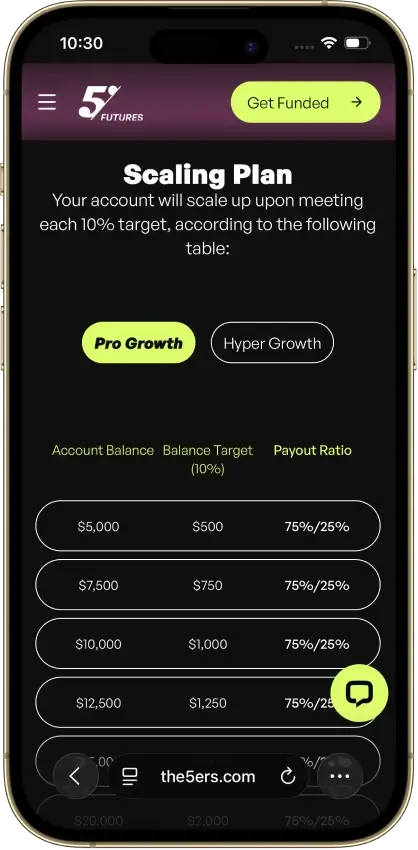
- Scaling over years. The5ers scaling programs step a funded account toward $4,000,000, on a payout cycle that restarts at every step up.
- Split without an add-on. AquaFunded's split and add-on pricing opens at 90% on CFD accounts where most of this table opens at 80%, and sells 100% as a checkout upgrade.
How We Score Prop Firms
Scores run 0 to 10 across weighted pillars: payout reliability and evidence, rules fairness and transparency, cost and value, trading conditions, profit split and scaling, firm transparency and stability, and support and reputation. Payout evidence carries the heaviest weight, which is why the classing above moves scores. Every firm name in the comparison table links to the full breakdown, with each pillar scored one by one. The weightings, the pillar definitions and the evidence classes are set out in the weights behind our scores.
CryptoSlate earns affiliate commission on some links in the comparison table, on the terms set out in our affiliate and funding disclosures. A commercial arrangement does not move a score. A comparison that only shows firms worth recommending is not a comparison, which is why every firm scored stays in the table whatever the number.