

Overview
Introduction
Every trade on a centralized crypto exchange runs through a queue. Before your order executes, it either matches against an existing order in that queue or joins the queue itself. That queue is the order book in trading, and the numbers on screen tell you exactly where buyers and sellers are willing to trade right now.
For beginners, the order book can look like a forecast. It is not. A large cluster of buy orders does not guarantee the price will hold there, and a wall of sell orders does not guarantee it will stop there. The book shows posted intent at one venue, at one moment, for one trading pair. Prices change, orders cancel, and liquidity shifts faster than most people expect.
This guide explains what order book data actually means, how a trade moves through the book, and what to look for before placing a market or limit order in crypto trading.
Key Takeaways
- Order books show where buyers and sellers are willing to trade, not where price must move next.
- Spread, depth, and order size shape the real cost of entering or exiting a position.
- Crypto order book data is fragmented by exchange, trading pair, quote currency, and market type.
- Buy walls, sell walls, and heatmaps can help with execution checks, but visible liquidity can disappear before execution.
What Is An Order Book in Trading?
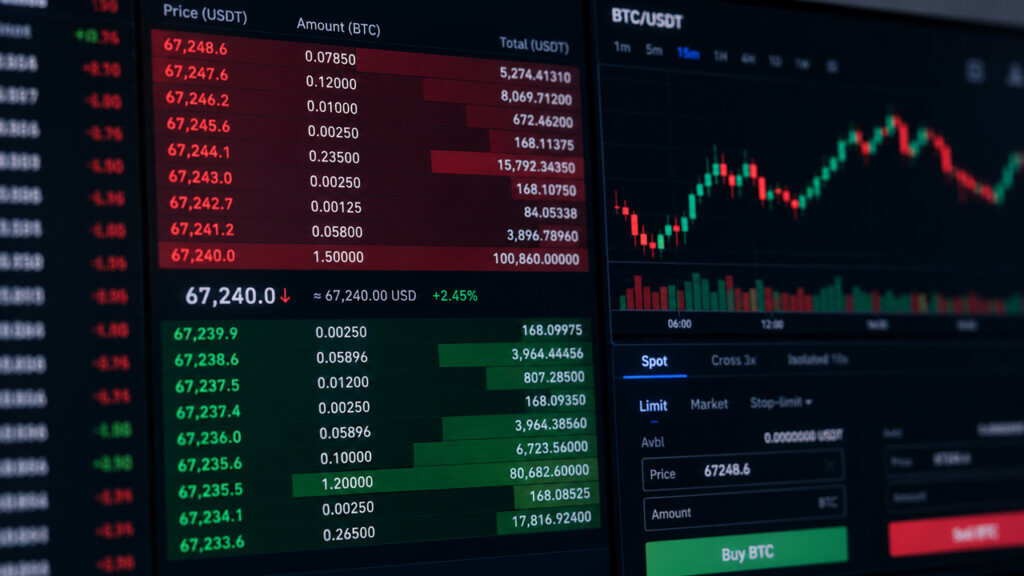
An order book in trading is the exchange's visible queue of open buy and sell orders for one market. In crypto, that market is usually a trading pair such as BTC/USDT, ETH/USD, or SOL/USDC. Bids sit on the buy side and asks sit on the sell side. Each price level shows how much of the asset is available there, and the matching engine uses that queue when a new order arrives and can trade.
Three limits keep that screen in context:
- The book belongs to one venue, not the whole crypto market.
- The quote currency changes what the price means.
- The visible queue can change in milliseconds.
A crypto order book helps users estimate whether a trade may fill near the displayed price or move through thinner levels. It is an execution tool first, not a forecast, a guarantee of support, or a complete record of every buyer and seller in the market.
Bids, Asks, Spread, And Depth in Order Book Trading
Bids, asks, spread, and depth are the four basic parts of an order book. Together, they show the nearest prices buyers and sellers have posted and how much volume is visible around those prices.
The top of the book is the closest bid and the closest ask. The spread is the gap between them, and it represents the immediate cost of crossing from one side to the other. Depth is the visible size available at each level below the best bid and above the best ask, and it tells you how much can be absorbed before the price starts moving.
| Component | What It Tells You |
|---|---|
| Bid | The highest visible price a buyer is currently willing to pay |
| Ask | The lowest visible price a seller is currently willing to accept |
| Spread | The gap between the best bid and best ask |
| Size | How much asset is visible at a specific price level |
| Depth | How much visible liquidity sits near or away from the current price |
| Top Of Book | The best bid and best ask available right now |
The quote currency matters here. A user checking the Bitcoin market, Ethereum market, Solana market, and XRP market still needs to confirm the specific venue, pair, and quote asset behind the book, because BTC/USDT and BTC/USD on the same exchange can show different depth.
Market makers often post both bids and asks at the same time, earning the spread or rebates while helping keep the top of book active. Depth can look strong near the current price and weak a few ticks away, so a trade larger than the first visible level may fill across several levels, raising the average price paid or lowering the average price received.
How An Order Book Matches Trades
An order book matches trades when an incoming order can execute against resting orders on the opposite side. The matching engine applies the venue's rules, usually starting with the best available price and then sorting orders at the same price by time priority.
A market order crosses the spread immediately, executing at whatever prices are available starting from the top of book. A limit order names a maximum buy price or minimum sell price and may rest in the book if it cannot fill right away. Resting limit orders add visible liquidity and are often called maker orders. Orders that execute against the book are often called taker orders, and most exchanges charge a higher fee to takers.
To see how this works in practice, consider a hypothetical ask side:
- 1 BTC offered at $100,000
- 2 BTC offered at $100,050
- 3 BTC offered at $100,100
If a 2 BTC market buy arrives, it fills 1 BTC at $100,000 and 1 BTC at $100,050. The average fill is $100,025 before fees, even though the best ask displayed was $100,000. That gap between the displayed price and the actual average fill is slippage, and it is a direct cost of placing a market order larger than the top level.
That is what traders mean when they say an order “walks the book.” The top ask was real, but it was not large enough to fill the whole order, so the remainder filled at the next price level. The same process runs in reverse for a market sell that consumes bids below the best bid.
A limit order can control the worst acceptable price, but it does not guarantee execution. If the market moves away, the order may sit unfilled, partially fill, or require cancellation and replacement at a different price. Slippage and non-execution are two sides of the same trade-off between price certainty and fill certainty.
Why Crypto Order Books Are Not Global
Crypto order books are not global because each exchange, pair, and market type maintains its own queue. BTC/USDT depth on one exchange is completely separate from BTC/USD depth on another, even if arbitrage keeps prices broadly connected over time.
That fragmentation changes how you should read any single book. A deep book on a large global venue does not prove that the same depth exists on a smaller exchange, a regional fiat pair, or a derivatives venue. If you execute on a smaller platform, you need to check that platform's book, not a larger exchange's.
Arbitrage can reduce price gaps between venues, but it is not instant or free. Traders moving between exchanges must account for transfer time, fees, withdrawal limits, funding rates, collateral rules, and the risk that prices move before the arbitrage closes. That friction is why gaps between exchanges can persist, especially during fast-moving markets.
Large trades may also happen outside public books through OTC desks, where institutional buyers and sellers negotiate directly. That means visible exchange depth can understate real institutional interest while still overstating what a public market order can safely execute at one moment.
Before reading one book as representing the whole market, narrow your scope:
- Check the exact venue.
- Check the exact trading pair and quote currency.
- Check whether the book is spot, margin, futures, or perpetuals.
- Do not infer global liquidity from one screen.
Depth Charts, Heatmaps, And Liquidity Walls in Order Book Trading
Depth charts and heatmaps turn order book data into visuals, making liquidity easier to scan quickly. They do not make the displayed orders more reliable, but they do help you spot patterns that are hard to read in a raw price-level list.
A depth chart sums bids and asks cumulatively away from the current price. As you move further from the top of book in either direction, the cumulative size builds. A large step in the depth chart at one price level usually means a big resting order there. A crypto order book heatmap adds a time dimension, showing where large resting orders have appeared, moved, or disappeared over a recent period.
| View | Best Use |
|---|---|
| Order Book | Reading exact bid and ask levels near the current price |
| Depth Chart | Seeing cumulative visible liquidity above and below price |
| Heatmap | Spotting large visible liquidity zones across time |
Buy walls are large visible bid areas below the current price. Sell walls are large visible ask areas above it. They can show where liquidity is posted, where market makers are quoting, or where many traders have set similar price targets. They can also mislead. A wall can be cancelled, moved, partially hidden, split across venues, or posted specifically to influence how other traders react before being pulled.
The CFTC, which oversees US futures markets, treats spoofing as placing bids or offers with intent to cancel before execution. That behavior exists in crypto too, though enforcement varies by venue and jurisdiction.
Use visual depth as a question to investigate, not a signal to act on. A useful check asks what happens if the wall disappears, how much volume actually trades near that level, and whether the same liquidity shows up across related venues.
How Traders Use Order Books Without Overtrusting Them
Order book trading uses visible depth to estimate execution risk before placing an order. The goal is not to predict price direction, but to understand spread, likely slippage, and whether the intended trade size fits the liquidity shown on screen.
Experienced traders tend to treat order books as execution inputs rather than market signals. Before placing an order, the checks below give a more complete picture than reacting to one large wall:
- Compare the spread with the trade size to estimate the immediate cost.
- Check depth near the current price, not only at extreme levels far away.
- Estimate whether the order would walk the book and at what cost.
- Include trading fees in the expected fill cost alongside spread and slippage.
- Watch how depth changes around news events or fast price moves.
- Confirm the exchange is operating normally before large orders.
- Avoid reading a visible wall as certain support or resistance.
A small market order in a deep book may fill very close to the displayed top price. The same order size in a thin book can create a meaningfully worse average fill, especially when volatility pulls liquidity away while the order is being matched. For users comparing execution venues, a compiled list of day trading exchanges covers platforms by liquidity, fees, and interface.
Limit orders can reduce price surprise but create a different trade-off. The market may never reach the limit price, or it may touch that price only briefly and fill the order behind earlier orders already waiting in the queue at the same level.
What A Central Limit Order Book in Trading Adds
A central limit order book is a shared matching system where buy and sell limit orders compete by price and time priority. It adds a transparent queue, a matching engine, and clear rules for who trades first when multiple users want the same price at the same moment.
In a CLOB, the highest bid and lowest ask define the top of book. When orders arrive, fill, cancel, or move, the visible queue updates. That constant movement is what people mean by limit order book dynamics, and it is why the screen changes even when the price is flat.
A CLOB adds three useful properties:
- Price priority rewards better bids and asks, so tighter quotes get filled first.
- Time priority rewards earlier orders at the same price level.
- Public depth gives users a rough view of available liquidity before committing to a trade.
Those properties improve price discovery in active markets, but they also create queue risk. A user placing a limit buy at the best bid may be behind other buyers already waiting at that price. A market order can jump the queue by paying the spread, but at the cost of price certainty.
CLOB design also matters when a new token lists on an exchange. A token with scattered quotes, wide spreads, and shallow bids can be difficult to trade cleanly even after it goes live. Healthy liquidity after a listing requires active market makers, not just a live order pair.
Order Books Vs AMMs
Order books and AMMs are two different ways to organize trading liquidity, and crypto users encounter both. An order book matches buyers and sellers through posted orders. An automated market maker uses liquidity pools and a pricing formula, so trades execute against pooled assets instead of a queue of individual orders.
Understanding the difference matters because many beginners move between centralized exchange spot markets and DeFi platforms without realizing the execution model has changed underneath them.
You can check this guide on AMMs to dive deeper into the concept!
Here's a quick comparison.
| Order Book | AMM |
|---|---|
| Liquidity comes from posted bids and asks | Liquidity comes from pooled assets |
| Price changes when trades consume visible levels | Price changes according to the pool formula |
| Market makers and traders compete in a queue | Liquidity providers deposit assets into pools |
| Slippage depends on spread, depth, and order size | Slippage depends on pool depth and trade size |
| Typical in CEX spot, perps, and some on-chain venues | Typical in many DeFi swaps |
Neither model is automatically better for every trade. Order books offer tighter control around limit prices when liquidity is deep, but thin books punish market orders. AMMs provide always-available pool quotes, but a large trade can move the pool price sharply in one direction.
Some decentralized exchanges use order book models on-chain, while others route through AMM pools or a combination of both. If you are exploring DeFi for the first time, understanding which execution model a platform uses changes how you should estimate costs and slippage before swapping.
An AMM does not have a spread in the traditional sense, but it does have a fee and price impact. For small trades in deep pools, those costs can be comparable to a tight order book spread. For large trades in shallow pools, the price impact can be significantly worse.
Beginner Mistakes To Avoid
The most common beginner mistake is using the order book as a price-prediction screen rather than an execution screen. Visible depth can help you avoid a poor fill, but it cannot remove market risk or tell you where the price is going next.
Most confusion starts with a few avoidable habits. Beginners tend to:
- Send a market order into a thin book without checking depth first.
- Treat one exchange's book as the whole market.
- Read a buy wall as guaranteed price support.
- Ignore fees when comparing the cost of limit versus market orders.
- Use leverage because a wall looks strong, without accounting for liquidation risk.
- Chase heatmap patterns without checking actual recent fills and volume.
- Forget to keep tax and reporting records after active trading.
New users deciding where to start should prioritize simple spot markets, clear fee schedules, and platforms with basic risk controls. A compiled list of beginner crypto exchanges is a better starting point than jumping straight into advanced interfaces.
Leverage deserves extra caution because a small order book misread can turn into a forced liquidation fast. Order books on futures platforms may look identical to spot books on screen, but collateral requirements, funding rates, liquidation engines, and contract specifications create risks the book itself does not show. Before using leverage, make sure you understand how the exchange handles liquidation, not just how the order form looks.
A practical beginner habit: before placing any order, preview the likely average fill. If the intended size would consume several levels, a smaller order, a limit order, or no trade at all may be more sensible than accepting whatever the book gives at that moment.
How BTC, ETH, SOL, And XRP Order Books in Trading Can Differ
BTC, ETH, SOL, and XRP books can differ significantly because liquidity follows the specific venue, pair, quote currency, region, and market type. Asset size and reputation influence how much market maker activity a pair attracts, but they do not guarantee deep liquidity on every exchange or in every pair.
A BTC order book for a dollar pair can look different from BTC/USDT on the same exchange. Ethereum order book depth can vary between spot and perpetual markets. Solana order book depth may shift quickly around network events, exchange changes, or memecoin-driven activity spikes. XRP order book depth can differ by region depending on which fiat rails and exchange licenses are available locally.
Several factors explain the differences across any pair:
- Larger venues attract more market makers, who tighten spreads and add depth.
- Stablecoin pairs may trade differently from fiat pairs because of settlement mechanics.
- Derivatives books can be deeper than spot books during periods of active speculation.
- Regional exchanges may have liquidity pockets that do not appear on global venues.
- Volatility can cause market makers to pull their quotes, shrinking displayed depth quickly.
The useful habit is to inspect the book on the venue you will actually trade against. Market capitalization and name recognition do not substitute for checking depth and spread at the time of execution on the specific platform you plan to use.
FAQs
What is an order book in crypto trading?
An order book in crypto trading is the visible list of buy and sell orders for one trading pair on one venue. It shows bids, asks, available size, and price levels, helping users estimate spread, depth, and possible slippage before placing an order.
What is order book depth in crypto?
Order book depth is the amount of visible buy and sell liquidity at different prices around the current market price. Deeper books can absorb larger orders with less price movement, while thin books may produce worse average fills when market orders cross several levels.
Is there one global crypto order book?
No. Each exchange, pair, quote asset, and market type has its own book, so BTC/USDT on one venue can show different depth from BTC/USD or BTC perpetuals on another.
Can buy walls and sell walls be fake?
Yes. Orders can be cancelled, moved, split, or posted without any intent to trade. A wall is useful context only when compared with actual trading volume, spread behavior, and depth across nearby prices.
What is the difference between an order book and an AMM?
An order book matches buyers and sellers through posted bids and asks. An AMM uses liquidity pools and a pricing formula, so trades execute against pooled assets instead of a queue of individual buy and sell orders.
Is a stock order book the same as a crypto order book?
They share core concepts: bids, asks, spread, depth, and matching. Crypto differs because venues are more fragmented, markets trade around the clock, and stablecoin pairs can create multiple books for the same underlying asset.