


Overview
Introduction
A funded trading account is a provider-controlled account that gives a trader defined buying power and conditional payout rights under the firm’s rules. The displayed size is usually not cash the trader owns or can withdraw. The terms that matter are the loss limits, total costs, trading restrictions, and payout conditions.
Key takeaways
- What it is. A funded trading account grants rules-based buying power and a conditional right to receive payouts from qualifying performance.
- Why it matters. It lets a trader seek returns tied to larger market exposure without depositing the advertised account balance.
- Main risk or limitation. The displayed balance is not withdrawable, and the usable loss allowance can be much smaller than the account label suggests.
What Is a Funded Trading Account?
A funded trading account is supplied through a proprietary trading firm or trader-evaluation program. A qualifying trader can place trades within a stated account size and receive an agreed share of eligible gains. The firm controls the instruments, position limits, loss thresholds, permitted conduct, and payout conditions.
The word “funded” describes the trader’s status within the program. It does not by itself confirm that the account contains live money. Many online firms call a participant funded after an evaluation even when every order remains in a simulated environment. Other firms move selected traders to a live account or use their trading data to place separate live trades.
A funded trader also does not own the number shown as the account balance. A six-figure label may describe nominal capital, buying power, or a simulation reference. The amount the trader can lose before the account closes is usually far lower. The amount available for withdrawal is limited to eligible profit under the payout policy.
How Does a Funded Trading Account Work?
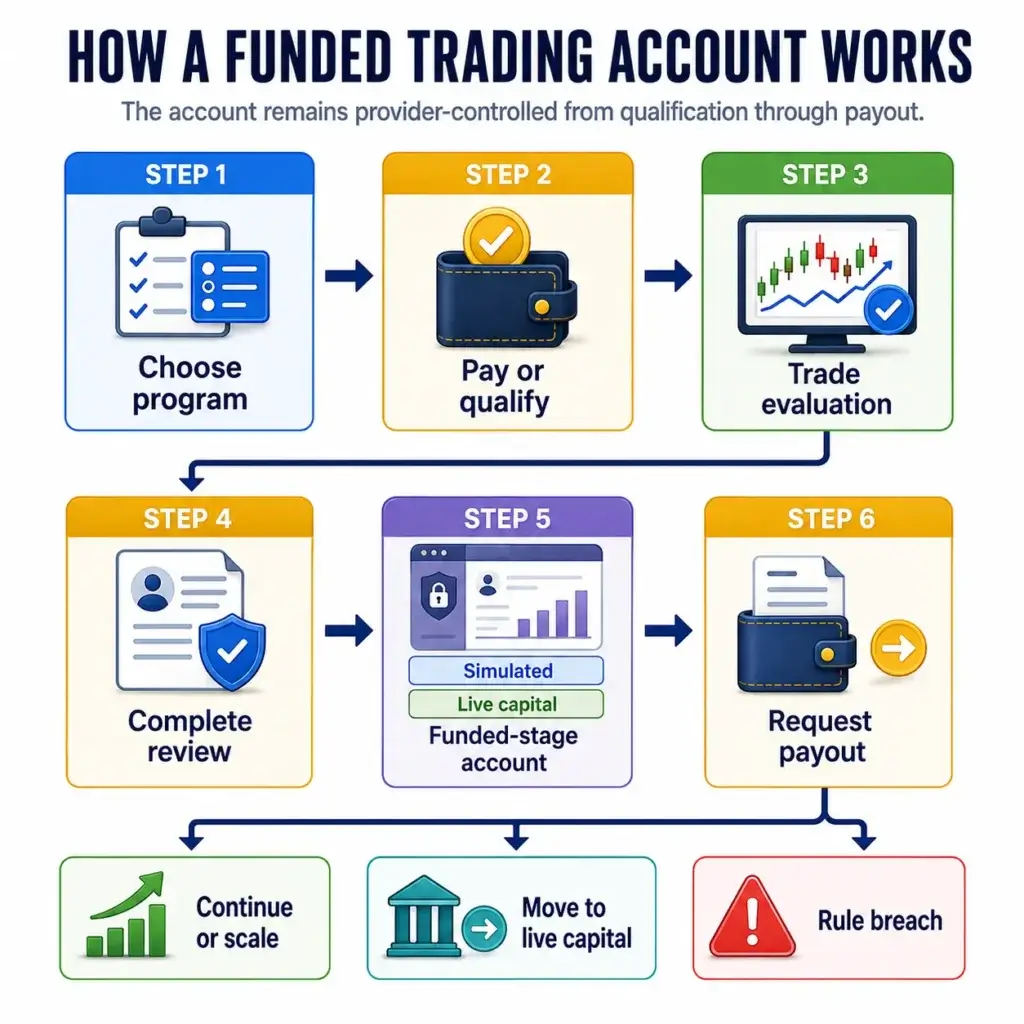
Evaluation-based programs move through seven stages. Direct-access products skip the evaluation step:
- Choose an account structure. The trader selects a market, platform, account size, evaluation format, and pricing model.
- Pay the program cost. The charge may be a one-time evaluation fee, monthly subscription, activation fee, data fee, or a combination.
- Complete the evaluation. The trader seeks a profit objective while staying inside drawdown, position, consistency, and conduct rules. The evaluation process ends when the target and every rule are satisfied, or when a breach closes the attempt.
- Pass the provider’s review. Qualification can require identity verification, tax details, a signed agreement, and a review of the trading record.
- Receive a funded-stage account. The account may be simulated or live. Profit targets often disappear, but loss and conduct rules remain.
- Build payout eligibility. A positive balance is only one condition. The trader may also need qualifying days, a consistency score, a minimum buffer, and closed positions.
- Continue, scale, or lose access. Rule-compliant performance can lead to more buying power or live allocation. A breach can close the account immediately.
Passing an evaluation confirms that the trader met one program’s criteria during one sample of trades. Funded status continues only while the trader follows the funded-stage agreement.
What Does the Advertised Account Size Mean?
Account size can refer to several different figures. A provider may use the label for nominal capital, buying power, a simulated starting balance, or a live allocation limit. None of those figures automatically equals the trader’s cash at risk or withdrawal balance.
Usable loss allowance measures the distance between the account’s current equity or balance and the threshold that closes it. A daily loss rule can reduce that room further, and a trailing threshold can rise after profitable trading. This figure sets the account’s practical risk room.
Two worked examples show why nominal size and usable loss room are different:
| Worked Example | What the Figures Mean |
|---|---|
| $100,000 account with a $10,000 maximum-loss rule | The trader has $10,000 of initial loss room, not $100,000 of withdrawable cash. |
| $50,000 of buying power with a -$2,000 closure threshold | The initial loss room is $2,000, even though the buying-power label is $50,000. |
The headline size does not state how much the trader can lose, keep, or withdraw.
Work out four numbers before buying a program:
- Nominal account size or buying power
- Starting balance in the evaluation and funded stages
- Daily and total loss allowance
- Withdrawal-eligible profit after the firm’s split and deductions
Evaluation Account vs Funded Account
An evaluation account tests whether the participant can meet a performance objective under fixed risk rules. A funded account is the next contractual stage, where qualifying results can create payout rights. Both stages can be simulated.
| Evaluation Account | Funded-Stage Account |
|---|---|
| Purpose: Measure performance against a profit objective and risk rules. | Purpose: Produce payout-eligible results while the trader remains inside ongoing rules. |
| Payment: The trader commonly pays an evaluation or subscription charge. | Payment: Activation, data, or platform charges may still apply, depending on the program. |
| Profit target: Often required to pass. | Profit target: Often removed, though payout thresholds or consistency conditions can replace it. |
| Loss rules: Daily, static, or trailing thresholds can end the attempt. | Loss rules: Account-closing thresholds normally continue and may change after a payout. |
| Withdrawals: Simulated evaluation gains are normally not withdrawable. | Withdrawals: Eligible profit can support a cash payout under the funded agreement. |
| Status: Passing remains subject to account review and contract completion. | Status: Access continues only while trading and conduct rules are met. |
Some firms use one evaluation step, others use two, and direct-access products skip the evaluation. One-stage evaluation routes shorten the qualification process, but they do not remove drawdown limits, payout conditions, or account reviews.
Are Funded Trading Accounts Live or Simulated?
Funded trading accounts can use live or simulated capital. The account name cannot settle the question. Check the agreement for direct language about demo trading, fictitious funds, order execution, brokerage accounts, trade copying, and live allocation.
| Account Model | What Actually Happens |
|---|---|
| Simulated evaluation | The trader uses virtual funds and market data to demonstrate compliance with the evaluation rules. |
| Simulated funded stage | The trader remains in a demo environment, but qualifying simulated performance can produce real contractual payouts. |
| Copied or selected-trade model | The participant stays in simulation while the firm decides whether to reproduce some exposure in a separate live account. |
| Live funded account | Orders use company capital in a live brokerage or exchange account, so gains and losses accrue directly to the firm. |
In a simulated funded stage, the trader’s orders do not place the displayed account balance into the live market. The contract can still create a real payment obligation when eligible results satisfy the payout rules. Some firms separately copy selected exposure into a live account, while others move selected traders to direct live execution.
Simulation does not make an approved cash payout fictitious. It changes how the trading result is generated and what the displayed funds represent. The guide to live and simulated funded accounts explains how execution, capital ownership, and payment rights can diverge.
How Do Funded Traders Get Paid?
A profit split divides eligible performance between the trader and the firm. A high advertised share does not mean the trader can immediately withdraw that percentage of every gain. Eligibility rules determine which results enter the calculation and when a request can be made.
| Payout Condition | What to Expect |
|---|---|
| Eligible profit | Closed, rule-compliant results usually matter. Open profit, platform credits, or gains linked to a breach may be excluded. |
| First request | A waiting period, minimum number of days, winning-day rule, or consistency target can apply. Funded status does not guarantee an immediate payout. |
| Account buffer | A withdrawal reduces the account balance. The loss threshold may stay fixed, trail the balance, or reset after the payment. |
| Profit split | The trader receives the contractual share after any permitted deductions. The highest headline percentage is not always the most favorable payout formula. |
| Review | Identity, tax, device, strategy, and prohibited-conduct checks can occur before approval. |
| Caps and scaling | Early payouts may have fixed caps. Larger limits can depend on continued performance or a scaling plan. |
| Payment costs | Bank, card, e-wallet, crypto, currency-conversion, and processing costs can change the net amount received. |
A payout can reduce the account’s remaining cushion. If the closure threshold stays at $0 and a withdrawal reduces the positive balance, the trader’s post-payout loss room becomes the amount left above $0.
A “24-hour payout” can refer to processing after approval instead of the time from funding to eligibility. The payout eligibility process separates those clocks and explains how the first eligible date, review, cap, split, and account buffer work together.
Which Rules Can Close a Funded Account?
The funded-stage contract remains active after qualification. A profitable account can close because of a momentary loss-limit breach, excessive position size, restricted holding period, or prohibited strategy.
| Rule | What It Changes |
|---|---|
| Maximum drawdown | Sets the lowest permitted balance or equity over the life of the account. Reaching it normally closes the account. |
| Daily loss limit | Caps the loss inside the provider’s trading-day window. Closed loss, open loss, commissions, and swaps may count. |
| Trailing loss limit | Raises the closure threshold as the account reaches new balance or equity highs. The threshold normally does not move back down. |
| Position limit | Caps contracts, lots, or total exposure. A profitable oversized position can still breach the account. |
| Consistency rule | Limits how much of the qualifying profit can come from one day or trade. A large win can delay payout eligibility. |
| Holding restrictions | Prohibit or limit positions around market closures, weekends, or scheduled events. |
| Inactivity rule | Allows the firm to close an account after a defined period without qualifying trades. |
| Prohibited conduct | Covers practices such as account sharing, unauthorized copying, coordinated trading, or exploiting simulation behavior. |
Loss calculations vary. One firm may use balance, another equity, and another the higher of several reference values. The reset time can also determine whether a late-session loss counts against one day or the next. Model how each loss floor moves after a profitable day, an open losing position, and a payout before trading the account.
What Happens If You Lose a Funded Account?
Losing a funded account normally means the trader’s access is closed and open orders are canceled. The provider can also forfeit pending rewards when the agreement ties payment to continued rule compliance. Some programs offer a reset or requalification route, while others require a new purchase.
The participant in a simulated program usually does not owe the advertised account balance after an ordinary trading loss. The trader’s direct financial loss is commonly the program fees already paid and any unpaid reward that the contract permits the firm to cancel. Fraud, chargebacks, account sharing, or other contract violations can create separate consequences.
In a live account, the firm’s capital absorbs market losses inside the permitted limit. The firm can liquidate positions and close access once the threshold is reached. Employment, contractor, and institutional arrangements can allocate responsibility differently, so the signed agreement remains decisive.
A trader deciding whether to start again should count every previous attempt, reset, activation charge, and data fee. The lowest-cost prop firm evaluations compare total cost to a first payout, including charges beyond the advertised entry price.
What Should You Realistically Expect?
Passing an evaluation, reaching a funded stage, receiving a payout, and moving to live capital are separate milestones. Success at one stage does not establish success at the next. Assess each milestone against its own eligibility rules instead of treating “funded” as the final outcome.
Types of Funded Trading Accounts
Providers package the route to funded status in several ways. The product name matters less than the evaluation, loss, payout, and trading-environment terms behind it.
| Account Type | How It Usually Works |
|---|---|
| One-step evaluation | One performance stage must be completed before the funded stage. The target may be higher or the loss rules tighter than in a longer process. |
| Two-step evaluation | The trader completes an initial target and a second verification stage before qualification. The second target may be lower. |
| Instant or direct-access account | The trader enters a payout-eligible stage without a separate challenge. Higher upfront cost, smaller loss room, or tighter payout conditions can apply. |
| Performance-history allocation | The firm reviews an existing verified record instead of selling a standardized challenge. Terms are often negotiated. |
| Simulated funded account | Trading remains virtual while the agreement provides for cash rewards based on eligible simulated results. |
| Live funded account | The trader places orders with firm-backed capital in a live market account. Risk controls and position limits remain in force. |
“Instant funding” should not be read as instant access to withdrawable capital. It usually means the program removes or compresses the evaluation stage. Crypto Fund Trader account models illustrate how a single provider can attach different prices and rules to each route.
Funded Account vs Personal Trading Account
A funded account exchanges control for access to program buying power and payout terms. A personal account gives the trader direct ownership of the deposited balance, along with full responsibility for market losses.
| Funded Trading Account | Personal Trading Account |
|---|---|
| Capital: The displayed size may be simulated or firm-owned. | Capital: The trader deposits and owns the account balance. |
| Loss exposure: Program rules close access at a defined threshold. | Loss exposure: The trader bears losses up to the broker, exchange, and margin limits. |
| Strategy control: The firm can restrict instruments, size, timing, holding periods, and conduct. | Strategy control: The trader chooses within the provider’s terms and applicable law. |
| Withdrawals: Only eligible profit can be requested under the payout contract. | Withdrawals: The trader can request available account funds, subject to provider controls. |
| Costs: Evaluations, subscriptions, resets, activation, data, and platform charges may apply. | Costs: Trading fees, spreads, financing, data, and custody charges may apply. |
| Provider exposure: Payment depends on the prop firm meeting its contractual obligations. | Provider exposure: Assets depend on the broker, exchange, bank, or custodian structure. |
Self-funded cryptocurrency trading gives the trader direct control over available withdrawals and places the entire trading loss on the trader.
Who Is a Funded Trading Account For?
A funded account is designed for a trader who already knows the normal drawdown, holding period, position size, and losing streak of a tested method. The method must also fit the provider’s trading sessions, instruments, execution rules, and loss formula.
A prospective participant should be able to answer these questions before paying:
- What is the strategy’s worst historical daily and total drawdown?
- How many consecutive losses are normal?
- Does the loss threshold trail balance, equity, or end-of-day profit?
- Can the strategy avoid restricted holding periods and event windows?
- Can every fee be paid without depending on a future payout?
- Is a simulated funded stage acceptable if the program never allocates live capital?
- What personal stop will prevent repeated purchases after failed attempts?
Beginners can test these constraints in simulation before paying. Funded accounts for beginners can be filtered by what the fee buys and which rule is most likely to end an account. Strategy testing comes first.
How to Evaluate Funded Trading Accounts
Start with the terms that determine how quickly the account can close and whether profitable trading can produce a payment.
- Identify the trading environment. Confirm whether the evaluation and funded stages are simulated, live, or part of a copied-trade model.
- Calculate usable loss room. Ignore the headline size until the daily, total, static, and trailing thresholds have been worked through.
- Add the full cost. Include subscriptions, resets, activation, data, platform access, currency conversion, and payout charges.
- Rebuild the payout formula. Record the first eligible date, qualifying days, consistency calculation, split, minimum request, cap, buffer, and review process.
- Check strategy compatibility. Review position limits, trading hours, event restrictions, automation, copying, hedging, and prohibited conduct.
- Identify the contracting company. Record which entity sells the program, signs the funded agreement, and owes approved payouts.
- Read the change and closure clauses. Check how active-account rules can change and what happens to open trades and pending rewards after a breach.
- Set a total attempt budget. Decide the maximum spend across purchases and resets before the first payment.
Market structure changes the decision. Crypto-focused prop firms can use exchange-connected products or simulated crypto-linked contracts. Forex and futures programs apply different position limits, sessions, settlement terms, and drawdown rules.
Each provider sets its own execution, account-limit, and payout terms. Check the current agreement before paying because those rules can change.
FAQ
What is a funded trading account in simple terms?
A funded trading account gives a qualifying trader access to defined buying power under a firm’s rules. The trader can receive a contractual share of eligible profit but does not own or withdraw the displayed account balance.
Is a funded trading account real money?
It can be live or simulated. Some firms place company capital in a live trading account. Others keep the trader in simulation and pay real cash rewards based on qualifying simulated performance. The account agreement should state which model applies.
How much money do you need to get a funded account?
The trader usually pays an evaluation, subscription, or direct-access fee instead of depositing the advertised account size. Additional activation, data, reset, and platform costs can apply. The total depends on the provider, account size, and number of attempts.
Do funded traders keep all their profits?
Usually not. The provider applies a profit split and pays only eligible results. Timing rules, caps, minimums, consistency tests, fees, and account reviews can reduce or delay the amount received.
Do you have to pay back funded-account losses?
An ordinary loss in a simulated retail program usually closes the account without making the trader repay the nominal balance. Live, employment, contractor, and institutional arrangements can use different terms. Misconduct or a contract breach can also create separate liabilities.
Can you withdraw the funded account balance?
No. The account size represents program buying power, simulated capital, or firm capital. The trader can request only the portion of eligible profit allowed by the payout agreement.