


Overview
Introduction
A simulated funded account records the participant's orders outside a live market account. A direct-live funded account sends permitted instructions into a market account controlled by the firm. Both models can produce real payments, and neither gives the participant ownership of the advertised balance. Copied-exposure and discretionary-routing models sit between them. The participant can remain in simulation while the firm independently creates or manages a live position. “Funded” describes program status. “Live” describes where an order is executed.
Key takeaways
What Is the Difference Between a Live and Simulated Funded Account?
A simulated funded instruction changes a program ledger, while a direct-live instruction creates or changes a position in a market account controlled by the firm. The recording environment is the direct difference.
| Account Model | Direct Answer |
|---|---|
| Simulated funded | The participant’s order stays in a simulator. The result can still qualify for a real contractual payment. |
| Copied exposure | The participant remains in simulation while the firm separately chooses whether to reproduce or hedge some exposure. |
| Discretionary routing | The firm can keep an instruction internal or route it externally. The dashboard does not reveal which path a specific order took. |
| Direct-live funded | Permitted instructions reach a firm-controlled broker or exchange account. The firm owns the position and absorbs its market result. |
| Personal live | The trader deposits personal money with a broker or exchange and bears the resulting market gain or loss. |
Real-time prices do not turn a simulator into a live account. A real payout does not prove that an order reached a market. A production trading interface does not establish who owns the position. These are separate claims that need separate evidence.
The broader definition of funded status and nominal buying power explains why the displayed account size can be a program limit instead of cash held for the participant. Live execution changes the market path, but it does not transfer ownership of the firm's account balance.
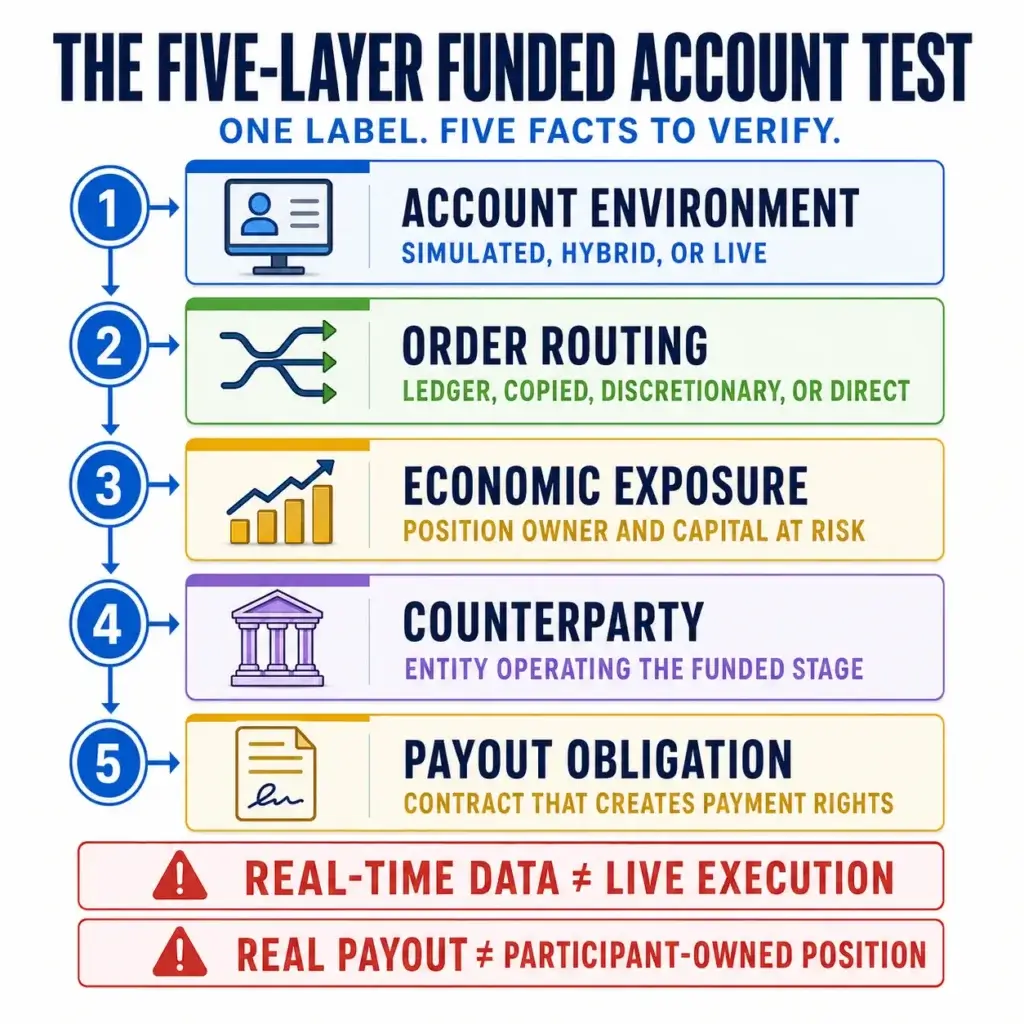
Use the Five-Layer Account Test
Test the funded stage in five layers because account environment, routing, ownership, counterparty, and payout rights require separate evidence. The records for each layer should agree.
| Layer | What Must Be Established |
|---|---|
| Account environment | Whether the participant’s orders, balance, and P&L sit in a simulator, a market account, or a mixed system |
| Order routing | Whether an instruction stays in a ledger, informs separate firm trading, routes at the firm’s discretion, or reaches a market directly |
| Economic exposure | Whether a live position exists, who owns it, and whose capital gains or loses value |
| Counterparty | Which legal entity operates the funded stage and controls any broker or exchange account |
| Payout obligation | Which agreement and entity create the participant’s conditional right to an approved payment |
Consider an account that displays a familiar exchange interface with live prices and moving P&L. The agreement can still define every participant order as simulated. Separately, the firm may reserve the right to use trading data in its own account. The participant position still exists only in simulation, while the firm may conduct separate market activity.
Evidence for one layer cannot substitute for another because a wallet transaction can prove payment without establishing the trade route. An authenticated live fill establishes market execution but may not identify the entity that owes the participant's reward. When current documents stop short of direct routing, record that routing is not established.
Four Ways a Funded Account Can Handle Orders
The participant's account and the firm's market activity can follow different paths. Classifying only the participant screen misses that separation.
| Order Model | What Happens |
|---|---|
| Pure simulation | The instruction changes a virtual balance and P&L record. No participant order is submitted to a market account. |
| Simulation with separate copying | The participant record stays simulated. The firm independently decides whether to reproduce or hedge some exposure in its own account. |
| Discretionary internal or external routing | The firm can retain the instruction internally or route market exposure under its policy. The participant may not know the route for an individual order. |
| Direct market execution | The participant’s permitted instruction places or manages a live position in a firm-controlled market account. |
Copied exposure leaves the participant account in simulation while the firm controls any separate market position. The firm can change size and timing, combine exposure across traders, or take no position. Its market P&L can therefore differ from the program P&L shown to the participant.
Traditional firm-capital trading starts with the business owning its market positions and economic result. Online funded programs can use participant simulation as an assessment and reward layer even when the firm also trades for itself.
Where Does the Profit or Loss Actually Exist?
One funded program can maintain several financial records at once. They should not be treated as one balance.
| Record | Who Owns It |
|---|---|
| Participant program ledger | A performance record maintained under the funded-stage rules. It is not participant-owned cash. |
| Firm market position | A live position owned by the firm or the named market-account entity |
| Firm market P&L | The firm’s realized or unrealized result from its own live exposure |
| Participant reward | A conditional payment calculated under the funded-stage agreement |
In pure simulation, the displayed gain exists only in the program ledger until the agreement turns eligible performance into a payment obligation. In a copied model, a separate firm position can create a different gain or loss. In direct-live trading, the market P&L is real, but it belongs to the firm-controlled account before the participant's contractual share is calculated.
The advertised balance normally remains firm-controlled or notional in all three models. A participant can manage risk against a $100,000 label without owning $100,000, and a $2,000 gain on screen need not create a right to withdraw $102,000. The agreement defines the amount that can be requested.
What Changes When an Order Goes Live?
Live execution makes market interaction economically real for the account owner. Simulation can model the same inputs, but the output remains a model unless routing evidence ties the instruction to a market record.
| Execution Factor | What Changes |
|---|---|
| Available liquidity | The order can fill only against available interest at acceptable prices. |
| Queue and partial fills | Time priority and order size can leave an instruction partly filled or waiting. |
| Slippage and rejects | The executed price can differ from the requested price, and an order can be rejected. |
| Market impact | A larger order can move the market or consume several price levels. |
| Costs | Broker, exchange, clearing, financing, and data charges can affect the live result. |
| Margin failure | A broker or exchange can reduce or close a position under its own margin rules. |
| Third parties | Connectivity and access depend on the broker, exchange, clearer, custodian, or data provider. |
A simulator can apply spreads and delay as well as partial-fill logic and modeled slippage. That may create a more realistic assessment, but it cannot prove the exact fill a live order would have received. The firm should identify any fixed assumptions and market-depth inputs, along with the resulting fill model.
Live market loss and a program breach can also occur at different points. The way a drawdown floor moves can close funded access before a live position reaches the broker's liquidation threshold. The reverse is possible when the broker's margin requirement is tighter.
Crypto adds its own execution details. Crypto-funded execution can involve perpetual funding and mark-price liquidation, while continuous markets and exchange APIs create separate dependencies.
How Can Simulated Trading Produce a Real Payout?
A simulated result can create a genuine payment because the funded-stage agreement defines a reward formula. The money does not need to come from a participant-owned market position. It comes from the entity that accepted the contractual obligation, subject to the account rules and approval process.
Four facts should be recorded separately:
- The legal entity that owes an approved payment
- The formula that turns eligible performance into a requestable amount
- The firm's review and deduction rules, including denial and reversal rights
- The payment method and settlement costs
A payout receipt establishes a completed payment only. It leaves the trade route and future request approval unanswered. It also says nothing about whether the firm copied the participant's positions. A live market profit belongs to the firm-controlled account before the agreement determines the trader's share.
The detailed rules for payout eligibility and settlement include timing and consistency conditions. Account buffers and conduct review can apply to simulated and live funded stages as well.
What Changes If a Firm Moves You to Live Capital?
Moving live triggers a new account event that can replace earlier rights and limits. The firm may close simulated accounts and issue a new agreement before recalculating the trader's limits.
| Transition Item | What to Recheck |
|---|---|
| Agreement and entity | Whether a new contract applies and whether the funded-stage counterparty changes |
| Account closure | Whether simulated accounts close, merge, or lose unused payout eligibility |
| Capital and reserve | The actual firm capital reserved for the live account and how it relates to the displayed balance |
| Position limits | New contract, lot, concentration, or exposure caps |
| Loss rules | Daily loss, total loss, trailing thresholds, liquidation, and broker-level margin rules |
| Payout rules | New split, cap, request schedule, reserve requirement, or minimum buffer |
| Conduct | Changes to holding, automation, news, inactivity, or strategy restrictions |
| Eligibility | Whether promotion is discretionary and whether country or identity rules change |
A participant should save the live-stage agreement before accepting the transition because prior payouts do not preserve the old rules. The live account may start with less usable loss room and fewer positions. Its request schedule can also change while the headline balance remains unchanged.
Promotion is never established by a generic promise that good traders can go live. The program must state who decides, which account replaces the simulated stage, and what happens to unpaid performance. If those terms are absent, a future live allocation should not be assumed.
Live Funded Account vs Personal Live Account
A direct-live prop account and a personal live account both create market positions, but they create different ownership and withdrawal rights.
| Question | How the Relationship Differs |
|---|---|
| Who supplies the money? | The firm supplies or controls capital in a live funded account. The trader deposits personal money in a personal account. |
| Who owns the position? | The firm or named account entity owns the funded position. The personal account holder owns the account rights under the broker agreement. |
| Who bears market loss? | The firm bears live market P&L, while the participant can lose access or unpaid rewards. The personal trader loses deposited equity. |
| Who sets risk limits? | The firm can impose tighter program rules on top of broker margin. The personal trader sets strategy limits within broker rules. |
| What can be withdrawn? | The funded trader can request only the contractual share. The personal trader can normally withdraw available equity. |
| Who is the counterparty? | The funded-stage entity owes the trader’s payment. The broker or exchange holds the personal account relationship. |
| How can access end? | A program breach or contract decision can close funded access. A personal account follows the provider’s margin and account terms. |
Direct-live funded trading can therefore create real execution history without giving the participant ownership of the market account. A personal account creates direct capital exposure and withdrawal rights, but it also places the trader's deposited money at risk.
How to Verify Whether a Funded Account Is Live
Start with the documents that govern the funded stage. Interface labels and promotional language carry less weight because they do not establish the legal or execution path.
| Evidence | What It Can Establish |
|---|---|
| Signed stage-specific agreement | The legal entity, account definition, ownership terms, payout obligation, and change rights |
| Incorporated routing policy | Whether orders stay internal, may be copied, route at the firm’s discretion, or reach a market directly |
| Stage-specific account documents | Whether the participant uses a simulator or a named firm-controlled market account |
| Authenticated market records | Whether a relevant order reached a broker, exchange, or clearing account |
| Reconciled order data | Whether identifiers, timestamps, fills, fees, and positions agree across the records |
| Dated written support | A product-specific clarification when it agrees with the governing documents |
Weak evidence includes “live” or funded labels and real-time charts. Broker branding, exchange integrations, and payout screenshots are weak for the same reason. Social posts can suggest a question to investigate, but they do not establish the account model on their own.
Begin with the agreement version and effective date. Confirm that any linked routing policy is incorporated into the contract and applies to the exact product and stage. Check country-specific terms separately. Then reconcile the account identifier with authenticated market records when the firm claims direct execution.
The due-diligence process used to verify a prop firm before paying should identify who can change the routing policy and how disputes are handled. Check separately whether payment obligations survive account closure. When evidence stops short, record the narrow result. “Direct-live routing is not established” is more accurate than either a live-capital claim or a fraud accusation.
Worked Example: Same Dashboard, Three Different Models
Assume three hypothetical accounts each display a $100,000 label and a $2,000 gain. The hypothetical reward share is 80%, so each model can produce a $1,600 payment. The ownership chain is different in every case.
| Model | What the $2,000 Result Means |
|---|---|
| Pure simulation | The $2,000 exists in a program ledger. The agreement can create a $1,600 payment, but there is no participant-owned $102,000 market account. |
| Simulation with separate firm copying | The participant records $2,000 in simulation. The firm copies only the exposure it chooses, and its market result may be higher or lower. The participant’s $1,600 still follows the contract. |
| Direct-live funded | The $2,000 is market P&L in a firm-controlled account before contract adjustments. The firm owns the position, while the participant can have a $1,600 contractual share. |
Because the payment amount and displayed gain cannot identify the account environment, the source records must show where the participant instruction went. They must also show whether the firm created market exposure and which agreement turns performance into payment.
These hypothetical figures illustrate ownership chains and do not represent a typical offer or expected outcome. A real program can apply caps and deductions, along with loss reserves and review rights, before approving a request.
Is a Live Funded Account Better Than a Simulated One?
The better model depends on whether the account terms fit the trader's purpose and whether the firm can support its obligations.
| Priority | What to Examine |
|---|---|
| Real market track record | Direct execution can produce authenticated fills and experience with actual liquidity. |
| Predictable rule testing | Simulation can apply a consistent fill model, although it cannot prove the exact live result. |
| Execution tolerance | Live orders face partial fills, rejects, slippage, and market impact. |
| Counterparty quality | Both models depend on the firm honoring the funded-stage agreement. |
| Strategy fit | Some methods behave differently when queue position, order size, or latency matters. |
| Cost | Program charges, market fees, financing, data, and payout deductions can differ. |
| Promotion path | A live transition can be discretionary and can replace prior account terms. |
Choose based on disclosed routing and realistic fill assumptions. Then assess usable loss room, contract durability, strategy fit, and total cost. A simulation model with precise rules and a reliable payout record can serve a trader's objective. A live model with unclear ownership or a fragile counterparty can still be unsuitable.
Checklist Before You Pay
Reduce every claim to a written field that can be checked again after purchase.
| Check | Confirm in Writing |
|---|---|
| Product and stage | Exact evaluation and funded product names |
| Legal entity | Company that contracts with the participant at each stage |
| Environment | Definition of simulated, hybrid, or direct-live activity |
| Routing | Whether the firm may internalize, copy, hedge, or route an instruction |
| Ownership | Owner of the account, any live position, market P&L, and trade data |
| Price and fills | Price source, spread, fee, delay, slippage, and rejection model |
| Drawdown | Balance or equity reference, reset time, trailing behavior, and fee treatment |
| Payout | Entity, formula, split, cap, minimum, review rights, and settlement method |
| Live transition | Decision authority, new agreement, account closure, reserve, and position limits |
| Change rights | Notice process for contract or rule changes |
| Disputes | Governing law, complaint route, and records required |
Read the same fields again before the first payout request and before accepting a live transition. A provider can change the account model between product tiers, and two programs from the same firm can use different routing.
Once the account model is clear, current prop firm listings can be filtered by market and cost, then by account structure and payout terms. The agreement available at checkout remains the controlling record.
FAQ
Are funded trading accounts live or simulated?
Funded accounts can remain simulated, use copied exposure, allow discretionary routing, or place permitted instructions directly into a firm-controlled market account. The funded label alone identifies none of these routes, so the stage-specific agreement and routing policy must establish the model.
Do prop firms use real money in funded accounts?
Traditional proprietary firms use company capital in live markets, while online funded programs may keep participant accounts in simulation after funded status begins. A firm can also trade separately using selected data or exposure from simulated accounts. Real firm capital may therefore exist without the participant account being live, and a live funded account can remain owned by the firm.
Can a simulated funded account pay real money?
A simulated funded account can pay real money because the funded-stage agreement can turn eligible performance into a genuine obligation. The result is a reward or contractual share. Participant-owned market-account equity is not involved. Approval can depend on closed performance and timing, plus consistency rules, account buffers, identity checks, and conduct review. A payment receipt establishes payment but not live execution.
Does an exchange or broker platform prove that trades are live?
An exchange or broker platform does not prove that trades are live. A simulator can use real-time market data and reproduce order tickets, depth, fills, fees, and moving P&L. An exchange connection can also feed prices into a simulated account while the firm reserves any live trading for a separate account. Stage-specific documents and authenticated market records establish direct execution. An interface logo or familiar screen cannot.
Do funded traders own the account balance or positions?
Funded traders normally do not own the advertised account balance because it represents program buying power or firm-controlled capital. In simulation, no participant-owned market asset sits behind that value. In a direct-live prop account, the firm or named account entity owns both the market position and its P&L. The trader’s economic right is the contractual share that becomes requestable under the funded-stage rules.
What happens when a trader moves from simulated to live funding?
The firm may close or consolidate simulated accounts, issue a new agreement, set a new capital reserve, and change loss or position limits. Payout caps, inactivity rules, strategy restrictions, and jurisdictional eligibility can change as well. Promotion may be discretionary. The trader should save the live-stage documents and recalculate usable loss room before placing the first live order.