Crypto loans let you borrow cash or stablecoins against digital assets while keeping exposure to their price. A sharp fall can force a sale before the planned payoff, ending the plan to keep those coins. Choosing between a company-managed loan and direct protocol borrowing means comparing usable funds, the cost until repayment, and who controls the collateral in the meantime.
Top Crypto Loans
- Borrowing terms
- Fixed rate · Up to 12 months
- Collateral & risk
- BTC sale: 80%/uncured 70% LTV
- Availability
- US · CA, NV & others excluded
- Monthly or deferred interest choice
- Custody with Anchorage Digital
- Gold-token collateral options
- Borrowing terms
- 12-month BTC loan
- Collateral & risk
- Price or maturity sale risk
- Availability
- Select US states & countries
- 12-month Bitcoin-backed loans
- No early-repayment penalty
- No traditional credit check
- Borrowing terms
- Variable USDC borrowing
- Collateral & risk
- Pooled cbBTC collateral
- Availability
- Sanctioned regions excluded
- USDC paid to your Base wallet
- No fixed repayment date
- Borrow against cbBTC on Base
- Borrowing terms
- Variable USDC borrowing
- Collateral & risk
- BTC wrapped as cbBTC
- Availability
- US except NY · Limited UK/CA
- USDC borrowing inside Coinbase
- Borrowing network fees covered
- Optional automatic collateral top-up
- Borrowing terms
- 12-month fixed-term loan
- Collateral & risk
- Standard: 90% LTV full sale
- Availability
- US · 9 states & DC excluded
- Optional price-liquidation protection
- Loan-specific collateral sub-wallet
- Standard loans support Solana collateral
- Borrowing terms
- Daily fee · Quote required
- Collateral & risk
- Individual Price Down Limit
- Availability
- US and Canada excluded
- Daily fees for actual borrowing days
- Take Profit automatic price-based closure
- Fiat and crypto payout options
- Borrowing terms
- Fixed or open-ended
- Collateral & risk
- Collateral ownership transfers
- Availability
- US/UK/HK excluded
- Up to 90% starting loan-to-value
- Paid Loan Restoration after liquidation
- Full and partial open-ended repayment
- Borrowing terms
- Revolving credit
- Collateral & risk
- Collateral reuse permitted
- Availability
- US, UK, EEA, others excluded
- Reusable crypto-backed credit
- Bank and stablecoin payout routes
- No fixed monthly installments
CryptoSlate may earn a commission when you visit partner sites through links on this page, at no extra cost to you. Our rankings and reviews remain editorially independent and based on our published methodology. Read disclosure
Disclaimer: CryptoSlate may receive a commission when you click links on our site and make a purchase or complete an action with a third party. This does not influence our editorial independence, reviews, or ratings, and we always aim to provide accurate, transparent information to our readers.A bank payment and a stablecoin balance solve different borrowing needs. If you need cash in a bank account, factor conversion costs, withdrawal charges, and processing time into the comparison.
Comparison Table
| Brand | Collateral & debt | Borrowing rate | Fees | Max starting LTV | Payout | Custody |
|---|---|---|---|---|---|---|
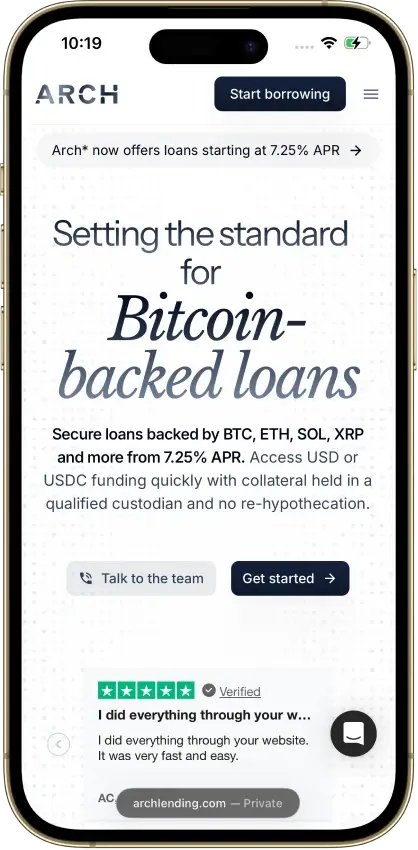
 Arch Lending | Arch Crypto-Backed Loan; Consumer crypto-backed loan for eligible US individuals, one collateral type per loan, for up to 12 months. The headline rate is the 12-month BTC, ETH, or SOL tier below $250,000.; BTC, ETH, SOL, XRP, PAX Gold (PAXG), Tether Gold (XAUT); Debt currency: USD or USDC | Arch Crypto-Backed Loan; Consumer crypto-backed loan for eligible US individuals, one collateral type per loan, for up to 12 months. The headline rate is the 12-month BTC, ETH, or SOL tier below $250,000.; 10.49–10.99% apr / annual; fixed; Fixed · 12-month BTC/ETH/SOL under $250,000 · 10.49% APR monthly / 10.99% APR deferred | Arch Crypto-Backed Loan; Consumer crypto-backed loan for eligible US individuals, one collateral type per loan, for up to 12 months. The headline rate is the 12-month BTC, ETH, or SOL tier below $250,000.; Origination · Collateral-sale fees · Late fees may apply | Arch Crypto-Backed Loan; Consumer crypto-backed loan for eligible US individuals, one collateral type per loan, for up to 12 months. The headline rate is the 12-month BTC, ETH, or SOL tier below $250,000.; 60% | Arch Crypto-Backed Loan; Consumer crypto-backed loan for eligible US individuals, one collateral type per loan, for up to 12 months. The headline rate is the 12-month BTC, ETH, or SOL tier below $250,000.; Bank/USDC · Same-day processing estimate | Arch Crypto-Backed Loan; Consumer crypto-backed loan for eligible US individuals, one collateral type per loan, for up to 12 months. The headline rate is the 12-month BTC, ETH, or SOL tier below $250,000.; Anchorage Digital · No-reuse policy |
 Ledn | Ledn Bitcoin-Backed Dollar Loan; 12-month US dollar loan against BTC for eligible borrowers. Unavailable in California, Connecticut, Hawaii, Nevada, North Dakota, South Dakota, Tennessee, Washington, and Washington, D.C. Other states and countries can carry conditions on amount, APR, or purpose.; Bitcoin (BTC); Debt currency: USD | Ledn Bitcoin-Backed Dollar Loan; 12-month US dollar loan against BTC for eligible borrowers. Unavailable in California, Connecticut, Hawaii, Nevada, North Dakota, South Dakota, Tennessee, Washington, and Washington, D.C. Other states and countries can carry conditions on amount, APR, or purpose.; Individual quote required; individual quote; Tiered APR · Quote required. Lower APRs apply to larger loans, and the 2% administration fee is included in the APR where charged (US/Canada exempt). | Ledn Bitcoin-Backed Dollar Loan; 12-month US dollar loan against BTC for eligible borrowers. Unavailable in California, Connecticut, Hawaii, Nevada, North Dakota, South Dakota, Tennessee, Washington, and Washington, D.C. Other states and countries can carry conditions on amount, APR, or purpose.; 2% admin included in APR (US/Canada exempt) · Partial-wire bank charge | — | Ledn Bitcoin-Backed Dollar Loan; 12-month US dollar loan against BTC for eligible borrowers. Unavailable in California, Connecticut, Hawaii, Nevada, North Dakota, South Dakota, Tennessee, Washington, and Washington, D.C. Other states and countries can carry conditions on amount, APR, or purpose.; Bank / stablecoins · Timing varies | Ledn Bitcoin-Backed Dollar Loan; 12-month US dollar loan against BTC for eligible borrowers. Unavailable in California, Connecticut, Hawaii, Nevada, North Dakota, South Dakota, Tennessee, Washington, and Washington, D.C. Other states and countries can carry conditions on amount, APR, or purpose.; Custodial · Funding pledges · No yield lending |
 Aave | Aave V3 · Base cbBTC/USDC; Aave V3 Base pool in normal mode (E-mode disabled), with cbBTC as the only collateral and USDC as the only debt.; cbBTC on Base · Normal mode; Debt currency: USDC | Aave V3 · Base cbBTC/USDC; Aave V3 Base pool in normal mode (E-mode disabled), with cbBTC as the only collateral and USDC as the only debt.; Rate not quoted; variable; Variable APY · Pool-demand pricing | Aave V3 · Base cbBTC/USDC; Aave V3 Base pool in normal mode (E-mode disabled), with cbBTC as the only collateral and USDC as the only debt.; Network gas · External conversion costs | Aave V3 · Base cbBTC/USDC; Aave V3 Base pool in normal mode (E-mode disabled), with cbBTC as the only collateral and USDC as the only debt.; 81% | Aave V3 · Base cbBTC/USDC; Aave V3 Base pool in normal mode (E-mode disabled), with cbBTC as the only collateral and USDC as the only debt.; USDC to wallet · After confirmation | Aave V3 · Base cbBTC/USDC; Aave V3 Base pool in normal mode (E-mode disabled), with cbBTC as the only collateral and USDC as the only debt.; Pooled contracts · cbBTC issuer dependency |
 Coinbase Borrow | Coinbase Borrow · Variable BTC loan; Variable USDC loan for eligible, verified Coinbase customers in the US except New York, with limited UK and Canadian access. BTC collateral is converted to cbBTC and locked in a Morpho market on Base. Fixed-rate loans have separate fees, maturity, and early-repayment rules.; BTC converted to cbBTC on Base; Debt currency: USDC | Coinbase Borrow · Variable BTC loan; Variable USDC loan for eligible, verified Coinbase customers in the US except New York, with limited UK and Canadian access. BTC collateral is converted to cbBTC and locked in a Morpho market on Base. Fixed-rate loans have separate fees, maturity, and early-repayment rules.; Rate not quoted; variable; Variable · Moves with Morpho market utilization · May include a monthly Coinbase platform fee | Coinbase Borrow · Variable BTC loan; Variable USDC loan for eligible, verified Coinbase customers in the US except New York, with limited UK and Canadian access. BTC collateral is converted to cbBTC and locked in a Morpho market on Base. Fixed-rate loans have separate fees, maturity, and early-repayment rules.; 2% first $250,000 · 1% above · Added to debt · May include platform fee | — | Coinbase Borrow · Variable BTC loan; Variable USDC loan for eligible, verified Coinbase customers in the US except New York, with limited UK and Canadian access. BTC collateral is converted to cbBTC and locked in a Morpho market on Base. Fixed-rate loans have separate fees, maturity, and early-repayment rules.; Coinbase USDC balance · After processing | Coinbase Borrow · Variable BTC loan; Variable USDC loan for eligible, verified Coinbase customers in the US except New York, with limited UK and Canadian access. BTC collateral is converted to cbBTC and locked in a Morpho market on Base. Fixed-rate loans have separate fees, maturity, and early-repayment rules.; Morpho contracts · cbBTC dependency |
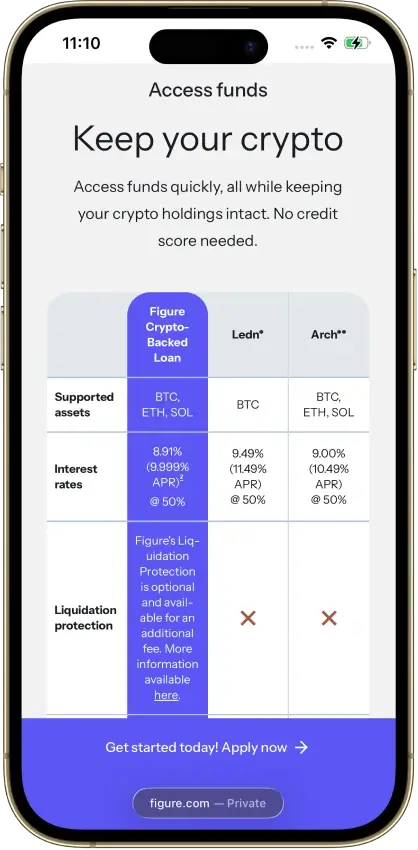
 Figure Crypto-Backed Loan | Figure Crypto-Backed Loan; 12-month US dollar term loan from Figure Lending LLC for eligible US borrowers, excluding residents of nine states and DC. Optional Liquidation Protection covers BTC and ETH loans at up to 50% initial LTV in ten states, for a 2% fee.; BTC, ETH, SOL · Protection: BTC/ETH; Debt currency: USD | Figure Crypto-Backed Loan; 12-month US dollar term loan from Figure Lending LLC for eligible US borrowers, excluding residents of nine states and DC. Optional Liquidation Protection covers BTC and ETH loans at up to 50% initial LTV in ten states, for a 2% fee.; 9.999–12.62% apr / annual; fixed; 8.91% interest (9.999% APR) at 50% initial LTV · 11.50% interest (12.62% APR) at up to 75% LTV · Advertised APRs exclude the 2% protection fee | Figure Crypto-Backed Loan; 12-month US dollar term loan from Figure Lending LLC for eligible US borrowers, excluding residents of nine states and DC. Optional Liquidation Protection covers BTC and ETH loans at up to 50% initial LTV in ten states, for a 2% fee.; 1% origination by jurisdiction · Protection fee · 2% sale fee where allowed | Figure Crypto-Backed Loan; 12-month US dollar term loan from Figure Lending LLC for eligible US borrowers, excluding residents of nine states and DC. Optional Liquidation Protection covers BTC and ETH loans at up to 50% initial LTV in ten states, for a 2% fee.; 75% | Figure Crypto-Backed Loan; 12-month US dollar term loan from Figure Lending LLC for eligible US borrowers, excluding residents of nine states and DC. Optional Liquidation Protection covers BTC and ETH loans at up to 50% initial LTV in ten states, for a 2% fee.; Figure Markets account · Timing varies | Figure Crypto-Backed Loan; 12-month US dollar term loan from Figure Lending LLC for eligible US borrowers, excluding residents of nine states and DC. Optional Liquidation Protection covers BTC and ETH loans at up to 50% initial LTV in ten states, for a 2% fee.; Multiparty computation · Protected loans may use third parties |
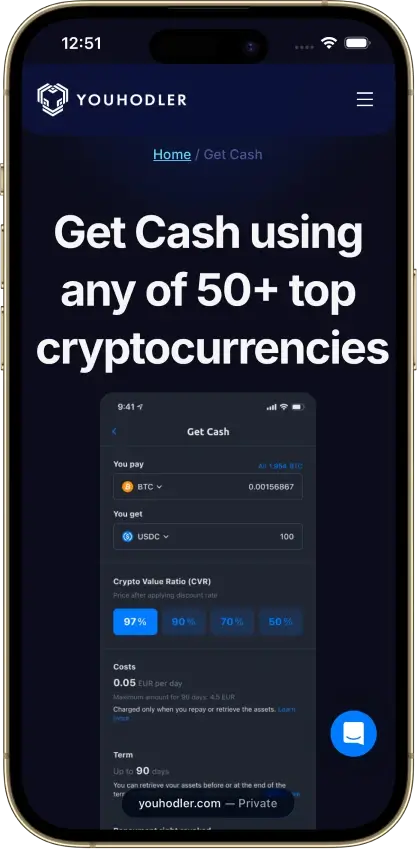
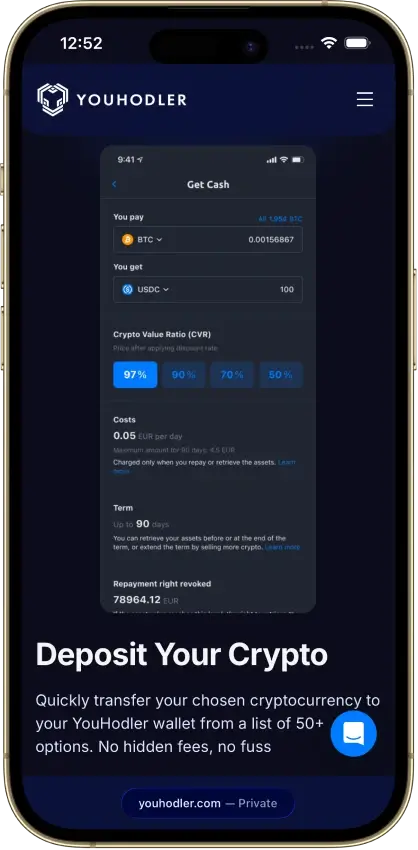
 YouHodler Crypto-Backed Loan | YouHodler Get Cash; Get Cash crypto-backed loan under YouHodler SA’s Swiss terms. Residents of the US and Canada are excluded, along with China, India, Hungary, and other restricted regions. The Get Cash page presents the tariff as a crypto value ratio, so the loan form and individual agreement confirm the final terms.; BTC, ETH · Other supported crypto; Debt currency: USD · EUR · GBP · CHF · Crypto | YouHodler Get Cash; Get Cash crypto-backed loan under YouHodler SA’s Swiss terms. Residents of the US and Canada are excluded, along with China, India, Hungary, and other restricted regions. The Get Cash page presents the tariff as a crypto value ratio, so the loan form and individual agreement confirm the final terms.; Individual quote required; individual quote; Daily fee on the borrowed amount, shown in the loan form · Higher when added to debt than when paid from the wallet | YouHodler Get Cash; Get Cash crypto-backed loan under YouHodler SA’s Swiss terms. Residents of the US and Canada are excluded, along with China, India, Hungary, and other restricted regions. The Get Cash page presents the tariff as a crypto value ratio, so the loan form and individual agreement confirm the final terms.; Close Now 1% of the overdraft amount · Extend PDL 1.5% of added collateral · Increase LTV 1.5% of the increased amount · Conversion and withdrawal charges | — | YouHodler Get Cash; Get Cash crypto-backed loan under YouHodler SA’s Swiss terms. Residents of the US and Canada are excluded, along with China, India, Hungary, and other restricted regions. The Get Cash page presents the tariff as a crypto value ratio, so the loan form and individual agreement confirm the final terms.; Wallet first · Bank or crypto withdrawal | YouHodler Get Cash; Get Cash crypto-backed loan under YouHodler SA’s Swiss terms. Residents of the US and Canada are excluded, along with China, India, Hungary, and other restricted regions. The Get Cash page presents the tariff as a crypto value ratio, so the loan form and individual agreement confirm the final terms.; Custodial · Pledged collateral |
 CoinRabbit | CoinRabbit Crypto Loan; Crypto-backed loan for eligible borrowers outside the US, UK, Hong Kong and other restricted jurisdictions, with fixed-term (usually 30 days) and open-ended options. The 11.95% starting rate needs the 80% liquidation LTV, which caps borrowing at 65% LTV.; BTC, ETH, XRP, and others; Debt currency: USDT or USDC | CoinRabbit Crypto Loan; Crypto-backed loan for eligible borrowers outside the US, UK, Hong Kong and other restricted jurisdictions, with fixed-term (usually 30 days) and open-ended options. The 11.95% starting rate needs the 80% liquidation LTV, which caps borrowing at 65% LTV.; 11.95% apr / annual; individual quote; Calculator estimate · BTC/USDT · 50% starting LTV · Open-ended; 2026-11-10 16:33:08 UTC | CoinRabbit Crypto Loan; Crypto-backed loan for eligible borrowers outside the US, UK, Hong Kong and other restricted jurisdictions, with fixed-term (usually 30 days) and open-ended options. The 11.95% starting rate needs the 80% liquidation LTV, which caps borrowing at 65% LTV.; Transfer and withdrawal fees · Restoration fee | CoinRabbit Crypto Loan; Crypto-backed loan for eligible borrowers outside the US, UK, Hong Kong and other restricted jurisdictions, with fixed-term (usually 30 days) and open-ended options. The 11.95% starting rate needs the 80% liquidation LTV, which caps borrowing at 65% LTV.; 90% | CoinRabbit Crypto Loan; Crypto-backed loan for eligible borrowers outside the US, UK, Hong Kong and other restricted jurisdictions, with fixed-term (usually 30 days) and open-ended options. The 11.95% starting rate needs the 80% liquidation LTV, which caps borrowing at 65% LTV.; Crypto wallet · Advertised 10 minutes | CoinRabbit Crypto Loan; Crypto-backed loan for eligible borrowers outside the US, UK, Hong Kong and other restricted jurisdictions, with fixed-term (usually 30 days) and open-ended options. The 11.95% starting rate needs the 80% liquidation LTV, which caps borrowing at 65% LTV.; Ownership transfer · Reuse clauses conflict |
 Nexo Credit Line | Nexo Classic Credit Line; Classic rest-of-world credit line against BTC and other accepted assets. Excludes the US, UK, EEA, Canada, Switzerland, Australia, New Zealand, the UAE, and other markets, where separate regional offers have their own terms. Booster, card borrowing, Private, and Zero-interest Credit are separate.; BTC · Other assets available; Debt currency: xUSD | Nexo Classic Credit Line; Classic rest-of-world credit line against BTC and other accepted assets. Excludes the US, UK, EEA, Canada, Switzerland, Australia, New Zealand, the UAE, and other markets, where separate regional offers have their own terms. Booster, card borrowing, Private, and Zero-interest Credit are separate.; Rate not quoted; variable; Depends on loyalty tier and LTV | Nexo Classic Credit Line; Classic rest-of-world credit line against BTC and other accepted assets. Excludes the US, UK, EEA, Canada, Switzerland, Australia, New Zealand, the UAE, and other markets, where separate regional offers have their own terms. Booster, card borrowing, Private, and Zero-interest Credit are separate.; 0.26% crypto repayment (stablecoins and FIATx exempt) · 45-day early-repayment interest at 17.9% · 2% to 3.5% liquidation fee | Nexo Classic Credit Line; Classic rest-of-world credit line against BTC and other accepted assets. Excludes the US, UK, EEA, Canada, Switzerland, Australia, New Zealand, the UAE, and other markets, where separate regional offers have their own terms. Booster, card borrowing, Private, and Zero-interest Credit are separate.; 50% | Nexo Classic Credit Line; Classic rest-of-world credit line against BTC and other accepted assets. Excludes the US, UK, EEA, Canada, Switzerland, Australia, New Zealand, the UAE, and other markets, where separate regional offers have their own terms. Booster, card borrowing, Private, and Zero-interest Credit are separate.; Bank / stablecoins · Minutes to 5 business days by route | Nexo Classic Credit Line; Classic rest-of-world credit line against BTC and other accepted assets. Excludes the US, UK, EEA, Canada, Switzerland, Australia, New Zealand, the UAE, and other markets, where separate regional offers have their own terms. Booster, card borrowing, Private, and Zero-interest Credit are separate.; Custodial · Lending and re-pledging allowed |
Compare the amount you receive with the debt you take on. A fee added to the loan can increase both the outstanding balance and the interest charged, even though it gives you no extra money to spend.
Crypto Loan Reviews
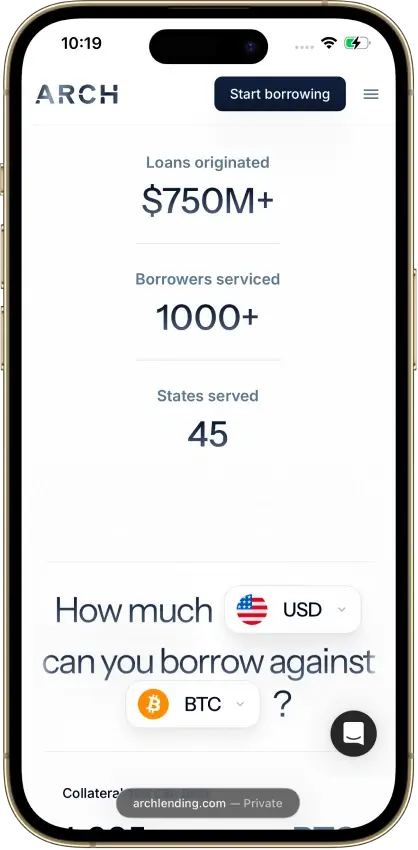
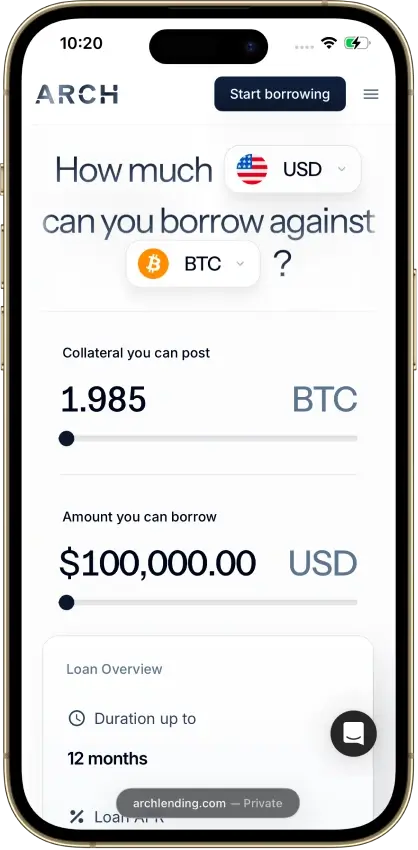
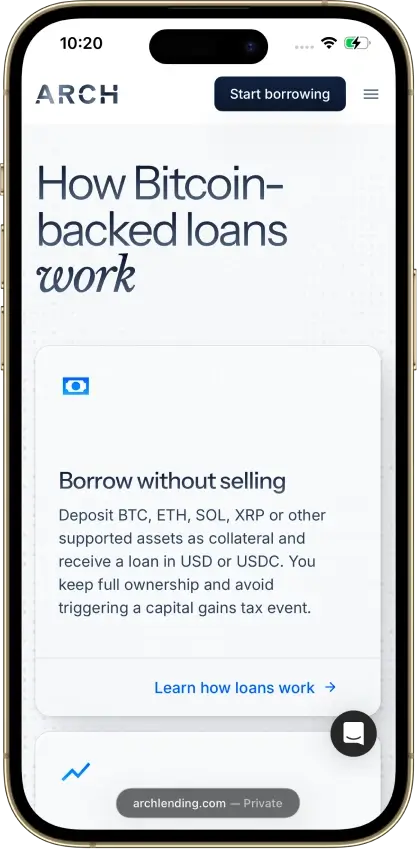
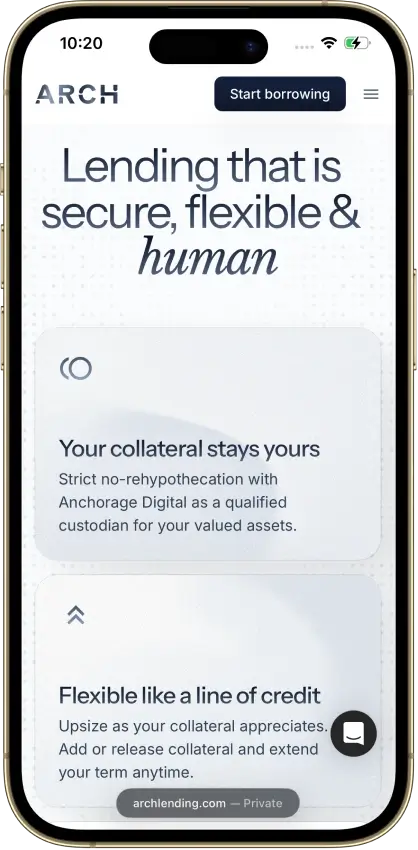
Arch Lending
- Borrowing terms
- Fixed rate · Up to 12 months
- Collateral & risk
- BTC sale: 80%/uncured 70% LTV
- Availability
- US · CA, NV & others excluded
Pros
- Bank and stablecoin disbursements
- Early repayment has no penalty
- Optional excess collateral withdrawals
Cons
- ACH payoff delays collateral release
- Deferred interest uses higher rates
- Rollover can increase the debt
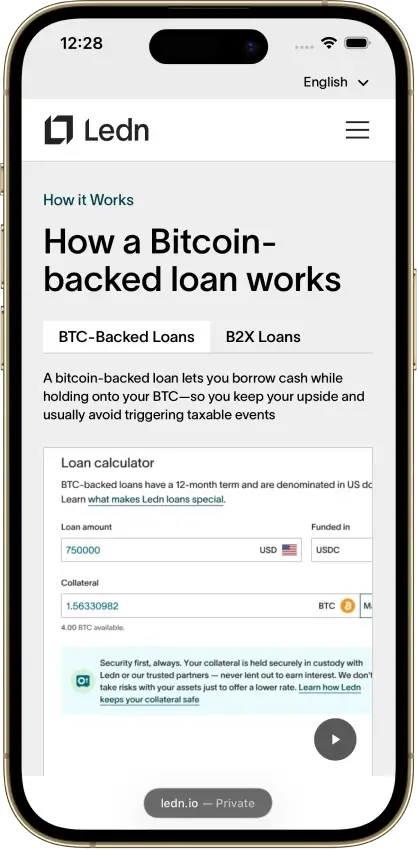
Ledn
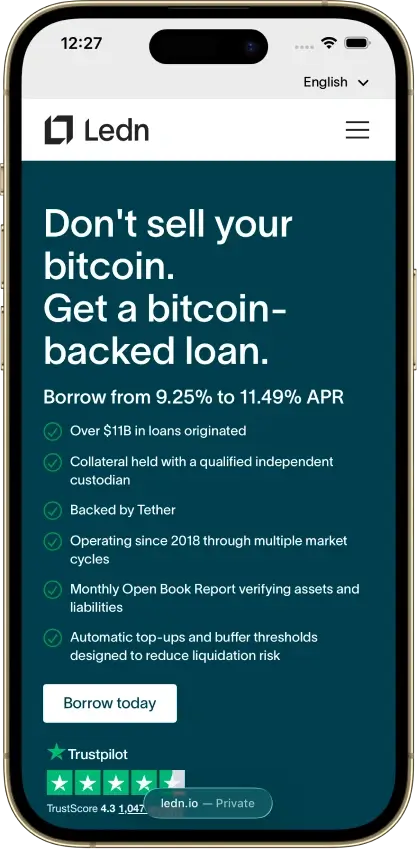
- Borrowing terms
- 12-month BTC loan
- Collateral & risk
- Price or maturity sale risk
- Availability
- Select US states & countries
Pros
- Partial repayments supported
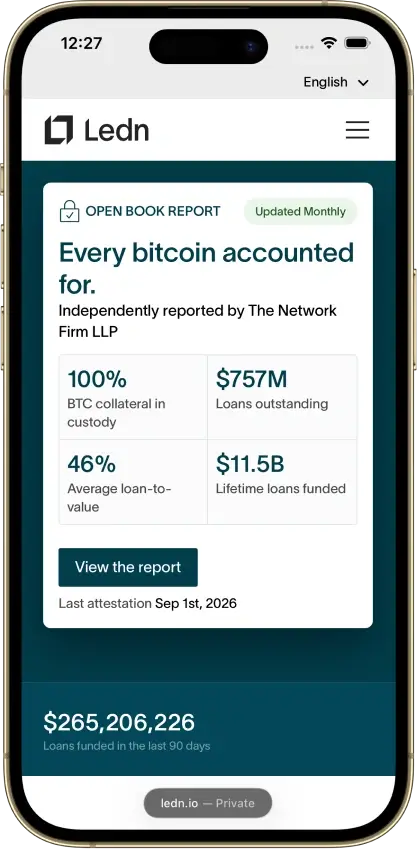
- Collateral not lent for yield
- LTV history and downloadable loan records
Cons
- Maturity can force BTC sales
- Collateral can be pledged for funding
- Bank payments and manual top-ups take time
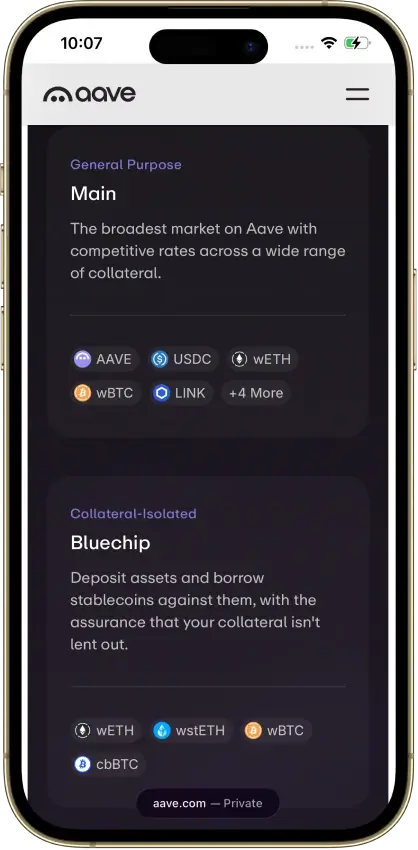
Aave
- Borrowing terms
- Variable USDC borrowing
- Collateral & risk
- Pooled cbBTC collateral
- Availability
- Sanctioned regions excluded
Pros
- Wallet-controlled loan management
- Public pool rates and risk parameters
- Partial repayments supported
Cons
- Borrowing rate changes with demand
- Collateral exits depend on liquidity
- cbBTC adds issuer and redemption risk
Coinbase Borrow
- Borrowing terms
- Variable USDC borrowing
- Collateral & risk
- BTC wrapped as cbBTC
- Availability
- US except NY · Limited UK/CA
Pros
- No fixed term on variable loans
- Partial repayments supported
- No credit check
Cons
- Processing fees also accrue interest
- BTC collateral adds a cbBTC dependency
- Loan protection must be funded and re-enabled
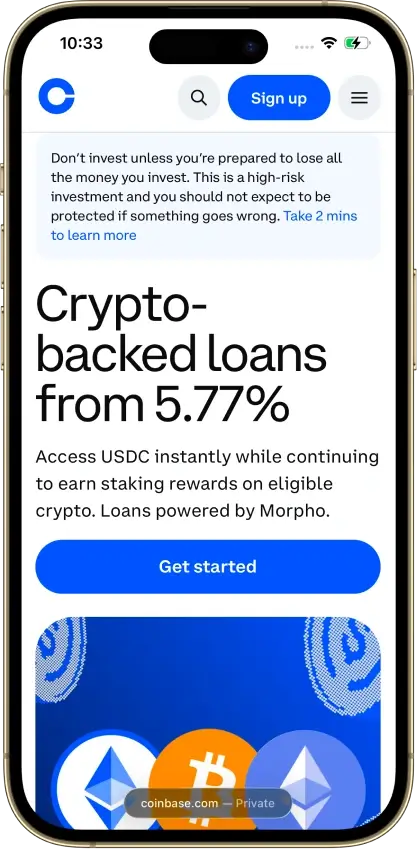
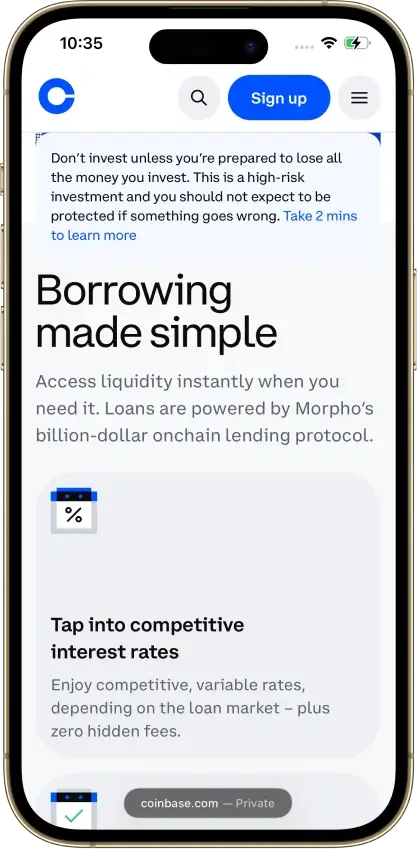
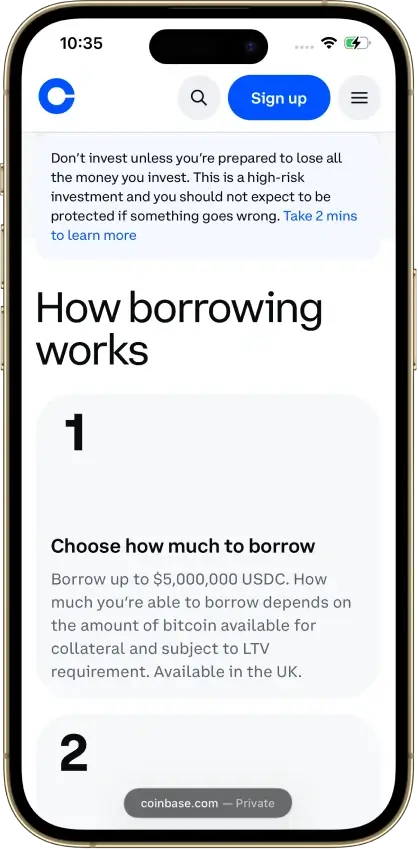
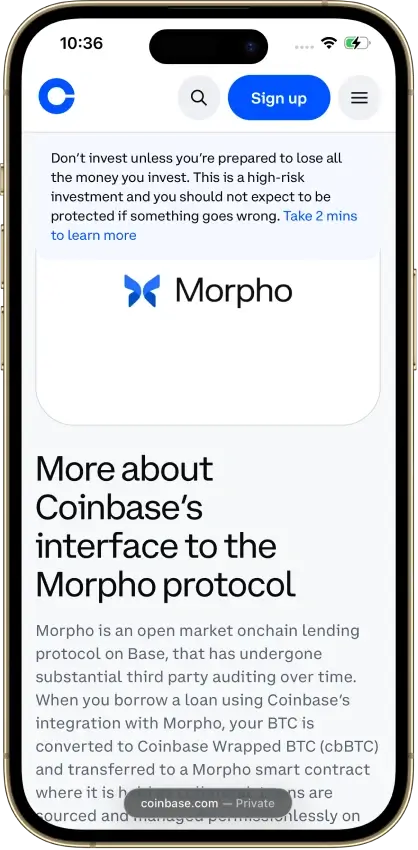
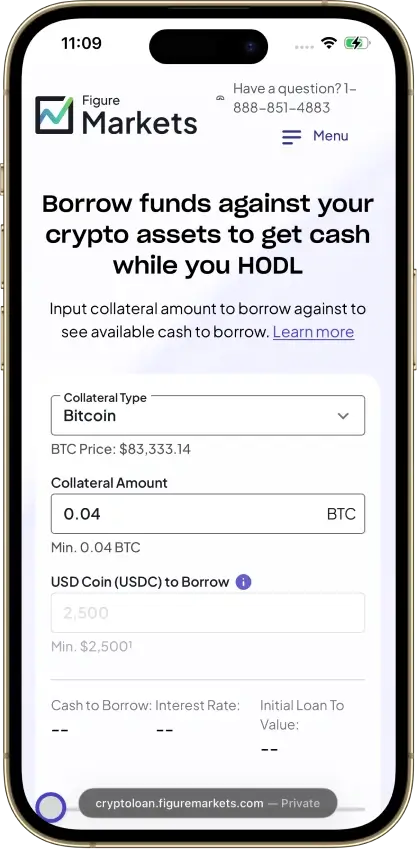
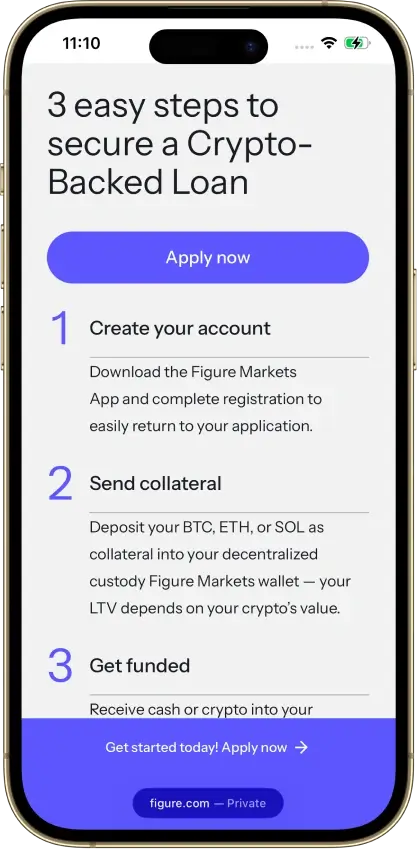
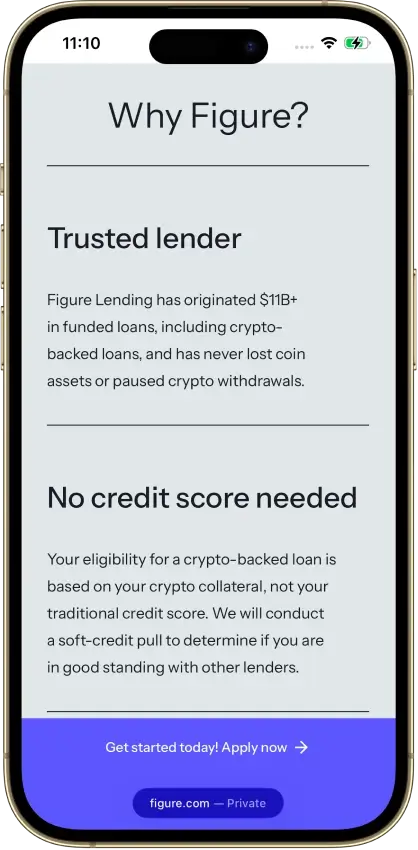
Figure Crypto-Backed Loan
- Borrowing terms
- 12-month fixed-term loan
- Collateral & risk
- Standard: 90% LTV full sale
- Availability
- US · 9 states & DC excluded
Pros
- Fixed rate during the loan term
- Early repayment without penalty
- BTC, ETH, and SOL collateral options
- Optional interest deferral
Cons
- Principal due at 12-month maturity
- Standard loans can be fully liquidated
- Protection restricted by state and loan type
- Deferral raises the balance due at maturity
YouHodler Crypto-Backed Loan
- Borrowing terms
- Daily fee · Quote required
- Collateral & risk
- Individual Price Down Limit
- Availability
- US and Canada excluded
Pros
- Partial wallet repayments supported
- Collateral top-ups where offered
- Several loan-management controls
Cons
- Debt-funded daily fees cost more
- Collateral adjustments can incur fees
- US and Canadian residents excluded
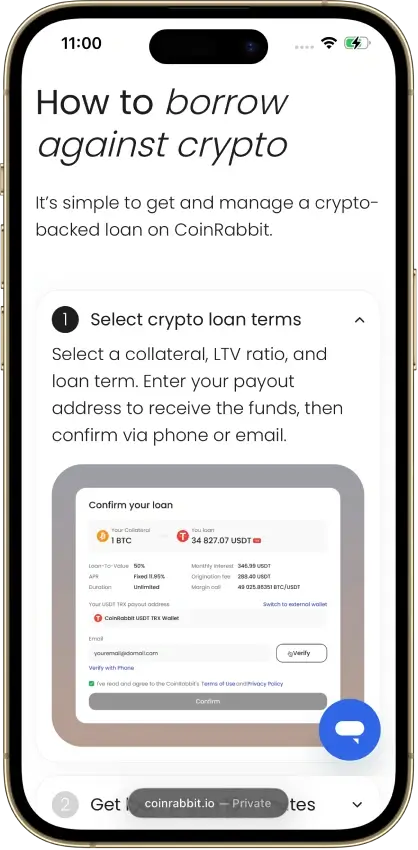
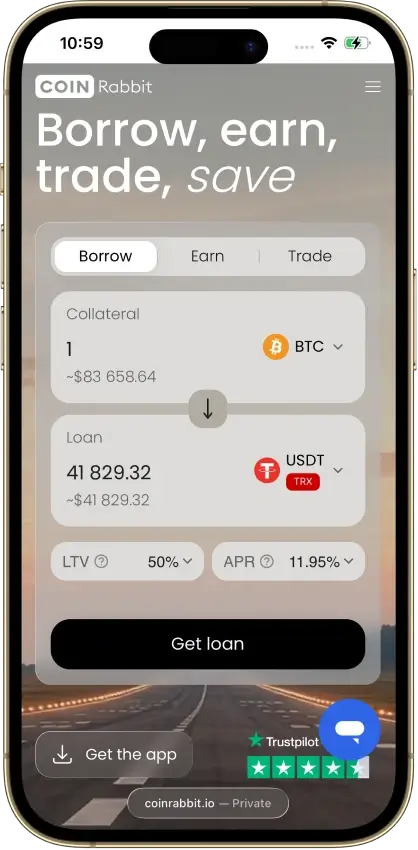
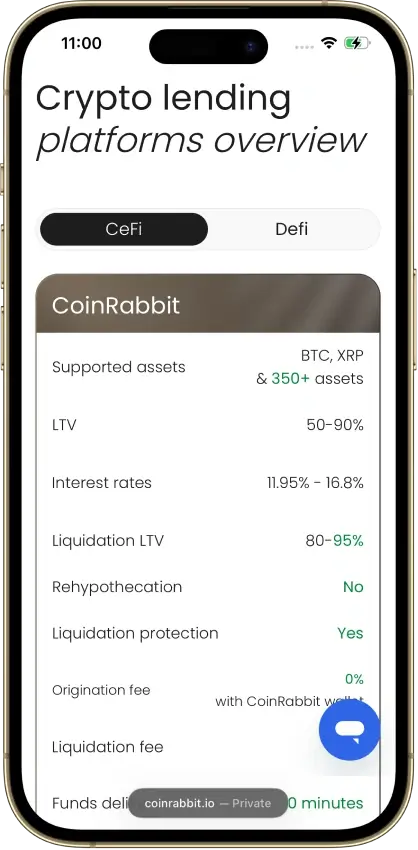
CoinRabbit
- Borrowing terms
- Fixed or open-ended
- Collateral & risk
- Collateral ownership transfers
- Availability
- US/UK/HK excluded
Pros
- Collateral beyond Bitcoin
- Optional automatic collateral top-ups
- Fixed-term interest set at the start
Cons
- US and UK customers excluded
- Collateral ownership transfers to lender
- Open-ended loan terms can change
Nexo Credit Line
- Borrowing terms
- Revolving credit
- Collateral & risk
- Collateral reuse permitted
- Availability
- US, UK, EEA, others excluded
Pros
- Per-line collateral transfer settings
- Repay the balance in stages
- Borrow against several collateral assets
Cons
- Extra interest on early repayments
- Lowest rate needs NEXO tokens and low LTV
- Collateral can be lent or re-pledged

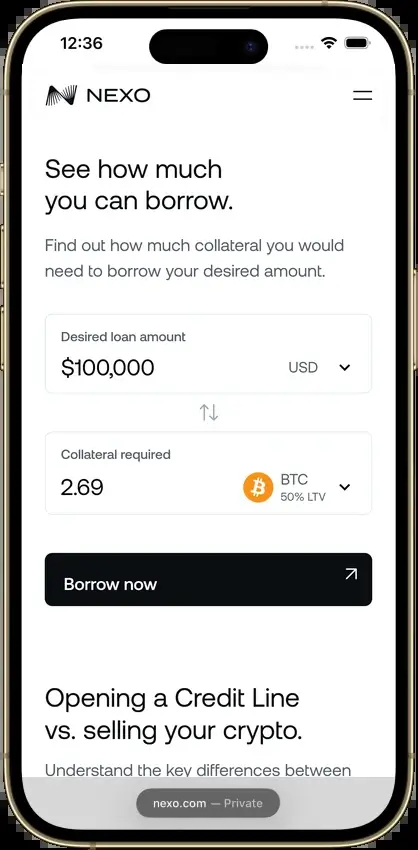
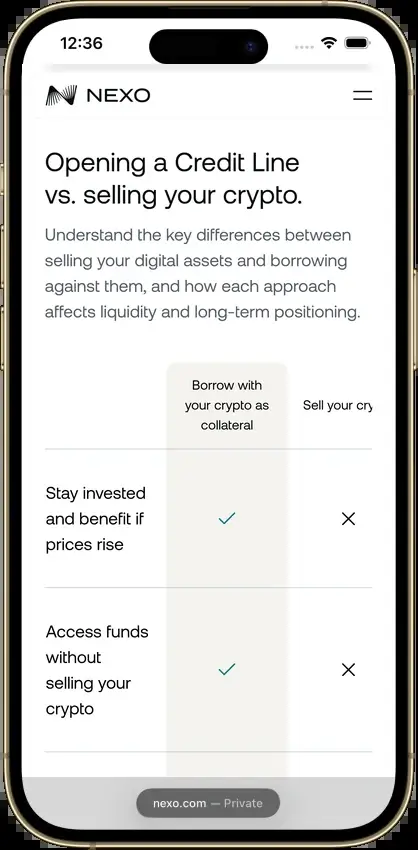
Before borrowing, identify who can sell the collateral and how to resolve a delayed payment or top-up. An account-based service offers customer support for a missing transfer, while direct decentralized finance (DeFi) borrowing leaves the wallet holder to follow the transaction and manage the position. That division determines who can act when funds needed to prevent a sale have not arrived.
How We Rank
- Cost and pricing clarity 20% weightWhat we assess
Interest, mandatory fees, pricing conditions, and the cost of early repayment.
What earns 10/10 The quoted terms show every ordinary charge and the net proceeds before you commit, the rate is fixed or capped for the planned borrowing period, and the price needs no paid membership or token. - Collateral control and counterparty risk 25% weightWhat we assess
Custody, permitted collateral use, and recovery rights.
What earns 10/10 The collateral secures only your debt, recovery rights are clear across every custodian or wrapper, and independent security review and incident handling are documented. - Liquidation rules and risk controls 20% weightWhat we assess
Sale triggers, warnings, penalties, and tools for managing collateral.
What earns 10/10 Every sale trigger and price source is clear, the position survives a 30% collateral fall, sale charges stay at or below 5% of the debt cleared, and you can add collateral or repay at any time. - Repayment and flexibility 15% weightWhat we assess
Partial payments, maturity, renewal, and collateral return.
What earns 10/10 Partial and full repayment work on demand, collateral comes back once the debt is cleared without pool liquidity or approval, and the payoff can be checked before and after you pay. - Access and funding 10% weightWhat we assess
Eligibility, verification, payout routes, and usable funds.
What earns 10/10 You can confirm eligibility, collateral, payout route and amount before depositing, and funds arrive within the expected time, with clear steps if funding fails. - Account controls and support 10% weightWhat we assess
Security controls, loan records, monitoring tools, and customer support.
What earns 10/10 Secure access, usable loan records, clear management screens, accountable support, and a working backup route to repay or close during an outage.
How We Compare Crypto Loans
When comparing costs, we use offers available to the same borrower in the same country or US state. Matching the amount received, payout destination, and borrowing period prevents a lower rate on an inaccessible or differently funded loan from determining the comparison.
These assessments use each loan’s public terms, help pages, and public app screens. We did not open or fund any loans, so payout and support times are the providers’ estimates rather than times we measured. If the terms do not cover the country or US state and borrower type shown, that loan is excluded from the comparison.
What Is a Crypto Loan?
A crypto-backed loan uses digital assets as security for a debt. You provide collateral, receive money or tokens, and owe the borrowed amount plus the applicable interest and charges. The lender or protocol can take collateral under the loan’s liquidation or default rules.
Collateralized borrowing commonly requires assets worth more than the debt. That difference gives the position room to absorb price changes, but it also ties up holdings you might otherwise sell, transfer, or use elsewhere.
Borrowing and depositing crypto to earn yield serve different purposes. A borrower pays for access to funds, while a supplier or lender provides them and accepts lending risks. The roles can overlap in a shared DeFi pool, where supplied collateral can itself be lent to other borrowers.
How Do Crypto Loans Work?
The process starts with an eligible collateral asset and a borrowing limit. After the collateral is committed and the loan is funded, interest accrues under the agreed terms. You must maintain sufficient collateral and meet any payment deadlines until the debt is cleared.
Loan-to-value, or LTV, expresses the debt as a percentage of the collateral’s assessed value. A $10,000 debt against $20,000 of collateral starts at 50% LTV. Price falls or growing debt increase that ratio.
Centralized Loans
A company administers the loan, verification, and payout. The agreement determines who controls the collateral and whether it can be pledged or used elsewhere. Customer service can help with account problems, but the borrower’s rights still depend on the contract.
App-Based Loans
An app can provide access to an onchain lending protocol while handling parts of the process inside an account. The app supplies the interface, the protocol executes the loan, and any wrapped collateral token depends on its issuer or redemption arrangement. A familiar account does not shield the borrower from failures in those systems or the protocol’s liquidation rules.
Direct DeFi Borrowing
You connect a wallet to a lending interface and authorize transactions involving a specific blockchain and market. Borrowing capacity depends on that market’s assets, parameters, and available liquidity. Interest can vary as demand for borrowed assets changes.
Your wallet authorizes actions on the position. The pledged assets stay committed to smart contracts, and withdrawals must leave enough collateral to secure the debt. In a shared lending pool, withdrawal also depends on how much of the relevant asset remains available rather than borrowed.
How to Choose the Best Crypto Loan
Start with the amount, currency, and destination you need. Then assess whether you can repay without relying on an increase in the collateral’s price.
-
Eligibility
Check the loan’s country or state restrictions, borrower-purpose rules, and amount limits before assessing its price.
-
Usable proceeds
Decide whether you need bank funds or tokens in a wallet. Allow for any conversion and withdrawal steps.
-
Full cost
Compare interest and fees over your intended borrowing period, including an earlier repayment date if that is realistic.
-
Collateral exposure
Assess the starting LTV, liquidation rules, and how much additional collateral you could supply during a price fall.
-
Control and recovery
Understand who holds the assets, what use is permitted, and how you recover them after repayment.
-
Repayment flexibility
Check partial payments, minimum interest, maturity, and renewal conditions against your expected source of repayment.
A flexible stablecoin loan can be an awkward fit for someone who needs a fixed bank payment and a predictable closing date. Choose a crypto loan platform that supports the payout and repayment plan you intend to use.
Crypto Loan Rates and Fees
Interest and Conditional Rates
A fixed interest rate can make the interest calculation more predictable over its stated term. A variable rate can change while the debt remains open. Fees and early-repayment conditions determine the additional cost in either case.
Advertised starting rates can depend on the loan amount, LTV, or pricing tier. Compare rates at the terms you would actually qualify for. Where a discount requires a lower starting LTV, calculate how much extra collateral the lower rate needs.
Before adding fees to a quoted annual percentage rate (APR), check which charges it already includes. APR can reflect costs beyond nominal interest, while a DeFi screen’s annualized borrowing rate may describe interest alone. Using those percentages as equivalent measures can understate one loan’s cost.
Fees from Payout to Repayment
| Charge | Effect on Cost |
|---|---|
| Origination or processing | Can be paid separately, deducted from proceeds, or added to the debt |
| Conversion | A spread or fee can reduce the value received when changing currencies or tokens |
| Payout and network | Bank transfers, withdrawals, or blockchain transactions may add charges |
| Repayment and release | Closing the debt and withdrawing collateral can involve separate costs |
| Early settlement | The closing balance may include interest beyond the repayment date |
Model liquidation penalties in a separate collateral-sale scenario. An ordinary repayment total shows the cost of the planned exit, while the sale scenario shows what a price decline or default could leave behind.
A Crypto Loan Cost Example
Suppose you receive $10,000, with a $200 processing fee added to the debt. Assume 10% simple annual interest on that $10,200 balance, no interim repayments, and closure after exactly one year. This is a hypothetical illustration, not an available offer.
| Item | Amount |
|---|---|
| Funds received | $10,000 |
| Fee added to debt | $200 |
| Starting debt | $10,200 |
| One year of simple interest | $1,020 |
| Total repayment | $11,220 |
| Borrowing cost above funds received | $1,220 |
With all other charges excluded, the $1,220 cost equals 12.2% of the amount received over that year. This percentage is a simple cost-to-proceeds ratio, not an APR disclosed by a lender. If collateral requirements include the financed fee, starting at 50% LTV would require $20,400 of collateral.
For comparison, a loan closed after 30 days under the same simple-interest assumptions and a 365-day year would accrue about $83.84 of interest. With the $200 fee still payable, the borrowing cost would be about $283.84. This early-close result assumes no minimum-interest period, remaining-term interest obligation, or other closing charge.
The $200 fee accounts for about 70% of the one-month cost. Choosing by the annual interest rate alone would miss most of the charge in this short-term example.
LTV, Margin Calls, and Liquidation
Maximum initial LTV limits the debt available when the loan opens. The liquidation threshold sets how far that ratio can rise afterward before a sale. Opening a loan near that threshold leaves less room for collateral prices to fall before liquidation.
Some loans issue a margin call, a notice to add collateral or repay part of the debt, before the liquidation threshold. Whether a call applies and how long the borrower has to respond depend on the loan. A fast price move can still trigger liquidation before that response period ends.
For a hypothetical $9,000 loan secured by $24,000 of assets, the opening LTV is 37.5%. The example holds debt constant and excludes interest, fees, repayments, and top-ups to isolate the price effect.
| Collateral Value | Debt | LTV |
|---|---|---|
| $24,000 | $9,000 | 37.5% |
| $18,000 | $9,000 | 50% |
| $12,000 | $9,000 | 75% |
Suppose this illustration uses a 75% liquidation threshold. The assets would have to lose half their starting value to reach it under those assumptions. Actual calculations also depend on the prices used and any interest or fees added to the debt.
In the middle row, restoring the original 37.5% LTV would require either $6,000 of additional collateral or a $2,250 repayment from outside funds. Those figures assume unchanged prices while the action completes. A pending transfer leaves the position exposed until it is credited, and a rapid market decline can outpace a borrower’s response.
Some DeFi pools also show a health factor, which divides collateral value weighted by each asset’s liquidation threshold by total debt. In that model, a result below 1 makes liquidation possible. A fall in any of the collateral assets or a growing debt can shrink the buffer for the whole loan.
When liquidation occurs, the rules determine how much collateral is taken and whether a penalty or discount applies. Collateral can also be sold after unpaid maturity or another contractual default. Check how any surplus is returned and whether a debt could remain after the sale.
Custody and Collateral Risk
Collateral arrangements determine what can happen to the assets while the loan is open. An agreement may allow a lender to pledge them to a funding partner. Lending collateral onward to earn a return is a separate permission. A promise not to lend assets for yield can still permit pledging them for funding.
Understanding how collateral reuse works helps identify which parties could hold or claim the pledged assets. Read the agreement for the legal counterparty and custody arrangements, including asset segregation and the borrower’s recovery rights if a party fails.
In pool-based lending, supplied collateral can also be available to other borrowers. The protocol’s rules govern that use and the conditions for withdrawing it, so wallet control does not mean the assets can be taken out at any time.
Onchain borrowing exposes the position to contract bugs and failures in the price feeds used to value collateral. A token issuer’s power to blacklist an address can restrict access to the affected assets. A wrapped asset can add an issuer or redemption dependency alongside the lending protocol itself.
An audit addresses a defined scope and cannot guarantee that software will remain free of vulnerabilities. A proof-of-reserves report is not a substitute for a financial-statement audit and may not provide a complete picture of liabilities. The loan and custody agreements determine what recovery rights remain if those protections fail.
Borrowing against volatile assets requires a repayment plan and continued attention to collateral. If you could not meet a margin call with extra collateral or a partial repayment, or you would need the pledged coins for essential spending, the loan can create obligations you have little room to manage.
Availability, KYC, and Credit Checks
A “no credit check” offer may still require identity verification, known as Know Your Customer (KYC) checks. Collateral can replace a traditional credit assessment while the provider continues to require information about the borrower or their funds.
Crypto Loans in the US
For US borrowers, eligibility can change at the state level even where a provider offers other services nationwide. The loan agreement must cover the borrower’s state, purpose, and requested amount.
Crypto Loans Globally
An international provider may issue loans through different companies depending on where the borrower lives. The applicable agreement can change with the country, as can the payout currency and repayment methods. Compare regional costs using the offer available to you.
An interface can apply legal or sanctions restrictions even when the underlying smart contracts are publicly accessible. Acquiring the collateral token and converting borrowed funds into a local bank payment can add further eligibility checks.
Bitcoin-Backed Loans
Bitcoin-backed loans use Bitcoin (BTC) or a representation of BTC as collateral. A custodial loan can accept Bitcoin directly, while borrowing on another blockchain may require a wrapped token. The wrapper’s custody and redemption arrangements then become part of the borrowing risk.
A loan denominated in dollars and one denominated in a dollar-linked stablecoin create different repayment obligations. For token debt, you owe the token amount plus accrued interest, even if the token’s price changes against the currency used to fund repayment.
Borrowing against Bitcoin can defer a voluntary sale, but the collateral can still be liquidated. Wrapping tokens, converting them, or selling collateral may also have tax consequences that depend on the action and jurisdiction. Assess those consequences before choosing how to borrow.
Applying, Repaying, and Recovering Collateral
Six stages from the first eligibility check to getting your collateral back.
-
Establish eligibility
Confirm that the borrowing product covers your location and purpose. Check its collateral and amount requirements before committing assets.
-
Review the complete offer
Calculate the funds you will receive and the full cost. Note initial LTV, sale triggers, and payment deadlines.
-
Complete verification and funding
Follow the account or wallet process. Check the destination and supported network before transferring the specified collateral.
-
Confirm receipt
Track the payout through to usable funds at your chosen destination.
-
Manage the open debt
Monitor accrued interest and collateral value. Leave time for payments or top-ups to be credited.
-
Settle and recover assets
Request a payoff quote and arrange the funds. After repayment, follow the steps to withdraw collateral.
Partial repayments can reduce debt without closing the loan, but their minimums and allocation rules vary. A payment may first cover fees and accrued interest before reducing principal. Part of the payment can therefore clear charges without reducing the amount originally borrowed.
Paying with collateral also sells some of the assets. In the $18,000-collateral example, selling $2,250 and applying it to debt leaves $6,750 owed against $15,750 of collateral, or about 42.9% LTV before fees. Using the same $2,250 from outside funds instead preserves the $18,000 collateral and restores 37.5% LTV.
If the loan has a maturity date, plan to repay by then unless a renewal has been agreed. Extending the loan may require a new assessment or different pricing.
Full repayment can free collateral inside a platform or protocol without delivering it to your external wallet. Withdrawal fees, transaction confirmations, and, for supplied assets in a lending pool, available liquidity can affect the final step. Plan how the collateral returns to the asset and wallet you want to use.