


Overview
Introduction
A prop firm payout is a real monetary payment based on eligible performance in a funded-stage account. The agreement defines which profit qualifies and when a request can be made. It also sets the trader's share and the account's state after withdrawal.
A positive dashboard does not make its displayed amount immediately withdrawable. A waiting period, minimum request or consistency rule may delay eligibility. A retained buffer or payout cap can reduce the amount. Identity and conduct checks precede the contractual split.
Many retail prop programs measure performance in a simulated account, so the trades and displayed balance can be virtual while an approved payout is real money. The trader does not own the advertised balance. Only an amount approved under the funded agreement can become a payout.
Key takeaways
- What it is. A prop firm payout is the trader's contractual share of eligible funded-account performance, paid as real money after the request passes review.
- Why it matters. Eligibility and deductions affect cash received more directly than nominal size, while caps and buffers constrain the request.
- Main risk or limitation. A withdrawal can change the active loss floor and reduce the account's cushion, with the exact result set by the product.
What Is a Prop Firm Payout?
A payout converts qualifying performance into a payment owed under the funded-stage agreement. The nominal account size is a rule and buying-power reference. On a $100,000 program, the request is based on eligible profit created while the account remains compliant.
In a simulated program, a trader can produce a virtual trading result and receive a real performance reward without placing orders with the firm's live capital. A live funded account produces market profit and loss directly in a brokerage account. Both routes leave payout rights subject to the signed terms.
Evaluation profit normally serves only as a qualification score. A specific agreement must make it payable. After passing, the trader may provide KYC and tax details, then sign a funded agreement. Account review can still precede reward-eligible trading.
This is why what a funded account represents matters before any payout percentage is assessed. Nominal size and loss allowance are separate from eligible profit and withdrawable cash.
A payout policy should identify the legal entity and funded product. It must define the calculation, trader share and approval rights. Payment-method terms should list the fees. A separate account rule should state what changes after withdrawal. If one field is missing, a headline such as “90% split” cannot fill the gap.
The Five Amounts Between Profit and Cash
A dashboard can show profit before the funded agreement has filtered it. The payout process therefore tracks five distinct amounts, each with a separate calculation.
| Amount | What It Means |
|---|---|
| Dashboard profit | The P&L displayed in the trading interface. It can include open profit, credits, or results that have not passed the payout rules. |
| Eligible profit | The portion recognized under the current funded agreement after applicable exclusions, thresholds, buffers, and activity rules. |
| Requested payout | The amount the trader submits for approval. It may be lower than eligible profit by choice or because a limit applies. |
| Approved trader share | The trader’s resulting amount after review. The agreement sets the order for applying any cap and the profit split. |
| Settled proceeds | The money received after any firm charge, payment-rail fee, blockchain cost, or currency conversion that applies. |
On a $1,400 dashboard, $200 of open P&L leaves no more than $1,200 when only closed results count. A $300 retained buffer reduces the eligible base to $900. A cap can lower the request again before the split and payment costs are applied.
The same displayed profit can produce different settled proceeds under two products without either request being denied. One policy may define eligible profit differently or impose an amount limit. The split and payment rail can create further differences.
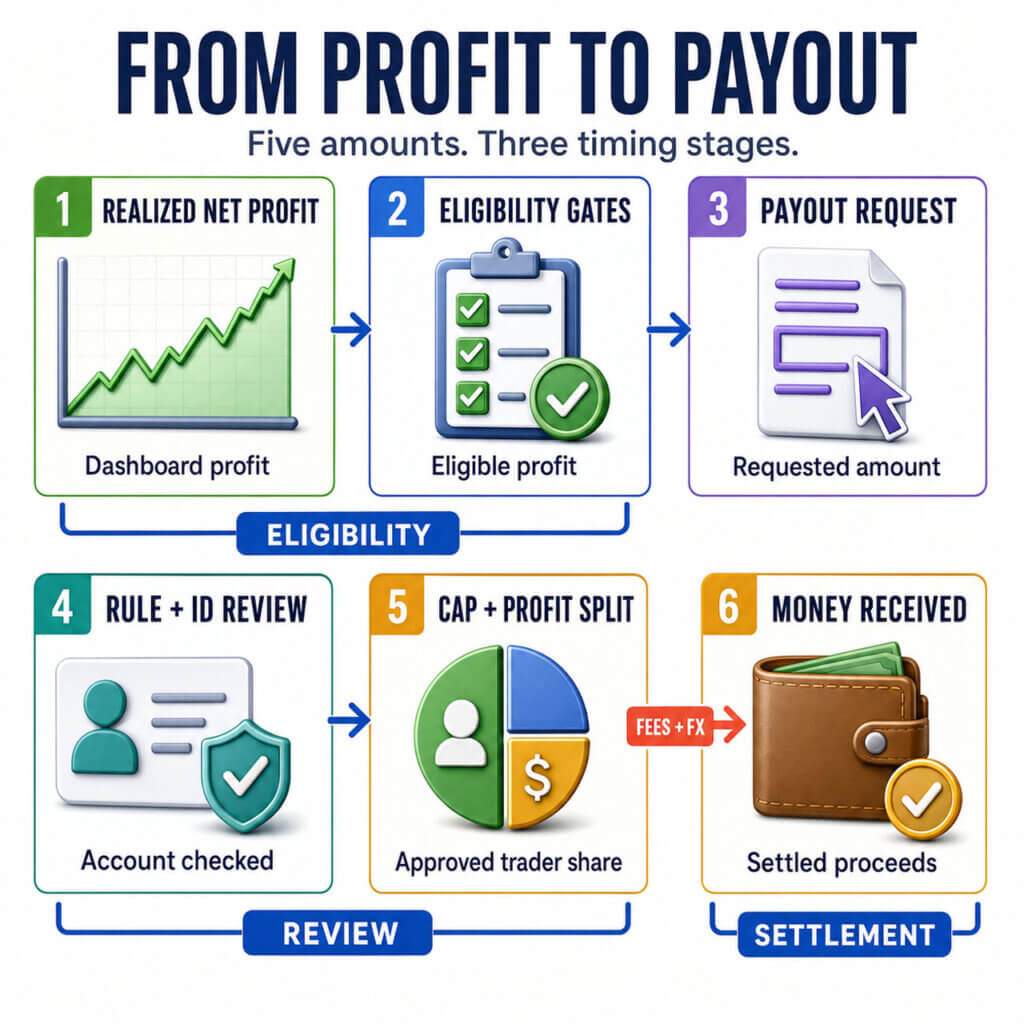
The six stages start with realized profit under the plan's accounting rules. It passes the eligibility gates before the trader submits an amount and payment details. The firm reviews the account, identity and conduct record, applies the amount limits and split, then sends the approved payment through the chosen rail.
A requested payout is not yet money sent, and sent money may still be in transit.
How the Payout Amount Is Calculated
A profit split divides an eligible or approved amount between the trader and the firm. When a split is written trader-first, an 80/20 split gives 80% to the trader and 20% to the firm. The agreement should make the order explicit because some providers reverse the notation or use different wording.
For an isolated split calculation:
Gross trader share = eligible profit × trader share
If eligible profit is $1,000 and the trader share is 80%, the gross trader share is $800. This calculation does not prove that $800 can be requested immediately. A minimum or cap may apply. Retained-balance and consistency rules can also affect the request, as can review.
The broader settlement relationship is:
Settled proceeds = approved trader share + contractual refund − firm fee − rail or conversion costs
The agreement controls the relationship between the requested amount and the cap. It must also state where the split enters the calculation. A provider may cap the request before that split or cap the resulting trader share. Another policy can base the limit on current balance. There is no safe universal order.
| Step | Calculation | Result |
|---|---|---|
| Isolate an 80% trader share | $1,000 eligible profit × 0.80 | $800 gross share |
| Apply a 3.5% method charge | $500 approved share − ($500 × 0.035) | $482.50 before other costs |
| Apply a documented share and ACH fee | $500 request − $50 firm share − $30 ACH fee | $420 received |
The5ers currently applies a 3.5% charge to its cash payout methods, which produces the $482.50 example. Product-specific split and minimum terms still apply. Topstep's published ACH example uses its 90/10 division and a $30 charge to reduce a $500 request to $420.
A refundable evaluation fee or deposit remains separate from trading profit. Count it in cash received only when the contract makes it refundable in that cycle. A returned purchase charge is not trading profit.
An amount can pass the split but fail a post-split minimum. A $100 threshold after an 80% share requires $125 of eligible pre-split profit if no other deduction applies. A pre-split threshold produces different math.
What Makes Profit Eligible for Withdrawal?
A profitable balance becomes eligible only when every active condition attached to the funded product has been met. Until then, a request may remain unavailable.
| Eligibility Gate | What to Verify |
|---|---|
| Payable account stage | Whether evaluation results are excluded and when funded status begins. |
| Realized profit | Whether open P&L, credits, refunds, commissions, swaps, or funding enter the calculation. |
| First-request wait | The starting event, elapsed period, day type, timezone, and earliest valid request date. |
| Required activity | Minimum trading, winning, profitable, or qualifying days and the formula for each day. |
| Consistency | Whether one day or trade may contribute more than a defined share of qualifying profit. |
| Minimum and cap | The amount required, the amount allowed, and whether each is measured before or after the split. |
| Retained buffer | The balance or profit that must remain after the request. |
| Account standing | Closed-position rules, active loss limits, prohibited conduct, and any unresolved review. |
| Identity and tax checks | Required documents, matching legal name, tax forms, and supported country. |
| Request window | The dashboard hours, cadence, cutoff, or fixed dates when a submission is accepted. |
A calendar day differs from a trading day, which may require one executed order. A winning day can require stated net profit, while a profitable-day formula may use initial balance. Each policy must define what counts as its required day.
Consistency tests can delay a payout until total profit grows enough to dilute one large day. Other versions reduce the permitted amount. A failed test becomes an account breach only when the agreement makes it one.
Under current FTMO reward and withdrawal terms, a claim becomes available on day 14 or later after the first trade on that FTMO Account. The account must have positive closed profit and no open positions or pending orders. FTMO's 1-Step product uses a 90% reward ratio and a Best Day condition, while its 2-Step product begins at 80% and does not carry the same published Best Day rule. Those terms cannot be merged into one firm-wide formula.
The funded stage must exist before its payout clock starts. Provider review and KYC can precede a signed agreement and account activation. Those steps belong to how a challenge reaches funding. A passed target is a different event from a valid payout request.
First-Payout Eligibility Is Not Processing Speed
“First payout in 14 days” can describe only the earliest request date. It does not necessarily include account review or delivery to a bank or wallet. A useful payout timeline separates three stages.
| Timing Stage | What the Clock Measures |
|---|---|
| Eligibility | Funded activation or another named starting event to the earliest valid request. |
| Review | Submission to approval, reduction, deferral, denial, or a request for more information. |
| Settlement | Approval or dispatch to receipt through the selected payment method. |
The first payout covers request eligibility through receipt. Recurring cadence controls when another request can follow an approved withdrawal. Daily request access can coexist with a separate review and settlement period, while on-demand access can still follow a longer first-cycle gate.
The terms “instant” and “same day” must identify the event. Immediate request access can precede manual approval. Automated approval can still lead to a multi-day bank transfer. Crypto settlement needs an accurate address on a supported network, followed by compliance clearance.
FTMO currently separates the stages in its public process. The day-14 rule controls claim eligibility. Its account review is stated as one to two business days. After the account passes review and the trader's invoice is accepted, the reward is typically sent within another one to two business days. Receipt can still depend on the payment method and external provider.
Business-day wording also excludes weekends or holidays unless the terms state otherwise. Central Time and Central European Time can convert to different UTC hours when daylight-saving time changes. Check the date before converting a stated deadline.
Readers choosing by speed can review firms with shorter payout timelines after separating eligibility from the review and settlement period. This guide does not rank providers or treat request frequency as cash-arrival speed.
How Traders Receive Prop Firm Payouts
The payment method determines which details and costs sit between approval and receipt. Availability can differ by country and legal entity. Currency or account type may change the options again.
| Method | What to Check |
|---|---|
| Bank transfer | Recipient-name match, supported country and currency, intermediary banks, firm charge, receiving-bank charge, FX rate, cutoff, and business-day estimate. |
| Third-party payment service | Account verification, regional support, withdrawal route, platform charge, conversion spread, transfer limit, and legal-name match. |
| Crypto or stablecoin | Supported asset and blockchain, wallet custody, exact address, memo or tag, network fee, compliance screening, confirmation standard, and conversion or off-ramp cost. |
A claim of “no withdrawal fee” should identify whose fee is absent. A bank, payment platform or exchange may still reduce the amount. Blockchain and conversion costs can apply separately. The receiving institution can reject a transfer when the legal name or account details do not match.
Crypto settlement replaces bank details with a wallet address while verification still applies. The asset and network must both match. A wrong network or incompatible address can make recovery impossible. Self-custody also places recordkeeping on the trader.
Breakout's USDC payout rules show one current single-rail setup with an 80% default share or a 90% paid add-on. Its $50 minimum is measured after the split, and approved payouts use USDC on Ethereum's ERC-20 network.
Save the request, approval and transaction records. Note the gross amount, currency, fees and exchange rate. Payouts may be taxable, with classification shaped by residence and legal status. Business structure and local rules can change the treatment. The payment method does not decide it.
Why a Payout Can Be Delayed, Reduced, or Denied
A payout request can stop before submission or during review. Problems after approval can also block settlement. The point at which it stops determines the remedy.
| Outcome | What It Means |
|---|---|
| Not yet eligible | The request cannot validly be submitted because one or more activity, time, profit, minimum, buffer, or account-standing gates are unmet. |
| Compliance hold | Identity, tax, sanctions, device, payment, strategy, or conduct review remains unresolved. |
| Deferred | The amount may become available in a later cycle after another requirement is met. |
| Reduced | The firm approves less than requested because of a cap, eligible-profit calculation, retained buffer, split, or permitted deduction. |
| Denied | A submitted request is rejected under a stated contract term. The account can remain open or close, depending on the reason. |
| Account terminated | The funded agreement ends after a loss-limit or conduct breach. Pending payment treatment depends on the contract. |
Profit can change between request and review, so a firm may deduct the request immediately or freeze trading. Another policy may let trading continue. If new trades create a breach or reduce the eligible balance, the pending request can be affected where the agreement permits it.
Open positions or pending orders can block submission under some policies. Consistency and minimum rules can keep a trader ineligible, as can a required buffer. A cap may reduce the amount while leaving excess profit in place. Another policy can remove the excess or provide no clear right to request it later. The contract must answer that point.
Conduct review can cover account sharing, identity masking, unauthorized copying or coordinated trading. Cross-account hedging and simulation exploits may fall under separate prohibited-strategy terms. Check the agreement for review criteria and notice requirements, then identify any appeal or dispute process. A review does not prove misconduct.
An expired identity document or name mismatch can hold an otherwise compliant request. So can an unsupported country or incorrect tax form. Invalid bank or wallet details create another hold. Fixing the issue may allow processing to continue.
What Happens to the Account After a Payout?
A payout normally reduces the account balance. The funded agreement then determines the active loss floor and remaining buffer. It can also change eligibility counters or scale, while the product terms control the account's status. There is no universal post-payout formula.
| Published Mechanic | Possible Effect |
|---|---|
| Floor stays tied to its original reference | The lower balance can leave less room above a static breach threshold. |
| Daily floor receives a temporary adjustment | The request can be accommodated before the next scheduled calculation. |
| Loss floor is rebased from the new balance | The post-withdrawal cushion is recalculated under the product formula. |
| A new account is issued | Balance, loss limits, and payout counters can restart in a new cycle. |
| Eligibility counters restart | The trader must rebuild winning, profitable, trading-day, or consistency requirements. |
| Full withdrawal closes the account | Taking all unlocked funds can operate as an exit instruction. |
Current products demonstrate incompatible results through their published formulas, starting with Topstep's first Express Funded Account payout. It sets the Maximum Loss Limit to $0 permanently and can lower permitted contract size. Breakout temporarily lowers its daily floor by the payout amount before the next 00:30 UTC calculation, while its static total floor remains tied to initial balance. The5ers Futures recalculates its floor at 4% below the post-withdrawal balance. FTMO provides a new account after a 1-Step Reward.
One agreement can keep a static floor while another resets it. A full withdrawal can close the account under a third product. These contrasts make the result product-specific, with account stage as important as provider name.
Calculate the expected account value after the request, then apply the product's new or continuing loss floor. The difference is the next trade's available cushion. Use how withdrawals affect drawdown to apply the correct static or trailing formula, including any daily limit, lock point or post-withdrawal rebase.
A larger request is not automatically the more valuable choice if it leaves the account one normal loss away from closure. A smaller request is not automatically safer if the floor rises or the product requires a fixed withdrawal. The calculation must use the accepted agreement.
What Counts as Payout Proof?
Prop firms do make real monetary payouts when traders meet the applicable agreement. This includes rewards based on eligible results generated in simulated accounts. The remaining question is what a particular piece of evidence establishes.
| Evidence | What It Can Establish |
|---|---|
| Current agreement or policy | The firm’s published obligation, calculation, eligibility rules, and discretion for the named product. |
| Firm-issued payout total | What the firm reports over its chosen period and scope. It needs a methodology and denominator. |
| Dated payment record | That a named payment was recorded, subject to the record’s authenticity and context. |
| Independently mapped transaction | That value moved between identified addresses or accounts through the covered rail. |
| Repeated trader reports | A pattern of experiences that can reveal recurring approval, delay, support, or denial themes. |
| Complaint pattern | A reason to investigate the relevant term, entity, date, and dispute handling. It does not decide an individual case. |
One screenshot does not prove approval rate, repeatability or solvency. A blockchain transaction can prove movement between mapped addresses without revealing the payment's purpose or source account. It cannot show rejected requests. On-chain trackers also miss bank transfers, payment platforms and unmapped wallets.
Firm-reported totals need a defined period and currency method. The included products and treatment of refunds must also be disclosed, along with the source data. A large cumulative figure without the number of eligible accounts or submitted requests cannot support a payout-rate claim.
Trader reports can reveal repeated friction around identity review or rule interpretation. Payment problems and delayed support can form other patterns. The reports remain separate from the contract. CryptoSlate assesses firm claims alongside user patterns, then looks for verifiable records. The full weighting is set out in how CryptoSlate weighs payout evidence.
Payout Checklist Before Paying
Record the rule and its calculation basis before paying for an evaluation. A payout percentage without a defined calculation base is incomplete, as is a timing claim without a starting event.
| Check | What to Record |
|---|---|
| Payable stage | Evaluation, simulated funded, live funded, or another contractual stage. |
| Eligible profit | Closed-result definition, included costs, exclusions, credits, refunds, and treatment after a breach. |
| First request | Starting event, waiting period, day type, timezone, and extra first-cycle checks. |
| Activity gate | Required trading, winning, profitable, or qualifying days and the exact formula. |
| Amount rules | Minimum, cap, split, calculation order, retained buffer, and treatment of excess profit. |
| Approval | KYC, tax, agreement, invoice, conduct review, and stated decision window. |
| Payment | Methods, country and currency support, recipient-name rules, fees, FX, network, and settlement estimate. |
| After withdrawal | New balance, active floor, counters, scale, account continuation, and closure conditions. |
| Dispute route | Evidence required, review process, deadline, and governing entity. |
Work one example from eligible profit to settled proceeds, then calculate the post-payout balance and headroom. Save the plan name and price. Preserve the agreement with its policy version and capture date because two products from the same firm can use different terms.
Use the recorded terms to narrow programs by payout conditions you can meet. Then browse current prop firm programs with the usable profit base, request timing and post-withdrawal account effect already defined.
FAQ
Do prop firms pay out real money?
Yes, a compliant funded-stage account can produce a real monetary payout under its agreement, including when the underlying trading environment is simulated. That payment does not guarantee that every profitable dashboard qualifies or every request will be approved. It also cannot prove the firm’s ability to meet every future obligation. Check the current contract and legal entity, then assess the payout record within its evidence limits.
How much can a trader receive from a $100,000 funded account?
The $100,000 label does not determine the payout because the calculation starts with eligible profit. Apply the request limit and cap under the agreement, then use the stated trader share. A retained buffer may reduce the request. Fees or payment costs can lower the settlement again. If $2,000 is eligible and only an 80% split applies, the gross trader share is $1,600.
What does an 80/20 prop firm payout split mean?
When written trader-first, an 80/20 split gives 80% of the applicable profit base to the trader and 20% to the firm. On $1,000 of eligible profit, the isolated split produces an $800 gross trader share. Confirm which side is listed first, which profit enters the calculation, and whether a cap or fee applies before or after it.
How long does a prop firm payout take?
The named product and payment method determine the total time. First measure funded activation to a valid request. Then add the firm’s review period and the rail’s settlement period. Calendar days differ from business days, while trading or qualifying days depend on account activity.
Can a prop firm deny a payout?
Yes, when the funded agreement permits denial for an unmet condition or rule breach. Prohibited conduct and a failed identity or tax review can create separate grounds, as can unsupported payment details. An incomplete request may instead remain ineligible or enter a compliance hold. It can also move to a later cycle or receive approval at a lower amount.
Are prop firm payouts taxable?
Prop firm payouts may be taxable, with classification set by the trader’s country and residence. Legal status or business structure can alter the result, as can the contractual relationship with the firm. The payment method and use of a simulated account do not settle the tax question. Keep payment records and obtain jurisdiction-specific advice for filing.
