


Overview
Introduction
A prop firm challenge is a rules-based trading evaluation that a trader completes before becoming eligible for a funded-stage account or reward contract. The participant normally trades a simulated balance, pursues a profit target, and must stay within loss and conduct limits. Reaching the target is one checkpoint. Review, identity checks, and a separate agreement can still stand between that result and any payout.
The advertised account size is only a reference value. It does not reveal the usable loss buffer, whether trades reach a live market, or what must happen before a withdrawal.
Key takeaways
- What it is. A prop firm challenge is an evaluation that requires a trader to reach a target without breaching the program's loss, activity, or conduct rules.
- Why it matters. Passing can make the trader eligible for a funded-stage account or reward agreement with a larger notional balance than the trader deposited personally.
- Main risk or limitation. Reaching the target does not guarantee approval, live capital, or a payout because later reviews and funded-stage rules still apply.
What Is a Prop Firm Challenge?
The challenge is the evaluation product, not the firm itself. A company creates the rules, supplies the trading interface, monitors the result, and decides whether a completed account qualifies for the next stage.
Most consumer-facing challenges begin with a simulated account. Its nominal balance provides a reference for position limits, targets, and loss thresholds. It is not a cash balance the participant owns or can withdraw. Challenge profit usually has no payment value because payout rights begin only under a later agreement.
Challenges can be paid, free, or offered through a competition. They may have one phase or several. Some companies sell direct-access products without a separate challenge. The product name does not settle whether the next account is simulated, selectively copied, or connected to live firm capital. The agreement for the selected program controls that distinction.
Paid online challenges are also separate from traditional proprietary-trading recruitment. A trading firm can hire an employee, back a partner, or allocate capital without selling a public evaluation.
How the Challenge Lifecycle Works
A challenge begins before the first trade. The trader selects a program and accepts its current terms, including the fee, platform, instruments, objectives, loss calculations, and prohibited conduct. The evaluation starts only after the company issues credentials or activates the account.
| Stage | What Changes |
|---|---|
| Select and pay | The trader chooses the account model, accepts the agreement, and pays any entry or subscription charge. |
| Evaluation account | The company issues a simulated balance with defined targets, limits, and permitted trading conditions. |
| Phase result | The trader must satisfy every active objective while avoiding a hard breach or disqualifying conduct. |
| Review | The company checks trades, account behavior, eligibility, identity, and any conditions that are not measured by the displayed balance. |
| Funded stage | An approved trader receives a new account or contractual status. The balance, rules, and execution method may differ from the challenge. |
| Payout eligibility | Separate timing, profitable-day, consistency, conduct, and withdrawal conditions determine whether a reward can be requested. |
| Closure or further allocation | A rule breach can end the account. Continued performance may lead to scaling or possible live allocation if the agreement provides it. |
A simulated evaluation balance is not live capital, and its displayed profit is not automatically payable. Breakout is one example: CryptoSlate's Breakout review examines an Evaluation Agreement that classifies evaluation transactions as simulated and evaluation profit as non-payable. The later “funded” label still does not, by itself, establish that the trader controls live capital.
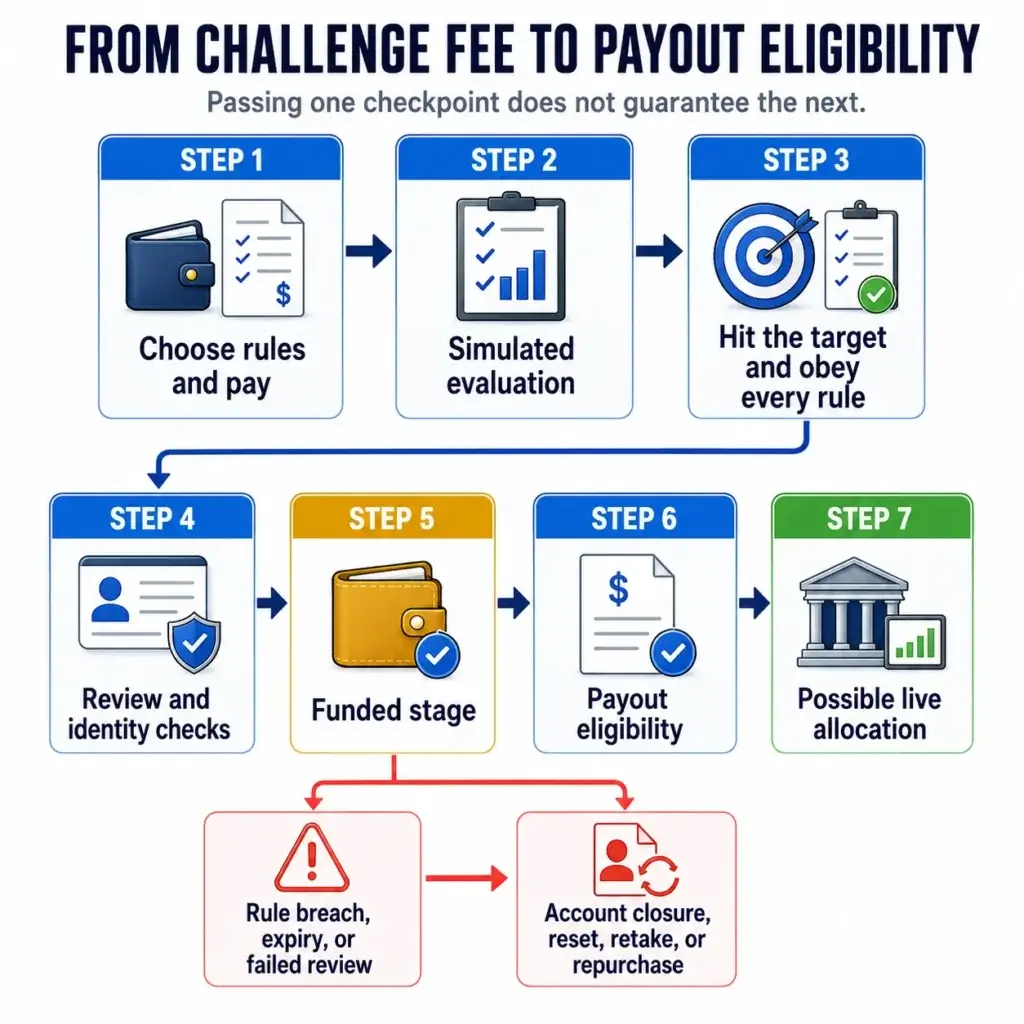
Each transition creates a new set of rights and obligations. Passing one phase can produce fresh credentials for another evaluation phase. Passing the final evaluation can produce eligibility for review. Approval can produce a funded-stage account, but that account can begin with a new balance, new loss floor, and a new payout clock.
The Rules That Decide Whether You Pass
A challenge passes only when its profit target and every other active condition are satisfied together. A profitable account can remain incomplete or fail because of a loss threshold, insufficient qualifying days, an oversized best day, an open position, or a conduct review.
| Rule | Exact Question to Ask |
|---|---|
| Profit target | Must the target appear in balance or equity, and must every position be closed before review? |
| Maximum daily loss | Which balance or equity value sets the allowance, when does the day reset, and do open P&L and fees count? |
| Maximum loss | Is the floor static, end-of-day trailing, or intraday trailing, and can it stop moving? |
| Minimum trading days | What makes a day qualify: any trade, closed profit, a minimum return, or a minimum trade size? |
| Trading period | Is there a completion deadline, recurring subscription, or inactivity expiry? |
| Consistency | Does one large winning day cause failure, delay completion, or increase the required total profit? |
| Position limits | Are caps based on lots, contracts, notional exposure, margin, or one-trade realized loss? |
| Conduct rules | Which forms of copying, hedging, automation, news trading, account sharing, or simulator exploitation are prohibited? |
Consistency rules illustrate why a displayed target can move. Topstep's current consistency formula compares the largest winning day with the target. A day above the permitted share raises the total profit needed to pass instead of immediately failing the account. The HyroTrader review covers a Profit Distribution Rule that instead limits how much of the evaluation result can come from one day. Similar labels do not guarantee identical math.
One program may count any day with an opened position. Another may require closed profit above a threshold. CryptoSlate's The5ers review covers a High Stakes profitable-day rule based on a return calculation, with several qualifying days required in each phase. A trader who reaches the target quickly can still need more qualifying days.
Conduct review sits beside the numeric rules. Account sharing, third-party passing services, cross-account hedging, latency exploitation, or a sudden increase in risk near the target can lead to removed profit, closure, or rejection under the provider's agreement. A green dashboard does not prevent a later manual review.
How Daily Loss and Maximum Loss Interact
Daily loss limits the account inside one firm-defined trading day. Maximum loss sets the overall floor for the evaluation. Both often monitor equity, which means an open position can breach a threshold before the loss is closed.
Balance is the value after closed trades and posted charges. Equity adds the profit or loss on open positions. A formula based on midnight balance can therefore set the day's allowance, while live equity determines whether the account has crossed it. “Daily” refers to the operator's reset zone and time, not the trader's local midnight.
The overall floor can remain static or move upward. Topstep's standard $50,000 Trading Combine provides a current end-of-day trailing example. The account begins with a $48,000 floor. A daily close at $50,500 lifts the next floor to $48,500. The floor never moves down and eventually locks at the starting balance.
| Account Event | Rule Effect |
|---|---|
| Account starts at $50,000 | The overall loss floor begins at $48,000 under Topstep’s cited example. |
| Day closes at $50,500 | The next session’s floor rises to $48,500 because the balance closed $500 higher. |
| Later balance falls | The $48,500 floor does not move back down. A prior gain has reduced the remaining loss room. |
| Floor reaches $50,000 | Topstep says the trailing floor locks at the original starting balance. |
Intraday trailing formulas can be stricter because the reference follows unrealized gains during the session. HyroTrader's standard daily drawdown calculation follows the highest intraday equity and includes unrealized P&L and fees. Giving back an open gain can consume loss room even when the account remains above its opening balance.
The dedicated guide to how prop firm drawdown works will cover the full set of static, balance-based, equity-based, and trailing calculations. Before that guide ships, the safe test is to identify the reference value, reset time, open-P&L treatment, and exact breach event in the purchased agreement.
One-Step, Two-Step, and No-Evaluation Models
Stage count describes the path to review. It does not measure difficulty by itself. A one-step challenge can demand a larger target relative to the loss buffer or add a consistency condition. A two-step route can provide more total loss room while requiring the trader to repeat the process on a fresh account.
| Model | What the Label Actually Means |
|---|---|
| One-step challenge | One evaluation phase must be completed before funded-stage review. |
| Two-step challenge | Phase 1 is followed by a separate verification phase, commonly with a lower second target. |
| Three-step challenge | The evaluation is divided across three accounts or phases before final review. |
| No-evaluation or direct access | A separate pass-before-funded test is removed only if payout-eligible funded status starts immediately. |
| Instant funding | A marketing label that can mean direct access, a compressed milestone, or a program that still has qualifying conditions. |
HyroTrader's current evaluation lineup puts different targets and loss formulas behind its one-step and two-step routes. At the review date, the one-step route uses a 10% target, 4% daily drawdown, and 6% maximum loss. The two-step route uses targets of 10% and 5%, with 5% daily drawdown and 10% maximum loss. Those figures describe one provider, not a market standard.
Readers deciding between staged products can review one-step prop firms ranked by rule structure after identifying how each provider calculates its loss room. Fewer phases can reduce the number of targets while leaving less room for a losing trade.
Direct-access products need a separate check because an instant-funding label can still hide an early milestone. The current contract must explain the account environment, loss limits, payout conditions, and whether an early milestone applies.
What Happens When You Pass?
Reaching the profit target can end the trading portion of a phase. The result is ready for review only after all required positions are closed and every remaining objective is complete. A successful first phase in a multi-step program usually creates another evaluation account, not a payout right.
Finishing the final phase moves the result into review rather than activating the next account automatically. Identity checks, eligibility screening, and agreement acceptance can follow before the provider issues new credentials.
Under Breakout's current program rules, an eligible evaluation can progress to a new demo account after KYC, a separate funded-trader agreement, and approval. Evaluation profit does not carry into that account.
The next account can also change the rules. The profit target may disappear, but daily loss, maximum loss, consistency, position limits, and prohibited-conduct rules can continue. A payout clock may start with the first funded-stage trade or account activation.
The nominal account balance remains under the provider's agreement rather than transferring to the trader. Passing creates neither employment nor partnership and does not prove that the provider copied trades into a live account. The new agreement defines what the trader receives and which result can become payable.
What Happens When You Fail?
A hard loss-limit breach commonly closes the evaluation or makes it ineligible for funding. Platforms may liquidate open positions immediately. Other violations can produce a warning, removed profit, a delayed review, or permanent termination. The agreement should separate soft consequences from events that end the account.
A reset restores the same evaluation to its starting conditions. Topstep's reset restores the starting balance, maximum loss, consistency target, and trading-day history. Its monthly subscription can also issue a reset credit at rebill. The subscription continues until the trader passes or cancels.
Breakout does not provide that type of in-account reset in its current rules. A trader whose evaluation is permanently disabled must purchase another evaluation to start again. Other providers may offer a discounted retry, a free repeat after narrowly missing a target, or no remedy at all.
A reset, retake, and repurchase create different costs. Traders should confirm whether billing stops automatically after failure, whether a reset changes the renewal date, and whether a new attempt receives the same terms as the original purchase.
What a Prop Firm Challenge Costs
Renewals, market data, activation payments, and repeated resets can push the total attempt cost above the checkout price.
| Possible Cost | When It Applies |
|---|---|
| Entry fee | A one-time challenge purchase creates the first evaluation account. |
| Subscription renewal | The evaluation rebills until the trader passes, cancels, or reaches another contract event. |
| Reset | A paid reset restores the original evaluation conditions after a loss or by choice. |
| New attempt | A failed account has no reset and the trader buys another challenge. |
| Activation | The provider charges for the funded-stage account after the evaluation passes. |
| Platform or market data | Exchange data, platform access, or a specific terminal carries a separate charge. |
| Add-on | A different payout split, drawdown method, news permission, or account condition changes the price. |
| Conversion and tax | Payment currency, card conversion, sales tax, or withdrawal rail changes the total outlay. |
Topstep's subscription model shows how monthly billing, resets, and activation can sit in one route. The FTMO review covers a one-time fee model in which the two-step fee can be refunded with the first qualifying reward withdrawal, while the one-step fee is not refunded. A conditional refund is therefore a later milestone, not a discount available when the challenge passes.
“Free challenge” can describe a trial, competition, temporary promotion, free retry, refundable fee, or a zero-cost evaluation. Each creates different rights. A competition prize may award a paid challenge account instead of funded status. A free trial may provide no route to payment.
The lowest-cost prop firm evaluations include charges beyond the headline price. Before buying, add the maximum number of attempts the trader is prepared to fund. Future payouts should not be used to make the attempt budget affordable.
How Forex, Futures, and Crypto Challenges Differ
The central evaluation logic is similar across markets, but instruments and trading sessions change which rules matter most.
| Market | Rules That Need Extra Attention |
|---|---|
| Forex and CFDs | Percentage drawdown, reset time zone, swaps, news restrictions, weekend positions, and whether symbols are simulated contracts. |
| Futures | Monthly subscription, exchange data, activation, contract caps, session close, daily settlement, and an end-of-day trailing floor. |
| Crypto | Continuous trading, perpetual funding, mark or index price, exchange-demo status, API use, copied strategies, and weekend liquidity. |
The5ers' High Stakes rules use percentage-based loss limits and a specified daily reset time. Swaps, commissions, and open P&L can count toward the equity test. News and weekend conditions may also change between the evaluation and funded stage. The exact contract and symbol type should be checked before applying a headline currency-program rule.
Topstep's futures model uses a monthly Combine, contract limits, and an end-of-day trailing Maximum Loss Limit. Passing creates an Express Funded Account that remains simulated before any risk-team decision about live allocation. Buying-power labels should be separated from contract caps and usable loss room.
Breakout states that its crypto evaluation is simulated and uses a static overall floor. HyroTrader also describes its evaluation as simulated while advertising exchange-connected infrastructure. Price feed, trading interface, and capital status are separate questions. Crypto readers can review crypto-focused prop firms by platform and account model after checking how mark prices, funding, and API activity affect the rules.
How to Compare a Challenge Before Paying
Before paying, confirm the usable loss buffer, total attempt cost, and conditions for payment in the current contract.
| Check | What to Confirm |
|---|---|
| Account status | Is each stage simulated, selectively copied, exchange-demo, or live with firm capital? |
| Fee model | Is the charge one-time or recurring, and does failure stop billing? |
| Daily loss | What anchors the calculation, when does it reset, and does open P&L count? |
| Maximum loss | Is the floor static or trailing, when does it move, and can it lock? |
| Passing event | Must trades be closed, minimum days complete, and consistency satisfied before review? |
| Review | Which identity, conduct, strategy, tax, and eligibility checks can delay or reject progression? |
| Funded-stage rules | Which targets disappear, which limits continue, and does the balance reset? |
| Payout clock | When can the first request be made, what result qualifies, and does a withdrawal change the loss floor? |
| Remedy | Is a failed attempt resettable, eligible for a retake, or replaced through a new purchase? |
| Contracting company | Which legal entity owes the next account or payment, and which dispute process applies? |
Readers who want to skip a staged test can inspect no-evaluation prop firms, but direct access still carries loss and payout conditions.
Strategy fit comes before a purchase. A method whose normal losing sequence exceeds the challenge's usable buffer is incompatible with the product even if the strategy has been profitable elsewhere. Tactical preparation belongs in the planned guide to how to pass a prop firm challenge.
The payout agreement deserves the same attention as the challenge rules. A large split or fast-processing claim does not show when the first request becomes eligible or which reviews occur before approval. The planned guide to how prop firm payouts work will cover those downstream conditions.
FAQ
What is a prop firm challenge in simple terms?
A prop firm challenge is a trading test with a profit target and firm-defined risk rules. The trader uses an evaluation account and must meet every active condition before the provider reviews the result for progression to a funded stage.
How hard is a prop firm challenge?
Difficulty depends on the target relative to the usable loss buffer, the drawdown formula, the trader’s normal losing sequence, minimum-day rules, and consistency conditions. No comparable industry-wide pass rate is available, so a universal percentage would be misleading.
Are prop firm challenges simulated?
Yes. A challenge can remain simulated through the evaluation and even the initial funded stage. The selected agreement should state whether orders stay in simulation, are copied selectively, or place firm capital at risk.
What happens after you pass a prop firm challenge?
The provider normally reviews the result and may require identity checks, a conduct review, and a new agreement. Approval can produce another evaluation phase or a funded-stage account. It does not guarantee live capital or an immediate payout.
Can you reset a failed prop firm challenge?
Only if the purchased program offers a reset. A reset can restore the starting balance and objectives, while other firms require a new evaluation purchase. Subscription renewal, reset credit, and a new attempt are separate contract events.
Is a prop firm challenge fee refundable?
Some firms make the original fee refundable only after a later funded-stage payout. Others do not refund it, and subscription payments or resets may remain nonrefundable. The current fee and payout policies should state the exact milestone.
