


Overview
Introduction
Prop firm drawdown is a contract-defined limit on how far an account's monitored value may fall. The rule can be expressed as a loss amount, such as $2,000, or as a floor, such as $48,000 on a $50,000 account. The floor is the decisive number. Reaching it can pause trading or end the account, depending on the selected program's terms.
Key takeaways
- What it is. Prop firm drawdown is a contract-defined limit that sets how far an account's monitored value may fall before a restriction or breach.
- Why it matters. The same headline percentage can produce different loss room under fixed and moving-floor formulas.
- Main risk or limitation. A percentage alone does not reveal its reference value, update time, open-profit treatment, or breach event.
What Is Prop Firm Drawdown?
In a trading journal, drawdown usually measures a past decline from a peak to a later low. A prop firm uses the same word for an active rule that limits losses inside an evaluation or funded-stage account.
The loss amount is the permitted distance. The loss floor is the breach value. If a $100,000 account permits a $10,000 static loss, the amount is $10,000 and the floor is $90,000. The firm's system watches the contractually named value against that floor.
A percentage does not supply the full formula because a 5% rule may use the starting balance, daily balance, highest close, or live equity. The firm may set the floor from balance while testing live equity for the breach. A moving floor can rise continuously or at a session boundary. A static floor does not rise.
The selected product defines the consequence. A hard maximum-loss breach commonly ends the account. A daily limit can do the same, while some products use a temporary trading stop that lifts at the next session. The current agreement must identify the threshold and the value tested against it. It must also state what happens when the two meet.
The Number That Matters Is Remaining Headroom
The advertised account size is not the amount a trader is allowed to lose. It is a reference for buying power and rule calculations. A $50,000 account with a $48,000 active floor begins with $2,000 of headroom.
The useful calculation is:
Remaining headroom = current breach-test value − current active floor
If current equity is $50,600 and the floor is $48,500, headroom is $2,100. A $50,600 balance does not guarantee that amount if open losses, commissions, swaps, funding, or other charges reduce the value used for enforcement.
Both the account value and the floor can change headroom. A gain may lift the account value while leaving a static floor fixed, which increases the cushion. The same gain may lift a trailing floor, which preserves some or all of the original distance. Under an intraday high-water rule, unrealized profit can raise the floor before the trade closes. Giving back that open profit can then consume headroom even if the account is still above its starting balance.
The current floor and the value tested against it provide a more useful risk measure than the account label. Together they determine the usable room.
The Five Parts of Every Drawdown Rule
Static and trailing describe movement. Balance and equity describe inputs. End-of-day and intraday describe timing. These labels do not form interchangeable account types.
| Rule Field | Question to Answer |
|---|---|
| Floor anchor | Is the floor derived from the initial balance, a reset-time value, the highest closed balance, or the highest equity? |
| High-water input | Can realized balance move the reference, or can unrealized profit raise it as well? |
| Recalculation cadence | Does the floor change continuously, after a session close, at a daily reset, or after another event? |
| Breach test | Is balance, equity, or net liquidation value tested, which costs count, and does touching the floor qualify? |
| Lock behavior | Can the floor rise forever, or does it stop at the starting balance, a buffer, a target, or another stated level? |
| Consequence | Does reaching or crossing the floor pause trading, liquidate positions, fail the account, or permit a reset? |
A hard breach may liquidate positions and close the account. A softer limit may pause trading until the next session or permit a paid reset. “Daily reset” is different from buying a fresh evaluation.
One provider can use different rules for its one-step and two-step products, while evaluation and funded stages can have different floors. Interfaces may also display the same high-water value differently. The version of the agreement accepted at purchase controls the account, so its effective date must be recorded.
A balance-derived floor can still be equity-enforced. An end-of-day trailing floor can still be monitored throughout the session. Separating the five fields prevents both mistakes.
Static, End-of-Day Trailing, and Intraday Trailing Drawdown
The three main maximum-loss structures differ in what moves the floor and when.
| Mechanic | How the Floor Moves |
|---|---|
| Static maximum loss | The floor stays tied to the starting reference for the life of the named account or stage. |
| End-of-day trailing | Qualifying closing gains can raise the next floor. Intraday highs do not move it immediately. |
| Intraday trailing | New live equity highs can raise the floor during an open trade. A later pullback does not normally lower it. |
A static maximum-loss formula uses floor = initial balance − allowed loss. Breakout's current account rules provide a clean example. Its Classic 1-Step product uses a 6% static total limit, so a $100,000 account has a permanent $94,000 total floor. A gain to $105,000 leaves that floor at $94,000 and increases the cushion to $11,000.
An end-of-day trailing formula raises the floor after a qualifying close or reset-time balance. If the allowance is a fixed $10,000 and the highest qualifying close becomes $106,000, the floor becomes $96,000. A later losing close does not normally move it back down. Some products stop the trail at a lock point, while others allow it to move above the starting balance.
HyroTrader's daily-loss setup illustrates an intraday rule built on a live high-water value. On its current $5,000 one-step example, the daily allowance is $200. If equity reaches $5,200, the active daily floor rises to $5,000. A reversal to the original $5,000 uses the full allowance even though the account has not fallen below its starting value.
The trail amount can be a fixed dollar distance derived from the original account size. It can also follow another published formula. “10% trailing” is incomplete until the allowance base is known.
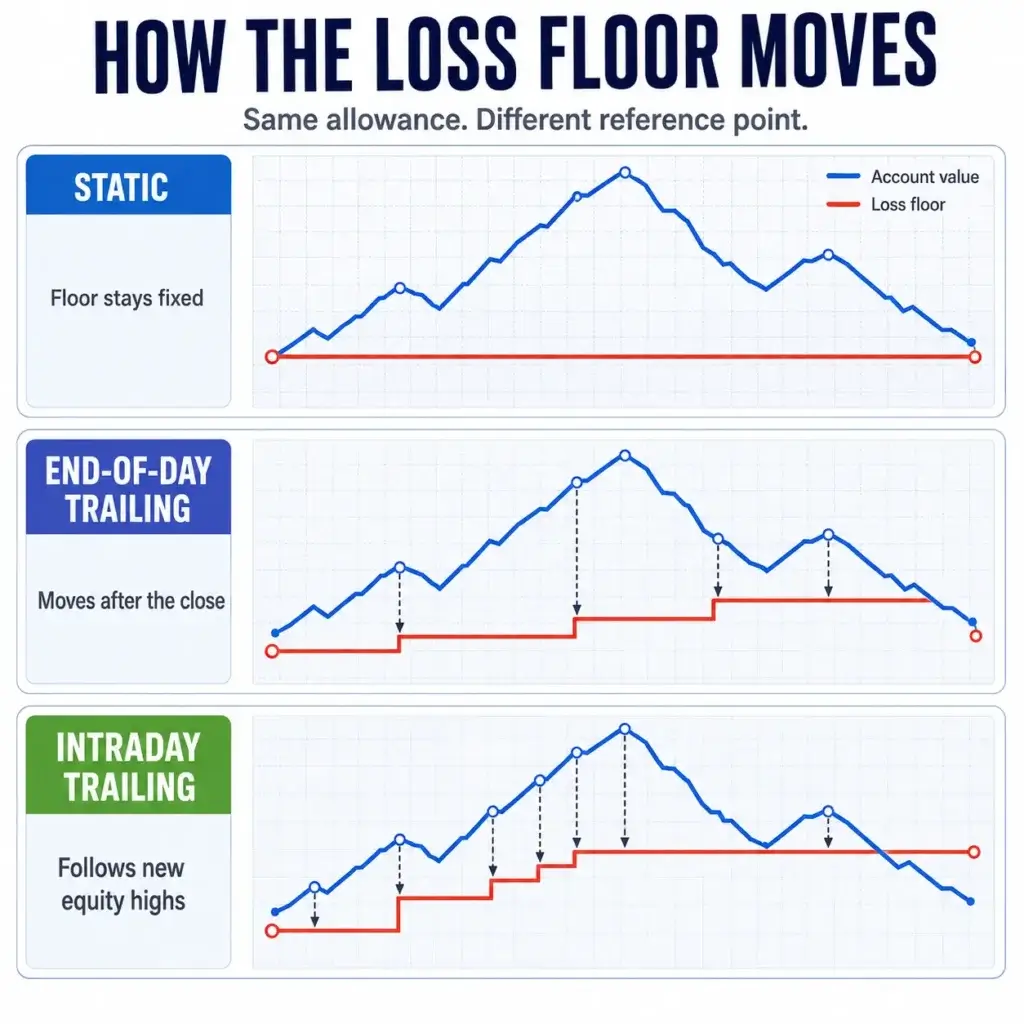
Worked Example: One Account Under Three Rules
Assume a hypothetical $100,000 account with a fixed $10,000 allowance. The static floor starts at $90,000. The end-of-day version trails the highest qualifying close by $10,000. The intraday version trails the highest live equity by $10,000. For this example only, touching the floor counts as a breach.
| Event | Account State | Active Floors |
|---|---|---|
| Account starts | Balance and equity are $100,000. | Static $90,000, EOD $90,000, intraday $90,000. |
| Open trade gains $6,000 | Balance stays $100,000 and equity reaches $106,000. | Static $90,000, EOD $90,000, intraday rises to $96,000. |
| Trade closes at a $4,000 gain | Balance and equity finish the day at $104,000. | Static $90,000, next EOD floor $94,000, intraday remains $96,000. |
| Open loss takes equity to $97,000 | Closed balance remains $104,000. | Headroom is $7,000 static, $3,000 EOD, and $1,000 intraday. |
| Equity reaches $96,000 | The closed balance still has not changed. | Intraday breaches under the assumed touch rule. Static and EOD remain above their floors. |
The first gain affects each account differently because static drawdown converts the full gain into added distance from the fixed floor. The EOD rule converts the $104,000 close into a higher $94,000 floor. The intraday rule remembers the earlier $106,000 equity peak, so its floor stays at $96,000 after the trade closes for less.
The final row also shows why balance and equity cannot be treated as substitutes. Closed balance remains $104,000, yet an open loss can bring equity to the active floor.
Real agreements can use a different allowance base, equality test, or lock point. This example isolates floor movement relative to account value and does not state any provider's terms.
Daily Loss Versus Maximum Drawdown
Daily loss and maximum drawdown can operate at the same time. The higher active floor is the immediate constraint.
| Rule | What It Restricts |
|---|---|
| Daily loss | Loss inside the provider’s defined trading day, based on a reset-time balance, equity, or another stated reference. |
| Maximum drawdown | Loss across the life of the account or stage, under a static or trailing total floor. |
Breakout's current $100,000 Classic structure shows the interaction through a static $94,000 total floor. If the balance recorded at 00:30 UTC is $105,000, the 3% daily calculation produces a $101,850 floor. At $103,000 equity, the account has $9,000 above the total floor but only $1,150 above the daily floor.
The lower total floor does not create permission to lose another $9,000 that day. The daily rule controls first. At the next reset, a new daily floor can be calculated, but a completed hard breach is not erased merely because the clock changes.
Loss rules are one part of how a prop firm challenge works. A profitable account can still fail before the target if either floor is reached, while a temporary session stop may produce a different outcome under another product.
Balance-Based and Equity-Based Rules Are Not Opposites
Balance normally reflects closed trading results and posted charges. Equity adds the current profit or loss on open positions. A simplified expression is:
Equity = balance + open P&L − applicable trading costs
A provider can calculate a floor from the daily balance and then test current equity against it. The anchor is balance-based. The enforcement value is equity-based.
Using the Breakout calculation above, a $105,000 reset balance creates a $101,850 daily floor. If the closed balance remains $105,000 and an open position falls by $3,150, equity reaches $101,850. The balance has not fallen, but the monitored value has reached the floor.
Open-position profit can work in the other direction under a high-water rule. If equity reaches a new peak, the floor may rise before that profit is realized. The account can then breach after giving back the gain.
Trading costs can also reduce equity, including commissions, swaps, and perpetual funding. The agreement should state which charges enter the calculation and when they post. A dashboard label that says “balance drawdown” does not prove that open positions are ignored.
Open Profit, Reset Times, and Real-Time Enforcement
Update timing determines when qualifying gains may lift a floor. Enforcement timing determines when the firm tests the already active floor. An end-of-day update does not guarantee end-of-day enforcement.
Topstep's standard $50,000 Trading Combine begins with a $48,000 maximum-loss floor. A $50,500 end-of-day balance raises the next floor to $48,500. A later losing day does not lower it. Once qualifying closes lift the floor to the $50,000 starting balance, the standard rule locks there.
Topstep monitors that active maximum-loss floor in real time and includes unrealized P&L. Equity reaching the floor can therefore trigger liquidation during the session even though profitable closes move the floor only after day-end. Readers reviewing futures prop firm choices should check both clocks and treat EOD as an update cadence.
Every daily reset needs a timezone. Breakout uses 00:30 UTC, while The5ers High Stakes names 00:00 UTC+3. Topstep defines its optional daily-loss session in CT, which moves between standard and daylight time. FTMO uses CE(S)T, another daylight-sensitive label. HyroTrader states that its Swing reference resets at the UTC server reset but does not disclose an exact hour on the public rule screens.
An open position that crosses the reset can face a newly calculated floor while it remains open. Funding, swaps, and commissions may post around the same boundary. For crypto prop firm accounts, 24-hour trading and perpetual funding can change the timing and cost of carrying a position across a reset.
Lock Points, Payouts, and New Account Stages
A lock point stops a trailing floor from rising above a stated level. Each product specifies whether end-of-day or intraday trailing has one.
A withdrawal changes the account balance, while the funded-stage agreement determines the post-payout floor. It may keep, reset, rebase, or temporarily buffer that floor.
| Published Mechanic | What Changes |
|---|---|
| Breakout funded 1-Step | The payout amount temporarily lowers the active daily floor by the same amount. At the next 00:30 UTC reset, the floor is recalculated from the new balance. The static total floor stays tied to the initial balance. |
| Topstep Express Funded Account | The first payout sets the maximum-loss floor to $0 permanently. The remaining positive balance becomes the effective cushion. |
| The5ers Futures | The 4% drawdown is recalculated from the new post-payout balance for that product. |
| FTMO 1-Step | A Reward produces a new account and resets the total floor to 90% of initial simulated capital. |
The four rows produce different post-payout floors. No single shortcut can predict the result from the payout amount alone.
Passing an evaluation or entering a live allocation can give a funded trading account a new balance and loss-floor formula. The transition can also start a new payout clock or execution environment.
Before requesting money, calculate the expected post-payout balance and active floor, then derive the remaining headroom. Check any lock point separately. If a field is not disclosed, the effect is not safe to infer.
How to Read Drawdown Terms Before Paying
Work from the formula outward. Marketing labels can wait until every input has a value.
| Check | What to Record |
|---|---|
| Loss allowance | Dollar amount or percentage, plus the balance used to calculate it. |
| Floor anchor | Initial balance, reset-time value, highest close, highest equity, or another reference. |
| High-water input | Closed balance only or live equity including unrealized profit. |
| Reset or update time | Exact clock, timezone, session close, and treatment of open positions. |
| Breach value | Balance, equity, net liquidation value, and included costs. |
| Equality rule | Whether touching the floor is enough or the value must move below it. |
| Lock point | The level where a trailing floor stops, if one exists. |
| Stage change | Which calculation applies during evaluation, funded simulation, and any live account. |
| Payout effect | Whether the floor stays fixed, receives a buffer, rebases, locks, or resets on a new account. |
| Consequence | Temporary stop, liquidation, failed evaluation, closed account, reset eligibility, or another result. |
| Rule-change clause | How notice is delivered, when revised terms take effect, and whether the account retains the version accepted at purchase. |
Run the formula through an open gain and an open loss. Repeat the calculation across a daily reset, payout, and stage transition. Record the resulting floor and headroom after each event. This catches contradictions that a percentage table hides.
After reconstructing the rules, readers can browse current prop firm programs by account model and supported market, then check cost and payout terms. The agreement for the chosen product should still be checked again immediately before payment.
Managing Risk Around a Drawdown Limit
Because active headroom is the contract constraint, a risk plan should start with the current monitored value and floor. Nominal account size can overstate that room by a wide margin. The plan should reserve capacity for trading costs and open-position movement.
A personal stop placed above the firm's hard boundary leaves room for execution costs or delayed liquidation. It also keeps the account-closing threshold separate from an ordinary stop-loss level. The amount depends on the strategy and the contract, so a universal percentage would be misleading.
Position size connects the loss floor with leverage and liquidity. Price gaps and thin order books can move equity past both a personal stop and the provider's floor, while leverage and forced liquidation can compound the loss.
Passing tactics and trade-level sizing belong in a dedicated guide to how to pass a prop firm challenge. The drawdown formula sets the boundary. It does not identify a profitable strategy.
FAQ
What does a 5% prop firm drawdown mean?
A 5% rule means a loss allowance equal to 5% of its stated base. On a $100,000 account, 5% of the initial balance is $5,000 and creates a $95,000 static floor. A firm can instead apply the allowance below a daily balance or a high-water mark. Check the reference value and update time first, then identify the breach test and lock rule.
What is the difference between static and trailing drawdown?
A static floor stays tied to its starting reference. A trailing floor can rise after new qualifying balance or equity highs. A trailing floor normally does not move back down after a loss. Its update timing and lock point remain contract-specific.
What is the difference between daily loss and maximum drawdown?
Daily loss restricts the account inside one provider-defined trading day. Maximum drawdown governs the account or stage across days. Both can be active together, and the higher floor is the immediate constraint. They can use different reference values and different consequences.
Does end-of-day drawdown mean breaches are checked only at the close?
No. End-of-day can describe when profitable results raise the floor. A firm can still monitor current equity against the already active floor throughout the session. The terms should separately state update timing and breach timing.
Does open profit count toward drawdown?
Open profit counts when an intraday high-water rule lets unrealized gains raise the floor. A balance-derived daily floor may also be enforced against equity, which includes open losses. The agreement should state whether open P&L and trading costs enter the monitored value. It should also identify when those costs post.
Does trailing drawdown reset after a payout?
A payout follows the named product’s current terms. It may leave the floor fixed or force a lock point. Other products rebase the allowance, add a temporary buffer, or issue a new account with a reset floor. Calculate the post-payout balance and floor before requesting money.
