A single evaluation phase reaches a funded account faster, which is how firms sell it. Removing the second phase changes the economics of the structure. The difference usually appears in the loss floor, the profit target or the split the account opens on.
A one-step prop firm puts a single simulated trading phase between checkout and a funded account. One starting balance, one profit target, one set of loss limits, and a payout agreement on the far side. The two-step alternative splits that gate into a pair of runs, a larger target first, then a smaller one on a freshly reset account. Either way the product is a simulated funded account paying a share of profits, with no custody of trader money at any point.
Best One-Step Prop Firms in 2026
- Evaluation fee
- From $20
- Max drawdown
- 3–6%
- Profit split
- 80%–90%
- Owned by Kraken's parent company, Payward
- Discloses its own conflicts in its terms
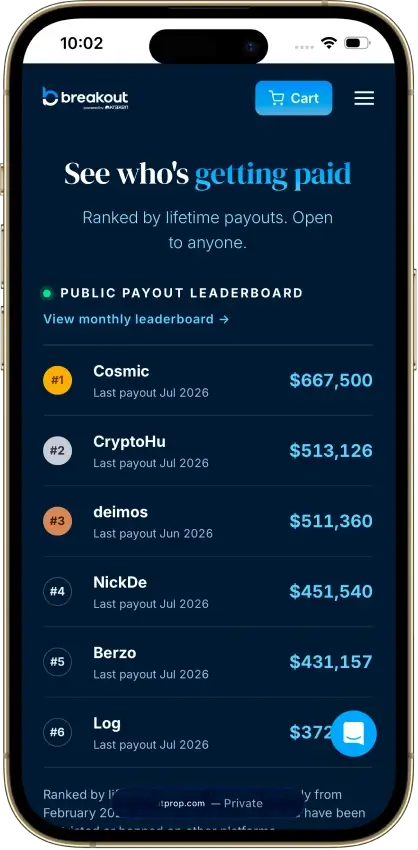
- Public payout leaderboard with totals
- Evaluation fee
- Forex / CFD: From $32.99; Futures: From $79.99
- Max drawdown
- Forex / CFD: Balance-Based Trailing (Closing Balance): 6%; Static (Initial Balance): 6–10%; Futures: 1,000–4,000 USD
- Profit split
- Forex / CFD: 70%–95%; Futures: 80%–95%
- Static loss floors on Stellar evaluations
- Flex removes funded consistency rules
- CFD and futures instant routes
- Evaluation fee
- From EUR 79
- Max drawdown
- End-of-Day Trailing (Closing Balance): 10%; Static (Initial Balance): 10%
- Profit split
- 80%–90%
- Rules spelled out in more detail than any rival
- Repeatable free trial before you pay
- Selling evaluations longer than almost anyone
- Evaluation fee
- Forex / CFD: From $19; Futures: From $59
- Max drawdown
- Forex / CFD: 4–10%; Futures: 4%
- Profit split
- Forex / CFD: 50%–100%; Futures: 80%
- Funding traders since 2016
- Scaling ladder reaches $4,000,000
- High Stakes pauses on a daily breach
- Max drawdown
- 5–10%
- Profit split
- 80%–90%
- Trades run on your own Bybit sub-account
- Static maximum loss floor that never moves
- Split from 80%, up to 90% on One-Step and Two-Step
- Evaluation fee
- From $40
- Max drawdown
- 3–10%
- Profit split
- 80%–90%
- All 60 public payouts verified on Arbitrum
- Mirror trades across your own accounts
- Weekly stablecoin payouts from a $100 minimum
- Evaluation fee
- Forex / CFD: From $29; Futures: From $83
- Max drawdown
- Forex / CFD: Intraday Trailing (Real-Time Equity): 6–10%; Static (Initial Balance): 8–10%; Futures: Balance-Based Trailing (Initial Balance): 4%; End-of-Day Trailing (Initial Balance): 3–4%
- Profit split
- Forex / CFD: 90%–100%; Futures: 80%–100%
- Scaling ceiling of $4,000,000
- Aqua Elite adds $1,000 to $3,000 a month
- Ten CFD models and five futures types
- Evaluation fee
- Forex / CFD: From $23; Crypto: From $49; Futures: From $139
- Max drawdown
- Forex / CFD: Intraday Trailing (Real-Time Equity): 5–6%; Static (Initial Balance): 5–8%; Crypto: End-of-Day Trailing (End-of-Day Equity): 4%; Intraday Trailing (Real-Time Equity): 5–6%; Futures: 2,000 USD
- Profit split
- Forex / CFD: 60%–90%; Crypto: 70%–90%; Futures: 80%
- A missed payout deadline pays you 100%
- No reset fee on any of the 51 plans
- No arbitration clause or class waiver
- Evaluation fee
- From $29
- Max drawdown
- 6–10%
- Profit split
- 60%–90%
- No trailing model anywhere in the catalog
- Three platform options at no extra charge
- Free five-level scaling ladder, fully public
- Evaluation fee
- From EUR 0
- Max drawdown
- Intraday Trailing (Higher of Balance / Equity): 6%; Static (Initial Balance): 8–10%
- Profit split
- 80%–100%
- Most permissive rulebook in our 9-firm test
- Free $1K Challenge, a $0 evaluation
- Split reaches 100% at the third scale-up
- Evaluation fee
- From $40
- Max drawdown
- Static (Initial Balance): 6–10%; Trailing until 6% profit, then static (Real-Time Equity): 6%
- Profit split
- 50%–90%
- No deadline, minimum days or consistency rule
- Instant route doubles the balance at each 10%
- 1-phase floor locks for good at 6% profit
- Evaluation fee
- From $5
- Max drawdown
- Intraday Trailing (Real-Time Equity): 6–8%; Static (Initial Balance): 6%
- Profit split
- 80%–100%
- Cheapest entry we rate, $5 up front
- Reward Guarantee or they pay $1,000
- Eight account models, more than any rival
CryptoSlate may earn a commission when you visit partner sites through links on this page, at no extra cost to you. Our rankings and reviews remain editorially independent and based on our published methodology. Read disclosure
Disclaimer: CryptoSlate may receive a commission when you click links on our site and make a purchase or complete an action with a third party. This does not influence our editorial independence, reviews, or ratings, and we always aim to provide accurate, transparent information to our readers.One-Step Prop Firms Compared
Compare the scored firms by market coverage, evaluation structure, account size, drawdown, profit split and first-payout timing.
| Prop Firm | Markets | Evaluation Types | Account Sizes | Maximum Drawdown | Profit Split | First Payout |
|---|---|---|---|---|---|---|
 Breakout Breakout | Crypto | One Step | $5,000–$200,000 | 3–6% | 80%–90% | No waiting period at all. A payout can be requested as soon as net profit after the split clears $50, which can be the same day the account is funded. |
 FundedNext FundedNext | Forex / CFD, Futures | Forex / CFD: Two Step, One Step, Instant; Futures: Futures Evaluation | Forex / CFD: $2,000–$200,000; Futures: $25,000–$150,000 | Forex / CFD: Balance-Based Trailing (Closing Balance): 6%; Static (Initial Balance): 6–10%; Futures: 1,000–4,000 USD | Forex / CFD: 70%–95%; Futures: 80%–95% | — |
 FTMO FTMO | Forex / CFD | Two Step, One Step | $10,000–$200,000 | End-of-Day Trailing (Closing Balance): 10%; Static (Initial Balance): 10% | 80%–90% | 14 calendar days |
 The5ers The5ers | Forex / CFD, Futures | Forex / CFD: One Step, Two Step, Three Step; Futures: Futures Evaluation | Forex / CFD: $2,500–$250,000; Futures: $25,000–$150,000 | Forex / CFD: 4–10%; Futures: 4% | Forex / CFD: 50%–100%; Futures: 80% | 14 calendar days |
 HyroTrader HyroTrader | Crypto | Zero Step, One Step, Two Step | — | 5–10% | 80%–90% | As soon as the funded account is in profit |
 Velotrade Velotrade | Forex / CFD | One Step, Two Step | $5,000–$200,000 | 3–10% | 80%–90% | 14 calendar days |
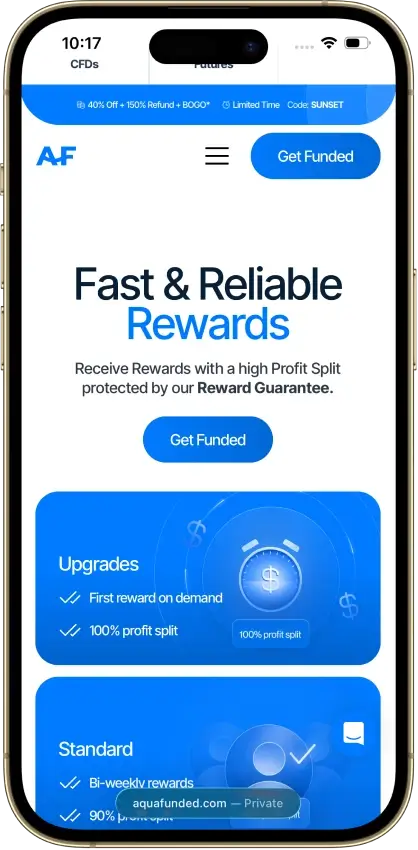
 AquaFunded AquaFunded | Forex / CFD, Futures | Forex / CFD: Two Step, Instant; Futures: Instant, Futures Evaluation | Forex / CFD: $2,500–$400,000; Futures: $25,000–$150,000 | Forex / CFD: Intraday Trailing (Real-Time Equity): 6–10%; Static (Initial Balance): 8–10%; Futures: Balance-Based Trailing (Initial Balance): 4%; End-of-Day Trailing (Initial Balance): 3–4% | Forex / CFD: 90%–100%; Futures: 80%–100% | 14 calendar days |
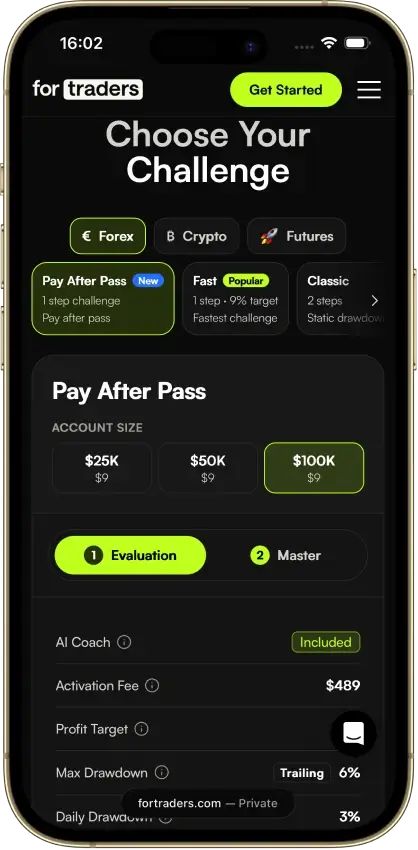
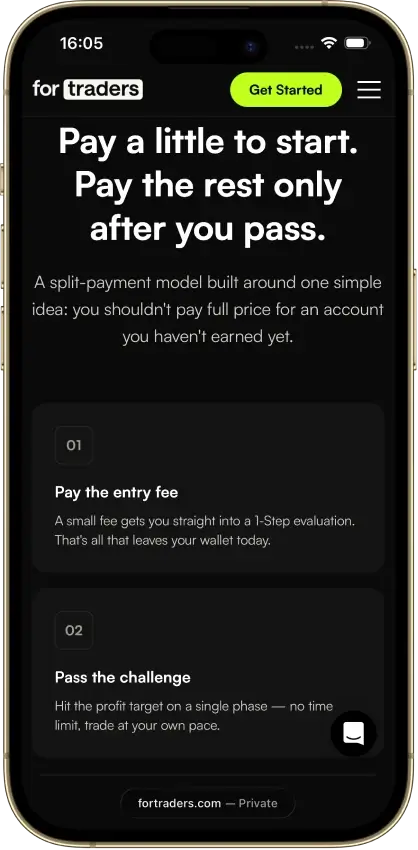
 For Traders For Traders | Forex / CFD, Crypto, Futures | Forex / CFD: One Step, Two Step, Three Step, Instant; Crypto: One Step, Instant; Futures: One Step, Instant | Forex / CFD: $3,000–$100,000; Crypto: $3,000–$100,000; Futures: $25,000–$100,000 | Forex / CFD: Intraday Trailing (Real-Time Equity): 5–6%; Static (Initial Balance): 5–8%; Crypto: End-of-Day Trailing (End-of-Day Equity): 4%; Intraday Trailing (Real-Time Equity): 5–6%; Futures: 2,000 USD | Forex / CFD: 60%–90%; Crypto: 70%–90%; Futures: 80% | 14 calendar days |
 OneFunded OneFunded | Forex / CFD | Two Step, One Step, Instant | $5,000–$200,000 | 6–10% | 60%–90% | 14 calendar days |
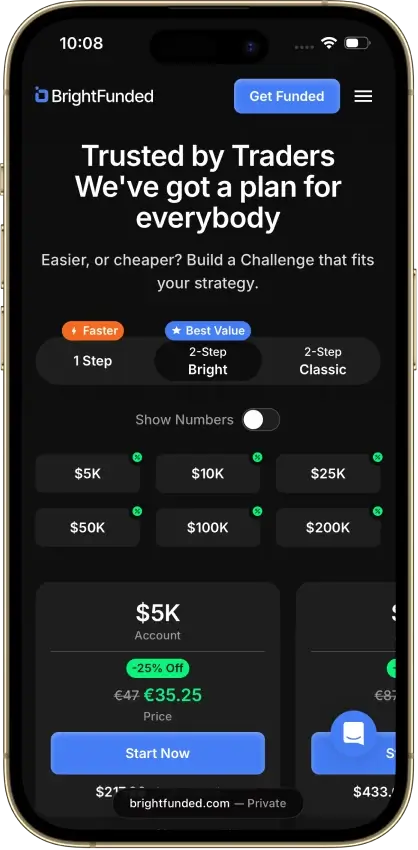
 BrightFunded BrightFunded | Forex / CFD | One Step, Two Step | $1,000–$200,000 | Intraday Trailing (Higher of Balance / Equity): 6%; Static (Initial Balance): 8–10% | 80%–100% | 30 calendar days |
 Crypto Fund Trader Crypto Fund Trader | Crypto | Two Step, One Step, Instant | $5,000–$200,000 | Static (Initial Balance): 6–10%; Trailing until 6% profit, then static (Real-Time Equity): 6% | 50%–90% | 15 trading days |
 Goat Funded Trader Goat Funded Trader | Forex / CFD | One Step | $5,000–$100,000 | Intraday Trailing (Real-Time Equity): 6–8%; Static (Initial Balance): 6% | 80%–100% | 14 calendar days |
The columns carry the rule set each firm attaches to its single-phase route, not what an attempt costs to buy or repeat. Comparable floors under futures trading session rules settle once a day against the closing balance.
One-Step Prop Firms in Detail
Breakout
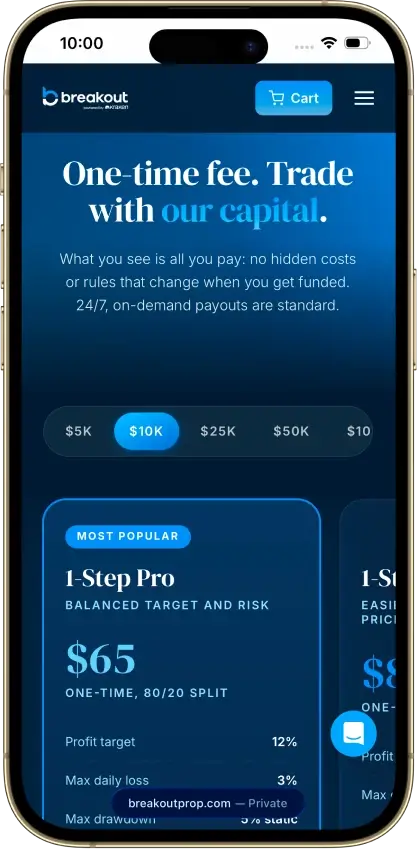
- Evaluation fee
- From $20
- Max drawdown
- 3–6%
- Profit split
- 80%–90%
Pros
- Static drawdown on all three plans
- Payouts on demand 24/7, $50 minimum
- No consistency rule or minimum days
- News trading and weekend holds allowed
Cons
- Your order may never reach an exchange
- Evaluation fee is never refunded
- Leverage varies by coin, 2x on many alts
- No MetaTrader on either terminal
- Funded capital limited to $200,000 total




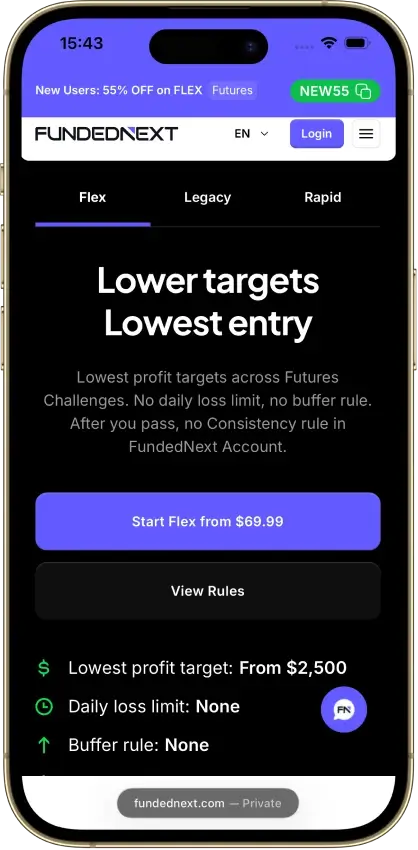
FundedNext
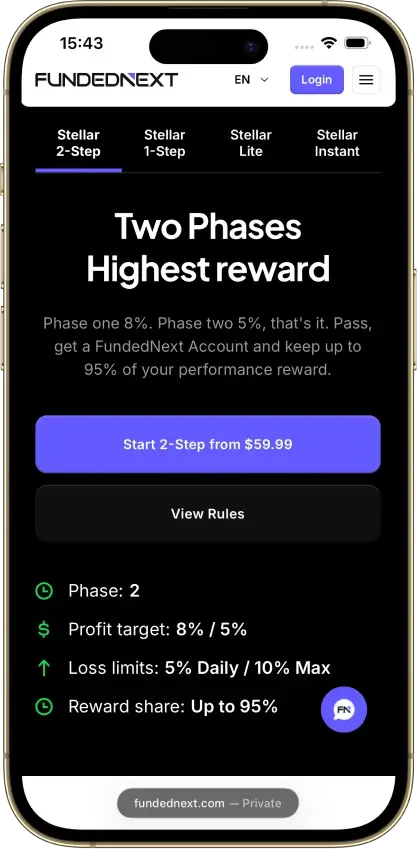
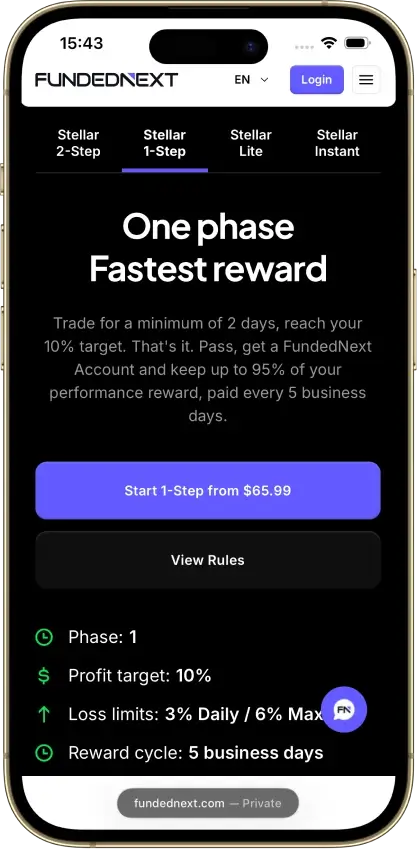
- Evaluation fee
- Forex / CFD: From $32.99; Futures: From $79.99
- Max drawdown
- Forex / CFD: Balance-Based Trailing (Closing Balance): 6%; Static (Initial Balance): 6–10%; Futures: 1,000–4,000 USD
- Profit split
- Forex / CFD: 70%–95%; Futures: 80%–95%
Pros
- Static overall loss on Stellar evaluations
- No funded consistency rule on Flex
- Tradovate, NinjaTrader and TradingView
- Lite standard challenge needs two days
- 2-Step fee return with first reward
Cons
- Flex limits requests to half the profit
- Flex concludes after five rewards
- Instant withdrawals shrink loss room
- Quick Strike can end funded CFD accounts
- Payout options cannot change after purchase


FTMO
- Evaluation fee
- From EUR 79
- Max drawdown
- End-of-Day Trailing (Closing Balance): 10%; Static (Initial Balance): 10%
- Profit split
- 80%–90%
Pros
- Fee refunded in full at your first payout
- Static 10% max loss on the 2-step route
- No time limit on any evaluation
- 48,676 reviews, the largest base in prop
- MT4, MT5 and cTrader all supported
Cons
- Among the priciest evaluations anywhere
- 1-step floor rises, reset only by a payout
- 1-step fee is not refundable
- No weekend holding on Standard accounts






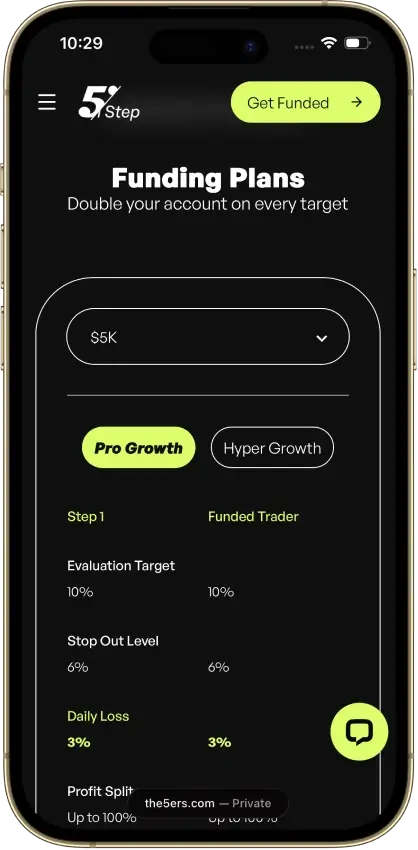
The5ers
- Evaluation fee
- Forex / CFD: From $19; Futures: From $59
- Max drawdown
- Forex / CFD: 4–10%; Futures: 4%
- Profit split
- Forex / CFD: 50%–100%; Futures: 80%
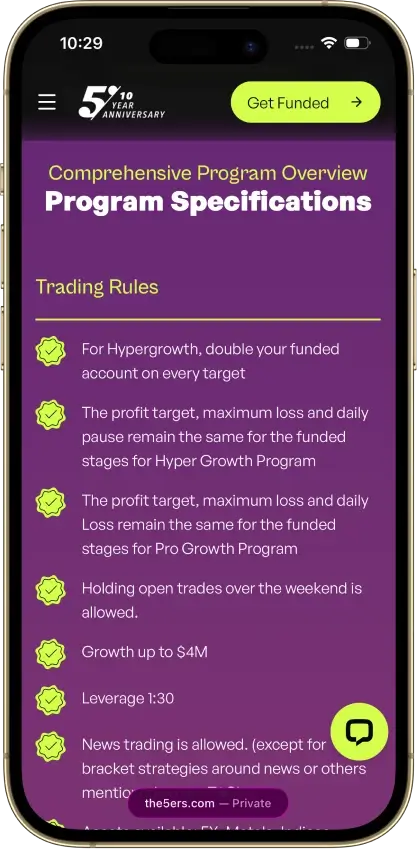
Pros
- Static drawdown on all five CFD programs
- No time limit to pass any challenge
- Entry from $19 for a 2-step $2.5K account
- Five CFD and two futures programs
- Overnight and weekend holding on CFD plans
Cons
- Refund terms conflict on its own page
- Futures drawdown trails, unlike CFD plans
- Splits start at 50/50 on two programs
- 30x leverage on three of five CFD plans
- Scaling resets the 14-day payout clock



HyroTrader
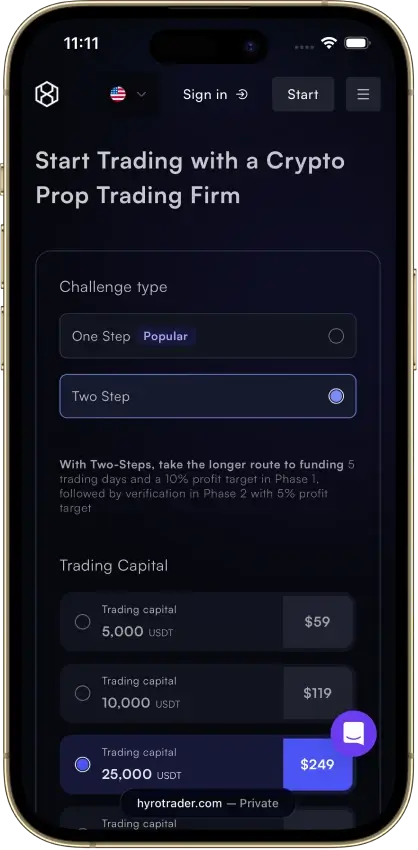
- Max drawdown
- 5–10%
- Profit split
- 80%–90%
Pros
- No time limit on any evaluation phase
- No mandatory stop loss on any trade
- Deposit returned with first payout (One-Step, Two-Step)
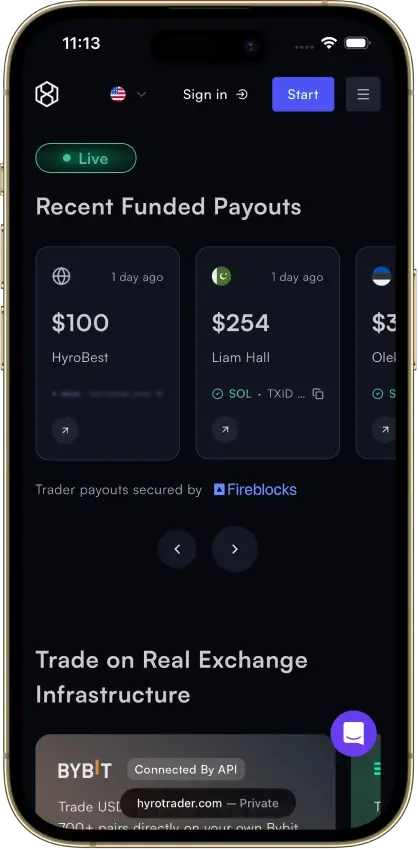
- Orders reach a live exchange order book
- Static daily drawdown on every challenge
Cons
- Forced withdrawal at 5%, excess forfeited
- API keys permit prohibited instruments



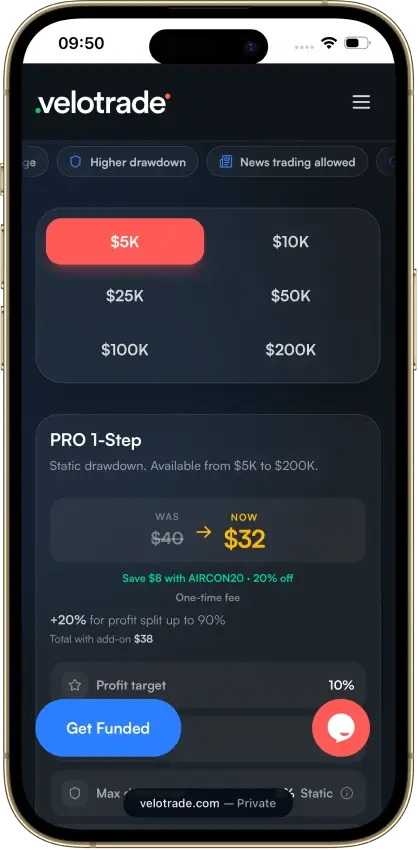
Velotrade
- Evaluation fee
- From $40
- Max drawdown
- 3–10%
- Profit split
- 80%–90%
Pros
- $40 entry, PRO cheapest at every size
- No time limit on any evaluation phase
- EAs and API allowed with no fee or approval
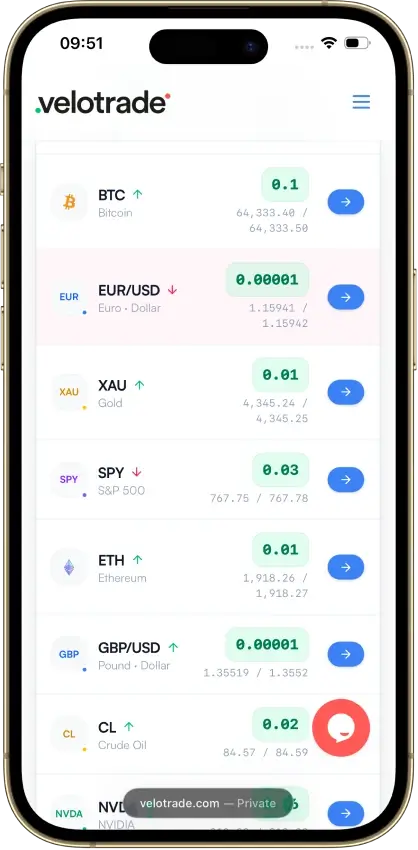
- 230+ instruments across five asset classes
Cons
- First two payouts limited to 20x the fee
- A trading day needs 0.8% realized profit
- 90% split is a paid add-on over 80% default




AquaFunded
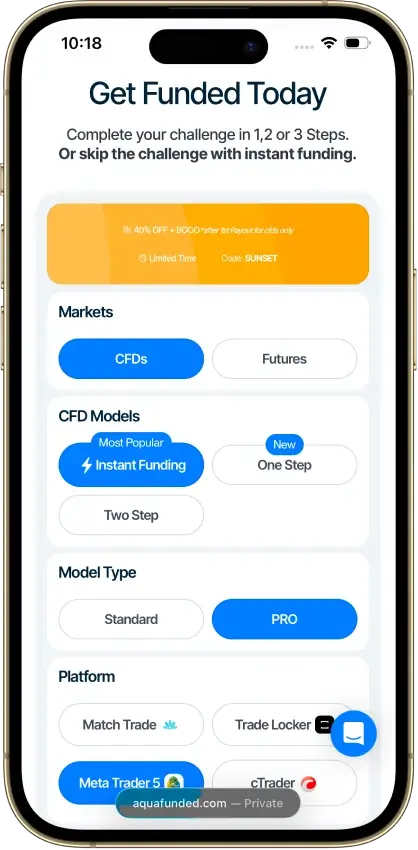
- Evaluation fee
- Forex / CFD: From $29; Futures: From $83
- Max drawdown
- Forex / CFD: Intraday Trailing (Real-Time Equity): 6–10%; Static (Initial Balance): 8–10%; Futures: Balance-Based Trailing (Initial Balance): 4%; End-of-Day Trailing (Initial Balance): 3–4%
- Profit split
- Forex / CFD: 90%–100%; Futures: 80%–100%
Pros
- 90% profit split on every CFD model
- $1,000 penalty if a payout misses 24 hours
- Three futures types have no daily loss limit
- Five of ten CFD models skip consistency
Cons
- The drawdown documents contradict themselves
- -2% floating loss closes the account for good
- The refund only lands on your fourth payout
- 30 days without a trade breaches funding



For Traders
- Evaluation fee
- Forex / CFD: From $23; Crypto: From $49; Futures: From $139
- Max drawdown
- Forex / CFD: Intraday Trailing (Real-Time Equity): 5–6%; Static (Initial Balance): 5–8%; Crypto: End-of-Day Trailing (End-of-Day Equity): 4%; Intraday Trailing (Real-Time Equity): 5–6%; Futures: 2,000 USD
- Profit split
- Forex / CFD: 60%–90%; Crypto: 70%–90%; Futures: 80%
Pros
- No time limit except on Strike
- EURUSD from 0.1 pips raw spread
- 74 crypto pairs, traded 24/7
- $3 per lot forex, $0 on indices
- Evaluations listed from $23
Cons
- 5-second hold rule is not in the rulebook
- Activation fee falls due before KYC
- 3% buffer locked up on Forex Instant
- Checkout omits drawdown limits on 37 plans




OneFunded
- Evaluation fee
- From $29
- Max drawdown
- 6–10%
- Profit split
- 60%–90%
Pros
- UK company, English law and courts
- $29 entry on the two-step Value plan
- Core advertises a fee return at payout
- No consistency limit while evaluating up to $50K
Cons
- Add-on costs shown only at checkout
- Core/Value consistency limit starts when funded
- Forex lot is $3.50 on cTrader, $4.00 on MT5
- Instant has a 1% exposure limit and no refund





BrightFunded
- Evaluation fee
- From EUR 0
- Max drawdown
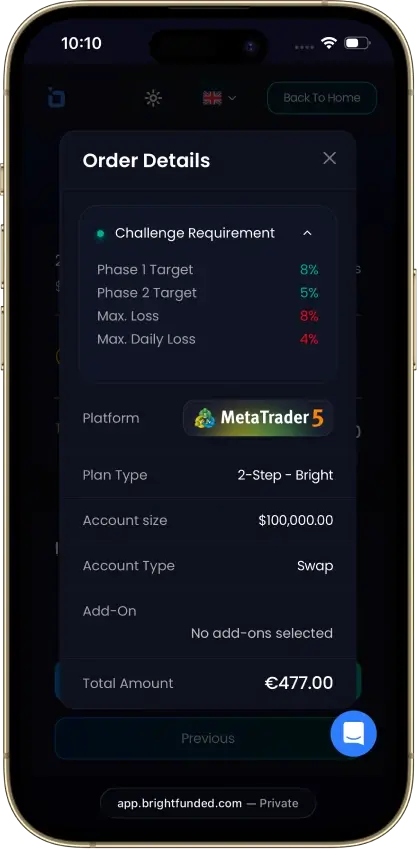
- Intraday Trailing (Higher of Balance / Equity): 6%; Static (Initial Balance): 8–10%
- Profit split
- 80%–100%
Pros
- EAs allowed on supported platforms
- Unlimited time on every evaluation
- $0.01 payout minimum, no firm fee
- Help center shows the drawdown math
- Payouts reported inside 24 hours
Cons
- 6% floor trails, checkout omits the type
- Default payout waits 30 days
- VAT appears only after buyer details


Crypto Fund Trader
- Evaluation fee
- From $40
- Max drawdown
- Static (Initial Balance): 6–10%; Trailing until 6% profit, then static (Real-Time Equity): 6%
- Profit split
- 50%–90%
Pros
- 715 crypto pairs and 900+ instruments
- 100x leverage advertised on every instrument
- Instant route skips the evaluation
- Up to 90% split with a paid upgrade
Cons
- On FINMA's warning list since August 2024
- Evaluation fee is never refunded
- 90% split and weekly payouts cost extra
- Registered as an education company






Goat Funded Trader
- Evaluation fee
- From $5
- Max drawdown
- Intraday Trailing (Real-Time Equity): 6–8%; Static (Initial Balance): 6%
- Profit split
- 80%–100%
Pros
- Fees refunded after the fourth funded payout
- $100 minimum payout, paid in 2 days
- Scales to $2M with up to 100% split
- Static floor, no consistency rule on 1 Step
Cons
- Up to three loss limits run at once
- Complaints cluster on payout denials
- Pay Later activation can top the Instant price






How We Rank
- Payout Reliability and Evidence 25% weight
Payout history, evidence and the conditions for receiving funds.
- Rules Fairness and Transparency 20% weight
Clarity and fairness of account rules and restrictions.
- Cost and Value 15% weight
Evaluation fees, refunds and the value of each program.
- Trading Conditions 15% weight
Markets, platforms, execution and trading limits.
- Profit Split and Scaling 10% weight
Profit sharing and paths to larger allocations.
- Firm Transparency and Stability 10% weight
Ownership, disclosures and operational stability.
- Support and Reputation 5% weight
Customer assistance and the firm’s public track record.
Here, the firm-level score remains separate from the question of whether a one-step structure suits a trader. The page compares the single-phase route through its target, loss allowance, floor behavior, opening split and any caps that can delay a pass or payout. Those terms are then read against the firm's wider evidence record. A shorter route can therefore be the better fit without becoming the higher-quality firm, and the reverse can also be true.
What a Phase Is, and What Resets Between Them
A phase is a simulated account issued with a starting balance, a profit target, a daily loss limit and a maximum loss floor. Passing means reaching the target without touching either limit. Touching either limit ends the phase, and with it the attempt, whatever the balance shows at the time.
Between the phases of a two-step, the account is rebuilt. The balance returns to its starting figure, the loss floor re-anchors against it, the daily counter starts clean, and the first target is replaced by the second. Profit earned in phase one buys nothing in phase two. The only things that survive the reset are the fee already paid and any refund promise attached to it.
| What the Structure Sets | Single Phase | Two Phases |
|---|---|---|
| Gates before funding | One continuous run | Two runs, with a full account reset between them |
| Target shape | One figure, cleared in one stretch | A larger figure first, then a smaller one on a fresh balance |
| Loss allowance | One allowance covering the whole journey | Restored in full at the reset |
| Floor attached | Static or trailing, set per firm. Trailing is widespread in the category | Static, anchored to the starting balance |
| What a failure costs | The attempt, at whichever balance it happens | The attempt, and the second gate is only reached by repassing the first |
That reset is the thing a trader gives up by choosing the shorter route. The single phase never grants one. Every dollar of allowance spent in the first week of the run is still spent in its last, because the run is continuous and the allowance is one allowance.
Why 8% Then 5% Is Not the Same as 10%
Set side by side, the structures look like a simple sum. A two-step asking 8% and then 5% appears to demand 13% of profit against 10% for the single phase, which would make the one-step the smaller task. The reset breaks that sum.
On a $100,000 account, the first phase of a two-step needs $8,000 of profit. The second starts from $100,000 again and needs $5,000. At no point in either run does the account have to stand more than $8,000 above a fresh anchor, and each run opens with its full loss allowance restored. The 13% is never carried at once. It is demonstrated in installments that each start from zero.
The single phase carries its 10% in one continuous stretch, and a trailing floor changes what that stretch demands. From a $100,000 start with a 5% trailing floor, the floor opens at $95,000. A peak of $104,000 drags it to $98,800. A peak of $106,000 puts it at $100,700, above the starting balance, and from there the floor can end the run while the balance still sits above its opening figure. Reaching $110,000 means traveling the whole distance without ever handing back 5% from any high. The two-step legs, run against a 10% static floor, can each absorb a $10,000 drawdown from their anchor and recover.
Dividing a run's target by its loss allowance produces a single figure for each structure. The two-step legs above come out at 0.8 and 0.5, with each target below its allowance. The single phase comes out at 2.0 because the run must earn double what it is permitted to lose. Routes carrying the same firm name can sit on opposite sides of 1.
Where the Single Phase Gets Paid For
The Floor
The floor under a two-step phase is commonly static, drawn at the opening balance and left where it is for the length of the run. Across other prop-firm routes, single phases lean on trailing floors that ratchet upward with each new equity high, and a tighter percentage is often part of the same purchase. A trailing floor converts open profit into obligation, since room is measured from the peak rather than from the start. The end-of-day variant moves once per day, at a fixed clock time, to wherever the closing balance puts it, and holds that level until the next close, which softens the intraday version without restoring the static one. Which floor a given route carries decides more about the run than its target does, and the comparison table above holds the type and size each scored route runs.
The Split
Across prop firms, the reference split is 80/20, and 90/10 sits above it as an upgrade paid for at checkout, before the account has produced anything. Where a firm sells the structures side by side and its single-phase route opens lower, that gap is the removed phase being collected in percentage points instead of dollars. The split each route opens at sits in the comparison table above, and it moves often enough to check against the live checkout before buying.
Consistency Rules and Single-Day Caps
A consistency rule caps how much of the total profit a single day may contribute. Where the whole target lands in one session, the cap does not fail the account. It holds the pass or the payout until later profit dilutes the outsized day's share. A max-single-day cap in an evaluation works the other way around, recalculating the target upward when one day exceeds the permitted share, so the run gets longer instead of ending. Lot-size and per-trade caps bound the position itself, whether as a contract ceiling, a per-idea risk percentage, or a floating-loss threshold that draws penalties as breaches accumulate.
These clauses bite hardest on a single phase, because a continuous run concentrates its profit however it arrives. A trader who reaches the target in one session has passed under a two-step's rules and may have passed nothing under a capped single phase. The table below carries what each firm attaches to its one-step route.
| Firm | Consistency and Single-Day Caps | Lot-Size and per-Trade Caps |
|---|---|---|
| FundingPips | None during the evaluation | Striking System once funded. A 1% floating loss on one trade idea logs a warning and deducts the profit, the second warning halves the split, the third cuts it to 20%, the fourth closes the account |
| FundedNext | None by default. A 40% single-day cap attaches only with the on-demand payout add-on | None published |
| Breakout | None, at either stage | None. Position size is bounded by per-instrument margin caps |
| FTMO | Best Day Rule, 50%. No single day may carry more than half of total profit, and progress holds until the best day falls inside that share | None published |
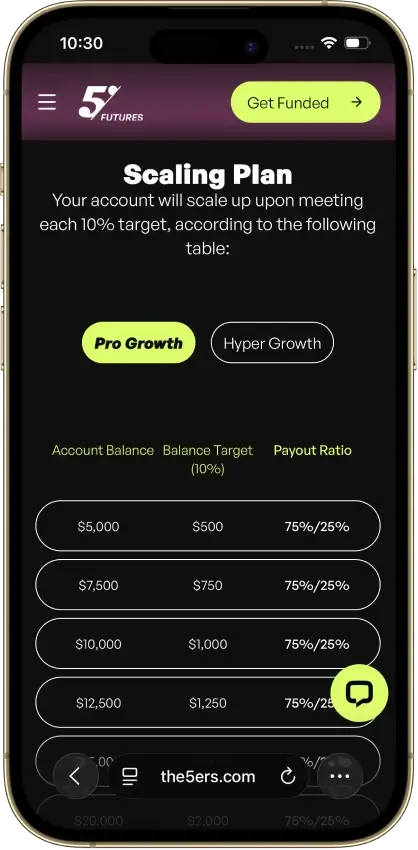
| The5ers | None on Pro Growth or Hyper Growth. A 50% single-day cap on the seasonal plan, and 40% per position on futures | Futures contracts capped, 2 mini or 20 micro at $25,000 and 40 micro on Swing at $50,000 |
| AquaFunded | 25% on 1-Step Pro, none on 1-Step Standard or Flex. All three need 3 profitable days of at least 0.5% each | Futures positions capped at 1 to 10 contracts by model and account size |
| Goat Funded Trader | None on the 1 Step. A day counts toward the minimum only when it closes 0.5% up or better | None on the 1 Step |
| Crypto Fund Trader | None, on any program | None published |
The Fees After Checkout
A one-time evaluation fee is the prop-firm norm, though it is not always the last charge. Reset fees and activation fees due on passing both exist. Some accounts also add monthly platform charges or market-data billing, and none of these costs is universal. Some firms refund the evaluation fee once a stated payout figure is reached. Others refund nothing. A single gate concentrates all of this on one run, so a failed attempt resolves to a rebuy at full fee, or a reset where one is sold. Each failed attempt that ends in a repurchase hands the firm another fee, a fact some firms state plainly in their own terms, and a structure with one gate compresses that arithmetic without changing it. Prop-firm costs across structures show whether failure triggers a full rebuy, a reset fee or no second route at all.
Who Each Structure Suits
The single phase fits trading that reaches its number quickly and takes its drawdown early or not at all. High win-rate styles with fixed risk per trade sit comfortably under a trailing floor, because they rarely hand back enough from a peak to meet it. It also fits the trader buying speed deliberately, funding in one run and accepting the thinner room as part of the purchase.
The two-step fits trading that gives ground on the way to its number. Any approach that routinely shows a loss before a profit lives longer against a static floor with a reset in the middle. Swing entries and positions built in stages are examples. That two-step structure remains common in forex and CFD program terms. Single-phase routes also reach crypto pairs, but crypto prop-firm market access varies by product.
- Best for comparing the structures inside one rulebook: FundedNext, which sells single-phase and two-phase models side by side on the same markets.
- Best for a single phase on crypto pairs: Breakout, funded on perpetual markets with a static floor, not a trailing one.
- Best for choosing a phase count instead of a firm: FundingPips, which sells the same markets behind several gate counts.
How Structure Shows up in a Score
Phase count does not affect the score by itself. It is a product decision, while the scores weigh what a firm proves. Payout evidence is weighted above the other pillars, and it is classed by source. A registry entry or a payout tested first-hand counts as verified, consistent third-party reporting counts as reported, and a firm's own payout total is logged as claimed however detailed it is. A single-phase route from a firm that cannot show payouts scores behind a two-phase route from one that can, whatever the structures suggest. Payout evidence scoring weights are published beside every score.
Risk Disclosure
Prop-firm evaluation fees are money at risk, and most participants never reach a payout. A simulated funded account is not a deposit and does not necessarily represent live firm capital. Nothing on this page is financial advice or a recommendation to buy an evaluation. CryptoSlate may earn a commission from links in this comparison, and commissions have no effect on scores.