Bitcoin ETFs offer Bitcoin price exposure through shares in a brokerage account, with costs and ownership limits that differ from buying coins. This comparison covers 13 U.S. spot funds assessed by CryptoSlate. Compare their annual charges, benchmarks and custody arrangements, then consider how trading shares fits the way you intend to use your investment.
Bitcoin ETFs at a Glance
- Annual Fee
- 0.15%
- Fund assets
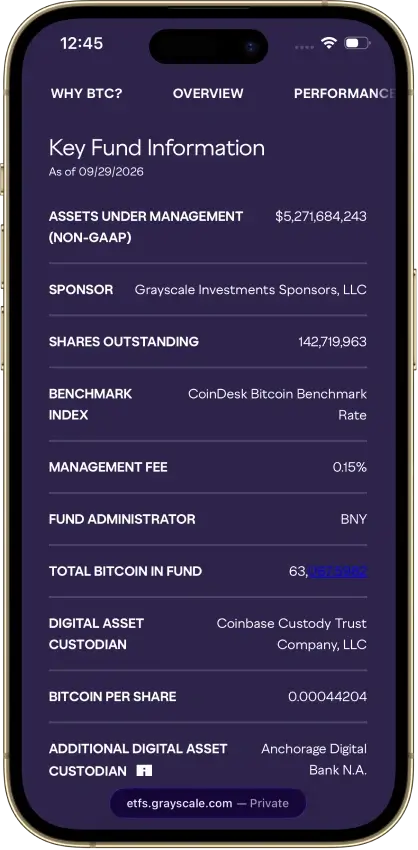
- $5.31BNon-GAAP AUM using investor NAV
- Bid/ask spread
- 0.03%30-day median
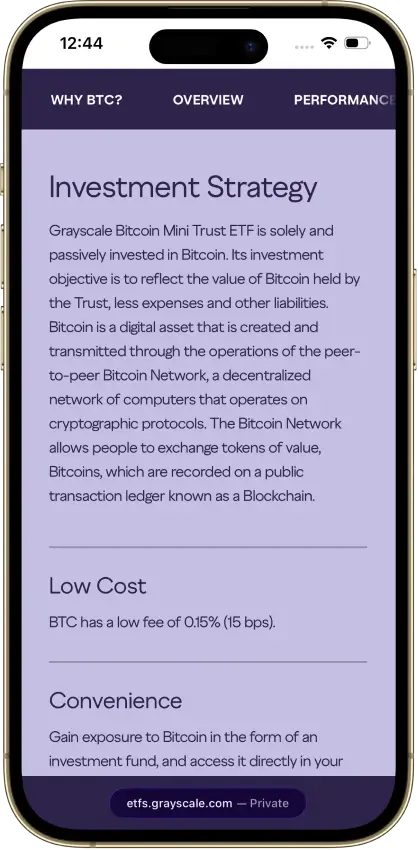
- Annual sponsor fee of 0.15%
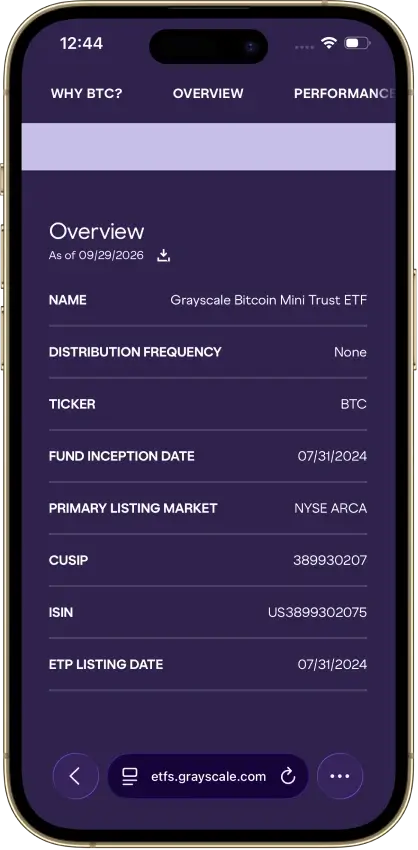
- Launched from GBTC in July 2024
- NYSE Arca share listing
Where to buy NYSEARCA: BTC
United States
 Fidelity
U.S. accounts; account eligibility and product approval requirements apply.
Listing: Primary listing (NYSE Arca: BTC).
Eligibility details for Fidelity
- Account access
- Fidelity Brokerage Services LLC; self-directed brokerage, subject to account trading permissions
- Eligibility
- U.S. accounts; account eligibility and product approval requirements apply.
- Access notes
- Buy and sell BTC ETF shares through a U.S. Fidelity brokerage account.
- Listing
- Primary listing (NYSE Arca: BTC)
 Interactive Brokers
U.S. accounts; account eligibility and product approval requirements apply.
Listing: Primary listing (NYSE Arca: BTC).
Eligibility details for Interactive Brokers
- Account access
- Interactive Brokers LLC; self-directed brokerage, subject to account trading permissions
- Eligibility
- U.S. accounts; account eligibility and product approval requirements apply.
- Access notes
- Buy and sell BTC ETF shares through a U.S. Interactive Brokers brokerage account.
- Listing
- Primary listing (NYSE Arca: BTC)
 Charles Schwab
U.S. accounts; account eligibility and product approval requirements apply.
Listing: Primary listing (NYSE Arca: BTC).
Eligibility details for Charles Schwab
- Account access
- Charles Schwab & Co., Inc.; self-directed brokerage, subject to account trading permissions
- Eligibility
- U.S. accounts; account eligibility and product approval requirements apply.
- Access notes
- Buy and sell BTC ETF shares through a U.S. Charles Schwab brokerage account.
- Listing
- Primary listing (NYSE Arca: BTC)
 Robinhood
U.S. accounts only; account eligibility and product access apply.
Listing: Primary listing (NYSE Arca: BTC — Grayscale Bitcoin Mini Trust ETF).
Eligibility details for Robinhood
- Account access
- Robinhood Financial LLC self-directed securities brokerage; confirm access in your account
- Eligibility
- U.S. accounts only; account eligibility and product access apply.
- Access notes
- Buy and sell BTC ETF shares through a U.S. Robinhood brokerage account.
- Listing
- Primary listing (NYSE Arca: BTC — Grayscale Bitcoin Mini Trust ETF)
Availability depends on country and account.
- Annual Fee
- 0.25%
- Fund assets
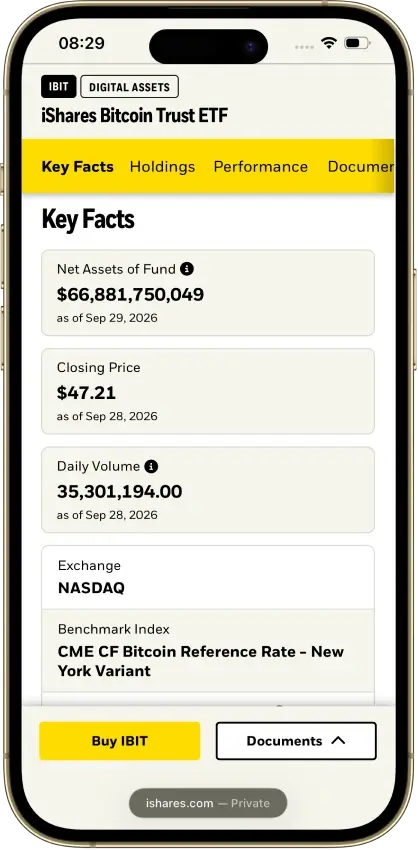
- $67.31BNet assets
- Bid/ask spread
- 0.02%30-day median
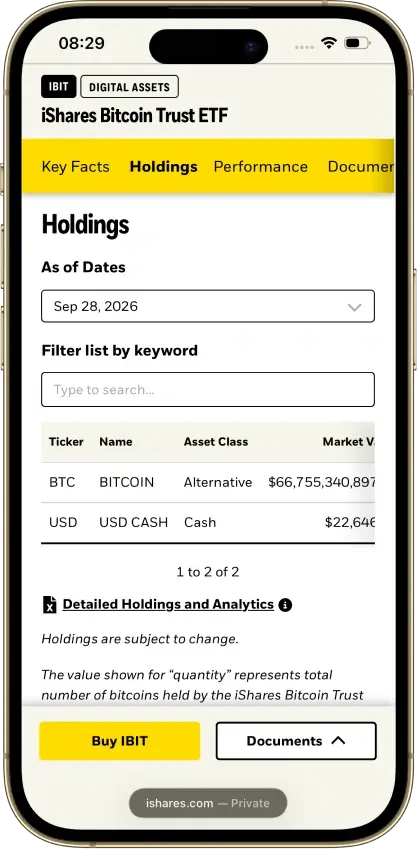
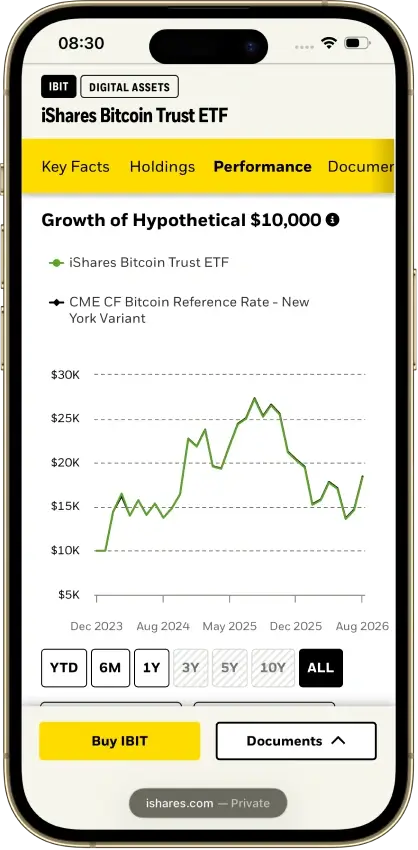
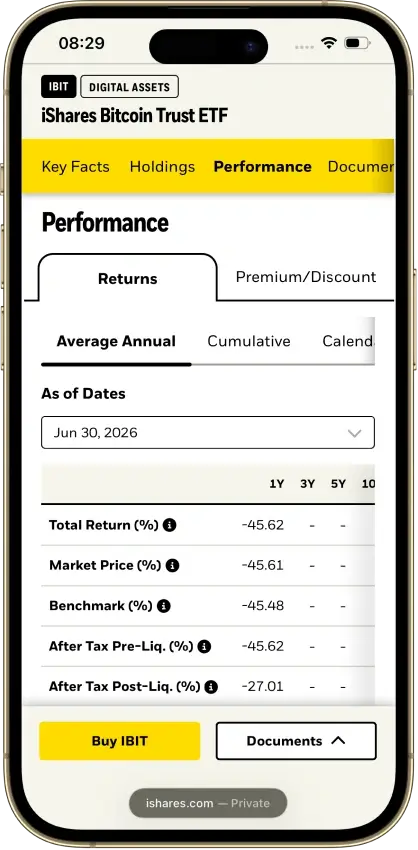
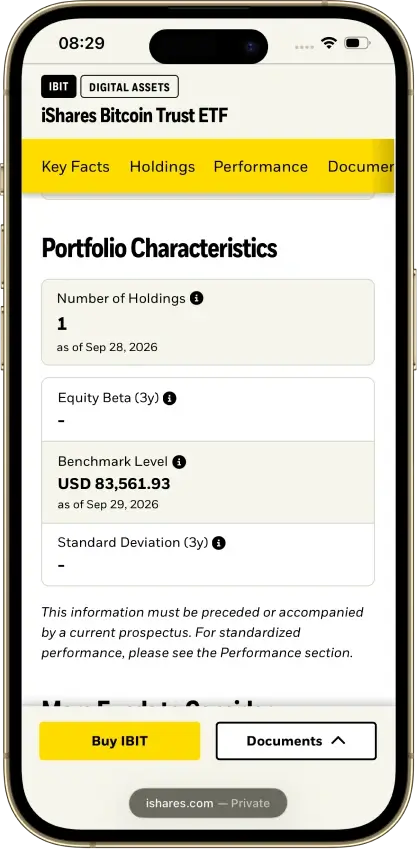
- BlackRock's iShares Bitcoin fund
- BRRNY benchmark at 4 pm New York time
- Coinbase custody, plus Anchorage appointment
Where to buy IBIT
Nasdaq: IBIT · United States
- Fidelity
U.S. accounts; account eligibility and product approval requirements apply.
Eligibility details for Fidelity
- Account access
- Fidelity Brokerage Services LLC; self-directed brokerage, subject to account trading permissions
- Eligibility
- U.S. accounts; account eligibility and product approval requirements apply.
- Access notes
- Buy and sell IBIT ETF shares through a U.S. Fidelity brokerage account.
- Robinhood
U.S. accounts only; account eligibility and product access apply.
Eligibility details for Robinhood
- Account access
- Robinhood Financial LLC self-directed securities brokerage; confirm access in your account
- Eligibility
- U.S. accounts only; account eligibility and product access apply.
- Access notes
- Buy and sell IBIT ETF shares through a U.S. Robinhood brokerage account.
 Webull
U.S. accounts; account eligibility and product approval requirements apply.
Eligibility details for Webull
- Account access
- Webull Financial LLC; self-directed brokerage, subject to account trading permissions
- Eligibility
- U.S. accounts; account eligibility and product approval requirements apply.
- Access notes
- Buy and sell IBIT ETF shares through a U.S. Webull brokerage account.
Availability depends on country and account.
- Annual Fee
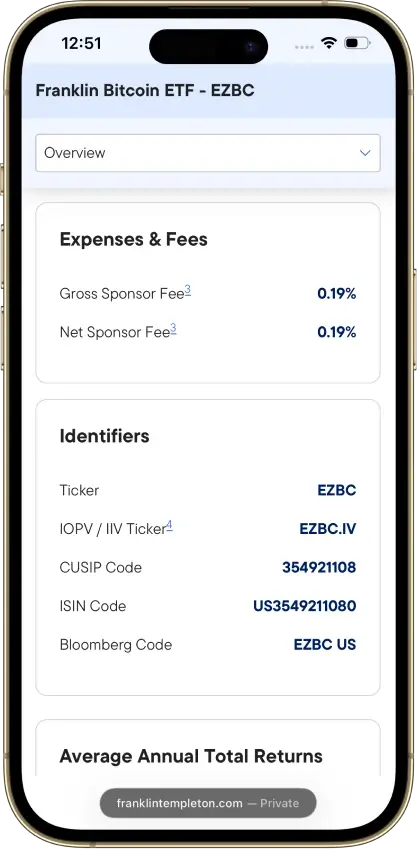
- 0.19%
- Fund assets
- $478.93MNet assets
- Bid/ask spread
- 0.05%30-day median
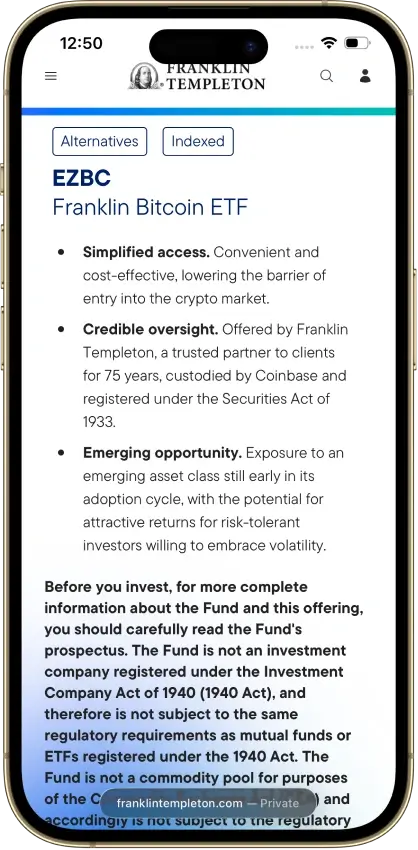
- Annual sponsor fee of 0.19%
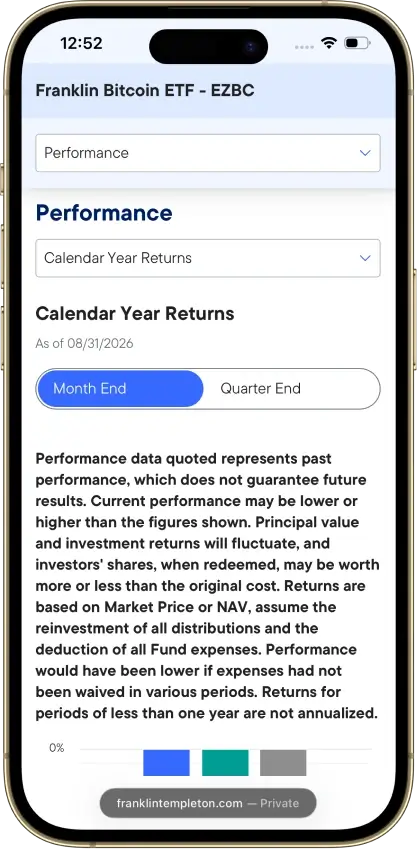
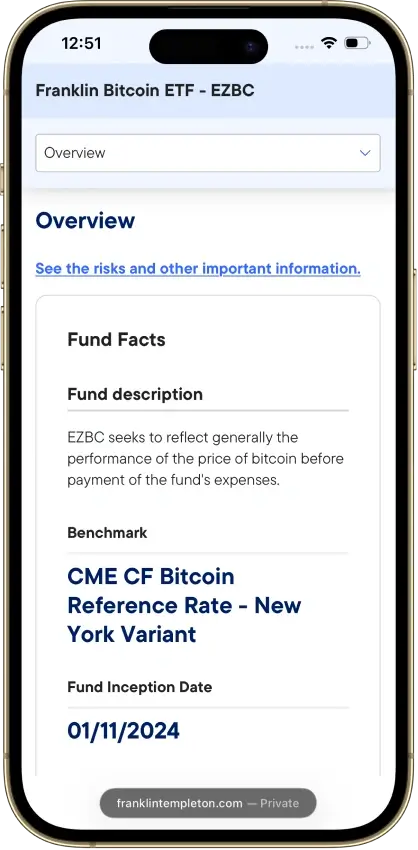
- CME CF Bitcoin pricing, New York variant
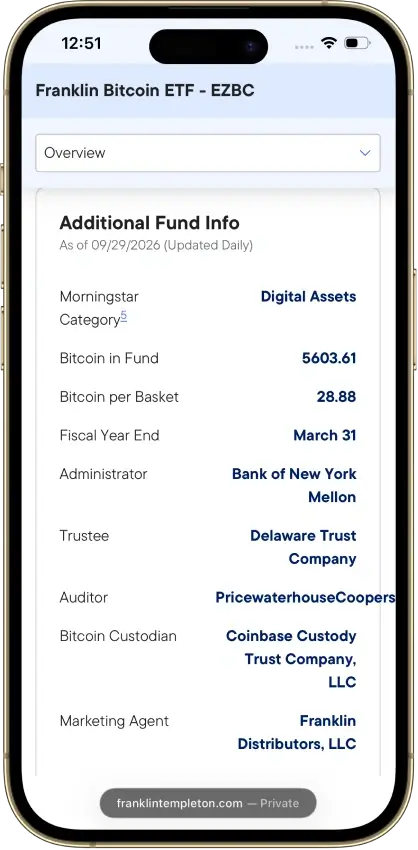
- Coinbase Custody appointment for Bitcoin
Where to buy EZBC
United States
- Robinhood
U.S. accounts only; account eligibility and product access apply.
Listing: Primary listing (Cboe BZX: EZBC).
Eligibility details for Robinhood
- Account access
- Robinhood Financial LLC self-directed securities brokerage; confirm access in your account
- Eligibility
- U.S. accounts only; account eligibility and product access apply.
- Access notes
- Buy and sell EZBC ETF shares through a U.S. Robinhood brokerage account.
- Listing
- Primary listing (Cboe BZX: EZBC)
- Webull
U.S. accounts; account eligibility and product approval requirements apply.
Listing: Primary listing (Cboe BZX Exchange: EZBC).
Eligibility details for Webull
- Account access
- Webull Financial LLC; self-directed brokerage, subject to account trading permissions
- Eligibility
- U.S. accounts; account eligibility and product approval requirements apply.
- Access notes
- Buy and sell EZBC ETF shares through a U.S. Webull brokerage account.
- Listing
- Primary listing (Cboe BZX Exchange: EZBC)
Availability depends on country and account.
- Annual Fee
- 0.2%
- Fund assets
- $3.25BNet assets
- Bid/ask spread
- 0.02%30-day median
- 0.20% annual sponsor fee
- Public Bitcoin-per-share figures
- Fund from crypto asset manager Bitwise
Where to buy BITB
NYSE Arca: BITB · United States
- Robinhood
U.S. accounts only; account eligibility and product access apply.
Eligibility details for Robinhood
- Account access
- Robinhood Financial LLC self-directed securities brokerage; confirm access in your account
- Eligibility
- U.S. accounts only; account eligibility and product access apply.
- Access notes
- Buy and sell BITB ETF shares through a U.S. Robinhood brokerage account.
- Webull
U.S. accounts; account eligibility and product approval requirements apply.
Eligibility details for Webull
- Account access
- Webull Financial LLC; self-directed brokerage, subject to account trading permissions
- Eligibility
- U.S. accounts; account eligibility and product approval requirements apply.
- Access notes
- Buy and sell BITB ETF shares through a U.S. Webull brokerage account.
Availability depends on country and account.
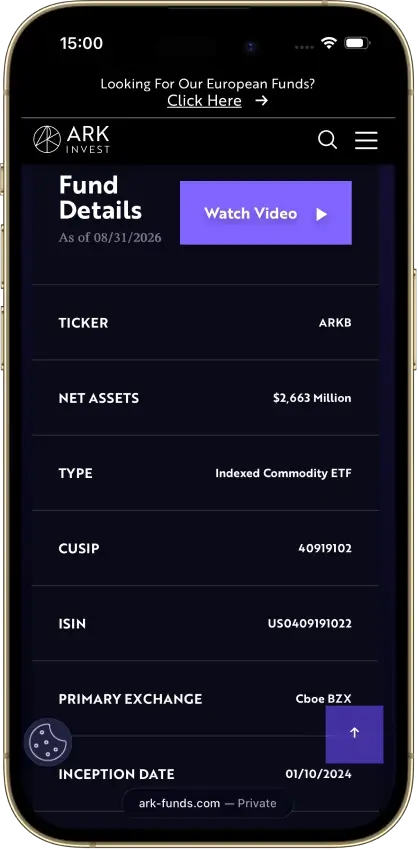
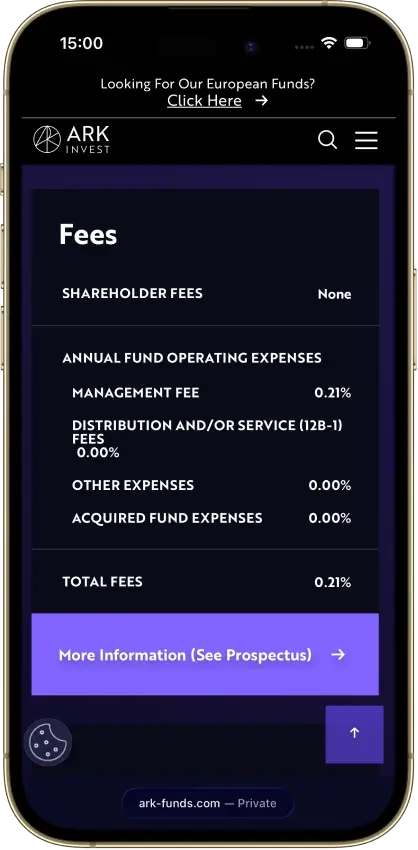
- Annual Fee
- 0.21%
- Fund assets
- $2.89BAssets under management
- Bid/ask spread
- 0.04%30-day median
- 0.21% annual sponsor rate
- FTSE Bitcoin Index pricing benchmark
- ARK and 21Shares fund partnership
Where to buy ARKB
United States
- Robinhood
U.S. accounts only; account eligibility and product access apply.
Listing: Primary listing (Cboe BZX: ARKB).
Eligibility details for Robinhood
- Account access
- Robinhood Financial LLC self-directed securities brokerage; confirm access in your account
- Eligibility
- U.S. accounts only; account eligibility and product access apply.
- Access notes
- Buy and sell ARKB ETF shares through a U.S. Robinhood brokerage account.
- Listing
- Primary listing (Cboe BZX: ARKB)
- Webull
U.S. accounts; account eligibility and product approval requirements apply.
Listing: Primary listing (Cboe BZX Exchange: ARKB).
Eligibility details for Webull
- Account access
- Webull Financial LLC; self-directed brokerage, subject to account trading permissions
- Eligibility
- U.S. accounts; account eligibility and product approval requirements apply.
- Access notes
- Buy and sell ARKB ETF shares through a U.S. Webull brokerage account.
- Listing
- Primary listing (Cboe BZX Exchange: ARKB)
Availability depends on country and account.
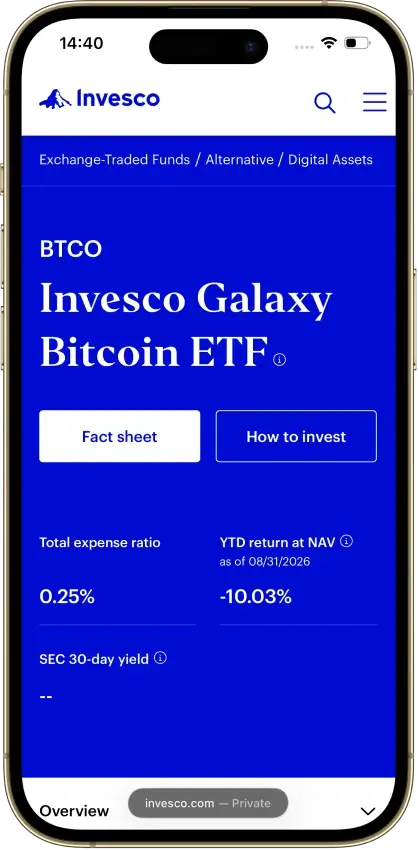
- Annual Fee
- 0.25%
- Fund assets
- $394.16MIssuer fund market value
- Bid/ask spread
- 0.06%30-day median
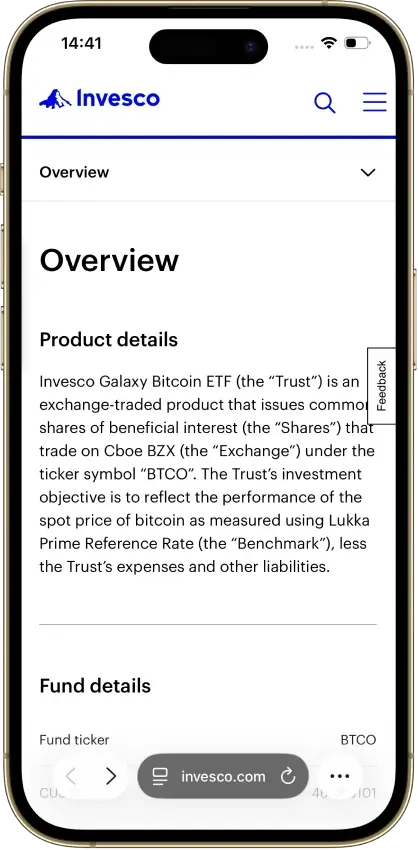
- Invesco and Galaxy fund partnership
- Lukka principal-market Bitcoin pricing
- Coinbase appointed for Bitcoin custody
Where to buy BTCO
United States
- Robinhood
U.S. accounts only; account eligibility and product access apply.
Listing: Primary listing (Cboe BZX: BTCO).
Eligibility details for Robinhood
- Account access
- Robinhood Financial LLC self-directed securities brokerage; confirm access in your account
- Eligibility
- U.S. accounts only; account eligibility and product access apply.
- Access notes
- Buy and sell BTCO ETF shares through a U.S. Robinhood brokerage account.
- Listing
- Primary listing (Cboe BZX: BTCO)
- Webull
U.S. accounts; account eligibility and product approval requirements apply.
Listing: Primary listing (Cboe BZX Exchange: BTCO).
Eligibility details for Webull
- Account access
- Webull Financial LLC; self-directed brokerage, subject to account trading permissions
- Eligibility
- U.S. accounts; account eligibility and product approval requirements apply.
- Access notes
- Buy and sell BTCO ETF shares through a U.S. Webull brokerage account.
- Listing
- Primary listing (Cboe BZX Exchange: BTCO)
Availability depends on country and account.
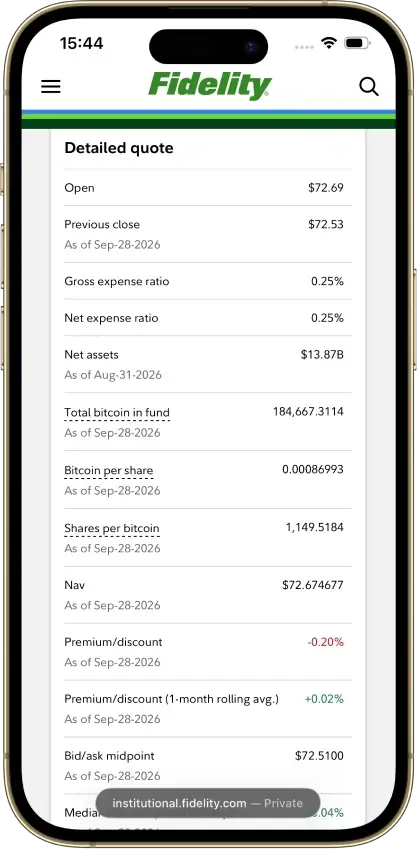
- Annual Fee
- 0.25%
- Fund assets
- $13.87BMonth-end net assets (approximate)
- Bid/ask spread
- 0.04%30-day median
- Fidelity affiliate appointed as custodian
- Fidelity Bitcoin Reference Rate benchmark
- BitGo appointed as an additional custodian
Where to buy FBTC
Cboe BZX Exchange: FBTC · United States
- Fidelity
U.S. accounts; account eligibility and product approval requirements apply.
Eligibility details for Fidelity
- Account access
- Fidelity Brokerage Services LLC; self-directed brokerage, subject to account trading permissions
- Eligibility
- U.S. accounts; account eligibility and product approval requirements apply.
- Access notes
- Buy and sell FBTC ETF shares through a U.S. Fidelity brokerage account.
- Robinhood
U.S. accounts only; account eligibility and product access apply.
Eligibility details for Robinhood
- Account access
- Robinhood Financial LLC self-directed securities brokerage; confirm access in your account
- Eligibility
- U.S. accounts only; account eligibility and product access apply.
- Access notes
- Buy and sell FBTC ETF shares through a U.S. Robinhood brokerage account.
- Webull
U.S. accounts; account eligibility and product approval requirements apply.
Eligibility details for Webull
- Account access
- Webull Financial LLC; self-directed brokerage, subject to account trading permissions
- Eligibility
- U.S. accounts; account eligibility and product approval requirements apply.
- Access notes
- Buy and sell FBTC ETF shares through a U.S. Webull brokerage account.
Availability depends on country and account.
- Annual Fee
- 0.14%
- Fund assets
- $606.37MTotal net assets
- Bid/ask spread
- 0.05%30-day median
- 0.14% annual delegated sponsor fee
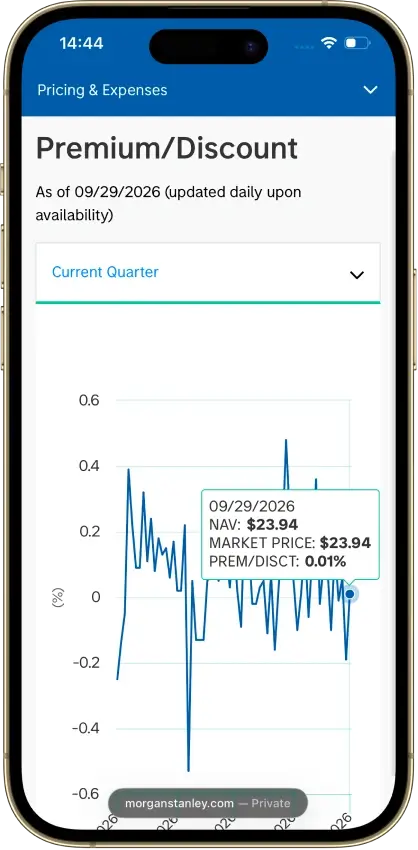
- Morgan Stanley fund on NYSE Arca
- CoinDesk 4PM New York benchmark
Where to buy MSBT
NYSE Arca: MSBT · United States
- Robinhood
U.S. accounts only; account eligibility and product access apply.
Eligibility details for Robinhood
- Account access
- Robinhood Financial LLC self-directed securities brokerage; confirm access in your account
- Eligibility
- U.S. accounts only; account eligibility and product access apply.
- Access notes
- Buy and sell MSBT ETF shares through a U.S. Robinhood brokerage account.
- Webull
U.S. accounts; account eligibility and product approval requirements apply.
Eligibility details for Webull
- Account access
- Webull Financial LLC; self-directed brokerage, subject to account trading permissions
- Eligibility
- U.S. accounts; account eligibility and product approval requirements apply.
- Access notes
- Buy and sell MSBT ETF shares through a U.S. Webull brokerage account.
Availability depends on country and account.
- Annual Fee
- 0.2%
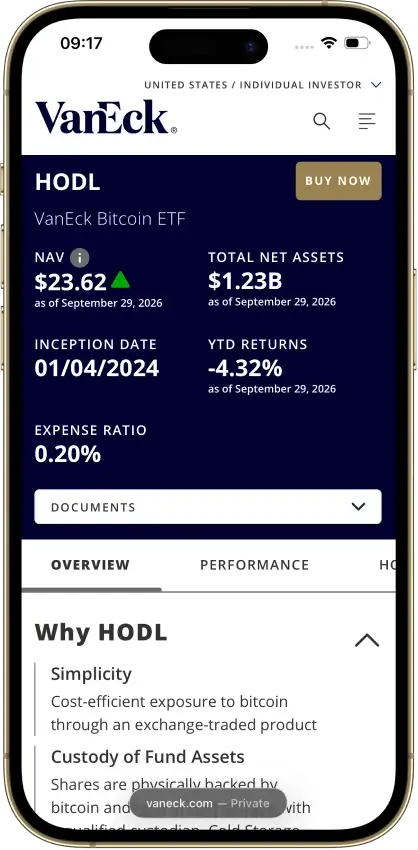
- Fund assets
- $1.24BNet assets, ETF Statistics table
- Bid/ask spread
- 0.09%30-day median
- Current annual sponsor rate of 0.20%
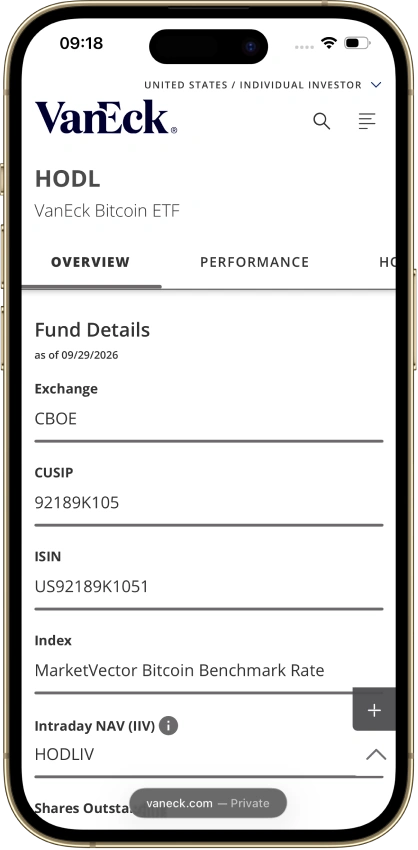
- MarketVector Bitcoin Benchmark Rate
- Gemini and Coinbase custody appointments
Where to buy HODL
United States
- Robinhood
U.S. accounts only; account eligibility and product access apply.
Listing: Primary listing (Cboe BZX: HODL).
Eligibility details for Robinhood
- Account access
- Robinhood Financial LLC self-directed securities brokerage; confirm access in your account
- Eligibility
- U.S. accounts only; account eligibility and product access apply.
- Access notes
- Buy and sell HODL ETF shares through a U.S. Robinhood brokerage account.
- Listing
- Primary listing (Cboe BZX: HODL)
- Webull
U.S. accounts; account eligibility and product approval requirements apply.
Listing: Primary listing (Cboe BZX Exchange: HODL).
Eligibility details for Webull
- Account access
- Webull Financial LLC; self-directed brokerage, subject to account trading permissions
- Eligibility
- U.S. accounts; account eligibility and product approval requirements apply.
- Access notes
- Buy and sell HODL ETF shares through a U.S. Webull brokerage account.
- Listing
- Primary listing (Cboe BZX Exchange: HODL)
Availability depends on country and account.
- Annual Fee
- 0.25%
- Fund assets
- $493.08MAUM in dated Product Information table
- Bid/ask spread
- 0.05%30-day median
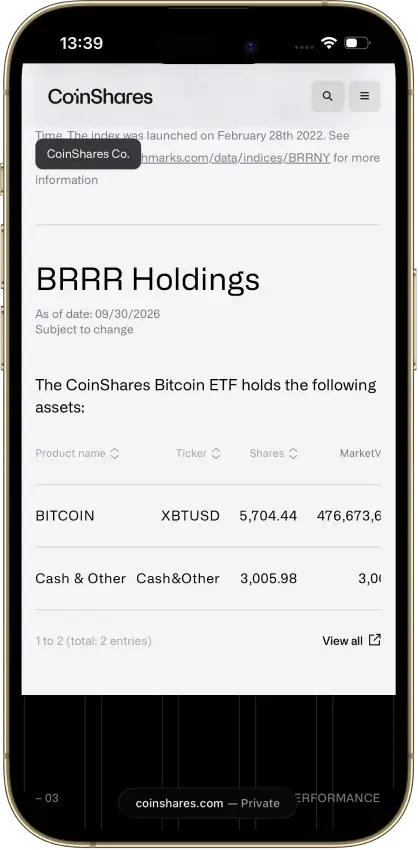
- Annual sponsor fee of 0.25%
- Nasdaq-listed spot Bitcoin trust
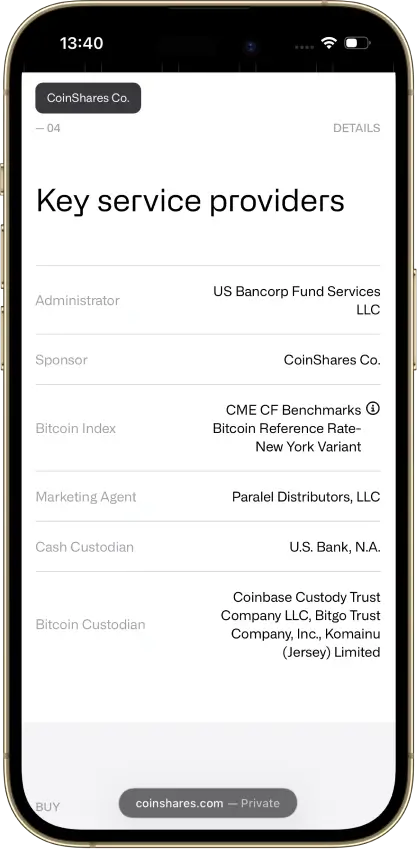
- Coinbase, BitGo and Komainu custody roles
Where to buy BRRR
Nasdaq: BRRR · United States
- Fidelity
U.S. accounts; account eligibility and product approval requirements apply.
Eligibility details for Fidelity
- Account access
- Fidelity Brokerage Services LLC; self-directed brokerage, subject to account trading permissions
- Eligibility
- U.S. accounts; account eligibility and product approval requirements apply.
- Access notes
- Buy and sell BRRR ETF shares through a U.S. Fidelity brokerage account.
- Interactive Brokers
U.S. accounts; account eligibility and product approval requirements apply.
Eligibility details for Interactive Brokers
- Account access
- Interactive Brokers LLC; self-directed brokerage, subject to account trading permissions
- Eligibility
- U.S. accounts; account eligibility and product approval requirements apply.
- Access notes
- Buy and sell BRRR ETF shares through a U.S. Interactive Brokers brokerage account.
- Charles Schwab
U.S. accounts; account eligibility and product approval requirements apply.
Eligibility details for Charles Schwab
- Account access
- Charles Schwab & Co., Inc.; self-directed brokerage, subject to account trading permissions
- Eligibility
- U.S. accounts; account eligibility and product approval requirements apply.
- Access notes
- Buy and sell BRRR ETF shares through a U.S. Charles Schwab brokerage account.
- Robinhood
U.S. accounts only; account eligibility and product access apply.
Eligibility details for Robinhood
- Account access
- Robinhood Financial LLC self-directed securities brokerage; confirm access in your account
- Eligibility
- U.S. accounts only; account eligibility and product access apply.
- Access notes
- Buy and sell BRRR ETF shares through a U.S. Robinhood brokerage account.
- Webull
U.S. accounts; account eligibility and product approval requirements apply.
Eligibility details for Webull
- Account access
- Webull Financial LLC; self-directed brokerage, subject to account trading permissions
- Eligibility
- U.S. accounts; account eligibility and product approval requirements apply.
- Access notes
- Buy and sell BRRR ETF shares through a U.S. Webull brokerage account.
Availability depends on country and account.
- Annual Fee
- 0.25%
- Fund assets
- $177.6MTotal assets (gross)
- Bid/ask spread
- 0.06%30-day median
- 0.25% annual sponsor fee
- Cboe BZX listing since January 2024
- CME CF New York reference rate
Where to buy BTCW
United States
- Robinhood
U.S. accounts only; account eligibility and product access apply.
Listing: Primary listing (Cboe BZX: BTCW).
Eligibility details for Robinhood
- Account access
- Robinhood Financial LLC self-directed securities brokerage; confirm access in your account
- Eligibility
- U.S. accounts only; account eligibility and product access apply.
- Access notes
- Buy and sell BTCW ETF shares through a U.S. Robinhood brokerage account.
- Listing
- Primary listing (Cboe BZX: BTCW)
- Webull
U.S. accounts; account eligibility and product approval requirements apply.
Listing: Primary listing (Cboe BZX Exchange: BTCW).
Eligibility details for Webull
- Account access
- Webull Financial LLC; self-directed brokerage, subject to account trading permissions
- Eligibility
- U.S. accounts; account eligibility and product approval requirements apply.
- Access notes
- Buy and sell BTCW ETF shares through a U.S. Webull brokerage account.
- Listing
- Primary listing (Cboe BZX Exchange: BTCW)
Availability depends on country and account.
- Annual Fee
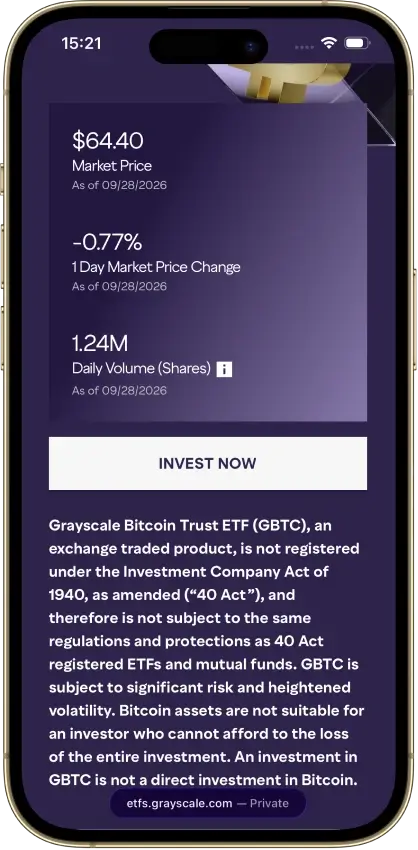
- 1.5%
- Fund assets
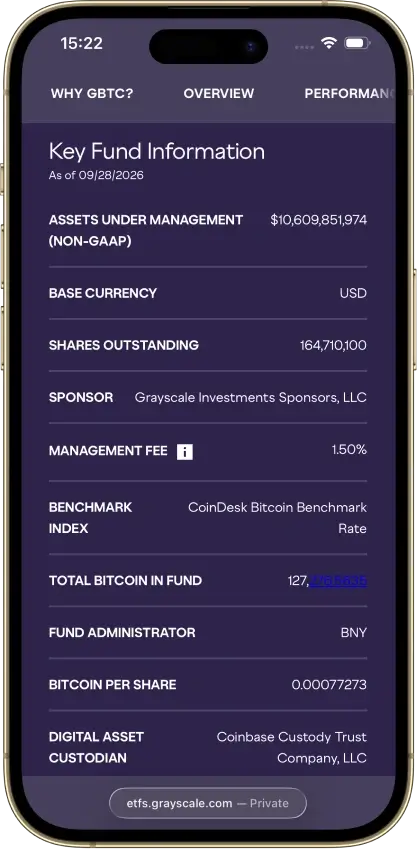
- $10.74BNon-GAAP AUM using investor NAV
- Bid/ask spread
- 0.02%30-day median
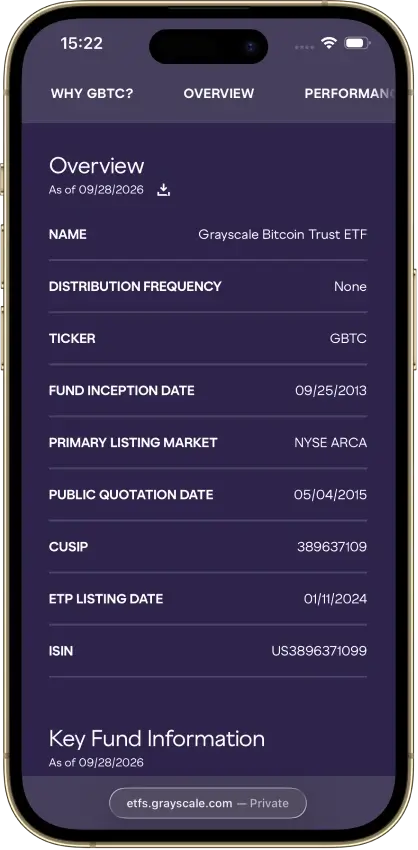
- Bitcoin trust operating since 2013
- NYSE Arca-listed Bitcoin exposure
- CoinDesk Bitcoin Benchmark Rate pricing
Where to buy GBTC
NYSE Arca: GBTC · United States
- Fidelity
U.S. accounts; account eligibility and product approval requirements apply.
Eligibility details for Fidelity
- Account access
- Fidelity Brokerage Services LLC; self-directed brokerage, subject to account trading permissions
- Eligibility
- U.S. accounts; account eligibility and product approval requirements apply.
- Access notes
- Buy and sell GBTC ETF shares through a U.S. Fidelity brokerage account.
- Interactive Brokers
U.S. accounts; account eligibility and product approval requirements apply.
Eligibility details for Interactive Brokers
- Account access
- Interactive Brokers LLC; self-directed brokerage, subject to account trading permissions
- Eligibility
- U.S. accounts; account eligibility and product approval requirements apply.
- Access notes
- Buy and sell GBTC ETF shares through a U.S. Interactive Brokers brokerage account.
- Charles Schwab
U.S. accounts; account eligibility and product approval requirements apply.
Eligibility details for Charles Schwab
- Account access
- Charles Schwab & Co., Inc.; self-directed brokerage, subject to account trading permissions
- Eligibility
- U.S. accounts; account eligibility and product approval requirements apply.
- Access notes
- Buy and sell GBTC ETF shares through a U.S. Charles Schwab brokerage account.
- Robinhood
U.S. accounts only; account eligibility and product access apply.
Eligibility details for Robinhood
- Account access
- Robinhood Financial LLC self-directed securities brokerage; confirm access in your account
- Eligibility
- U.S. accounts only; account eligibility and product access apply.
- Access notes
- Buy and sell GBTC ETF shares through a U.S. Robinhood brokerage account.
- Webull
U.S. accounts; account eligibility and product approval requirements apply.
Eligibility details for Webull
- Account access
- Webull Financial LLC; self-directed brokerage, subject to account trading permissions
- Eligibility
- U.S. accounts; account eligibility and product approval requirements apply.
- Access notes
- Buy and sell GBTC ETF shares through a U.S. Webull brokerage account.
Availability depends on country and account.
- Annual Fee
- 0.49%
- Fund assets
- $78.99MIssuer-listed Fund Assets
- Bid/ask spread
- 0.43%30-day median
- Nasdaq ETF conversion in December 2025
- 0.49% annual management fee
- CME CF New York reference rate
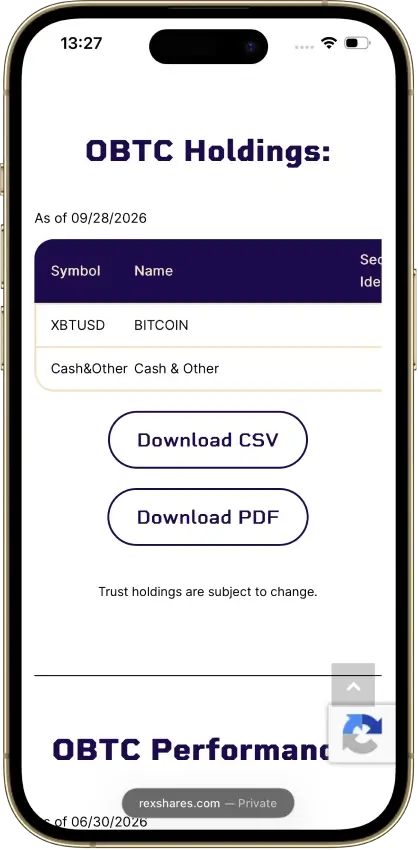
Where to buy OBTC
Nasdaq: OBTC · United States
- Fidelity
U.S. accounts; account eligibility and product approval requirements apply.
Eligibility details for Fidelity
- Account access
- Fidelity Brokerage Services LLC; self-directed brokerage, subject to account trading permissions
- Eligibility
- U.S. accounts; account eligibility and product approval requirements apply.
- Access notes
- Buy and sell OBTC ETF shares through a U.S. Fidelity brokerage account.
- Robinhood
U.S. accounts only; account eligibility and product access apply.
Eligibility details for Robinhood
- Account access
- Robinhood Financial LLC self-directed securities brokerage; confirm access in your account
- Eligibility
- U.S. accounts only; account eligibility and product access apply.
- Access notes
- Buy and sell OBTC ETF shares through a U.S. Robinhood brokerage account.
Availability depends on country and account.
CryptoSlate may earn a commission when you visit partner sites through links on this page, at no extra cost to you. Our rankings and reviews remain editorially independent and based on our published methodology. Read disclosure
Disclaimer: CryptoSlate may receive a commission when you click links on our site and make a purchase or complete an action with a third party. This does not influence our editorial independence, reviews, or ratings, and we always aim to provide accurate, transparent information to our readers.The table shows stated annual charges before any applicable temporary waiver or asset-threshold concession. Sponsor, delegated sponsor and management fee labels come from each fund's documents, and the expenses covered can differ. Trading costs and expenses outside the stated fee are additional. Check current terms before comparing the amount you would pay.
A few basis points can amount to a small dollar difference on a modest position, while the cost of entering or replacing that position arises when the trade occurs. Compare the annual charge over the expected holding period with transaction costs before treating a lower rate as a complete cost advantage.
Bitcoin ETF Comparison Table
| Fund | Ticker | Issuer | Annual Fee (%) | Exchange |
|---|---|---|---|---|
 Grayscale Bitcoin Mini Trust ETF Grayscale Bitcoin Mini Trust ETF | NYSEARCA: BTC | Grayscale | 0.15 | NYSE Arca |
 iShares Bitcoin Trust iShares Bitcoin Trust | IBIT | BlackRock / iShares | 0.25 | Nasdaq |
 Franklin Bitcoin ETF Franklin Bitcoin ETF | EZBC | Franklin Templeton | 0.19 | Cboe BZX |
 Bitwise Bitcoin ETF Bitwise Bitcoin ETF | BITB | Bitwise | 0.20 | NYSE Arca |
 ARK 21Shares Bitcoin ETF ARK 21Shares Bitcoin ETF | ARKB | ARK / 21Shares | 0.21 | Cboe BZX |
 Invesco Galaxy Bitcoin ETF Invesco Galaxy Bitcoin ETF | BTCO | Invesco / Galaxy | 0.25 | Cboe BZX |
 Fidelity Wise Origin Bitcoin Fund Fidelity Wise Origin Bitcoin Fund | FBTC | Fidelity Investments / FD Funds Management LLC | 0.25 | Cboe BZX Exchange |
 Morgan Stanley Bitcoin Trust Morgan Stanley Bitcoin Trust | MSBT | Morgan Stanley | 0.14 | NYSE Arca |
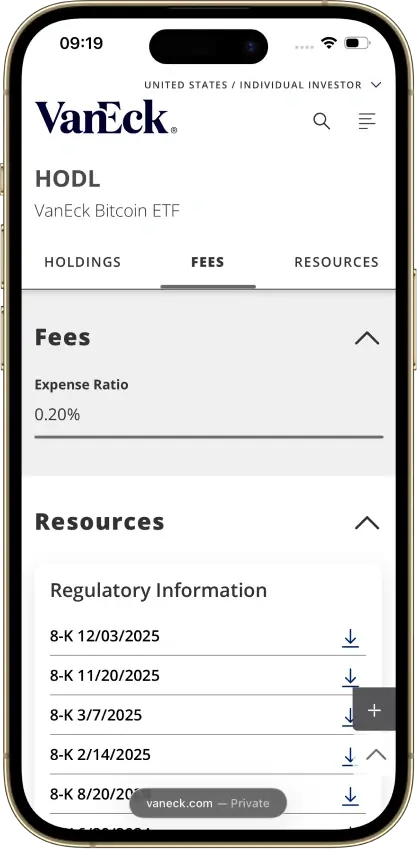
 VanEck Bitcoin Trust VanEck Bitcoin Trust | HODL | VanEck | 0.20 | Cboe BZX |
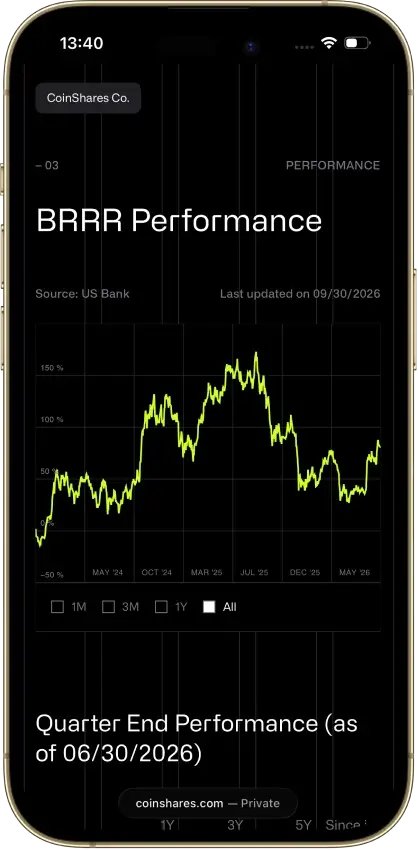
 CoinShares Bitcoin ETF CoinShares Bitcoin ETF | BRRR | CoinShares | 0.25 | Nasdaq |
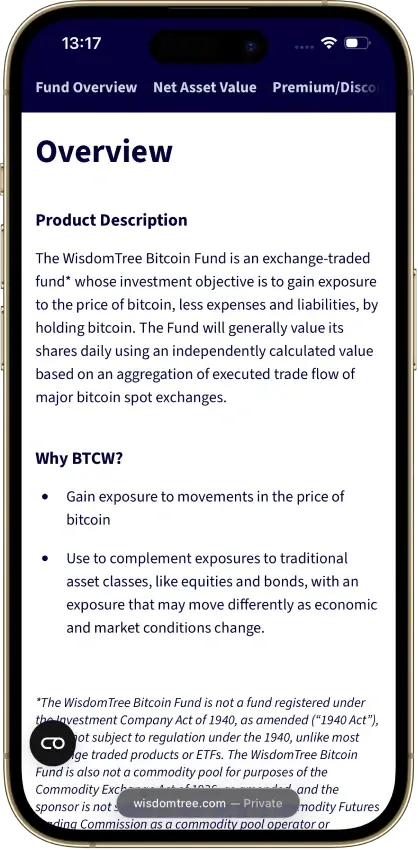
 WisdomTree Bitcoin Fund WisdomTree Bitcoin Fund | BTCW | WisdomTree | 0.25 | Cboe BZX |
 Grayscale Bitcoin Trust Grayscale Bitcoin Trust | GBTC | Grayscale | 1.50 | NYSE Arca |
 Osprey Bitcoin Trust Osprey Bitcoin Trust | OBTC | Osprey Funds | 0.49 | Nasdaq |
Custody names use short provider labels. Primary, additional and affiliated roles follow the fund disclosures. Appointments do not show how Bitcoin is allocated between providers.
A benchmark supplies a valuation reference, while a shareholder trades at the price available in the brokerage account. Custodian appointments describe who is authorized to perform a role. Neither a familiar benchmark name nor a longer provider list establishes better tracking or safer storage on its own. Each card includes benefits that may also be available from other funds.
Bitcoin ETFs Reviews
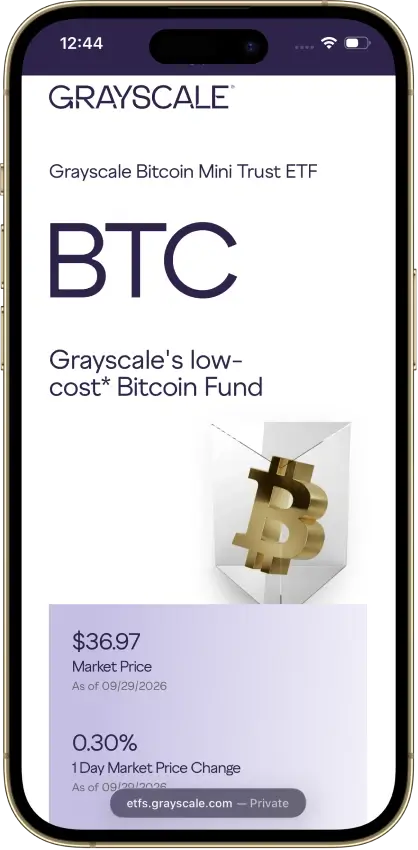
Grayscale Bitcoin Mini Trust ETF
- Annual Fee
- 0.15%
- Fund assets
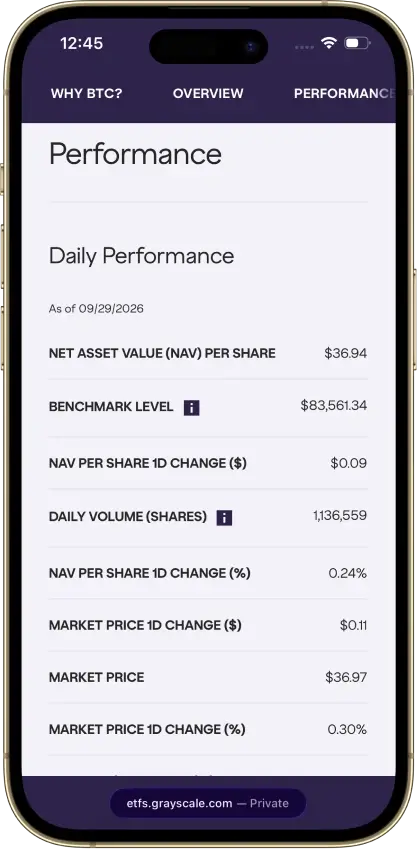
- $5.31BNon-GAAP AUM using investor NAV
- Bid/ask spread
- 0.03%30-day median
Pros
- Lower annual rate than IBIT and GBTC
- Coin custody arranged by the trust
- Monitor Bitcoin alongside brokerage assets
Cons
- Bitcoin losses can dwarf the fee saving
- Holding shares gives no access to fund wallets
- Trading costs come on top of the annual fee

iShares Bitcoin Trust
- Annual Fee
- 0.25%
- Fund assets
- $67.31BNet assets
- Bid/ask spread
- 0.02%30-day median
Pros
- Bitcoin exposure in a brokerage account
- No personal wallet or private keys to manage
- Bitcoin backing instead of futures contracts
Cons
- 0.25% annual sponsor fee
- No Bitcoin withdrawals to your wallet
- Share price can differ from asset value
Franklin Bitcoin ETF
- Annual Fee
- 0.19%
- Fund assets
- $478.93MNet assets
- Bid/ask spread
- 0.05%30-day median
Pros
- Lower sponsor rate than BITB
- No private keys for shareholders to manage
- Buy through an eligible brokerage account
Cons
- Higher sponsor rate than Grayscale BTC
- Bitcoin volatility can cause large losses
- Shares cannot fund a personal Bitcoin wallet
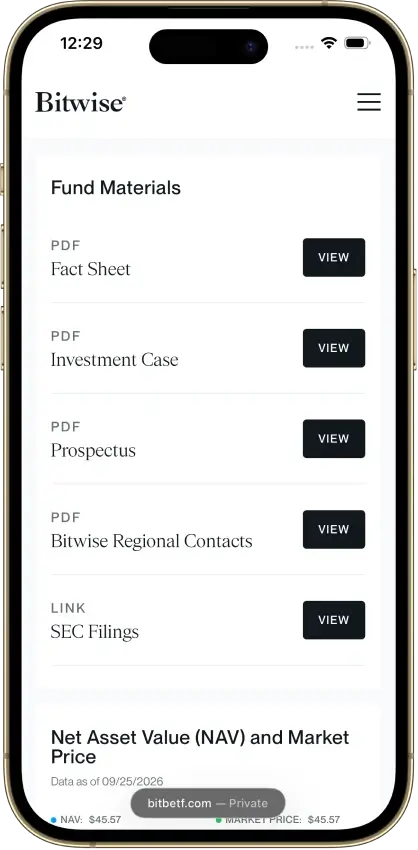
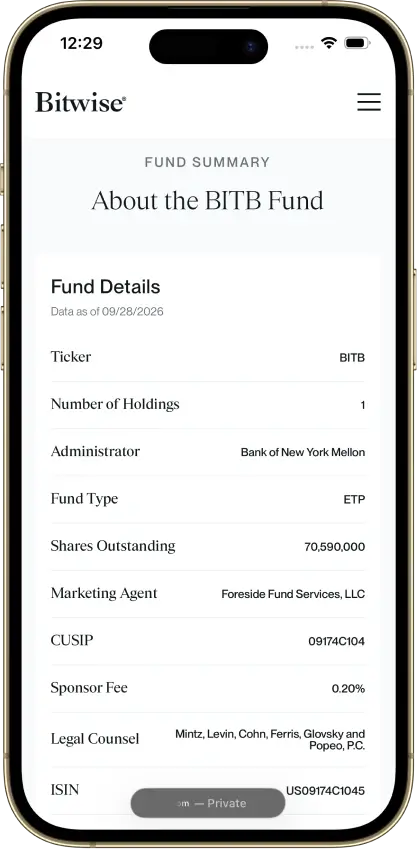
Bitwise Bitcoin ETF
- Annual Fee
- 0.2%
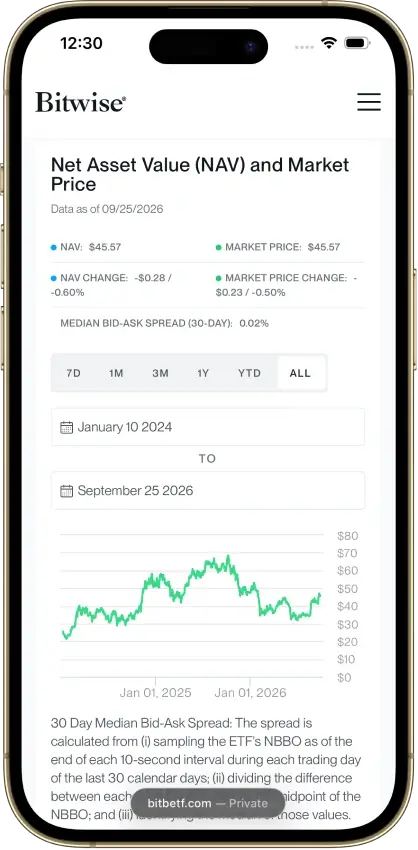
- Fund assets
- $3.25BNet assets
- Bid/ask spread
- 0.02%30-day median
Pros
- Lower sponsor rate than IBIT and FBTC
- See the Bitcoin amount behind each share
- Custodian manages the fund’s Bitcoin keys
Cons
- Annual charge erodes the Bitcoin per share
- No retail redemption into a Bitcoin wallet
- Holdings disclosures do not prevent losses
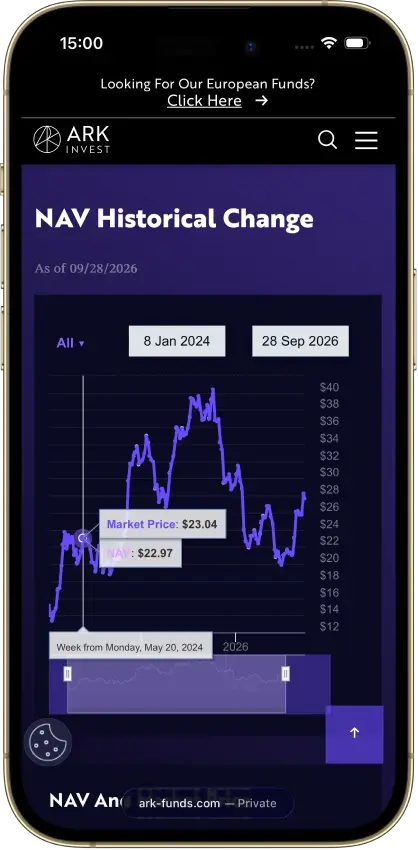
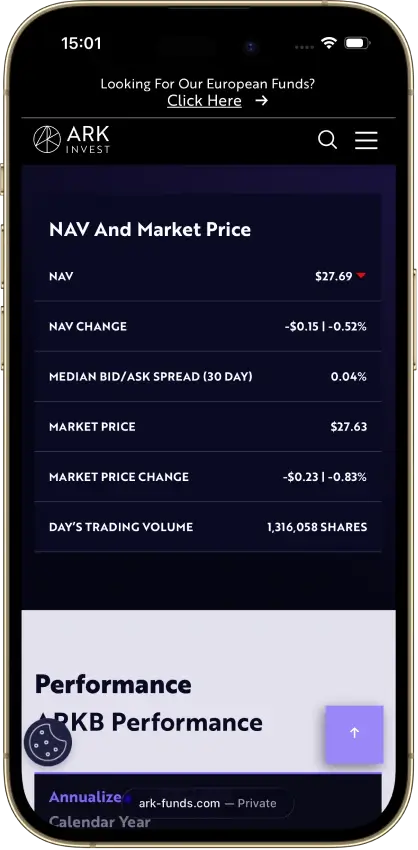
ARK 21Shares Bitcoin ETF
- Annual Fee
- 0.21%
- Fund assets
- $2.89BAssets under management
- Bid/ask spread
- 0.04%30-day median
Pros
- Lower annual sponsor rate than IBIT
- Hold Bitcoin exposure in a brokerage account
- Custody arrangements identified in filings
Cons
- Costs reduce the Bitcoin backing each share
- Retail shareholders cannot withdraw coins
- Older tracking data uses a different index
Invesco Galaxy Bitcoin ETF
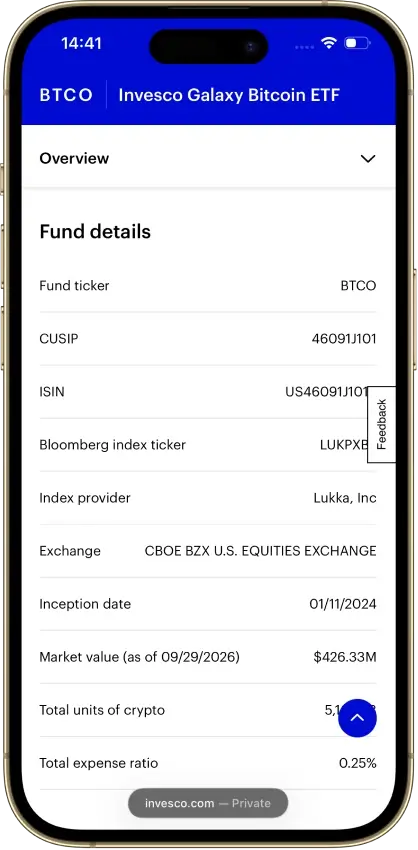
- Annual Fee
- 0.25%
- Fund assets
- $394.16MIssuer fund market value
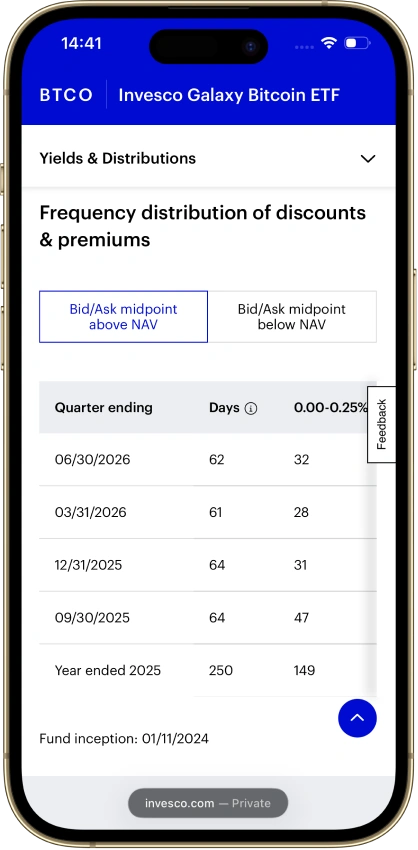
- Bid/ask spread
- 0.06%30-day median
Pros
- Hold Bitcoin exposure in a securities account
- Fund arranges third-party Bitcoin custody
- Bitcoin backing avoids a futures strategy
Cons
- Sponsor charge reduces returns over time
- Shares cannot be exchanged for personal coins
- Brokerage availability depends on the account
Fidelity Wise Origin Bitcoin Fund
- Annual Fee
- 0.25%
- Fund assets
- $13.87BMonth-end net assets (approximate)
- Bid/ask spread
- 0.04%30-day median
Pros
- Buy alongside other brokerage holdings
- No Bitcoin keys to store yourself
- Direct Bitcoin backing, without futures
Cons
- Annual fee continues while shares are held
- No Bitcoin withdrawals to a personal wallet
- Market price may differ from fund value
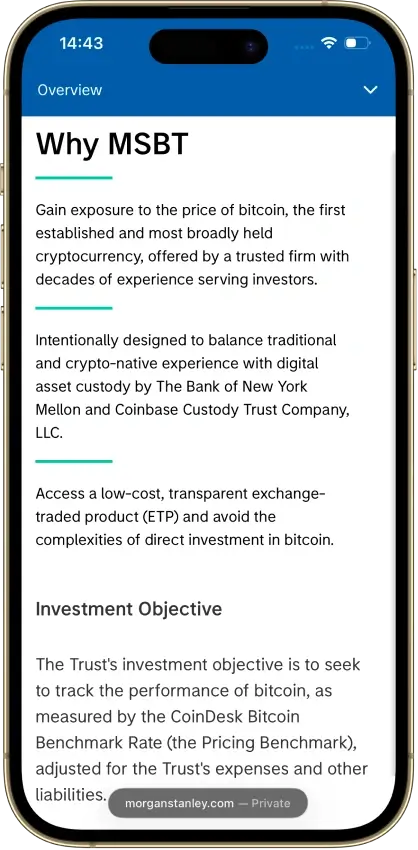
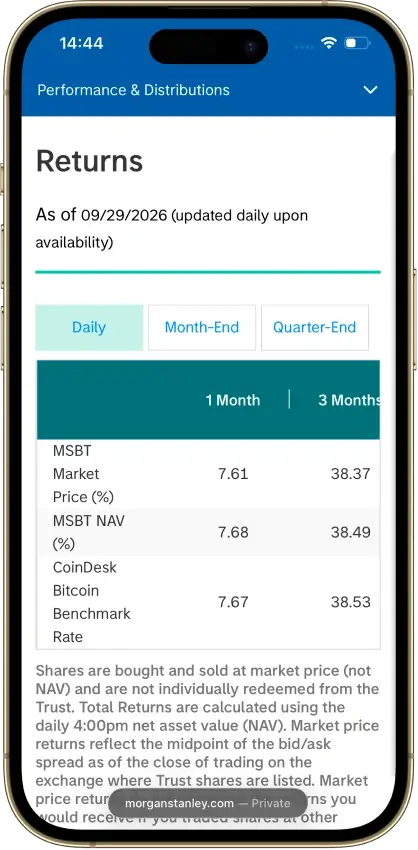
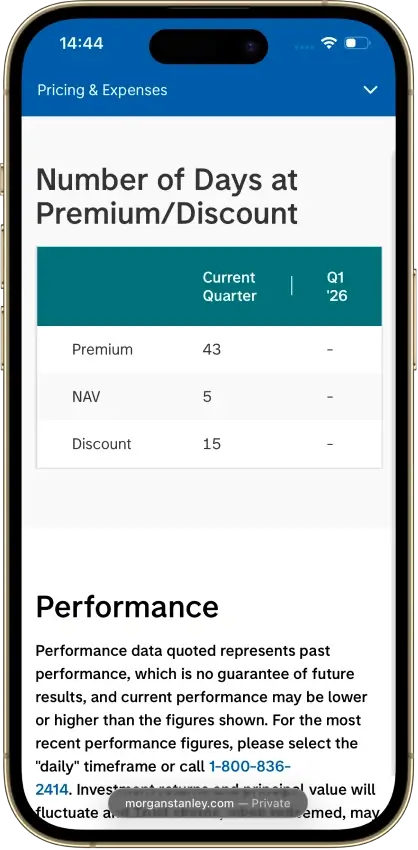
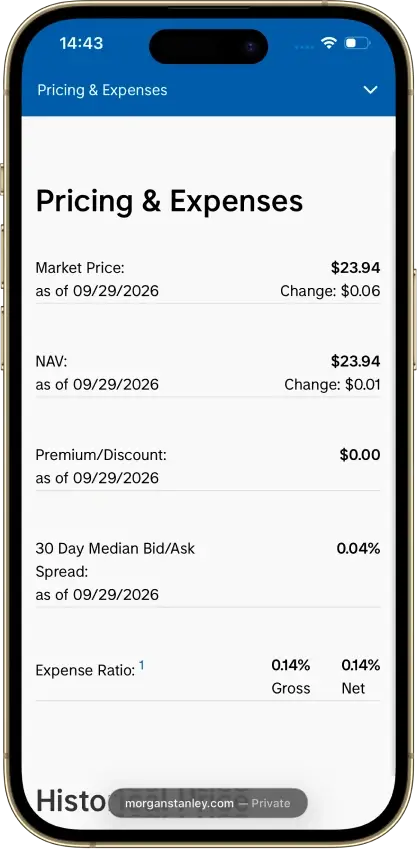
Morgan Stanley Bitcoin Trust
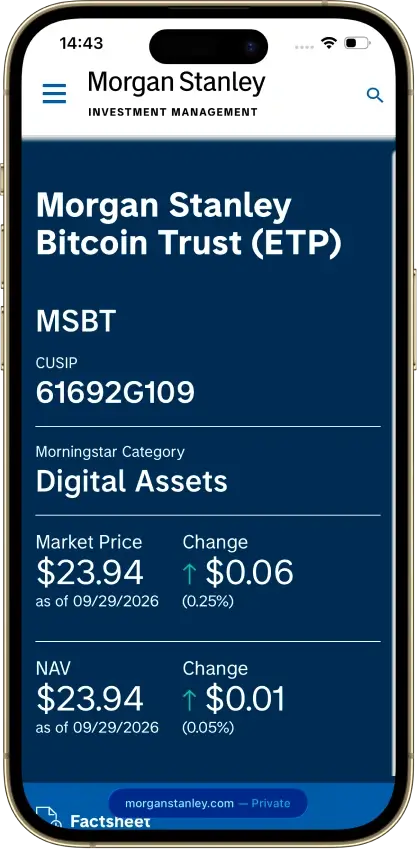
- Annual Fee
- 0.14%
- Fund assets
- $606.37MTotal net assets
- Bid/ask spread
- 0.05%30-day median
Pros
- Lower headline fee than IBIT and Grayscale Mini
- No personal private-key storage required
- Public fund filings and valuation reports
Cons
- Exchange trading record begins in April 2026
- No bank guarantee against investment losses
- Retail shares cannot deliver Bitcoin
VanEck Bitcoin Trust
- Annual Fee
- 0.2%
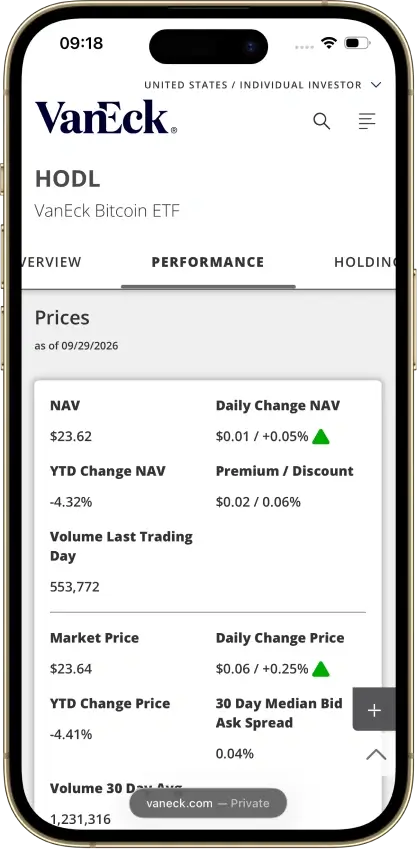
- Fund assets
- $1.24BNet assets, ETF Statistics table
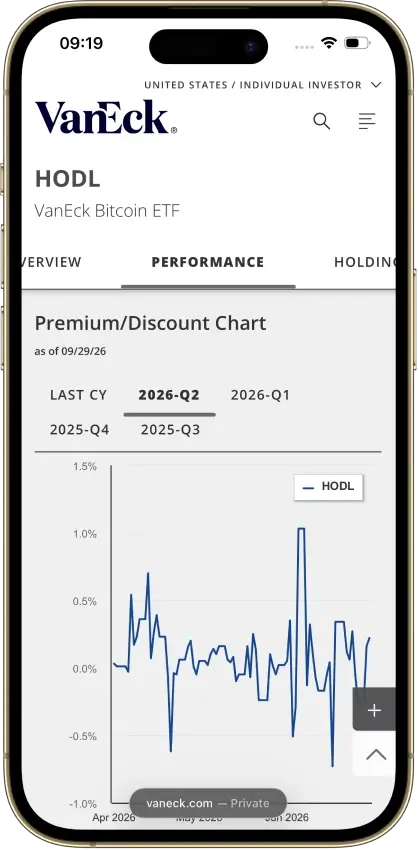
- Bid/ask spread
- 0.09%30-day median
Pros
- Annual sponsor rate below IBIT’s
- Trust’s Bitcoin held by appointed custodians
- Trade shares through a brokerage account
Cons
- Standard sponsor charges now apply
- Fund costs reduce Bitcoin backing per share
- Investors cannot move the underlying coins
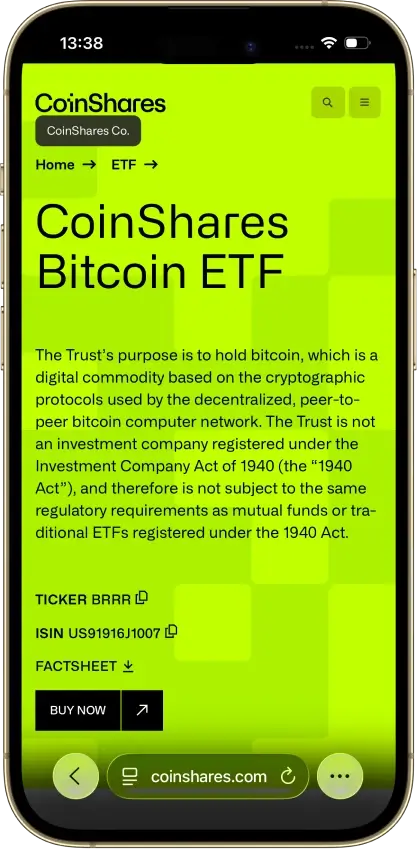
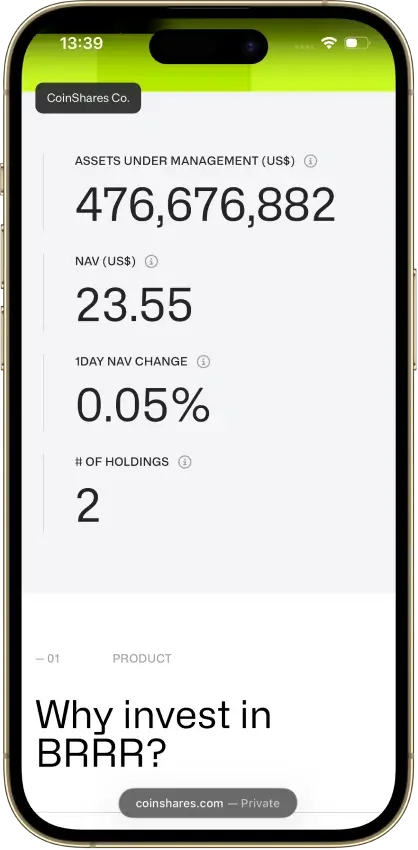
CoinShares Bitcoin ETF
- Annual Fee
- 0.25%
- Fund assets
- $493.08MAUM in dated Product Information table
- Bid/ask spread
- 0.05%30-day median
Pros
- Bitcoin held by the fund
- No private-key management for shareholders
- Trade through an eligible brokerage account
Cons
- Higher sponsor rate than Grayscale BTC
- Exposure to sharp Bitcoin price declines
- No coin withdrawals from individual shares
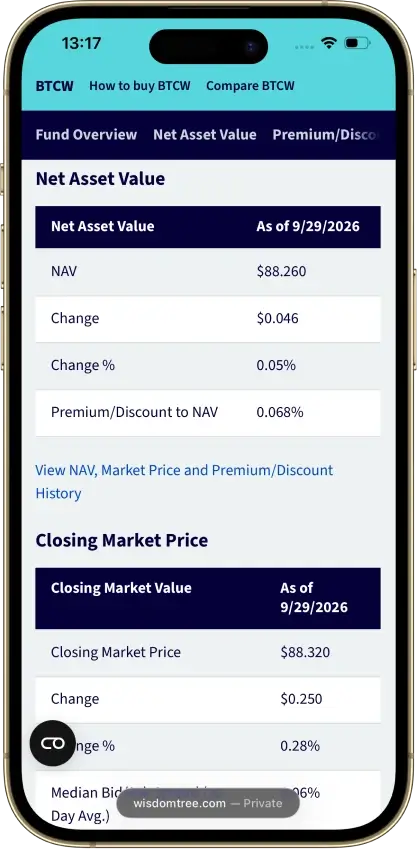
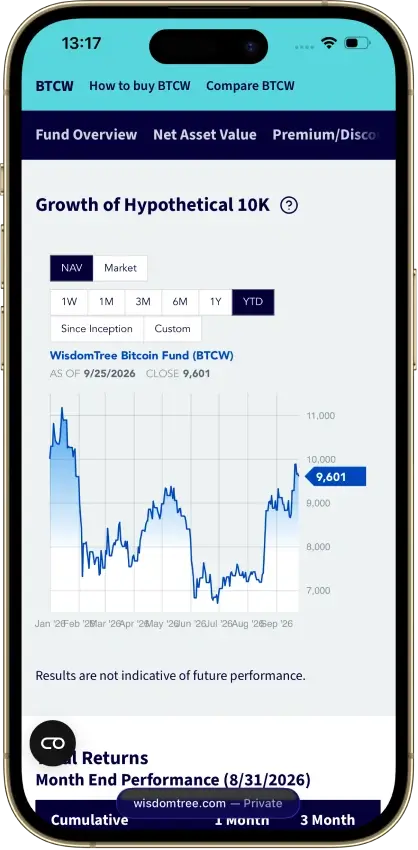
WisdomTree Bitcoin Fund
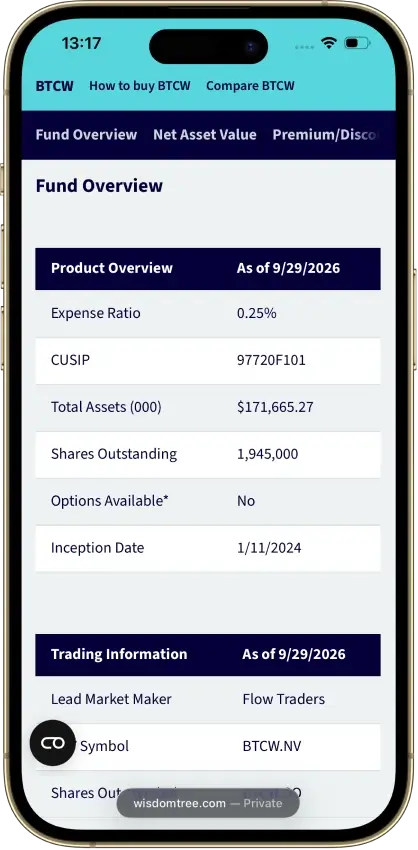
- Annual Fee
- 0.25%
- Fund assets
- $177.6MTotal assets (gross)
- Bid/ask spread
- 0.06%30-day median
Pros
- Spot Bitcoin owned by the trust
- No need to store private keys yourself
- Public fund holdings and NAV figures
Cons
- Higher sponsor rate than HODL
- Bitcoin losses pass through to shares
- No Bitcoin withdrawals for retail holders
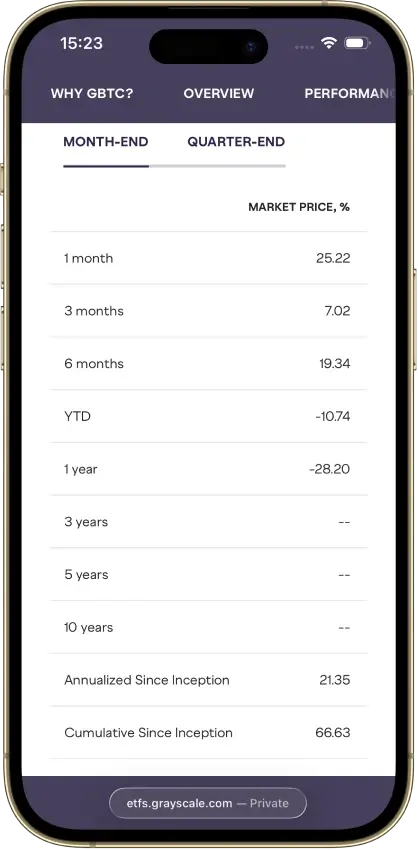
Grayscale Bitcoin Trust
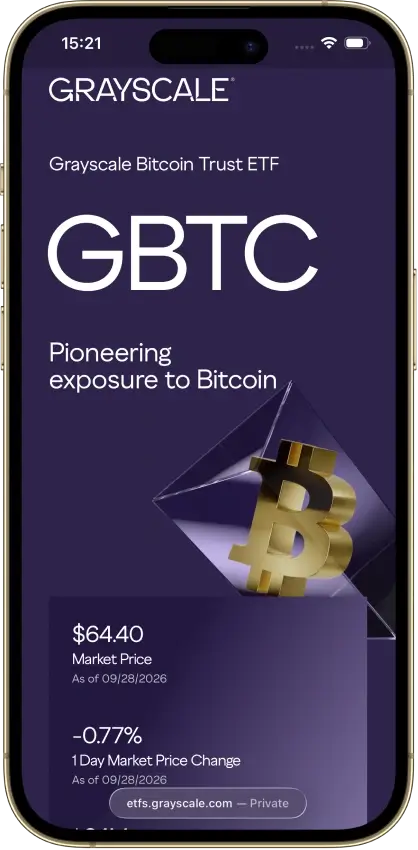
- Annual Fee
- 1.5%
- Fund assets
- $10.74BNon-GAAP AUM using investor NAV
- Bid/ask spread
- 0.02%30-day median
Pros
- Brokerage access without managing Bitcoin keys
- Published fund financial statements
- Direct Bitcoin holdings within the trust
Cons
- Higher annual rate than BTC and IBIT
- Fund expenses erode coin backing per share
- Shares cannot fund a Bitcoin wallet directly
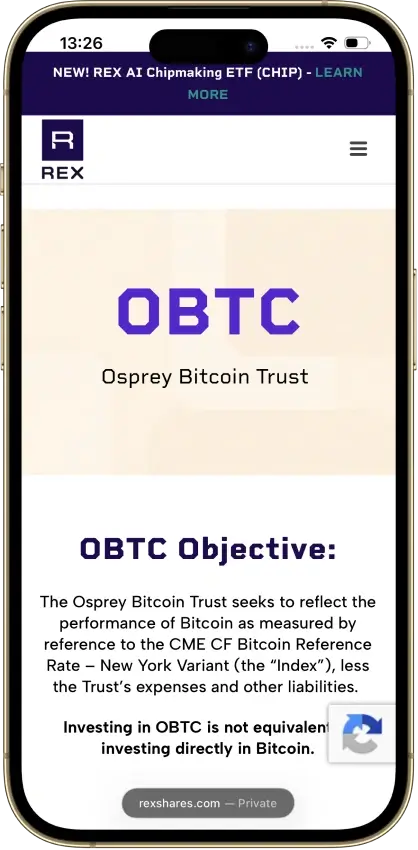
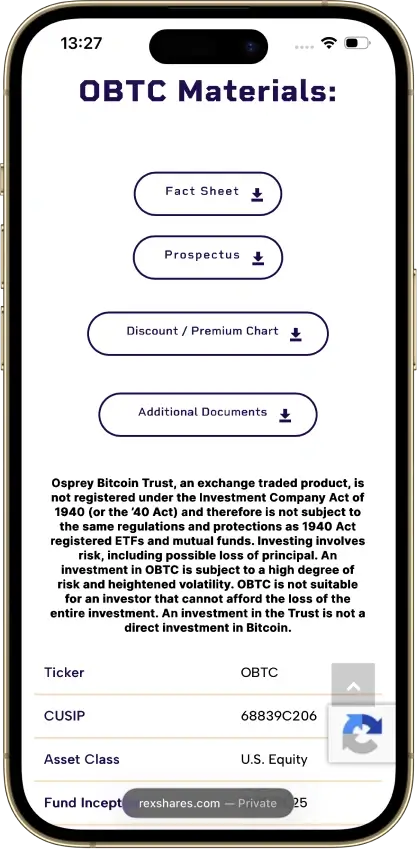
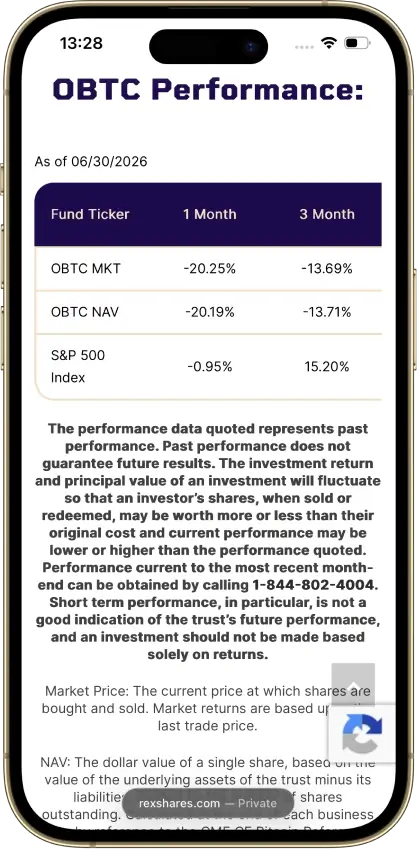
Osprey Bitcoin Trust
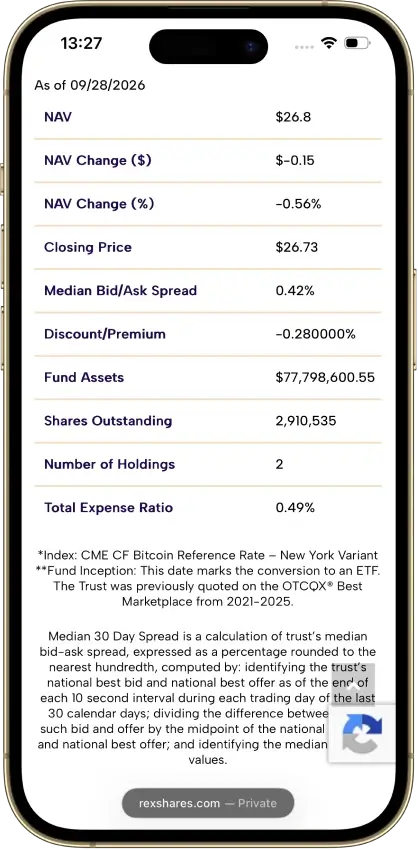
- Annual Fee
- 0.49%
- Fund assets
- $78.99MIssuer-listed Fund Assets
- Bid/ask spread
- 0.43%30-day median
Pros
- Shares backed by spot Bitcoin
- No personal private-key storage
- Public NAV and holdings disclosures
Cons
- Higher annual fee than IBIT and BITB
- Reporting-control weakness disclosed in 2026
- Retail shares cannot be redeemed for coins
How We Rank
- Fund fees 30% weightWhat we assess
Ongoing sponsor charge before temporary waivers, fee basis, covered expenses, extra fund costs, and waiver terms.
What earns 10/10 Zero ongoing sponsor charge before temporary waivers, with the fee basis, payment method, covered expenses, extra fund costs, and any waiver conditions clearly disclosed. - Trading spread 25% weightWhat we assess
Median difference between bid and ask prices over 30 days.
What earns 10/10 The formula reaches 10/10 at a valid published 30-day median bid-ask spread of 0.00%, without implying zero execution cost. - Fund size 10% weightWhat we assess
Value of the fund’s assets.
What earns 10/10 A dated fund-level asset figure that meets the methodology's evidence requirements shows at least $1 billion. - Custody & asset rights 20% weightWhat we assess
Fund ownership, separate asset records, and the custodian's contractual responsibility for its own safekeeping failures.
What earns 10/10 Every Bitcoin custodian recognizes fund ownership and separate client records, with contractual recourse for its own safekeeping loss caused by ordinary negligence or breach of an express duty. - Reporting & transparency 15% weightWhat we assess
Required reports, public holdings, valuation benchmark, net asset value (NAV), and management's disclosure-control conclusions.
What earns 10/10 Required reports are current, holdings, benchmark and NAV are public, and management's latest disclosure-control conclusion is effective with no unresolved material reporting-control weakness.
How We Assess Bitcoin ETFs
CryptoSlate scores the 13 U.S. spot Bitcoin funds covered here out of 10 and orders the ranking by overall score. The weighted assessment covers fund fees (30%), trading spread (25%), fund size (10%), custody and asset rights (20%), and reporting transparency (15%). Scores compare these fund characteristics; they do not predict Bitcoin returns or determine whether an investment suits an individual investor.
We use issuer disclosures and filings, exchange records, benchmark information and corroborating sources. Fund assets and trading spreads are dated observations, not live quotes. Dates vary by fund and metric, and the reviews identify the supporting evidence and its limitations.
We preserve each fund's stated fee type and distinguish a custodian's appointment from evidence about assets actually held. Our assessment uses public documents and observable disclosures. It does not include brokerage trading tests or inspection of private custody systems.
For an existing holding, weigh any recurring fee saving against trading costs and the consequences of switching. The comparison covers the funds reviewed here, rather than every Bitcoin investment product.
What Is a Bitcoin ETF?
A Bitcoin ETF is an exchange-traded investment that gives shareholders exposure to Bitcoin. In a spot product, the trust owns Bitcoin and the shares represent an interest in its net assets. An investor buys the shares without opening a personal crypto wallet.
The funds covered here are exchange-traded commodity trusts, commonly called ETFs, and are not investment companies registered under the Investment Company Act of 1940. Securities registration and disclosure obligations still apply. The ETF name alone does not establish that two products have identical legal protections.
Spot Bitcoin ETFs vs. Futures and Other Bitcoin Funds
| Product Type | Source of Exposure | Difference to Check |
|---|---|---|
| Spot Bitcoin fund | Bitcoin held by a trust | Fees, custody terms and shareholder rights |
| Bitcoin futures fund | Contracts linked to Bitcoin | Contract pricing and replacement costs |
| Leveraged or inverse fund | A multiplied or opposite target return | The stated reset period and compounding effects |
| Bitcoin income strategy | Bitcoin-related exposure combined with option writing or similar positions | How options or other positions change returns |
An income strategy can combine spot exposure with covered calls, exchanging some potential upside for option premiums while substantial downside remains. A daily-reset fund has a different objective from holding Bitcoin exposure over several months. Identify the holdings and return objective before comparing headline performance.
How to Choose a Bitcoin ETF
The best Bitcoin ETF for an intended use depends on the account, expected holding period and costs of entering and leaving the position. A fund name or a low share price cannot answer those questions.
A brokerage position may suit someone who wants financial exposure and accepts fund-managed custody. Someone who needs coins to transfer or spend needs a different form of ownership. Buying several spot Bitcoin funds also leaves the underlying investment concentrated in one asset.
Next, compare the annual charge and the conditions behind it. Establish whether the displayed rate is permanent, temporarily reduced, or limited to a particular asset threshold. Check the rate that applies after a waiver ends before estimating a longer holding period.
Then examine trading conditions in the account you would actually use. The available bid and ask matter more to an immediate transaction than a quoted last-trade price. For an existing holding, weigh the recurring fee difference against the costs and account consequences of switching. A decision to keep or replace a position requires more information than a fee ordering provides.
Bitcoin ETF Fees and Trading Costs
Owning fund shares can involve both ongoing charges and transaction costs. Comparing only the annual rate leaves part of the cost unanswered.
| Cost | How It Affects the Investor | What to Check |
|---|---|---|
| Sponsor or management fee | Reduces the assets supporting the shares over time | Annual rate, calculation basis and covered expenses |
| Fee waiver | Reduces an eligible charge for a stated period or amount | Expiry, asset threshold and later rate |
| Bid-ask spread | Creates a difference between available buying and selling quotes | Both sides of the quote when placing the order |
| Broker charges | Can add costs for trades, accounts or transfers | The schedule for the relevant service and account |
For a hypothetical annual-fee comparison, assume a constant $10,000 calculation base for one year, with no waiver, price change or transaction costs. Fund A charges 0.18%, equivalent to $18. Fund B charges 0.32%, equivalent to $32. The annual difference is $14 on that fixed base.
Actual charges depend on the fund's calculation method and changing asset values, so this fixed-base illustration cannot predict the amount an investor will pay. A small recurring saving may take time to outweigh the costs of changing an existing position. Commission-free trading also leaves the fund's ongoing charge and the spread to consider.
Bitcoin ETF vs. Buying Bitcoin
The ownership decision comes before the choice between funds. Fund shares provide an interest in a trust, while direct Bitcoin ownership can give you coins that move between wallets.
| Question | Spot Bitcoin Fund Shares | Bitcoin in a Personal Wallet |
|---|---|---|
| What do you hold? | An interest in a trust's net assets | Bitcoin controlled through your wallet's keys |
| Who manages the keys? | The fund's custody providers | You, using your chosen wallet setup |
| Can you transfer or spend the Bitcoin? | Ordinary shares do not provide retail coin withdrawals | You can authorize Bitcoin transfers |
| When can you trade? | During sessions supported by the exchange and broker | Crypto markets operate around the clock, subject to service availability |
| Which costs matter? | Fund charges, spreads and broker fees | Buying or selling costs, wallet costs and network fees |
You take responsibility for recovery arrangements and transaction checks when using a wallet you control. A mistaken transfer or lost recovery information can have lasting consequences. A custodial crypto account is a separate arrangement and should not be confused with either personal key control or ETF share ownership.
Shares reduce the need to operate a wallet for that investment. They leave the trust dependent on providers and the shareholder exposed to Bitcoin's price. Neither ownership route removes the possibility of substantial losses.
How to Buy a Bitcoin ETF
Access depends on the brokerage service, jurisdiction, account type and exact security. A provider offering one Bitcoin product does not establish access to every fund or the same features across its accounts.
-
Confirm eligibility
Confirm that the account permits purchases of the intended spot fund. Check any eligibility requirements or investment acknowledgments.
-
Match the fund's identity
Match the fund's full name, ticker and listing exchange. A similar ticker can identify a different product or market.
-
Review the prospectus and costs
Review the current prospectus, annual charge and any waiver conditions. Check the broker's separate costs.
-
Set the order
Inspect the bid, ask and supported trading session. Set the intended quantity and understand the order's price conditions before submitting it.
-
Confirm execution
Check the execution confirmation and retain the records needed to monitor the holding and its costs.
A market order seeks execution at the available market price, which may differ from the displayed quote. A limit order sets a price boundary but may remain unfilled. Available order types and trading sessions depend on the broker.
Some IRA accounts permit spot Bitcoin fund shares. Confirm the particular fund and account with the provider. IRA eligibility does not establish fractional-share access, suitability for retirement savings or an identical option in a workplace plan.
Bitcoin ETF Risks and Custody
Bitcoin exposure can lose substantial value. A securities-exchange listing changes how the investment is held and traded, without making Bitcoin's price stable. Holding several funds linked to the same asset does not remove that common price risk.
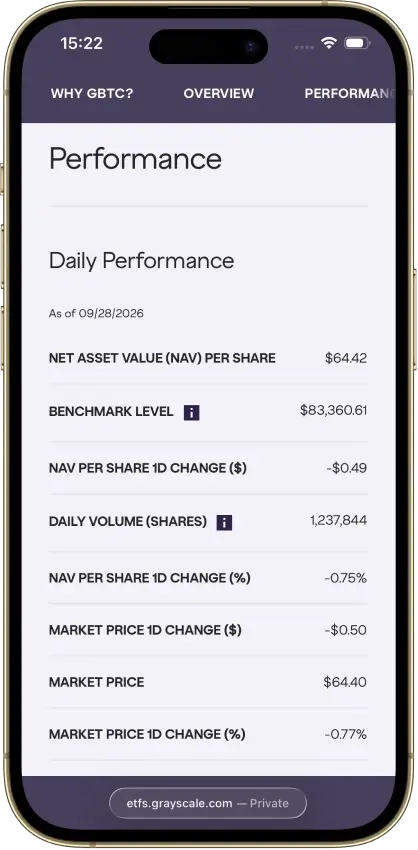
Share prices can also depart from net asset value, or NAV. NAV expresses the trust's net assets per share using its valuation process. Your transaction occurs at a market price. Comparing a fund quote with a Bitcoin price from a different moment can therefore give a misleading impression of tracking performance.
A document naming several custody providers establishes their appointments. It does not reveal the percentage of coins stored with each or guarantee a reduction in losses. Review their roles and the fund's disclosures about custody, transaction processing and service interruptions. Fund custody does not give an ordinary shareholder personal control of the underlying keys.
Neither registration nor a provider's name promises repayment of the amount invested. Read the exact fund terms and account conditions before relying on a particular safeguard.