

Overview
Introduction
Bitcoin (BTC) moves value between people over a public network, with no bank or card company approving the payment. Its software limits supply to 21 million coins, a rule every full node checks for itself.
Holding BTC can mean keeping your own keys, leaving a balance on an exchange, or buying fund shares through a broker. Each route fails in its own way, and the choice decides who can lose or freeze your coins.

How Bitcoin Works
Bitcoin keeps its ledger on a public blockchain, a chain of blocks that each hold a batch of transfers. Anyone can operate a full node, which downloads every block and checks it against the same consensus rules. No company decides who may send a transaction or who may join the network.
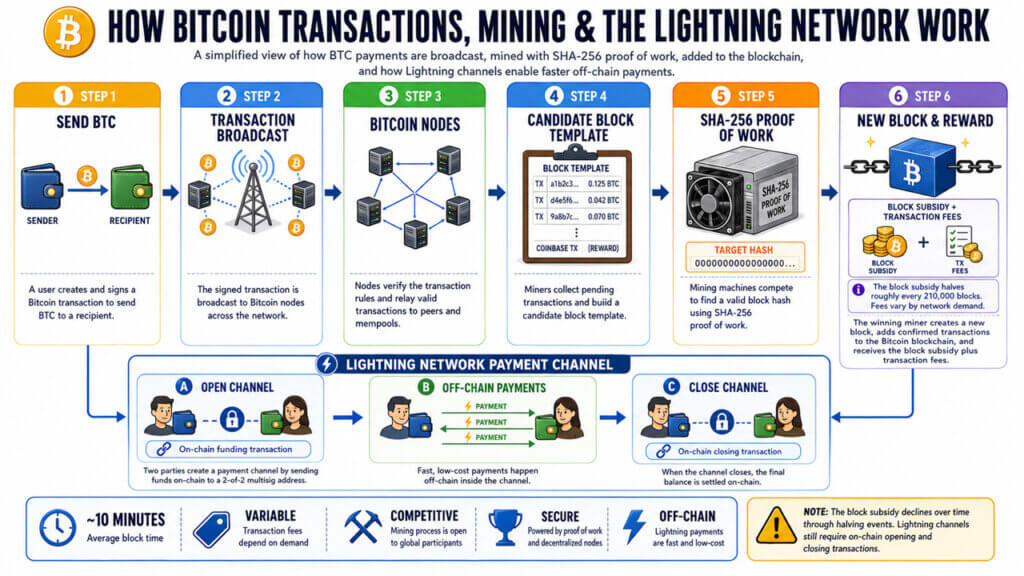
A payment starts in a wallet, which signs the transaction with the sender's private key and broadcasts it to other nodes. Each node checks the signature and the basic rules, then adds the transaction to its mempool and passes it on to its peers. The mempool is the waiting area for unconfirmed transactions, and miners pick from it, favoring the transactions that pay the highest fee for their size, to assemble a candidate block.
To add that block, a miner has to win the proof-of-work race. Mining machines hash the block header with SHA-256 again and again until one result falls below the network's target. The winner broadcasts the block, other nodes verify it, and miners start on the next block on top of it. Rewriting history would mean redoing all of that work faster than the rest of the network, which makes attacks on settled blocks expensive.
Blocks arrive about every 10 minutes on average. Each new block on top of a transaction adds one confirmation, so a payment buried under six blocks is much harder to reverse than one in the latest block. Exchanges and merchants set their own confirmation counts for that reason, and some ask for more on large transfers.
Coins as Unspent Outputs
Inside the protocol, Bitcoin keeps no account balances. It tracks unspent transaction outputs, or UTXOs, each a set amount locked to an address until it's spent, and the balance your wallet shows is the total of the UTXOs its keys can spend.
A transaction has to spend each UTXO it uses in full. Say your wallet holds outputs of 0.003 BTC and 0.002 BTC and you pay someone 0.0035 BTC. The transaction spends both, sends 0.0035 BTC to the recipient, and returns 0.0014 BTC of change to an address of yours, ideally a fresh one. The 0.0001 BTC that no output claims goes to the miner as the fee.
Every full node keeps track of the unspent outputs and rejects any transaction that spends one twice or pays out more than its inputs hold, which stops double spending with no central database.
A Bitcoin payment spends whole outputs and returns the rest as change
Bitcoin tracks unspent transaction outputs. A payment spends its inputs in full, creates a payment output and a change output, and leaves the fee as the difference between inputs and outputs.
Every input is spent whole, the change comes back to a new address of yours, and the miner keeps whatever the outputs leave unclaimed.
Hypothetical amounts. Real fees depend on transaction size in bytes and on demand for block space, so a 2% fee is only an example. Some payments have one input or no change output, and wallets choose which outputs to spend in different ways.
Sources and evidence
Sources
Supporting facts
- The Bitcoin developer guide says each transaction has at least one input and one output, each input spends the satoshis paid to a previous output, and each output waits as an unspent transaction output, or UTXO, until a later input spends it. [1]
- The developer guide says that because a UTXO can only be spent once, the full value of the included UTXOs must be spent or given to a miner as a transaction fee, and that change outputs send the surplus satoshis back to the spender, ideally at a new address. [1]
- The Bitcoin white paper says a transaction normally has either a single input from a larger previous transaction or multiple inputs combining smaller amounts, and at most two outputs, one for the payment and one returning the change, if any, to the sender. [2]
- Bitcoin Core's CheckTxInputs rejects a transaction whose input value is lower than its output value and computes the transaction fee as the input value minus the output value. [3]
- Bitcoin Core defines one coin as 100,000,000 of its base unit, the satoshi. [4]
- In a hypothetical payment, inputs of 0.003 BTC and 0.002 BTC total 0.005 BTC. A 0.0035 BTC payment output and a 0.0014 BTC change output total 0.0049 BTC, so the fee is 0.0001 BTC, or 10,000 satoshis. [3] [4]
Method
Hypothetical amounts in satoshis, 1 BTC = 100,000,000 per Bitcoin Core. Inputs 300,000 + 200,000 = 500,000. Outputs 350,000 + 140,000 = 490,000. Fee = 500,000 - 490,000 = 10,000, or 0.0001 BTC, 2% of the inputs. Both bars use one linear scale from 0 to 0.005 BTC. Arithmetic asserted in gen.py.
Scope
Hypothetical amounts. Real fees depend on transaction size in bytes and on demand for block space, so a 2% fee is only an example. Some payments have one input or no change output, and wallets choose which outputs to spend in different ways.
 CryptoSlate
Who Created Bitcoin?
Bitcoin's creator used the name Satoshi Nakamoto, a pseudonym that no one has tied to a confirmed identity. Satoshi released the Bitcoin white paper on Oct. 31, 2008, then the first version of the software in January 2009. The network's first block, known as the genesis block, started the chain that every node still builds on.
The design grew out of earlier cypherpunk work on digital cash and privacy. Wei Dai's b-money and Adam Back's Hashcash both appear in the white paper's references, and Bitcoin joined those ideas to a reward that pays strangers on the open internet to secure a shared ledger.
Early users tested and improved the software on public mailing lists and forums. Hal Finney, one of the first developers to try the code, received the first recorded Bitcoin transfer from Satoshi. More maintainers joined over the following years, and the codebase grew into an open-source project with many contributors.
Satoshi stopped posting publicly around 2010 to 2011 and handed control of the code repository to other developers. Bitcoin kept going without its founder, which left it as a protocol with no owner.
What Gives Bitcoin Its Value?
No government guarantees bitcoin, no one will redeem it for a commodity, and it pays no cash flows. Its price comes from what buyers will pay for a scarce asset that moves online.
Scarcity alone doesn't explain the demand, though. BTC trades on spot markets at large exchanges around the world and through exchange-traded products (ETPs) in the US, and wallets, custodians, and payment apps support it. That wide access usually means narrower spreads and more custody choices when you buy or sell.
A payment to another country follows the same protocol rules as one next door, and blocks keep arriving around the clock, weekends and holidays included. Confirmations still take time, so a Bitcoin transfer isn't always faster than a domestic bank payment.
Gold is the usual comparison, since both are scarce and neither is tied to one government's monetary policy. BTC is easier to move and to split into small amounts, while gold has physical form and thousands of years of use as money. Fiat currency comes up for another reason, because central banks adjust its supply to meet economic goals. Each system solves a different problem, so the comparison only goes so far.
Bitcoin ETFs, Institutional Adoption, and Regulation
On Jan. 10, 2024, the US Securities and Exchange Commission (SEC) approved the listing of spot bitcoin ETP shares, as set out in Chair Gary Gensler's statement on spot bitcoin ETPs. From then on, investors could buy bitcoin exposure through exchange-traded funds (ETFs) in an ordinary brokerage account.
As of Nov. 16, 2026, one of those funds, BlackRock's iShares Bitcoin Trust ETF (IBIT), had about $50.9 billion in net assets, according to its iShares fund page. It trades on Nasdaq and charges a 0.25% sponsor fee.
Companies became buyers too. Strategy, formerly MicroStrategy, holds bitcoin as its main treasury reserve asset and lists each purchase on its website. As of Nov. 17, 2026, its ledger showed 850,849 BTC. Owning the stock still differs from owning BTC, though corporate balance-sheet demand has become a market story of its own.
Bitcoin first traded above $100,000 in December 2024, a level visible on the long-range Bitcoin price chart. The milestone didn't end the volatility, though it shaped market sentiment, media coverage, and the attention of policymakers.
In the EU, the Markets in Crypto-Assets Regulation (MiCA) sets separate rules for token issuers and for crypto-asset service providers (CASPs), and bitcoin has no identifiable issuer. An answer in the MiCA Q&A of the European Securities and Markets Authority (ESMA), provided by the European Commission and dated Feb. 18, 2026, says crypto-assets with no identifiable issuer need no white paper under MiCA. The same answer says a CASP operating a trading platform still needs authorization and must meet its general obligations, so in the EU, MiCA's duties around BTC fall on the service providers that handle it.
El Salvador changed course as well. In a Feb. 26, 2025, press release, the International Monetary Fund (IMF) said legal reforms had made private-sector acceptance of bitcoin voluntary, as part of the country's commitments under a new IMF-supported program. So a country's stance on bitcoin can shift when its government needs outside financing.
Bitcoin ETF vs. Buying Bitcoin vs. Self-Custody
Buying bitcoin is one decision, and choosing how to hold it is another. Price exposure, easy selling, on-chain control, and long-term custody each point to a different route, and the routes differ on fees and tax treatment too.
Each route sits on the left below, next to what you end up holding.
- Spot bitcoin ETF
Brokerage shares that track the BTC price, with no on-chain transfers
- Exchange balance
Easy buying, selling, and fiat withdrawals, with the exchange holding the keys
- Hot wallet
Your keys on a phone or computer, for small balances, exposed to device and phishing risk
- Hardware wallet
Your keys on a dedicated device for long-term storage, with a seed phrase to protect
- Multisig setup
Several keys needed to move funds, for larger balances, shared control, or inheritance
For a small first purchase, an exchange account or an ETF is simpler to set up than cold storage. As holdings grow, self-custody puts the keys in your hands and leaves no platform between you and the coins. Before picking a fund, compare the spot bitcoin ETFs on fees, custodian, and structure.
The 21-Million Cap and Halving Schedule
New bitcoin enters circulation only through the block subsidy, the coins a miner pays itself in each new block. The subsidy halves every 210,000 blocks in an event called the Bitcoin halving, and because the series starts at 50 BTC and keeps halving, total issuance approaches 21 million without ever passing it.
The subsidy has been cut four times since the first 50 BTC blocks.
- 25 BTC per block in 2012
- 12.5 BTC per block in 2016
- 6.25 BTC per block in 2020
- 3.125 BTC per block since April 2024
The schedule fixes how many coins appear, and demand decides what each one is worth.
Each cut also shrinks what miners earn from new coins, so transaction fees are expected to pay a growing share of the network's security over time. The next halving falls at block 1,050,000, which block-time estimates put around 2028, and the subsidy reaches zero around 2140. From then on, fees alone will pay miners, and how much users will pay for block space by then is still an open question.
Is Bitcoin Anonymous or Traceable?
Every Bitcoin transaction sits on a public blockchain that anyone can read, with addresses standing in for names.
Common beliefs about Bitcoin privacy are listed below, each next to what holds in practice.
- Bitcoin is anonymous
Pseudonymous, with every address and amount visible
- No one can track Bitcoin
Traceable, especially once an address links to an exchange account
- A wallet hides your identity
Activity stays visible, and exchanges or spending patterns can link it to you
- Privacy tools make Bitcoin untraceable
Partial help only, with added complexity
Bitcoin's white paper notes that a transaction spending several inputs reveals that one owner held them, so combining coins in one payment ties their histories together.
Buying through a regulated exchange ties your identity, through its verification checks, to the addresses you withdraw to. Even without a name attached, transaction patterns can reveal habits over time. So each step of buying, sending, and storing BTC gives something away, and the privacy question is how much.
Bitcoin Risks and Limitations
BTC has been through price drawdowns lasting many months, and borrowed money can turn ordinary swings into forced liquidations.
Holding your own keys removes the dependence on a platform and hands you the whole job of keeping them safe. A lost seed phrase, a compromised device, or a phishing attack can mean losing the coins for good, so learn how a private key works before you move meaningful value.
Leaving coins with an exchange or lending platform brings a different danger, counterparty risk. Platform failures in past market cycles froze customer balances when governance and risk controls broke down. Self-custody removes that risk and adds the operational one, so the right setup depends on your skill, what you're protecting against, and how much is at stake.
Rules are clearer in some regions than others, and elections, court rulings, or economic stress can change them. MiCA gave the EU one framework across its member states while treatment elsewhere stays fragmented, so anyone moving between countries has to track local tax and reporting duties.
Energy use is a standing criticism of Bitcoin's proof-of-work design. The Cambridge Bitcoin Electricity Consumption Index (CBECI) models the network's power demand from hash rate and mining-hardware efficiency and gives a daily best-guess estimate. The debate over energy mix, curtailed power, and grid effects goes on, while high power use stays built into how Bitcoin is secured.
No support desk can reverse a confirmed Bitcoin payment. That protects payments from censorship and makes user mistakes permanent, which some new users learn only after sending coins to a wrong address. Sending a small test amount first catches that mistake before it costs much.
Can You Stake Bitcoin and Earn Interest on BTC?
Bitcoin has no native staking of the kind Ethereum, Solana, or Cardano offer. It secures blocks with proof of work, so holders can't lock coins with the protocol to validate blocks and earn rewards.
Products sold as “Bitcoin staking” are built on external protocols, time-locked outputs, lending, wrapped BTC, or exchange earn programs, and their yield comes with risks a plain wallet balance doesn't have. Each route below is paired with what to check first.
- Native Bitcoin staking
Not part of Bitcoin’s consensus rules
- Exchange earn product
Custody, eligibility, reward asset, lockup, and withdrawal rules
- Babylon-style BTC staking
Reward asset, and whether funds get time-locked
- Wrapped BTC in decentralized finance (DeFi)
Bridge, custodian, smart contract, and chain risk
- Bitcoin lending
Borrower, platform, liquidation, and counterparty risk
Any yield on BTC therefore comes from a third party or a separate protocol, and each added party or contract is one more thing that can fail.
How to Buy and Store Bitcoin
Buying starts with choosing an exchange. Check supported regions, fees, liquidity, and withdrawal policies when you compare crypto exchanges, then open an account with one that serves your country and fits your risk tolerance.
Regulated exchanges ask for identity verification before you fund the account by bank transfer, card, or stablecoin deposit. After that, a market order buys at the current price, and a limit order lets you set the most you'll pay.
Once the order fills, you can leave the coins on the exchange or withdraw them to one of the wallets for beginners. A simple pattern splits them between a hot wallet for small spending balances and cold storage for long-term savings, with the seed phrase backed up offline.
For retirement savings, Bitcoin individual retirement accounts (IRAs) hold the exposure for you. Compare their custody terms, fee structure, and withdrawal limits with holding BTC directly.
What Happens If You Lose Your Bitcoin Wallet or Seed Phrase?
Self-custody takes the bank or exchange out of the middle, and password resets go with it. Once you hold the keys, access depends on the seed phrase, the private keys, any passphrase, the wallet setup, and your recovery notes.
Each setup below is paired with its main point of failure.
- Exchange account
Frozen, hacked, restricted, or passed to heirs only through the platform’s process
- Single hardware wallet
One seed phrase, lost or stolen, decides everything
- Seed plus passphrase
Safer against theft, with heirs locked out if the passphrase isn’t recorded safely
- Multisig wallet
No single-key failure, with recovery steps that must be clear and tested
- ETF or brokerage product
Simpler estate handling, with fund shares and no spendable BTC
Never store a seed phrase in email, cloud notes, screenshots, or a will that becomes public during probate. Heirs need to know the bitcoin exists, where it's held, and who can help, without getting the keys before they need them.
For larger balances, test the recovery with a small amount before trusting the setup. A backup nobody can follow under stress won't bring the coins back.
Bitcoin vs. Other Cryptocurrencies
Bitcoin is one network inside a much larger crypto market. Its core role is neutral settlement and scarce digital value, while other networks aim at different goals, such as smart contracts, application ecosystems, or high-throughput payments.
Ethereum makes the clearest comparison, since it was built to execute smart contracts and hosts many on-chain applications. Bitcoin keeps its base layer conservative and puts monetary credibility first, so the two compete in some markets while their base layers aim at different jobs.
Bitcoin Cash (BCH) is a separate network created by a 2017 fork over how to scale. It raised the block size to cut on-chain fees, while Bitcoin kept smaller blocks and moved some scaling to second layers. The shared name confuses beginners, though BTC and BCH are different assets with different security and liquidity.
One of those second layers is the Lightning Network, a layer-two system that settles many small payments off-chain and records the net result on Bitcoin. It extends what the base chain can handle and still relies on Bitcoin for final settlement and disputes.
Some institutional portfolio frameworks treat Bitcoin as the core crypto holding and frame smaller tokens as sector or technology bets. The framing varies from firm to firm, and it still explains why Bitcoin anchors risk discussions even for investors who hold many assets.
FAQ
Who invented Bitcoin?
Someone using the name Satoshi Nakamoto, and nobody has confirmed whether that was one person or a group. Bitcoin doesn’t depend on Satoshi either, since any change to its rules has to be adopted by the nodes that enforce them.
How many bitcoins are there?
As of Nov. 17, 2026, the Blockchain.com explorer put the mined supply at about 20.11 million BTC, roughly 95.8% of the 21 million cap. The remaining 0.89 million or so arrive at a shrinking rate with each halving.
Is Bitcoin legal?
It’s legal to own and trade in many countries, and the rules can differ even by state or province. In the US, the Internal Revenue Service (IRS) treats digital assets as property for tax purposes, so selling or spending BTC can create a taxable gain. Check local guidance from your tax authority and financial regulator before buying or moving funds across borders.
What is bitcoin halving?
It’s the cut in the block subsidy every 210,000 blocks. A block height triggers it, so the calendar date drifts with block times. At 10 minutes a block, 210,000 blocks take about four years, which is why halvings land roughly four years apart.
What is a Bitcoin wallet?
Software or a device that stores your private keys and signs transactions with them. With a custodial wallet, the provider keeps the keys and approves withdrawals on your behalf, and a self-custody wallet leaves both jobs to you.
Can Bitcoin be hacked?
Yes, a bug was exploited in 2010. On Aug. 15, 2010, users found block 74,638 held a transaction creating about 184 billion BTC, and a fixed client with a soft fork rejecting such transactions came out within five hours. Once the corrected chain overtook the bad one at block 74,691, the transaction and its coins were gone from Bitcoin’s history. Since then, users have lost coins through phishing, malware, weak backups, and exchange breaches, all outside the protocol’s rules.
Can you buy less than one Bitcoin?
Yes. One BTC divides into 100 million satoshis, the smallest unit, so exchanges sell small fractions. On a small purchase, the spread, trading fee, and withdrawal fee can cost more than you’d expect, so check all three first.
Do I own actual Bitcoin if I buy a Bitcoin ETF?
You own fund shares, and the trust holds the BTC. IBIT’s shares follow the CME CF Bitcoin Reference Rate, New York Variant, and you can sell them on the exchange during market hours without ever touching a private key.
Can you stake Bitcoin?
Not natively. Before depositing BTC into any product that pays a yield, ask who pays the reward and in which asset, since a reward paid in another token adds that token’s price risk.
Is Bitcoin private?
Only partly. Reusing one address links all its payments together, so a fresh receiving address for each payment keeps your history harder to piece together.
How much does it cost to send Bitcoin?
The network fee depends on the transaction’s size in bytes and on demand for block space, and the amount you send doesn’t change it. A payment that spends many small UTXOs is larger, so it costs more. Exchange withdrawal fees come on top of the network fee.
Is Lightning the same as Bitcoin?
No. Lightning payments move through payment channels, and opening or closing a channel is an ordinary Bitcoin transaction with a normal network fee. You also need a wallet or service that supports Lightning.
What happens if I lose my seed phrase?
Losing a hardware wallet is usually fixable, because the seed phrase restores the same keys on a new device that follows the same standard, such as Bitcoin Improvement Proposal (BIP) 39. Losing every copy of the phrase is what ends access, and if you also set a passphrase, you need both to restore the wallet.
Is it too late to buy Bitcoin?
Price alone can’t answer that. Weigh your time horizon, how much loss you can absorb, your custody skills, and local tax rules. Buying a small fixed amount on a schedule spreads out your entry price, though it doesn’t remove volatility or guarantee a profit.