
Coinbase fits U.S. users who fund by ACH and use Advanced, but Simple Buy costs and regional product rules require attention.
Coinbase vs Gemini: Fees, Cards, and Security Compared
Coinbase is the better exchange for most users in this comparison.

Gemini scores 7.1/10 for U.S. access, free ACH, and documented controls. Compare alternatives for lower entry fees or access in more countries.
Affiliate Disclosure
Some links in this comparison are affiliate links. CryptoSlate may earn a commission if you sign up through these links. Our ratings remain editorially independent.
Overview
Coinbase Gemini
Current review score
7.6 / 10
7.1 / 10
Best fit
People who want one account for buying, Advanced Trade, staking, and US derivatives
US customers who want required 2FA, address allowlisting, published audits, or a crypto rewards credit card
Listed crypto
Roughly 270–315 US retail assets
99 in Gemini's Trust Center snapshot
Market count
About 460 US retail pairs
655 Trust Center pairs versus 347 public endpoint symbols
Entry advanced spot fee
0.40% maker and 0.60% taker
0.60% maker and 1.20% taker
US derivatives
Futures and perpetual-style contracts through separate Coinbase derivatives entities for eligible accounts
Margin up to 5x for eligible Gemini Moonbase ECP accounts
Staking
Eight named assets: ETH, SOL, ADA, XTZ, DOT, MATIC, ATOM, and AVAX
ETH, SOL, and MON, with conflicting 35%, up to 35%, and 25% fee wording
Exchange-linked cards
Visa debit and Coinbase One Amex credit
Gemini Mastercard credit
User-verifiable reserve proof
No
No
US bank rails
Free ACH, $10/$25 wires, PayPal, and instant RTP
Free ACH, free wire deposits with $25 withdrawals, card wallets, and 2.50% PayPal
International position
Multiple named markets
41 operational countries in the August 29, 2026 snapshot after three regional closures
Coinbase wins overview
Coinbase fits users who want the larger stated asset count, lower entry order-book fees, or eligible US derivatives. Gemini fits users prioritizing required 2FA or a no-membership crypto rewards card.
Coinbase vs Gemini Winners by Category
Coinbase Gemini
7.6 review score, roughly 270–315 US retail assets, 0.40%/0.60% entry Advanced fees, and eligible US derivatives
7.1 review score
Free ACH and quote-based buying in the same account as Advanced Trade
Retail buying and ActiveTrader in one exchange relationship
0.40% maker and 0.60% taker
0.60% maker and 1.20% taker
Roughly 270–315 for US retail
99 in Gemini's Trust Center snapshot
Futures and perpetual-style contracts through separate Coinbase derivatives entities for eligible accounts
Margin up to 5x for eligible Gemini Moonbase ECP accounts
Eight named assets
ETH, SOL, and MON
2FA, passkeys, hardware keys, and allowlisting available
Required 2FA with hardware keys and allowlisting
Quarterly and annual SEC reporting
Annual audited financial statements
Coinbase One Amex card, 2%–4% bitcoin back, paid plan required
Gemini Mastercard, no annual fee or exchange plan
Visa debit card for USD or converted crypto
No exchange-linked debit card
Named access in the UK, EEA, and Australia
Those customer accounts closed April 6, 2026
REST and WebSocket with a static, mocked sandbox
REST, WebSocket, and FIX
Help center, chat, and tickets, with 24/7 phone on Coinbase One
Form or email exchange support, with 24/7 phone for Card only
Coinbase wins overall. Gemini wins on required account controls and credit-card access without an exchange membership.
Screenshots
Coinbase screenshots

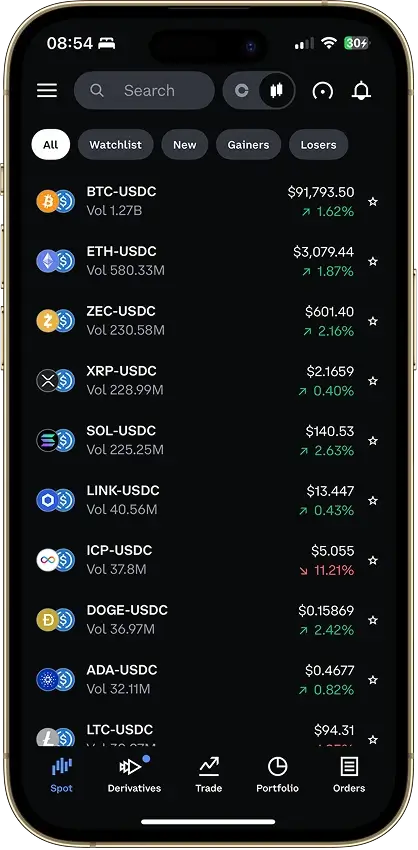
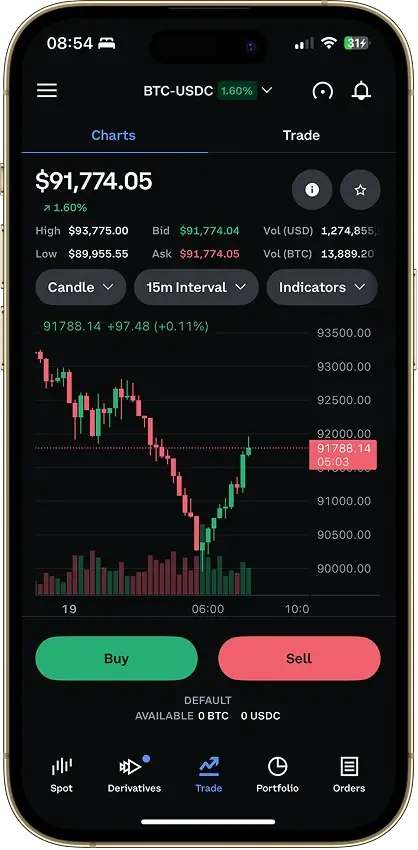
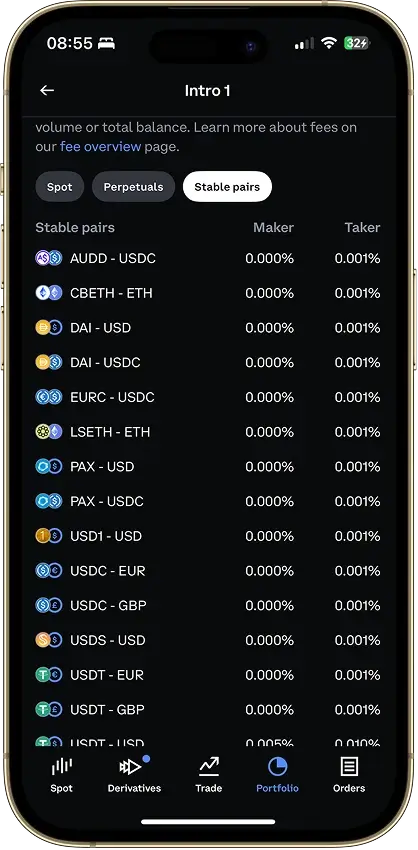
Screenshot 1 of 4
Gemini screenshots

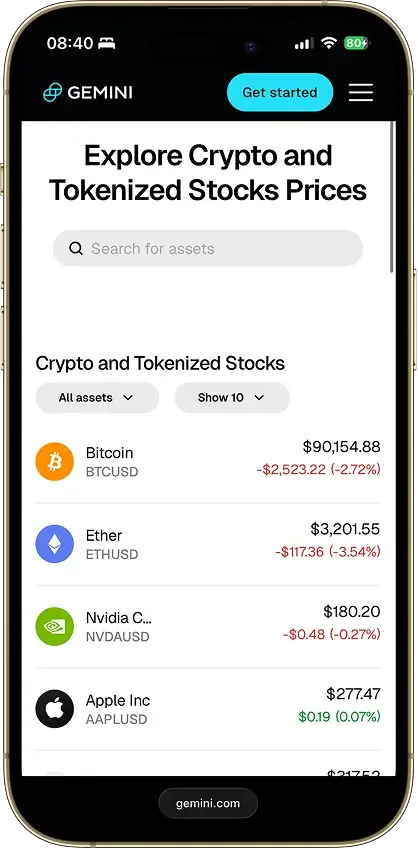

Screenshot 1 of 4
Trading Fees and Pricing
Coinbase Gemini
Entry maker
0.40%
0.60%
Entry taker
0.60%
1.20%
Simple purchase
Fee plus spread, roughly 2.5%–3.5% on small orders
Spread plus variable transaction fee
$10,000 Gemini tier
Matching Coinbase tier is not public
0.40% maker and 0.80% taker
$25,000 Gemini tier
Matching Coinbase tier is not public
0.25% maker and 0.50% taker
Highest published endpoint
The public Advanced schedule does not state a complete retail floor
0% maker and 0.02% taker at $250 million
Selected stablecoin pairs
Standard schedule varies by pair and tier
0% maker and taker on the July 9, 2026 schedule, with listing confirmation required
Bank funding
Free ACH
Free ACH
Debit card funding
Higher-cost method, exact rate is not public
3.49%
PayPal funding
Supported, exact rate is not public
2.50%
Coinbase wins trading Fees and Pricing
Coinbase wins entry pricing. Matching thresholds are unavailable for every high-volume tier.
Coinbase has lower entry Advanced Trade fees. Gemini publishes lower rates as volume or account assets rise, but Coinbase does not publish a comparable Advanced top-tier figure.
Gemini ActiveTrader Spot Tiers
The entry maker fee is 0.20 percentage points lower on Coinbase, and its entry taker fee is half Gemini's. Gemini becomes more competitive as volume or assets rise, though Coinbase does not publish a comparable Advanced top-tier figure. Matching thresholds for every Coinbase tier are unavailable, so a precise high-volume crossover cannot be established.
A low-volume Gemini account pays 0.60% as maker and 1.20% as taker. The schedule drops sharply once trading volume or account value passes the thresholds below.
| Volume or Asset-Balance Threshold | Maker Fee | Taker Fee |
|---|---|---|
| $0 | 0.600% | 1.200% |
| $10,000 volume or $1 million asset balance | 0.400% | 0.800% |
| $25,000 volume or $5 million asset balance | 0.250% | 0.500% |
| $75,000 volume or $15 million asset balance | 0.125% | 0.250% |
| $250,000 volume or $25 million asset balance | 0.075% | 0.150% |
| $1 million volume | 0.050% | 0.100% |
| $20 million volume | 0.010% | 0.050% |
| $250 million volume | 0.000% | 0.020% |
Supported Crypto and Markets
Coinbase Gemini
Distinct crypto assets
Roughly 270–315 for US retail
99 in Gemini's Trust Center snapshot
Reported trading pairs
About 460 for US retail
655 in the Trust Center versus 347 on the public symbols endpoint
Native stablecoin link
USDC
GUSD
Zero-fee named stablecoin pairs
Not stated
RLUSD/USD, USDC/GUSD, and GUSD/USD on the July 9, 2026 schedule, with listing confirmation required
OTC
Coinbase Prime and OTC services
OTC and electronic OTC
Coinbase wins supported Crypto and Markets
Coinbase wins distinct-asset choice. Gemini provides zero-fee trading on three named stablecoin pairs.
Coinbase lists more distinct crypto assets. Gemini's Trust Center reported 655 pairs while its public endpoint returned 347 symbols, so pair counts cannot establish a winner.
Trading Products and Staking
Coinbase Gemini
Retail spot buying
Yes
Yes
Order-book interface
Advanced Trade
ActiveTrader
US retail perpetual-style futures
Separate Coinbase derivatives entity, for eligible accounts
No equivalent product for ordinary US retail accounts
US spot margin
No matched US retail product
Gemini Moonbase ECP accounts in eligible jurisdictions, up to 5x
Non-US perpetuals
Separate regulated products in named markets
Up to 100x in selected jurisdictions
Staking assets
ETH, SOL, ADA, XTZ, DOT, MATIC, ATOM, and AVAX
ETH, SOL, and MON
Staking service fee
35% standard on eight named assets, with lower Coinbase One rates where eligible
Agreement: 35%. Product page: up to 35%. Support page: 25%
OTC
Yes
Yes
Coinbase wins trading Products and Staking
Coinbase wins for a US retail account that may progress from spot trading into derivatives or staking.
Coinbase provides eligible US futures and perpetual-style contracts through separate entities and supports eight named staking assets. Gemini's margin and perpetual products depend on account type or jurisdiction, and its staking set contains ETH, SOL, and MON.
The exchange staking guide explains how commissions and lockups affect realized returns.
Order Types, Programmatic Access, and Trading Limits
Coinbase Gemini
Market orders
Yes
Yes
Limit orders
Yes
Yes
Stop orders
Yes
Multiple order types, exact list not fully stated
Order book
Advanced Trade
ActiveTrader with price-time priority
Programmatic trading
REST and WebSocket
REST, WebSocket, and FIX
Crypto withdrawal limit
Account-specific
Asset, funding-method, and account-specific
ACH limit
Account-specific. Separate $100,000 RTP figure is per transaction
Up to $100,000 daily on ACH withdrawals
USD wire limit
Product and account-specific
No stated maximum, with a $25.01 withdrawal minimum
No clear winner
Neither platform publishes matched figures for a universal fill-quality winner.
Coinbase supports market, limit, stop, and additional US spot orders through REST and WebSocket. Gemini adds FIX and a price-time-priority order book. Neither platform publishes matched execution statistics.
Deposits, Withdrawals, Fiat Rails, and Networks
Coinbase Gemini
ACH deposit
Free
Free
ACH withdrawal
Free, timing varies by product
Free
Instant bank cash-out
RTP up to $100,000 per transaction
No matching instant cash-out route published
Incoming wire
$10, waived for eligible Coinbase One Preferred and Premium members
Free
Outgoing wire
$25
$25
Debit card purchase
Higher-cost method, exact rate varies
3.49%
PayPal
Supported, exact rate is not public
2.50% deposit fee
Crypto withdrawal
Network fee and account-specific limit
Dynamic network fee and account-specific limit
Withdrawal allowlisting
Available
Available
Coinbase wins deposits, Withdrawals, Fiat Rails, and Networks
ACH users can fund either exchange without a platform fee.
Coinbase wins cash-out speed through RTP. Gemini does not charge for incoming wires.
KYC, Regulation, and Geographic Availability
Coinbase Gemini
Full KYC
Required
Required
US spot access
All states
All states, Puerto Rico, and Washington, DC
New-fund staking pauses
CA, MD, NJ, and WI
No US state pause list published. The staking page still names closed regions
US operating structure
Coinbase, Inc. under Coinbase Global
Most accounts use Gemini Moonbase, with named Trust and transitional exceptions
Public-company parent
Coinbase Global with SEC reporting
Gemini Space Station with audited financials
United Kingdom
Available with local limits
Closed April 6, 2026
EEA
Available with local product limits
Closed April 6, 2026
Australia
Available with local rules
Closed April 6, 2026
Coinbase wins KYC, Regulation, and Geographic Availability
Coinbase wins geographic availability. Gemini remains centered on US accounts.
Both exchanges require full KYC. Coinbase serves more international markets after Gemini's April 2026 closures.
Security, Custody, Insurance, and Reserve Disclosure
Coinbase Gemini
Cold storage disclosure
Vast majority of customer crypto
Majority, no matching percentage
Customer asset treatment
Held 1:1 and accounted separately from company assets
Held 1:1 and segregated from company assets
User-verifiable Merkle proof
No
No
Financial reporting
Quarterly and annual SEC filings
Annual audited financial statements
SOC examinations
Security program disclosures
Published SOC examinations
Required 2FA
Supported with passkeys and hardware keys
Required by default
Withdrawal allowlisting
Available
Available
USD cash protection
Pass-through FDIC up to $250,000 for qualifying cash
FDIC treatment follows the named fiat arrangement
Crypto insurance
Crime policy covers a portion against specified theft events
No exchange-wide customer coverage amount published
No clear winner
Neither exchange provides a user-verifiable Merkle proof.
There is no overall security winner. Gemini requires 2FA and publishes SOC examinations. Coinbase Global publishes quarterly and annual SEC filings. Coinbase states that qualifying cash held through partner banks can receive pass-through FDIC insurance with a $250,000 ceiling.
The exchange safety rankings separate corporate audits and insurance from cold storage and login protection.
Coinbase and Gemini Cards
Coinbase Gemini
Credit network
Amex
Mastercard
Required exchange plan
Coinbase One from $49.99 per year
None
Starting reward
2% bitcoin back
1% crypto back on uncategorized purchases
Highest standard reward
Up to 4% based on assets held
Up to 4% on gas, EV charging, transit, taxis, and rideshare
Intermediate rewards
2.5% at $10,000–$50,000 held, 3% at $50,000–$200,000
3% dining and 2% groceries
Top-rate monthly cap
Rates above 2% apply to first $10,000 of qualifying purchases
4% category applies to first $300, then 1%
Crypto sale at checkout
No
No
US availability
US residents. Territory coverage beyond that is unspecified
No US footprint disclosed for the Gemini card
Main cost risk
Membership fee, card interest, and asset concentration
Card interest
No clear winner
Gemini has no required membership. Coinbase One starts at 2% bitcoin back and can reach 4% based on assets held.
The Coinbase Visa debit card draws from USD or converts supported crypto and has no annual fee or Coinbase spending fee. The WebBank-issued Gemini Credit Card runs on Mastercard, has no annual fee, and pays 1% to 4% in crypto according to spending category.
Coinbase Debit Card
Coinbase Gemini
Card type
Visa debit
No exchange-linked debit card
Funding source
USD or converted supported crypto
Not applicable
Annual fee
$0
Not applicable
Crypto rewards
Variable offers shown in the account
Not applicable
US availability
Every state except Hawaii
Not applicable
No clear winner
Gemini has no exchange-linked debit card, so costs and availability are not comparable.
Coinbase is the only one of the two with an exchange-linked debit card.
Websites, Mobile Apps, APIs, Wallets, and Support
Coinbase Gemini
Consumer mobile app
Funding, trading, staking, withdrawals, and Advanced Trade
Funding, trading, staking, card management, and security
Advanced interface
Advanced Trade
ActiveTrader
Separate self-custody wallet
Base app on EVM networks, Solana, and Bitcoin
Browser-based Gemini Wallet on Ethereum, Arbitrum, Optimism, Polygon, and Base
REST API
Yes
Yes
WebSocket
Yes
Yes
FIX API
Not specified
Yes
Public sandbox
Static mocked responses with no live execution simulation
No public test environment documented
General chat
Yes
No chat. General support uses a form or email
Dedicated phone
Coinbase One
Card product only
No clear winner
Both provide mobile apps and order-book interfaces. Their API and support details differ.
Gemini adds FIX connectivity, while Coinbase documents a static mocked sandbox. Moving funds into either separate self-custody wallet shifts recovery responsibility to the user through different network coverage and form factors.
The custodial wallet guide explains how moving funds changes recovery responsibility.
Final Verdict
Affiliate Disclosure
Some links in this comparison are affiliate links. CryptoSlate may earn a commission if you sign up through these links. Our ratings remain editorially independent.
Coinbase wins final rating
Coinbase wins overall. Gemini remains the specific fit for default account controls or a no-membership crypto rewards credit card.
Coinbase wins for most users because it lists roughly 270–315 US retail assets, charges half Gemini's entry order-book taker rate, offers eligible US derivatives, and serves more international markets. Instant RTP cash-out, the Base app, and eight named staking assets add separate functions beyond a first purchase.
Gemini fits users who want required 2FA, withdrawal allowlisting, audited 1:1 custody, SOC examinations, or a credit card without an exchange membership. Its 1.20% ActiveTrader base taker fee and 99-asset Trust Center count are the main constraints.
Choose Coinbase If…
- You want roughly 270 to 315 assets instead of Gemini's 99-crypto Trust Center snapshot.
- You expect to use Advanced Trade or eligible derivatives through a separate Coinbase entity.
- You want staking access alongside the Base self-custody app.
- You need instant RTP cash-out or exchange access from the UK, EEA, or Australia.
- You prefer a debit card that can spend USD without selling crypto.
- You want quarterly and annual SEC reporting from a listed parent company.
Choose Gemini If…
- You want required 2FA and hardware-key support.
- You want withdrawal-address allowlisting.
- You prefer an explicit 1:1 custody statement backed by audited financials and SOC examinations.
- You want a conventional credit card with category-based crypto rewards and no required exchange membership.
- You trade one of Gemini's named zero-fee stablecoin pairs and have confirmed that the pair is still listed.
- You have enough volume or account assets to move below its 0.60% maker and 1.20% taker base tier.
Coinbase vs Gemini FAQs
Is Coinbase or Gemini better for beginners?
Coinbase fits a beginner who wants roughly 270 to 315 assets and Advanced Trade in the same account as a quote-based purchase screen. Eligible ACH, wire, and immediate RTP routes cover US cash-outs. On a low-value simple order, the fee-plus-spread total can reach roughly 2.5% to 3.5%, with the exact amount shown before execution. Gemini combines its retail screen with ActiveTrader, whose base taker fee is 1.20%.
Is Coinbase cheaper than Gemini?
At the opening order-book tier, Coinbase charges less: 0.40% on maker orders and 0.60% on taker orders against Gemini's 0.60% and 1.20%. Gemini's rates fall through volume or asset-balance tiers and reach 0% maker and 0.02% taker at $250 million of volume. Matching Coinbase thresholds are unavailable, so a high-volume crossover cannot be calculated.
Does Coinbase or Gemini list more crypto assets?
Coinbase lists roughly 270 to 315 assets for US retail accounts, compared with the 99 cryptos in Gemini's August 29, 2026 Trust Center snapshot. The Trust Center's 655-pair figure conflicts with 347 symbols from Gemini's public endpoint, so it cannot establish a market-count winner.
Is Coinbase or Gemini safer?
Coinbase describes offline custody as covering the vast majority of customer crypto. It also publishes quarterly and annual SEC filings. Gemini makes 2FA mandatory, with hardware keys and withdrawal allowlisting available too. It also holds customer assets 1:1 and publishes audited financial statements alongside SOC examinations. Neither provides a user-verifiable Merkle-tree proof of reserves.
Which card is better, Coinbase One Card or Gemini Credit Card?
Gemini is better for a credit-card user who does not want a paid exchange membership. It offers 4% back across as much as $300 of eligible monthly gas, EV charging, transit, taxi, and rideshare spending. Dining pays 3% and groceries pay 2%, while other purchases earn 1%. Coinbase One starts at 2% bitcoin back and can reach 4% based on assets held, but it requires a plan starting at $49.99 per year. Coinbase also has a separate Visa debit card for spending USD or converted crypto.
Can I stake crypto on Coinbase and Gemini?
Coinbase supports eight named staking assets, compared with Gemini's three. Coinbase sets its standard staking commission at 35% for ETH, SOL, ADA, XTZ, DOT, MATIC, ATOM, and AVAX. Eligible Coinbase One members receive lower rates. New-fund staking is paused in California, Maryland, New Jersey, and Wisconsin. Gemini supports ETH, SOL, and MON. Its agreement says 35%, while the product page says up to 35%. A support page still says 25%, so users should confirm the rate shown for their account.
Are Coinbase and Gemini available in every US state?
Both list spot access across all 50 states, although product access can vary. Coinbase pauses new-fund staking in four states and its debit card excludes Hawaii. Gemini's operating entity and access to staking or margin depend on the state and account. Other products have their own eligibility rules.
Can UK, EEA, or Australian users use Coinbase or Gemini?
Coinbase remains available in the UK, EEA, and Australia, with local limits on payments, assets, and products. Gemini no longer serves retail customers in those markets after closing the accounts on April 6, 2026. Users should check the functions offered in their country instead of assuming the US product set applies.



Coinbase is the better exchange for most users in this comparison. It lists roughly 270 to 315 assets for US retail accounts. Maker orders on the opening Advanced Trade tier cost 0.40%, while taker orders cost 0.60%. Separate Coinbase derivatives entities offer futures and perpetual-style contracts to eligible US accounts under their own onboarding and product terms. Coinbase's simple buy and Advanced Trade share one account and balance, while staking, cards, derivatives, and the separate Base self-custody app sit alongside it as distinct products.
The Coinbase exchange assessment covers roughly 270–315 US retail assets, provides eligible US derivatives through separate entities, and retains named access in the UK, EEA, and Australia. The Gemini review and rating covers 99 assets, requires 2FA, and provides an exchange-linked credit card. Coinbase pauses new-fund staking in four states and excludes Hawaii from its debit card, while Gemini changes account entity and margin eligibility by state, details that matter when comparing US exchange access and bank methods.