

Crypto.com Exchange serves spot traders in the U.S. and abroad, with global margin and derivatives outside restricted jurisdictions. Its U.S. bank-transfer terms differ from Main App banking, although ACH deposit allowan...
Crypto.com vs Coinbase: US Fees, Banking and Features
Coinbase wins our US Crypto.com vs Coinbase comparison for account access, cash-outs and financial reporting. Crypto.com offers lower opening spot fees and ETH staking commission.

Coinbase fits U.S. users who fund by ACH and use Advanced, but Simple Buy costs and regional product rules require attention.
Affiliate Disclosure
Some links in this comparison are affiliate links. CryptoSlate may earn a commission if you sign up through these links. Our ratings remain editorially independent.
Overview
Coinbase combines simple buying and Advanced trading in one account. Crypto.com separates its US Exchange from the Main App, with different pricing and banking rules for each.
Crypto.com Coinbase
US Order-Book Platform
Crypto.com US Exchange
Coinbase Advanced
Opening Maker / Taker Commission
0.25% / 0.50%
0.50% / 0.90%, effective September 16, 2026
Core State Access
Excludes New York
All 50 states, with product and asset restrictions
Standard ACH Cash-Out
Exchange minimum $100. Additional USD charges can apply
No Coinbase ACH fee. Account limits apply
Financial Reporting
Historical December 2022 reserve snapshot
Audited annual financial statements and quarterly public filings
Crypto.com vs Coinbase Winners by Category
Coinbase wins overall for US account access, cash-out options and financial reporting. Crypto.com takes opening spot fees and standard ETH staking commission. Neither earns a liquidity or execution-speed award.
Crypto.com Coinbase
Coinbase is our default choice for a US account used for both buying and bank transfers. Crypto.com is the alternative when opening trading costs matter most.
Lower opening spot fees and App staking commission on ETH
All-state access, dollar cash-outs and recurring financial reporting
At these rates, Crypto.com saves $2.50 on a $1,000 maker fill or $4 on a taker fill. Higher tiers can change the result.
0.25% maker / 0.50% taker
0.50% maker / 0.90% taker
Coinbase serves New York residents. Individual assets and products still have local restrictions.
New York excluded
Spot accounts available in all 50 states
Coinbase adds an instant bank route for supported accounts and banks. Its account-specific minimums and fees should be checked before a transfer.
Exchange ACH from $100 and eligible Fedwire
ACH, domestic wires and eligible instant bank transfers
Coinbase provides recurring company financial reporting. That is not deposit insurance or a customer-queryable reserve proof.
December 2022 reserve procedures report
Audited annual financial statements plus quarterly filings
Crypto.com retains a smaller share of ETH rewards. This does not guarantee a higher final yield.
15% of ETH rewards in the Main App
35% standard commission on ETH rewards
Coinbase offers the relevant US futures product. Its risks and eligibility differ from Crypto.com’s event contracts.
Domestic event and limited-risk contracts, not international perpetuals
Perpetual-style futures after separate approval
Both advertise round-the-clock chat. Coinbase also offers phone support, but no matched resolution-time test establishes service quality.
24/7 in-app chat
24/7 chat and phone support
Coinbase wins overall. Crypto.com wins the opening-fee and standard ETH staking-commission comparisons.
Trading Fees and Pricing
Crypto.com’s published opening spot commissions are below Coinbase’s new US rates. The examples compare order-book fills, not consumer App purchases or a monthly trading bill.
Crypto.com Coinbase
Opening Maker Commission
0.25%
0.50%
Opening Taker Commission
0.50%
0.90%
$1,000 Maker Fill
$2.50 commission
$5 commission
$1,000 Taker Fill
$5 commission
$9 commission
First Volume Threshold
$10,000 in 30-day spot volume
Advanced tiers start at $10,000 in qualifying volume
Other Discount Routes
Qualifying CRO holdings
Eligible USDC balances and Coinbase One benefits
Simple Purchase
Main App preview quote and any administrative fee
Simple Buy preview fee and spread
Crypto.com wins opening spot commission. Compare the actual account tier before extending that verdict to high-volume trading.
A user taking liquidity on a $1,000 opening-tier trade pays $4 less in commission at Crypto.com. Spread and slippage can still affect the execution price, and bank or crypto transfer fees are separate. A limit order that immediately matches an existing order can incur the taker rate.
Coinbase’s new US schedule took effect on September 16, 2026. It should not be confused with its lower EU/UK rates or the separate institutional Coinbase Exchange schedule. Qualifying spot and derivatives activity can contribute to Advanced tiers where permitted, and eligible USDC balances provide another route to VIP pricing. Check the rate assigned to your account before placing a larger order.
Crypto.com’s standard commission becomes 0.20% maker and 0.40% taker at $10,000 in 30-day spot volume. A qualifying CRO balance can reduce its rates separately. Buying CRO solely for a discount exposes the user to changes in the Cronos token’s market value, which can outweigh commission savings.
Neither order-book rate describes a simple purchase. Compare the amount of crypto received for the same dollar payment at the confirmation screen. Coinbase One’s eligible simple-trade fee waiver does not remove the spread or waive Advanced commissions. Preferred and Premium have separate Advanced rebates, subject to their plan terms.
US Availability and Supported Assets
Coinbase accepts spot customers in all 50 states, including New York. Crypto.com’s US service excludes New York. A global asset total is not a reliable count of what the same US customer can trade.
Crypto.com Coinbase
Core State Coverage
US service excluding New York
All 50 states
US Asset Inventory
Varies by US product and account
Varies by state and listing availability
Identity Verification
Required for ordinary Exchange and App use
Required for ordinary account use
Additional Checks
Bank matching, source-of-funds and product reviews
Bank matching, source-of-funds and product reviews
International Products
Global margin and perpetuals do not carry into US accounts
International derivatives do not establish US eligibility
Coinbase wins state coverage. There is no matched US asset-count winner.
For a New York resident, the core account decision is straightforward: Coinbase is available and Crypto.com is not. Elsewhere, check the exact token and trading pair before moving money. The global Crypto.com Exchange count cannot establish that it lists more US assets than Coinbase.
Staking, futures and card applications have additional requirements, and a funded account can still face a compliance review. Coinbase’s all-state spot availability does not mean that every feature is available in every state.
Crypto.com’s US Exchange agreement names Foris DAX, Inc. Coinbase’s trading, custody and derivatives services operate through their applicable entities. Registration or permission for one service should not be treated as approval of every related product. Other US exchange options also need to be assessed at the product level.
Trading Tools and US Derivatives
Both provide order-book trading and APIs. Crypto.com adds spot bots, while Coinbase offers US perpetual-style futures through a separately approved derivatives account.
Crypto.com Coinbase
Spot Order Types
Market, limit, stop-loss, take-profit and OCO
Market, limit and advanced order instructions
Spot Automation
DCA and Grid bots for supported pairs
Advanced API workflows
US Perpetual-Style Futures
Not the Global Exchange’s international perpetuals
Available after separate account approval
Other US Contracts
CDNA event, prediction and limited-risk contracts
US futures through the applicable derivatives account
Retail API Testing
No open retail matching-engine sandbox documented
Static mocked Advanced API sandbox
Coinbase wins US perpetual-style futures access. Crypto.com’s built-in spot bots serve a different trading workflow.
Crypto.com’s spot bots let a user schedule purchases or configure a grid without building an external trading system. A grid can accumulate an asset during a falling market, and repeated orders still incur trading costs. The presence of a bot is not evidence of profitable execution.
Coinbase’s US perpetual-style futures offer a different choice from Crypto.com’s domestic event contracts. They require separate onboarding and suitability checks. Margin, funding, liquidation and contract-specific trading fees matter independently of the spot account’s commission. Losses can exceed the amount initially committed.
Neither international borrowing limits nor an exchange’s global derivatives list belongs in this US comparison. Review the domestic contract’s settlement and trading hours when choosing a crypto futures platform.
Both platforms support REST and WebSocket integrations for their documented trading functions. Coinbase’s mocked sandbox helps test request and response handling, but it does not simulate live matching or prove a strategy’s fill quality. No comparable order-book depth, slippage or latency test supports an execution winner here.
Staking and Cards
Crypto.com’s Main App takes a smaller standard commission on ETH staking rewards. Coinbase membership can reduce its ETH commission, while card rewards at either platform require a separate comparison of plan costs and caps.
Crypto.com Coinbase
Staking Programs
Main App list includes 25 assets, subject to eligibility
ETH, SOL, ADA, XTZ, DOT, MATIC, ATOM, AVAX and SUI, subject to eligibility
Standard ETH Reward Commission
15%
35%
ETH Membership Commission
Main App ETH service fee remains the comparison point
31.75% Basic, 28.5% Preferred or 25.25% Premium
State Restrictions
Staking excludes NY, CA, MD, NJ and WI
New principal paused in CA, MD, NJ and WI. SUI excludes NY
US Payment Cards
Separate prepaid and credit card products
Visa debit card and separate Coinbase One credit card
Crypto.com wins ETH staking commission, including against the listed Coinbase One rates. No overall card-rewards or staking-yield winner is assigned.
If a protocol generates $10 in gross ETH rewards, a 15% commission leaves $8.50 and a 35% commission leaves $6.50. This isolates the service fee, not the actual return: validator performance, token price, network rules and withdrawal queues can change the outcome.
Coinbase One reduces staking commission on six named assets: ADA, ATOM, DOT, ETH, SOL and XTZ. The discount should not be applied automatically to AVAX, MATIC or SUI. A paid membership also has a cost, so the reduction alone does not establish a net saving for a small staking balance.
Crypto.com’s 25-asset program and Coinbase’s nine named assets are not guaranteed inventories for every state. Confirm that the same token is available in your account, then compare commission and the withdrawal wait when choosing where to stake your crypto.
Crypto.com’s US credit card and prepaid card have different funding arrangements, plan requirements and reward caps. Coinbase’s Visa debit card is available outside Hawaii, while its Coinbase One credit card requires qualifying membership and credit approval. Spending rewards do not reduce an exchange order’s trading fee, and spending crypto can create a taxable disposal.
Deposits and Dollar Withdrawals
Coinbase wins cash-out flexibility with ACH, wires and an eligible instant bank route. Crypto.com US Exchange supports ACH too, but its $100 withdrawal minimum matters for smaller balances.
Crypto.com Coinbase
Standard ACH Cash-Out Fee
No ACH network fee. Additional USD charges may apply
No Coinbase ACH fee
ACH Withdrawal Minimum
$100 on the US Exchange
Check the minimum displayed for your account
Standard Domestic Wire Cash-Out
Crypto.com’s base charge is $5 lower. Additional charges and Coinbase membership exceptions can reverse that comparison.
$20 network charge plus applicable USD withdrawal charges
$25 standard fee
Paid-Plan Wire Exception
Exchange bank schedule applies
Preferred and Premium include free domestic US wires
Instant Bank Cash-Out
No comparable Exchange RTP route documented
Eligible RTP transfers up to $100,000 per transaction
Availability of Newly Deposited Funds
Instant ACH restricts credited value for 7 business days
Payment-method and account-specific holds
Coinbase wins cash-out flexibility. Crypto.com has a lower standard base wire charge, while Coinbase’s paid-plan exception and additional Crypto.com charges need separate consideration.
A user withdrawing a small leftover dollar balance should distinguish Crypto.com’s Exchange from its Main App. The Exchange requires at least $100 for ACH cash-out. Its App has a separate $1 ACH minimum, but moving through another product is not the same as a direct Exchange withdrawal.
Crypto.com Exchange estimates one to three business days for ACH withdrawals after release. Its daily allowance is five withdrawals, up to $100,000 in total. The monthly allowance is 30 withdrawals, capped at $500,000. Coinbase displays the available amount and timing for the account and method. An instant route requires a supported bank and eligible account, and its preview can include a fee.
For a standard wire, Crypto.com’s $20 network charge is below Coinbase’s $25 cash-out fee, before additional charges. Coinbase One Preferred and Premium include free domestic US wires, but a subscription should not be purchased for that benefit without comparing its cost with expected use. Crypto.com’s Fedwire route excludes Texas, Tennessee and Hawaii.
Large Crypto.com Exchange cash-outs can incur another charge: 0.05% on the portion of rolling 30-day net USD withdrawals exceeding $1 million. The ACH guide permits additional USD withdrawal charges even though it lists no ACH network fee. The confirmation screen should show which charges apply.
Instant ACH can make money tradable before it can leave the platform. Crypto.com’s seven-business-day restriction covers the credited value and assets purchased with it. Coinbase uses payment-method and account-specific holds. A completed trade does not end a bank settlement hold.
Crypto transfers require a matching asset and network at the destination. Compare the actual withdrawal fee and minimum shown in the exchange, not the list of networks supported by its separate self-custody wallet.
Security, Custody and Financial Disclosure
Coinbase wins recurring financial disclosure. Crypto.com’s December 2022 reserve snapshot is historical, and neither company’s reporting removes the risks of leaving crypto with a custodian.
Crypto.com Coinbase
Financial Reporting
Historical reserve agreed-upon-procedures report
Audited annual statements and quarterly public filings
Individual Reserve Inclusion
Historical December 7, 2022 Merkle snapshot
No customer-queryable Merkle inclusion proof
Account Controls
Passkeys, MFA and withdrawal-address whitelisting
Passkeys, security keys, 2FA and address allowlisting
Crypto Deposit Insurance
No blanket deposit insurance for crypto
No blanket deposit insurance for crypto
Separate Self-Custody App
Crypto.com Onchain
Base App
Coinbase wins recurring financial disclosure. This is not a blanket safety or insurance verdict.
Coinbase’s public filings allow users to examine company finances on a recurring basis. An annual audit and a quarterly filing are not the same process, and neither provides continuous verification of every customer balance. Crypto.com’s independent December 2022 procedures covered nine assets at one point in time.
A customer checking an old reserve snapshot should not read it as confirmation of today’s holdings or liabilities. Conversely, Coinbase’s audited financial statements do not provide a personal Merkle inclusion test. The financial-disclosure verdict concerns the reporting available, not a prediction that one exchange cannot fail.
Coinbase’s 2025 support-contractor incident exposed customer data used in social-engineering scams. Customers suffered losses, although Coinbase said passwords and private keys were not exposed and offered reimbursement to eligible victims. Crypto.com said it reimbursed users affected by its January 2022 account-compromise incident. Neither response guarantees compensation after a future loss.
Coinbase describes conditional pass-through FDIC or NCUSIF coverage for eligible cash held at participating institutions. Crypto.com’s US Exchange terms do not provide pass-through FDIC coverage for its Exchange USD balance. Main App bank arrangements must not be transferred to the Exchange. Crypto itself is outside those deposit-insurance protections.
Both custodial accounts remain exposed to account takeover, operational interruptions and company risk. Address restrictions and security keys can help protect an account, but they do not insure its balance. Moving to Crypto.com Onchain or Base App transfers recovery responsibility to the user. Compare the responsibilities of a self-custody wallet before moving funds.
Apps, API Access and Customer Support
Coinbase keeps basic and Advanced trading within a shared account and advertises 24/7 phone and chat support. Crypto.com uses separate consumer and Exchange apps, with 24/7 in-app chat.
Crypto.com Coinbase
Simple and Advanced Trading
Main App and separate Exchange
Shared Coinbase account with Advanced
Programmatic Trading
Exchange REST and WebSocket
Advanced REST and WebSocket
24/7 Live Chat
Advertised
Advertised
Phone Support
No general consumer phone line documented
24/7 phone support advertised
Paid Support Benefits
Product and plan-specific arrangements
Priority or concierge benefits depend on Coinbase One plan
Coinbase wins for a shared simple/Advanced account and a documented phone-support option. Chat hours are a tie.
Coinbase’s shared balance makes it easier to move from a simple purchase to an order-book trade without moving money between product accounts. That does not make the two purchase screens equally priced. Check that the trade is being placed in Advanced when you intend to use its commission schedule.
At Crypto.com, the Main App is where consumer staking and card activity sit, while the Exchange supplies the order book and its API. Using both can be useful, but a withdrawal limit, discount or bank-protection statement from one should not be assumed to apply to the other.
Coinbase’s general live support is not restricted to paid members. Membership can change priority or add concierge help. Both companies advertise continuous chat access, yet neither supplies a matched public measure of how quickly a comparable account problem is resolved. We award Coinbase the documented phone option, not a claim of faster or more effective support.
Screenshots
Crypto.com screenshots

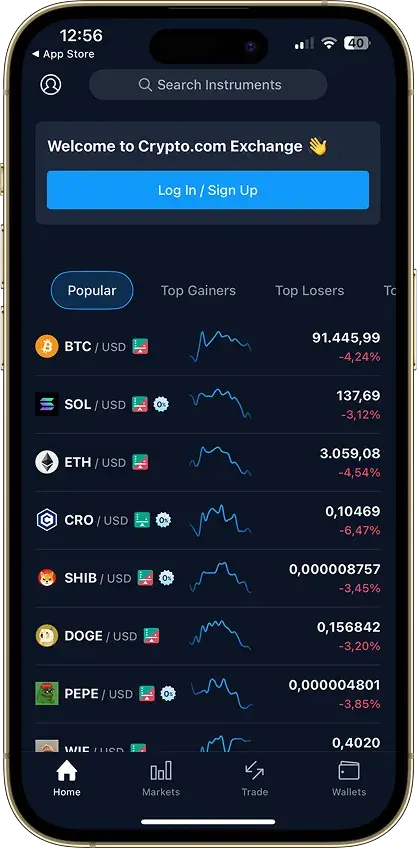
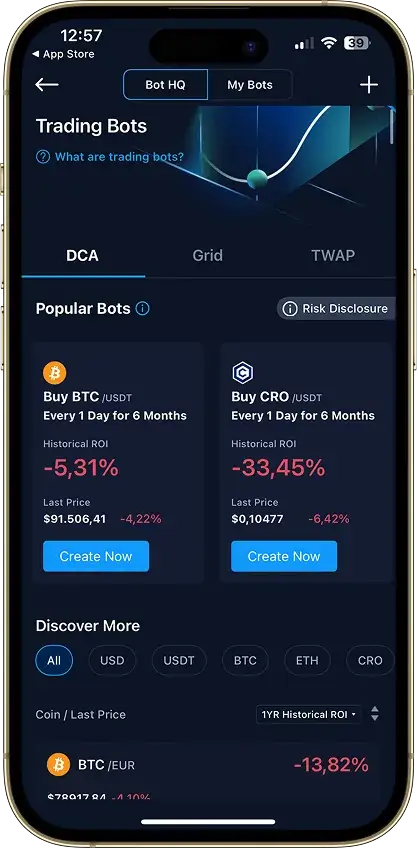
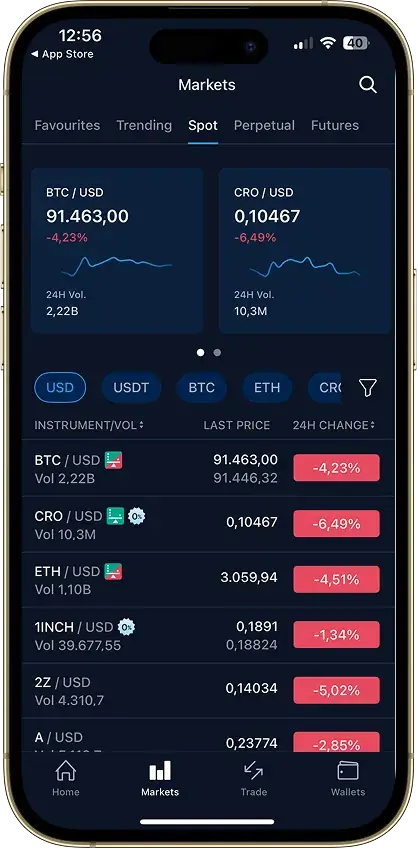
Screenshot 1 of 4
Coinbase screenshots

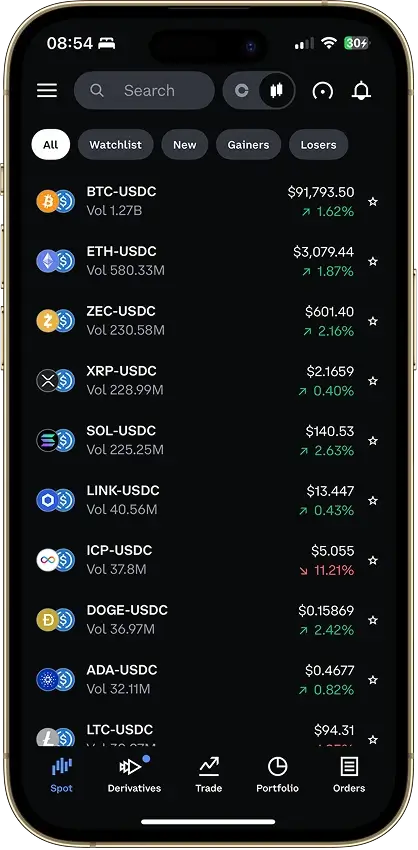
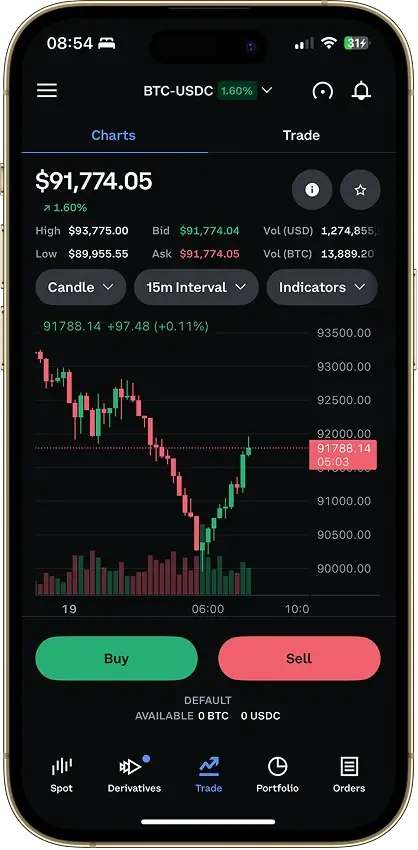
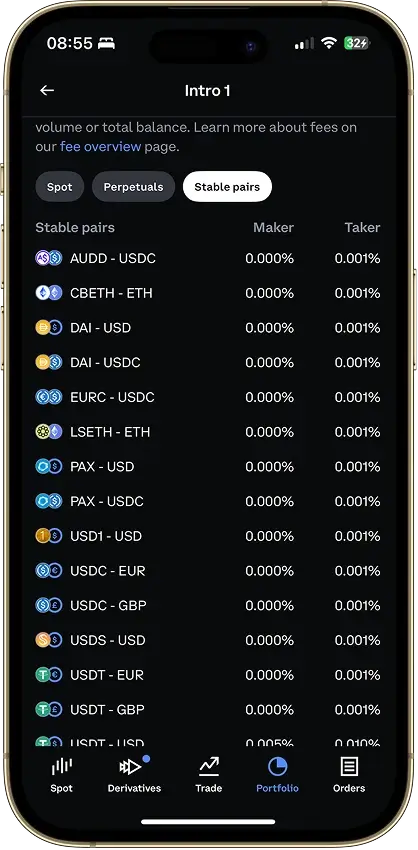
Screenshot 1 of 4
Final Verdict
Coinbase is our overall US choice for account access, cash-out flexibility and recurring financial reporting. Crypto.com is the lower-opening-fee alternative, with a smaller standard ETH staking commission.
Affiliate Disclosure
Some links in this comparison are affiliate links. CryptoSlate may earn a commission if you sign up through these links. Our ratings remain editorially independent.
Choose Crypto.com If…
- You mainly place opening-tier spot orders and want to reduce maker-taker commission.
- You want built-in spot bots rather than building an API workflow.
- You can use its Main App ETH staking program and understand its withdrawal conditions.
- You are comfortable managing separate Exchange and consumer App balances.
Choose Coinbase If…
- You live in New York or want simple buying and Advanced in the same account.
- You need ACH plus eligible instant bank cash-out options.
- You value recurring public financial statements and filings.
- You plan to apply for US perpetual-style futures alongside your spot account.
FAQs
Is Crypto.com or Coinbase better for US users?
Coinbase wins our overall comparison for all-state spot access, dollar withdrawal options and recurring public financial reporting. Crypto.com has lower opening spot commissions and a smaller standard ETH staking commission. The relevant state, account and product rules still apply.
Can Americans use Crypto.com Exchange?
Yes. Crypto.com offers a US retail spot Exchange with ACH and eligible Fedwire transfers. New York is excluded, and Fedwire has additional state restrictions. Main App staking and cards are separate, and US access does not include international Exchange margin or perpetuals.
Which has lower trading fees?
Crypto.com’s standard opening spot rates are 0.25% maker and 0.50% taker. Coinbase’s US Advanced rates became 0.50% and 0.90% on September 16, 2026. A $1,000 opening-tier taker fill costs $5 or $9 in commission, before other costs. Higher tiers and consumer purchases use different pricing.
Does Coinbase One remove Advanced trading fees?
No. Its eligible simple-trade fee waiver does not waive Advanced commissions or eliminate the spread. Preferred and Premium offer separate Advanced rebates under their plan terms. Membership costs must be included when estimating a saving.
Which is easier for withdrawing dollars?
Coinbase offers ACH, domestic wires and eligible instant bank cash-outs. Crypto.com US Exchange also supports ACH, but with a $100 withdrawal minimum. Its Main App has separate rules. Coinbase charges $25 for a standard domestic wire cash-out, with free domestic wires included in Preferred and Premium membership.
Which takes less commission on ETH staking?
Crypto.com’s Main App takes 15% of ETH rewards, compared with Coinbase’s standard 35%. Coinbase One reduces its ETH commission to 31.75%, 28.5% or 25.25% by plan. These are deductions from rewards, not guaranteed yields, and state eligibility and network withdrawal waits apply.
Are crypto balances FDIC-insured?
No. Coinbase’s conditional pass-through coverage concerns eligible cash at participating banks or credit unions, not crypto. Crypto.com’s US Exchange terms do not provide pass-through FDIC coverage for Exchange USD balances. Main App arrangements are separate. Account-security tools and reserve reports are not deposit insurance.
Do both exchanges offer 24/7 support?
Both advertise 24/7 chat. Coinbase also advertises 24/7 phone support for general customers, while paid plans can add priority or concierge services. Advertised opening hours do not establish response speed or how a dispute will be resolved.



Coinbase wins this US comparison for its all-state spot access, dollar withdrawal options and recurring public financial disclosure. Its opening trading commission is higher, so a frequent trader should calculate that cost before choosing convenience over price.
The Crypto.com fees and product review covers the Exchange and its related products. US customers can use a domestic spot Exchange, not just the consumer App. This comparison keeps App staking and cards separate from Exchange fees, and does not count international margin or perpetuals as US features.
The Coinbase trading and custody evaluation explains its shared simple-buy and Advanced account. Switching interfaces changes how a trade is priced without requiring another exchange balance. Coinbase’s US Advanced opening rates changed on September 16, 2026, and the figures below reflect that change.