

 Launched in 2015
- Audited financials and SOC examinations
- Every state plus D.C. and Puerto Rico
- No-fee credit card that pays back in crypto
Gemini Overview
- Crypto Exchange Name
- Gemini
- Parent Company
- Gemini Space Station, Inc.
- Launch Year
- 2015
- KYC
- Yes
- Total Assets
- 99+
- Staking
- Yes
- Copy Trading
- No
- Derivatives
- Yes
- Proof of Reserves
- No
- Trading Fees
- 0.00% - 1.20%
- Maker Fee
- 0.60%
- Payout Time
- 5 days
Additional details
- Languages
- English, Spanish, French, Portuguese, Italian
- Products
- Spot, Futures or Perps, OTC, Simple-buy Broker
- Restricted Countries
- Afghanistan, Iran, North Korea, Sudan, Syria, Iraq, Libya, Pakistan, …Afghanistan, Iran, North Korea, Sudan, Syria, Iraq, Libya, Pakistan, Yemen
- Supported Cryptos
- Bitcoin, Ethereum, Zcash, Litecoin, Gemini Dollar, …Bitcoin, Ethereum, Zcash, Litecoin, Gemini Dollar, Chainlink, Basic Attention Token, Orchid, Dai, Avalanche, Bitcoin Cash, Bonfida (aka SNS), Dogecoin, Filecoin, Polkadot, Raydium, Samoyedcoin, Solana, GMT, Tezos, Zebec Protocol
Gemini Screenshots

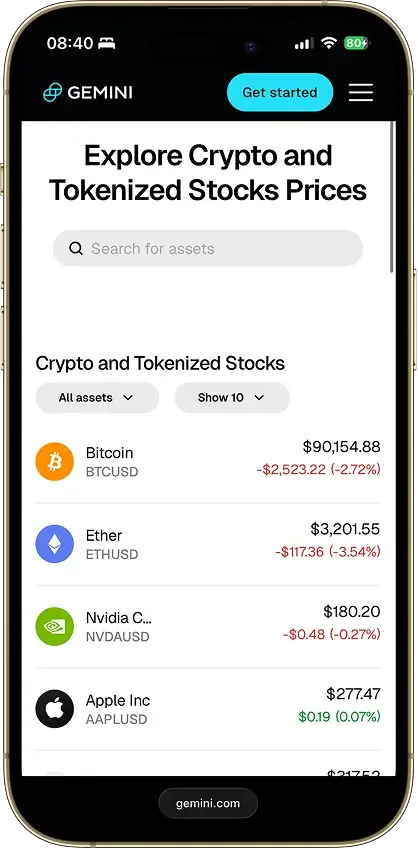
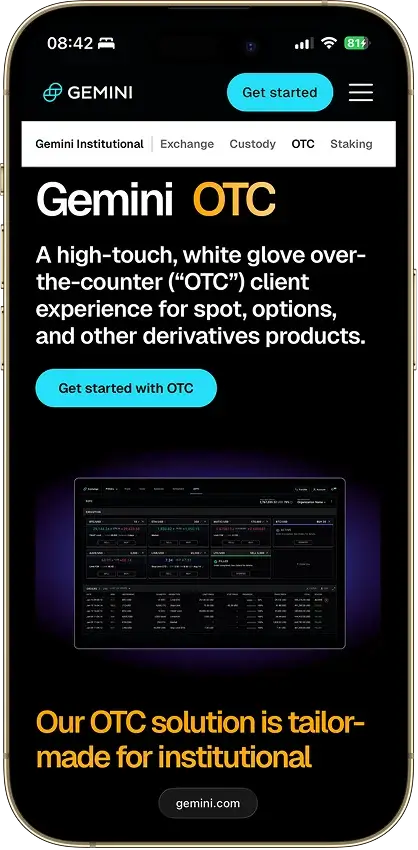
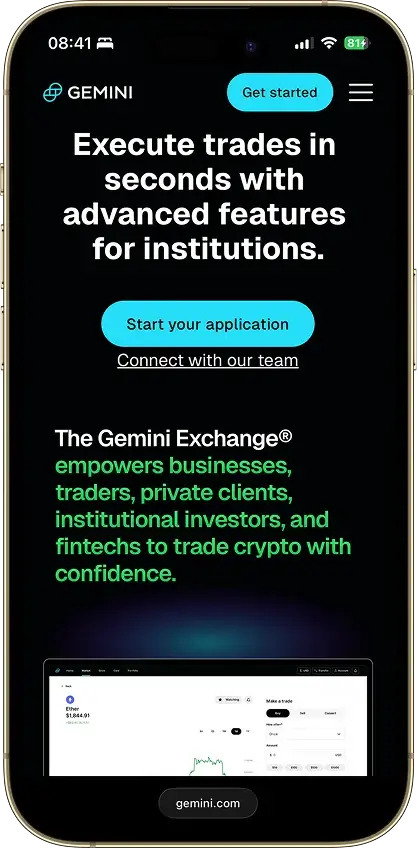
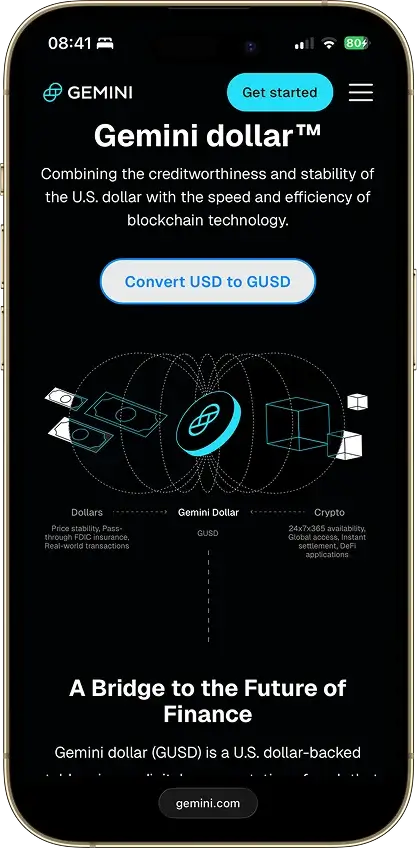
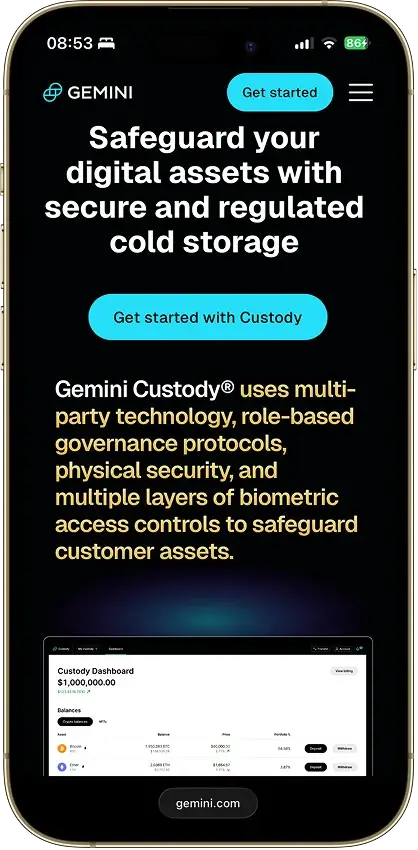
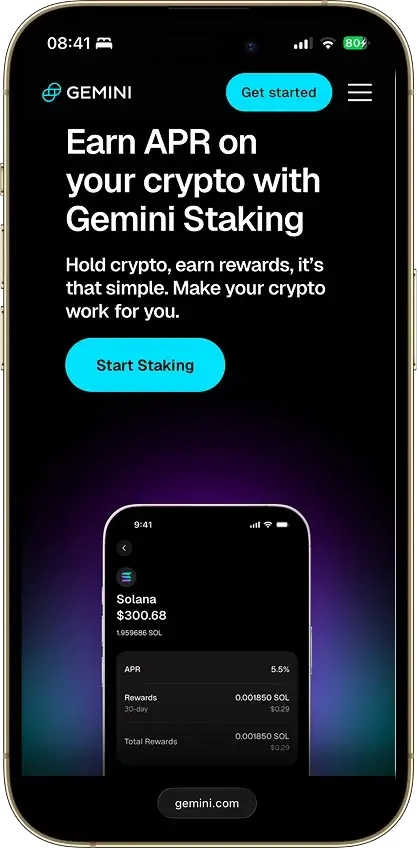
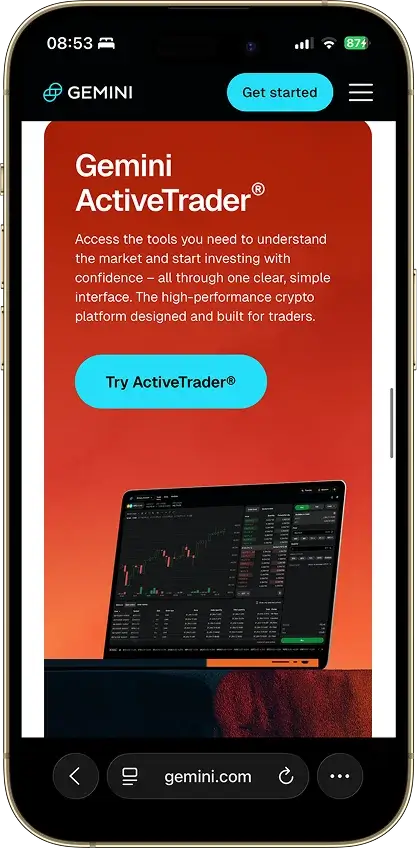
Screenshot 1 of 8
Gemini Pros and Cons
Pros
- Free ACH, up to $100,000 a day out
- REST and WebSocket plus FIX access
- TradingView charts in ActiveTrader
- RLUSD/USD and GUSD/USD trade fee-free
- ETH, SOL and MON staking with monthly rewards
Cons
- 1.20% taker fee at the ActiveTrader entry tier
- No user-verifiable Merkle reserve proof
- Exchange support relies on form and email
- Card and Apple Pay buys cost 3.49%
Quick Decision: Is Gemini Worth It?
Audited disclosures, all-state U.S. access, and free ACH distinguish Gemini's domestic account, but ActiveTrader begins at 0.600% maker and 1.200% taker. It does not suit users who need ordinary retail margin or an account outside Gemini's 41-country footprint. Gemini products also operate under different entities and eligibility rules.
Use Gemini if U.S. state coverage and custody disclosure matter more than the cheapest entry commission. Skip it if you need access in the U.K. or Australia. EEA residents and users who want a general exchange phone line should also look elsewhere.
Who Gemini Is Best For And Who Should Skip It
Gemini works best when the user needs U.S. exchange access and can fund by ACH. ActiveTrader should become the main trading surface for repeat orders. Product and entity checks become more important for staking and margin. Custody and international derivatives have their own boundaries.
Gemini fits a U.S. user who prioritizes state access and documented controls over raw asset count. Free ACH reduces funding friction, and FIX connectivity matters for a narrower professional audience.
The fit weakens outside Gemini's 41-country operating footprint. It also weakens when purchased assets must leave before payment settlement. Retail access to margin or perpetuals requires extra eligibility or a supported non-U.S. jurisdiction.
Features And Services
Gemini separates its simple exchange interface from ActiveTrader while keeping both under the same account experience. Staking and Asset Rewards remain distinct. The credit card and self-custody wallet do too. Qualified custody, margin access, and perpetuals follow separate rules.
ActiveTrader is the important surface for repeat spot orders because it exposes the order book and published maker-taker schedule. The retail interface is simpler, but its final quote and payment method still need checking before confirmation.
Supported Assets And Markets
Gemini's Trust Center listed 99 cryptocurrencies and eight fiat currencies on August 29, 2026. It also displayed 655 trading pairs, while the public symbols endpoint returned 347 symbols. That unresolved difference makes 99 the usable dated asset count and rules out one precise market total.
The asset range covers major cryptocurrencies and a selected altcoin set, but the dated count should not be used as proof of market depth. Users need to check the asset and quote currency. The withdrawal network and account eligibility require separate checks.
Liquidity, Order Types, And Trading Limits
ActiveTrader uses central-limit order books with price-time priority, shows order-book depth, and integrates TradingView charting. No published measurement of spread or slippage exists for these markets. Fill rate and order-book depth are unmeasured too, so execution quality must be checked on the intended market and order size.
The API protocols and order-book model support professional workflows. They do not establish the fill price or uptime a particular strategy will receive.
Margin And Derivatives
Gemini Margin is not an ordinary retail margin product. It requires a Moonbase account with Eligible Contract Participant status. Product approval and an eligible jurisdiction are also required. Selected non-U.S. customers can access a separate perpetual product.
The distinction prevents a U.S. retail user from mistaking product-page marketing for account eligibility. Borrowing rates and liquidation fees can also outweigh spot commission on a borrowed position.
Staking And Rewards
Gemini Staking supports ETH plus SOL and MON. Advertised APRs vary with protocol conditions. The current agreement and product page give different service-fee wording, while the support article retains another figure.
Gemini deducts commission from protocol rewards, and the displayed APR is not established as a net figure. Compare the quoted reward with the service fee. Exit delay and regional access also matter when evaluating exchange staking options.
Gemini Staking and Asset Rewards are separate programs. The same assets cannot generate rewards in both at the same time.
Card
The Gemini Credit Card draws on a U.S. credit line and does not spend an exchange balance. It earns 4% in crypto on qualifying gas and EV charging. Transit and rideshare qualify too, including taxis. The rate covers the first $300 of that category each calendar month, then falls to 1%. Dining earns 3%. Groceries earn 2%, while other qualifying purchases earn 1%.
Gemini states that the card has no annual fee and no foreign-transaction fee. Interest and approval terms still matter, and the explicit 24/7 phone route inside Card settings applies to card issues, not ordinary exchange support. Users comparing rewards can place it alongside other crypto-linked card products without treating card approval as exchange access.
Wallet And Self-Custody Options
Gemini holds exchange balances in custody, while Gemini Wallet is a separate browser-based self-custody smart wallet. It uses passkeys and signs on the user's device. Ethereum is supported alongside Arbitrum / Optimism / Polygon / Base.
Moving funds to Gemini Wallet shifts key control and recovery responsibility to the user. The wallet's five networks are not the exchange's deposit-and-withdrawal network count. The self-custody wallet directory covers alternatives for users who want a different chain set or recovery model.
API And Programmatic Trading
Gemini provides REST and WebSocket access for retail automation plus FIX connectivity for eligible institutional workflows. It does not publish a latency or fill-quality benchmark for those interfaces, so live testing and conservative key permissions still matter.
FIX and TradingView distinguish the pro stack from a basic retail API. No independent latency, depth, or fill-quality measurement is available, so endpoint access alone does not establish execution performance.
Fees And Pricing
Gemini's July 9, 2026 ActiveTrader schedule is clear but costly at entry. Order-book spot starts at 0.600% maker and 1.200% taker. The top displayed tier reaches 0% maker and 0.020% taker at $250 million in qualifying trailing volume.
A $1,000 entry ActiveTrader order costs $6 as a maker or $12 as a taker before spread or slippage. Funding and withdrawal costs sit outside that calculation. Debit-card funding would add $34.90 before applicable trading fees.
Hidden Costs To Watch On Gemini
The maker-taker schedule applies to ActiveTrader and API order-book activity. It does not describe every retail quote or payment fee. Margin charges and withdrawal costs sit outside it.
- Debit and mobile-wallet purchases cost 3.49%
- U.S. PayPal costs 2.50% plus trading fees
- USD wire withdrawals cost $25
- External transfer charges use the selected route
- Margin accrues hourly and liquidation adds 0.5%
- Staking commission reduces protocol rewards
The lowest-cost practical U.S. path is generally free ACH funding followed by an ActiveTrader order at the account's qualifying tier. Check the settlement hold and cash-out route before funding if the assets need to leave quickly.
VIP Tiers And Fee Discounts
Gemini recalculates the fee tier daily using qualifying trailing 30-day volume or an eligible asset balance, whichever creates the lower fee. The highest displayed volume tiers do not show a balance-based shortcut.
The 0% maker endpoint requires $250 million in qualifying activity. A low-volume user should compare the entry tier, which is the normal retail cost before volume discounts.
Deposits, Withdrawals, KYC And Availability
Payment method determines both the fee and settlement time. It also decides when purchased crypto can leave. Gemini requires identity verification for normal exchange use, and no low-KYC operating tier is supported.
ACH can provide trading credit before settlement at Gemini's discretion, but the associated value cannot necessarily be withdrawn immediately. Wire and crypto transfers use separate timing and review rules.
What U.S. Users Need To Check Before Signing Up
Gemini serves the entire U.S. state footprint plus Puerto Rico and Washington, D.C. The Moonbase and Gemini Trust entity split does not remove core exchange access. Individual assets and products remain subject to state, entity, and eligibility rules. Most U.S. users moved to Gemini Moonbase. New York and Idaho accounts remain with Gemini Trust, as do qualified-custody relationships and some other documented exceptions.
The user's governing agreement controls the account entity and identifies the applicable custody relationship. A Gemini Trust qualified-custody relationship should not be treated as the default for every Moonbase exchange account. Users comparing U.S.-available exchanges should confirm the exact product as well as state access.
Payment Rails, Networks, And Limits
Free U.S. ACH deposits and withdrawals make that rail Gemini's clearest funding advantage. Wire transfers suit larger or time-sensitive bank movements. Card and mobile-wallet routes cost more, while PayPal combines a fee with a settlement hold.
Fiat Rails By Region
The 41-country Trust Center figure describes current operations. Each country can receive a different bank method and product set.
Users outside the United States need to confirm that both the account and desired payment rail are active. Older country and staking lists still name closed regions and do not override the April 6, 2026 closure notice.
Withdrawal Networks And Fees
An asset listing does not establish every network route. Gemini shows the available asset-and-network combination before confirmation. The same screen supplies the dynamic fee and minimum.
Gemini charges no crypto deposit fee, while the external withdrawal quote varies by route. Sending through an unsupported chain can leave the transfer unrecoverable. A valid transfer can still wait on blockchain confirmation and account controls.
Verification Levels And Withdrawal Limits
Gemini uses full KYC and risk-based controls without a simple public tier ladder. Payment-method limits and settlement holds can apply even after identity approval.
ACH withdrawal is capped at $100,000 per day in the current U.S. table. Debit-card and PayPal purchases each have a $1,000 daily limit, while the USD wire table gives no maximum. These figures apply by rail and do not form a universal account ceiling.
Is Gemini Safe? Security, Custody And Proof Of Reserves
Gemini has a documented custody and controls framework, but neither audits nor one-for-one claims guarantee future solvency or protect against every loss. Its trust model relies on segregation and audited statements. SOC examinations, account controls, and qualified custody where applicable add further support. A user-queryable Merkle reserve proof is absent.
Controls
Gemini requires 2FA by default for account access and withdrawals. It supports hardware security keys and withdrawal-address allowlisting. Those controls reduce account-takeover exposure when configured correctly, but they do not validate the exchange's liabilities.
Custody And Insurance
Gemini states that customer fiat and digital assets are held one-for-one and segregated from company assets. Qualified custody is provided through Gemini Trust Company, while ordinary U.S. exchange accounts can sit with Gemini Moonbase depending on the governing agreement.
Gemini separates custody protections by entity and account relationship. Gemini publishes no current exchange-wide customer-loss insurance amount, so cash or custody protections should not be described as blanket crypto insurance.
Proof Of Reserves Or Audits
Gemini does not provide a current exchange-wide Merkle-tree tool that lets a customer verify that an account balance was included in a reserve calculation. Its Trust Center instead listed audited financial statements through December 2025 and SOC 1 Type 2 and SOC 2 Type 2 examinations through September 30, 2025. Gemini also states ISO 27001 coverage and annual penetration testing.
This disclosure model provides recurring financial and control reporting, but it differs from user-verifiable proof of reserves. The crypto exchange review directory lets users compare which platforms publish balance-inclusion proofs and which rely on audits or segregation statements.
App, UX And Customer Support
Gemini does not expose every product through one uniform account surface. Moving from basic trading into ActiveTrader, staking, custody, margin, or derivatives can change the interface, agreement, entity, or eligibility rules.
UI And Navigation
The retail interface covers funding and portfolio monitoring alongside basic trading. Users must switch to ActiveTrader for the central-limit order book, depth display, and published maker-taker schedule. TradingView and advanced connectivity complete that surface. Staking and Asset Rewards remain distinct. Custody and margin do too, while perpetuals follow country rules. The card and self-custody wallet carry separate risks.
Mobile App
The mobile app supports core funding, trading, portfolio, and security workflows. Staking and card management appear where eligible. ActiveTrader access is available for supported products. Gemini Wallet remains a separate browser-based self-custody product.
Reliability And Status Page
Gemini publishes a status page with current incidents and historical service records. That transparency helps users distinguish a platform outage from an account-specific review, although it does not predict future uptime.
Gemini's status page tracks platform-wide events and historical incidents. Account-specific verification delays, funding holds, and restrictions require separate support review.
Customer Support
General exchange support relies on a request form and email. The explicit 24/7 phone route appears inside Gemini Credit Card settings and applies to card issues.
- Help center covers common account procedures
- Support requests route through form and email
- Card users receive a separate phone path
- Support can investigate account and payment issues
- Support cannot reverse confirmed blockchain transfers
- Account review timing depends on the case
Gemini provides a support form and email but states no target for a reply or case resolution. Account-review timing depends on the case, and no general exchange phone line is documented.
Reporting And Account Records
Gemini provides account history and tax reporting support for eligible U.S. users. Gemini issues Form 1099-MISC for qualifying reward income and Form 1099-DA for sale proceeds beginning with tax year 2025. Forms and exports assist recordkeeping but do not complete a user's return.
Gemini Alternatives
-


Coinbase
Coinbase fits U.S. users who fund by ACH and use Advanced, but Simple Buy costs and regional product rules require attention.
-

Kraken
Kraken combines quarterly reserve-inclusion checks with separate Pro trading tools and account security controls. Its entry spot fees and funding-related withdrawal holds are the main tradeoffs.
-

Crypto.com
Crypto.com Exchange serves spot traders in the U.S. and abroad, with global margin and derivatives outside restricted jurisdictions. Its U.S. bank-transfer terms differ from Main App banking, although ACH deposit allowances are...
Gemini's 0.600% maker and 1.200% taker entry fees and reduced international access are the main reasons to compare another exchange. The replacement should solve a specific constraint instead of adding products the account cannot use.
- Coinbase's banking and disclosure model — A beginner who wants a larger U.S. asset range and live chat. Simple purchases can still cost more than Advanced Trade
- Kraken's fee and reserve model — A trader who wants quarterly user-verifiable reserve inclusion and more global listings. New York and Maine are excluded
- Crypto.com review — An eligible user prioritizing more assets, staking choices, and card programs. Product surfaces and regional rules are more fragmented
- Another Crypto Exchange — Users who need a different state, country, fee, reserve, or bank-rail fit. Each platform must be checked by product and jurisdiction
Kraken is the clearest alternative when verifiable balance inclusion is the priority. Coinbase adds a larger dated U.S. asset range and live chat, although Simple Buy can cost more than Advanced. Crypto.com lists 422 dated spot assets and separates its Exchange from Main App staking, cards, and Onchain.
Gemini Category Scores
These scores highlight how this review performs in specific categories, with each score tailored to the focus of that category.
Final Verdict
Gemini suits a U.S. user who funds and cashes out by free ACH and accepts ActiveTrader's entry fees. Audited financial statements and SOC examinations document its control environment. Hardware-key support pairs with address allowlisting, while FIX connectivity serves professional workflows. ActiveTrader begins at 0.600% maker and 1.200% taker, making the cost limit material. General exchange support uses form and email. Accounts in the U.K. and Australia closed in April 2026, together with those in the EEA. Gemini also lacks an exchange-wide Merkle inclusion tool, so its reserve case depends on audit reports and segregation statements. Custody protections depend on whether the account sits with Gemini Trust Company or Gemini Moonbase. Choose Gemini if U.S. access and published controls matter more than entry trading fees. Free ACH adds practical value. Compare alternatives if you need lower commission at low volume or access in more than 41 countries. A larger asset range and ordinary retail margin access also require a different exchange.
Disclaimer: CryptoSlate may receive a commission when you click links on our site and make a purchase or complete an action with a third party. This does not influence our editorial independence, reviews, or ratings, and we always aim to provide accurate, transparent information to our readers.