

Worth considering for planned Advanced spot trading in supported states. Less suitable for immediate withdrawals after funding or for checking independently that your balance is in reserves.
Binance.US vs Coinbase: US Fees, Staking and Cash-Out
Coinbase wins overall for all-state spot access, audited reporting and broader cash-out options. Binance.US wins on entry Advanced commissions and the number of standard-staking assets.

Coinbase fits U.S. users who fund by ACH and use Advanced, but Simple Buy costs and regional product rules require attention.
Affiliate Disclosure
Some links in this comparison are affiliate links. CryptoSlate may earn a commission if you sign up through these links. Our ratings remain editorially independent.
Winners by Category
Binance.US takes the fees and staking-menu categories. Coinbase takes the overall verdict plus state access, cash-out options, financial reporting and human-support hours.
Binance.US Coinbase
Coinbase wins overall for access and account flexibility. Binance.US is the cost-focused alternative for supported-state spot traders.
Low-commission spot trading with state and funding restrictions
All-state spot access, audited reporting and eligible instant cash-out
Binance.US wins on entry commission. This does not compare the total cost of Simple Buy quotes or trade execution.
0% maker / 0.02% standard taker
0.50% maker / 0.90% entry taker
Coinbase wins on state coverage. Individual assets and other products still have restrictions.
38 states, the District of Columbia and Puerto Rico
All 50 states for centralized spot
Binance.US wins on the listed standard-staking range, not net yield. Soft-Staking is a separate program.
30+ standard-staking assets
Nine named assets where eligible
Coinbase wins on the extra instant bank route. Only available funds can be cashed out.
ACH and domestic wires where USD services are enabled
ACH, domestic wires and eligible instant RTP
Coinbase wins on financial disclosure. An audit does not insure a customer balance or eliminate custody risk.
SOC 2 controls audit, not public audited financial statements
Audited annual financial statements and recurring SEC reports
Coinbase wins on published human-support hours. This is not a measured response-time or resolution comparison.
Chat daily 6 a.m.–midnight Eastern, phone on weekdays
24/7 live phone and chat
Screenshots
Binance.US screenshots
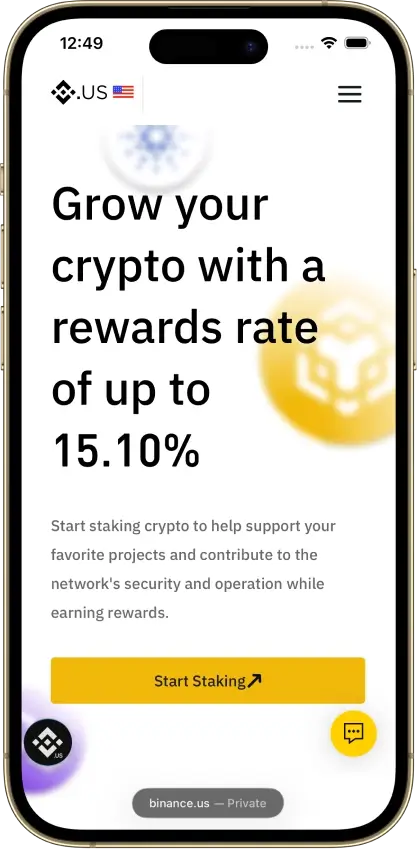
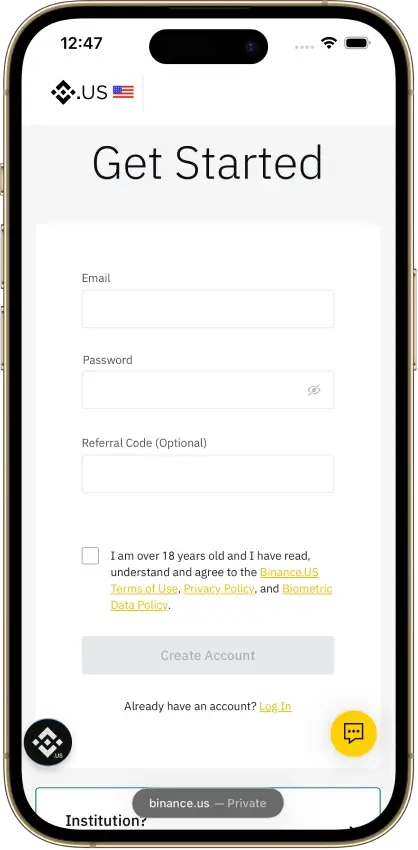
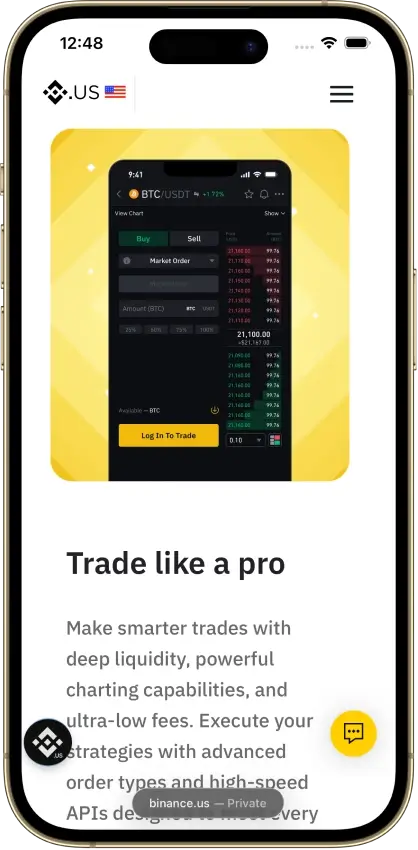
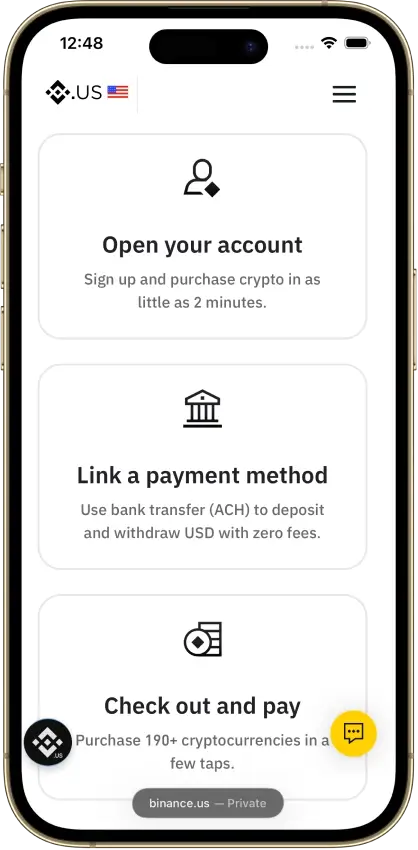
Screenshot 1 of 4
Coinbase screenshots

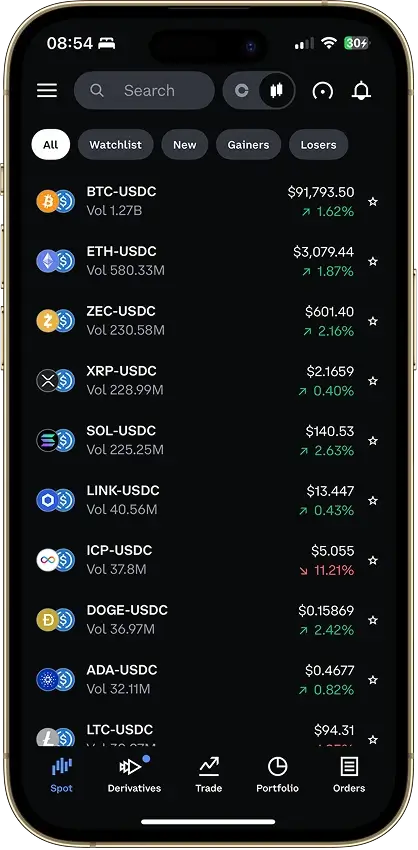
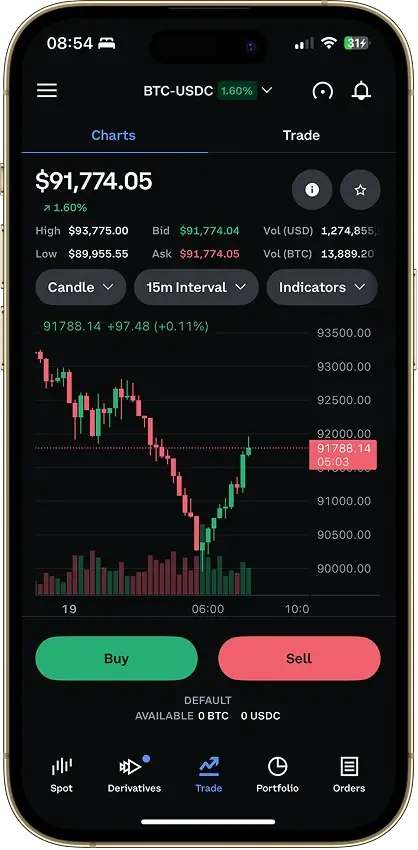
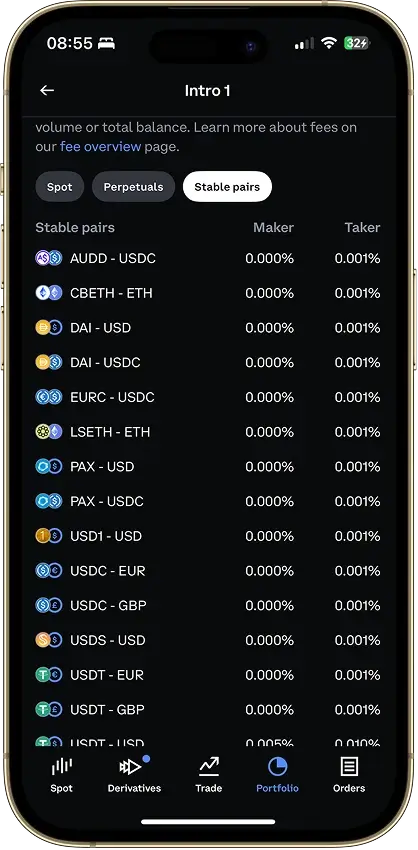
Screenshot 1 of 4
Binance.US vs Coinbase Overview
This page compares Binance.US with Coinbase US retail and Advanced. Binance.com’s international products, fees and reserve disclosures do not apply to Binance.US.
Trading Fees
Binance.US wins on entry Advanced commission. On a $1,000 taker trade, its standard charge is $0.20 against Coinbase’s $9, before market spread, slippage or later withdrawal costs.
Binance.US Coinbase
Entry Maker Commission
Binance.US wins by $5 in commission. The order must qualify as a maker.
0%: $0 on a $1,000 order
0.50%: $5 on a $1,000 order
Entry Taker Commission
Binance.US wins by $8.80 in commission at these tiers. Execution prices and transfer charges are separate.
0.02%: $0.20 on a $1,000 order
0.90%: $9 on a $1,000 order
Coinbase’s US entry schedule changed on September 16, 2026. Its lower EU and UK rates are not the rates for this comparison. Higher qualifying volume or eligible USDC balances can change a Coinbase account’s tier. The separate institutional Coinbase Exchange schedule is not a substitute for retail Advanced pricing.
Binance.US charges 0.01% taker on BNB/USD and at its $500 million 30-day-volume tier. Paying eligible fees with available BNB gives an optional 5% discount. At the standard 0.02% rate, that reduces a $1,000 trade’s commission from $0.20 to $0.19. Buying BNB solely for that saving adds exposure to its market price.
Simple Buy uses a different calculation. Both services can include a spread in a quoted purchase, and Coinbase’s review estimates roughly 2.5%–3.5% total cost on small purchases. That estimate is not a universal fee. Compare the executable quotes for the same spend if you want the simpler purchase screen.
Coinbase One’s qualifying simple-trade fee waiver does not make Advanced free. Preferred and Premium instead offer a 25% Advanced spot rebate, capped at 100 USDC monthly for Preferred. Subscription charges and rebate conditions belong in the calculation before comparing crypto trading platforms.
US Availability and Supported Assets
Coinbase wins on state coverage. Binance.US excludes 12 states and provides crypto-only accounts in Kansas and Wisconsin, so low trading fees do not always come with dollar banking.
Binance.US Coinbase
Centralized Spot State Coverage
Coinbase wins on state access, including New York and Texas where Binance.US is unavailable.
38 states, plus the District of Columbia and Puerto Rico
All 50 states, with asset-level rules
USD Banking in Kansas and Wisconsin
Coinbase wins for bank-funded accounts in these states, subject to account and bank eligibility.
Unavailable: crypto services only
ACH and other eligible US banking methods
Binance.US excludes Alaska, Connecticut, Georgia, Maine, New York, North Carolina, North Dakota, Ohio, Oregon, Texas, Vermont and Washington. Passing identity verification does not remove a state restriction. Residents of those states need a different US exchange, regardless of Binance.US’s commission advantage.
Binance.US counted 204 assets and 265 pairs on September 15, 2026. Coinbase’s review gives a dated US retail range of roughly 270–315 assets and about 460 pairs. The snapshots are not a synchronized inventory, and neither total guarantees access to a particular coin in your state. Check the trading pair and its deposit and withdrawal networks.
Tokens available only through either company’s separate self-custody products are not exchange listings. An exchange can also leave trading enabled while a token’s deposits or withdrawals are interrupted.
Staking and Rewards
Binance.US wins on the number of standard-staking assets. That wider menu does not settle the better reward rate: commissions, enrollment requirements and exit times differ.
Binance.US Coinbase
Published Standard-Staking Menu
Binance.US wins on the listed asset count. Access and reward terms remain asset-specific.
30+ assets
Nine named assets where eligible
Binance.US standard staking deducts 9.95%–39.95% of rewards, depending on the asset. Its separate Soft-Staking program covers SOL, ADA, ETH and BNB, leaves balances usable, and deducts 90% of rewards. A $10 protocol reward therefore leaves $1 under Soft-Staking after that deduction. Standard staking locks assets during staking and unstaking.
Accounts opened on or after June 5, 2026 must enroll in Binance.US Soft-Staking to use all account functions. Earlier accounts can opt out. This enrollment rule matters even to someone opening the exchange only to trade.
Coinbase names ADA, ATOM, AVAX, DOT, ETH, MATIC (POL), SOL, SUI and XTZ. Its general 35% deduction applies to eight of those assets, not SUI. Eligible Coinbase One discounts reduce the deduction on ADA, ATOM, DOT, ETH, SOL and XTZ. Check the SUI terms in the account instead of extending the general schedule to it.
New staking principal is paused on Coinbase in California, Maryland, New Jersey and Wisconsin, and SUI staking excludes New York. For a shared eligible asset, compare each staking exchange on the displayed net reward and unstaking wait.
Deposits and Withdrawals
Both offer free standard ACH where dollar services are enabled. Coinbase adds eligible instant RTP cash-out, while Binance.US charges less for a standard incoming wire without a paid Coinbase plan.
Binance.US Coinbase
Standard ACH Platform Fees
Tie on platform charges, not holds or processing speed. The account must support USD services.
No deposit or withdrawal fee
No deposit or withdrawal fee
Incoming Domestic Wire Fee Without a Paid Plan
Binance.US wins on the standard platform charge. Coinbase One Preferred and Premium waive Coinbase’s fee. Bank charges can remain.
No Binance.US deposit fee
$10 Coinbase deposit fee
Outgoing Domestic Wire Fee Without a Paid Plan
Tie on the standard platform charge. Coinbase One Preferred and Premium waive Coinbase’s fee, and bank charges can remain.
$25 Binance.US fee
$25 Coinbase fee
Instant Bank Cash-Out Route
Coinbase wins on the available instant bank route, not a guarantee that a new deposit can be withdrawn immediately.
ACH and wires, no instant RTP route listed
Eligible instant RTP, up to $100,000 per transaction
Every new Binance.US ACH or card deposit starts a seven-day withdrawal hold on the funded amount, including crypto bought with it. Previously available funds are not automatically locked by that deposit. A completed trade does not shorten the hold. Coinbase also applies account- and funding-specific holds, so check the available-to-withdraw balance on either platform.
Binance.US lists ACH cash-out at 1–5 business days once funds are available. Coinbase’s US review also lists ACH at 1–5 business days. Bank processing is separate from the time spent waiting for deposited funds to become withdrawable.
Binance.US card deposits cost 3.99%, or $39.90 on a $1,000 deposit before any issuer charge. ACH avoids that exchange fee, but its linked bank account must hold at least 130% of the intended deposit. A $1,000 ACH request therefore needs a $1,300 available bank balance.
Binance.US wire withdrawals require at least $100. Its wire instructions say 2–5 business days, while the FAQ on the same page says 1–3. Use the longer window for planning and confirm the estimate when submitting. Coinbase’s $100,000 RTP figure is a per-transaction limit, not a universal daily or crypto-withdrawal allowance.
Trading Tools and Crypto Transfers
Both have Advanced spot orders and trading APIs. Coinbase adds Bitcoin Lightning transfers and separate eligible US derivatives access, while Binance.US remains a spot-only retail exchange.
Binance.US Coinbase
Market and Limit Orders
Tie on these basic instructions. A limit order can still execute as a taker.
Supported on Advanced
Supported on Advanced
Bitcoin Lightning Transfers
Coinbase wins for access to Lightning. The recipient must support the route.
No Lightning route
Lightning sends with a 0.2% processing fee
US Retail Derivatives Access
Coinbase wins on access to a separate derivatives product. A spot account alone does not qualify a user.
No retail margin, futures, perpetuals or options
Separate eligible US futures and perpetual-style contracts
Binance.US documents post-only, OCO and iceberg orders on the website. Coinbase Advanced includes market, limit and stop-limit instructions, with additional controls depending on product and market. Commission and order types do not prove that one exchange will produce a better fill.
For crypto cash-out, choose a network supported at both ends and review its current charge. Binance.US supports ETH withdrawals on Ethereum, Arbitrum, Base and Optimism, among other routes. Coinbase’s Lightning route creates another Bitcoin option, but neither exchange is universally cheaper across all transfer amounts and networks.
Coinbase’s US derivatives require separate onboarding, collateral and contract eligibility. Binance.com’s international derivatives are not a Binance.US alternative. Coinbase’s futures accounts use separate margin and liquidation rules, so losses can exceed the initial margin committed.
Security, Custody and Financial Disclosure
Coinbase wins on audited financial reporting. Both remain custodians, and neither provides a customer Merkle-inclusion tool for independently checking a personal exchange balance.
Binance.US Coinbase
Public Audited Financial Statements
Coinbase wins on financial disclosure. SOC 2 assesses controls and is not an audit of the financial statements.
SOC 2 Type II controls audit announced, not a public financial audit
Audited annual statements and recurring SEC filings
Binance.US says customer assets are backed one-for-one, while Coinbase publishes corporate financial statements and recurring reports. Neither disclosure gives the individual customer a Merkle proof of reserve inclusion. Binance.com’s reserve dashboard does not cover the separate Binance.US service.
Both provide two-factor authentication and withdrawal-address allowlisting. Coinbase additionally documents passkeys and hardware-key support. Use those controls before funding and keep recovery details protected. They address account takeover, not every risk associated with exchange custody.
Coinbase’s partial crime insurance covers specified events, not losses from compromised customer credentials. Its qualifying dollar balances can receive pass-through FDIC or NCUSIF coverage only under the relevant conditions. Crypto does not receive that cash protection. Binance.US does not promise FDIC protection for its exchange wallet.
Coinbase’s 2025 support-contractor data incident led to social-engineering losses for some users, and it offered voluntary reimbursement to eligible affected customers. Binance.US lost dollar banking in 2023 before ACH restoration began in February 2025. These histories explain different operational risks, not a guarantee about the next withdrawal.
Apps, APIs and Customer Support
Coinbase wins on published human-support hours. Both offer mobile apps and REST/WebSocket access, but Coinbase’s mocked sandbox is not a live order-book test.
Binance.US Coinbase
Web and Mobile Access
Tie: both support website, iOS and Android access.
Website, iOS and Android apps
Website, iOS and Android apps
Trading API Protocols
Tie: both offer REST requests and WebSocket feeds.
REST and WebSocket
Advanced REST and WebSocket
Live Human Chat Hours
Coinbase wins for overnight access to live chat.
Daily, 6 a.m.–midnight Eastern
24/7
Live Telephone Hours
Coinbase wins for evening and weekend telephone access.
Monday–Friday, 9 a.m.–7 p.m. Eastern
24/7
Binance.US uses an automated assistant outside its live-agent hours. On Coinbase, paid support benefits change priority or service level rather than whether human phone and chat exist. These hours describe access to an agent, not how quickly a case will be resolved.
Coinbase Advanced’s sandbox returns static mocked responses for supported requests. Binance.US has a test-order endpoint, but that is not a simulated market. Neither is evidence of a bot’s live fill quality. Limit API permissions to the required activity and keep withdrawal access disabled unless the integration needs it.
Binance.US transaction-history reports can be exported as CSV or PDF, with up to 10 custom reports per month and 12 months per report. Coinbase supplies account history and tax tools. Keep separate wallet and exchange records too, since a platform report may not establish the acquisition cost of incoming assets.
Cards and Separate Wallets
Coinbase has US spending-card products. Binance.US accepts eligible card deposits but does not issue a spending card. Separate wallets do not change either exchange’s custody terms.
Binance.US Coinbase
Exchange-Linked US Debit Card
Coinbase wins on having a US debit-card option. Card eligibility and spending terms are separate from the spot account.
No Binance.US-issued spending card
Coinbase Visa debit card outside Hawaii
Coinbase Card can spend eligible USD, USDC or crypto balances, with no annual fee or Coinbase spending fee. A crypto-funded payment can create a taxable disposal. The separate Coinbase One credit card requires eligible membership and credit approval, so it should not be confused with the debit product.
Binance.US Web3 Wallet and Coinbase’s Base app use separate self-custody arrangements. Their token menus do not increase the custodial exchanges’ asset counts. Users moving funds into either wallet take responsibility for recovery and transaction approvals.
Final Verdict
Coinbase wins overall for all-state US spot access, audited reporting and eligible instant bank cash-out. Choose Binance.US for lower entry Advanced commissions and more standard-staking assets, if your state and funding plans fit.
Affiliate Disclosure
Some links in this comparison are affiliate links. CryptoSlate may earn a commission if you sign up through these links. Our ratings remain editorially independent.
Binance.US vs Coinbase FAQs
Is Binance.US or Coinbase better for US users?
Coinbase is the overall choice for all-state spot access, audited financial reporting and eligible instant bank cash-out. Binance.US is the lower-commission Advanced spot option for residents it accepts, with a larger standard-staking menu.
Is Binance.US cheaper than Coinbase?
At entry Advanced tiers, Binance.US charges 0% maker and 0.02% standard taker, against Coinbase US at 0.50% and 0.90%. A $1,000 taker order therefore costs $0.20 versus $9 in commission. Simple Buy quotes, spread and withdrawals need separate comparisons.
Is Binance.US the same as Binance.com?
No. BAM Trading Services operates Binance.US as a separate US service. Binance.com’s international fee tiers, derivatives and reserve disclosures do not apply to this account.
Can New York or Texas residents use Binance.US?
No. Both are among its 12 excluded states. Coinbase supports centralized spot accounts in all 50 states, although individual assets and other products can remain restricted.
Can I withdraw a new Binance.US deposit immediately?
No. ACH and card deposits impose a seven-day hold on the funded amount, including crypto bought with it. Previously available funds are not automatically locked. ACH bank processing takes additional time after funds are withdrawable.
Which has more staking assets?
Binance.US lists more than 30 standard-staking assets, compared with nine named Coinbase assets where eligible. The larger list does not guarantee a better return. Binance.US Soft-Staking is separate and deducts 90% of rewards.
Are ACH transfers free on both exchanges?
Both charge no platform fee for standard ACH deposits or withdrawals where USD services are enabled. Binance.US accounts in Kansas and Wisconsin have crypto services only. Account holds and bank processing still apply.
Does either exchange provide proof of my reserves?
Neither offers a customer Merkle-inclusion tool for checking a personal exchange balance. Coinbase publishes audited financial statements. Binance.US’s announced SOC 2 audit concerns controls rather than a financial statement or reserve attestation.


Coinbase is the more broadly usable US account: residents of every state can access centralized spot trading, and eligible accounts get an instant bank cash-out option alongside ACH and wires. Its audited public-company reporting also gives users more financial information to assess. These advantages make Coinbase the overall winner even though its opening Advanced commission is higher.
Binance.US is compelling when the main task is repeated spot trading with funds deposited ahead of time. Its standard Advanced taker commission is $0.20 on a $1,000 order, compared with $9 at Coinbase’s US entry tier. New Binance.US accounts require Soft-Staking enrollment, and ACH-funded amounts cannot be withdrawn for seven days.
A Coinbase retail account shares one balance between Simple Buy and Advanced. Using the same balance does not make those screens equally priced. Both exchanges offer quoted purchases as well as order-book trading, so select the intended interface before comparing the final cost.