





Scams
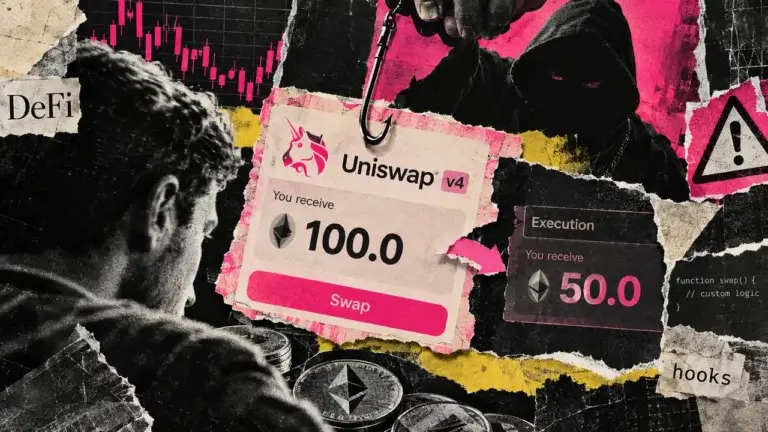
Malicious Uniswap v4 hooks are baiting DeFi traders with fake swap quotes
Malicious Uniswap v4 hooks can win aggregator routing with attractive quotes, then change behavior when a user's transaction settles.

$572.03M traded Price signal supported
Trading Activity price-reliability indicator with 100 percent data coverage. Low activity replaces price-derived sentiment because the displayed market price may not be supported by meaningful trading.Target
Peg Health price-stability indicator with 0 percent data coverage. It measures observed market pricing, not reserve quality or redemption safety.30D +40.5% 80.0% below ATH
Price-based current market conditions indicator with 100 percent data coverage. This is not a price forecast.$572,033,276.96 traded over the last 24 hours. The available activity evidence is sufficient to retain the asset’s price-derived signal.
Low activity can make the displayed price sensitive to a handful of trades. Trading Activity assesses price reliability—not project development, legal status, reserves, or solvency.
Price movement Not interpreted while trading support is below the reliability threshold.
What it measures
The model combines reported 24-hour volume, market-cap turnover, valid-pair liquidity, active exchange breadth, and quote freshness. Missing optional evidence lowers coverage; missing volume or a known-stale quote suppresses price-derived interpretation.
Configured model weights
When inputs are missing, these configured weights are renormalized across the available evidence; data coverage records what is missing.
How to read it
Scores of 0–19 are dormant, 20–39 are thin, 40–69 are supported, and 70–100 are active. Scores below 40 withhold price-derived interpretation.
Short-term volume confirms the weaker move, while Price momentum across the scored timeframes supports the reading. Together these inputs produce a bullish reading rather than a price forecast.
A complete ATL and ATH range is not available for this asset.
What it measures
The model converts price momentum, logarithmic historical position, milestone recency, and short-term volume confirmation into one 0–100 score. Missing evidence lowers data coverage instead of counting as neutral.
Configured model weights
When inputs are missing, these configured weights are renormalized across the available evidence; data coverage records what is missing.
How to read it
50 is the neutral midpoint. Scores of 60 or higher are bullish, 40 or lower are bearish, and 41–59 are neutral.
Showing 10 spot markets sorted by CoinMarketCap exchange rank. Markets excluded from CMC price or volume calculations are hidden.
| Pair | |||||
|---|---|---|---|---|---|
| 1 | UNI/USDT | $9.05 | $53.53M | 742 | |
| 2 | UNI/USDC | $9.05 | $3.68M | 688 | |
| 3 | UNI/USD | $9.05 | $9.65M | 676 | |
| 4 | UNI/KRW | $9.14 | $5.53M | 504 | |
| 5 | UNI/USDT | $9.05 Best price | $15.78M | 549 | |
| 6 | UNI/USDT | $9.06 | $3.24M | 519 | |
| 7 | UNI/USDT | $9.07 | $3.29M | 634 | |
| 8 | UNI/USDT | $9.05 | $11.56M | 639 | |
| 9 | UNI/USDT | $9.05 | $13.07M | 572 | |
| 10 | UNI/USDT | $9.07 | $790.99K | 633 |
Affiliate Disclaimer: CryptoSlate may receive a commission when you click trading links on this page and complete an action with a third party. This does not influence our editorial independence or coverage.
Malicious Uniswap v4 hooks can win aggregator routing with attractive quotes, then change behavior when a user's transaction settles.
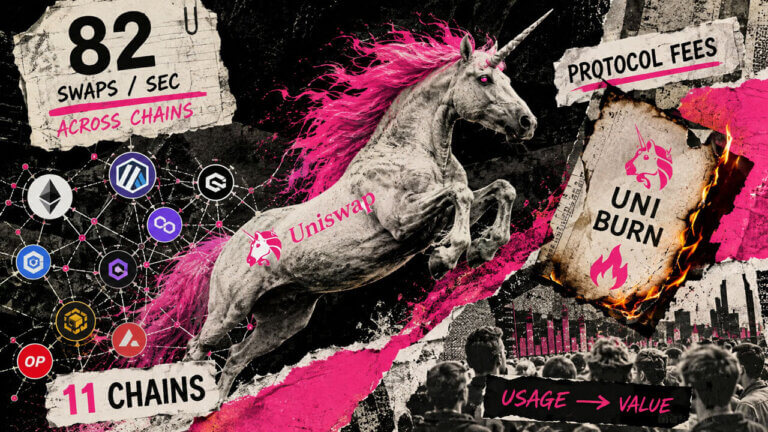
More than 7 million daily swaps fit the record pace, while public data cannot show what share reached fee-enabled pools.
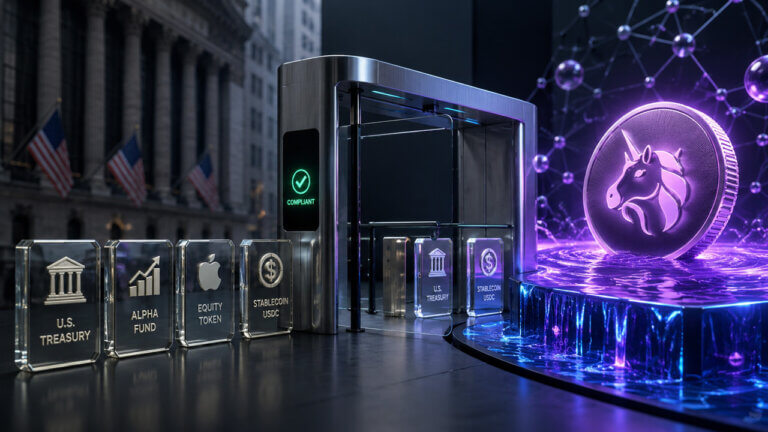
The reported $100 UNI target hinges on tokenized assets leaving closed rails for liquid, composable markets.

A New York judge drew a hard line on neutral infrastructure, and it could ripple from DeFi into app stores and AI.
See UNI across major fiat currencies and swap the active converter instantly.
Quick SelectUsing the live USD market price. Additional fiat rates will appear after the daily sync.
Uniswap is the native governance token of the Uniswap Protocol, a decentralized trading system that helped define the automated market maker model in crypto. Rather than relying on a traditional order book, Uniswap allows users to swap tokens against onchain liquidity pools supplied by other users. UNI represents governance rights over one of the most influential pieces of decentralized finance infrastructure and is closely associated with the growth of onchain trading, liquidity provisioning, and permissionless market access.
The Uniswap Protocol launched on Ethereum in 2018 and became one of the foundational applications of DeFi. Its core innovation was making token trading possible through smart contracts and liquidity pools instead of centralized intermediaries. This design lowered the barriers to listing and trading assets onchain, while also creating a new role for users as liquidity providers who could earn fees by depositing assets into pools.
UNI, introduced in 2020, is the governance token tied to that ecosystem. It does not function primarily as a payment coin or collateral asset. Instead, its main purpose is to let holders participate in governance decisions affecting protocol upgrades, treasury use, fee policy, and the broader direction of the Uniswap ecosystem.
Uniswap was created by Hayden Adams and grew from a simple Ethereum-based trading protocol into one of the most important decentralized exchanges in crypto. Early versions of the protocol demonstrated that automated market making could support substantial trading activity without centralized custody. That design quickly influenced the broader market and inspired a large number of competing decentralized exchanges.
As Uniswap evolved through multiple protocol versions, it expanded its capabilities around liquidity concentration, routing efficiency, and customizability. The launch of UNI in 2020 added a formal governance layer and marked a shift toward community-led coordination. Since then, Uniswap has remained central to the DeFi landscape, not only because of trading volume but also because of its influence on market structure, token distribution, and protocol governance norms.
UNI is best understood as a governance asset linked to a major piece of decentralized market infrastructure. Its significance comes from its relationship to protocol control and ecosystem strategy.
Uniswap’s importance comes from the protocol more than the token alone. The platform is one of the best-known decentralized exchanges in crypto and has expanded beyond its earliest Ethereum-only footprint into a broader multichain environment. Its development path, from early AMM design to later protocol versions and routing systems such as UniswapX, has kept it relevant as onchain trading has become more competitive.
This makes UNI different from many governance tokens that sit on top of lightly used products. Uniswap is tied to a protocol with real market share, deep liquidity, strong brand recognition, and broad integration across wallets, aggregators, and decentralized applications. As a result, UNI is often treated as a blue-chip DeFi asset alongside tokens linked to other major financial primitives.
UNI’s direct use case is governance, but its market relevance is broader. It gives holders exposure to the strategic future of decentralized trading infrastructure. That includes questions around protocol monetization, multichain expansion, user incentives, and how decentralized exchanges compete with centralized venues and newer onchain market models.
Because Uniswap has become a core liquidity venue for the Ethereum ecosystem and beyond, UNI is often viewed as a proxy for the long-term role of permissionless trading in crypto. It benefits when onchain volume grows, when decentralized execution becomes more important, and when the protocol continues to attract developers and liquidity.
UNI also carries clear risks. Governance tokens do not automatically capture the value created by protocol usage, and debates around fee activation or tokenholder economics can remain unresolved for long periods. Uniswap also faces growing competition from other decentralized exchanges, aggregators, and specialized trading systems. Regulatory pressure on trading interfaces and DeFi infrastructure can add another layer of uncertainty.
Even so, UNI remains one of the most important governance assets in crypto because it represents influence over a protocol that helped reshape how digital assets are traded. Its long-term significance depends on whether Uniswap can remain a leading venue for onchain liquidity while translating protocol relevance into durable governance value.


As of Oct 3, 2026, Uniswap trades at $9.00.
Uniswap has a market capitalization of $5,629,507,079.79.
Uniswap has a 24-hour trading volume of $572,033,276.96.
Uniswap reached an all-time high of $44.97, recorded on May 3, 2021. It is currently 79.98% below its all-time high.
Uniswap recorded an all-time low of $0.42, recorded on Sep 17, 2020. It is currently 2.05 thousand percent above its all-time low.
Uniswap has a total value locked of $4,010,325,896.
Uniswap has a market cap to TVL ratio of 1.40x.