

Quick Take
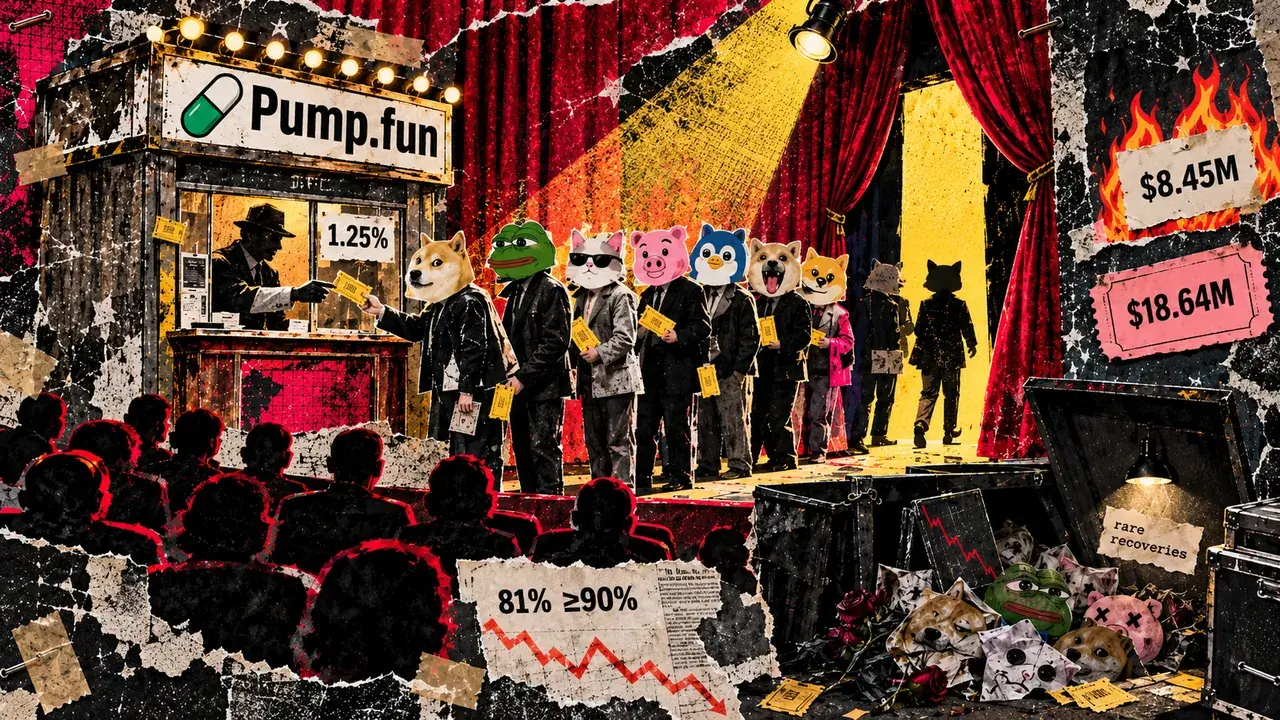
- Pump.fun generated $18.6M in weekly revenue even as Talos found 81% of tracked memecoins had fallen at least 90%.
- Platform fees benefit Pump, creators and PUMP differently from traders still holding older coins.
- The unresolved test is whether rewards can offset token losses before attention and liquidity move elsewhere.


Pump.fun, a leading Solana token launchpad, keeps generating millions of dollars from memecoin trading even as most established tokens struggle to recover from steep losses.
The platform produced about $18.6 million in protocol revenue over the seven days through Oct. 7, according to DefiLlama data. Separately, a Talos study found that 81% of a selected group of memecoins had fallen at least 90% from their all-time highs, and recoveries from deep collapses were rare.
The contrast exposes a central fault line in the memecoin economy: trading across Pump.fun can enrich the platform, support PUMP buybacks, or reward selected users without necessarily helping someone holding a token whose demand has already disappeared.
Talos examined 150 memecoins for its survival analysis and 151 for return comparisons, requiring each asset to have pricing available on at least one centralized exchange. That threshold already selects for relatively successful tokens, meaning the results may understate the failure rate across the much larger universe of launchpad coins that never secure such listings.
Even among that stronger cohort, losses were severe.
The median token peaked about 17 days after exchange trading began. Talos defined collapse as a 95% decline from the eventual peak and estimated a median of about 370 days between the high and that threshold.
Only a small fraction of collapsed tokens later revisited their previous highs, while just five of the 151 coins in its return sample remained above their first-day price. In Talos’ analysis of major Solana memecoins, active addresses with balances of at least $1 had also fallen to no more than 7% of their respective peaks.
The pattern suggests attention frequently moves on rather than returning to repair older positions. Talos found roughly two-thirds of the Solana-era memecoins it examined never staged a meaningful second rally after their initial run.
For a trader, that creates a very different economic exposure from the one Pump.fun itself carries.
Memecoin churn keeps Pump earning
Pump’s revenue depends on transactions occurring somewhere across its ecosystem and does not require an older token to recover.
A trader who sells one fading coin and moves into another generates another fee-producing transaction. New launches, rotations between tokens and speculative bursts can therefore support platform income even while earlier buyers remain heavily underwater.
DefiLlama showed traders paying about $52.5 million in fees over the seven days through Oct. 7, with roughly $18.64 million accruing to the protocol. Over 30 days, fees totaled about $184.5 million, and protocol revenue reached about $60.7 million.
Who ultimately benefits from that activity depends on where the money flows.
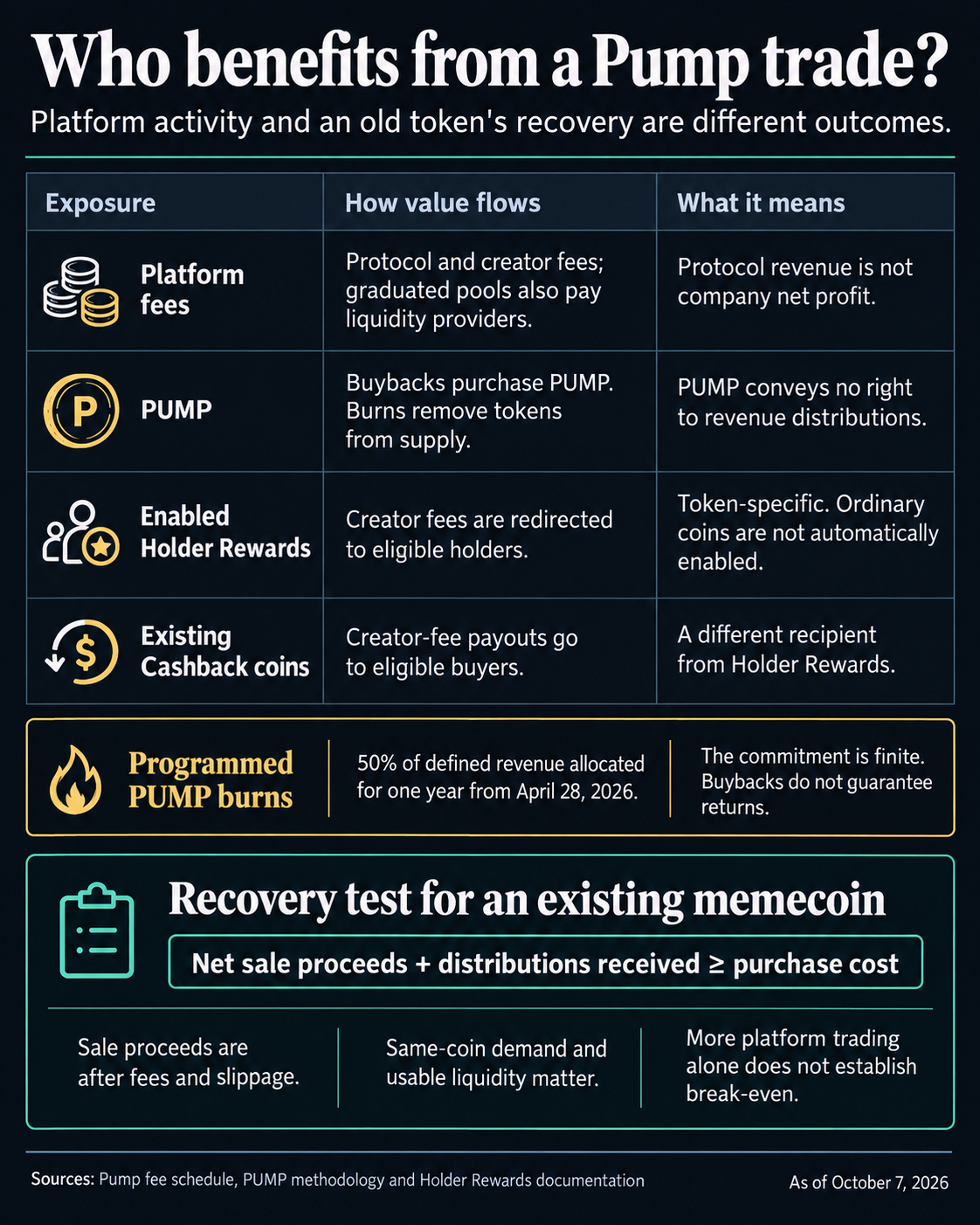
Pump’s fee structure distributes portions of trading income among the protocol, creators and liquidity-related recipients. Its native PUMP token also has a route through buybacks and burns, giving the asset exposure to activity across the broader platform.
DefiLlama recorded about $8.45 million of PUMP burns over seven days and $27.29 million over 30 days. Pump has committed part of designated revenue to buy and burn PUMP for a year starting in April.
However, that mechanism does little directly for somebody holding a separate memecoin.
For those investors, recovery still depends on demand returning to the asset they own, enough liquidity to sell it, and distributions large enough to offset losses in the token itself.
Still, Pump.fun says it is widening the share of platform economics reaching users.
Alon Cohen, the memecoin launchpad co-founder, said more than 140,000 users collectively received about $4.46 million over a recent 24-hour period, including $730,000 in Holder Rewards, $330,000 in Callout Rewards and $3.4 million in creator fees.
“In time, Pumpfun will vastly outperform the social media industry in user payouts & rewards,” he said.
The payouts support Pump’s argument that the platform is increasingly distributing trading economics rather than retaining them entirely at the protocol level. But the three categories reward different participants.
Creator fees benefit people behind tokens. Callout Rewards compensate eligible promoters or contributors. Holder Rewards apply to participating coins and do not automatically reach every person holding a Pump-launched asset.
That distinction matters most when token losses are measured against the rewards.
A holder can receive distributions and still lose money if the underlying coin's value falls faster. Likewise, a creator can generate substantial trading fees even as buyers who entered near the peak suffer deep drawdowns.
PUMP holders face another equation. Buybacks create demand and burns reduce supply, but the token carries its own market risk and does not grant a contractual claim on Pump.fun revenue. Scheduled unlocks can also add supply even as burns remove tokens from circulation.
The economics therefore separate as speculation moves through the platform. Pump can earn from aggregate trading, PUMP can capture part of that activity through buybacks, and selected creators or holders can receive fee distributions. None guarantees recovery for the investor waiting for buyers to return to an older memecoin.
That gap will become more important as Pump expands its rewards programs.
If distributions grow enough to materially compensate holders for declining token values, they could alter the economics of staying invested after the initial speculative rush fades. If trading continues migrating toward new launches faster than rewards accumulate in older ones, Pump may keep converting churn into revenue while many of the traders supplying that activity remain unable to exit their original positions at break-even.
Mentioned in this article



Editorial credits