An instant funding account is priced for what it skips, but the premium rarely appears as one line at checkout. The same balance carries a larger fee. Its drawdown, the loss floor that ends the account, sits closer and is built to move. The split opens lower, and the first withdrawal waits behind another bar. A sticker comparison catches the larger fee and misses the rest.
Best Instant Funding Prop Firms in 2026
- Evaluation fee
- Forex / CFD: From $32.99; Futures: From $79.99
- Max drawdown
- Forex / CFD: Balance-Based Trailing (Closing Balance): 6%; Static (Initial Balance): 6–10%; Futures: 1,000–4,000 USD
- Profit split
- Forex / CFD: 70%–95%; Futures: 80%–95%
- Static loss floors on Stellar evaluations
- Flex removes funded consistency rules
- CFD and futures instant routes
- Evaluation fee
- Forex / CFD: From $29; Futures: From $83
- Max drawdown
- Forex / CFD: Intraday Trailing (Real-Time Equity): 6–10%; Static (Initial Balance): 8–10%; Futures: Balance-Based Trailing (Initial Balance): 4%; End-of-Day Trailing (Initial Balance): 3–4%
- Profit split
- Forex / CFD: 90%–100%; Futures: 80%–100%
- Scaling ceiling of $4,000,000
- Aqua Elite adds $1,000 to $3,000 a month
- Ten CFD models and five futures types
- Evaluation fee
- Forex / CFD: From $23; Crypto: From $49; Futures: From $139
- Max drawdown
- Forex / CFD: Intraday Trailing (Real-Time Equity): 5–6%; Static (Initial Balance): 5–8%; Crypto: End-of-Day Trailing (End-of-Day Equity): 4%; Intraday Trailing (Real-Time Equity): 5–6%; Futures: 2,000 USD
- Profit split
- Forex / CFD: 60%–90%; Crypto: 70%–90%; Futures: 80%
- A missed payout deadline pays you 100%
- No reset fee on any of the 51 plans
- No arbitration clause or class waiver
- Evaluation fee
- From $29
- Max drawdown
- 6–10%
- Profit split
- 60%–90%
- No trailing model anywhere in the catalog
- Three platform options at no extra charge
- Free five-level scaling ladder, fully public
- Evaluation fee
- From $40
- Max drawdown
- Static (Initial Balance): 6–10%; Trailing until 6% profit, then static (Real-Time Equity): 6%
- Profit split
- 50%–90%
- No deadline, minimum days or consistency rule
- Instant route doubles the balance at each 10%
- 1-phase floor locks for good at 6% profit
- Evaluation fee
- From $5
- Max drawdown
- Intraday Trailing (Real-Time Equity): 6–8%; Static (Initial Balance): 6%
- Profit split
- 80%–100%
- Cheapest entry we rate, $5 up front
- Reward Guarantee or they pay $1,000
- Eight account models, more than any rival
CryptoSlate may earn a commission when you visit partner sites through links on this page, at no extra cost to you. Our rankings and reviews remain editorially independent and based on our published methodology. Read disclosure
Disclaimer: CryptoSlate may receive a commission when you click links on our site and make a purchase or complete an action with a third party. This does not influence our editorial independence, reviews, or ratings, and we always aim to provide accurate, transparent information to our readers.Instant Funding Prop Firms Compared
Compare the scored firms by market coverage, evaluation structure, account size, drawdown, profit split and first-payout timing.
| Prop Firm | Markets | Evaluation Types | Account Sizes | Maximum Drawdown | Profit Split | First Payout |
|---|---|---|---|---|---|---|
 FundedNext FundedNext | Forex / CFD, Futures | Forex / CFD: Two Step, One Step, Instant; Futures: Futures Evaluation | Forex / CFD: $2,000–$200,000; Futures: $25,000–$150,000 | Forex / CFD: Balance-Based Trailing (Closing Balance): 6%; Static (Initial Balance): 6–10%; Futures: 1,000–4,000 USD | Forex / CFD: 70%–95%; Futures: 80%–95% | — |
 AquaFunded AquaFunded | Forex / CFD, Futures | Forex / CFD: Two Step, Instant; Futures: Instant, Futures Evaluation | Forex / CFD: $2,500–$400,000; Futures: $25,000–$150,000 | Forex / CFD: Intraday Trailing (Real-Time Equity): 6–10%; Static (Initial Balance): 8–10%; Futures: Balance-Based Trailing (Initial Balance): 4%; End-of-Day Trailing (Initial Balance): 3–4% | Forex / CFD: 90%–100%; Futures: 80%–100% | 14 calendar days |
 For Traders For Traders | Forex / CFD, Crypto, Futures | Forex / CFD: One Step, Two Step, Three Step, Instant; Crypto: One Step, Instant; Futures: One Step, Instant | Forex / CFD: $3,000–$100,000; Crypto: $3,000–$100,000; Futures: $25,000–$100,000 | Forex / CFD: Intraday Trailing (Real-Time Equity): 5–6%; Static (Initial Balance): 5–8%; Crypto: End-of-Day Trailing (End-of-Day Equity): 4%; Intraday Trailing (Real-Time Equity): 5–6%; Futures: 2,000 USD | Forex / CFD: 60%–90%; Crypto: 70%–90%; Futures: 80% | 14 calendar days |
 OneFunded OneFunded | Forex / CFD | Two Step, One Step, Instant | $5,000–$200,000 | 6–10% | 60%–90% | 14 calendar days |
 Crypto Fund Trader Crypto Fund Trader | Crypto | Two Step, One Step, Instant | $5,000–$200,000 | Static (Initial Balance): 6–10%; Trailing until 6% profit, then static (Real-Time Equity): 6% | 50%–90% | 15 trading days |
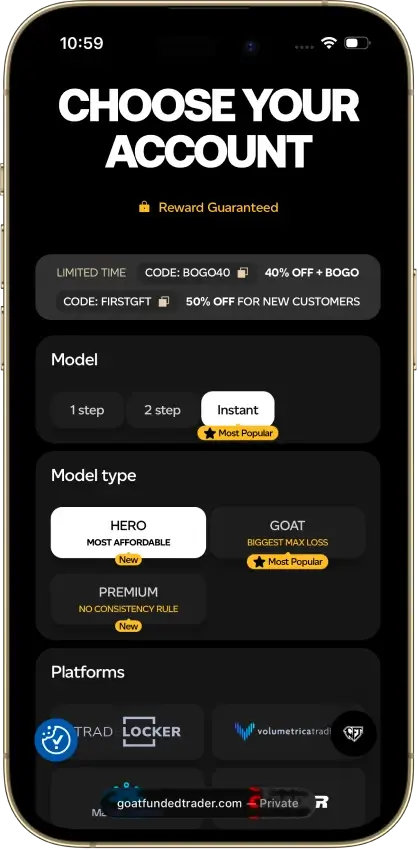
 Goat Funded Trader Goat Funded Trader | Forex / CFD | One Step | $5,000–$100,000 | Intraday Trailing (Real-Time Equity): 6–8%; Static (Initial Balance): 6% | 80%–100% | 14 calendar days |
The table separates firms that actually sell an instant route from firms included for score context only. For the available routes, compare the fee and purchased balance alongside the drawdown build, opening split and withdrawal conditions. A lower entry price can be offset by a tighter moving floor or a longer path to usable profit. Treat each row as one connected product, because no single column captures what skipping the evaluation costs.
Instant Funding Prop Firms in Detail
FundedNext
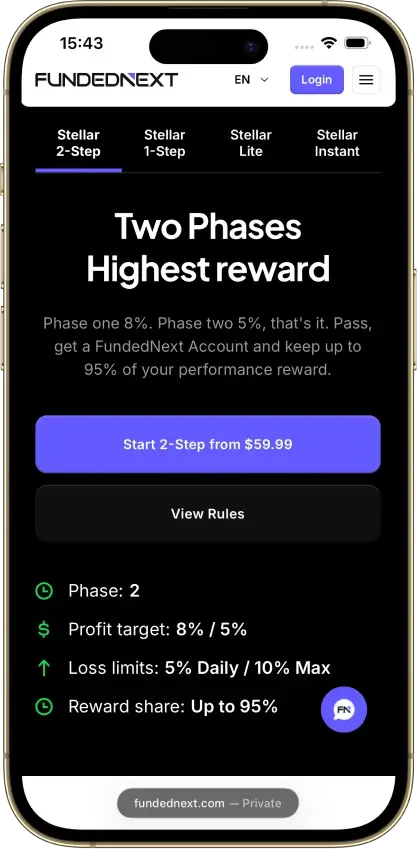
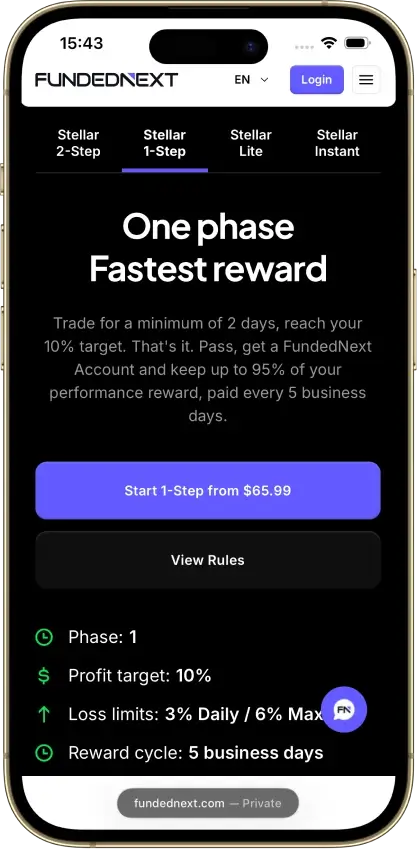
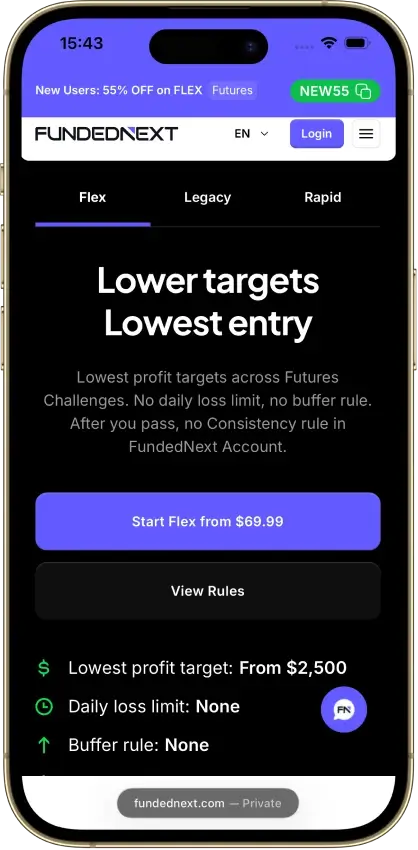
- Evaluation fee
- Forex / CFD: From $32.99; Futures: From $79.99
- Max drawdown
- Forex / CFD: Balance-Based Trailing (Closing Balance): 6%; Static (Initial Balance): 6–10%; Futures: 1,000–4,000 USD
- Profit split
- Forex / CFD: 70%–95%; Futures: 80%–95%
Pros
- Static overall loss on Stellar evaluations
- No funded consistency rule on Flex
- Tradovate, NinjaTrader and TradingView
- Lite standard challenge needs two days
- 2-Step fee return with first reward
Cons
- Flex limits requests to half the profit
- Flex concludes after five rewards
- Instant withdrawals shrink loss room
- Quick Strike can end funded CFD accounts
- Payout options cannot change after purchase


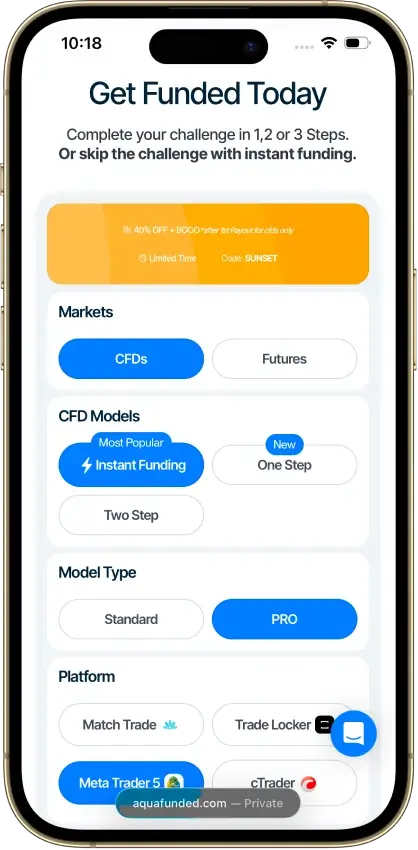
AquaFunded
- Evaluation fee
- Forex / CFD: From $29; Futures: From $83
- Max drawdown
- Forex / CFD: Intraday Trailing (Real-Time Equity): 6–10%; Static (Initial Balance): 8–10%; Futures: Balance-Based Trailing (Initial Balance): 4%; End-of-Day Trailing (Initial Balance): 3–4%
- Profit split
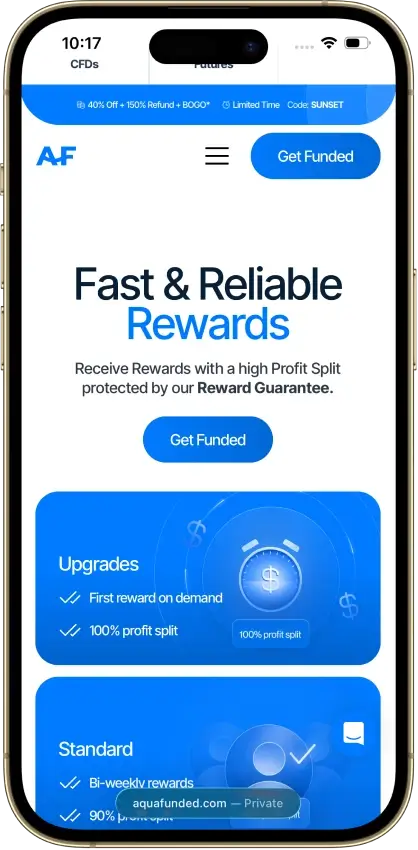
- Forex / CFD: 90%–100%; Futures: 80%–100%
Pros
- 90% profit split on every CFD model
- $1,000 penalty if a payout misses 24 hours
- Three futures types have no daily loss limit
- Five of ten CFD models skip consistency
Cons
- The drawdown documents contradict themselves
- -2% floating loss closes the account for good
- The refund only lands on your fourth payout
- 30 days without a trade breaches funding


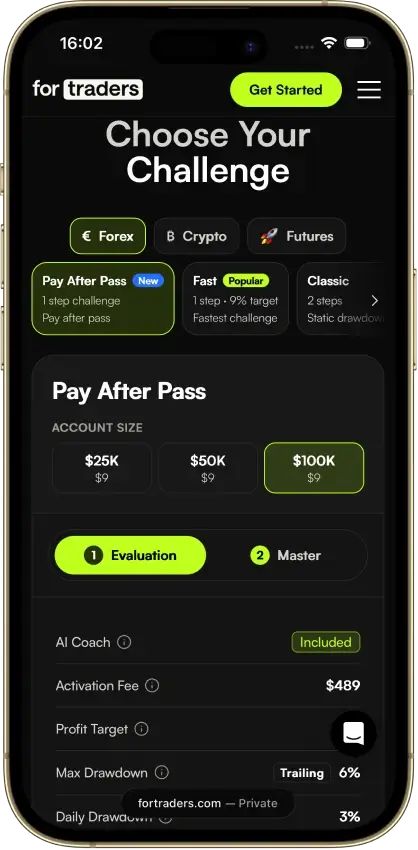
For Traders
- Evaluation fee
- Forex / CFD: From $23; Crypto: From $49; Futures: From $139
- Max drawdown
- Forex / CFD: Intraday Trailing (Real-Time Equity): 5–6%; Static (Initial Balance): 5–8%; Crypto: End-of-Day Trailing (End-of-Day Equity): 4%; Intraday Trailing (Real-Time Equity): 5–6%; Futures: 2,000 USD
- Profit split
- Forex / CFD: 60%–90%; Crypto: 70%–90%; Futures: 80%
Pros
- No time limit except on Strike
- EURUSD from 0.1 pips raw spread
- 74 crypto pairs, traded 24/7
- $3 per lot forex, $0 on indices
- Evaluations listed from $23
Cons
- 5-second hold rule is not in the rulebook
- Activation fee falls due before KYC
- 3% buffer locked up on Forex Instant
- Checkout omits drawdown limits on 37 plans


OneFunded
- Evaluation fee
- From $29
- Max drawdown
- 6–10%
- Profit split
- 60%–90%
Pros
- UK company, English law and courts
- $29 entry on the two-step Value plan
- Core advertises a fee return at payout
- No consistency limit while evaluating up to $50K
Cons
- Add-on costs shown only at checkout
- Core/Value consistency limit starts when funded
- Forex lot is $3.50 on cTrader, $4.00 on MT5
- Instant has a 1% exposure limit and no refund




Crypto Fund Trader
- Evaluation fee
- From $40
- Max drawdown
- Static (Initial Balance): 6–10%; Trailing until 6% profit, then static (Real-Time Equity): 6%
- Profit split
- 50%–90%
Pros
- 715 crypto pairs and 900+ instruments
- 100x leverage advertised on every instrument
- Instant route skips the evaluation
- Up to 90% split with a paid upgrade
Cons
- On FINMA's warning list since August 2024
- Evaluation fee is never refunded
- 90% split and weekly payouts cost extra
- Registered as an education company




Goat Funded Trader
- Evaluation fee
- From $5
- Max drawdown
- Intraday Trailing (Real-Time Equity): 6–8%; Static (Initial Balance): 6%
- Profit split
- 80%–100%
Pros
- Fees refunded after the fourth funded payout
- $100 minimum payout, paid in 2 days
- Scales to $2M with up to 100% split
- Static floor, no consistency rule on 1 Step
Cons
- Up to three loss limits run at once
- Complaints cluster on payout denials
- Pay Later activation can top the Instant price




How We Rank
- Payout Reliability and Evidence 25% weight
Payout history, evidence and the conditions for receiving funds.
- Rules Fairness and Transparency 20% weight
Clarity and fairness of account rules and restrictions.
- Cost and Value 15% weight
Evaluation fees, refunds and the value of each program.
- Trading Conditions 15% weight
Markets, platforms, execution and trading limits.
- Profit Split and Scaling 10% weight
Profit sharing and paths to larger allocations.
- Firm Transparency and Stability 10% weight
Ownership, disclosures and operational stability.
- Support and Reputation 5% weight
Customer assistance and the firm’s public track record.
Firm order and route fit answer different questions. This page compares each instant account as it opens: the fee, floor behavior, starting split, scaling path and conditions before a first withdrawal. A strong overall score does not erase an expensive or restrictive instant model, just as an appealing instant specification does not repair weak firm-level evidence. Reading both layers together prevents the route's speed from standing in for its actual cost and usability.
What Is Instant Funding?
Instant funding is a prop firm account that starts funded the moment the payment clears. There is no evaluation phase and no profit target standing in front of the balance. After paying a one-time fee, the trader receives a simulated account at the purchased size or at the first rung of a scaling ladder. The firm's payout rules determine the share of profit the trader keeps.
A short list of terms decides how any instant account actually behaves.
| Term | What It Means |
|---|---|
| Instant funding | A funded simulated account sold outright, live at purchase, with no evaluation in front of it |
| Drawdown | The loss limit that closes the account, measured as a percentage below a reference balance. Also written as the loss floor |
| Static drawdown | Anchored to the starting balance and fixed there for the life of the account |
| Trailing drawdown | Rises behind each new balance or equity high and never comes back down |
| End-of-day drawdown | Recalculates once per session from the closing balance, locked at a set hour |
| Profit split | The trader's share of withdrawn profit, written trader-first, as in 80/20 |
| Consistency rule | A cap on the share of total profit any single day or position may contribute. Breaking it blocks the payout, not the account |
| Scaling | The schedule that grows the balance after profit milestones, and on instant routes commonly the schedule that raises the split |
The specification cells describe only each firm's instant route, using its product pages and terms. A dash means the firm sells no instant account. The route splits the scored field along asset lines. Instant models cluster inside forex and CFD firms that already sell evaluations, while the crypto programs remain evaluation-based. Those programs are compared in crypto prop firm rankings.
The eligibility column uses each firm's own terms. A firm that takes US residents says so where the claim can be checked. A Not disclosed entry means checkout rules platforms out one by one without a country-level answer. US buyers must then confirm in writing what the terms never state.
Where the route exists, the same firm prices both versions of the same balance. Comparing those versions holds the other variables still and isolates the feature being bought.
Why the Same Balance Costs More Without a Pass Stage
Most evaluation participants never reach funding or see a payout. The fees from those failed attempts stand behind withdrawals by the few who pass. An instant firm gives that cushion away. Every purchase creates an account that can demand a payout from the day it exists, so the cost per dollar of balance rises to cover it.
The instant route sharpens the category's structural conflict. Every failure that ends in a repurchase pays the funding firm again, and some firms state as much in their own terms. An evaluated account may restart at a reset fee where one is sold. An instant breach commonly requires another purchase at the full figure, returning more to the firm. The party collecting that fee also sets the drawdown that decides when failure occurs. This describes how the model is built without alleging misconduct by any firm running it.
The Drawdown Sits Closer and It Moves
Drawdown comes in the three builds the glossary names, and the same percentage behaves differently in each. A static build never moves. A trailing build ratchets one way only, each new equity high dragging the limit up behind it. An end-of-day build resets once per session, taking the closing balance as its reference at a set UTC hour. An instant account commonly carries a smaller allowance than the firm's own evaluated equivalent, in a build that moves.
Take a $100,000 instant account with a 6% drawdown trailing equity highs. It opens at $94,000. A run to $107,000 in equity drags the limit up to $100,580, and past that point a breach no longer requires a loss. A pullback through $100,580 ends the account above its own starting balance. A $100,000 evaluated account with a 10% static drawdown is untouched by the identical trading and still holds $10,580 of room at that level. The two accounts bought the same balance and share nothing else.
Two specification lines determine how hard a moving drawdown bites. One says whether the floor stops at the starting balance or keeps climbing past it. The other states where the daily limit is measured. A fixed UTC snapshot commonly supplies the balance used to compute daily loss and may leave open positions out. The rule can therefore police a different number from the one on the screen. Drawdowns that settle once per session against the close belong to futures prop firms with close-based limits.
The Split Opens Lower and the First Withdrawal Sits Behind a Gate
On evaluated accounts, the trader's share commonly starts at 80/20. Paying extra at checkout can raise it to 90/10 through an upgrade chosen at purchase. Instant routes commonly open below the evaluated figure and climb back through scaling milestones, which makes the split on the sales card a destination, not a starting point. The distance between the two figures is part of the fee, collected in withheld profit instead of at checkout. Where an instant route pays a full split instead, the premium has moved somewhere else on the account.
Sizing can impose the same kind of premium. Some instant routes open the account at a fraction of the advertised balance and grow it through profit milestones, making the checkout number a ceiling instead of an opening state. An evaluated account that funds at full size after a pass has no such climb. The forex and CFD funding-program comparison shows how splits and ladders work on evaluated accounts.
An evaluated trader who reaches funding has already cleared the profit target, and the funded account opens onto a payout cycle. An instant buyer skipped that stage, and the terms commonly reintroduce it after the purchase as an eligibility bar. A profit threshold, a minimum stretch of trading days, or both stand between checkout and the first withdrawal. Cleared under the live account's closer drawdown, that bar is the evaluation relocated to the one place where failing it costs the full fee instead of a reset.
The bar has a second arm that no checkout screen mentions. A consistency rule caps the share of total profit any single day may contribute. Breaking it leaves the account open but voids the payout request. The profit stays banked while the withdrawal waits. More profit must then be spread across more days under the same closer drawdown. On an instant account the rule belongs in the cost math because it sets the date the fee starts coming back.
Each firm sets its own withdrawal gate, including any consistency rule.
| Instant Route | Minimum Trading Days | Consistency Rule | Payout Cycle and Buffer |
|---|---|---|---|
| FundingPips Zero | 7 profitable days per rolling 30 | 15% | Bi-weekly by default. The first 3% of profit cannot be requested |
| FundedNext Stellar Instant | None | None | On demand or bi-weekly |
| The5ers Hyper Growth | None to fund. A payout becomes available at 3 profitable days | None published | Every 14 days, first payout 14 days after funding, $150 minimum |
| AquaFunded Instant Pro and Instant Standard | None published | 15% on Instant Pro, 20% on Instant Standard | Bi-weekly on CFD and on demand on futures, first payout 14 days after the first trade, $100 minimum. Fee refunded at the fourth payout |
| Goat Funded Trader Instant models | Not disclosed | None on Premium, 20% on PRO, 15% on GOAT and Hero | Every 14 days, every 10 on Premium, $100 minimum, with a 2% processing charge on payouts |
An account sold as funded from day one earns nothing withdrawable until the bar clears. The purchase therefore provides a head start on the calendar without advancing the payout.
Cost to First Payout Is the Comparison That Holds
At the checkout screen the evaluated route wins on the same balance. That comparison prices one line of a longer invoice. The full route runs from first payment to first settled withdrawal, and each route fills the invoice differently.
| Cost Line | Evaluated Route | Instant Route |
|---|---|---|
| Upfront fee for the same balance | The smaller figure, priced against a pass rate | The larger figure, priced against a payout liability that exists at once |
| Activation fee | Can land after the pass, and is not universal | None. There is no pass event for one to attach to |
| Cost of a breach | A reset fee where sold, or a fresh attempt at the entry fee | Commonly a new purchase at the full instant fee |
| Recurring charges | Monthly platform and market-data fees exist and are not universal | The same pattern, running from the first day rather than after a pass |
| Starting split | 80/20 is the common opening, 90/10 a purchasable upgrade | Commonly opens lower and climbs through scaling |
| First withdrawal | Opens on the funded account's payout cycle | Sits behind an eligibility bar of profit or time, plus any consistency rule |
| Refund of the fee | Refund at a stated payout number is a live pattern, as is no refund at all | The same two patterns, applied to a larger figure |
Suppose a firm sells the same $50,000 balance as a $250 evaluation and an $800 instant account. A buyer who fails the evaluation twice and passes on the third attempt has spent $750 before any activation charge. Where one exists, that charge closes the gap entirely. The instant fee collects the failure arithmetic in advance. It benefits the trader who would have burned attempts and costs more for the one who passes once. Nobody knows in advance which trader they are.
After a breach, the calendar becomes part of the cost. A funded evaluated account goes back through the entire pass before it can earn again, at $250 a run plus the weeks each run takes. A breached instant account is repurchased at $800 and is live the same day. The instant premium buys back time on both sides of the purchase while charging for it in every other column. The complete prop firm rankings show what each scored firm charges across its full lineup.
Both Routes Buy the Same Simulated Account
A higher price does not change the account's simulated status. Prop programs remain simulated throughout on the instant route and every other route. The balance is virtual, and the firm holds no trader money on deposit. A payout is its contractual obligation, settled from its own revenue without proceeds withdrawn from a market. Simulated funding also does not establish that live capital stands anywhere behind it. The scoring pillars and evidence standards explain how payout evidence is classed and weighed.
Risk Disclosure
Every figure paid to a funding firm, on the instant route or any other, is money at full risk. Most buyers never reach a first withdrawal. A simulated balance is not live trading capital and does not establish that any stands behind it. This comparison is informational. None of it is financial advice, and CryptoSlate may earn commissions from links here, which has no effect on any score.