


Prop-firm fees are at risk, most participants do not reach a payout, and simulated funding does not necessarily represent live firm capital. This review is informational, not financial advice.
Breakout Overview
- Company Name
- Breakout
- Registered In
- Delaware, United States
- Launch Year
- 2023
- Languages
- English
- Restricted Countries
- Cambodia, Eritrea, Haiti, South Sudan, Afghanistan, Belarus, Central African Republic, Democratic Republic of the Congo, …Cambodia, Eritrea, Haiti, South Sudan, Afghanistan, Belarus, Central African Republic, Democratic Republic of the Congo, Ethiopia, Iraq, Lebanon, Libya, Myanmar, Nicaragua, Somalia, Sudan, Zimbabwe, Cuba, Iran, North Korea, Russia, Syria, Venezuela
- Evaluation Fees
- $20–$1,090
- Account Balances
- $5,000–$200,000
- Challenge Types
- One Step
- Profit Targets
- 9–12%
- Maximum Drawdown
- 3–6%
- Maximum Daily Loss
- 3%
- Profit Split
- 80%–90%
- Minimum Trading Days
- 0
- Fee Refund
- Not refundable
- Maximum Allocation
- $200,000
- Website
- breakoutprop.com
Breakout Screenshots
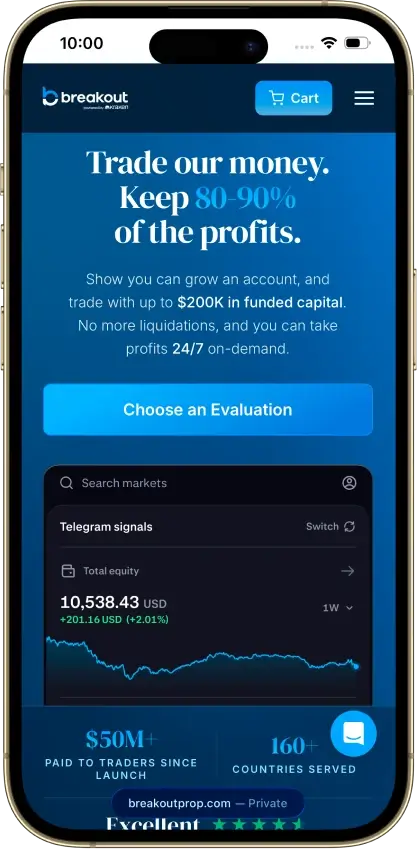
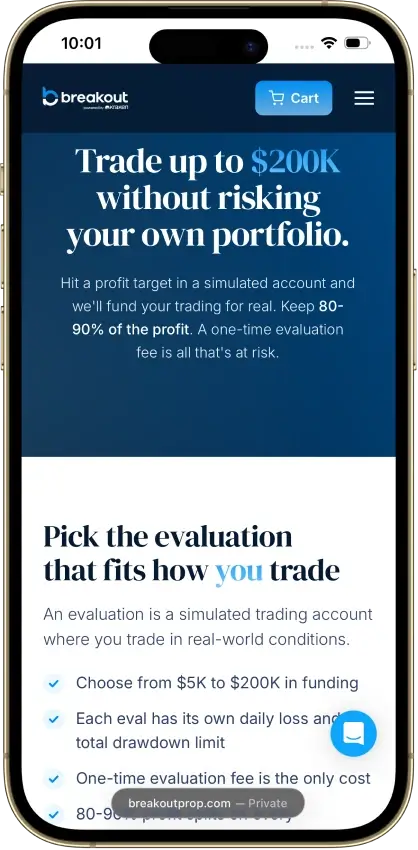
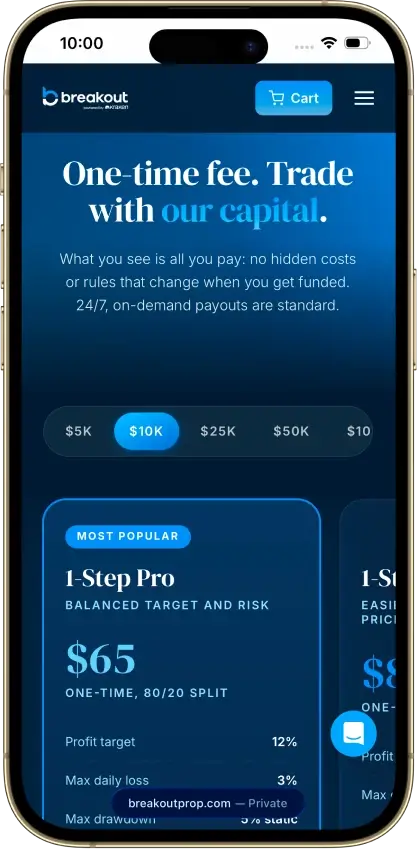
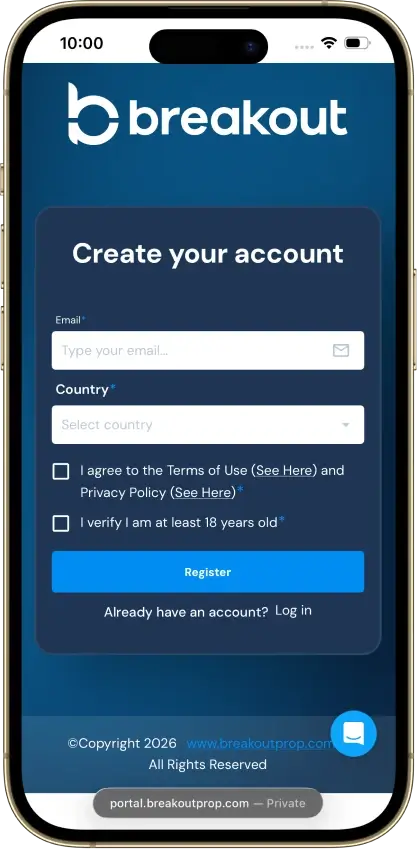
Screenshot 1 of 8
Breakout Pros and Cons
Pros
- Static drawdown on all three plans
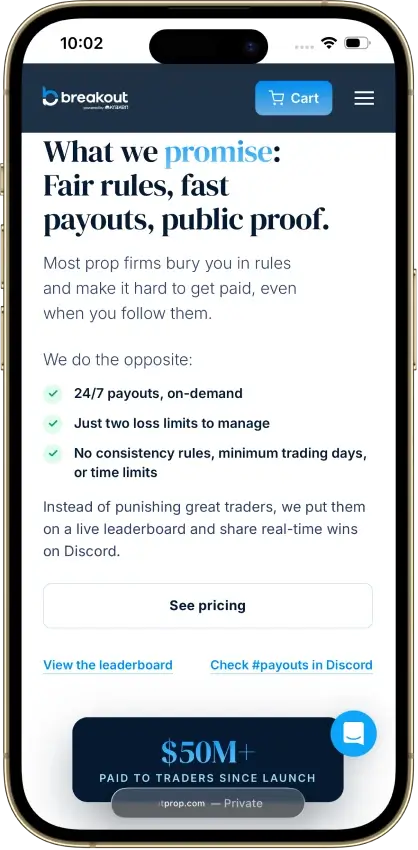
- Payouts on demand 24/7, $50 minimum
- No consistency rule or minimum days
- News trading and weekend holds allowed
Cons
- Your order may never reach an exchange
- Evaluation fee is never refunded
- Leverage varies by coin, 2x on many alts
- No MetaTrader on either terminal
- Funded capital limited to $200,000 total
Breakout Discount Code
There is no active Breakout discount code. A 24OFF24 promotion ran for a single 24-hour window and appeared on neither purchase page on Aug. 13, 2026, so treat any site still advertising it as current as out of date.
The saving that does exist is structural rather than promotional. Turbo starts at $20 for a $5,000 account, among the lowest entry prices in crypto prop, and the 90/10 profit-split upgrade costs exactly 20% on top of the plan fee at every account size.
| Code | Discount | Applies to | Verified | Expires |
|---|---|---|---|---|
| 24OFF24 | 24% off the evaluation fee | Account sizes of $10,000 and above | Aug. 10, 2026 | Expired; unavailable at checkout on Aug. 13, 2026 |
Breakout discount at a glance
How the Breakout Evaluation Works
Every plan Breakout currently sells is a one-step evaluation. You buy an account, reach the profit target without breaching either loss limit, and the account passes. There is no second phase, no deadline and no minimum number of trading days, so a single good session can finish it.
Three plans split the same idea by how much room you get. Turbo asks 9% and gives 3% of drawdown. Pro asks 12% and gives 5%. Classic asks 10% and gives 6%. All three cap the daily loss at 3%.
Passing does not make funding instant. KYC through SumSub and the Funded Trader Agreement come first, both from the dashboard, and trading is enabled once the account is approved.
A two-step evaluation still has documentation in Breakout’s knowledge base and is still supported for traders who hold one, but it cannot be bought. The older checkout that sells it is not the one breakoutprop.com links to.
Turbo
| Phase | Profit target | Daily loss | Maximum drawdown | Minimum days | Time limit | Consistency rule |
|---|---|---|---|---|---|---|
| EvaluationNote 1 | 9% | 3% | 3% | 0 | None | None |
| Funded AccountNote 2 | — | 3% | 3% | 0 | None | None |
- One step, no second phase and no deadline. Turbo asks 9% while allowing 3% of drawdown, a three-to-one ratio and the tightest room of the three plans, which is why it is the cheapest. No consistency rule, no minimum trading days and no time limit. Leverage is 5x on BTC, ETH, the Nasdaq 100 and the S&P 500, and 2x on altcoins.
- The static 3% floor and the 3% daily limit carry over from the evaluation unchanged. Passing locks the account, then Sumsub KYC and the Funded Trader Agreement come before funding, so funding is not instant. Payouts are on demand 24/7 from $50 in USDC on Ethereum, and the withdrawn amount is credited back as daily-loss headroom so a payout cannot breach the account next session.
80% as standard. The 90% upgrade must be bought at checkout and cannot be added later, costing $48 on Turbo, $78 on Pro and $102 on Classic at $10,000. Funded capital is capped at $200,000 across all accounts, reviewed case by case after roughly three months.
Pro
| Phase | Profit target | Daily loss | Maximum drawdown | Minimum days | Time limit | Consistency rule |
|---|---|---|---|---|---|---|
| EvaluationNote 1 | 12% | 3% | 5% | 0 | None | None |
| Funded AccountNote 2 | — | 3% | 5% | 0 | None | None |
- Pro asks the highest target of the three at 12%, against 5% of drawdown. No consistency rule, no minimum trading days and no time limit. Leverage is 5x on BTC, ETH, the Nasdaq 100 and the S&P 500, and 2x on altcoins.
- The static 5% floor and the 3% daily limit carry over from the evaluation unchanged. Passing locks the account, then Sumsub KYC and the Funded Trader Agreement come before funding, so funding is not instant. Payouts are on demand 24/7 from $50 in USDC on Ethereum, and the withdrawn amount is credited back as daily-loss headroom so a payout cannot breach the account next session.
80% as standard. The 90% upgrade must be bought at checkout and cannot be added later, costing $48 on Turbo, $78 on Pro and $102 on Classic at $10,000. Funded capital is capped at $200,000 across all accounts, reviewed case by case after roughly three months.
Classic
| Phase | Profit target | Daily loss | Maximum drawdown | Minimum days | Time limit | Consistency rule |
|---|---|---|---|---|---|---|
| EvaluationNote 1 | 10% | 3% | 6% | 0 | None | None |
| Funded AccountNote 2 | — | 3% | 6% | 0 | None | None |
- Classic asks 10% against 6% of drawdown, a ratio under two to one, which makes it the easiest of the three by a wide margin and the reason it costs more than double Turbo at the same balance. Every plan funds the same capital, so what is priced here is drawdown room rather than size. Classic stops at $100,000 while Turbo and Pro reach $200,000. Leverage is 5x on BTC, ETH, the Nasdaq 100 and the S&P 500, and 2x on altcoins.
- The static 6% floor and the 3% daily limit carry over from the evaluation unchanged. Passing locks the account, then Sumsub KYC and the Funded Trader Agreement come before funding, so funding is not instant. Payouts are on demand 24/7 from $50 in USDC on Ethereum, and the withdrawn amount is credited back as daily-loss headroom so a payout cannot breach the account next session.
80% as standard. The 90% upgrade must be bought at checkout and cannot be added later, costing $48 on Turbo, $78 on Pro and $102 on Classic at $10,000. Funded capital is capped at $200,000 across all accounts, reviewed case by case after roughly three months.
Breakout Rules and Restrictions
Breakout runs two loss limits at once, and breaching either ends the account permanently.
The maximum daily loss is 3% on every plan on sale. It is not a fixed dollar figure and it does not reset to your starting balance. It recalculates at 00:30 UTC each day from your balance at that moment, excluding open positions. A $105,000 balance sets the limit at $101,850 for the next 24 hours.
The maximum drawdown is static and never trails. Turbo 3%, Pro 5%, Classic 6%, measured from the starting balance and fixed there for the life of the account. A $100,000 Classic account sits at $94,000 from the first trade to the last, no matter how much profit it makes. That is the most trader-friendly rule Breakout has, because the usual alternative moves the floor up behind every winning day.
How Breakout’s Static Drawdown Stays Fixed
A $50,000 Classic account with a 6% static maximum drawdown.
Illustrative $50,000 Classic example using Breakout’s published static drawdown rule.
Requesting a payout does not cost you daily-loss room. Breakout drops the daily limit by the payout amount at the same time as the balance, so a withdrawal cannot breach the account by itself.
There is no consistency rule and no minimum trading days. News trading is unrestricted and positions can be held over the weekend. Copy trading is prohibited, as are third-party and off-the-shelf strategies sold to pass evaluations. Hedging is allowed inside a single account under conditions and prohibited across accounts.
Breakout excludes 23 countries outright, plus Crimea, Donetsk and Luhansk. Combined active account size is capped at $200,000.
| Rule | Limit | Consequence | Applies To |
|---|---|---|---|
| Maximum daily loss | 3% | Measured from the balance at 00:30 UTC, a figure that excludes open positions, then checked against live equity including floating profit and loss. Intraday gains after 00:30 UTC do not lift the line. Because the reset ignores open positions, carrying a trade more than 3% underwater through 00:30 UTC breaches the account the instant it takes effect. Enforcement is automatic liquidation the moment equity crosses the line, not at candle close, with no grace period and no discretion. | All Stages |
| No account reset | 0 No reset offered at any price | Breakout offers no reset at any price. A failed evaluation closes all open positions, forfeits the account and refunds nothing. Trading again means buying a new evaluation at full price, and the firm discloses that it earns fees each time that happens. | Evaluation |
| Funded capital cap | $200,000 | The cap is $200,000 across all accounts combined, and several evaluations and funded accounts can run at once inside it. Beyond the ceiling, scaling is reviewed case by case after roughly three months of consistent funded profitability rather than by a published ladder. | Funded |
| Discretionary execution routing | 0 No threshold, routing is at the firm’s sole option | No breach attached. Payward Oceanic Ltd may record a trade as an internal book entry and calculate a hypothetical result, or route it to a market maker or exchange, at its sole option and with no visibility for the trader. The firm also discloses that it keeps any payments other companies make off traders’ order flow. | Funded |
| Withdrawal headroom credit | 0 No threshold, withdrawn amounts are credited back as daily-loss headroom | No breach. When a withdrawal is taken the system adds the withdrawn amount back as headroom on the daily loss limit, so a payout does not shrink the balance the 3% limit is measured against and cannot breach the account the following session. | Funded |
| Commission and funding costs | 0.04% | 0.04% per side and 0.08% round trip, plus standard 8-hour funding rates on positions held overnight. These are the only recurring costs: there is no subscription, no activation fee and no monthly platform charge. | All Stages |
Prohibited Strategies
- Copy trading
- Account sharing and pass services
- Latency arbitrage against the platform feed
- Group hedging across accounts
- High-frequency order flooding
Restricted Countries
- Cambodia
- Eritrea
- Haiti
- South Sudan
- Afghanistan
- Belarus
- Central African Republic
- Democratic Republic of the Congo
- Ethiopia
- Iraq
- Lebanon
- Libya
- Myanmar
- Nicaragua
- Somalia
- Sudan
- Zimbabwe
- Cuba
- Iran
- North Korea
- Russia
- Syria
- Venezuela
Marketing vs. Contract
Marketing language is checked against the terms that govern the selected program.
Breakout Pricing and Account Sizes
Breakout charges once. There is no subscription, no reset fee and no activation fee on passing.
Turbo is the cheapest way in at every size and buys the least room, with 3% of drawdown against a 9% target. Classic costs roughly double and gives 6%. Pro sits between them on fee while asking the highest target at 12%.
Classic stops at $100,000. Pro and Turbo run to $200,000, which is also the ceiling on combined active capital, so $200,000 is the most Breakout will have you trading at once however many accounts you buy.
The 90/10 upgrade adds exactly 20% to the fee at every size and has to be bought with the account. It cannot be added afterwards.
Fees are not refundable. Breakout’s current knowledge base answers the refund question with a single word.
| Account balance | Turbo | Pro | Classic |
|---|---|---|---|
| $5,000 | $20 One-time | $33 One-time | $45 One-time |
| $10,000 | $40 One-time | $65 One-time | $85 One-time |
| $25,000 | $95 One-time | $150 One-time | $215 One-time |
| $50,000 | $180 One-time | $280 One-time | $400 One-time |
| $100,000 | $330 One-time | $545 One-time | $800 One-time |
| $200,000 | $660 One-time | $1,090 One-time | — |
Breakout Payouts and Profit Split
Payouts are on demand, 24 hours a day, with a $50 minimum after the split and no approval wait before you can trade again. Money moves in USDC on Ethereum, so a wallet that only takes another network will not work.
The split is 80/20 as standard. Paying 20% more for the account at purchase makes it 90/10 permanently for that account, and it cannot be added later.
Payout terms at a glance
Verified Payout Evidence
| Evidence | Class | Source | Date accessed |
|---|---|---|---|
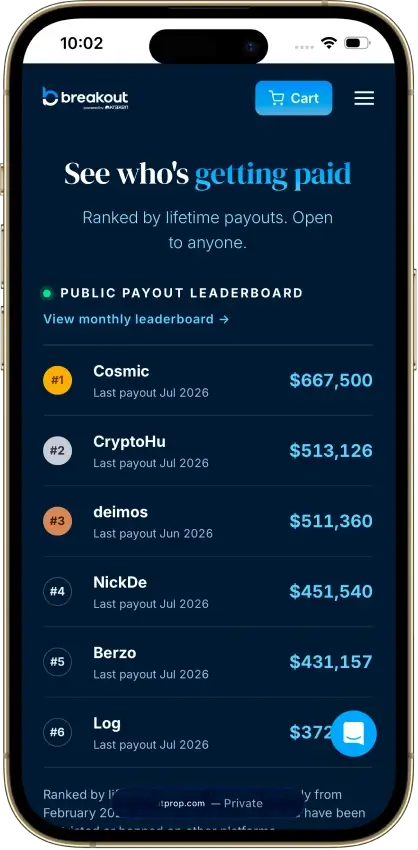
| Public payout leaderboard naming individual traders with lifetime totals, led by a $667,500 entry | CLAIMED | breakoutprop.com payout leaderboard | Aug. 10, 2026 |
| Trustpilot showed 4.7 from 959 reviews, with payout speed a common positive theme | REPORTED | Trustpilot | Aug. 10, 2026 |
| $50M+ paid to traders since launch | CLAIMED | breakoutprop.com | Aug. 10, 2026 |
| Traders reported USDC arriving within hours of a request | REPORTED | Trustpilot reviews | Aug. 10, 2026 |
| Kraken completed its acquisition of Breakout in September 2025 | VERIFIED | Kraken and Breakout announcements | Aug. 10, 2026 |
Breakout’s leaderboard is unusually detailed, but it remains the firm’s own record. Public handles and totals are more transparent than an aggregate marketing figure, while still falling short of independently verified transfers.
Scaling Plan
Breakout publishes no scaling ladder. The profit split does not improve with performance, and funded capital stops at $200,000 across all accounts combined.
Platforms and Trading Conditions
Breakout is no longer crypto only. Alongside BTC, ETH, SOL and the rest of the coin list it now carries the Nasdaq 100, the S&P 500, crude oil and silver.
Leverage is tiered by instrument rather than set once. BTC, the Nasdaq 100 and the S&P 500 reach 10x. ETH, SOL, XRP, DOGE and around two dozen other coins sit at 5x, as do crude oil and silver. A middle band including PEPE, SHIB and NEAR gets 3x, and the long tail of smaller coins gets 2x. Breakout was rolling these limits out between Aug. 12 and Aug. 14, 2026, so check the live figure on the symbols page before sizing a position.
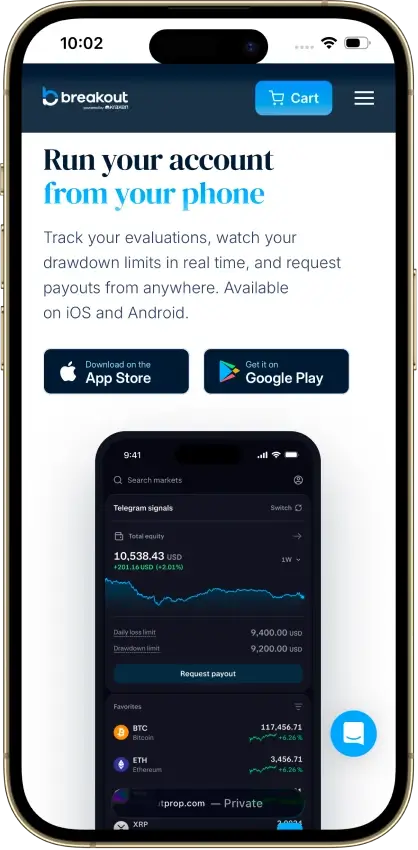
Trading runs 24/7. Two terminals are available, Breakout’s own on web and mobile, and DXTrade. The choice changes what holding a position costs, because the 0.033% daily swap is taken in one charge on DXTrade and in six four-hourly slices of roughly 0.0055% on Breakout Terminal. Trading fees are 0.04% per side either way. There is no MetaTrader on either.
The part worth reading twice is Breakout’s own disclosure about where a funded order goes. Payward Oceanic Ltd may either record the idea internally and calculate a hypothetical result, or route it to a market maker or exchange, at its sole discretion. Traders have no visibility into which happened on any given order.
Trading conditions at a glance
Is Breakout Legit and Safe?
Breakout is a Payward company, which puts Kraken behind it. That is more corporate backing than anything else in crypto prop has, and it is worth separating from what it does not prove. Ownership is not a guarantee of future operation, and it says nothing about how any individual dispute will be handled.
Two entities appear in its own material. Breakout Trading Group, LLC holds the copyright, and Payward Oceanic Ltd is the counterparty a funded trader actually contracts with.
The firm is unregulated, which is normal for the category and worth stating plainly rather than implying otherwise. Balances are simulated throughout and Breakout never takes custody of trader funds.
What stands out is how much it discloses against itself. Its own terms state that Payward Oceanic may book a funded order internally without routing it, that it can keep third-party incentives earned from trade ideas, and that Breakout profits when an evaluation trader fails and buys again. Publishing all three is unusual. They remain real conflicts once published.
KYC runs through SumSub and is required before a funded account is enabled rather than at purchase.
Breakout Company and Legal Details
Legal entity, operating history, ownership and regulatory status.
Breakout Alternatives
How long a firm has been trading, and under which company, tells you more about payout risk than a rating does. Look for a registered legal entity, a jurisdiction, a founding year, and disclosed leadership at each firm here. Where a rules page and a blog post from the same firm disagree on a limit, take the rules page as the live version.
Compare Breakout with the wider prop firm rankings, the crypto prop firms and the firms offering one-step evaluations. Breakout’s nearest alternatives are scored on the same seven categories and ranked below by total.
Most prop firms are unregulated, which is the normal state of the sector and not a sign of wrongdoing on its own. It does mean there is no regulator to appeal to if a payout is refused, so the terms document is the only protection you have. Save the version you agreed to on the day you buy.
Prop Firm Pillar Scores
- Payout Reliability and Evidence 25% weight On-demand withdrawals 24/7, a $50 floor and settlement in USDC on Ethereum. The leaderboard is the category's most detailed disclosure and the firm's own record, not an audit.8.5 / 10
- Rules Fairness and Transparency 20% weight Static drawdown, no consistency rule, no time limit and no minimum days favor the trader. Against that, routing is discretionary and invisible, and the reset lands at 00:30 UTC.7.8 / 10
- Cost and Value 15% weight A $20 entry is among the lowest in crypto prop, fees are one-time with no reset or activation charge, and the ladder prices drawdown room fairly. Non-refundable fees cost a point.9.0 / 10
- Trading Conditions 15% weight Purpose-built terminal with real depth, a DXTrade alternative, no news or weekend limits, and markets beyond crypto into oil, silver and indices. Tiered leverage, no MetaTrader.8.2 / 10
- Profit Split and Scaling 10% weight 80% is standard and 90% is available, but the upgrade must be bought with the account and can never be added later. Funded capital stops at $200,000 across all accounts.8.8 / 10
- Firm Transparency and Stability 10% weight Kraken ownership through Payward gives backing nothing else here has, and the firm publishes its own conflicts of interest. Those conflicts are still real once disclosed.8.0 / 10
- Support and Reputation 5% weight Support is handled in-house through live chat, alongside a Discord community Breakout puts at more than 20,000 traders.9.0 / 10
Final Verdict
Breakout pairs unusually clean rules with fine print that deserves reading. Static drawdown on every plan, no consistency rule, no minimum trading days, on-demand USDC payouts from $50, and a payout leaderboard more detailed than anything else in the category. Kraken bought it in 2025, which puts an exchange behind it in a way nothing else in crypto prop can claim. The problem sits in its own disclosures, where a funded order may be booked internally and never reach an exchange, and you have no way of knowing which happened.
Prop-firm fees are at risk, most participants do not reach a payout, and simulated funding does not necessarily represent live firm capital. This review is informational, not financial advice.
Disclaimer: CryptoSlate may receive a commission when you click links on our site and make a purchase or complete an action with a third party. This does not influence our editorial independence, reviews, or ratings, and we always aim to provide accurate, transparent information to our readers.
Breakout earns its score on the rules a trader actually lives with. A static drawdown that never trails, no consistency rule, no minimum days, no time limit and a $50 payout available at any hour is a genuinely clean rulebook, and the entry price undercuts most of the category.
The reservation is the same one Breakout writes down itself. A funded order may be recorded internally and never reach an exchange, the firm may keep incentives earned from trade ideas, and it makes money when traders fail and rebuy. Those are disclosed conflicts rather than hidden ones, which is to its credit, and they are still the reason this is not a higher score.
Buy the plan whose drawdown you can actually trade, not the cheapest one. Turbo’s 3% is a tight floor for a 9% target.
FAQ
Breakout FAQ
Is Breakout legit?
Breakout is a Payward company, which puts Kraken behind it, and it has issued funded accounts since 2023. It is unregulated, as almost every prop firm is, and it says so itself. Its own terms also disclose that a funded order may be recorded internally rather than routed to an exchange.
Is the Breakout drawdown static or trailing?
Static, on every plan it sells. The limit is set from your starting balance and never moves, so profit does not drag the floor up behind you. Turbo is 3%, Pro 5% and Classic 6%.
What is the Breakout daily loss limit?
3% on all three plans. It is recalculated each day at 00:30 UTC from your balance at that moment, excluding open positions, so it is not a fixed dollar figure and it does not reset to your starting balance.
Is there a Breakout discount code?
No. There is no code to apply at checkout. A 24OFF24 promotion ran for a single 24-hour window and appears on neither purchase page as of Aug. 13, 2026.
Does Breakout refund the evaluation fee?
No. Breakout’s knowledge base answers the refund question with a single word, and the fee is not returned whether you pass or fail.
What can I trade on Breakout?
Crypto plus the Nasdaq 100, the S&P 500, crude oil and silver. Leverage is tiered by instrument, reaching 10x on BTC and the two indices and falling to 2x on smaller coins.
How do Breakout payouts work?
On demand, 24 hours a day, with a $50 minimum after the profit split. Payouts are sent in USDC on Ethereum. Requesting one does not cost you daily-loss room, because the limit drops alongside the balance.