



Prop-firm fees are at risk, most participants do not reach a payout, and simulated funding does not necessarily represent live firm capital. This review is informational, not financial advice.
FundedNext Overview
- Company Name
- FundedNext
- Registered In
- Ajman Free Zone, United Arab Emirates
- Launch Year
- 2022
- Languages
- English, Spanish, German, French, Chinese, Japanese, Turkish, Hindi, Arabic, Farsi, Uzbek
- Restricted Countries
- Afghanistan, Albania, Antigua and Barbuda, Bangladesh, Belarus, Belize, Burkina Faso, Burundi, …Afghanistan, Albania, Antigua and Barbuda, Bangladesh, Belarus, Belize, Burkina Faso, Burundi, Cabo Verde, Chad, Comoros, Cote d’Ivoire, Cuba, Democratic Republic of the Congo, Djibouti, Eritrea, Fiji, Grenada, Guinea-Bissau, Iran, Iraq, Jordan, Laos, Lebanon, Lesotho, Libya, Malawi, Malaysia, Mali, Myanmar, North Korea, Palestine, Republic of the Congo, Russia, Rwanda, Sierra Leone, Somalia, South Sudan, Sri Lanka, Sudan, Syria, Tajikistan, Timor-Leste, Tuvalu, Ukraine, Venezuela, Vietnam, Yemen, Antarctica, Bouvet Island, Cook Islands
- Evaluation Fees
- Forex / CFD: $32.99–$1,099.99; Futures: $79.99–$499.98
- Account Sizes
- Forex / CFD: $2,000–$200,000; Futures: $25,000–$150,000
- Challenge Types
- Forex / CFD: Two Step, One Step, Instant; Futures: Futures Evaluation
- Profit Targets
- Forex / CFD: 4–10%; Futures: 1250–8000 USD
- Maximum Drawdown
- Forex / CFD: Balance-Based Trailing (Closing Balance): 6%; Static (Initial Balance): 6–10%; Futures: 1,000–4,000 USD
- Maximum Daily Loss
- Forex / CFD: 3–5%; Futures: 0–1250 USD
- Profit Split
- Forex / CFD: 70%–95%; Futures: 80%–95%
- Minimum Trading Days
- Forex / CFD: 0–5; Futures: 0
- Fee Refund
- Forex / CFD: Program dependent: Eligible purchase or reset fee returned with the first funded reward.; Third funded reward under current terms. Older eligible accounts return the fee with the first reward.; Eligible fee returned with the third funded reward.; Futures: Not refundable
- Maximum Allocation
- Forex / CFD: $20,000–$4,000,000; Futures: $750,000
- Website
- fundednext.com
FundedNext Screenshots

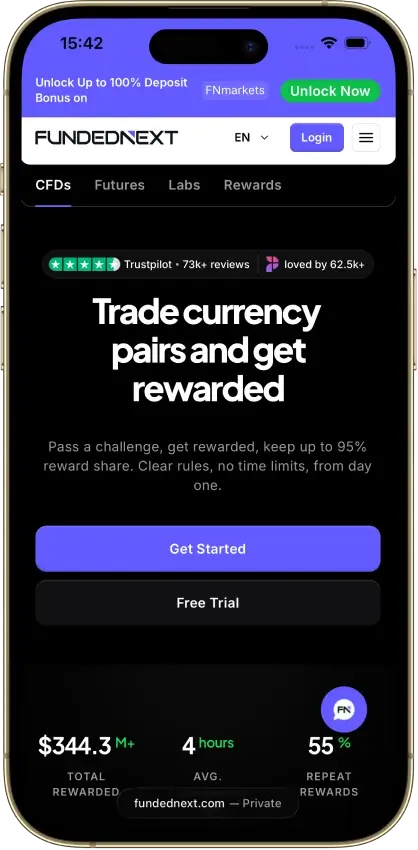
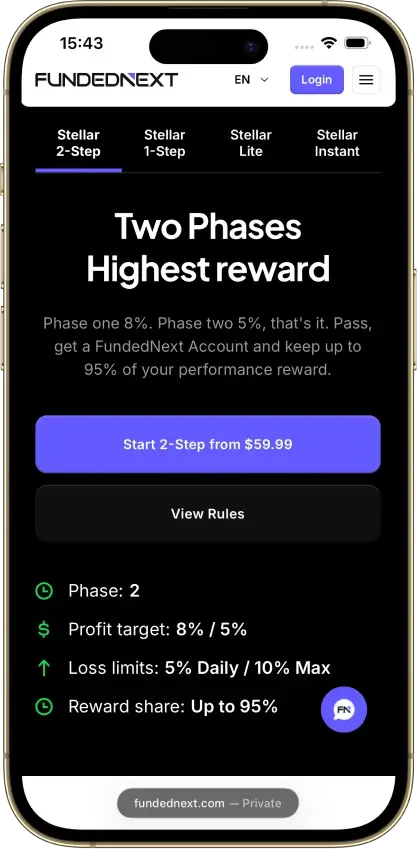
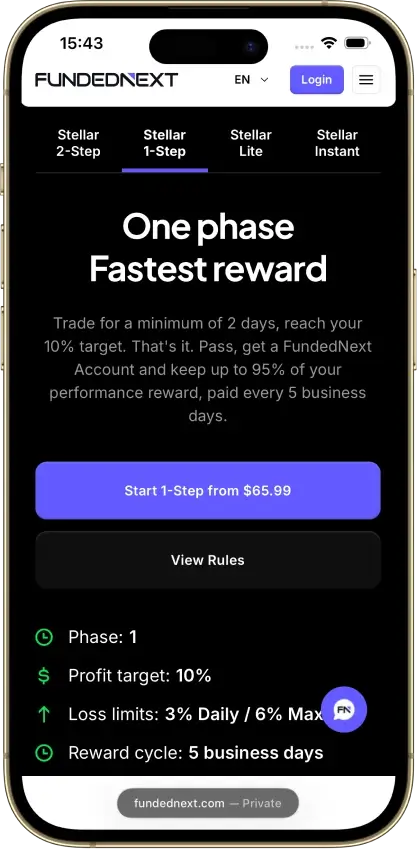
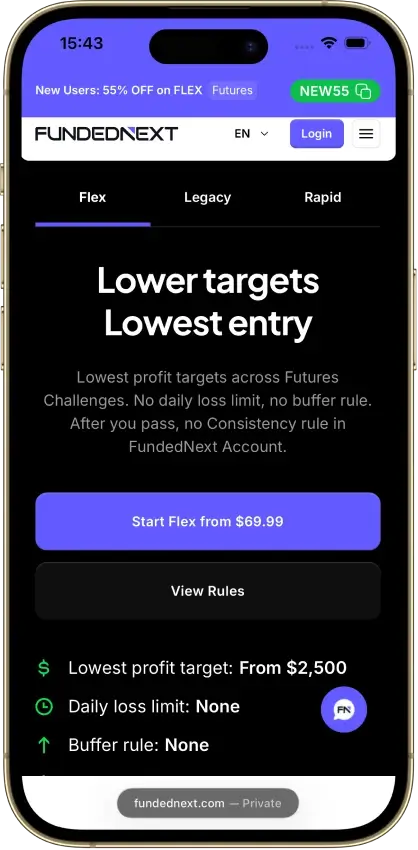
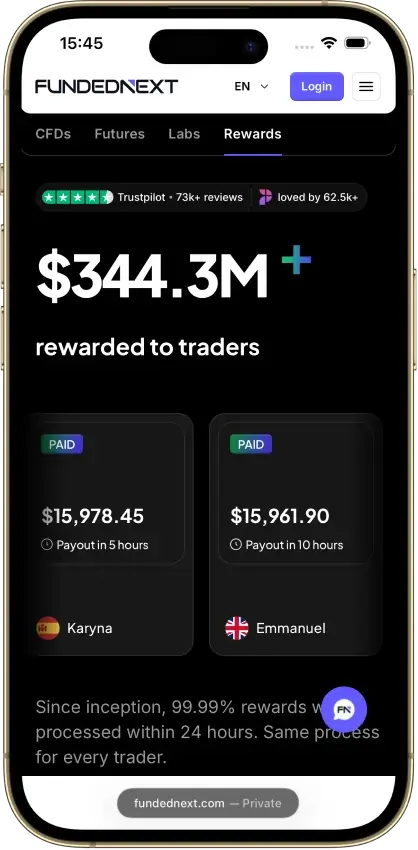

Screenshot 1 of 8
FundedNext Pros and Cons
Pros
- Static overall loss on Stellar evaluations
- No funded consistency rule on Flex
- Tradovate, NinjaTrader and TradingView
- Lite standard challenge needs two days
- 2-Step fee return with first reward
Cons
- Flex limits requests to half the profit
- Flex concludes after five rewards
- Instant withdrawals shrink loss room
- Quick Strike can end funded CFD accounts
- Payout options cannot change after purchase
FundedNext Offers and Pricing
Use code FNFLEX for FundedNext’s advertised 47% discount on your first two Flex Futures challenges, then 40% off later purchases. The offer applies to Flex challenge fees, with separate reset pricing. Check your selected account size and purchase history at checkout. The final total can differ slightly from the published price schedule below.
How FundedNext Works
FundedNext sells access to simulated trading accounts. On an evaluation, you first meet a profit target while staying inside the loss limits. Passing leads to a FundedNext Account, where eligible profit can produce a cash Performance Reward. Stellar Instant and Futures Direct skip the evaluation, but they still impose withdrawal conditions and account-breach rules.
The CFD choice starts with the loss allowance. Stellar 2-Step gives more room than 1-Step or Lite, although you must pass two phases. Lite reduces the second target and, on its newer standard payout option, needs fewer challenge days. Instant removes the pass requirement but replaces the static floor with a trailing one, so withdrawing profit can reduce what you can afford to lose next.
Futures models use benchmark days, consistency ratios or a retained buffer to control withdrawals. Flex removes consistency once funded, Rapid Pro keeps it, and Rapid Daily uses a buffer instead. Those differences survive the evaluation. Your selected Rapid path and CFD payout option cannot simply be changed after purchase, so choose them before comparing the headline reward share.
Stellar 1-Step
| Phase | Profit Target | Max Daily Loss | Max Overall Loss | Min Trading Days | Time Limit | Leverage |
|---|---|---|---|---|---|---|
| Challenge | 10% | 3% | 6%, static | 2 | No challenge deadline | Forex 1:30 · full asset schedule below |
| FundedNext Account | No pass target | 3% | 6%, static | Reward-cycle conditions | Ongoing | Forex 1:30 |
Stellar 2-Step
| Phase | Profit Target | Max Daily Loss | Max Overall Loss | Min Trading Days | Time Limit | Leverage |
|---|---|---|---|---|---|---|
| Phase 1 | 8% | 5% | 10%, static | 5 | No challenge deadline | Forex 1:100 |
| Phase 2 | 5% | 5% | 10%, static | 5 | No challenge deadline | Forex 1:100 |
| FundedNext Account | No pass target | 5% | 10%, static | Depends on payout option | Ongoing | Forex 1:100 |
Stellar Lite
| Phase | Profit Target | Max Daily Loss | Max Overall Loss | Min Trading Days | Time Limit | Leverage |
|---|---|---|---|---|---|---|
| Phase 1 | 8% | 4% | 8%, static | 2 standard · 5 alternative payout options | No challenge deadline | Forex 1:100 |
| Phase 2 | 4% | 4% | 8%, static | 2 standard · 5 alternative payout options | No challenge deadline | Forex 1:100 |
| FundedNext Account | No pass target | 4% | 8%, static | Depends on payout option | Ongoing | Forex 1:100 |
Eligible 1-Step and 2-Step accounts purchased or reset from January 12, 2026 follow the Pro scaling route. Those 1-Step accounts start with an 80% reward share and return the fee with the third reward. Older eligible 1-Step accounts start at 90% and return the fee with the first reward.
Stellar Lite standard-option accounts purchased or reset from October 12, 2026 require two trading days per challenge phase and use ten-business-day reward cycles. Earlier standard accounts retain five challenge days per phase and a first reward cycle of 21 days, then 14 days. The three-profitable-day and On-Demand options require five challenge days per phase. Eligible add-ons can change the minimum-day requirement or loss allowance.
Stellar Instant
| Phase | Profit Target | Max Daily Loss | Max Overall Loss | Min Trading Days | Time Limit | Leverage |
|---|---|---|---|---|---|---|
| Immediate FundedNext Account | None to start · growth needed for rewards | None | 6% initial allowance, balance-based trailing | None | No evaluation | Model-specific instrument limits |
Instant starts with a 70% reward share and a maximum total active allocation of $20,000. Its entry fee is not refunded. The absence of a daily loss cap does not remove the overall trailing floor, the risk rule or the conditions for requesting a reward.
Futures Challenges and Direct
Flex, Rapid Pro, Rapid Daily and Legacy have separate evaluation and reward rules. Direct starts as a $50,000 FundedNext Account, with identity verification required before its first withdrawal. The original Rapid and Bolt programs no longer accept new purchases or resets. That retirement does not apply to Rapid Pro or Rapid Daily.
FundedNext Rules and Restrictions
The Drawdown Explained
Stellar evaluations have a fixed overall loss floor: $90,000 on a $100,000 2-Step account, including after profitable days. Daily loss counts closed and floating results, commissions and swaps. It resets at midnight server time, so yesterday’s profits cannot cover today’s open loss.
Stellar Instant trails the recorded balance high using a fixed allowance. On a $20,000 account, 6% is $1,200. A closed balance of $20,500 lifts the floor to $19,300. Losses do not lower it, and it stops rising at the initial $20,000 balance. Keep equity clear of the active floor as well as watching the balance.
A withdrawal leaves that floor in place. For example, a $10,000 Instant account reaching $10,450 has a $9,850 floor. A $100 withdrawal leaves $10,350 and $500 of room. FundedNext’s withdrawal rule carries that smaller gap into the next cycle, so the next $50 of closed profit lifts the floor to $9,900 immediately, without waiting for the old balance high.
Futures floors update at the end of the day, while floating losses can breach the existing floor during a trade. With a $1,500 allowance, a $50K Flex account closing a day at $50,400 has a $48,900 floor. Flex’s floor ultimately locks at $50,100, and the first withdrawal also sets it there, so the remaining balance must leave room above that level.
Consistency Rule
Flex and Legacy restrict the best challenge day to 40% of the target, increasing the total profit needed if that threshold is exceeded. Their funded accounts remove that ratio. Rapid Pro applies 40% when funded, while Direct compares the best day ever recorded on the account with 20% of the current cycle’s profit. That Direct benchmark survives withdrawals.
News and Weekend Trading
On funded Stellar accounts, opening or closing correlated trades within five minutes either side of a listed high-impact release can reduce the profit credited to 40%, while losses still count in full. Challenge news trades are exempt. Stellar Instant’s own account rules also apply this deduction. Stellar Instant allows overnight and weekend holding, with swaps still charged.
Prohibited Strategies
Splitting an order does not avoid the CFD risk cap: entries tied to the same trading idea are assessed together. A second violation permanently reduces that account’s permitted risk, and merging accounts carries the stricter history forward. Profit from very short trades is controlled separately, with different CFD and futures thresholds.
Rapid Daily has daily loss limits of $500/$1,000/$1,250 by account size at both stages. Direct has a $1,000 daily limit, and Rapid Pro offers an optional daily-loss limit. A daily breach pauses trading until the next day. Reaching the overall loss floor can close the account during a trade.
Stellar evaluations allow copying between the same trader’s challenge accounts, while funded copying is restricted. Instant permits copying only between that trader’s Instant accounts. Prohibited copying or manipulation can lead to account closure and reward forfeiture.
| Rule | Limit | Consequence | Applies To |
|---|---|---|---|
| CFD risk | 3% | 3% of initial balance at a time · swaps and commissions excluded from risk utilization Applies to: Funded Stellar accounts · Labs conditions separate. First violation: warning and violating-profit deduction. Second: deduction and permanent 1% risk limit. Later violations incur deductions. | Funded |
| CFD Quick Strike | 30% | Profit from trades closed in under 30 seconds · warning at 20%, violation at 30% Applies to: Challenge and funded, with different consequences. Challenge advancement pauses at 30% until reduced. Funded Quick Strike profit can be deducted, with termination if the threshold remains at cycle end. | All Stages |
| Futures micro-scalping | 40% | Profit from trades closed in under 10 seconds · warning at 30%, threshold 40% Applies to: Futures challenge and funded. Challenge progress pauses at 40%. Funded micro-scalping profit is deducted at 40% without termination for this rule alone. | All Stages |
| Direct inactivity | 1 trades | At least one trade in each Monday–Friday trading week Applies to: Direct funded. Account breach for an inactive week | Funded |
Restricted Countries
- Afghanistan
- Albania
- Antigua and Barbuda
- Bangladesh
- Belarus
- Belize
- Burkina Faso
- Burundi
- Cabo Verde
- Chad
- Comoros
- Cote d’Ivoire
- Cuba
- Democratic Republic of the Congo
- Djibouti
- Eritrea
- Fiji
- Grenada
- Guinea-Bissau
- Iran
- Iraq
- Jordan
- Laos
- Lebanon
- Lesotho
- Libya
- Malawi
- Malaysia
- Mali
- Myanmar
- North Korea
- Palestine
- Republic of the Congo
- Russia
- Rwanda
- Sierra Leone
- Somalia
- South Sudan
- Sri Lanka
- Sudan
- Syria
- Tajikistan
- Timor-Leste
- Tuvalu
- Ukraine
- Venezuela
- Vietnam
- Yemen
- Antarctica
- Bouvet Island
- Cook Islands
Marketing vs. Contract
Marketing language is checked against the terms that govern the selected program.
FundedNext Pricing and Account Sizes
The one-time entry payment buys access to a trading evaluation or an Instant/Direct account. Failing a challenge can lead to another reset or purchase, while fee returns require a funded reward. That makes the time to a refund part of the cost comparison between Lite and 2-Step. The CFD figures are FundedNext’s approximate plan prices before optional add-ons. Futures prices are the base fees, with promotional schedules shown separately.
CFD Fees
| Program | Account Sizes | Published Fees, USD | Fee Return | Challenge Target | Overall Loss |
|---|---|---|---|---|---|
| Stellar 1-Step | $6K / $15K / $25K / $50K / $100K / $200K | $65.99 / $129.99 / $219.99 / $329.99 / $569.99 / $1,099.99 | Third reward under current terms · first for older eligible accounts | 10% | 6% static |
| Stellar 2-Step | $6K / $15K / $25K / $50K / $100K / $200K | $59.99 / $119.99 / $199.99 / $299.99 / $549.99 / $999.99 | First funded reward | 8% then 5% | 10% static |
| Stellar Lite | $5K / $10K / $25K / $50K / $100K / $200K | $32.99 / $59.99 / $139.99 / $229.99 / $399.99 / $798.99 | Third funded reward | 8% then 4% | 8% static |
| Stellar Instant | $2K / $5K / $10K / $20K | $59.99 / $149.99 / $299.99 / $599.99 | No | No evaluation | 6% trailing |
Futures Sizes, Fees and Limits
Futures account sizes describe simulated buying power. The dollar loss allowance determines how much adverse movement an account can absorb.
| Program | Buying Power | Published Base Fee | Target | Overall Loss | Floor Lock | Mini / Micro Limit |
|---|---|---|---|---|---|---|
| Flex | $50K | $141.99 | $2,500 | $1,500 EOD | $50,100 | 3 / 30 |
| Flex | $100K | $273.99 | $5,000 | $2,500 EOD | $100,100 | 5 / 50 |
| Flex | $150K | $490.99 | $8,000 | $4,000 EOD | $150,100 | 8 / 80 |
| Rapid Pro / Daily | $25K | $159.98 | $1,500 | $1,000 EOD | $25,100 | 2 / 20 |
| Rapid Pro / Daily | $50K | $299.98 | $3,000 | $2,000 EOD | $50,100 | 4 / 40 |
| Rapid Pro / Daily | $100K | $499.98 | $5,000 | $2,500 EOD | $100,100 | 6 / 60 |
| Direct | $50K | $283.99 | No evaluation | $2,000 EOD | $50,100 | 3 / 30 |
| Legacy | $25K | $79.99 | $1,250 | $1,000 EOD | $25,000 | 2 / 20 challenge · 3 / 30 funded |
| Legacy | $50K | $199.99 | $3,000 | $2,000 EOD | $50,000 | 3 / 30 challenge · 5 / 50 funded |
| Legacy | $100K | $239.99 | $6,000 | $3,000 EOD | $100,000 | 5 / 50 challenge · 7 / 70 funded |
Offers and Secondary Costs
| Flex Size | First Two Purchases | Later Purchases | Challenge Reset |
|---|---|---|---|
| $50K | $74.99 | $84.99 | $82.99 |
| $100K | $144.99 | $159.99 | $157.99 |
| $150K | $259.99 | $289.99 | $284.99 |
Rapid promotional prices depend on the offer and selected daily-loss option. The table shows published base fees. Confirm the order total before paying. The optional Rapid Pro daily-loss limit changes the risk rules as well as the entry price.
| Additional Cost | Program | Terms |
|---|---|---|
| Activation | Flex / Rapid | No activation fee |
| Challenge reset | Flex / Rapid | Challenge stage only. Flex prices are above. Rapid prices depend on size and daily-loss option. |
| Challenge reset | Legacy | $73.99 / $183.99 / $220.79 for $25K / $50K / $100K |
| Reset | Direct | Not available |
| Reset | Stellar Instant | 10% below original purchase price. Entry and reset fees are non-refundable. |
| Optional add-ons | CFD | Swap-free, reward-share and EA options can increase the purchase price. |
| Payment-provider fees | CFD | Deducted from the reward. Limits and fees are in Payout Terms. |
FundedNext Payouts and Profit Split
Payout Terms
The 2-Step and Lite payout options change both the wait and the reward share. Eligible Lifetime 95% add-ons override the ordinary share. The option is locked at purchase, so later profits do not let you switch to a better-paying schedule.
| CFD Program / Option | Standard Share | First and Later Eligibility | Fee Return |
|---|---|---|---|
| Stellar 1-Step, current terms | 80% | Five-business-day cycles, starting with the first funded trade | Third reward |
| Stellar 2-Step standard | 80% | First cycle 21 days, then 14 days | First reward |
| Stellar Lite standard, current terms | 80% | Ten business days per cycle | Third reward |
| 2-Step / Lite: three profitable days | 60% | Three days per cycle, each earning at least 1% of account size | Program-specific |
| 2-Step / Lite: On-Demand | 90% | At least 2% growth · best day no more than 40% of cycle profit · end-of-day eligibility | Program-specific |
| Stellar Instant | 70% in tiers one/two · 80% from tier three | 5% growth with end-of-day confirmation, or 14 days with at least 1% growth | No entry-fee return |
| Stellar Lite standard, older accounts | 80% | First cycle 21 days, then 14 days | Third reward |
| Stellar 1-Step, older accounts | 90% | Five-business-day cycles | First reward |
The separate 15% challenge reward uses the challenge profit target and requires Pro scale-up eligibility on newer eligible 1-Step and 2-Step accounts.
| Futures Model | Eligibility | Request Limits | Share of Request | Account Outcome |
|---|---|---|---|---|
| Flex | Five benchmark days: $200/day at $50K/$100K, $250/day at $150K · $500 cycle profit | $250 minimum · at most 50% of profit, capped at $1,500/$2,500/$4,000 | 95% | Concludes after five rewards |
| Rapid Pro | $500 cycle profit and 40% best-day consistency · rewards every three days | $250 minimum · caps $800/$1,200/$2,500 | 90% | Concludes after five rewards |
| Rapid Daily | $500 cycle profit and EOD balance above $26,100/$52,100/$102,600 · no minimum days | $250 minimum from profit above buffer · caps $800/$1,200/$2,500 | 90% | Concludes after five rewards |
| Direct | Clear the $2,100 buffer and meet 20% perpetual consistency | $800–$1,200 above the buffer | 90% | Concludes after five rewards |
| Legacy | Five benchmark days · $100/day at $25K or $200/day at $50K/$100K · $500 cycle profit | $250 minimum · normally 50% of profit, capped at $3,000/$6,000/$6,000 until the 30-day milestone | 80% | Continues beyond five rewards |
An eligible Flex account with $3,000 cycle profit can request $1,500. Its 95% share gives $1,425 before payment fees, or 47.5% of that cycle’s profit. The first withdrawal also locks the loss floor. Legacy removes request caps after 30 benchmark days, but withdrawing all simulated profit breaches the account.
| CFD Payment Method | Minimum | Maximum | Conditions |
|---|---|---|---|
| Crypto | $20 | $1,999 standard | Route and eligibility exceptions apply |
| RiseWorks | $50 | No stated upper limit | Eligibility exceptions apply |
| Bank transfer | $1,000 | $50,000 | Transfer eligibility applies |
| Saved payment card | $20 | $3,000 | Eligible saved cards only |
CFD provider charges can reach 3.5%, leaving $965 from a $1,000 reward at that rate. Method limits are separate from futures request limits.
The CFD Brand Promise offers $1,000 for qualifying delays beyond 24 hours, with the clock ending at transfer initiation. Exclusions include bank transfers, held or manually processed requests, incorrect payment details and processor disruptions. Bank or wallet receipt can take longer.
Payout Evidence
FundedNext’s processing promise and reward schedules establish contractual entitlements. They provide no independent record of completed payments or the proportion of requests honored.
Payout evidence
Editorial payout records and their verification status.
FundedNext CFD and Futures help centers, accessed October 16, 2026. Operator policies describe eligibility and limits, not completed payments.
FundedNext Brand Promise, accessed October 16, 2026. The clock ends at transfer initiation and has exclusions. This policy is not an independently checked payment record.
Scaling Plan
Qualifying Pro accounts grow by 25%, taking $100,000 to $125,000. The advertised $4 million ceiling requires further scaling. Futures live funding remains discretionary.
| Plan | Eligibility | Change |
|---|---|---|
| FundedNext Pro | Eligible 1-Step and 2-Step accounts under the Pro terms described above. Four qualifying rewards, at least 4% growth each cycle and a minimum two months. Merged accounts excluded. | 25% account increase and standard reward share of 90% |
| Regular scale-up | Lite: 10% accumulated growth over four months, at least two rewards and a profitable final cycle | Reviewed 40% increase |
| Stellar Instant tiers | Disbursed rewards of at least 10% of the current tier size, plus at least one withdrawal | Each tier adds the initial account size. Reward share reaches 80% at tier three. |
Platforms and Trading Conditions
CFD Trading
MT4, MT5, cTrader and Match-Trader support the CFD business, with availability varying by model and account size. TradingView is analysis-only for these accounts. The instruments include forex, indices, commodities, crypto and stock CFDs. Crypto trades use synthetic exposure.
The challenge leverage schedule changes after funding. In particular, 2-Step and Lite indices and commodities fall from 1:25 to 1:15, while 1-Step commodities fall from 1:15 to 1:10. A position that fits during evaluation can therefore require more margin when funded. Automated strategies also depend on the account and add-on: the standard Stellar EA options are unavailable at $50,000 and above.
| Program / Stage | Forex | Indices | Commodities | Crypto | Stocks |
|---|---|---|---|---|---|
| 1-Step challenge | 1:30 | 1:10 | 1:15 | 1:1 | 1:2 |
| 1-Step funded | 1:30 | 1:10 | 1:10 | 1:1 | 1:2 |
| 2-Step / Lite challenge | 1:100 | 1:25 | 1:25 | 1:1 | 1:2 |
| 2-Step / Lite funded | 1:100 | 1:15 | 1:15 | 1:1 | 1:2 |
The commission schedule charges $5 per forex/oil lot on 1-Step and 2-Step, versus $7 on Lite and Instant. Metals use 0.0016% of opening notional, crypto 0.04% and stock CFDs 0.004%. Spread and overnight swap are additional costs. Instant’s separate schedule charges at opening, with no closing commission, and lists no index commission.
Futures Trading
Tradovate, NinjaTrader and TradingView integration are the futures choices. Contract limits stay fixed as profit grows. Legacy has higher funded limits than challenge limits. The accounts remain simulated unless the firm separately selects a trader for its live program.
Is FundedNext Legit and Safe?
FundedNext is an operating simulated-trading business, but its company details and reward policies do not guarantee that a particular withdrawal will be approved. The CFD agreement identifies GrowthNext–F.Z.E. as the provider and Incenteco Trading LTD as a payment processor. Neither the contractual provider nor the processor’s role establishes regulatory protection for trading funds.
A purchased challenge gives access to a simulated account under contractual rules. Rule violations can reduce rewards or end the account, even when the platform shows a trading profit. The CFD risk and Quick Strike policies spell out those consequences, while futures withdrawals can lock a loss floor or conclude the account after a set number of rewards.
FundedNext’s compensation promise gives eligible traders a defined remedy for certain processing delays, with substantial exceptions. It does not establish the firm’s payout history, and a large company-reported payout total would not establish that independently either.
FundedNext Alternatives
Compare FundedNext with the wider prop firm rankings. Start with the product you trade, then compare the loss allowance, full entry cost and amount you can withdraw. A lower initial fee may be followed by an activation charge, while a high reward share can apply only after a request cap or retained buffer.
For CFD evaluations, compare static and trailing loss floors separately. For futures, check the dollar loss allowance at your chosen size, the consistency rule after passing and what happens to the account after a withdrawal. The native comparison below uses CryptoSlate’s existing firm ratings.
Prop Firm Pillar Scores
- Payout Reliability and Evidence 25% weight The CFD processing promise has exclusions and ends at transfer initiation. Reward policies set eligibility and limits, but do not independently prove completed payments.8.5 / 10
- Rules Fairness and Transparency 20% weight Stellar evaluations use static loss floors. Instant withdrawals reduce loss room. Futures consistency, buffers and request caps differ by model.8.0 / 10
- Cost and Value 15% weight Lite starts below the other standard Stellar evaluations on the published fee schedule. Resets, add-ons and the reward required for a fee return affect the total cost.9.0 / 10
- Trading Conditions 15% weight CFD and futures accounts have different platform choices. Funded news-profit deductions, asset-specific leverage and short-trade controls affect which strategies fit.8.0 / 10
- Profit Split and Scaling 10% weight Flex’s 95% share applies after its request cap. CFD payout options change the share and timing, and eligible Pro accounts use a separate 25% scaling step.9.0 / 10
- Firm Transparency and Stability 10% weight The CFD agreement names the provider and processor. These details establish neither regulatory protection nor independent evidence of financial stability.8.0 / 10
- Support and Reputation 5% weight No new first-hand support test or dated independent review sample was completed for this factual update. The existing score is retained pending that review.9.0 / 10
Final Verdict
Stellar 2-Step is the more straightforward FundedNext choice for traders who want a static overall loss floor and can wait through the standard first reward cycle. Flex removes funded consistency requirements, but its benchmark days, withdrawal cap and account conclusion limit the benefit of its 95% share. Choose Instant or Direct only if the drawdown left after a withdrawal fits your trading plan, and settle the payout option and add-ons before buying.
Prop-firm fees are at risk, most participants do not reach a payout, and simulated funding does not necessarily represent live firm capital. This review is informational, not financial advice.
Evaluation trading carries a substantial risk of losing the fees paid. You can lose the fees paid without ever reaching a payout, and most participants never reach one. Simulated accounts are not deposits of real trading capital, and nothing on this page is financial advice. Figures come from the firm's own pages and can change without notice. CryptoSlate may earn a commission through links on this page and may receive complimentary evaluation accounts for testing. Compensation and complimentary access never affect review scores.
Our review methodology gives payout reliability and evidence the largest weight, followed by rule fairness, cost and trading conditions. FundedNext’s reward share is assessed alongside the amount a trader can request and the loss room left afterward. Promotional discounts do not determine the score. The seven weighted pillars cover the firm as a whole, while the program comparisons explain where an individual account can be a better or worse fit.
Review Update Notes
-
Updated drawdown examples, program-specific payout conditions, published base fees, Stellar Lite purchase-date rules and platform coverage. The existing 8.4 rating is unchanged while the scoring review continues.
FAQ
FundedNext FAQs
Is FundedNext a real funded account?
FundedNext’s challenges and initial funded accounts use simulated trading. Eligible results can earn a cash Performance Reward under the program’s contract. Futures traders may be considered for a separate live-trading program, but meeting its milestones does not guarantee selection.
How does FundedNext’s Stellar Instant drawdown work?
Stellar Instant uses a trailing allowance equal to 6% of the initial account size. On $20,000, that is $1,200, so a $20,500 recorded balance puts the floor at $19,300. Withdrawals leave the floor in place and reduce the gap available for future losses.
Does FundedNext pay 95% of every profit?
No. The share depends on the program and payout option. Flex pays 95% of an approved request, but normally limits that request to half the cycle’s profit, subject to a size cap. Eligible CFD add-ons can offer 95%, while Stellar Instant starts at 70%.
When can I request my first FundedNext payout?
The starting point depends on the account. New Stellar Lite standard accounts use ten-business-day cycles, 1-Step uses five business days, and 2-Step standard starts at 21 days. Futures programs add benchmark days, consistency or a buffer. Payment processing begins only after the applicable eligibility conditions are met.
Is the FundedNext challenge fee refundable?
Stellar 2-Step returns the eligible purchase or reset fee with the first funded reward. Newer 1-Step accounts and Stellar Lite return it with the third reward. Older 1-Step purchases have different timing. Stellar Instant’s purchase and reset fees are not refundable.
How many trading days does Stellar Lite require?
Stellar Lite’s current standard option requires two trading days per challenge phase and uses ten-business-day reward cycles. Older accounts retain their original terms. The three-profitable-day and On-Demand options require five challenge days per phase. Eligible add-ons can change the minimum-day requirement.
Can I use TradingView with FundedNext?
TradingView supports FundedNext Futures through its integration, alongside Tradovate and NinjaTrader. For FundedNext CFD accounts, TradingView is currently an analysis tool rather than an execution platform. CFD orders use the supported trading terminal, subject to the account’s model and size restrictions.
Is FundedNext’s 24-hour payout promise unconditional?
No. The CFD Brand Promise ends its clock when FundedNext initiates the transfer. Bank transfers, held or manually processed requests, incorrect payment details and processor disruptions are excluded. The extra $1,000 applies only to qualifying delays, not every payment that arrives after a day.